

The DOI matches its Crossref record; 44 of the 44 references it cites were found in a registry or an index.
Skeletal muscle quality as assessed by CT-derived skeletal muscle density is associated with 6-month mortality in mechanically ventilated critically ill patients
Open accessAbstract
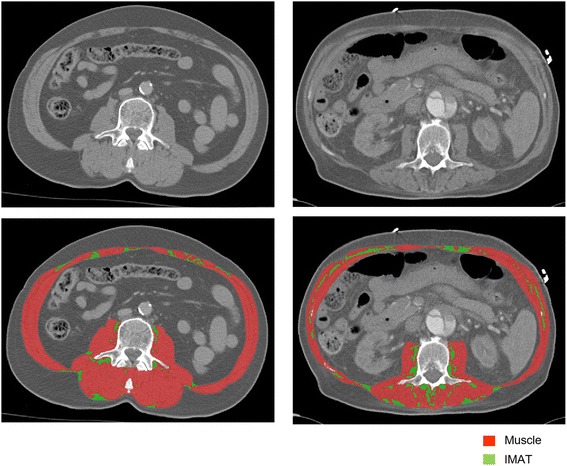
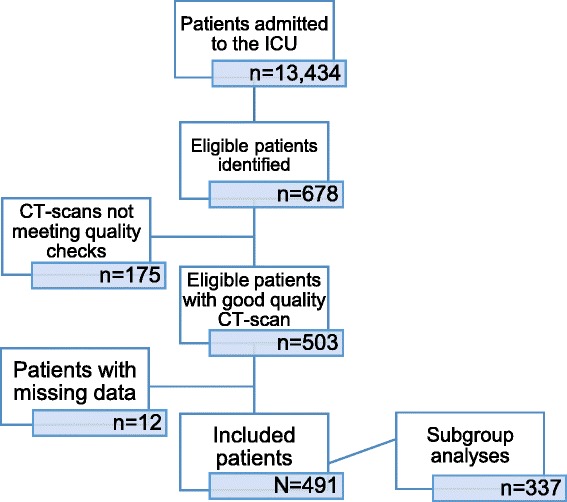
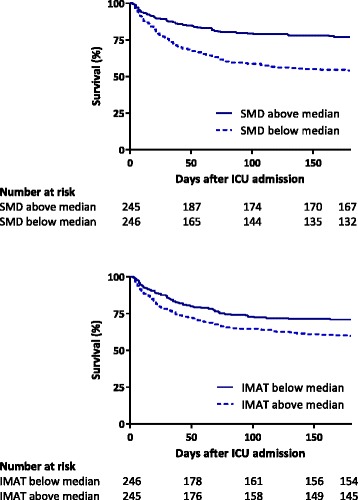
BACKGROUND: Muscle quantity at intensive care unit (ICU) admission has been independently associated with mortality. In addition to quantity, muscle quality may be important for survival. Muscle quality is influenced by fatty infiltration or myosteatosis, which can be assessed on computed tomography (CT) scans by analysing skeletal muscle density (SMD) and the amount of intermuscular adipose tissue (IMAT). We investigated whether CT-derived low skeletal muscle quality at ICU admission is independently associated with 6-month mortality and other clinical outcomes. METHODS: This retrospective study included 491 mechanically ventilated critically ill adult patients with a CT scan of the abdomen made 1 day before to 4 days after ICU admission. Cox regression analysis was used to determine the association between SMD or IMAT and 6-month mortality, with adjustments for Acute Physiological, Age, and Chronic Health Evaluation (APACHE) II score, body mass index (BMI), and skeletal muscle area. Logistic and linear regression analyses were used for other clinical outcomes. RESULTS: ; p = 0.004). Higher SMD was associated with a lower 6-month mortality (hazard ratio (HR) per 10 HU, 0.640; 95% confidence interval (CI), 0.552-0.742; p < 0.001), and also after correction for APACHE II score, BMI, and skeletal muscle area (HR, 0.774; 95% CI, 0.643-0.931; p = 0.006). Higher IMAT was not significantly associated with higher 6-month mortality after adjustment for confounders. A 10 HU increase in SMD was associated with a 14% shorter hospital length of stay. CONCLUSIONS: Low skeletal muscle quality at ICU admission, as assessed by CT-derived skeletal muscle density, is independently associated with higher 6-month mortality in mechanically ventilated patients. Thus, muscle quality as well as muscle quantity are prognostic factors in the ICU. TRIAL REGISTRATION: Retrospectively registered (initial release on 06/23/2016) at ClinicalTrials.gov: NCT02817646 .
Overview
The claims and statistics of this paper haven’t been checked yet.
Run the check — free, no account needed. It reads the open-access text and checks the sources it cites.
Integrity signals
Registry
Cites
Statistics
Figures
Verification
Claims the paper makes
The claims and statistics of this paper haven’t been checked yet.
Run the check — free, no account needed. It reads the open-access text and checks the sources it cites.
Claims other papers make about this one
Each is checked against this paper’s own text: does it say what the citing paper says it does?
The cited source says what the claim attributes to it.
In the citing paper
“Low skeletal-derived muscle density has been linked to higher 6-month mortality in mechanically ventilated patients, implying that muscle quality as well as muscle quantity are prognostic factors in intensive care units (Looijaard et al., 2016).”
From Myosteatosis in the Context of Skeletal Muscle Function Deficit: An Interdisciplinary Workshop at the National Institute on Aging (2020) · cites this paper as Looijaard et al., 2016
The cited source says what the claim attributes to it.
In the citing paper
“Muscle mass can be evaluated by ultrasound [18], computerized tomography scan [19], or bioelectric impedance analysis (BIA) [20].”
From ESPEN practical and partially revised guideline: Clinical nutrition in the intensive care unit (2023) · cites this paper as [19]
The check wasn’t confident either way, so it gives no verdict — never disputed.
In the citing paper
“In a retrospective study, Song et al. (167) showed a significant improvement in ICU outcomes of ventilated critically ill patients receiving > 90% of target protein intake.”
From ESPEN guideline on clinical nutrition in the intensive care unit. (2019) · cites this paper as [167]
Experimental — accuracy not yet measuredIn the citing paper
“Low skeletal-derived muscle density has been linked to higher 6-month mortality in mechanically ventilated patients, implying that muscle quality as well as muscle quantity are prognostic factors in intensive care units (Looijaard et al., 2016).”
From Myosteatosis in the Context of Skeletal Muscle Function Deficit: An Interdisciplinary Workshop at the National Institute on Aging (2020) · cites this paper as Looijaard et al., 2016
In the citing paper
“Low muscle density has also been associated with poor survival and increased risk of hospitalization (Cawthon et al., 2009; Looijaard et al., 2016).”
From Myosteatosis in the Context of Skeletal Muscle Function Deficit: An Interdisciplinary Workshop at the National Institute on Aging (2020) · cites this paper as Looijaard et al., 2016
Self-check
Percentages, sums and reported differences re-computed from the paper’s own numbers.
The self-check needs the paper’s full text.
Citations
Cites
(2000) · PubMed · Cited by 13,173
(1992) · Applied Ergonomics · doi:10.1016/0003-6870(92)90318-p · Cited by 5,774
Functional Disability 5 Years after Acute Respiratory Distress Syndrome
Herridge, M. S., Tansey, C. M., Matte, A. L., TOMLINSON, G. A., Diaz-Granados, N., Cooper, A., Guest, C. B., Mazer, C. D., Mehta, S., Stewart, T. E., et al. (2011) · New England Journal of Medicine · doi:10.1056/nejmoa1011802 · Cited by 2,892
Martin, L., Birdsell, L., Macdonald, N., Reiman, T., Clandinin, M. T., McCargar, L. J., Murphy, R. A., Ghosh, S., Sawyer, M. B., & Baracos, V. E. (2013) · Journal of Clinical Oncology · doi:10.1200/jco.2012.45.2722 · Cited by 2,761
Long-term cognitive impairment and functional disability among survivors of severe sepsis.
Iwashyna, T. J., Ely, E. W., Smith, D. M., & Langa, K. M. (2010) · JAMA · doi:10.1001/jama.2010.1553 · Cited by 2,582
Mourtzakis, M., Prado, C. M. M., Lieffers, J. R., Reiman, T., McCargar, L. J., & Baracos, V. E. (2008) · Applied Physiology, Nutrition, and Metabolism · doi:10.1139/h08-075 · Cited by 2,224
Acute skeletal muscle wasting in critical illness
Puthucheary, Z. A., Rawal, J., McPhail, M., Connolly, B., Ratnayake, G., Chan, P., Hopkinson, N. S., Padhke, R., Dew, T., Sidhu, P. S., et al. (2013) · JAMA · doi:10.1001/jama.2013.278481 · Cited by 2,103
Shen, W., Punyanitya, M., Wang, Z., Gallagher, D., St.-Onge, M.-P., Albu, J., Heymsfield, S. B., & Heshka, S. (2004) · Journal of Applied Physiology · doi:10.1152/japplphysiol.00744.2004 · Cited by 1,692
Paresis Acquired in the Intensive Care Unit A Prospective Multicenter Study
Jonghe, B. D. (2002) · JAMA · doi:10.1001/jama.288.22.2859 · Cited by 1,518
Longitudinal study of muscle strength, quality, and adipose tissue infiltration
Delmonico, M. J., Harris, T. B., Visser, M., Park, S. W., Conroy, M. B., Velasquez-Mieyer, P., Boudreau, R., Manini, T. M., Nevitt, M., Newman, A. B., et al. (2009) · The American Journal of Clinical Nutrition · doi:10.3945/ajcn.2009.28047 · Cited by 1,446
Cited by
Sorted by citations
Items 201–218 of 218
Preventive Strategies for Intensive Care Unit-Acquired Weakness;Up-to-Date
Katsumata, Y. (2024) · THE JOURNAL OF JAPAN SOCIETY FOR CLINICAL ANESTHESIA · doi:10.2199/jjsca.44.248
Transforming body composition of computational phantoms based on form‐finding dynamics
Salinas, C. S., Segars, W. P., Samei, E., & Magudia, K. A. (2025) · Medical Physics · doi:10.1002/mp.17935
Should muscle mass now be routinely assessed in the Intensive Care Unit?
Czarnik, T., & Gawda, R. (2025) · Minerva Anestesiologica · doi:10.23736/s0375-9393.25.19309-7
Highlights of the June 2025 issue
Cavaliere, F. (2025) · Minerva Anestesiologica · doi:10.23736/s0375-9393.25.19305-x
Hou, S., Li, M., Cao, J., Wang, Y., Yang, M., Tian, L., Ni, Y.-H., Yang, B.-X., Hao, L.-R., Hao, J., et al. (2025) · Frontiers in Physiology · doi:10.3389/fphys.2025.1687179
Puthucheary, Z., & Hodgson, C. L. (2025) · Elsevier eBooks · doi:10.1016/b978-0-443-11611-7.00066-9
Tumor-Derived Polyamines Initiate Fat Wasting in Cancer CachexiaPreprint
Fabregat, M., Fenske, R. J., Hansen, J. K., Kaminsky, C. J., Lortie, J. J., Nassar, A., Kressin, K. A., Jen, A., Cilloni, L., Overmyer, K. A., et al. (2025) · bioRxiv (Cold Spring Harbor Laboratory) · doi:10.64898/2025.12.01.691597
Jiang, T., Lin, T., Shu, X., Song, Q., Dai, M., Zhao, Y., Huang, L., Tu, X., & Yue, J. (2022) · Figshare · doi:10.6084/m9.figshare.19778044
Body roundness index: superior predictors of intramuscular fat infiltration in general population
Yu, R., Yu, W., Zhang, Y., Gao, X., Zhang, D., Wang, J., & Chen, X. (2026) · Frontiers in Nutrition · doi:10.3389/fnut.2026.1721126
Deep learning methods for localization, segmentation and robustness in medical imaging
Laousy, O. (2024) · theses.fr (ABES) · doi:10.70675/4ffc4285z667dz430czb4d9za731fb5f4d27
Zhou, Y., Wan, L., 李小鹏, Li, G., Peng, H., Chen, Q., Zeng, Y., Huang, J., Wu, J., Chen, R., et al. (2026) · Frontiers in Medicine · doi:10.3389/fmed.2026.1815137
Pectoralis muscle area predicts in-hospital mortality in older COPD patients with pneumonia
Fındıklı, H. A., Tutak, A. Ş., & Çil, E. (2026) · Minerva Anestesiologica · doi:10.23736/s0375-9393.26.19795-8
ESPEN practical and partially revised guideline: Clinical nutrition in the intensive care unit
González, J. C. M., Singer, P., Blaser, A. R., Berger, M. M., Calder, P. C., Casaer, M. P., Hiesmayr, M., Mayer, K., Pichard, C., Preiser, J., et al. (2026) · Nutrición Hospitalaria · doi:10.20960/nh.06943 · Cited by 1
Mohammed, M. R., Tadros, S. F., Alkhateeb, A. S., Saïd, R., & Ewis, N. M. (2026) · The Egyptian Journal of Radiology and Nuclear Medicine · doi:10.1186/s43055-026-01806-z
Ahn, T. R., Lee, K. H., Yoon, Y. S., Lee, J. H., & Lee, J. (2026) · British Journal of Radiology · doi:10.1093/bjr/tqag190
Miano, N., Marco, M. D., Scilletta, S., Todaro, G., Bosco, G., Barbagallo, F. D. G., Scicali, R., Piro, S., & Pino, A. D. (2026) · Acta Diabetologica · doi:10.1007/s00592-026-02785-3
Metadata
- Authors
- Looijaard, W. G. P. M., Dekker, I. M., Stapel, S. N., Girbes, A. R. J., Twisk, J. W. R., Oudemans-van Straaten, H. M., & Weijs, P. J. M.
- Affiliations
- Amsterdam Cardiovascular Sciences (NL)
- Amsterdam UMC Location Vrije Universiteit Amsterdam (NL)
- Amsterdam University of Applied Sciences (NL)
- Corresponding author
- Looijaard, Wilhelmus G. P. M.
- ORCID
- Venue
- Critical Care
- Published
- 2016-12
- Volume
- 20
- Issue
- 1
- Pages
- 386-386
- ISSN
- 1364-8535 (ISSN-L)
- PMC
- PMC5131531
- OpenAlex
- W2556942267
- Cited by
- 218
- References
- 44
- Citations by year
- 2026: 13 · 2025: 28 · 2024: 22 · 2023: 26 · 2022: 28 · 2021: 31 · 2020: 22 · 2019: 23 · 2018: 18 · 2017: 7
- FWCI
- 12.87
- Type
- journal article
- Language
- en
- Open access
- gold
- doi.org
- Licence
- cc-by
- Locations
- Critical Care (publishedVersion, cc-by)
- Europe PMC (PubMed Central) (publishedVersion, cc-by)
- PubMed Central (publishedVersion, cc-by)
- PubMed (publishedVersion)
- Amsterdam UMC (VU Amsterdam) - Institutional Repository (publishedVersion)
- Data Archiving and Networked Services (DANS) (submittedVersion, cc-by)
- Pure Amsterdam UMC (submittedVersion, other-oa)
- Data Archiving and Networked Services (DANS) (submittedVersion)
- Funders
- Baxter Healthcare Corporation (US) (Research grant GHOL6290)
- Topics
- Health Sciences › Medicine › Physiology (medical) › Nutrition and Health in Aging
- Health Sciences › Medicine › Critical Care and Intensive Care Medicine › Intensive Care Unit Cognitive Disorders
- Health Sciences › Nursing › Nutrition and Dietetics › Clinical Nutrition and Gastroenterology
- Keywords
- skeletal muscle quality, skeletal muscle density, intermuscular adipose tissue, myosteatosis, critically ill patients, mechanical ventilation, 6-month mortality, prognostic factors, length of hospital stay, intensive care unit admission
- MeSH terms
- Adult, Aged, Humans, Intensive Care Units, Length of Stay, Male, Middle Aged, Respiration, Artificial, Retrospective Studies, Tomography, X-Ray Computed, Proportional Hazards Models, Critical Illness, Muscle, Skeletal, Statistics, Nonparametric, APACHE, Abdominal Wall
About these checks
Registry, retraction, Cites and statistics results are computed, not judged, with one exception: a printed reference that no index lists is read once by a model before it counts as a citation error. Claims are extracted by a model and kept only when their quote appears verbatim in the text; each cited source is then checked, with a model’s help, for whether it says what the claim relies on. Those verdicts can be wrong — read the claim’s quote and the cited source before relying on one.
Statistics and arithmetic are recomputed, not judged.
Confidence bands are shown only for fields calibrated on our annotated test set. None is calibrated yet, so no band is shown.
What counts as a claim ›How we measure confidence ›How we check this ›
Are you an author, or do you see a problem with this page? Request a review
