

The DOI matches its Crossref record; 44 of the 44 references it cites were found in a registry or an index.
Skeletal muscle quality as assessed by CT-derived skeletal muscle density is associated with 6-month mortality in mechanically ventilated critically ill patients
Open accessAbstract
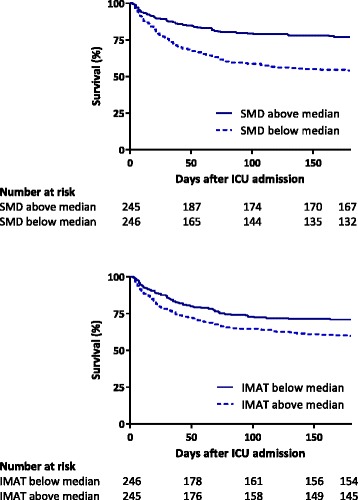
BACKGROUND: Muscle quantity at intensive care unit (ICU) admission has been independently associated with mortality. In addition to quantity, muscle quality may be important for survival. Muscle quality is influenced by fatty infiltration or myosteatosis, which can be assessed on computed tomography (CT) scans by analysing skeletal muscle density (SMD) and the amount of intermuscular adipose tissue (IMAT). We investigated whether CT-derived low skeletal muscle quality at ICU admission is independently associated with 6-month mortality and other clinical outcomes. METHODS: This retrospective study included 491 mechanically ventilated critically ill adult patients with a CT scan of the abdomen made 1 day before to 4 days after ICU admission. Cox regression analysis was used to determine the association between SMD or IMAT and 6-month mortality, with adjustments for Acute Physiological, Age, and Chronic Health Evaluation (APACHE) II score, body mass index (BMI), and skeletal muscle area. Logistic and linear regression analyses were used for other clinical outcomes. RESULTS: ; p = 0.004). Higher SMD was associated with a lower 6-month mortality (hazard ratio (HR) per 10 HU, 0.640; 95% confidence interval (CI), 0.552-0.742; p < 0.001), and also after correction for APACHE II score, BMI, and skeletal muscle area (HR, 0.774; 95% CI, 0.643-0.931; p = 0.006). Higher IMAT was not significantly associated with higher 6-month mortality after adjustment for confounders. A 10 HU increase in SMD was associated with a 14% shorter hospital length of stay. CONCLUSIONS: Low skeletal muscle quality at ICU admission, as assessed by CT-derived skeletal muscle density, is independently associated with higher 6-month mortality in mechanically ventilated patients. Thus, muscle quality as well as muscle quantity are prognostic factors in the ICU. TRIAL REGISTRATION: Retrospectively registered (initial release on 06/23/2016) at ClinicalTrials.gov: NCT02817646 .
Overview
The claims and statistics of this paper haven’t been checked yet.
Run the check — free, no account needed. It reads the open-access text and checks the sources it cites.
Integrity signals
Registry
Cites
Statistics
Figures
Verification
Claims the paper makes
The claims and statistics of this paper haven’t been checked yet.
Run the check — free, no account needed. It reads the open-access text and checks the sources it cites.
Claims other papers make about this one
Each is checked against this paper’s own text: does it say what the citing paper says it does?
The cited source says what the claim attributes to it.
In the citing paper
“Low skeletal-derived muscle density has been linked to higher 6-month mortality in mechanically ventilated patients, implying that muscle quality as well as muscle quantity are prognostic factors in intensive care units (Looijaard et al., 2016).”
From Myosteatosis in the Context of Skeletal Muscle Function Deficit: An Interdisciplinary Workshop at the National Institute on Aging (2020) · cites this paper as Looijaard et al., 2016
The cited source says what the claim attributes to it.
In the citing paper
“Muscle mass can be evaluated by ultrasound [18], computerized tomography scan [19], or bioelectric impedance analysis (BIA) [20].”
From ESPEN practical and partially revised guideline: Clinical nutrition in the intensive care unit (2023) · cites this paper as [19]
The check wasn’t confident either way, so it gives no verdict — never disputed.
In the citing paper
“In a retrospective study, Song et al. (167) showed a significant improvement in ICU outcomes of ventilated critically ill patients receiving > 90% of target protein intake.”
From ESPEN guideline on clinical nutrition in the intensive care unit. (2019) · cites this paper as [167]
Experimental — accuracy not yet measuredIn the citing paper
“Low skeletal-derived muscle density has been linked to higher 6-month mortality in mechanically ventilated patients, implying that muscle quality as well as muscle quantity are prognostic factors in intensive care units (Looijaard et al., 2016).”
From Myosteatosis in the Context of Skeletal Muscle Function Deficit: An Interdisciplinary Workshop at the National Institute on Aging (2020) · cites this paper as Looijaard et al., 2016
In the citing paper
“Low muscle density has also been associated with poor survival and increased risk of hospitalization (Cawthon et al., 2009; Looijaard et al., 2016).”
From Myosteatosis in the Context of Skeletal Muscle Function Deficit: An Interdisciplinary Workshop at the National Institute on Aging (2020) · cites this paper as Looijaard et al., 2016
Self-check
Percentages, sums and reported differences re-computed from the paper’s own numbers.
The self-check needs the paper’s full text.
Citations
Cites
(2000) · PubMed · Cited by 13,173
(1992) · Applied Ergonomics · doi:10.1016/0003-6870(92)90318-p · Cited by 5,774
Functional Disability 5 Years after Acute Respiratory Distress Syndrome
Herridge, M. S., Tansey, C. M., Matte, A. L., TOMLINSON, G. A., Diaz-Granados, N., Cooper, A., Guest, C. B., Mazer, C. D., Mehta, S., Stewart, T. E., et al. (2011) · New England Journal of Medicine · doi:10.1056/nejmoa1011802 · Cited by 2,892
Martin, L., Birdsell, L., Macdonald, N., Reiman, T., Clandinin, M. T., McCargar, L. J., Murphy, R. A., Ghosh, S., Sawyer, M. B., & Baracos, V. E. (2013) · Journal of Clinical Oncology · doi:10.1200/jco.2012.45.2722 · Cited by 2,761
Long-term cognitive impairment and functional disability among survivors of severe sepsis.
Iwashyna, T. J., Ely, E. W., Smith, D. M., & Langa, K. M. (2010) · JAMA · doi:10.1001/jama.2010.1553 · Cited by 2,582
Mourtzakis, M., Prado, C. M. M., Lieffers, J. R., Reiman, T., McCargar, L. J., & Baracos, V. E. (2008) · Applied Physiology, Nutrition, and Metabolism · doi:10.1139/h08-075 · Cited by 2,224
Acute skeletal muscle wasting in critical illness
Puthucheary, Z. A., Rawal, J., McPhail, M., Connolly, B., Ratnayake, G., Chan, P., Hopkinson, N. S., Padhke, R., Dew, T., Sidhu, P. S., et al. (2013) · JAMA · doi:10.1001/jama.2013.278481 · Cited by 2,103
Shen, W., Punyanitya, M., Wang, Z., Gallagher, D., St.-Onge, M.-P., Albu, J., Heymsfield, S. B., & Heshka, S. (2004) · Journal of Applied Physiology · doi:10.1152/japplphysiol.00744.2004 · Cited by 1,692
Paresis Acquired in the Intensive Care Unit A Prospective Multicenter Study
Jonghe, B. D. (2002) · JAMA · doi:10.1001/jama.288.22.2859 · Cited by 1,518
Longitudinal study of muscle strength, quality, and adipose tissue infiltration
Delmonico, M. J., Harris, T. B., Visser, M., Park, S. W., Conroy, M. B., Velasquez-Mieyer, P., Boudreau, R., Manini, T. M., Nevitt, M., Newman, A. B., et al. (2009) · The American Journal of Clinical Nutrition · doi:10.3945/ajcn.2009.28047 · Cited by 1,446
Attenuation of skeletal muscle and strength in the elderly: the Health ABC Study
Goodpaster, B. H., Carlson, C. L., Visser, M., Kelley, D. E., Scherzinger, A., Harris, T. B., Stamm, E., & Newman, A. B. (2001) · Journal of Applied Physiology · doi:10.1152/jappl.2001.90.6.2157 · Cited by 1,226
Goodpaster, B. H., Kelley, D. E., Thaete, F. L., He, J., & Ross, R. (2000) · Journal of Applied Physiology · doi:10.1152/jappl.2000.89.1.104 · Cited by 956
Clinical review: intensive care unit acquired weakness
Hermans, G., & Van den Berghe, G. (2015) · Critical Care · doi:10.1186/s13054-015-0993-7 · Cited by 792
Acquired Weakness, Handgrip Strength, and Mortality in Critically Ill Patients
Ali, N. A., O’Brien, J. M., Hoffmann, S. P., Phillips, G. S., Garland, A., Finley, J. C. W., Almoosa, K. F., Hejal, R. B., Wolf, K. M., Lemeshow, S. A., et al. (2008) · American Journal of Respiratory and Critical Care Medicine · doi:10.1164/rccm.200712-1829oc · Cited by 778
Measurement of skeletal muscle radiation attenuation and basis of its biological variation
Aubrey, J., Esfandiari, N., Baracos, V. E., Buteau, F. A., Frenette, J., Putman, C. T., & Mazurak, V. C. (2014) · Acta Physiologica · doi:10.1111/apha.12224 · Cited by 720
Intermuscular fat: a review of the consequences and causes
Addison, O., Marcus, R. L., LaStayo, P. C., & Ryan, A. S. (2014) · International Journal of Endocrinology · doi:10.1155/2014/309570 · Cited by 656
Respiratory weakness is associated with limb weakness and delayed weaning in critical illness*
Jonghe, B. D., Bastuji‐Garin, S., Durand, M., Malissin, I., Rodrigues, P., Cerf, C., Outin, H., & Sharshar, T. (2007) · Critical Care Medicine · doi:10.1097/01.ccm.0000281450.01881.d8 · Cited by 555
McGregor, R. A., Cameron-Smith, D., & Poppitt, S. D. (2014) · Longevity & Healthspan · doi:10.1186/2046-2395-3-9 · Cited by 532
Bey, L., & Hamilton, M. T. (2003) · The Journal of Physiology · doi:10.1113/jphysiol.2003.045591 · Cited by 509
Skeletal muscle predicts ventilator-free days, ICU-free days, and mortality in elderly ICU patients
Moisey, L. L., Mourtzakis, M., Cotton, B. A., Premji, T., Heyland, D. K., Wade, C. E., Bulger, E. M., & Kozar, R. A. (2013) · Critical Care · doi:10.1186/cc12901 · Cited by 494
Weijs, P. J. M., Looijaard, W. G. P. M., Dekker, I. M., Stapel, S. N., Girbes, A. R. J., Straaten, H. M. O., & Beishuizen, A. (2014) · Critical Care · doi:10.1186/cc13189 · Cited by 479
Self-citationParry, S. M., El‐Ansary, D., Cartwright, M. S., Sarwal, A., Berney, S. C., Koopman, R., Annoni, R., Puthucheary, Z., Gordon, I. R., Morris, P. E., et al. (2015) · Journal of Critical Care · doi:10.1016/j.jcrc.2015.05.024 · Cited by 438
Adipokines: A treasure trove for the discovery of biomarkers for metabolic disorders
Lehr, S., Hartwig, S., & Sell, H. (2011) · PROTEOMICS - CLINICAL APPLICATIONS · doi:10.1002/prca.201100052 · Cited by 376
Schweitzer, L., Geisler, C., Pourhassan, M., Braun, W., Glüer, C., Bosy‐Westphal, A., & Müller, M. J. (2015) · American Journal of Clinical Nutrition · doi:10.3945/ajcn.115.111203 · Cited by 336
Reduced physical activity increases intermuscular adipose tissue in healthy young adults
Manini, T. M., Clark, B. C., Nalls, M. A., Goodpaster, B. H., Ploutz-Snyder, L. L., & Harris, T. B. (2007) · The American Journal of Clinical Nutrition · doi:10.1093/ajcn/85.2.377 · Cited by 332
Reid, M. B., Lännergren, J., & Westerblad, H. (2002) · American Journal of Respiratory and Critical Care Medicine · doi:10.1164/rccm.2202005 · Cited by 322
Sharshar, T., Bastuji‐Garin, S., Stevens, R. D., Durand, M., Malissin, I., Rodríguez, P., Cerf, C., Outin, H., & Jonghe, B. D. (2009) · Critical Care Medicine · doi:10.1097/ccm.0b013e3181b027e9 · Cited by 269
Role of intramyocelluar lipids in human health
Coen, P. M., & Goodpaster, B. H. (2012) · Trends in Endocrinology & Metabolism · doi:10.1016/j.tem.2012.05.009 · Cited by 252 · cited 2×
“These inflammatory cells produce proinflammatory cytokines such as tumour necrosis factoralpha (TNFα) and interleukin-6 (IL-6) [35] which mediate contractile dysfunction [36, 37] and create a low-grade inflammatory environment in which the metabolic syndrome, cardiovascular disease, and insulin resistance are prone to…”
BackgroundQualitative Ultrasound in Acute Critical Illness Muscle Wasting
Puthucheary, Z., Phadke, R., Rawal, J., McPhail, M. J. W., Sidhu, P. S., Rowlerson, A. M., Moxham, J., Harridge, S. D. R., Hart, N., & Montgomery, H. (2015) · Critical Care Medicine · doi:10.1097/ccm.0000000000001016 · Cited by 244
Impact of ICU-acquired weakness on post-ICU physical functioning: a follow-up study
Wieske, L., Dettling-Ihnenfeldt, D. S., Verhamme, C., Nollet, F., van Schaik, I. N., Schultz, M. J., Horn, J., & van der Schaaf, M. (2015) · Critical Care · doi:10.1186/s13054-015-0937-2 · Cited by 243
Antoun, S., Lanoy, É., Iacovelli, R., Albiges, L. K., Loriot, Y., Merad-Taoufik, M., Fizazi, K. S., Palma, M. D., Baracos, V. E., & Escudier, B. J. (2013) · Cancer · doi:10.1002/cncr.28218 · Cited by 224
Metabolic Consequences of Muscle Disuse Atrophy
Stein, T. P., & Wade, C. E. (2005) · Journal of Nutrition · doi:10.1093/jn/135.7.1824s · Cited by 195
Khan, I. M., Perrard, X.-Y., Brunner, G., Lui, H., Sparks, L. M., Smith, S. R., Wang, X., Shi, Z.-Z., Lewis, D. E., Wu, H., et al. (2015) · International Journal of Obesity · doi:10.1038/ijo.2015.104 · Cited by 182
Zderic, T. W., & Hamilton, M. T. (2005) · Journal of Applied Physiology · doi:10.1152/japplphysiol.00925.2005 · Cited by 174
Hikida, R. S., Gollnick, P. D., Dudley, G. A., Convertino, V. A., & Buchanan, P. (1989) · PubMed · Cited by 173
Ferretti, G., Antonutto, G., Denis, C., Hoppeler, H. H., Minetti, A. E., Narici, M. V., & Dominique Desplanches, C. (1997) · The Journal of Physiology · doi:10.1111/j.1469-7793.1997.677bm.x · Cited by 162
Clinical outcomes related to muscle mass in humans with cancer and catabolic illnesses
Baracos, V. E., & Kazemi‐Bajestani, S. M. R. (2013) · The International Journal of Biochemistry & Cell Biology · doi:10.1016/j.biocel.2013.06.016 · Cited by 160
Casaer, M. P., Langouche, L., Coudyzer, W., Vanbeckevoort, D., Dobbelaer, B. D., Güiza, F., Wouters, P. J., Mesotten, D., & den Berghe, G. V. (2013) · Critical Care Medicine · doi:10.1097/ccm.0b013e31828cef02 · Cited by 142
Getting the message across: mechanisms of physiological cross talk by adipose tissue
Lee, D.-E., Kehlenbrink, S., Lee, H., Hawkins, M. A., & Yudkin, J. S. (2009) · American Journal of Physiology-Endocrinology and Metabolism · doi:10.1152/ajpendo.00015.2009 · Cited by 140
The advantages and limitations of cross-sectional body composition analysis
MacDonald, A. J., Greig, C. A., & Baracos, V. (2011) · Current Opinion in Supportive & Palliative Care · doi:10.1097/spc.0b013e32834c49eb · Cited by 101
Ruan, X. Y., Gallagher, D., Harris, T. B., Albu, J., Heymsfield, S. B., Kuznia, P., & Heshka, S. (2006) · Journal of Applied Physiology · doi:10.1152/japplphysiol.00304.2006 · Cited by 65
Langouche, L., Casaer, M. P., Coudyzer, W., Vanbeckevoort, D., Dobbelaer, B. D., Güiza, F., Wouters, P., Mesotten, D., & den Berghe, G. V. (2013) · Critical Care · doi:10.1186/cc12191 · Cited by 63
Monocyte Inflammatory Mediators Impair In Vitro Hamster Diaphragm Contractility
Wilcox, P., Osborne, S., & Bressler, B. (1992) · American Review of Respiratory Disease · doi:10.1164/ajrccm/146.2.462 · Cited by 52
A malonyl-CoA fuel sensing mechanism in muscle: effects of insulin, glucose and denervation
Wagenmakers, A. J. M. (1996) · Clinical Nutrition · doi:10.1016/s0261-5614(96)80041-0 · Cited by 28
Cited by
Sorted by citations
ESPEN guideline on clinical nutrition in the intensive care unit.
Singer, P., Blaser, A. R., Berger, M. M., Alhazzani, W., Calder, P. C., Casaer, M. P., Hiesmayr, M., Mayer, K., Montejo, J. C., Pichard, C., et al. (2019) · Clinical Nutrition · doi:10.1016/j.clnu.2018.08.037 · Cited by 2,904
ESPEN practical and partially revised guideline: Clinical nutrition in the intensive care unit
Singer, P., Blaser, A. R., Berger, M. M., Calder, P. C., Casaer, M., Hiesmayr, M., Mayer, K., Montejo-Gonzalez, J. C., Pichard, C., Preiser, J.-C., et al. (2023) · Clinical Nutrition · doi:10.1016/j.clnu.2023.07.011 · Cited by 793
Correa-de-Araujo, R., Addison, O., Miljkovic, I., Goodpaster, B. H., Bergman, B. C., Clark, R. V., Elena, J. W., Esser, K. A., Ferrucci, L., Harris-Love, M. O., et al. (2020) · Frontiers in Physiology · doi:10.3389/fphys.2020.00963 · Cited by 468
Implications of low muscle mass across the continuum of care: a narrative review
Prado, C. M., Purcell, S. A., Alish, C., Pereira, S. L., Deutz, N. E., Heyland, D. K., Goodpaster, B. H., Tappenden, K. A., & Heymsfield, S. B. (2018) · Annals of Medicine · doi:10.1080/07853890.2018.1511918 · Cited by 286
Advances in muscle health and nutrition: A toolkit for healthcare professionals
Prado, C. M., Landi, F., Chew, S. T. H., Atherton, P. J., Molinger, J., Ruck, T., & Gonzalez, M. C. (2022) · Clinical Nutrition · doi:10.1016/j.clnu.2022.07.041 · Cited by 237
Metadata
- Authors
- Looijaard, W. G. P. M., Dekker, I. M., Stapel, S. N., Girbes, A. R. J., Twisk, J. W. R., Oudemans-van Straaten, H. M., & Weijs, P. J. M.
- Affiliations
- Amsterdam Cardiovascular Sciences (NL)
- Amsterdam UMC Location Vrije Universiteit Amsterdam (NL)
- Amsterdam University of Applied Sciences (NL)
- Corresponding author
- Looijaard, Wilhelmus G. P. M.
- ORCID
- Venue
- Critical Care
- Published
- 2016-12
- Volume
- 20
- Issue
- 1
- Pages
- 386-386
- ISSN
- 1364-8535 (ISSN-L)
- PMC
- PMC5131531
- OpenAlex
- W2556942267
- Cited by
- 218
- References
- 44
- Citations by year
- 2026: 13 · 2025: 28 · 2024: 22 · 2023: 26 · 2022: 28 · 2021: 31 · 2020: 22 · 2019: 23 · 2018: 18 · 2017: 7
- FWCI
- 12.87
- Type
- journal article
- Language
- en
- Open access
- gold
- doi.org
- Licence
- cc-by
- Locations
- Critical Care (publishedVersion, cc-by)
- Europe PMC (PubMed Central) (publishedVersion, cc-by)
- PubMed Central (publishedVersion, cc-by)
- PubMed (publishedVersion)
- Amsterdam UMC (VU Amsterdam) - Institutional Repository (publishedVersion)
- Data Archiving and Networked Services (DANS) (submittedVersion, cc-by)
- Pure Amsterdam UMC (submittedVersion, other-oa)
- Data Archiving and Networked Services (DANS) (submittedVersion)
- Funders
- Baxter Healthcare Corporation (US) (Research grant GHOL6290)
- Topics
- Health Sciences › Medicine › Physiology (medical) › Nutrition and Health in Aging
- Health Sciences › Medicine › Critical Care and Intensive Care Medicine › Intensive Care Unit Cognitive Disorders
- Health Sciences › Nursing › Nutrition and Dietetics › Clinical Nutrition and Gastroenterology
- Keywords
- skeletal muscle quality, skeletal muscle density, intermuscular adipose tissue, myosteatosis, critically ill patients, mechanical ventilation, 6-month mortality, prognostic factors, length of hospital stay, intensive care unit admission
- MeSH terms
- Adult, Aged, Humans, Intensive Care Units, Length of Stay, Male, Middle Aged, Respiration, Artificial, Retrospective Studies, Tomography, X-Ray Computed, Proportional Hazards Models, Critical Illness, Muscle, Skeletal, Statistics, Nonparametric, APACHE, Abdominal Wall
About these checks
Registry, retraction, Cites and statistics results are computed, not judged, with one exception: a printed reference that no index lists is read once by a model before it counts as a citation error. Claims are extracted by a model and kept only when their quote appears verbatim in the text; each cited source is then checked, with a model’s help, for whether it says what the claim relies on. Those verdicts can be wrong — read the claim’s quote and the cited source before relying on one.
Statistics and arithmetic are recomputed, not judged.
Confidence bands are shown only for fields calibrated on our annotated test set. None is calibrated yet, so no band is shown.
What counts as a claim ›How we measure confidence ›How we check this ›
Are you an author, or do you see a problem with this page? Request a review
