

Pharmacokinetics-pharmacodynamics issues relevant for the clinical use of beta-lactam antibiotics in critically ill patients.
Open accessThe DOI matches its Crossref record; 216 of the 216 references it cites were found in a registry or an index.
Abstract
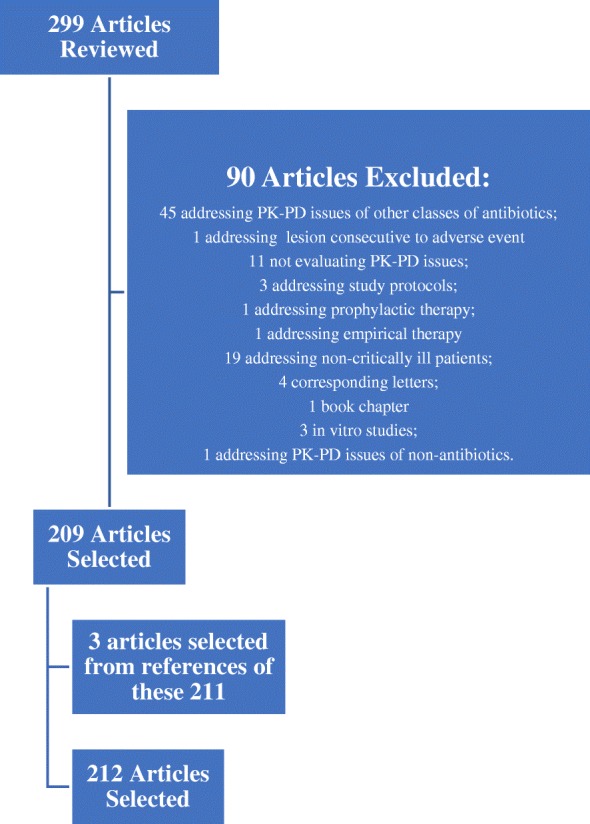
Antimicrobials are among the most important and commonly prescribed drugs in the management of critically ill patients and beta-lactams are the most common antibiotic class used. Critically ill patient's pathophysiological factors lead to altered pharmacokinetics and pharmacodynamics of beta-lactams.A comprehensive bibliographic search in PubMed database of all English language articles published from January 2000 to December 2017 was performed, allowing the selection of articles addressing the pharmacokinetics or pharmacodynamics of beta-lactam antibiotics in critically ill patients.In critically ill patients, several factors may increase volume of distribution and enhance renal clearance, inducing high intra- and inter-patient variability in beta-lactam concentration and promoting the risk of antibiotic underdosing. The duration of infusion of beta-lactams has been shown to influence the fT > minimal inhibitory concentration and an improved beta-lactam pharmacodynamics profile may be obtained by longer exposure with more frequent dosing, extended infusions, or continuous infusions.The use of extracorporeal support techniques in the critically ill may further contribute to this problem and we recommend not reducing standard antibiotic dosage since no drug accumulation was found in the available literature and to maintain continuous or prolonged infusion, especially for the treatment of infections caused by multidrug-resistant bacteria.Prediction of outcome based on concentrations in plasma results in overestimation of antimicrobial activity at the site of infection, namely in cerebrospinal fluid and the lung. Therefore, although no studies have assessed clinical outcome, we recommend using higher than standard dosing, preferably with continuous or prolonged infusions, especially when treating less susceptible bacterial strains at these sites, as the pharmacodynamics profile may improve with no apparent increase in toxicity.A therapeutic drug monitoring-guided approach could be particularly useful in critically ill patients in whom achieving target concentrations is more difficult, such as obese patients, immunocompromised patients, those infected by highly resistant bacterial strains, patients with augmented renal clearance, and those undergoing extracorporeal support techniques.
Overview
The claims and statistics of this paper haven’t been checked yet.
Free: it reads the open-access text and checks the first 5 claims that cite a source we can check. Create a free account to check every claim.
Integrity signals
Registry
Cites
Statistics
Figures
Verification
Claims the paper makes
The claims and statistics of this paper haven’t been checked yet.
Free: it reads the open-access text and checks the first 5 claims that cite a source we can check. Create a free account to check every claim.
Claims other papers make about this one
Each is checked against this paper’s own text: does it say what the citing paper says it does?
The cited source says what the claim attributes to it.
In the citing paper
“Antibiotics are subject to changes in PK/PD parameters in sepsis and septic shock where resultant concentrations may be too low risking clinical failure, or too high leading to toxicity (Table 3) [237–239].”
From Surviving sepsis campaign: international guidelines for management of sepsis and septic shock 2021 (2021) · cites this paper as [239]
The check wasn’t confident either way, so it gives no verdict — never disputed.
In the citing paper
“Some observational studies suggested that prompt initiation of appropriate empiric antifungal therapy may be associated with a reduction in mortality, however these studies do not prove a causal relationship between antifungal therapy and outcome, nor do they clarify the role of timing of treatment, and some other studies have failed to show this association (167,(171)(172)(173).”
From Surviving Sepsis Campaign: International Guidelines for Management of Sepsis and Septic Shock 2021. (2021) · cites this paper as [172]
Experimental — accuracy not yet measured
Self-check
Percentages, sums and reported differences re-computed from the paper’s own numbers.
The self-check needs the paper’s full text.
Citations
Cites
Items 201–216 of 216
Morita, A., Kamei, S., Minami, M., Yoshida, K., Kawabata, S., Kuroda, H., Suzuki, Y. A., Araki, N., Iwasaki, Y., Kobayashi, R., et al. (2014) · Journal of Infection and Chemotherapy · doi:10.1016/j.jiac.2014.04.013 · Cited by 9
Cephalosporin-Induced Leukopenia Following Rechallenge with Cefoxitin
Whitman, C. B., Joseph, J., & Sjoholm, L. O. (2008) · Annals of Pharmacotherapy · doi:10.1345/aph.1l183 · Cited by 9
Bourquin, V., Ponte, B., Saudan, P., & Martin, P. (2009) · Néphrologie & Thérapeutique · doi:10.1016/j.nephro.2009.02.010 · Cited by 8
Cefepime-AssociatedStatus Epilepticusin an ICU Patient with Renal Failure
Shaheen, T., Volles, D. F., Calland, F., Sifri, C. D., Mytinger, J. R., Hagspiel, K. D., Sawyer, R. G., & Bonatti, H. (2009) · Journal of Chemotherapy · doi:10.1179/joc.2009.21.4.452 · Cited by 8
Waele, J. J. D., & Carlier, M. (2014) · Critical Care · doi:10.1186/cc13945 · Cited by 8
Nag, D. S., Samaddar, D. P., Kant, S., & Mahanty, P. R. (2014) · Brazilian Journal of Anesthesiology (English Edition) · doi:10.1016/j.bjane.2014.08.001 · Cited by 7
Imipenem-associated encephalopathy: alert to physicians
Finkelsztejn, A., Cabral, L. S., Bragatti, J. A., da Silva, A. V., & Schuh, A. F. S. (2010) · Arquivos de Neuro-Psiquiatria · doi:10.1590/s0004-282x2010000100030 · Cited by 7
Single-dose pharmacokinetics of cefodizime in critically ill elderly patients
MEYER, B., Traunmüller, F., Bojic, A., Locker, G. J., Schmid, R. M., Winkler, S., & Thalhammer, F. (2006) · International Journal of Antimicrobial Agents · doi:10.1016/j.ijantimicag.2005.11.018 · Cited by 6
Lambden, S., Akeru, J., & Barrett, N. A. (2010) · PubMed · Cited by 5
Alvarez, S. D., González-Aragón, M. D. C. F., Moreno, A., Palomares‐Alonso, F., Cook, H. J., Cárdenas, G., & Soto‐Hernández, J. L. (2011) · Central Nervous System Agents in Medicinal Chemistry · doi:10.2174/187152411798047799 · Cited by 4
Nag, D. S., Samaddar, D. P., Kant, S., & Mahanty, P. R. (2015) · Brazilian Journal of Anesthesiology · doi:10.1016/j.bjan.2014.08.003 · Cited by 3
D’Agostino, C., Rhodes, N. J., Skoglund, E. W., Roberts, J. A., & Scheetz, M. H. (2015) · Journal of Infection and Chemotherapy · doi:10.1016/j.jiac.2015.05.010 · Cited by 3
Morabito, S., Guzzo, I., Vitaliano, E., Muzi, L., Solazzo, A., Pistolesi, V., & Pierucci, A. (2006) · PubMed · Cited by 3
New treatments for CNS pathologies.
Ml, L.-R. (2011) · PubMed · Cited by 2
Morabito, S., Guzzo, I., Vitaliano, E., et al. (2006) · Giornale Italiano di Nefrologia · Cited by 1
López-Rodríguez, M. L. (2011) · Central Nervous System Agents in Medicinal Chemistry · doi:10.2174/187152411794961059 · Cited by 1
Research works printed but not linked: 3
- Bloos F Rüdde H Thomas-Rüddel D Schwarzkopf D Pausch C Harbarth S Schreiber T Gründling M Marshall J Simon P Levy MM Weiss M Weyland A Gerlach H Schürholz T Engel C Matth C Scheer C Bach F Riessen R Poidinger B Dey K Weiler N Meier-Hellmann A Häberle HH Wöbker G Kaisers UX Reinhart K for the MEDUSA study group Effect of a multifaceted educational intervention for anti-infectious measures on sepsis mortality: a cluster randomized trial Intensive Care Med 2017 43 1602 1612 10.1007/s00134-017-4782-4 28466151 · DOI · Paper page
- Morabito S Guzzo I Vitaliano E Muzi L Solazzo A Pistolesi V Pierucci A Farmacocinetica degli Antibiotici nelle Terapie Sostitutive Renali Continue (CRRT) Gionale Italiano di Nefrologia 2012 29 425 444 22843155
- Langgartner J Vasold A Glück T Reng M Kees F Pharmacokinetics of meropenem during intermittent and continuous intravenous application in patients treated by continuous renal replacement therapy Intens Care Med 2008 34 1091 1096 10.1007/s00134-008-1034-7 18297267 · DOI
Cited by
Surviving sepsis campaign: international guidelines for management of sepsis and septic shock 2021
Evans, L., Rhodes, A., Alhazzani, W., Antonelli, M., Coopersmith, C. M., French, C., Machado, F. R., Mcintyre, L., Ostermann, M., Prescott, H. C., et al. (2021) · Intensive Care Medicine · doi:10.1007/s00134-021-06506-y · Cited by 5,082
Surviving Sepsis Campaign: International Guidelines for Management of Sepsis and Septic Shock 2021.
Evans, L., Rhodes, A., Alhazzani, W., Antonelli, M., Coopersmith, C. M., French, C., Machado, F. R., Mcintyre, L., Ostermann, M., Prescott, H. C., et al. (2021) · Critical Care Medicine · doi:10.1097/ccm.0000000000005337 · Cited by 2,935
The Minimum Inhibitory Concentration of Antibiotics: Methods, Interpretation, Clinical Relevance
Kowalska-Krochmal, B., & Dudek-Wicher, R. (2021) · Pathogens · doi:10.3390/pathogens10020165 · Cited by 1,039
Guilhaumou, R., Benaboud, S., Bennis, Y., Dahyot-Fizelier, C., Dailly, E., Gandia, P., Goutelle, S., Lefeuvre, S., Mongardon, N., Roger, C., et al. (2019) · Critical Care · doi:10.1186/s13054-019-2378-9 · Cited by 543
New β-Lactam–β-Lactamase Inhibitor Combinations
Yahav, D., Giske, C. G., Grāmatniece, A., Abodakpi, H., Tam, V. H., & Leibovici, L. (2020) · Clinical Microbiology Reviews · doi:10.1128/cmr.00115-20 · Cited by 521
“As hydrophilic drugs, -lactams and -lactamase inhibitors have a characteristically low volume of distribution (V), akin to extracellular water, and are predominantly renally excreted (17).”
Background
Metadata
- Authors
- Veiga, R. P., & Paiva, J.-A.
- Affiliations
- Universidade do Porto (PT)
- Corresponding author
- Veiga, Rui Pedro
- ORCID
- Veiga, Rui Pedro
- Venue
- Critical Care
- Published
- 2018-09-24
- Volume
- 22
- Issue
- 1
- Pages
- 233-233
- ISSN
- 1364-8535 (ISSN-L)
- PMC
- PMC6151903
- OpenAlex
- W2889630471
- Cited by
- 203
- References
- 216
- Citations by year
- 2026: 21 · 2025: 23 · 2024: 33 · 2023: 20 · 2022: 36 · 2021: 28 · 2020: 22 · 2019: 18 · 2018: 2
- FWCI
- 2.04
- Type
- journal article
- Language
- en
- Open access
- gold
- doi.org
- Licence
- cc-by
- creativecommons.org/licenses/by/4.0/ (tdm)
- Locations
- Critical Care (publishedVersion, cc-by)
- Europe PMC (PubMed Central) (publishedVersion, other-oa)
- PubMed Central (publishedVersion, cc-by)
- PubMed (publishedVersion)
- DOAJ (DOAJ: Directory of Open Access Journals) (submittedVersion, cc-by-sa)
- Topics
- Health Sciences › Medicine › Pharmacology (medical) › Antibiotics Pharmacokinetics and Efficacy
- Health Sciences › Medicine › Microbiology (medical) › Antibiotic Resistance in Bacteria
- Health Sciences › Medicine › Infectious Diseases › Antibiotic Use and Resistance
- Keywords
- beta-lactam antibiotics, pharmacokinetics, pharmacodynamics, critically ill patients, antibiotic dosing, prolonged infusion, continuous infusion, therapeutic drug monitoring, volume of distribution, renal clearance, extracorporeal support, multidrug-resistant bacteria, cerebrospinal fluid penetration, pulmonary infection, obesity, immunocompromised patients
- MeSH terms
- Anti-Bacterial Agents, Humans, Infusions, Intravenous, Critical Illness, Drug Monitoring, Drug Utilization Review, beta-Lactams
About these checks
Registry, retraction, Cites and statistics results are computed, not judged, with one exception: a printed reference that no index lists is read once by a model before it counts as a citation error. Claims are extracted by a model and kept only when their quote appears verbatim in the text; each cited source is then checked, with a model’s help, for whether it says what the claim relies on. Those verdicts can be wrong — read the claim’s quote and the cited source before relying on one.
Statistics and arithmetic are recomputed, not judged.
Confidence bands are shown only for fields calibrated on our annotated test set. None is calibrated yet, so no band is shown.
What counts as a claim ›How we measure confidence ›How we check this ›
Are you an author, or do you see a problem with this page? Request a review
Data sources
Bibliographic data: Semantic Scholar, OpenAlex, Crossref.
Contains information from the Semantic Scholar Academic Graph Datasets, made available under the ODC Attribution License (ODC-BY 1.0).
Semantic Scholar’s data is described in: Kinney, R., et al. (2023). The Semantic Scholar Open Data Platform. arXiv:2301.10140.
