

Liberal versus restrictive red blood cell transfusion strategy in sepsis or septic shock: A systematic review and meta-analysis of randomized trials.
Open accessThe DOI matches its Crossref record; 31 of the 31 references it cites were found in a registry or an index.
Abstract
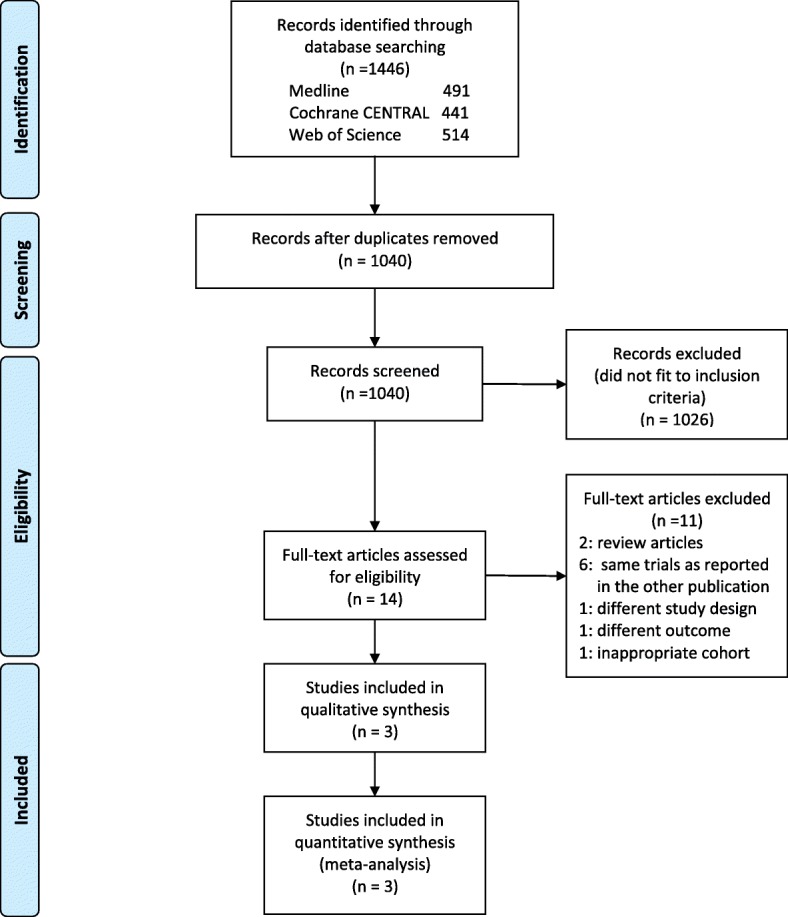
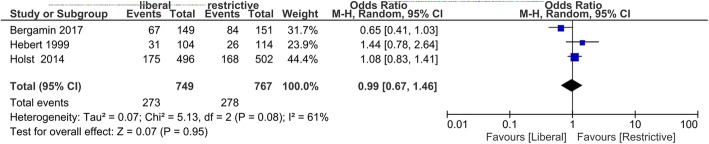
We assessed the effect of liberal versus restrictive red blood cell transfusion strategy on survival outcome in sepsis or septic shock by systematically reviewing the literature and synthesizing evidence from randomized controlled trials (RCTs). We searched the MEDLINE, Cochrane Central Register of Controlled Trials, and Web of Science databases. We included RCTs that compared mortality between a liberal transfusion strategy with a hemoglobin threshold of 9 or 10 g/dL and a restrictive transfusion strategy with a hemoglobin threshold of 7 g/dL in adults with sepsis or septic shock. Two investigators independently screened citations and conducted data extraction. The primary outcome was 28- or 30-day mortality. Secondary outcomes were 60- and 90-day mortality, use of life support at 28 days of admission, and number of patients transfused during their intensive care unit stay. DerSimonian-Laird random-effects models were used to report pooled odds ratios (ORs). A total of 1516 patients from three RCTs were included; 749 were randomly assigned to the liberal transfusion group and 767 to the restrictive strategy group. Within 28–30 days, 273 patients (36.4%) died in the liberal transfusion group, while 278 (36.2%) died in the restrictive transfusion group (pooled OR, 0.99; 95% confidence interval [CI], 0.67–1.46). For the primary outcome, heterogeneity was observed among the studies ( I 2 = 61.0%, χ 2 = 5.13, p = 0.08). For secondary outcomes, only two RCTs were included. There were no significant differences in secondary outcomes between the two groups. We could not show any difference in 28- or 30-day mortality between the liberal and restrictive transfusion strategies in sepsis or septic shock patients by meta-analysis of RCTs. Our results should be interpreted with caution due to the existence of heterogeneity. As sepsis complicates a potentially wide range of underlying diseases, further trials in carefully selected populations are anticipated. This present study was registered in the PROSPERO database ( CRD42018108578 ).
Overview
The claims and statistics of this paper haven’t been checked yet.
Free: it reads the open-access text and checks the first 5 claims that cite a source we can check. Create a free account to check every claim.
Integrity signals
Registry
Cites
Statistics
Figures

Verification
Claims the paper makes
The claims and statistics of this paper haven’t been checked yet.
Free: it reads the open-access text and checks the first 5 claims that cite a source we can check. Create a free account to check every claim.
Self-check
Percentages, sums and reported differences re-computed from the paper’s own numbers.
The self-check needs the paper’s full text.
Citations
Cites
Bias in meta-analysis detected by a simple, graphical test
Egger, M., Smith, G. D., Schneider, M., & Minder, C. (1997) · BMJ · doi:10.1136/bmj.315.7109.629 · Cited by 56,722
The Cochrane Collaboration's tool for assessing risk of bias in randomised trials
Higgins, J. P. T., Altman, D. G., Gotzsche, P. C., Juni, P., Moher, D., Oxman, A. D., Savovic, J., Schulz, K. F., Weeks, L., Sterne, J. A. C., et al. (2011) · BMJ · doi:10.1136/bmj.d5928 · Cited by 33,817
The third international consensus definitions for sepsis and septic shock (Sepsis-3).
Singer, M., Deutschman, C. S., Seymour, C. W., Shankar-Hari, M., Annane, D., Bauer, M., Bellomo, R., Bernard, G. R., Chiche, J.-D., Coopersmith, C. M., et al. (2016) · JAMA · doi:10.1001/jama.2016.0287 · Cited by 28,250 · cited 1×
“We did not restrict the definition of sepsis to the latest definition [10]; instead, we allowed all past definitions of sepsis when identifying the studies to be included.”
MethodDermyshi, E., Wang, Y., Yan, C., Hong, W., Qiu, G., Gong, X., & Zhang, T. (2017) · Neonatology · doi:10.1159/000454668 · Cited by 24,451
GRADE guidelines: 1. Introduction—GRADE evidence profiles and summary of findings tables
Guyatt, G., Oxman, A. D., Akl, E. A., Kunz, R., Vist, G., Brozek, J., Norris, S., Falck-Ytter, Y., Glasziou, P., & deBeer, H. (2011) · Journal of Clinical Epidemiology · doi:10.1016/j.jclinepi.2010.04.026 · Cited by 10,681
A Multicenter, Randomized, Controlled Clinical Trial of Transfusion Requirements in Critical Care
Hébert, P. C., Wells, G., Blajchman, M. A., Marshall, J., Martin, C., Pagliarello, G., Tweeddale, M., Schweitzer, I., & Yetisir, E. (1999) · New England Journal of Medicine · doi:10.1056/nejm199902113400601 · Cited by 5,187 · cited 3×
“conducted an RCT involving critically ill patients to compare the 30-day mortality rate between the liberal transfusion group (with a hemoglobin threshold of 10 g/ dL) and restrictive transfusion group (with a hemoglobin threshold of 7 g/dL) (TRICC trial) [15].”
BackgroundSurviving Sepsis Campaign: International guidelines for management of sepsis and septic shock: 2016.
Rhodes, A., Evans, L. E., Alhazzani, W., Levy, M. M., Antonelli, M., Ferrer, R., Kumar, A., Sevransky, J. E., Sprung, C. L., Nunnally, M. E., et al. (2017) · Critical Care Medicine · doi:10.1097/ccm.0000000000002255 · Cited by 3,652
Norderyd, O. M., Koch, G., Papias, A., Köhler, A. A., Helkimo, A. N., Brahm, C., Lindmark, U., Lindfors, N., Mattsson, A., Rolander, B., et al. (2015) · PubMed · Cited by 3,584
A randomized trial of protocol-based care for early septic shock.
The ProCESS Investigators (2014) · New England Journal of Medicine · doi:10.1056/nejmoa1401602 · Cited by 2,414 · cited 1×
“However, this recommendation is based on limited data from only two clinical trials, including one less-direct assessment of blood transfusion therapy [8, 9].”
MethodA Multicenter, Randomized, Controlled Clinical Trial of Transfusion Requirements in Critical Care
(1999) · New England Journal of Medicine · doi:10.1056/nejm199904013401322 · Cited by 2,037
Liberal or Restrictive Transfusion in High-Risk Patients after Hip Surgery
Carson, J. L., Terrin, M. L., Noveck, H., Sanders, D. W., Chaitman, B. R., Rhoads, G. G., Nemo, G., Dragert, K., Beaupre, L., Hildebrand, K., et al. (2011) · New England Journal of Medicine · doi:10.1056/nejmoa1012452 · Cited by 1,328
Transfusion thresholds and other strategies for guiding allogeneic red blood cell transfusion
Carson, J. L., Stanworth, S. J., Roubinian, N., Fergusson, D. A., Triulzi, D., Doree, C., & Hebert, P. C. (2016) · Cochrane Database of Systematic Reviews · doi:10.1002/14651858.cd002042.pub4 · Cited by 1,250
Lower versus Higher Hemoglobin Threshold for Transfusion in Septic Shock
Holst, L. B., Haase, N., Wetterslev, J., Wernerman, J., Guttormsen, A. B., Karlsson, S., Johansson, P. I., Åneman, A., Vang, M. L., Winding, R., et al. (2014) · New England Journal of Medicine · doi:10.1056/nejmoa1406617 · Cited by 899
Restrictive or Liberal Red-Cell Transfusion for Cardiac Surgery
Mazer, C. D., Whitlock, R. P., Fergusson, D. A., Hall, J., Belley-Cote, E., Connolly, K., Khanykin, B., Gregory, A. J., de Médicis, É., McGuinness, S., et al. (2017) · New England Journal of Medicine · doi:10.1056/nejmoa1711818 · Cited by 764
Systematic reviews and meta-analysis: Understanding the best evidence in primary healthcare
Ganeshkumar, P., & Gopalakrishnan, S. (2013) · Journal of Family Medicine and Primary Care · doi:10.4103/2249-4863.109934 · Cited by 743 · cited 1×
“meta-analyses are considered to be powerful tools for solving research questions, heterogeneity is the one of the weaknesses of these statistical methods [25, 26].”
MethodPatient Blood Management: Recommendations From the 2018 Frankfurt Consensus Conference
Mueller, M. M., Van Remoortel, H., Meybohm, P., Aranko, K., Aubron, C., Burger, R., Carson, J. L., Cichutek, K., De Buck, E., Devine, D., et al. (2019) · JAMA · doi:10.1001/jama.2019.0554 · Cited by 632
Cata, J. P., Wang, H., Gottumukkala, V., Reuben, J., & Sessler, D. I. (2013) · British Journal of Anaesthesia · doi:10.1093/bja/aet068 · Cited by 539
Perioperative blood transfusions for the recurrence of colorectal cancer
Amato, A., & Pescatori, M. (2004) · Cochrane Database of Systematic Reviews · doi:10.1002/14651858.cd005033 · Cited by 406
The Promise and Problems of Meta-Analysis
Bailar, J. C. (1997) · New England Journal of Medicine · doi:10.1056/nejm199708213370810 · Cited by 402
Anemia, Allogenic Blood Transfusion, and Immunomodulation in the Critically Ill
Raghavan, M., & Marik, P. E. (2005) · Chest · doi:10.1378/chest.127.1.295 · Cited by 272
Jairath, V., Kahan, B. C., Gray, A., Doré, C. J., Mora, A., James, M. W., Stanley, A. J., Everett, S. M., Bailey, A. A., Dallal, H., et al. (2015) · The Lancet · doi:10.1016/s0140-6736(14)61999-1 · Cited by 251
Perioperative blood transfusions and recurrence of colorectal cancer
Amato, A., & Pescatori, M. (2006) · Cochrane Database of Systematic Reviews · doi:10.1002/14651858.cd005033.pub2 · Cited by 246
Docherty, A. B., O’Donnell, R., Brunskill, S., Trivella, M., Doree, C., Holst, L. B., Parker, M., Gregersen, M., Pinheiro de Almeida, J., Walsh, T. S., et al. (2016) · BMJ · doi:10.1136/bmj.i1351 · Cited by 245
Palmieri, T. L., Holmes, J. H., Arnoldo, B. D., Peck, M. D., Potenza, B. M., Cochran, A. L., King, B. T., Dominic, W. J., Cartotto, R. C., Bhavsar, D., et al. (2017) · Annals of Surgery · doi:10.1097/sla.0000000000002408 · Cited by 140
Bergamin, F. S., Almeida, J. P., Landoni, G., Galas, F. R. B. G., Fukushima, J. T., Fominskiy, E., Park, C. H. L., Osawa, E. A., Diz, M. P. E., Oliveira, G. Q., et al. (2017) · Critical Care Medicine · doi:10.1097/ccm.0000000000002283 · Cited by 132
Dupuis, C., Sonneville, R., Adrie, C., Gros, A., Darmon, M., Bouadma, L., & Timsit, J. (2017) · Annals of Intensive Care · doi:10.1186/s13613-016-0226-5 · Cited by 71
Leukoreduction of blood components
Dzik, S. (2002) · Current Opinion in Hematology · doi:10.1097/00062752-200211000-00010 · Cited by 62
Best practice in critical care: anaemia in acute and critical illness
Docherty, A. B., Turgeon, A. F., & Walsh, T. S. (2018) · Transfusion Medicine · doi:10.1111/tme.12505 · Cited by 53
English, S. W., Fergusson, D. A., Chassé, M., Turgeon, A. F., Lauzier, F., Griesdale, D. E. G., Algird, A. R., Kramer, A. H., Tinmouth, A. T., Lum, C., et al. (2016) · BMJ Open · doi:10.1136/bmjopen-2016-012623 · Cited by 51
Transfusion of Red Blood Cells to Patients with Sepsis
Chan, Y., Han, S.-T., Li, C.-H., Wu, C., & Chen, K. (2017) · International Journal of Molecular Sciences · doi:10.3390/ijms18091946 · Cited by 29
Dupuis, C., Sonneville, R., Essaied, W. I., Ruckly, S., Bouadma, L., & Timsit, J. (2015) · Intensive Care Medicine Experimental · doi:10.1186/2197-425x-3-s1-a641 · Cited by 2
Cited by
Surviving sepsis campaign: international guidelines for management of sepsis and septic shock 2021
Evans, L., Rhodes, A., Alhazzani, W., Antonelli, M., Coopersmith, C. M., French, C., Machado, F. R., Mcintyre, L., Ostermann, M., Prescott, H. C., et al. (2021) · Intensive Care Medicine · doi:10.1007/s00134-021-06506-y · Cited by 5,082
Surviving Sepsis Campaign: International Guidelines for Management of Sepsis and Septic Shock 2021.
Evans, L., Rhodes, A., Alhazzani, W., Antonelli, M., Coopersmith, C. M., French, C., Machado, F. R., Mcintyre, L., Ostermann, M., Prescott, H. C., et al. (2021) · Critical Care Medicine · doi:10.1097/ccm.0000000000005337 · Cited by 2,935
The spectrum of sepsis-associated encephalopathy: a clinical perspective
Sonneville, R., Benghanem, S., Jeantin, L., de Montmollin, E., Doman, M., Gaudemer, A., Thy, M., & Timsit, J.-F. (2023) · Critical Care · doi:10.1186/s13054-023-04655-8 · Cited by 188
Prevalence of and Recovery From Anemia Following Hospitalization for Critical Illness Among Adults
Warner, M. A., Hanson, A. C., Frank, R. D., Schulte, P. J., Go, R. S., Storlie, C. B., & Kor, D. J. (2020) · JAMA Network Open · doi:10.1001/jamanetworkopen.2020.17843 · Cited by 104
“Not available (n = 1207) Not anemic (n = 3374) Anemia Overall (n = 6901) Mild (n = 1811) Moderate (n = 422) Severe (n = 87) Patient characteristics Age, median (IQR), y 57 (43-70) 66 (51-78) 74 (60-84) 72 (58-83) 67 (55-78) 67 (52-79) Sex Women 413 (34) 1720 (51) 700 (39) 231 (55) 45 (52) 3109 (45) Men 794 (66) 1654 (…”
The Role of Circulating Cell-Free Hemoglobin in Sepsis-Associated Acute Kidney Injury
Kerchberger, V. E., & Ware, L. B. (2020) · Seminars in Nephrology · doi:10.1016/j.semnephrol.2020.01.006 · Cited by 67
Metadata
- Authors
- Hirano, Y., Miyoshi, Y., Kondo, Y., Okamoto, K., & Tanaka, H.
- Affiliations
- Juntendo University Urayasu Hospital (JP)
- Corresponding author
- Hirano, Yohei
- Venue
- Critical Care
- Published
- 2019-07-25
- Volume
- 23
- Issue
- 1
- Pages
- 262-262
- ISSN
- 1364-8535 (ISSN-L)
- PMC
- PMC6659290
- OpenAlex
- W2962884354
- Cited by
- 51
- References
- 31
- Citations by year
- 2026: 3 · 2025: 6 · 2024: 14 · 2023: 5 · 2022: 5 · 2021: 7 · 2020: 10 · 2019: 1
- FWCI
- 0.56
- Type
- journal article
- Language
- en
- Open access
- gold
- doi.org
- Licence
- cc-by
- creativecommons.org/licenses/by/4.0/ (tdm)
- creativecommons.org/licenses/by/4.0/ (vor)
- Locations
- Critical Care (publishedVersion, cc-by)
- PubMed Central (publishedVersion, cc-by)
- PubMed (publishedVersion)
- DOAJ (DOAJ: Directory of Open Access Journals) (submittedVersion, cc-by-sa)
- Funders
- Japan Society of the Promotion of Science (17K11593)
- Topics
- Health Sciences › Medicine › Hematology › Blood transfusion and management
- Health Sciences › Medicine › Critical Care and Intensive Care Medicine › Sepsis Diagnosis and Treatment
- Health Sciences › Medicine › Critical Care and Intensive Care Medicine › Trauma, Hemostasis, Coagulopathy, Resuscitation
- Keywords
- red blood cell transfusion, liberal transfusion, restrictive transfusion, sepsis, septic shock, hemoglobin threshold, 28-day mortality, 30-day mortality, intensive care unit
- MeSH terms
- Humans, Randomized Controlled Trials as Topic, Treatment Outcome, Erythrocyte Transfusion, Sepsis
About these checks
Registry, retraction, Cites and statistics results are computed, not judged, with one exception: a printed reference that no index lists is read once by a model before it counts as a citation error. Claims are extracted by a model and kept only when their quote appears verbatim in the text; each cited source is then checked, with a model’s help, for whether it says what the claim relies on. Those verdicts can be wrong — read the claim’s quote and the cited source before relying on one.
Statistics and arithmetic are recomputed, not judged.
Confidence bands are shown only for fields calibrated on our annotated test set. None is calibrated yet, so no band is shown.
What counts as a claim ›How we measure confidence ›How we check this ›
Are you an author, or do you see a problem with this page? Request a review
Data sources
Bibliographic data: Semantic Scholar, OpenAlex, Crossref.
Contains information from the Semantic Scholar Academic Graph Datasets, made available under the ODC Attribution License (ODC-BY 1.0).
Semantic Scholar’s data is described in: Kinney, R., et al. (2023). The Semantic Scholar Open Data Platform. arXiv:2301.10140.
