

The DOI matches its Crossref record; 18 of the 19 references it cites were found in a registry or an index.
Anakinra treatment in critically ill COVID-19 patients: a prospective cohort study
Open accessAbstract
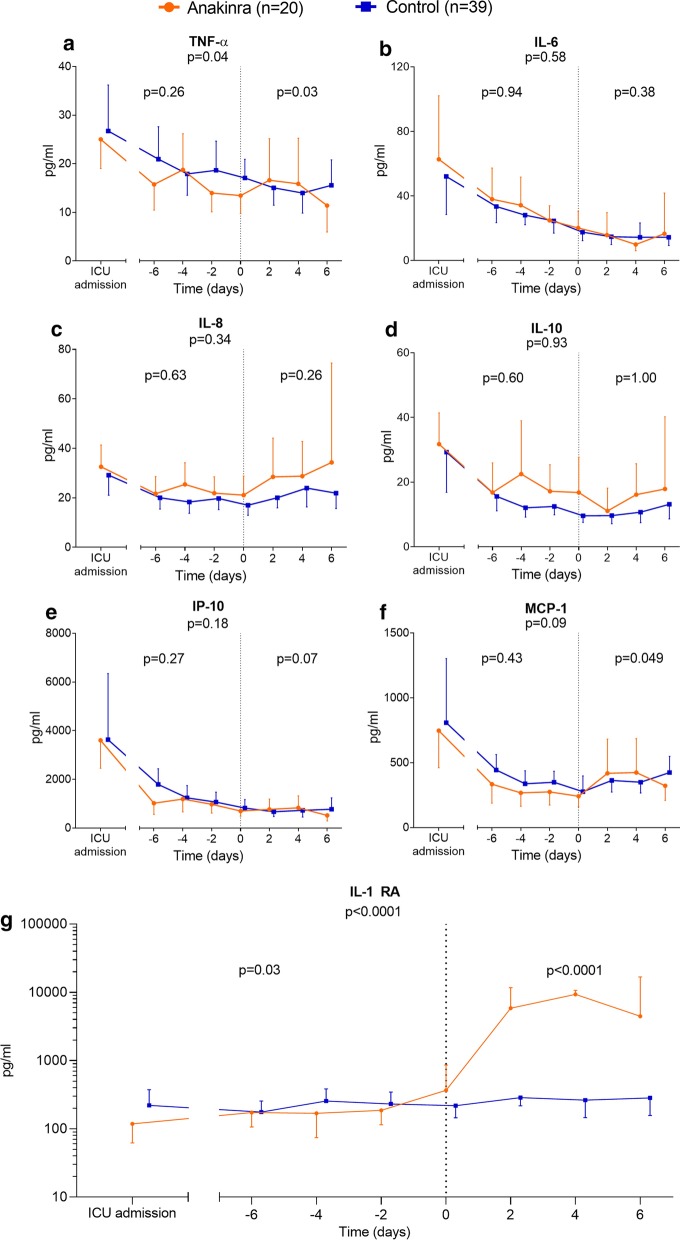
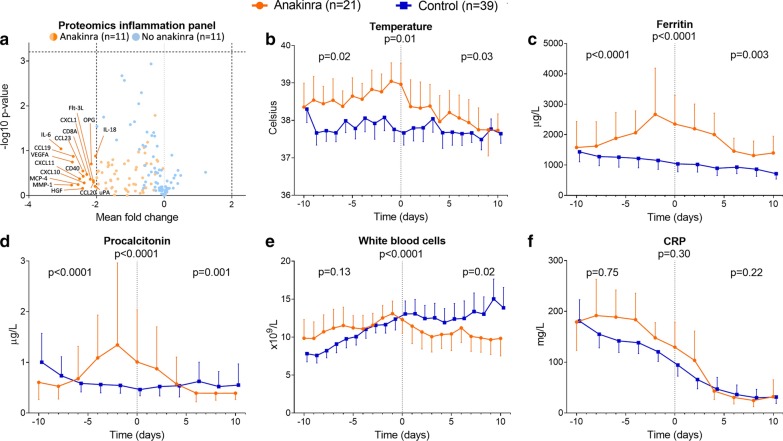
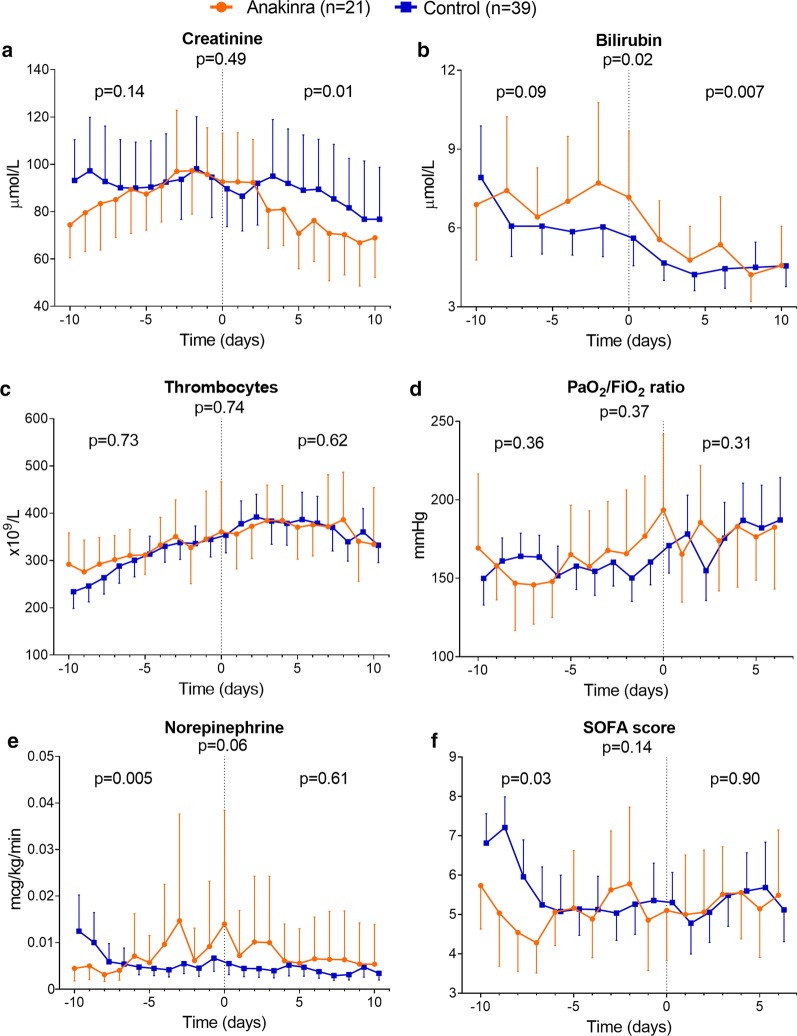
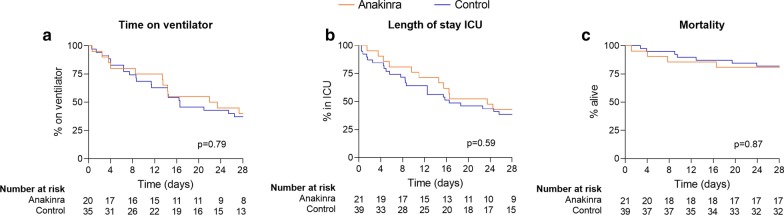
Background: A subset of critically ill COVID-19 patients develop a hyperinflammatory state. Anakinra, a recombinant interleukin-1 receptor antagonist, is known to be effective in several hyperinflammatory diseases. We investigated the effects of anakinra on inflammatory parameters and clinical outcomes in critically ill, mechanically ventilated COVID-19 patients with clinical features of hyperinflammation. Methods: In this prospective cohort study, 21 critically ill COVID-19 patients treated with anakinra were compared to a group of standard care. Serial data of clinical inflammatory parameters and concentrations of multiple circulating cytokines were determined and aligned on start day of anakinra in the treatment group, and median start day of anakinra in the control group. Analysis was performed for day − 10 to + 10 relative to alignment day. Clinical outcomes were analyzed during 28 days. Additionally, three sensitivity analyses were performed: (1) using propensity score-matched groups, (2) selecting patients who did not receive corticosteroids, and (3) using a subset of the control group aimed to match the criteria (fever, elevated ferritin) for starting anakinra treatment. Results: Baseline patient characteristics and clinical parameters on ICU admission were similar between groups. As a consequence of bias by indication, plasma levels of aspartate aminotransferase (ASAT) (p = 0.0002), ferritin (p = 0.009), and temperature (p = 0.001) were significantly higher in the anakinra group on alignment day. Following treatment, no relevant differences in kinetics of circulating cytokines were observed between both groups. Decreases of clinical parameters, including temperature (p = 0.03), white blood cell counts (p = 0.02), and plasma levels of ferritin (p = 0.003), procalcitonin (p = 0.001), creatinine (p = 0.01), and bilirubin (p = 0.007), were more pronounced in the anakinra group. No differences in duration of mechanical ventilation or ICU length of stay were observed between groups. Sensitivity analyses confirmed these results. Conclusions: Anakinra is effective in reducing clinical signs of hyperinflammation in critically ill COVID-19 patients. A randomized controlled trial is warranted to draw conclusion about the effects of anakinra on clinical outcomes.
Overview
The claims and statistics of this paper haven’t been checked yet.
Run the check — free, no account needed. It reads the open-access text and checks the sources it cites.
Integrity signals
Registry
Cites
Statistics
Figures
Verification
Claims the paper makes
The claims and statistics of this paper haven’t been checked yet.
Run the check — free, no account needed. It reads the open-access text and checks the sources it cites.
Claims other papers make about this one
Each is checked against this paper’s own text: does it say what the citing paper says it does?
In the citing paper
“This might be similarly true for targeting IL-1 with anakinra for which several smaller studies were reporting beneficial effects (Iglesias-Julián et al., 2020; Kooistra et al., 2020)”
From COVID-19 and the human innate immune system (2021) · cites this paper as Kooistra et al., 2020
Self-check
Percentages, sums and reported differences re-computed from the paper’s own numbers.
The self-check needs the paper’s full text.
Citations
Cites
Clinical features of patients infected with 2019 novel coronavirus in Wuhan, China
Huang, C., Wang, Y., Li, X., Ren, L., Zhao, J., Hu, Y., Zhang, L., Fan, G., Xu, J., Gu, X., et al. (2020) · The Lancet · doi:10.1016/s0140-6736(20)30183-5 · Cited by 48,884
Dexamethasone in Hospitalized Patients with Covid-19
The RECOVERY Collaborative Group (2021) · New England Journal of Medicine · doi:10.1056/nejmoa2021436 · Cited by 11,477
COVID-19: consider cytokine storm syndromes and immunosuppression
Mehta, P., McAuley, D. F., Brown, M., Sanchez, E., Tattersall, R. S., & Manson, J. J. (2020) · The Lancet · doi:10.1016/s0140-6736(20)30628-0 · Cited by 9,664
Ruan, Q., Yang, K., Wang, W., Jiang, L., & Song, J. (2020) · Intensive Care Medicine · doi:10.1007/s00134-020-05991-x · Cited by 4,898
Complex Immune Dysregulation in COVID-19 Patients with Severe Respiratory Failure
Giamarellos-Bourboulis, E. J., Netea, M. G., Rovina, N., Akinosoglou, K., Antoniadou, A., Antonakos, N., Damoraki, G., Gkavogianni, T., Adami, M.-E., Katsaounou, P., et al. (2020) · Cell Host & Microbe · doi:10.1016/j.chom.2020.04.009 · Cited by 2,045
Self-citationHenry, B. M., de Oliveira, M. H. S., Benoit, S., Plebani, M., & Lippi, G. (2020) · Clinical Chemistry and Laboratory Medicine (CCLM) · doi:10.1515/cclm-2020-0369 · Cited by 1,964
Zhang, C., Wu, Z., Li, J., Zhao, H., & Wang, G.-Q. (2020) · International Journal of Antimicrobial Agents · doi:10.1016/j.ijantimicag.2020.105954 · Cited by 1,776
Understanding the mechanism of IL-1β secretion
Lopez-Castejon, G., & Brough, D. (2011) · Cytokine & Growth Factor Reviews · doi:10.1016/j.cytogfr.2011.10.001 · Cited by 1,519
Cavalli, G., Luca, G. D. D., Campochiaro, C., Della‐Torre, E., Ripa, M., Canetti, D., Oltolini, C., Castiglioni, B., Din, C. T., Boffini, N., et al. (2020) · The Lancet Rheumatology · doi:10.1016/s2665-9913(20)30127-2 · Cited by 988
Shakoory, B., Carcillo, J. A., Chatham, W. W., Amdur, R. L., Zhao, H., Dinarello, C. A., Cron, R. Q., & Opal, S. M. (2016) · Critical Care Medicine · doi:10.1097/ccm.0000000000001402 · Cited by 867
Cited by
Sorted by citations
Items 101–118 of 118
Bahmani, M., & Saberian, L. (2021) · Journal of Preventive Epidemiology · doi:10.34172/jpe.2021.20
Apoptosis, necroptosis, and pyroptosis in health and disease
Liao, D. (2021) · Elsevier eBooks · doi:10.1016/b978-0-12-814208-0.00008-7
(2022) · The Annals of Clinical and Analytical Medicine · doi:10.4328/acam.21185
Immunomodulation in COVID-19: A Review of Literature
Yadav, C. K., Shah, B. P., Mishra, M. K., Jha, D., Mehta, B., & Yadav, P. S. (2022) · Scholars Journal of Medical Case Reports · doi:10.36347/sjmcr.2022.v10i09.005
COVID‐19: Inpatient Management
Lopez, A., Matusov, Y. P., Pedraza, I., Tapson, V. F., Falk, J., & Chen, P. (2022) · Wiley eBooks · doi:10.1002/9781119789741.ch10
Effectiveness Of Anakinra Therapy On Covid-19 Patients In Icu
UYSAL, E., Turan, İ. Ö., & Ankaralı, H. Ç. (2023) · Archives of Current Medical Research · doi:10.47482/acmr.1129700
Thurner, L., & Kessel, C. (2023) · Elsevier eBooks · doi:10.1016/b978-0-443-18566-3.00031-1
Innate immune responses in COVID-19
Jacotot, E. D., Talamini, L., Bonam, S. R., Vieira, A. T., Frémeaux‐Bacchi, V., Radic, M. Z., Dragon‐Durey, M., Lozano, J. M., Saia, R. S., & Muller, S. (2023) · Elsevier eBooks · doi:10.1016/b978-0-443-18566-3.00041-4
VAI TRÒ QUAN TRỌNG CỦA INTERLEUKIN 6 TRONG COVID-19
Trần, T. T. N., Lê, H. L., Nguyễn, T. Q., Nguyễn, T. T. T., & Trần, Q. H. (2023) · Tạp chí Y Dược học Cần Thơ · doi:10.58490/ctump.2023i58.699
IL-1-mediated inflammation in COVID-19
Jain, P., Singh, B., Aggarwal, S., & Singh, M. (2023) · Elsevier eBooks · doi:10.1016/b978-0-12-824273-5.00005-2
Gomon, Y. М., Колбин, А. С., Fakhrutdinova, A. M., Usmanova, T. A., Sultanova, F. М., & Balykina, Y. Е. (2023) · Antibiot Khimioter = Antibiotics and Chemotherapy · doi:10.37489/0235-2990-2023-68-3-4-52-65
Real-life use of High-Dose Anakinra in Patients with COVID-19 Treated with Remdesivir
Monardo, R., Mastrángelo, A., Galli, L., Tomelleri, A., Spagnuolo, V., Oltolini, C., Ponta, G., Campochiaro, C., Cavalli, G., Dagna, L., et al. (2024) · Future Virology · doi:10.2217/fvl-2023-0132
All available clinical data on anakinra in COVID-19: an updated comprehensive reviewPreprint
Shahrabi, M., Khani, E., Pourkarim, F., Afsharirad, H., & Solduzian, M. (2024) · doi:10.22541/au.170666812.28371636/v1
Inflammation, cytokines, and COVID-19 severity
Pattanayak, S. P., Sahu, R., & Sunita, P. (2025) · Elsevier eBooks · doi:10.1016/b978-0-443-19170-1.00012-7
Kooistra, E. J., Dahm, K., van Herwaarden, A. E., Gerretsen, J., Nuesch-Germano, M., Mauer, K., Smeets, R. L., van der Velde, S., van den Berg, M. J. W., van der Hoeven, J. G., et al. (2023) · Figshare · doi:10.6084/m9.figshare.23916723
Self-citationAmikishiyev, S., Deniz, R., Günver, M. G., Aghamuradov, S., Koca, N., İnce, B., Bektaş, M., Yilmaz, A., Cantürk, Y., Durak, G., et al. (2026) · Frontiers in Immunology · doi:10.3389/fimmu.2026.1722572
Neumann, C. M., Hickl, F., Kemnitzer, J., Leitner, M., Giamarellos‐Bourboulis, E. J., & Rubio, I. (2026) · Critical Care · doi:10.1186/s13054-026-06315-z
Metadata
- Authors
- the RCI-COVID-19 Study Group, Kooistra, E. J., Waalders, N. J. B., Grondman, I., Janssen, N. A. F., de Nooijer, A. H., Netea, M. G., van de Veerdonk, F. L., Ewalds, E., van der Hoeven, J. G., Kox, M., & Pickkers, P.
- Affiliations
- Radboud University Medical Center (NL)
- University of Bonn (DE)
- Corresponding author
- Pickkers, Peter
- ORCID
- Venue
- Critical Care
- Published
- 2020-12
- Volume
- 24
- Issue
- 1
- Pages
- 688-688
- ISSN
- 1364-8535 (ISSN-L)
- PMC
- PMC7726611
- OpenAlex
- W3112686683
- Cited by
- 119
- References
- 19
- Citations by year
- 2026: 3 · 2025: 3 · 2024: 8 · 2023: 21 · 2022: 34 · 2021: 50
- FWCI
- 3.44
- Type
- journal article
- Language
- en
- Open access
- gold
- doi.org
- Licence
- Locations
- Critical Care (publishedVersion, cc-by)
- PubMed Central (publishedVersion, cc-by)
- PubMed (publishedVersion)
- Amsterdam UMC (VU Amsterdam) - Institutional Repository (publishedVersion, other-oa)
- Radboud Repository (Radboud University) (submittedVersion, other-oa)
- DOAJ (DOAJ: Directory of Open Access Journals) (submittedVersion, cc-by-sa)
- Pure Amsterdam UMC (submittedVersion, cc-by)
- Data Archiving and Networked Services (DANS) (submittedVersion, other-oa)
- Funders
- H2020 European Research Council (833247)
- Nederlandse Organisatie voor Wetenschappelijk Onderzoek
- Radboud Universitair Medisch Centrum
- Topics
- Health Sciences › Medicine › Infectious Diseases › COVID-19 Clinical Research Studies
- Health Sciences › Medicine › Pulmonary and Respiratory Medicine › Respiratory Support and Mechanisms
- Health Sciences › Medicine › Critical Care and Intensive Care Medicine › Sepsis Diagnosis and Treatment
- Keywords
- anakinra, COVID-19 pandemic, hyperinflammation, interleukin-1 receptor antagonist, critically ill patients, mechanical ventilation, cytokines, ferritin, procalcitonin, inflammatory markers, clinical outcomes
- MeSH terms
- COVID-19, COVID-19 Drug Treatment, Aged, Female, Humans, Male, Middle Aged, Prospective Studies, Cohort Studies, Critical Illness, Receptors, Interleukin-1, Statistics, Nonparametric, Interleukin 1 Receptor Antagonist Protein, Pandemics
About these checks
Registry, retraction, Cites and statistics results are computed, not judged, with one exception: a printed reference that no index lists is read once by a model before it counts as a citation error. Claims are extracted by a model and kept only when their quote appears verbatim in the text; each cited source is then checked, with a model’s help, for whether it says what the claim relies on. Those verdicts can be wrong — read the claim’s quote and the cited source before relying on one.
Statistics and arithmetic are recomputed, not judged.
Confidence bands are shown only for fields calibrated on our annotated test set. None is calibrated yet, so no band is shown.
What counts as a claim ›How we measure confidence ›How we check this ›
Are you an author, or do you see a problem with this page? Request a review
