

The DOI matches its Crossref record; 4 of the 4 references it cites were found in a registry or an index.
Impact of syndromic molecular diagnostics on antimicrobial adequacy and time to therapy in critically ill patients with pneumonia: a systematic review and meta-analysis of randomized trials
Open accessPublished version of a preprint
Abstract
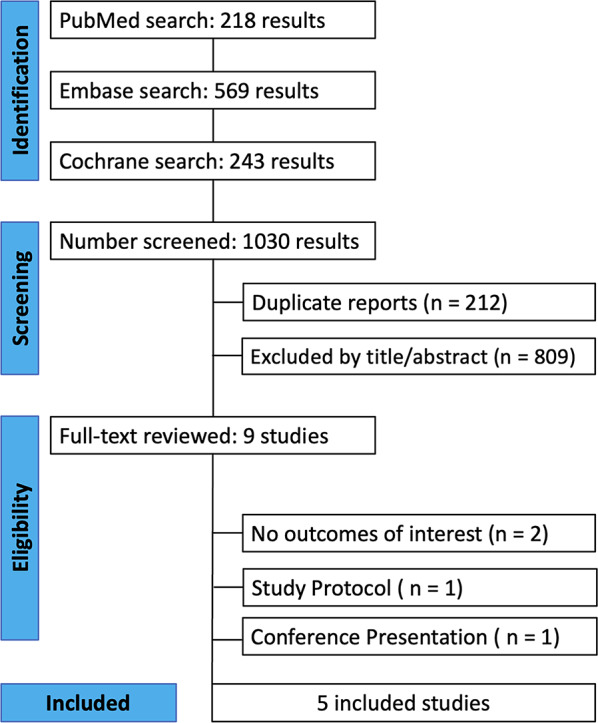
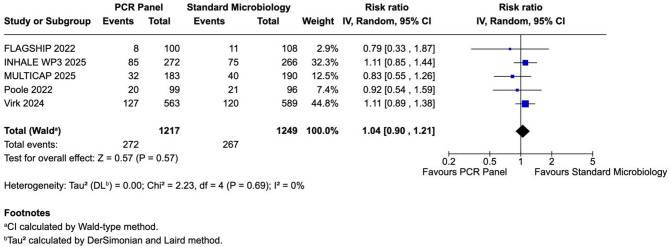
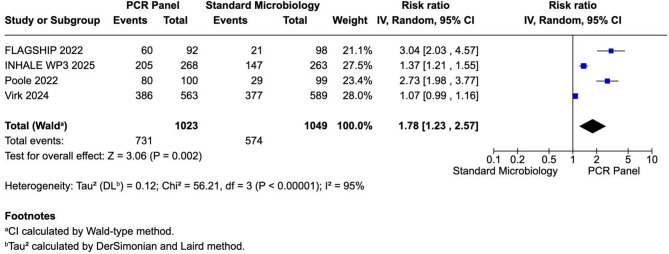
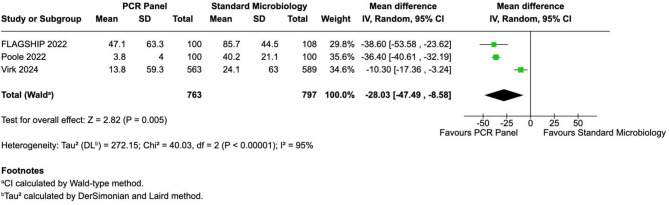
BACKGROUND: Pneumonia is a leading cause of ICU admission and mortality, requiring prompt and adequate antimicrobial therapy to improve outcomes. Conventional cultures are slow and often insensitive, delaying targeted treatment. Syndromic PCR panels offer rapid identification of pathogens and resistance genes directly from respiratory samples, potentially improving early antibiotic optimization. However, the true clinical benefit of these diagnostics in critically ill patients remains uncertain. METHODS: We conducted a systematic review and meta-analysis of randomized controlled trials (RCTs) comparing PCR-based molecular diagnostics with standard culture techniques in predominantly adult ICU patients with severe community-acquired, hospital-acquired, or ventilator-associated pneumonia. Literature searches were performed in PubMed, Embase, and Cochrane CENTRAL from inception to July 16, 2025. The primary outcome was in-hospital mortality. Secondary outcomes included adequacy of initial antimicrobial therapy and time to effective antibiotic administration. Data were synthesized using random-effects models. RESULTS: We included five randomized controlled trials comprising 2,466 patients. Syndromic PCR testing did not significantly reduce in-hospital mortality, the primary outcome (RR 1.04; 95% CI: 0.90–1.21; p = 0.57; I² = 0%). However, PCR testing was associated with a higher rate of adequate initial antimicrobial therapy (RR 1.82; 95% CI: 1.10–3.00; p = 0.02; I² = 97%) and a reduction in time to effective antibiotic administration (mean difference − 27.98 h; 95% CI: − 46.07 to − 9.89; p = 0.002; I² = 94%). CONCLUSIONS: Syndromic PCR diagnostics did not reduce in-hospital mortality in critically ill patients with pneumonia but were associated with improved adequacy of initial antimicrobial therapy and faster initiation of effective treatment. These findings support their role as a complementary tool in ICU-based antimicrobial stewardship. TRIAL REGISTRATION : PROSPERO CRD420251006301.
Overview
The claims and statistics of this paper haven’t been checked yet.
Run the check — free, no account needed. It reads the open-access text and checks the sources it cites.
Integrity signals
Registry
Cites
Statistics
Figures
Verification
Claims the paper makes
The claims and statistics of this paper haven’t been checked yet.
Run the check — free, no account needed. It reads the open-access text and checks the sources it cites.
Self-check
Percentages, sums and reported differences re-computed from the paper’s own numbers.
The self-check needs the paper’s full text.
Citations
Cites
RoB 2: a revised tool for assessing risk of bias in randomised trials
Sterne, J. A. C., Savović, J., Page, M. J., Elbers, R. G., Blencowe, N. S., Boutron, I., Cates, C. J., Cheng, H.-Y., Corbett, M. S., Eldridge, S. M., et al. (2019) · BMJ · doi:10.1136/bmj.l4898 · Cited by 34,787
Luo, D., Wan, X., Liu, J., & Tong, T. (2018) · Statistical Methods in Medical Research · doi:10.1177/0962280216669183 · Cited by 4,066 · cited 1×
“…reported as medians and interquartile ranges, we estimated means and standard deviations using the validated method proposed by Wan et al. and Luo et al. [18, 19] A random-effects model (DerSimonian and Laird) was applied to account for anticipated clinical and methodological heterogeneity.”
Declaración PRISMA 2020: una guía actualizada para la publicación de revisiones sistemáticas
Page, M. J., McKenzie, J. E., Bossuyt, P. M., Boutron, I., Hoffmann, T. C., Mulrow, C. D., Shamseer, L., Tetzlaff, J. M., Akl, E. A., Brennan, S. E., et al. (2021) · Revista Española de Cardiología · doi:10.1016/j.recesp.2021.06.016 · Cited by 2,095
Declaración PRISMA 2020: una guía actualizada para la publicación de revisiones sistemáticas
Page, M. J., McKenzie, J. E., Bossuyt, P. M., Boutron, I., Hoffmann, T. C., Mulrow, C. D., Shamseer, L., Tetzlaff, J. M., Akl, E. A., Brennan, S. E., et al. (2021) · Revista Española de Cardiología (English Edition) · doi:10.1016/j.rec.2021.07.010 · Cited by 1,313
Research works printed but not linked: 24
- Torres A, Chalmers JD, Dela Cruz CS, Dominedò C, Kollef M, Martin-Loeches I, et al. Challenges in severe community-acquired pneumonia: a point-of-view review. Intensive Care Med. 2019;45(2):159–71. · DOI
- Torres A, Niederman MS, Chastre J, Ewig S, Fernandez-Vandellos P, Hanberger H et al. International ERS/ESICM/ESCMID/ALAT guidelines for the management of hospital-acquired pneumonia and ventilator-associated pneumonia: guidelines for the management of hospital-acquired pneumonia (HAP)/ventilator-associated pneumonia (VAP) of the European respiratory society (ERS), European society of intensive care medicine (ESICM), European society of clinical microbiology and infectious diseases (ESCMID) and asociación Latinoamericana Del tórax (ALAT). Eur Respir J. 2017;50(3):1700582. · DOI · Paper page
- Kalil AC, Metersky ML, Klompas M, Muscedere J, Sweeney DA, Palmer LB, et al. Management of adults with Hospital-acquired and Ventilator-associated pneumonia: 2016 clinical practice guidelines by the infectious diseases society of America and the American thoracic society. Clin Infect Dis. 2016;63(5):e61–111. · DOI · Paper page
- Peiffer-Smadja N, Bouadma L, Mathy V, Allouche K, Patrier J, Reboul M, et al. Performance and impact of a multiplex PCR in ICU patients with ventilator-associated pneumonia or ventilated hospital-acquired pneumonia. Crit Care. 2020;24(1):366. · DOI
- Candel FJ, Salavert M, Cantón R, Del Pozo JL, Galán-Sánchez F, Navarro D, et al. The role of rapid multiplex molecular syndromic panels in the clinical management of infections in critically ill patients: an experts-opinion document. Crit Care. 2024;28(1):440. · DOI
- Buchan BW, Windham S, Balada-Llasat JM, Leber A, Harrington A, Relich R et al. Practical Comparison of the BioFire FilmArray Pneumonia Panel to Routine Diagnostic Methods and Potential Impact on Antimicrobial Stewardship in Adult Hospitalized Patients with Lower Respiratory Tract Infections. J Clin Microbiol. 2020;58(7). · DOI
- Torres A, Lee N, Cilloniz C, Vila J, Van der Eerden M. Laboratory diagnosis of pneumonia in the molecular age. Eur Respir J. 2016;48(6):1764–78. · DOI
- Couturier MR, Bard JD. Direct-from-Specimen pathogen identification: evolution of syndromic panels. Clin Lab Med. 2019;39(3):433–51. · DOI
- Echavarría M, Marcone DN, Querci M, Seoane A, Ypas M, Videla C, et al. Clinical impact of rapid molecular detection of respiratory pathogens in patients with acute respiratory infection. J Clin Virol. 2018;108:90–5. · DOI
- Gentilotti E, De Nardo P, Cremonini E, Górska A, Mazzaferri F, Canziani LM, et al. Diagnostic accuracy of point-of-care tests in acute community-acquired lower respiratory tract infections. A systematic review and meta-analysis. Clin Microbiol Infect. 2022;28(1):13–22. · DOI
- Karolyi M, Pawelka E, Hind J, Baumgartner S, Friese E, Hoepler W, et al. Detection of bacteria via multiplex PCR in respiratory samples of critically ill COVID-19 patients with suspected HAP/VAP in the ICU. Wien Klin Wochenschr. 2022;134(9–10):385–90. · DOI
- Andrews D, Chetty Y, Cooper BS, Virk M, Glass SK, Letters A, et al. Multiplex PCR point of care testing versus routine, laboratory-based testing in the treatment of adults with respiratory tract infections: a quasi-randomised study assessing impact on length of stay and antimicrobial use. BMC Infect Dis. 2017;17(1):671. · DOI
- Mattila S, Paalanne N, Honkila M, Pokka T, Tapiainen T. Effect of Point-of-Care testing for respiratory pathogens on antibiotic use in children: A randomized clinical trial. JAMA Netw Open. 2022;5(6):e2216162. · DOI
- Dessajan J, Timsit JF. Impact of multiplex PCR in the therapeutic management of severe bacterial pneumonia. Antibiot (Basel). 2024;13(1):95. · DOI
- Wan X, Wang W, Liu J, Tong T. Estimating the sample mean and standard deviation from the sample size, median, range and/or interquartile range. BMC Med Res Methodol. 2014;14:135. · DOI · Paper page
- Enne VI, Stirling S, Barber JA, High J, Russell C, Brealey D, et al. INHALE WP3, a multicentre, open-label, pragmatic randomised controlled trial assessing the impact of rapid, ICU-based, syndromic PCR, versus standard-of-care on antibiotic stewardship and clinical outcomes in hospital-acquired and ventilator-associated pneumonia. Intensive Care Med. 2025;51(2):272–86. · DOI
- Darie AM, Khanna N, Jahn K, Osthoff M, Bassetti S, Schumann DM, et al. Fast multiplex bacterial PCR of Bronchoalveolar lavage for antibiotic stewardship in hospitalised patients with pneumonia at risk of Gram-negative bacterial infection (Flagship II): a multicentre, randomised controlled trial. Lancet Respir Med. 2022;10(9):877–87. · DOI
- Voiriot G, Argaud L, Cohen Y, Tuffet S, Chauvelot L, Souweine B et al. Combined use of a multiplex PCR and serum procalcitonin to reduce antibiotic exposure in critically ill patients with community-acquired pneumonia: the MULTI-CAP randomized controlled trial. Intensive Care Med. 2025;51(8):1417–1430. · DOI
- Poole S, Tanner AR, Naidu VV, Borca F, Phan H, Saeed K, et al. Molecular point-of-care testing for lower respiratory tract pathogens improves safe antibiotic de-escalation in patients with pneumonia in the ICU: results of a randomised controlled trial. J Infect. 2022;85(6):625–33. · DOI
- Virk A, Strasburg AP, Kies KD, Donadio AD, Mandrekar J, Harmsen WS, et al. Rapid multiplex PCR panel for pneumonia in hospitalised patients with suspected pneumonia in the USA: a single-centre, open-label, pragmatic, randomised controlled trial. Lancet Microbe. 2024;5(12):100928. · DOI
- Moy AC, Kimmoun A, Merkling T, Berçot B, Caméléna F, Poncin T, et al. Performance evaluation of a PCR panel (FilmArray® pneumonia Plus) for detection of respiratory bacterial pathogens in respiratory specimens: A systematic review and meta-analysis. Anaesth Crit Care Pain Med. 2023;42(6):101300.
- Yoo IY, Huh K, Shim HJ, Yun SA, Chung YN, Kang OK, et al. Evaluation of the biofire filmarray pneumonia panel for rapid detection of respiratory bacterial pathogens and antibiotic resistance genes in sputum and endotracheal aspirate specimens. Int J Infect Dis. 2020;95:326–31. · DOI
- Banerjee R, Teng CB, Cunningham SA, Ihde SM, Steckelberg JM, Moriarty JP, et al. Randomized trial of rapid multiplex polymerase chain Reaction-Based blood culture identification and susceptibility testing. Clin Infect Dis. 2015;61(7):1071–80. · DOI · Paper page
- MacGowan A, Grier S, Stoddart M, Reynolds R, Rogers C, Pike K, et al. Impact of rapid microbial identification on clinical outcomes in bloodstream infection: the RAPIDO randomized trial. Clin Microbiol Infect. 2020;26(10):1347–54. · DOI
Metadata
- Authors
- de Albuquerque Pessoa dos Santos, Y., Tomazini, B. M., dos Santos, M. H. C., de Queiroz, E. L., Pastore Júnior, L., Costa, E. L. V., & da Silva Ramos, F. J.
- Affiliations
- Hospital do Coração (BR)
- Hospital Sírio-Libanês (BR)
- Universidade de São Paulo (BR)
- Corresponding author
- dos Santos, Maurício Henrique Claro
- ORCID
- Venue
- Critical Care
- Published
- 2025-08-22
- Volume
- 29
- Issue
- 1
- Pages
- 379-379
- ISSN
- 1364-8535 (ISSN-L)
- PMC
- PMC12374470
- OpenAlex
- W4413412404
- Cited by
- 20
- References
- 4
- Citations by year
- 2026: 20
- FWCI
- 2.44
- Type
- journal article
- Language
- en
- Open access
- gold
- doi.org
- Licence
- Locations
- Critical Care (publishedVersion, cc-by-nc-nd)
- Research Square (acceptedVersion, cc-by)
- Europe PMC (PubMed Central) (publishedVersion, cc-by-nc-nd)
- PubMed Central (publishedVersion, cc-by-nc-nd)
- PubMed (publishedVersion)
- Topics
- Health Sciences › Medicine › Microbiology (medical) › Bacterial Identification and Susceptibility Testing
- Health Sciences › Medicine › Epidemiology › Pneumonia and Respiratory Infections
- Health Sciences › Medicine › Critical Care and Intensive Care Medicine › Nosocomial Infections in ICU
- Keywords
- molecular diagnosis, pneumonia, critically ill patients, in-hospital mortality, antimicrobial stewardship, ventilator-associated pneumonia, nosocomial pneumonia, community-acquired pneumonia, pathogen identification, antimicrobial resistance genes, cultural comparison
- MeSH terms
- Anti-Infective Agents, Anti-Bacterial Agents, Humans, Pneumonia, Randomized Controlled Trials as Topic, Critical Illness, Hospital Mortality, Molecular Diagnostic Techniques, Time-to-Treatment
About these checks
Registry, retraction, Cites and statistics results are computed, not judged, with one exception: a printed reference that no index lists is read once by a model before it counts as a citation error. Claims are extracted by a model and kept only when their quote appears verbatim in the text; each cited source is then checked, with a model’s help, for whether it says what the claim relies on. Those verdicts can be wrong — read the claim’s quote and the cited source before relying on one.
Statistics and arithmetic are recomputed, not judged.
Confidence bands are shown only for fields calibrated on our annotated test set. None is calibrated yet, so no band is shown.
What counts as a claim ›How we measure confidence ›How we check this ›
Are you an author, or do you see a problem with this page? Request a review
