

The DOI matches its Crossref record; 94 of the 95 references it cites were found in a registry or an index.
Genomic legacy of the African cheetah, Acinonyx jubatus
Open accessAbstract
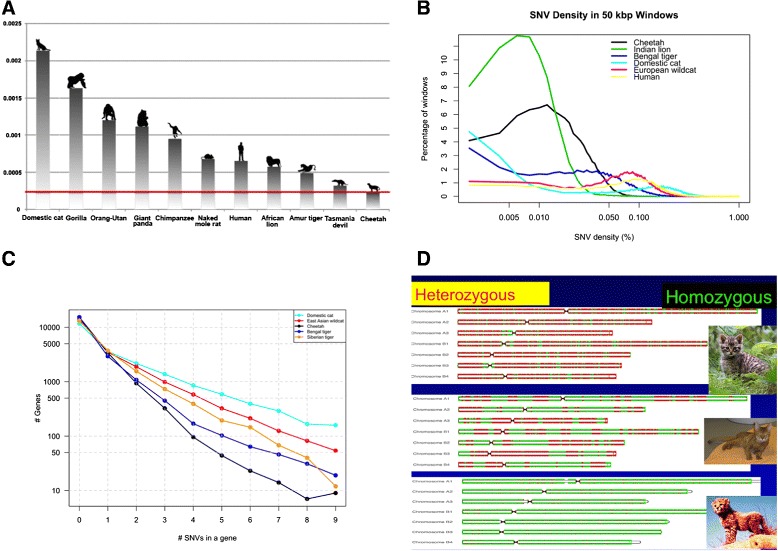
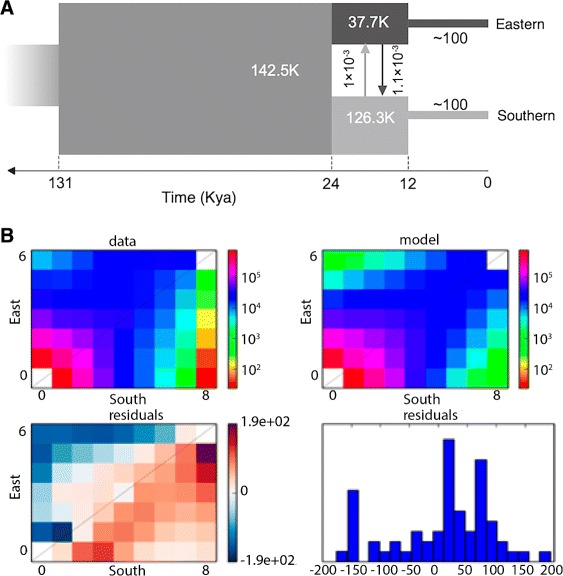
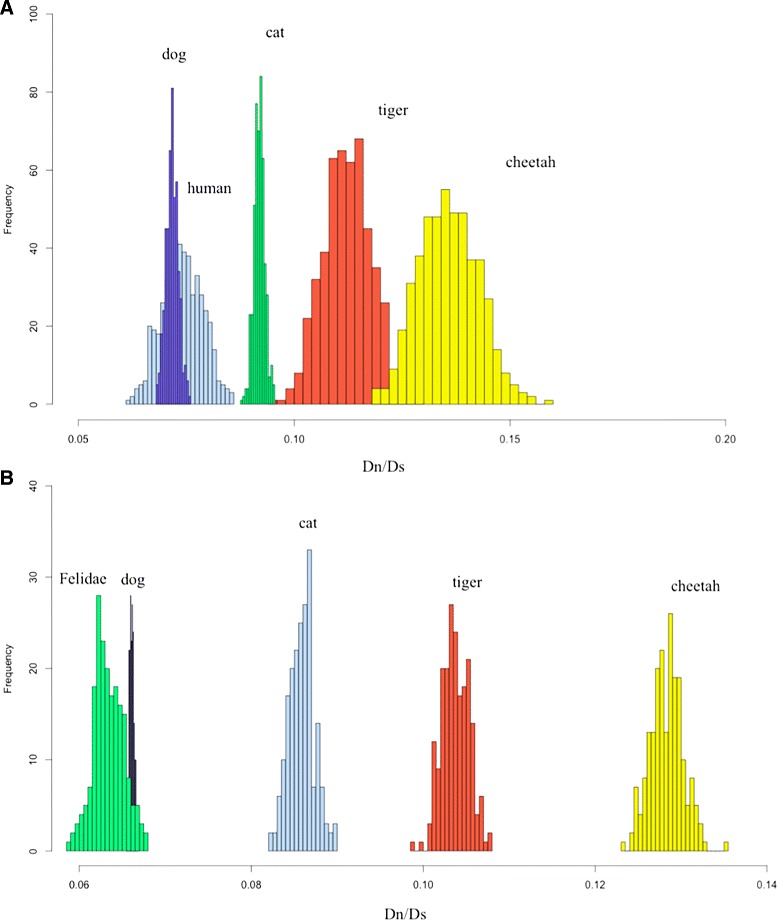
BACKGROUND: Patterns of genetic and genomic variance are informative in inferring population history for human, model species and endangered populations. RESULTS: Here the genome sequence of wild-born African cheetahs reveals extreme genomic depletion in SNV incidence, SNV density, SNVs of coding genes, MHC class I and II genes, and mitochondrial DNA SNVs. Cheetah genomes are on average 95 % homozygous compared to the genomes of the outbred domestic cat (24.08 % homozygous), Virunga Mountain Gorilla (78.12 %), inbred Abyssinian cat (62.63 %), Tasmanian devil, domestic dog and other mammalian species. Demographic estimators impute two ancestral population bottlenecks: one >100,000 years ago coincident with cheetah migrations out of the Americas and into Eurasia and Africa, and a second 11,084-12,589 years ago in Africa coincident with late Pleistocene large mammal extinctions. MHC class I gene loss and dramatic reduction in functional diversity of MHC genes would explain why cheetahs ablate skin graft rejection among unrelated individuals. Significant excess of non-synonymous mutations in AKAP4 (p<0.02), a gene mediating spermatozoon development, indicates cheetah fixation of five function-damaging amino acid variants distinct from AKAP4 homologues of other Felidae or mammals; AKAP4 dysfunction may cause the cheetah's extremely high (>80 %) pleiomorphic sperm. CONCLUSIONS: The study provides an unprecedented genomic perspective for the rare cheetah, with potential relevance to the species' natural history, physiological adaptations and unique reproductive disposition.
Overview
The claims and statistics of this paper haven’t been checked yet.
Run the check — free, no account needed. It reads the open-access text and checks the sources it cites.
Integrity signals
Registry
Cites
Statistics
Figures
Verification
Claims the paper makes
The claims and statistics of this paper haven’t been checked yet.
Run the check — free, no account needed. It reads the open-access text and checks the sources it cites.
Claims other papers make about this one
Each is checked against this paper’s own text: does it say what the citing paper says it does?
The source backs part of the claim, not all of it — or backs it for a different population, condition or comparison.
In the citing paper
“Muskox genetic diversity is lower than two mammalian species under threat that have undergo recent genetic bottlenecks, the Tasmanian devil (Sarcophilus harrisii)66 and the cheetah (Acinonyx jubatus)67.”
From Chromosomal-level reference genome assembly of muskox (Ovibos moschatus) from Banks Island in the Canadian Arctic, a resource for conservation genomics (2024) · cites this paper as [67]
Experimental — accuracy not yet measuredThe source backs part of the claim, not all of it — or backs it for a different population, condition or comparison.
In the citing paper
“Progressive Cactus has been developed over several years, and has already been successfully used as an integral component of high-profile comparative genomics projects16–20.”
From Progressive Cactus is a multiple-genome aligner for the thousand-genome era (2020) · cites this paper as [17]
Experimental — accuracy not yet measured
Self-check
Percentages, sums and reported differences re-computed from the paper’s own numbers.
The self-check needs the paper’s full text.
Citations
Cites
Gapped BLAST and PSI-BLAST: a new generation of protein database search programs
Altschul, S. (1997) · Nucleic Acids Research · doi:10.1093/nar/25.17.3389 · Cited by 73,302
The Sequence Alignment/Map format and SAMtools
Li, H., Handsaker, B., Wysoker, A., Fennell, T., Ruan, J., Homer, N., Marth, G., Abecasis, G., Durbin, R., & 1000 Genome Project Data Processing Subgroup (2009) · Bioinformatics · doi:10.1093/bioinformatics/btp352 · Cited by 62,041
Fast and accurate short read alignment with Burrows-Wheeler transform
Li, H., & Durbin, R. (2009) · Bioinformatics · doi:10.1093/bioinformatics/btp324 · Cited by 58,607
MAFFT Multiple Sequence Alignment Software Version 7: Improvements in Performance and Usability
Katoh, K., & Standley, D. M. (2013) · Molecular Biology and Evolution · doi:10.1093/molbev/mst010 · Cited by 46,209
MUSCLE: multiple sequence alignment with high accuracy and high throughput
Edgar, R. C. (2004) · Nucleic Acids Research · doi:10.1093/nar/gkh340 · Cited by 44,662
BEDTools: a flexible suite of utilities for comparing genomic features
Quinlan, A. R., & Hall, I. M. (2010) · Bioinformatics · doi:10.1093/bioinformatics/btq033 · Cited by 27,437
The variant call format and VCFtools
Danecek, P., Auton, A., Abecasis, G. R., Albers, C. A., Banks, E., DePristo, M. A., Handsaker, R. E., Lunter, G. A., Marth, G., Sherry, S. T., et al. (2011) · Bioinformatics · doi:10.1093/bioinformatics/btr330 · Cited by 16,450
PAML 4: Phylogenetic Analysis by Maximum Likelihood
Yang, Z. (2007) · Molecular Biology and Evolution · doi:10.1093/molbev/msm088 · Cited by 13,879
A method and server for predicting damaging missense mutations.
Adzhubei, I. A., Schmidt, S., Peshkin, L., Ramensky, V. E., Gerasimova, A., Bork, P., Kondrashov, A. S., & Sunyaev, S. R. (2010) · Nature Methods · doi:10.1038/nmeth0410-248 · Cited by 13,194
Cingolani, P., Platts, A., Wang, L. L., Coon, M., Nguyen, T., Wang, L., Land, S. J., Lu, X., & Ruden, D. M. (2012) · Fly · doi:10.4161/fly.19695 · Cited by 11,816
Cited by
Sorted by citations
Understanding Inbreeding Depression, Purging, and Genetic Rescue
Hedrick, P. W., & García‐Dorado, A. (2016) · Trends in Ecology & Evolution · doi:10.1016/j.tree.2016.09.005 · Cited by 700
Progressive Cactus is a multiple-genome aligner for the thousand-genome era
Armstrong, J., Hickey, G., Diekhans, M., Fiddes, I. T., Novak, A. M., Deran, A., Fang, Q., Xie, D., Feng, S., Stiller, J., et al. (2020) · Nature · doi:10.1038/s41586-020-2871-y · Cited by 586
Self-citationGenomics advances the study of inbreeding depression in the wild
Kardos, M. D., Taylor, H. R., Ellegren, H., Luikart, G., & Allendorf, F. W. (2016) · Evolutionary Applications · doi:10.1111/eva.12414 · Cited by 405
Genetics and the conservation of natural populations: allozymes to genomes
Allendorf, F. W. (2016) · Molecular Ecology · doi:10.1111/mec.13948 · Cited by 409
Quantifying Temporal Genomic Erosion in Endangered Species
Díez-del-Molino, D., Sánchez-Barreiro, F., Barnes, I., Gilbert, M. T. P., & Dalén, L. (2018) · Trends in Ecology & Evolution · doi:10.1016/j.tree.2017.12.002 · Cited by 258
Metadata
- Authors
- Dobrynin, P., Liu, S., Tamazian, G., Xiong, Z., Yurchenko, A. A., Krasheninnikova, K., Kliver, S., Schmidt-Küntzel, A., Koepfli, K.-P., Johnson, W., Kuderna, L. F. K., García-Pérez, R., Manuel, M. D., Godinez, R., Komissarov, A., Makunin, A., Brukhin, V., Qiu, W., Zhou, L., Li, F., Yi, J., Driscoll, C., Antunes, A., Oleksyk, T. K., Eizirik, E., Perelman, P., Roelke, M., Wildt, D., Diekhans, M., Marques-Bonet, T., Marker, L., Bhak, J., Wang, J., Zhang, G., & O’Brien, S. J.
- Affiliations
- St Petersburg University (RU)
- Sun Yat-sen University (CN)
- China National GeneBank (CN)
- Smithsonian Conservation Biology Institute (US)
- Consejo Superior de Investigaciones Científicas (ES)
- Harvard University (US)
- National Institutes of Health (US)
- Universidade do Porto (PT)
- Russian Academy of Sciences (RU)
- Leidos Biomedical Research Inc. (United States) (US)
- University of California, Santa Cruz (US)
- Cheetah Conservation Fund (NA)
- Ulsan National Institute of Science and Technology (KR)
- BGI Group (China) (CN)
- University of Copenhagen (DK)
- Corresponding author
- O’Brien, Stephen J.
- ORCID
- Dobrynin, Pavel
- Liu, Shiping
- Tamazian, Gaik
- Xiong, Zijun
- Yurchenko, Andrey A.
- Krasheninnikova, Ksenia
- Koepfli, Klaus-Peter
- Johnson, Warren
- Kuderna, Lukas F.K.
- García-Pérez, Raquel
- Komissarov, Aleksey
- Brukhin, Vladimir
- Zhou, Long
- Li, Fang
- Yi, Jian
- Driscoll, Carlos
- Antunes, Agostinho
- Perelman, Polina
- Roelke, Melody
- Diekhans, Mark
- Marker, Laurie
- Bhak, Jong
- Wang, Jun
- Zhang, Guojie
- O’Brien, Stephen J.
- Venue
- Genome Biology
- Published
- 2015-12
- Volume
- 16
- Issue
- 1
- Pages
- 277-277
- ISSN
- 1465-6906 (ISSN-L)
- 1474-760X
- PMC
- PMC4676127
- OpenAlex
- W2196011667
- Cited by
- 204
- References
- 95
- Citations by year
- 2026: 8 · 2025: 16 · 2024: 10 · 2023: 16 · 2022: 23 · 2021: 18 · 2020: 20 · 2019: 18 · 2018: 51 · 2017: 9 · 2016: 13
- FWCI
- 16.63
- Type
- journal article
- Language
- en
- Open access
- gold
- doi.org
- Licence
- Locations
- Genome biology (publishedVersion, cc-by)
- Europe PMC (PubMed Central) (publishedVersion, cc-by)
- PubMed Central (publishedVersion, cc-by)
- PubMed (publishedVersion)
- LA Referencia (Red Federada de Repositorios Institucionales de Publicaciones Científicas) (publishedVersion, other-oa)
- Research at the University of Copenhagen (University of Copenhagen) (publishedVersion, cc-by)
- RECERCAT (Consorci de Serveis Universitaris de Catalunya) (publishedVersion, other-oa)
- Digital Access to Scholarship at Harvard (DASH) (Harvard University) (submittedVersion, cc-by)
- NSUWorks (Nova Southeastern University) (submittedVersion, cc-by)
- DIGITAL.CSIC (Spanish National Research Council (CSIC)) (submittedVersion, cc-by)
- Repositori digital de la UPF (Universitat Pompeu Fabra) (submittedVersion, cc-by)
- Scholarworks@UNIST (Ulsan National Institute of Science and Technology) (submittedVersion)
- Figshare (cc-by)
- Funders
- Ministry of Environment
- Institució Catalana de Recerca i Estudis Avançats
- Saint Petersburg State University (1.50.1623.2013)
- Ministerio de Ciencia e Innovación (BFU2014-55090-P)
- Megagrants
- Topics
- Life Sciences › Biochemistry, Genetics and Molecular Biology › Genetics › Genetic diversity and population structure
- Life Sciences › Biochemistry, Genetics and Molecular Biology › Genetics › Genetic and phenotypic traits in livestock
- Life Sciences › Biochemistry, Genetics and Molecular Biology › Molecular Biology › Genomics and Phylogenetic Studies
- Keywords
- cheetah, inbreeding depression, homozygosity, population bottleneck, non-synonymous mutations, AKAP4, sperm abnormalities, skin graft rejection, Late Pleistocene extinction, demographic history
- MeSH terms
- Animals, Cats, Acinonyx, Dogs, Multigene Family, Male, Genetic Variation, Genome, Genomics
About these checks
Registry, retraction, Cites and statistics results are computed, not judged, with one exception: a printed reference that no index lists is read once by a model before it counts as a citation error. Claims are extracted by a model and kept only when their quote appears verbatim in the text; each cited source is then checked, with a model’s help, for whether it says what the claim relies on. Those verdicts can be wrong — read the claim’s quote and the cited source before relying on one.
Statistics and arithmetic are recomputed, not judged.
Confidence bands are shown only for fields calibrated on our annotated test set. None is calibrated yet, so no band is shown.
What counts as a claim ›How we measure confidence ›How we check this ›
Are you an author, or do you see a problem with this page? Request a review
