

The DOI matches its Crossref record; 94 of the 95 references it cites were found in a registry or an index.
Genomic legacy of the African cheetah, Acinonyx jubatus
Open accessAbstract
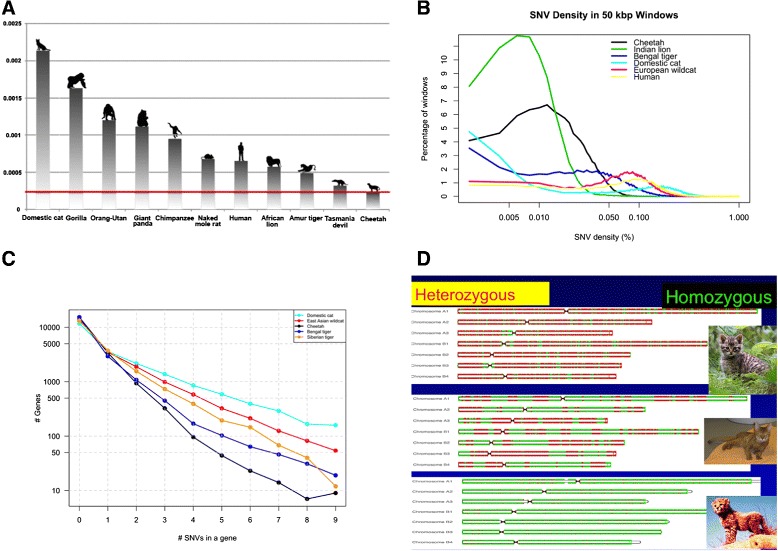
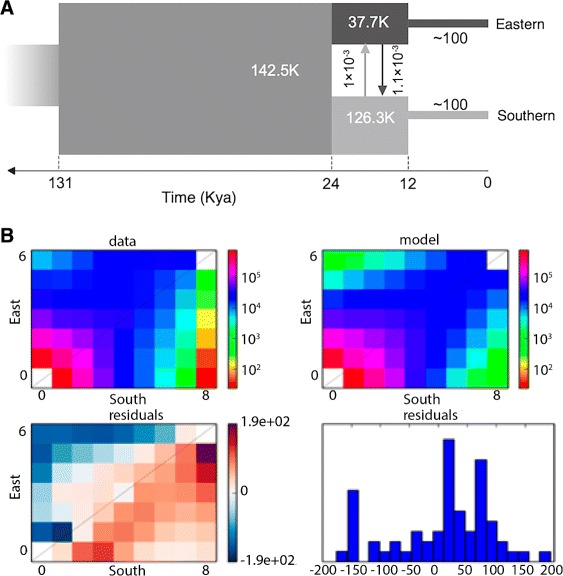
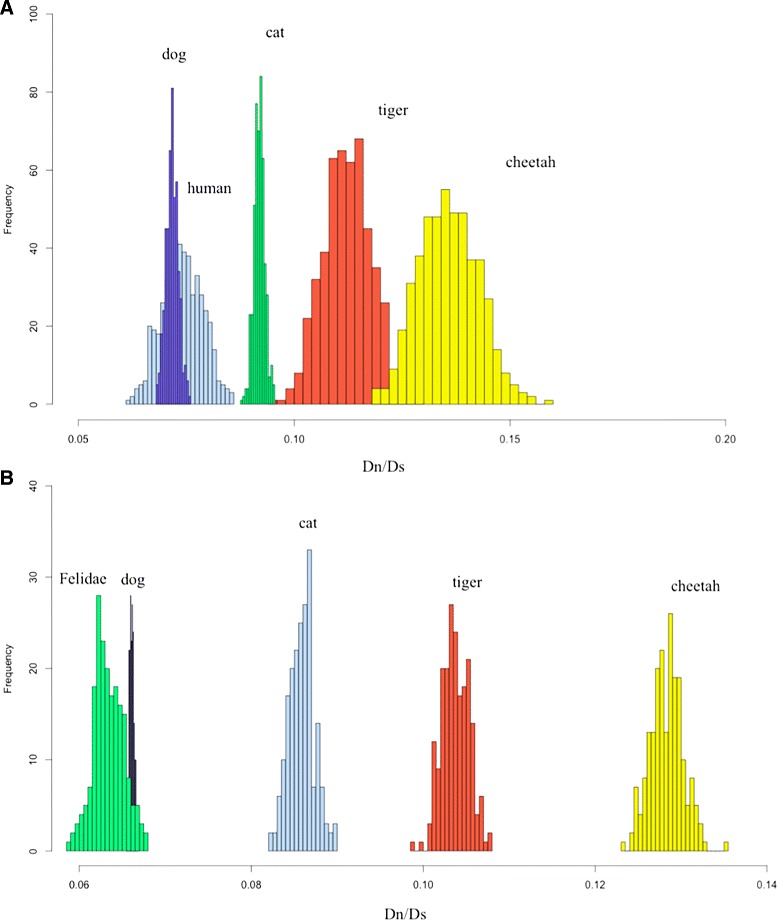
BACKGROUND: Patterns of genetic and genomic variance are informative in inferring population history for human, model species and endangered populations. RESULTS: Here the genome sequence of wild-born African cheetahs reveals extreme genomic depletion in SNV incidence, SNV density, SNVs of coding genes, MHC class I and II genes, and mitochondrial DNA SNVs. Cheetah genomes are on average 95 % homozygous compared to the genomes of the outbred domestic cat (24.08 % homozygous), Virunga Mountain Gorilla (78.12 %), inbred Abyssinian cat (62.63 %), Tasmanian devil, domestic dog and other mammalian species. Demographic estimators impute two ancestral population bottlenecks: one >100,000 years ago coincident with cheetah migrations out of the Americas and into Eurasia and Africa, and a second 11,084-12,589 years ago in Africa coincident with late Pleistocene large mammal extinctions. MHC class I gene loss and dramatic reduction in functional diversity of MHC genes would explain why cheetahs ablate skin graft rejection among unrelated individuals. Significant excess of non-synonymous mutations in AKAP4 (p<0.02), a gene mediating spermatozoon development, indicates cheetah fixation of five function-damaging amino acid variants distinct from AKAP4 homologues of other Felidae or mammals; AKAP4 dysfunction may cause the cheetah's extremely high (>80 %) pleiomorphic sperm. CONCLUSIONS: The study provides an unprecedented genomic perspective for the rare cheetah, with potential relevance to the species' natural history, physiological adaptations and unique reproductive disposition.
Overview
The claims and statistics of this paper haven’t been checked yet.
Run the check — free, no account needed. It reads the open-access text and checks the sources it cites.
Integrity signals
Registry
Cites
Statistics
Figures
Verification
Claims the paper makes
The claims and statistics of this paper haven’t been checked yet.
Run the check — free, no account needed. It reads the open-access text and checks the sources it cites.
Claims other papers make about this one
Each is checked against this paper’s own text: does it say what the citing paper says it does?
The source backs part of the claim, not all of it — or backs it for a different population, condition or comparison.
In the citing paper
“Muskox genetic diversity is lower than two mammalian species under threat that have undergo recent genetic bottlenecks, the Tasmanian devil (Sarcophilus harrisii)66 and the cheetah (Acinonyx jubatus)67.”
From Chromosomal-level reference genome assembly of muskox (Ovibos moschatus) from Banks Island in the Canadian Arctic, a resource for conservation genomics (2024) · cites this paper as [67]
Experimental — accuracy not yet measuredThe source backs part of the claim, not all of it — or backs it for a different population, condition or comparison.
In the citing paper
“Progressive Cactus has been developed over several years, and has already been successfully used as an integral component of high-profile comparative genomics projects16–20.”
From Progressive Cactus is a multiple-genome aligner for the thousand-genome era (2020) · cites this paper as [17]
Experimental — accuracy not yet measured
Self-check
Percentages, sums and reported differences re-computed from the paper’s own numbers.
The self-check needs the paper’s full text.
Citations
Cites
Gapped BLAST and PSI-BLAST: a new generation of protein database search programs
Altschul, S. (1997) · Nucleic Acids Research · doi:10.1093/nar/25.17.3389 · Cited by 73,302
The Sequence Alignment/Map format and SAMtools
Li, H., Handsaker, B., Wysoker, A., Fennell, T., Ruan, J., Homer, N., Marth, G., Abecasis, G., Durbin, R., & 1000 Genome Project Data Processing Subgroup (2009) · Bioinformatics · doi:10.1093/bioinformatics/btp352 · Cited by 62,041
Fast and accurate short read alignment with Burrows-Wheeler transform
Li, H., & Durbin, R. (2009) · Bioinformatics · doi:10.1093/bioinformatics/btp324 · Cited by 58,607
MAFFT Multiple Sequence Alignment Software Version 7: Improvements in Performance and Usability
Katoh, K., & Standley, D. M. (2013) · Molecular Biology and Evolution · doi:10.1093/molbev/mst010 · Cited by 46,209
MUSCLE: multiple sequence alignment with high accuracy and high throughput
Edgar, R. C. (2004) · Nucleic Acids Research · doi:10.1093/nar/gkh340 · Cited by 44,662
BEDTools: a flexible suite of utilities for comparing genomic features
Quinlan, A. R., & Hall, I. M. (2010) · Bioinformatics · doi:10.1093/bioinformatics/btq033 · Cited by 27,437
The variant call format and VCFtools
Danecek, P., Auton, A., Abecasis, G. R., Albers, C. A., Banks, E., DePristo, M. A., Handsaker, R. E., Lunter, G. A., Marth, G., Sherry, S. T., et al. (2011) · Bioinformatics · doi:10.1093/bioinformatics/btr330 · Cited by 16,450
PAML 4: Phylogenetic Analysis by Maximum Likelihood
Yang, Z. (2007) · Molecular Biology and Evolution · doi:10.1093/molbev/msm088 · Cited by 13,879
A method and server for predicting damaging missense mutations.
Adzhubei, I. A., Schmidt, S., Peshkin, L., Ramensky, V. E., Gerasimova, A., Bork, P., Kondrashov, A. S., & Sunyaev, S. R. (2010) · Nature Methods · doi:10.1038/nmeth0410-248 · Cited by 13,194
Cingolani, P., Platts, A., Wang, L. L., Coon, M., Nguyen, T., Wang, L., Land, S. J., Lu, X., & Ruden, D. M. (2012) · Fly · doi:10.4161/fly.19695 · Cited by 11,816
Cited by
Sorted by citations
Understanding Inbreeding Depression, Purging, and Genetic Rescue
Hedrick, P. W., & García‐Dorado, A. (2016) · Trends in Ecology & Evolution · doi:10.1016/j.tree.2016.09.005 · Cited by 700
Progressive Cactus is a multiple-genome aligner for the thousand-genome era
Armstrong, J., Hickey, G., Diekhans, M., Fiddes, I. T., Novak, A. M., Deran, A., Fang, Q., Xie, D., Feng, S., Stiller, J., et al. (2020) · Nature · doi:10.1038/s41586-020-2871-y · Cited by 586
Self-citationGenomics advances the study of inbreeding depression in the wild
Kardos, M. D., Taylor, H. R., Ellegren, H., Luikart, G., & Allendorf, F. W. (2016) · Evolutionary Applications · doi:10.1111/eva.12414 · Cited by 405
Genetics and the conservation of natural populations: allozymes to genomes
Allendorf, F. W. (2016) · Molecular Ecology · doi:10.1111/mec.13948 · Cited by 409
Quantifying Temporal Genomic Erosion in Endangered Species
Díez-del-Molino, D., Sánchez-Barreiro, F., Barnes, I., Gilbert, M. T. P., & Dalén, L. (2018) · Trends in Ecology & Evolution · doi:10.1016/j.tree.2017.12.002 · Cited by 258
Introduction to Population Biology
Neal, D. (2003) · Cambridge University Press eBooks · doi:10.1017/9781139107976 · Cited by 234
Abascal, F., Corvelo, A., Cruz, F., Villanueva‐Cañas, J. L., Vlasova, A. V., Marcet‐Houben, M., Martínez‐Cruz, B., Cheng, J. Y., Prieto, P., Quesada, V., et al. (2016) · Genome biology · doi:10.1186/s13059-016-1090-1 · Cited by 221
Li, G., Figueiró, H. V., Eizirik, E., & Murphy, W. J. (2019) · Molecular Biology and Evolution · doi:10.1093/molbev/msz139 · Cited by 157
Saremi, N. F., Supple, M. A., Byrne, A., Cahill, J. A., Coutinho, L. L., Dalén, L., Figueiró, H. V., Johnson, W. E., Milne, H. J., O’Brien, S. J., et al. (2019) · Nature Communications · doi:10.1038/s41467-019-12741-1 · Cited by 147
Self-citationComparison of carnivore, omnivore, and herbivore mammalian genomes with a new leopard assembly
Kim, S., Cho, Y. S., Kim, H.-M., Chung, O., Kim, H., Jho, S., Seomun, H., Kim, J., Bang, W. Y., Kim, C., et al. (2016) · Genome Biology · doi:10.1186/s13059-016-1071-4 · Cited by 137
Self-citationGenomic effects of population collapse in a critically endangered ironwood tree Ostrya rehderiana
Yang, Y. P., Ma, T., Wang, Z., Lu, Z., Li, Y., Fu, C., Chen, X., Zhao, M., Olson, M. S., & Liu, J. (2018) · Nature Communications · doi:10.1038/s41467-018-07913-4 · Cited by 137
Population Genomics: Advancing Understanding of Nature
Luikart, G., Kardos, M. D., Hand, B. K., Rajora, O. P., Aitken, S. N., & Hohenlohe, P. A. (2018) · Population genomics · doi:10.1007/13836_2018_60 · Cited by 138
Chromosome assembly of large and complex genomes using multiple referencesPreprint
Kolmogorov, M., Armstrong, J. C., Raney, B. J., Streeter, I., Dunn, M., Yang, F., Odom, D. T., Flicek, P., Keane, T., Thybert, D., et al. (2018) · Genome Research · doi:10.1101/gr.236273.118 · Cited by 123
Muñoz‐Fuentes, V., Cacheiro, P., Meehan, T. F., Aguilar‐Pimentel, J. A., Brown, S. D. M., Flenniken, A. M., Flicek, P., Galli, A., Mashhadi, H. H., de Angelis, M. H., et al. (2018) · Conservation Genetics · doi:10.1007/s10592-018-1072-9 · Cited by 115
Hu, J., Hao, Z.-Q., Frantz, L., Wu, S., Wu, C., Jiang, Y.-F., Wu, H., Kuang, W., Li, H., Zhang, Y., et al. (2020) · National Science Review · doi:10.1093/nsr/nwaa031 · Cited by 108
Westbury, M. V., Hartmann, S. A., Barlow, A., Wiesel, I., Leo, V., Welch, R. J., Parker, D. M., Sicks, F., Ludwig, A., Dalén, L., et al. (2018) · Molecular Biology and Evolution · doi:10.1093/molbev/msy037 · Cited by 98
Roycroft, E., MacDonald, A. J., Moritz, C. C., Moussalli, A., Miguez, R. P., & Rowe, K. C. (2021) · Proceedings of the National Academy of Sciences · doi:10.1073/pnas.2021390118 · Cited by 94
Genome sequencing and conservation genomics in the Scandinavian wolverine population
Ekblom, R., Brechlin, B. H. E., Persson, J., Smeds, L., Johansson, M., Magnusson, J. J., Flagstad, Ø., & Ellegren, H. (2018) · Conservation Biology · doi:10.1111/cobi.13157 · Cited by 93
Beichman, A. C., Koepfli, K., Li, G., Murphy, W. J., Dobrynin, P., Kliver, S. F., Tinker, M. T., Murray, M. J., Johnson, J., Lindblad‐Toh, K., et al. (2019) · Molecular Biology and Evolution · doi:10.1093/molbev/msz101 · Cited by 80
Self-citationEndangered island endemic plants have vulnerable genomes
Hamabata, T., Kinoshita, G., Kurita, K., Cao, P.-L., Itô, M., Murata, J., Komaki, Y., Isagi, Y., & Makino, T. (2019) · Communications Biology · doi:10.1038/s42003-019-0490-7 · Cited by 68
LoPresti, M., Beck, D. B., Duggal, P., Cummings, D. A. T., & Solomon, B. D. (2020) · The American Journal of Human Genetics · doi:10.1016/j.ajhg.2020.08.007 · Cited by 65
Pečnerová, P., Garcia‐Erill, G., Liu, X., Nursyifa, C., Waples, R. K., Santander, C. G., Quinn, L. J. E., Frandsen, P., Meisner, J., Stæger, F. F., et al. (2021) · Current Biology · doi:10.1016/j.cub.2021.01.064 · Cited by 68
Rabanus‐Wallace, M. T., Wooller, M. J., Zazula, G. D., Shute, E., Jahren, A. H., Kosintsev, P. A., Burns, J. A., Breen, J., Llamas, B., & Cooper, A. (2017) · Nature Ecology & Evolution · doi:10.1038/s41559-017-0125 · Cited by 60
Bentley, B. P., Carrasco-Valenzuela, T., Ramos, E. K. S., Pawar, H., Arantes, L. S., Alexander, A. M., Banerjee, S. M., Masterson, P., Kuhlwilm, M., Pippel, M., et al. (2023) · Proceedings of the National Academy of Sciences · doi:10.1073/pnas.2201076120 · Cited by 59
Self-citationBarnett, R., Westbury, M. V., Sandoval‐Velasco, M., Vieira, F. G., Jeon, S., Zazula, G. D., Martin, M. D., Ho, S. Y. W., Mather, N., Gopalakrishnan, S., et al. (2020) · Current Biology · doi:10.1016/j.cub.2020.09.051 · Cited by 55
Self-citationEvaluating recovery potential of the northern white rhinoceros from cryopreserved somatic cells
Tunstall, T., Kock, R., Vahala, J., Diekhans, M., Fiddes, I., Armstrong, J., Paten, B., Ryder, O. A., & Steiner, C. C. (2018) · Genome Research · doi:10.1101/gr.227603.117 · Cited by 50
Self-citationBig Cat Coalitions: A Comparative Analysis of Regional Brain Volumes in Felidae
Sakai, S. T., Arsznov, B. M., Hristova, A. E., Yoon, E. J., & Lundrigan, B. L. (2016) · Frontiers in Neuroanatomy · doi:10.3389/fnana.2016.00099 · Cited by 49
Armstrong, E. E., Taylor, R. W., Miller, D. E., Kaelin, C. B., Barsh, G. S., Hadly, E. A., & Petrov, D. A. (2020) · BMC Biology · doi:10.1186/s12915-019-0734-5 · Cited by 50
Rougemont, Q., Moore, J., Leroy, T., Normandeau, É., Rondeau, E. B., Withler, R. E., Doornik, D. M. V., Crane, P. A., Naish, K. A., Garza, J. C., et al. (2020) · PLoS Genetics · doi:10.1371/journal.pgen.1008348 · Cited by 46
Prost, S., Machado, A. P., Zumbroich, J., Preier, L., Mahtani‐Williams, S., Meißner, R., Guschanski, K., Brealey, J. C., Fernandes, C. R., Vercammen, P., et al. (2022) · Molecular Ecology · doi:10.1111/mec.16577 · Cited by 47
The Muskox Lost a Substantial Part of Its Genetic Diversity on Its Long Road to Greenland
Hansen, C. C. R., Hvilsom, C., Schmidt, N. M., Aastrup, P., Van Coeverden de Groot, P. J., Siegismund, H. R., & Heller, R. (2018) · Current Biology · doi:10.1016/j.cub.2018.10.054 · Cited by 42
Chen, Z., Ai, F., Zhang, J., Ma, X., Yang, W., Wang, W., Su, Y., Wang, M., Yang, Y. P., Mao, K., et al. (2020) · The Plant Journal · doi:10.1111/tpj.14744 · Cited by 41
Genetic evaluation of the Iberian lynx ex situ conservation programme
Kleinman‐Ruiz, D., Soriano, L., Casas‐Marce, M., Szychta, C., Sánchez, I., Fernández, J., & Godoy, J. A. (2019) · Heredity · doi:10.1038/s41437-019-0217-z · Cited by 39
Genetic Drift and Effective Population Size
Neal, D. (2018) · Cambridge University Press eBooks · doi:10.1017/9781139107976.012 · Cited by 39
Wang, Q., Lan, T., Li, H., Sahu, S. K., Shi, M., Zhu, Y., Han, L., Yang, S., Li, Q., Zhang, L., et al. (2022) · Communications Biology · doi:10.1038/s42003-022-03757-3 · Cited by 39
Gottscho, A. D., Wood, D. A., Vandergast, A. G., Lemos‐Espinal, J. A., Gatesy, J., & Reeder, T. W. (2016) · Molecular Phylogenetics and Evolution · doi:10.1016/j.ympev.2016.09.008 · Cited by 38
Bredemeyer, K. R., Hillier, L., Harris, A. J., Hughes, G. M., Foley, N. M., Lawless, C., Carroll, R. A., Storer, J. M., Batzer, M. A., Rice, E. S., et al. (2023) · Nature Genetics · doi:10.1038/s41588-023-01548-y · Cited by 37
Self-citationConservation Genetics of the Cheetah: Lessons Learned and New Opportunities
O’Brien, S. J., Johnson, W. E., Driscoll, C. A., Dobrynin, P. V., & Marker, L. L. (2017) · Journal of Heredity · doi:10.1093/jhered/esx047 · Cited by 37
Self-citationThe value of new genome references
Worley, K. C., Richards, S., & Rogers, J. (2016) · Experimental Cell Research · doi:10.1016/j.yexcr.2016.12.014 · Cited by 37
Recent inner ear specialization for high-speed hunting in cheetahs
Grohé, C., Lee, B., & Flynn, J. J. (2018) · Scientific Reports · doi:10.1038/s41598-018-20198-3 · Cited by 35
Liu, L., Bosse, M., Megens, H., de Visser, M. C., Groenen, M. A. M., & Madsen, O. (2020) · Evolutionary Applications · doi:10.1111/eva.13150 · Cited by 34
Humble, E., Dobrynin, P. V., Senn, H., Chuven, J., Scott, A. F., Mohr, D. W., Dudchenko, O., Omer, A. D., Colaric, Z., Aiden, E. L., et al. (2020) · Molecular Ecology Resources · doi:10.1111/1755-0998.13181 · Cited by 34
Self-citationKrasheninnikova, K., Diekhans, M., Armstrong, J., Dievskii, A., Paten, B., & O'Brien, S. (2020) · GigaScience · doi:10.1093/gigascience/giaa047 · Cited by 30
Self-citationTerrell, K. A., Crosier, A. E., Wildt, D. E., O’Brien, S. J., Anthony, N. M., Marker, L. L., & Johnson, W. E. (2016) · Biological Conservation · doi:10.1016/j.biocon.2016.05.034 · Cited by 30
Self-citationChromosome-Level Genome Assemblies Expand Capabilities of Genomics for Conservation Biology
Totikov, A., Tomarovsky, A. A., Prokopov, D., Yakupova, A. R., Bulyonkova, T., Derežanin, L., Рассказов, Д. А., Wolfsberger, W., Koepfli, K., Oleksyk, T. K., et al. (2021) · Genes · doi:10.3390/genes12091336 · Cited by 29
Self-citationConservation of chromatin conformation in carnivores
Corbo, M., Damas, J., Bursell, M. G., & Lewin, H. A. (2022) · Proceedings of the National Academy of Sciences · doi:10.1073/pnas.2120555119 · Cited by 28
Zhang, L., Lan, T., Lin, C., Fu, W., Yuan, Y., Lin, K., Li, H., Sahu, S. K., Liu, Z., Chen, D., et al. (2022) · Molecular Ecology Resources · doi:10.1111/1755-0998.13669 · Cited by 28
Hawkins, M. T. R., Culligan, R. R., Frasier, C. L., Dikow, R. B., Hagenson, R. A., Lei, R., & Louis, E. E. (2018) · BMC Genomics · doi:10.1186/s12864-018-4841-4 · Cited by 29
Genomic diversity and geographical structure of the Pyrenean desman
Querejeta, M., González‐Esteban, J., Gómez, A., Fernández‐González, Á., Aymerich, P., Gosálbez, J., Escoda, L., Igea, J., & Castresana, J. (2016) · Conservation Genetics · doi:10.1007/s10592-016-0865-y · Cited by 27
Draft genome of the Marco Polo Sheep (Ovis ammon polii)
Yang, Y. P., Wang, Y., Zhao, Y., Zhang, X., Li, R., Chen, L., Zhang, G., Jiang, Y., Qiu, Q., Wang, W., et al. (2017) · GigaScience · doi:10.1093/gigascience/gix106 · Cited by 27
Self-citationCost-effective assembly of the African wild dog (Lycaon pictus) genome using linked reads
Armstrong, E. E., Taylor, R. W., Prost, S., Blinston, P., van der Meer, E., Madzikanda, H., Mufute, O., Mandisodza‐Chikerema, R. L., Stuelpnagel, J., Sillero‐Zubiri, C., et al. (2018) · GigaScience · doi:10.1093/gigascience/giy124 · Cited by 27
Yusoff, A. M., Tan, T. K., Hari, R., Koepfli, K., Wee, W. Y., Antunes, A., Sitam, F. T., Rovie‐Ryan, J. J., Karuppannan, K. V., Wong, G. J., et al. (2016) · Scientific Reports · doi:10.1038/srep28199 · Cited by 23
Self-citationKuang, W., Hu, J., Wu, H., Fen, X., Dai, Q., Fu, Q., Xiao, W., Frantz, L., Roos, C., Nadler, T., et al. (2020) · Frontiers in Genetics · doi:10.3389/fgene.2020.615926 · Cited by 24
Self-citationCrossman, C. A., Fontaine, M. C., & Frasier, T. R. (2023) · Molecular Ecology · doi:10.1111/mec.17099 · Cited by 23
Comparative analysis of corrected tiger genome provides clues to its neuronal evolution
Mittal, P., Jaiswal, S. K., Vijay, N., Saxena, R., & Sharma, V. K. (2019) · Scientific Reports · doi:10.1038/s41598-019-54838-z · Cited by 22
Estimates of genetic load in small populations suggest extensive purging of deleterious allelesPreprint
van der Valk, T., de Manuel, M., Guschanski, K., & Marquès‐Bonet, T. (2021) · Edinburgh Research Explorer (University of Edinburgh) · doi:10.1101/696831 · Cited by 21
Self-citationRougemont, Q., Moore, J., Leroy, T., Normandeau, É., Rondeau, E. B., Withler, R. E., Doornik, D. M. V., Crane, P. A., Naish, K. A., Garza, J. C., et al. (2021) · PLoS Genetics · doi:10.1371/journal.pgen.1009397 · Cited by 21
Conservation genomics of the critically endangered Chinese pangolin
Wei, S., Fan, H., Zhou, W., Huang, G., Hua, Y., Wu, S., Wei, X. L., Chen, Y., Tan, X., & Wei, F. (2024) · Science China Life Sciences · doi:10.1007/s11427-023-2540-y · Cited by 22
Feyrer, L., Bentzen, P., Whitehead, H., Paterson, I. G., & Einfeldt, A. L. (2019) · Ecology and Evolution · doi:10.1002/ece3.5813 · Cited by 20
What Can Genome Sequence Data Reveal About Population Viability?
Kardos, M. D., Keller, L. F., & Funk, W. C. (2024) · Molecular Ecology · doi:10.1111/mec.17608 · Cited by 22
New high copy tandem repeat in the content of the chicken W chromosome
Komissarov, A. S., Galkina, S., Koshel, E. I., Kulak, M., Dyomin, A. G., O’Brien, S. J., Gaginskaya, E. R., & Saifitdinova, A. F. (2017) · Chromosoma · doi:10.1007/s00412-017-0646-5 · Cited by 18
Self-citationThe chromosome-scale genome of the raccoon dog: Insights into its evolutionary characteristics
Lan, T., Li, H., Yang, S., Shi, M., Han, L., Sahu, S. K., Lu, Y., Wang, J., Zhou, M., Liu, H., et al. (2022) · iScience · doi:10.1016/j.isci.2022.105117 · Cited by 19
Self-citationHow genomic insights into the evolutionary history of clouded leopards inform their conservation
Yuan, J., Gui-qiang, W., Zhao, L., Kitchener, A. C., Ting, S., Chen, W., Huang, C., Wang, C., Xu, X. J., Wang, J., et al. (2023) · Science Advances · doi:10.1126/sciadv.adh9143 · Cited by 18
Self-citationCopy number variants and fixed duplications among 198 rhesus macaques (Macaca mulatta)
Brasó‐Vives, M., Povolotskaya, I., Hartasánchez, D. A., Farré, X., Fernández-Callejo, M., Raveendran, M., Harris, R. A., Rosene, D. L., Lorente-Galdós, B., Navarro, A., et al. (2020) · PLoS Genetics · doi:10.1371/journal.pgen.1008742 · Cited by 18
Schwensow, N., Castro-Prieto, A., Wachter, B., & Sommer, S. (2019) · Conservation Genetics · doi:10.1007/s10592-019-01143-x · Cited by 18
Lan, T., Li, H., Liu, B., Shi, M., Tian, Y., Sahu, S. K., Cui, L., Dussex, N., Liu, D., Ma, Y., et al. (2024) · Journal of genetics and genomics/Journal of Genetics and Genomics · doi:10.1016/j.jgg.2024.12.004 · Cited by 17
Self-citationGrigorev, K. A., Kliver, S. F., Dobrynin, P. V., Komissarov, A. S., Wolfsberger, W., Krasheninnikova, K., Afanador-Hernández, Y. M., Brandt, A. L., Paulino, L. A., León, R. C., et al. (2018) · GigaScience · doi:10.1093/gigascience/giy025 · Cited by 17
Self-citationYakupova, A. R., Tomarovsky, A. A., Totikov, A., Beklemisheva, V. R., Logacheva, M. D., Perelman, P. L., Komissarov, A. S., Dobrynin, P. V., Krasheninnikova, K., Tamazian, G., et al. (2023) · Genes · doi:10.3390/genes14030619 · Cited by 17
Self-citationConservation Genetics of the Cheetah: Genetic History and Implications for Conservation
Schmidt‐Küntzel, A., Dalton, D. L., Menotti-Raymond, M. A., Fabiano, E. C., Charruau, P., Johnson, W. E., Sommer, S., Marker, L. L., Kotzé, A., & O’Brien, S. J. (2018) · Elsevier eBooks · doi:10.1016/b978-0-12-804088-1.00006-x · Cited by 17
Self-citationFull disclosure: Genome assembly is still hard
Richards, S. (2018) · PLoS Biology · doi:10.1371/journal.pbio.2005894 · Cited by 17
Comparative Genomics of the Major Histocompatibility Complex (MHC) of Felids
Plášil, M., Futas, J., Jelinek, A. L., Burger, P. A., & Hořín, P. (2022) · Frontiers in Genetics · doi:10.3389/fgene.2022.829891 · Cited by 17
Population size history from short genomic scaffolds: how short is too short?Preprint
Gower, G., Tuke, J., Rohrlach, A. B., Soubrier, J., Llamas, B., Bean, N. G., & Cooper, A. (2018) · bioRxiv (Cold Spring Harbor Laboratory) · doi:10.1101/382036 · Cited by 17
Give and take: Effects of genetic admixture on mutation load in endangered Florida panthers
Ochoa, A., Onorato, D. P., Parker, M. R., Culver, M., & Fitak, R. R. (2022) · Journal of Heredity · doi:10.1093/jhered/esac037 · Cited by 17
Janečka, J. E., Hacker, C., Broderick, J. C., Pulugulla, S. H., Auron, P. E., Ringling, M., Nelson, B., Munkhtsog, B., Hussain, S., Davis, B. W., et al. (2020) · Springer eBooks · doi:10.1007/978-3-030-33334-8_5 · Cited by 15
Exceedingly low genetic diversity in snow leopards due to persistently small population size
Solari, K. A., Morgan, S., Poyarkov, A. D., Weckworth, B., Samelius, G., Sharma, K., Ostrowski, S., Ramakrishnan, U., Kubanychbekov, Z., Kachel, S. M., et al. (2025) · Proceedings of the National Academy of Sciences · doi:10.1073/pnas.2502584122 · Cited by 16
Li, A., Yang, Q., Li, R., Dai, X., Cai, K., Lei, Y., Jia, K., Jiang, Y., & Zan, L. (2022) · Molecular Ecology · doi:10.1111/mec.16483 · Cited by 15
Cotts, L., Slifkin, J. P., Moratelli, R., Gonçalves, L., & Rocha-Barbosa, O. (2023) · Zoologia (Curitiba) · doi:10.1590/s1984-4689.v40.e22034 · Cited by 12
Campana, M. G., Corvelo, A., Shelton, J., Callicrate, T., Bunting, K. L., Riley-Gillis, B. M., Wos, F., DeGrazia, J., Jarvis, E. D., & Fleischer, R. C. (2019) · Journal of Heredity · doi:10.1093/jhered/esz057 · Cited by 17
Derežanin, L., Blažytė, A., Dobrynin, P. V., Duchêne, D. A., Grau, J. H., Jeon, S., Kliver, S. F., Koepfli, K., Meneghini, D., Preick, M., et al. (2022) · Molecular Ecology · doi:10.1111/mec.16443 · Cited by 14
Self-citationViļuma, A., Flagstad, Ø., Åkesson, M., Wikenros, C., Sand, H., Wabakken, P., & Ellegren, H. (2022) · Genome Research · doi:10.1101/gr.276070.121 · Cited by 14
Gajdárová, B., Belotti, E., Bufka, L., Volfová, J., Wölfl, S., Mináriková, T., Hollerbach, L., Duľa, M., Kleven, O., Kutal, M., et al. (2023) · Global Ecology and Conservation · doi:10.1016/j.gecco.2023.e02399 · Cited by 15
Lan, T., Tian, Y., Shi, M., Liu, B., Lin, Y., Xia, Y., Ma, Y., Sahu, S. K., Wang, Q., Li, J., et al. (2025) · GigaScience · doi:10.1093/gigascience/giaf003 · Cited by 13
Ochoa, A., Onorato, D. P., Fitak, R. R., Parker, M. R., & Culver, M. (2019) · G3 Genes Genomes Genetics · doi:10.1534/g3.119.400629 · Cited by 13
Genomic insights and the conservation potential of captive breeding: The case of Chinese alligator
Pan, T., Miao, J., Sun, K., Nie, H., Luscombe, N. M., Li, W., Zhang, S., Yang, L., Wang, H., Zhou, Y., et al. (2025) · Science Advances · doi:10.1126/sciadv.adm7980 · Cited by 12
Rai, N., Verma, S. K., Gaur, A., Iliescu, F. M., Thakur, M. K., Golla, T. R., Chandra, K., Prakash, S., Tabasum, W., Ara, S., et al. (2020) · Scientific Reports · doi:10.1038/s41598-020-60751-7 · Cited by 12
Comparative neocortical neuromorphology in felids: African lion, African leopard, and cheetah
Nguyen, V. T., Uchida, R., Warling, A., Sloan, L. J., Saviano, M. S., Wicinski, B. A., Hård, T., Bertelsen, M. F., Stimpson, C. D., Bitterman, K., et al. (2019) · The Journal of Comparative Neurology · doi:10.1002/cne.24823 · Cited by 11
Crane, N. L., Tariel-Adam, J., Caselle, J. E., Friedlander, A. M., Robertson, D. R., & Bernardi, G. (2018) · PLoS ONE · doi:10.1371/journal.pone.0198901 · Cited by 11
Developmental instability and phenotypic evolution in a small and isolated bear population
Loy, A., Ciucci, P., Guidarelli, G., Roccotelli, E., & Colangelo, P. (2021) · Biology Letters · doi:10.1098/rsbl.2020.0729 · Cited by 10
Tahoor, A., Khan, J. A., & Mahfooz, S. (2019) · Molecular Biology Reports · doi:10.1007/s11033-019-04739-1 · Cited by 10
Brown, A. P. C., Greenway, R., Morgan, S., Quackenbush, C. R., Giordani, L., Arias‐Rodríguez, L., Tobler, M., & Kelley, J. L. (2017) · Molecular Ecology · doi:10.1111/mec.14249 · Cited by 9
Samaha, G., Wade, C. M., Mazrier, H., Grueber, C. E., & Haase, B. (2021) · BMC Genomics · doi:10.1186/s12864-021-07899-2 · Cited by 9
Meiring, C., Schurz, H., van Helden, P. D., Hoal, E. G., Tromp, G., Kinnear, C. J., Kleynhans, L., Glanzmann, B., van Schalkwyk, O. L., Miller, M. A., et al. (2022) · Scientific Reports · doi:10.1038/s41598-022-19025-7 · Cited by 8
Kishida, T., Ohashi, M., & Komatsu, Y. (2022) · Ecological Research · doi:10.1111/1440-1703.12335 · Cited by 7
Zhang, L., Leonard, N., Passaro, R., Luan, M. S., Tuyen, P. V., Han, L. T. N., Cam, N. H., Vogelnest, L., Lynch, M., Fine, A. E., et al. (2024) · Nature Communications · doi:10.1038/s41467-024-52811-7 · Cited by 9
BIOMARKERS OF GASTROINTESTINAL DISEASE IN CHEETAHS (ACINONYX JUBATUS)
Fox, L., Haefele, H. J., Uelmen, J. A., Hoppes, S. M., Swenson, J., Tolbert, M. K., Suchodolski, J. S., & Steiner, J. M. (2021) · Journal of Zoo and Wildlife Medicine · doi:10.1638/2021-0012 · Cited by 7
von Seth, J., Niemann, J., & Dalén, L. (2018) · Population genomics · doi:10.1007/13836_2018_53 · Cited by 8
Reproductive Physiology of the Cheetah and Assisted Reproductive Techniques
Crosier, A. E., Wachter, B., Schulman, M. L., Lüders, I., Koester, D. C., Wielebnowski, N. C., Comizzoli, P., & Marker, L. L. (2018) · Elsevier eBooks · doi:10.1016/b978-0-12-804088-1.00027-7 · Cited by 7
Self-citationNeal, D. (2018) · Cambridge University Press eBooks · doi:10.1017/9781139107976.009 · Cited by 7
Lok, S., Lau, T. N. H., Trost, B., Tong, A. H. Y., Wintle, R. F., Engstrom, M. D., Stacy, E., Waits, L. P., Scrafford, M., & Scherer, S. W. (2022) · G3 Genes|Genomes|Genetics · doi:10.1093/g3journal/jkac138 · Cited by 6
The brain of the North American cheetah-like cat Miracinonyx trumani
Figueirido, B., Pérez‐Ramos, A., Hotchner, A., Lovelace, D. M., Pastor, J. F., & Palmqvist, P. (2022) · iScience · doi:10.1016/j.isci.2022.105671 · Cited by 6
Metadata
- Authors
- Dobrynin, P., Liu, S., Tamazian, G., Xiong, Z., Yurchenko, A. A., Krasheninnikova, K., Kliver, S., Schmidt-Küntzel, A., Koepfli, K.-P., Johnson, W., Kuderna, L. F. K., García-Pérez, R., Manuel, M. D., Godinez, R., Komissarov, A., Makunin, A., Brukhin, V., Qiu, W., Zhou, L., Li, F., Yi, J., Driscoll, C., Antunes, A., Oleksyk, T. K., Eizirik, E., Perelman, P., Roelke, M., Wildt, D., Diekhans, M., Marques-Bonet, T., Marker, L., Bhak, J., Wang, J., Zhang, G., & O’Brien, S. J.
- Affiliations
- St Petersburg University (RU)
- Sun Yat-sen University (CN)
- China National GeneBank (CN)
- Smithsonian Conservation Biology Institute (US)
- Consejo Superior de Investigaciones Científicas (ES)
- Harvard University (US)
- National Institutes of Health (US)
- Universidade do Porto (PT)
- Russian Academy of Sciences (RU)
- Leidos Biomedical Research Inc. (United States) (US)
- University of California, Santa Cruz (US)
- Cheetah Conservation Fund (NA)
- Ulsan National Institute of Science and Technology (KR)
- BGI Group (China) (CN)
- University of Copenhagen (DK)
- Corresponding author
- O’Brien, Stephen J.
- ORCID
- Dobrynin, Pavel
- Liu, Shiping
- Tamazian, Gaik
- Xiong, Zijun
- Yurchenko, Andrey A.
- Krasheninnikova, Ksenia
- Koepfli, Klaus-Peter
- Johnson, Warren
- Kuderna, Lukas F.K.
- García-Pérez, Raquel
- Komissarov, Aleksey
- Brukhin, Vladimir
- Zhou, Long
- Li, Fang
- Yi, Jian
- Driscoll, Carlos
- Antunes, Agostinho
- Perelman, Polina
- Roelke, Melody
- Diekhans, Mark
- Marker, Laurie
- Bhak, Jong
- Wang, Jun
- Zhang, Guojie
- O’Brien, Stephen J.
- Venue
- Genome Biology
- Published
- 2015-12
- Volume
- 16
- Issue
- 1
- Pages
- 277-277
- ISSN
- 1465-6906 (ISSN-L)
- 1474-760X
- PMC
- PMC4676127
- OpenAlex
- W2196011667
- Cited by
- 204
- References
- 95
- Citations by year
- 2026: 8 · 2025: 16 · 2024: 10 · 2023: 16 · 2022: 23 · 2021: 18 · 2020: 20 · 2019: 18 · 2018: 51 · 2017: 9 · 2016: 13
- FWCI
- 16.63
- Type
- journal article
- Language
- en
- Open access
- gold
- doi.org
- Licence
- Locations
- Genome biology (publishedVersion, cc-by)
- Europe PMC (PubMed Central) (publishedVersion, cc-by)
- PubMed Central (publishedVersion, cc-by)
- PubMed (publishedVersion)
- LA Referencia (Red Federada de Repositorios Institucionales de Publicaciones Científicas) (publishedVersion, other-oa)
- Research at the University of Copenhagen (University of Copenhagen) (publishedVersion, cc-by)
- RECERCAT (Consorci de Serveis Universitaris de Catalunya) (publishedVersion, other-oa)
- Digital Access to Scholarship at Harvard (DASH) (Harvard University) (submittedVersion, cc-by)
- NSUWorks (Nova Southeastern University) (submittedVersion, cc-by)
- DIGITAL.CSIC (Spanish National Research Council (CSIC)) (submittedVersion, cc-by)
- Repositori digital de la UPF (Universitat Pompeu Fabra) (submittedVersion, cc-by)
- Scholarworks@UNIST (Ulsan National Institute of Science and Technology) (submittedVersion)
- Figshare (cc-by)
- Funders
- Ministry of Environment
- Institució Catalana de Recerca i Estudis Avançats
- Saint Petersburg State University (1.50.1623.2013)
- Ministerio de Ciencia e Innovación (BFU2014-55090-P)
- Megagrants
- Topics
- Life Sciences › Biochemistry, Genetics and Molecular Biology › Genetics › Genetic diversity and population structure
- Life Sciences › Biochemistry, Genetics and Molecular Biology › Genetics › Genetic and phenotypic traits in livestock
- Life Sciences › Biochemistry, Genetics and Molecular Biology › Molecular Biology › Genomics and Phylogenetic Studies
- Keywords
- cheetah, inbreeding depression, homozygosity, population bottleneck, non-synonymous mutations, AKAP4, sperm abnormalities, skin graft rejection, Late Pleistocene extinction, demographic history
- MeSH terms
- Animals, Cats, Acinonyx, Dogs, Multigene Family, Male, Genetic Variation, Genome, Genomics
About these checks
Registry, retraction, Cites and statistics results are computed, not judged, with one exception: a printed reference that no index lists is read once by a model before it counts as a citation error. Claims are extracted by a model and kept only when their quote appears verbatim in the text; each cited source is then checked, with a model’s help, for whether it says what the claim relies on. Those verdicts can be wrong — read the claim’s quote and the cited source before relying on one.
Statistics and arithmetic are recomputed, not judged.
Confidence bands are shown only for fields calibrated on our annotated test set. None is calibrated yet, so no band is shown.
What counts as a claim ›How we measure confidence ›How we check this ›
Are you an author, or do you see a problem with this page? Request a review
