Cited by 29

The DOI matches its Crossref record; 1 of the 1 references it cites were found in a registry or an index.

EpiTEome: Simultaneous detection of transposable element insertion sites and their DNA methylation levels

Daron, Josquin, Slotkin, R. Keith·2017·Genome Biology

Overview

The claims and statistics of this paper haven’t been checked yet.

Run the check — free, no account needed. It reads the open-access text and checks the sources it cites.

A few free checks a day · papers already verified open instantly · results are public

Integrity signals

Registry

Crossref · 10.1186/s13059-017-1232-0

Cites

1 of 1 references verified0 citation errors · 0 not checkable

Statistics

Figures

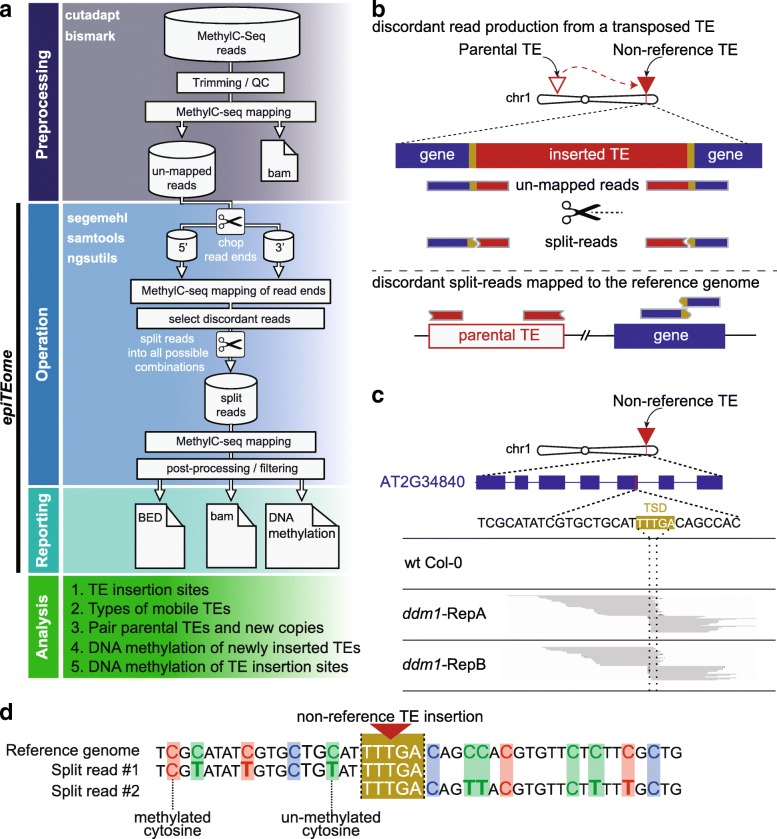
Fig. 1 Design of epiTEome function. a Workflow of methodology developed to identify non-reference insertions of TEs using filtered MethylC-seq reads that fail to align to the reference genome. b Principle behind split-read detection of new TE insertion sites. Reads that fail to fully map to the reference genome are used to identify the sites of new TE insertion. Non-mapping reads are split and mapped to the reference genome to identify reads with one end that maps to a TE and the other end to the site of insertion. c Example of a new TE insertion detected by epiTEome in Arabidopsis: ddm1 mutants undergo TE transcriptional reactivation and transposition [30]. Split reads not present in wild-type (wt Col-0) identify a TE insertion into the gene At2g34840 in two biological replicates of ddm1 MethylC-seq (RepA and RepB). The 5′ and 3′ flanking spit reads overlap (dashed lines) at the target site duplication (gold sequence) generated by TE insertion. d In addition to identifying new TE insertion sites, epiTEome detects the cytosine methylation status at these loci. Sequence alignment of split MethylC-seq reads at the insertion site are used to determine the cytosine DNA methylation status. Unconverted cytosines represent methylated bases, while C → T transitions (bold) in the MethylC-seq reads represent unmethylated cytosines. The sequence context of each cytosine is displayed (CG = red, CHG = blue, CHH = green)
Fig. 1 Design of epiTEome function. a Workflow of methodology developed to identify non-reference insertions of TEs using filtered MethylC-seq reads that fail to align to the reference genome. b Principle behind split-read detection of new TE insertion sites. Reads that fail to fully map to the reference genome are used to identify the sites of new TE insertion. Non-mapping reads are split and mapped to the reference genome to identify reads with one end that maps to a TE and the other end to the site of insertion. c Example of a new TE insertion detected by epiTEome in Arabidopsis: ddm1 mutants undergo TE transcriptional reactivation and transposition [30]. Split reads not present in wild-type (wt Col-0) identify a TE insertion into the gene At2g34840 in two biological replicates of ddm1 MethylC-seq (RepA and RepB). The 5′ and 3′ flanking spit reads overlap (dashed lines) at the target site duplication (gold sequence) generated by TE insertion. d In addition to identifying new TE insertion sites, epiTEome detects the cytosine methylation status at these loci. Sequence alignment of split MethylC-seq reads at the insertion site are used to determine the cytosine DNA methylation status. Unconverted cytosines represent methylated bases, while C → T transitions (bold) in the MethylC-seq reads represent unmethylated cytosines. The sequence context of each cytosine is displayed (CG = red, CHG = blue, CHH = green)CC BY · PubMed Central
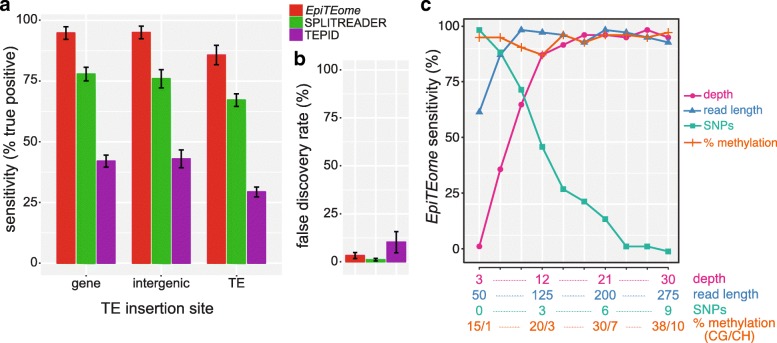
Fig. 2 Validation of epiTEome on simulated data. a Bar plot of sensitivity of detection for simulated TE insertions at three different TE insertion contexts (gene, intergenic, TE). SPLITREADER and TEPID use non-bisulfite converted reads, while epiTEome utilizes bisulfite-converted MethylC-seq reads. b FDR of epiTEome, SPLITREADER, and TEPID calculated from the same simulated data as part A. Error bars in (a) and (b) represent the 95% confidence interval (CI) generated using five replicates. c Analysis of how the variables of sequencing depth, read length, methylation level, and number of SNPs affect epiTEome sensitivity. Throughout the analysis in (c), epiTEome produced a 2.88% false-positive average, with a standard deviation of 1.45
Fig. 2 Validation of epiTEome on simulated data. a Bar plot of sensitivity of detection for simulated TE insertions at three different TE insertion contexts (gene, intergenic, TE). SPLITREADER and TEPID use non-bisulfite converted reads, while epiTEome utilizes bisulfite-converted MethylC-seq reads. b FDR of epiTEome, SPLITREADER, and TEPID calculated from the same simulated data as part A. Error bars in (a) and (b) represent the 95% confidence interval (CI) generated using five replicates. c Analysis of how the variables of sequencing depth, read length, methylation level, and number of SNPs affect epiTEome sensitivity. Throughout the analysis in (c), epiTEome produced a 2.88% false-positive average, with a standard deviation of 1.45CC BY · PubMed Central
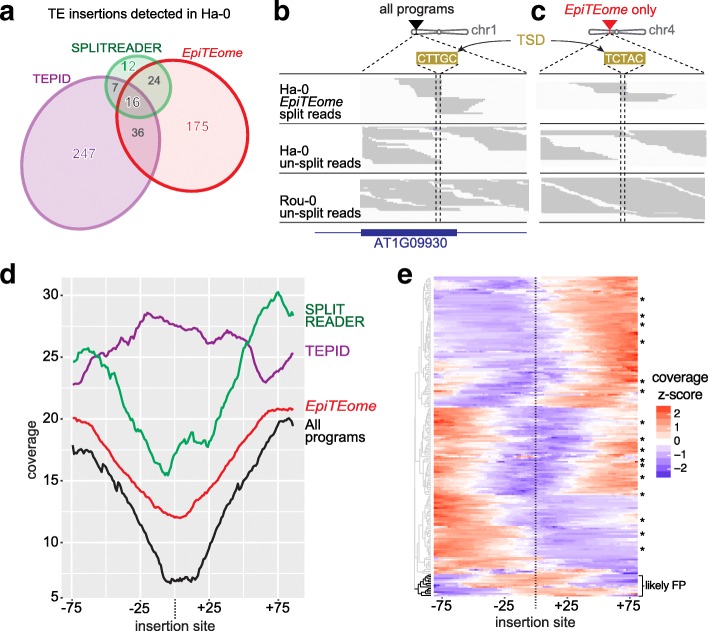
Fig. 3 Validation of epiTEome using published MethylC-seq data. a Venn diagram comparing three independent programs created to identify TE insertion sites in the Arabidopsis ecotype Ha-0. EpiTEome is the only program that utilizes MethylC-seq data. Color codes are maintained throughout panels (b)–(d). Split-reads identify the insertion and target site duplication of a TE insertion detected by all three programs (b) and a TE insertion specifically detected by epiTEome (c). The split-read analysis is confirmed by the decrease in coverage of un-split MethylC-seq reads in Ha-0 (insertion present) vs. the ecotype Rou-0 (insertion absent). d Meta-plot of MethylC-seq un-split read coverage at the TE insertion sites and flanking regions uniquely detected by each program or detected by all three. e MethylC-seq un-split read coverage z-score for each of the 175 TE insertions uniquely identified by epiTEome, plus the 16 detected by all three programs (asterisks). Seven percent of the insertion sites with high un-split read coverage (bracket) at the TE insertion site are likely false positives (FP)
Fig. 3 Validation of epiTEome using published MethylC-seq data. a Venn diagram comparing three independent programs created to identify TE insertion sites in the Arabidopsis ecotype Ha-0. EpiTEome is the only program that utilizes MethylC-seq data. Color codes are maintained throughout panels (b)–(d). Split-reads identify the insertion and target site duplication of a TE insertion detected by all three programs (b) and a TE insertion specifically detected by epiTEome (c). The split-read analysis is confirmed by the decrease in coverage of un-split MethylC-seq reads in Ha-0 (insertion present) vs. the ecotype Rou-0 (insertion absent). d Meta-plot of MethylC-seq un-split read coverage at the TE insertion sites and flanking regions uniquely detected by each program or detected by all three. e MethylC-seq un-split read coverage z-score for each of the 175 TE insertions uniquely identified by epiTEome, plus the 16 detected by all three programs (asterisks). Seven percent of the insertion sites with high un-split read coverage (bracket) at the TE insertion site are likely false positives (FP)CC BY · PubMed Central
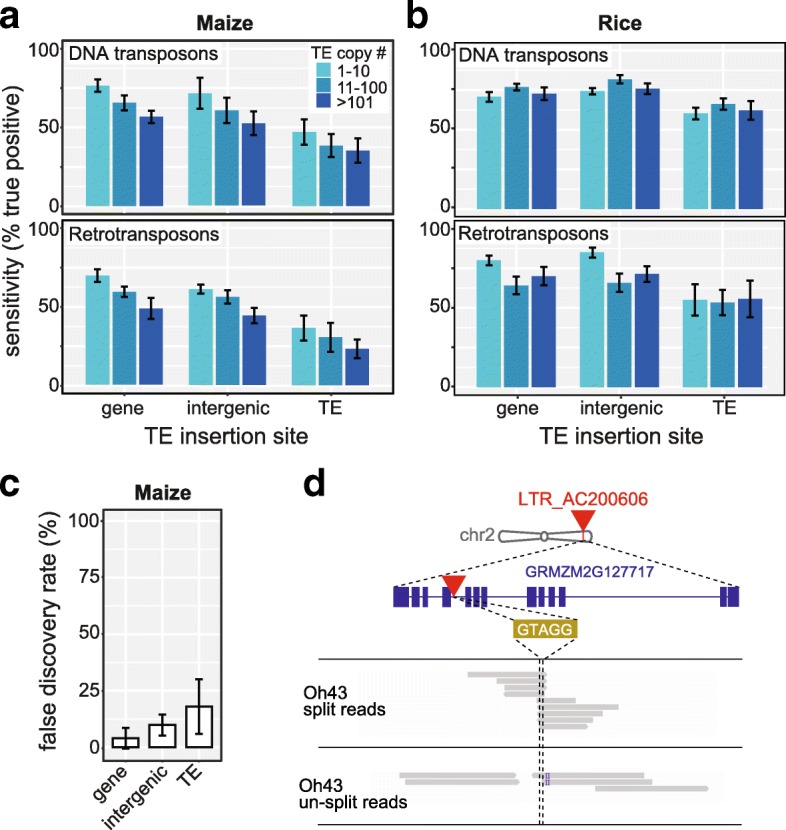
Fig. 4 EpiTEome detects new TE insertions in repetitive crop genomes. a, b Bar plot of sensitivity of detection for simulated TE insertions at three different potential TE insertion contexts (gene, intergenic, TE) in the maize (a) or rice (b) genomes using in silico generated bisulfite-converted reads. Results are divided by TE copy number. c FDR of epiTEome calculated from the same simulated data as part A. Error bars in (a)–(c) represent the 95% CI generated using five replicates. d Genome browser visualization of a non-reference (not in the reference B73 genome) LTR retrotransposon TE insertion into the PFK5 GRMZM2G127717 gene in the Oh43 inbred line identified by epiTEome
Fig. 4 EpiTEome detects new TE insertions in repetitive crop genomes. a, b Bar plot of sensitivity of detection for simulated TE insertions at three different potential TE insertion contexts (gene, intergenic, TE) in the maize (a) or rice (b) genomes using in silico generated bisulfite-converted reads. Results are divided by TE copy number. c FDR of epiTEome calculated from the same simulated data as part A. Error bars in (a)–(c) represent the 95% CI generated using five replicates. d Genome browser visualization of a non-reference (not in the reference B73 genome) LTR retrotransposon TE insertion into the PFK5 GRMZM2G127717 gene in the Oh43 inbred line identified by epiTEomeCC BY · PubMed Central
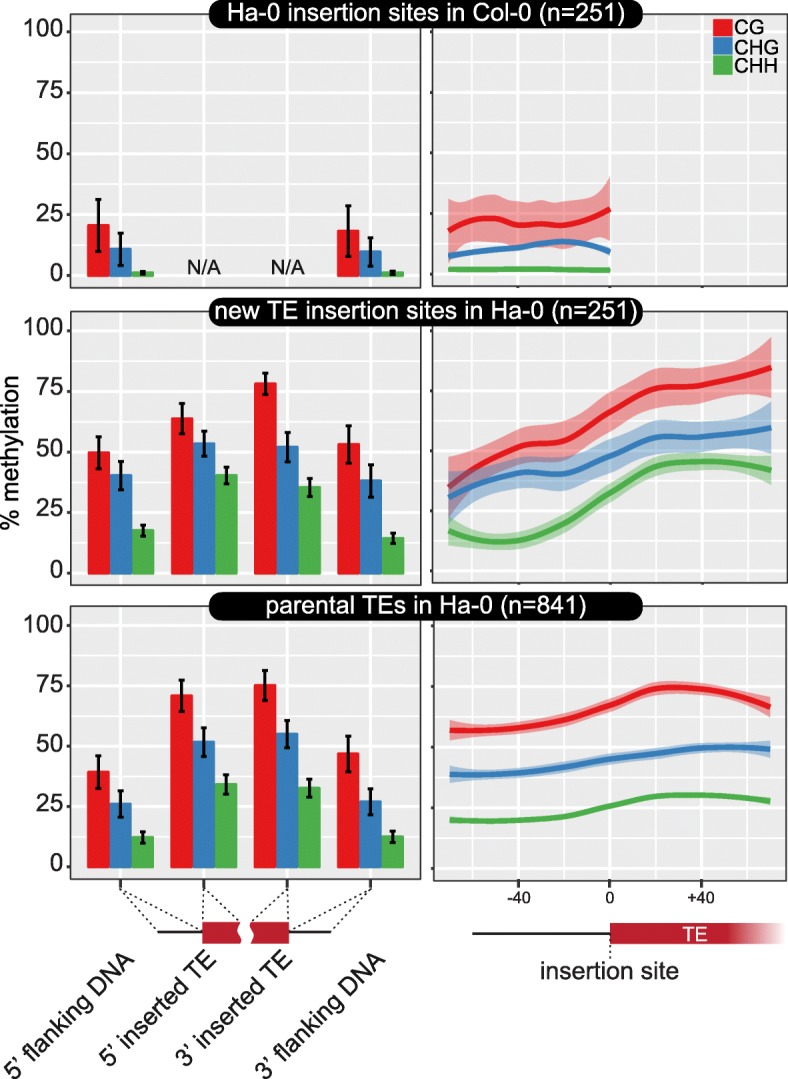
Fig. 5 EpiTEome detects DNA methylation at new TE insertion sites. Average DNA methylation at new insertions in the Arabidopsis Ha-0 ecotype (middle), these same sites without TE insertion in the reference Col-0 ecotype (top), and the parental TEs in Ha-0 that produced each transposed TE (bottom). DNA methylation is split between cytosine sequence contexts (colors) and location at the insertion site (x-axis). Bar plots are shown on the left and a metaplot combining both the 5′ and 3′ TE ends and insertion sites is shown on the right. Error bars (left) and transparent colors (right) represent the 95% CI. N/A not applicable
Fig. 5 EpiTEome detects DNA methylation at new TE insertion sites. Average DNA methylation at new insertions in the Arabidopsis Ha-0 ecotype (middle), these same sites without TE insertion in the reference Col-0 ecotype (top), and the parental TEs in Ha-0 that produced each transposed TE (bottom). DNA methylation is split between cytosine sequence contexts (colors) and location at the insertion site (x-axis). Bar plots are shown on the left and a metaplot combining both the 5′ and 3′ TE ends and insertion sites is shown on the right. Error bars (left) and transparent colors (right) represent the 95% CI. N/A not applicableCC BY · PubMed Central

Verification

Claims the paper makes

The claims and statistics of this paper haven’t been checked yet.

Run the check — free, no account needed. It reads the open-access text and checks the sources it cites.

A few free checks a day · papers already verified open instantly · results are public

Claims other papers make about this one

Each is checked against this paper’s own text: does it say what the citing paper says it does?

Self-check

Percentages, sums and reported differences re-computed from the paper’s own numbers.

The self-check needs the paper’s full text.

Citations

Cites

Research works printed but not linked: 28

  1. Kidwell MG, Lisch D. Transposable elements as sources of variation in animals and plants. Proc Natl Acad Sci U S A. 1997;94:7704–11. · DOI
  2. Levin HL, Moran JV. Dynamic interactions between transposable elements and their hosts. Nat Rev Genet. 2011;12:615–27. · DOI · Paper page
  3. Wicker T, Sabot F, Hua-Van A, Bennetzen JL, Capy P, Chalhoub B, et al. A unified classification system for eukaryotic transposable elements. Nat Rev Genet. 2007;8:973–82. · DOI
  4. Daron J, Glover N, Pingault L, Theil S, Jamilloux V, Paux E, et al. Organization and evolution of transposable elements along the bread wheat chromosome 3B. Genome Biol. 2014;15:546. · DOI
  5. Kidwell MG. Transposable elements and the evolution of genome size in eukaryotes. Genetica. 2002;115:49–63. · DOI
  6. Zhang J, Yu C, Krishnaswamy L, Peterson T. Transposable elements as catalysts for chromosome rearrangements. Methods Mol Biol. 2011;701:315–26. · DOI
  7. Fultz D, Choudury SG, Slotkin RK. Silencing of active transposable elements in plants. Curr Opin Plant Biol. 2015;27:67–76. · DOI
  8. Urich MA, Nery JR, Lister R, Schmitz RJ, Ecker JR. MethylC-seq library preparation for base-resolution whole-genome bisulfite sequencing. Nat Protoc. 2015;10:475–83. · DOI
  9. Jiang N, Bao Z, Zhang X, Hirochika H, Eddy SR, McCouch SR, et al. An active DNA transposon family in rice. Nature. 2003;421:163–7. · DOI
  10. Ewing AD. Transposable element detection from whole genome sequence data. Mob DNA. 2015;6:164. · DOI · Paper page
  11. Quadrana L, Bortolini Silveira A, Mayhew GF, LeBlanc C, Martienssen RA, Jeddeloh JA, et al. The Arabidopsis thaliana mobilome and its impact at the species level. Elife. 2016;5:e15716. · DOI
  12. Stuart T, Eichten S, Cahn J, Karpievitch Y, Borevitz J, Lister R. Population scale mapping of transposable element diversity reveals links to gene regulation and epigenomic variation. Elife. 2016;5:e20777. · DOI
  13. Krueger F, Andrews SR. Bismark: a flexible aligner and methylation caller for Bisulfite-Seq applications. Bioinformatics. 2011;27:1571–2. · DOI
  14. Otto C, Stadler PF, Hoffmann S. Fast and sensitive mapping of bisulfite-treated sequencing data. Bioinformatics. 2012;28:1698–704. · DOI
  15. Cao J, Schneeberger K, Ossowski S, Günther T, Bender S, Fitz J, et al. Whole-genome sequencing of multiple Arabidopsis thaliana populations. Nat Genet. 2011;43:956–63. · DOI
  16. Kawakatsu T, Huang S-SC, Jupe F, Sasaki E, Schmitz RJ, Urich MA, et al. Epigenomic diversity in a global collection of Arabidopsis thaliana accessions. Mol Cell. 2016;166:492–505.
  17. 1001 Genomes Consortium. 1,135 genomes reveal the global pattern of polymorphism in Arabidopsis thaliana. Cell. 2016;166:481–91. · DOI
  18. Schnable PS, Ware D, Fulton RS, Stein JC, Wei F, Pasternak S, et al. The B73 maize genome: complexity, diversity, and dynamics. Science. 2009;326:1112–5. · DOI
  19. International Rice Genome Sequencing Project. The map-based sequence of the rice genome. Nature. 2005;436:793–800. · DOI
  20. Li Q, Eichten SR, Hermanson PJ, Zaunbrecher VM, Song J, Wendt J, et al. Genetic perturbation of the maize methylome. Plant Cell. 2014;26:4602–16. · DOI
  21. Ahmed I, Sarazin A, Bowler C, Colot V, Quesneville H. Genome-wide evidence for local DNA methylation spreading from small RNA-targeted sequences in Arabidopsis. Nucleic Acids Res. 2011;39:6919–31. · DOI
  22. SanMiguel P, Tikhonov A, Jin YK, Motchoulskaia N, Zakharov D, Melake-Berhan A, et al. Nested retrotransposons in the intergenic regions of the maize genome. Science. 1996;274:765–8. · DOI
  23. Martin M. Cutadapt removes adapter sequences from high-throughput sequencing reads. EMBnet J. 2011;17:10–2. · DOI · Paper page
  24. Neph S, Kuehn MS, Reynolds AP, Haugen E, Thurman RE, Johnson AK, et al. BEDOPS: high-performance genomic feature operations. Bioinformatics. 2012;28:1919–20. · DOI
  25. Micallef L, Rodgers P. eulerAPE: drawing area-proportional 3-Venn diagrams using ellipses. PLoS One. 2014;9:e101717. · DOI
  26. Law M, Childs KL, Campbell MS, Stein JC, Olson AJ, Holt C, et al. Automated update, revision, and quality control of the maize genome annotations using MAKER-P improves the B73 RefGen_v3 gene models and identifies new genes. Plant Physiol. 2014;167:25–39. · DOI
  27. Panda K, Ji L, Neumann DA, Daron J, Schmitz RJ, Slotkin RK. Full-length autonomous transposable elements are preferentially targeted by expression-dependent forms of RNA-directed DNA methylation. Genome Biol. 2016;17:100. · DOI
  28. Miura A, Yonebayashi S, Watanabe K, Toyama T, Shimada H, Kakutani T. Mobilization of transposons by a mutation abolishing full DNA methylation in Arabidopsis. Nature. 2001;411:212–4. · DOI

Cited by

Sorted by citations

See all 29

Metadata

Authors
Daron, J., & Slotkin, R. K.
Venue
Genome Biology
Published
2017-05-12
Volume
18
Issue
1
ISSN
1474-760X
Cited by
29
References
1
Language
en
Funders
Directorate for Biological Sciences (MCB-1252370)

About these checks

Registry, retraction, Cites and statistics results are computed, not judged, with one exception: a printed reference that no index lists is read once by a model before it counts as a citation error. Claims are extracted by a model and kept only when their quote appears verbatim in the text; each cited source is then checked, with a model’s help, for whether it says what the claim relies on. Those verdicts can be wrong — read the claim’s quote and the cited source before relying on one.

Statistics and arithmetic are recomputed, not judged.

Confidence bands are shown only for fields calibrated on our annotated test set. None is calibrated yet, so no band is shown.

What counts as a claim ›How we measure confidence ›How we check this ›

Are you an author, or do you see a problem with this page? Request a review