

The DOI matches its Crossref record; 41 of the 41 references it cites were found in a registry or an index.
Evaluation of in silico algorithms for use with ACMG/AMP clinical variant interpretation guidelines
Open accessPublished version of a preprint
Abstract
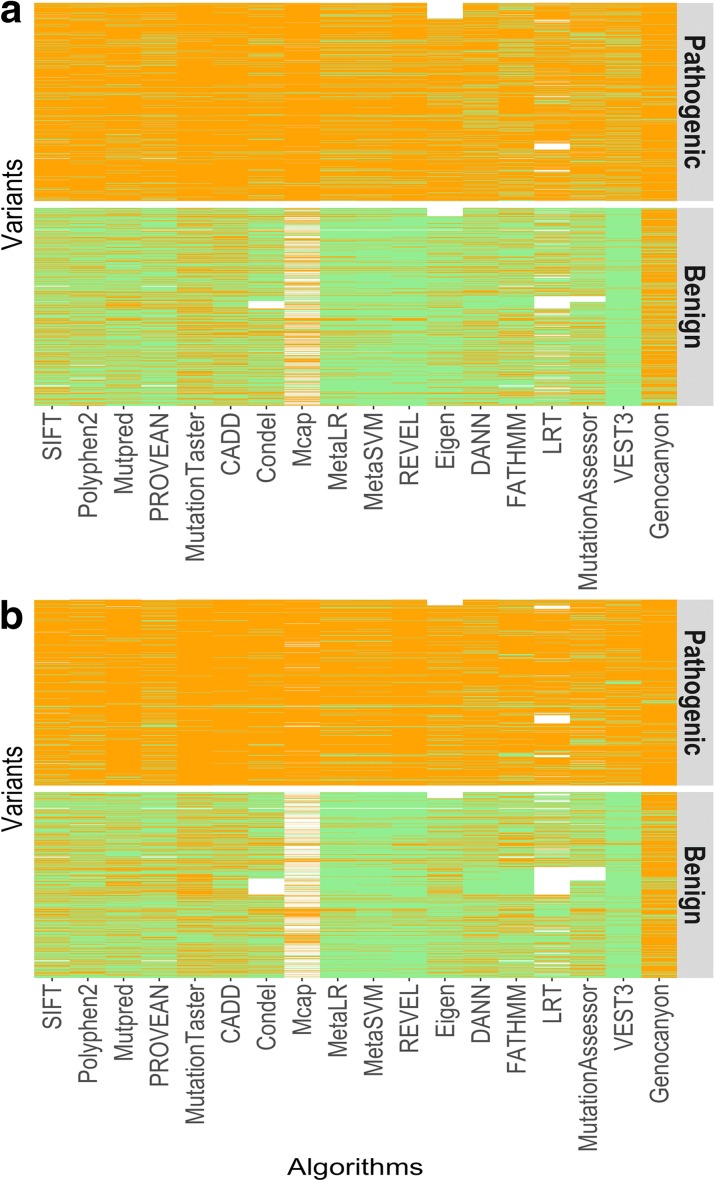
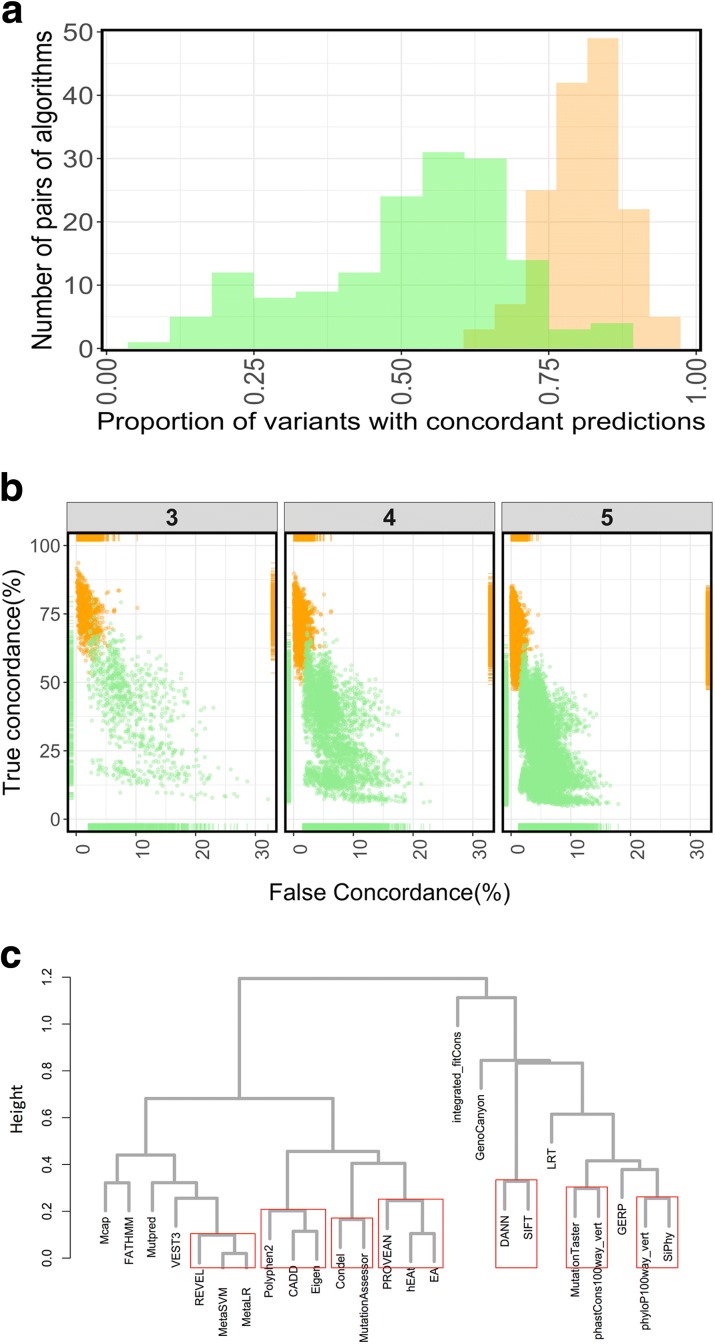
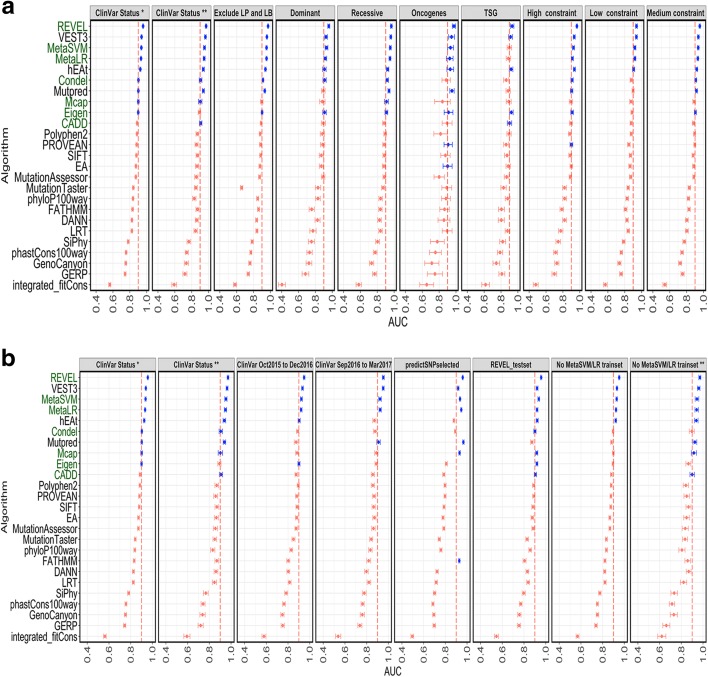
BACKGROUND: The American College of Medical Genetics and American College of Pathologists (ACMG/AMP) variant classification guidelines for clinical reporting are widely used in diagnostic laboratories for variant interpretation. The ACMG/AMP guidelines recommend complete concordance of predictions among all in silico algorithms used without specifying the number or types of algorithms. The subjective nature of this recommendation contributes to discordance of variant classification among clinical laboratories and prevents definitive classification of variants. RESULTS: Using 14,819 benign or pathogenic missense variants from the ClinVar database, we compared performance of 25 algorithms across datasets differing in distinct biological and technical variables. There was wide variability in concordance among different combinations of algorithms with particularly low concordance for benign variants. We also identify a previously unreported source of error in variant interpretation (false concordance) where concordant in silico predictions are opposite to the evidence provided by other sources. We identified recently developed algorithms with high predictive power and robust to variables such as disease mechanism, gene constraint, and mode of inheritance, although poorer performing algorithms are more frequently used based on review of the clinical genetics literature (2011-2017). CONCLUSIONS: Our analyses identify algorithms with high performance characteristics independent of underlying disease mechanisms. We describe combinations of algorithms with increased concordance that should improve in silico algorithm usage during assessment of clinically relevant variants using the ACMG/AMP guidelines.
Overview
The claims and statistics of this paper haven’t been checked yet.
Run the check — free, no account needed. It reads the open-access text and checks the sources it cites.
Integrity signals
Registry
Cites
Statistics
Figures
Verification
Claims the paper makes
The claims and statistics of this paper haven’t been checked yet.
Run the check — free, no account needed. It reads the open-access text and checks the sources it cites.
Claims other papers make about this one
Each is checked against this paper’s own text: does it say what the citing paper says it does?
The source backs part of the claim, not all of it — or backs it for a different population, condition or comparison.
In the citing paper
“However, score intervals defined by tool developers, and ACMG/AMP recommendations that require the consensus of multiple predictors, lack quantitative support.”
From Calibration of computational tools for missense variant pathogenicity classification and ClinGen recommendations for PP3/BP4 criteria (2022) · cites this paper as [3]
Experimental — accuracy not yet measuredThe cited source says what the claim attributes to it.
In the citing paper
“These fractions were considerably larger than 4.41%, our estimate of the prior probability of pathogenicity (prevalence of pathogenic variants) in the gnomAD set, suggesting a high false positive rate with respect to PP3, in agreement with previous studies.3”
From Calibration of computational tools for missense variant pathogenicity classification and ClinGen recommendations for PP3/BP4 criteria (2022) · cites this paper as [3]
The cited source says what the claim attributes to it.
In the citing paper
“Several studies have attempted to benchmark methods to identify tools and tool-threshold combinations that are the most accurate and appropriate for clinically relevant variants.3,38,39,40,41”
From Calibration of computational tools for missense variant pathogenicity classification and ClinGen recommendations for PP3/BP4 criteria (2022) · cites this paper as [3]
Self-check
Percentages, sums and reported differences re-computed from the paper’s own numbers.
The self-check needs the paper’s full text.
Citations
Cites
Richards, S., Aziz, N., Bale, S., Bick, D., Das, S., Gastier-Foster, J., Grody, W. W., Hegde, M., Lyon, E., Spector, E., et al. (2015) · Genetics in Medicine · doi:10.1038/gim.2015.30 · Cited by 32,594
A method and server for predicting damaging missense mutations.
Adzhubei, I. A., Schmidt, S., Peshkin, L., Ramensky, V. E., Gerasimova, A., Bork, P., Kondrashov, A. S., & Sunyaev, S. R. (2010) · Nature Methods · doi:10.1038/nmeth0410-248 · Cited by 13,194
Analysis of protein-coding genetic variation in 60,706 humans
Exome Aggregation Consortium, Lek, M., Karczewski, K. J., Minikel, E. V., Samocha, K. E., Banks, E., Fennell, T., O’Donnell-Luria, A. H., Ware, J. S., Hill, A. J., et al. (2016) · Nature · doi:10.1038/nature19057 · Cited by 9,587
Shrestha, S., & Offer, S. M. (2016) · Medical Epigenetics · doi:10.1159/000444713 · Cited by 8,951
The Ensembl Variant Effect Predictor
McLaren, W., Gil, L., Hunt, S. E., Riat, H. S., Ritchie, G. R. S., Thormann, A., Flicek, P., & Cunningham, F. (2016) · Genome Biology · doi:10.1186/s13059-016-0974-4 · Cited by 8,099
Vogelstein, B., Papadopoulos, N., Velculescu, V. E., Zhou, S., Diaz, L. A., & Kinzler, K. W. (2013) · Science · doi:10.1126/science.1235122 · Cited by 7,863
SIFT: predicting amino acid changes that affect protein function
Ng, P. C. (2003) · Nucleic Acids Research · doi:10.1093/nar/gkg509 · Cited by 6,601
A general framework for estimating the relative pathogenicity of human genetic variants
Kircher, M., Witten, D. M., Jain, P., O'Roak, B. J., Cooper, G. M., & Shendure, J. (2014) · Nature Genetics · doi:10.1038/ng.2892 · Cited by 6,183
Evolutionarily conserved elements in vertebrate, insect, worm, and yeast genomes
Siepel, A., Bejerano, G., Pedersen, J. S., Hinrichs, A. S., Hou, M., Rosenbloom, K., Clawson, H., Spieth, J., Hillier, L. W., Richards, S., et al. (2005) · Genome Research · doi:10.1101/gr.3715005 · Cited by 3,971 · cited 1×
“All the largely evolutionary conservation algorithms such as phyloP [25], phastCons [26], GERP [27], and Siphy [28] belong to different clusters from the metapredictors REVEL, MetaSVM, and MetaLR (Fig.”
MethodMutationTaster evaluates disease-causing potential of sequence alterations
Schwarz, J. M., Rödelsperger, C., Schuelke, M., & Seelow, D. (2010) · Nature Methods · doi:10.1038/nmeth0810-575 · Cited by 2,975
Cited by
Sorted by citations
CADD: predicting the deleteriousness of variants throughout the human genome
Rentzsch, P., Witten, D., Cooper, G. M., Shendure, J., & Kircher, M. (2019) · Nucleic Acids Research · doi:10.1093/nar/gky1016 · Cited by 3,534
Accurate classification of BRCA1 variants with saturation genome editing
Findlay, G. M., Daza, R. M., Martin, B., Zhang, M. D., Leith, A. P., Gasperini, M., Janizek, J. D., Huang, X., Starita, L. M., & Shendure, J. (2018) · Nature · doi:10.1038/s41586-018-0461-z · Cited by 843
Pejaver, V., Byrne, A. B., Feng, B.-J., Pagel, K. A., Mooney, S. D., Karchin, R., O’Donnell-Luria, A., Harrison, S. M., Tavtigian, S. V., Greenblatt, M. S., et al. (2022) · The American Journal of Human Genetics · doi:10.1016/j.ajhg.2022.10.013 · Cited by 589
Self-citationExpert specification of the ACMG/AMP variant interpretation guidelines for genetic hearing loss
Oza, A. M., DiStefano, M. T., Hemphill, S. E., Cushman, B. J., Grant, A. R., Siegert, R. K., Shen, J., Chapin, A., Boczek, N. J., Schimmenti, L. A., et al. (2018) · Human Mutation · doi:10.1002/humu.23630 · Cited by 487
Horak, P., Griffith, M., Danos, A. M., Pitel, B. A., Madhavan, S., Liu, X., Chow, C., Williams, H. E., Carmody, L., Barrow-Laing, L., et al. (2022) · Genetics in Medicine · doi:10.1016/j.gim.2022.01.001 · Cited by 268
Self-citationRates and Classification of Variants of Uncertain Significance in Hereditary Disease Genetic Testing
Chen, E. Y., Facio, F. M., Aradhya, K., Rojahn, S., Hatchell, K. E., Aguilar, S. J., Ouyang, K., Saitta, S. C., Hanson‐Kahn, A., Nakousi‐Capurro, N., et al. (2023) · JAMA Network Open · doi:10.1001/jamanetworkopen.2023.39571 · Cited by 253
Deignan, J. L., Chung, W. K., Kearney, H. M., Monaghan, K. G., Rehder, C. W., & Chao, E. (2019) · Genetics in Medicine · doi:10.1038/s41436-019-0478-1 · Cited by 224
Zhu, N., Welch, C. L., Wang, J., Allen, P. M., Gonzaga-Jauregui, C. G., Ma, L., King, A. K., Krishnan, U., Rosenzweig, E. B., Ivy, D. D., et al. (2018) · Genome Medicine · doi:10.1186/s13073-018-0566-x · Cited by 162
ALG9 Mutation Carriers Develop Kidney and Liver Cysts
Besse, W., Chang, A. R., Luo, J. Z., Triffo, W. J., Moore, B. S., Gulati, A., Hartzel, D. N., Mane, S., Torres, V. E., Somlo, S., et al. (2019) · Journal of the American Society of Nephrology · doi:10.1681/asn.2019030298 · Cited by 157
ClinGen Myeloid Malignancy Variant Curation Expert Panel recommendations for germline RUNX1 variants
Luo, X., Feurstein, S. K., Mohan, S., Porter, C. C., Jackson, S. A., Keel, S., Chicka, M. C., Brown, A. L., Kesserwan, C. A., Agarwal, A., et al. (2019) · Blood Advances · doi:10.1182/bloodadvances.2019000644 · Cited by 158
Self-citationRole of POLE and POLD1 in familial cancer
Mur, P., García‐Mulero, S., Valle, J. D., Magraner-Pardo, L., Vidal, A., Pineda, M., Cinnirella, G., Martin, E. J., Pons, T., López‐Doriga, A., et al. (2020) · Genetics in Medicine · doi:10.1038/s41436-020-0922-2 · Cited by 144
Assessing performance of pathogenicity predictors using clinically relevant variant datasets
Gunning, A. C., Fryer, V., Fasham, J., Crosby, A. H., Ellard, S., Baple, E. L., & Wright, C. F. (2020) · Journal of Medical Genetics · doi:10.1136/jmedgenet-2020-107003 · Cited by 137
Functional regulatory variants implicate distinct transcriptional networks in dementia
Cooper, Y. A., Teyssier, N., Dräger, N. M., Guo, Q., Davis, J. E., Sattler, S. M., Yang, Z., Patel, A. M., Wu, S. J., Kosuri, S., et al. (2022) · Science · doi:10.1126/science.abi8654 · Cited by 121
CHASMplus Reveals the Scope of Somatic Missense Mutations Driving Human Cancers
Tokheim, C. J., & Karchin, R. (2019) · Cell Systems · doi:10.1016/j.cels.2019.05.005 · Cited by 134
Suiter, C. C., Moriyama, T., Matreyek, K. A., Yang, W., Scaletti, E. R., Nishii, R., Yang, W., Hoshitsuki, K., Singh, M., Trehan, A., et al. (2020) · Proceedings of the National Academy of Sciences · doi:10.1073/pnas.1915680117 · Cited by 121
REVEL and BayesDel outperform other in silico meta-predictors for clinical variant classification
Tian, Y., Pesaran, T., Chamberlin, A., Fenwick, R. B., Li, S., Gau, C.-L., Chao, E. C., Lu, H.-M., Black, M. H., & Qian, D. (2019) · Scientific Reports · doi:10.1038/s41598-019-49224-8 · Cited by 114
Clinical application of next-generation sequencing to the practice of neurology
Rexach, J. E., Lee, H., Martínez-Agosto, J. A., Nemeth, A. H., & Fogel, B. L. (2019) · The Lancet Neurology · doi:10.1016/s1474-4422(19)30033-x · Cited by 117
Insights on variant analysis in silico tools for pathogenicity prediction
Garcia, F. A. D. O., de Andrade, E. S., & Palmero, E. I. (2022) · Frontiers in Genetics · doi:10.3389/fgene.2022.1010327 · Cited by 123
Liu, Z., Zhu, L., Roberts, R. A., & Tong, W. (2019) · Trends in Genetics · doi:10.1016/j.tig.2019.08.006 · Cited by 117
Chinn, I. K., Chan, A. Y. K., Chen, K., Chou, J. S., Dorsey, M. J., Hajjar, J., Jongco, A. M., Keller, M. D., Kobrynski, L. J., Kumánovics, A., et al. (2019) · Journal of Allergy and Clinical Immunology · doi:10.1016/j.jaci.2019.09.009 · Cited by 112
Piñeiro-Yáñez, E., Reboiro‐Jato, M., Goméz-López, G., Perales-Patón, J., Troulé, K., Rodrı́guez, J. M., Tejero, H., Shimamura, T., Lopez-Casas, P. P., Carretero, J., et al. (2018) · Genome Medicine · doi:10.1186/s13073-018-0546-1 · Cited by 104
Singh, H., Choudhari, R. H., Nema, V., & Khan, A. A. (2020) · Microbial Pathogenesis · doi:10.1016/j.micpath.2020.104621 · Cited by 106
Coughlin, C. R., Swanson, M. A., Spector, E., Meeks, N. J. L., Kronquist, K. E., Aslamy, M., Wempe, M. F., van Karnebeek, C., Gospe, S. M., Aziz, V. G., et al. (2019) · Journal of Inherited Metabolic Disease · doi:10.1002/jimd.12045 · Cited by 103
Targeted next generation sequencing as a tool for precision medicine
Gulilat, M., Lamb, T., Teft, W. A., Wang, J., Dron, J. S., Robinson, J. F., Tirona, R. G., Hegele, R. A., Kim, R. B., & Schwarz, U. I. (2019) · BMC Medical Genomics · doi:10.1186/s12920-019-0527-2 · Cited by 101
Raraigh, K. S., Han, S. T., Davis-Marcisak, E. F., Evans, T. A., Pellicore, M. J., McCague, A. F., Joynt, A. T., Lu, Z., Atalar, M., Sharma, N., et al. (2018) · The American Journal of Human Genetics · doi:10.1016/j.ajhg.2018.04.003 · Cited by 87
Comparison and integration of computational methods for deleterious synonymous mutation prediction
Cheng, N., Li, M., Zhao, L., Zhang, B., Yang, Y., Zheng, C.-H., & Xia, J. (2019) · Briefings in Bioinformatics · doi:10.1093/bib/bbz047 · Cited by 82
Çubuk, C., Garrett, A., Choi, S., King, L., Loveday, C., Torr, B., Burghel, G. J., Durkie, M., Callaway, A., Robinson, R., et al. (2021) · Genetics in Medicine · doi:10.1038/s41436-021-01265-z · Cited by 82
Genome interpretation using in silico predictors of variant impact
Katsonis, P., Wilhelm, K. O., Williams, A. M., & Lichtarge, O. (2022) · Human Genetics · doi:10.1007/s00439-022-02457-6 · Cited by 86
An update on the central nervous system manifestations of Li–Fraumeni syndrome
Orr, B. A., Clay, M. R., Pinto, E. M., & Kesserwan, C. A. (2019) · Acta Neuropathologica · doi:10.1007/s00401-019-02055-3 · Cited by 80
Integrating non-mammalian model organisms in the diagnosis of rare genetic diseases in humans
Yamamoto, S., Kanca, O., Wangler, M. F., & Bellen, H. J. (2023) · Nature Reviews Genetics · doi:10.1038/s41576-023-00633-6 · Cited by 81
A catalog of GWAS fine-mapping efforts in autoimmune disease
Çalışkan, M., Brown, C. D., & Maranville, J. (2021) · The American Journal of Human Genetics · doi:10.1016/j.ajhg.2021.03.009 · Cited by 68
Li, S., van der Velde, K. J., de Ridder, D., van Dijk, A. D. J., Soudis, D., Zwerwer, L. R., Deelen, P., Hendriksen, D., Charbon, B., van Gijn, M. E., et al. (2020) · Genome Medicine · doi:10.1186/s13073-020-00775-w · Cited by 61
Evaluating the impact of in silico predictors on clinical variant classification
Wilcox, E. H., Sarmady, M., Wulf, B., Wright, M. W., Rehm, H. L., Biesecker, L. G., & Tayoun, A. N. A. (2021) · Genetics in Medicine · doi:10.1016/j.gim.2021.11.018 · Cited by 58
Implication of Heterozygous Variants in Genes of the Leptin–Melanocortin Pathway in Severe Obesity
Courbage, S., Poitou, C., Beyec, J. L., Karsenty, A., Lemale, J., Pelloux, V., Lacorte, J., Carel, J., Lecomte, N., Storey, C., et al. (2021) · The Journal of Clinical Endocrinology & Metabolism · doi:10.1210/clinem/dgab404 · Cited by 60
Applications of artificial intelligence in clinical laboratory genomics
Aradhya, S., Facio, F. M., Metz, H. C., Manders, T. R., Colavin, A., Kobayashi, Y., Nykamp, K., Johnson, B. A., & Nussbaum, R. L. (2023) · American Journal of Medical Genetics Part C Seminars in Medical Genetics · doi:10.1002/ajmg.c.32057 · Cited by 62
Functional effects of protein variants
Vihinen, M. (2020) · Biochimie · doi:10.1016/j.biochi.2020.10.009 · Cited by 56
Navigating the nuances of clinical sequence variant interpretation in Mendelian disease
Strande, N. T., Brnich, S. E., Roman, T. S., & Berg, J. S. (2018) · Genetics in Medicine · doi:10.1038/s41436-018-0100-y · Cited by 63
Aldrian, D., Vogel, G. F., Frey, T. K., Civan, H. A., Aksu, A. Ü., Avitzur, Y., Boluda, E. R., Çakır, M., Demir, A. M., Deppisch, C., et al. (2021) · Journal of Clinical Medicine · doi:10.3390/jcm10030481 · Cited by 53
Challenges and Considerations in Sequence Variant Interpretation for Mendelian Disorders
Kim, Y.-E., Ki, C., & Jang, M. (2019) · Annals of Laboratory Medicine · doi:10.3343/alm.2019.39.5.421 · Cited by 52
High-impact rare genetic variants in severe schizophrenia
Zoghbi, A. W., Dhindsa, R. S., Goldberg, T. E., Mehralizade, A., Motelow, J. E., Wang, X., Alkelai, A., Harms, M. B., Lieberman, J. A., Markx, S., et al. (2021) · Proceedings of the National Academy of Sciences · doi:10.1073/pnas.2112560118 · Cited by 53
Variation benchmark datasets: update, criteria, quality and applications
Sarkar, A., Yang, Y., & Vihinen, M. (2019) · bioRxiv · doi:10.1093/database/baz117 · Cited by 47
The clinical and functional effects of TERT variants in myelodysplastic syndrome
Reilly, C. R., Myllymäki, M., Redd, R. A., Padmanaban, S., Karunakaran, D., Tesmer, V. M., Tsai, F. D., Gibson, C. J., Rana, H. Q., Zhong, L., et al. (2021) · Blood · doi:10.1182/blood.2021011075 · Cited by 51
Genetic Analysis of the Coronavirus SARS-CoV-2 Host Protease TMPRSS2 in Different Populations
Russo, R., Andolfo, I., Lasorsa, V. A., Iolascon, A., & Capasso, M. (2020) · Frontiers in Genetics · doi:10.3389/fgene.2020.00872 · Cited by 50
Edmonson, M. N., Patel, A., Hedges, D. J., Wang, Z., Rampersaud, E., Kesserwan, C. A., Zhou, X., Liu, Y., Newman, S., Rusch, M., et al. (2019) · Genome Research · doi:10.1101/gr.250357.119 · Cited by 51
Renner, S., Schüler, H., Alawi, M., Kolbe, V., Rybczynski, M., Woitschach, R., Sheikhzadeh, S., Stark, V. C., Olfe, J., Roser, E., et al. (2019) · Genetics in Medicine · doi:10.1038/s41436-019-0435-z · Cited by 47
Toward automation of germline variant curation in clinical cancer genetics
Ravichandran, V., Shameer, Z., Kemel, Y. M., Walsh, M. F., Cadoo, K. A., Lipkin, S. M., Mandelker, D. L., Zhang, L., Stadler, Z. K., Robson, M. E., et al. (2019) · Genetics in Medicine · doi:10.1038/s41436-019-0463-8 · Cited by 47
Murro, V., Banfi, S., Testa, F., Iarossi, G., Falsini, B., Sodi, A., Signorini, S. G., Iolascon, A., Russo, R., Mucciolo, D. P., et al. (2023) · Orphanet Journal of Rare Diseases · doi:10.1186/s13023-023-02798-z · Cited by 49
Candidate genes for hereditary colorectal cancer: Mutational screening and systematic review
Belhadj, S., Terradas, M., Muñoz-Torres, P., Aiza, G., Navarro, M., Capellá, G., & Valle, L. (2020) · Human Mutation · doi:10.1002/humu.24057 · Cited by 46
Nicora, G., Limongelli, I., Gambelli, P., Memmi, M., Malovini, A., Mazzanti, A., Napolitano, C., Priori, S., & Bellazzi, R. (2018) · Human Mutation · doi:10.1002/humu.23665 · Cited by 38
Fortuño, C., James, P. A., Young, E. L., Feng, B., Olivier, M., Pesaran, T. F., Tavtigian, S. V., & Spurdle, A. B. (2018) · Human Mutation · doi:10.1002/humu.23553 · Cited by 43
Accetturo, M., D’Uggento, A. M., Portincasa, P., & Stella, A. (2019) · Lara D. Veeken · doi:10.1093/rheumatology/kez332 · Cited by 41
In Vivo Functional Study of Disease-Associated Rare Human Variants using Drosophila
Harnish, J., Deal, S. L., Chao, H.-T., Wangler, M., & Yamamoto, S. (2019) · Journal of Visualized Experiments · doi:10.3791/59658 · Cited by 42
LEAP: Using machine learning to support variant classification in a clinical setting
Lai, C., Zimmer, A. D., O'Connor, R., Kim, S., Chan, R., van den Akker, J., Zhou, A. Y., Topper, S., & Mishne, G. (2020) · Human Mutation · doi:10.1002/humu.24011 · Cited by 38
Won, D., Kim, D., Woo, J., & Lee, K. (2021) · Bioinformatics · doi:10.1093/bioinformatics/btab529 · Cited by 40
Pottinger, T. D., Puckelwartz, M. J., Pesce, L. L., Robinson, A., Kearns, S. D., Pacheco, J. A., Rasmussen‐Torvik, L. J., Smith, M. E., Chisholm, R. L., & McNally, E. M. (2020) · Journal of the American Heart Association · doi:10.1161/jaha.119.013808 · Cited by 38
Zhou, Y., & Lauschke, V. M. (2021) · Clinical Pharmacology & Therapeutics · doi:10.1002/cpt.2289 · Cited by 36
Genomics and electronic health record systems
Lucila Ohno-machado, A., Kim, J., Gabriel, R. A., Kuo, G. M., & Hogarth, M. A. (2018) · Human Molecular Genetics · doi:10.1093/hmg/ddy104 · Cited by 35
Comparison of Pathogenicity Prediction Tools on Somatic Variants
Suybeng, V., Koeppel, F., Harlé, A., & Rouleau, É. (2020) · Journal of Molecular Diagnostics · doi:10.1016/j.jmoldx.2020.08.007 · Cited by 34
Wu, D., Luo, X., Feurstein, S. K., Kesserwan, C. A., Mohan, S., Álvarez, D. E. P., & Godley, L. A. (2020) · Haematologica · doi:10.3324/haematol.2018.214221 · Cited by 33
Evans, P., Wu, C., Lindy, A. S., McKnight, D., Lebo, M. S., Sarmady, M., & Tayoun, A. N. A. (2019) · Genome Research · doi:10.1101/gr.240994.118 · Cited by 33
A Genocentric Approach to Discovery of Mendelian Disorders
Hansen, A. W., Murugan, M., Li, H., Khayat, M. M., Wang, L., Rosenfeld, J. A., Andrews, B. K., Jhangiani, S. N., Coban‐Akdemir, Z., Sedlazeck, F. J., et al. (2019) · The American Journal of Human Genetics · doi:10.1016/j.ajhg.2019.09.027 · Cited by 32
Cadherin 2-Related Arrhythmogenic Cardiomyopathy
Ghidoni, A., Elliot, P. M., Syrris, P., Calkins, H. G., James, C. A., Judge, D. P., Murray, B. A., Barc, J., Probst, V., Schott, J., et al. (2021) · Circulation Genomic and Precision Medicine · doi:10.1161/circgen.120.003097 · Cited by 32
‘Channeling’ therapeutic discovery for epileptic encephalopathy through iPSC technologies
Simkin, D., Ambrosi, C. M., Marshall, K. A., Williams, L. A., Eisenberg, J., Gharib, M., Dempsey, G. T., George, A. L., McManus, O. B., & Kiskinis, E. (2022) · Trends in Pharmacological Sciences · doi:10.1016/j.tips.2022.03.001 · Cited by 32
CAGI5: Objective performance assessments of predictions based on the Evolutionary Action equation
Katsonis, P., & Lichtarge, O. (2019) · Human Mutation · doi:10.1002/humu.23873 · Cited by 31
Variant effect predictors: a systematic review and practical guide
Riccio, C., Jansen, M. L., Guo, L., & Ziegler, A. (2024) · Human Genetics · doi:10.1007/s00439-024-02670-5 · Cited by 34
Terradas, M., Muñoz-Torres, P., Belhadj, S., Aiza, G., Navarro, M., Brunet, J., Capellá, G., & Valle, L. (2019) · Human Mutation · doi:10.1002/humu.23853 · Cited by 29
MTR3D: identifying regions within protein tertiary structures under purifying selection
Silk, M. A., Pires, D. E. V., Rodrigues, C. H. M., D’Souza, E. N., Olshansky, M., Thorne, N., & Ascher, D. B. (2021) · Nucleic Acids Research · doi:10.1093/nar/gkab428 · Cited by 29
Burdon, K. P., Graham, P. S., Hadler, J. S., Hulleman, J. D., Pasutto, F., Boese, E. A., Craig, J. E., Fingert, J. H., Hewitt, A. W., Siggs, O. M., et al. (2022) · Human Mutation · doi:10.1002/humu.24482 · Cited by 28
Inferring the effect of genomic variation in the new era of genomics
Chakravorty, S., & Hegde, M. (2018) · Human Mutation · doi:10.1002/humu.23427 · Cited by 29
How Functional Genomics Can Keep Pace With VUS Identification
Anderson, C. L., Munawar, S., Reilly, L., Kamp, T. J., January, C. T., Delisle, B. P., & Eckhardt, L. L. (2022) · Frontiers in Cardiovascular Medicine · doi:10.3389/fcvm.2022.900431 · Cited by 26
Cannon, S. J., Williams, M., Gunning, A. C., & Wright, C. F. (2023) · BMC Medical Genomics · doi:10.1186/s12920-023-01454-6 · Cited by 26
Predicting Genetic Variation Severity Using Machine Learning to Interpret Molecular Simulations
McCoy, M., Hamre, J. R., Klimov, D. K., & Jafri, M. S. (2020) · Biophysical Journal · doi:10.1016/j.bpj.2020.12.002 · Cited by 24
Accetturo, M., Bartolomeo, N., & Stella, A. (2020) · International Journal of Molecular Sciences · doi:10.3390/ijms21030721 · Cited by 23
Fierheller, C. T., Guitton-Sert, L., Alenezi, W. M., Revil, T., Oros, K. K., Gao, Y., Bédard, K., Arcand, S. L., Serruya, C., Behl, S., et al. (2021) · Genome Medicine · doi:10.1186/s13073-021-00998-5 · Cited by 22
Problems in variation interpretation guidelines and in their implementation in computational tools
Vihinen, M. (2020) · Molecular Genetics & Genomic Medicine · doi:10.1002/mgg3.1206 · Cited by 22
Sahu, S., Sullivan, T. L., Mitrophanov, A. Y., Galloux, M., Nousome, D., Southon, E. A., Caylor, D., Mishra, A. P., Evans, C. N., Clapp, M. E., et al. (2023) · PLoS Genetics · doi:10.1371/journal.pgen.1010940 · Cited by 24
Bean, L. J., & Hegde, M. (2017) · Genome Medicine · doi:10.1186/s13073-017-0508-z · Cited by 22
Castellanos, E., Rosas, I., Negro, A., Gel, B., Alibés, A., Baena, N., Pineda, M., Pi, G., Pintos‐Morell, G., Salvador, H., et al. (2019) · Clinical Genetics · doi:10.1111/cge.13649 · Cited by 22
Vlachostergios, P. J., Faltas, B. M., Carlo, M. I., Nassar, A. H., Alaiwi, S. A., & Sonpavde, G. (2020) · Cancer Treatment and Research Communications · doi:10.1016/j.ctarc.2020.100165 · Cited by 22
Cimmaruta, C., Citro, V., Andreotti, G., Liguori, L., Cubellis, M. V., & Mele, B. H. (2018) · BMC Bioinformatics · doi:10.1186/s12859-018-2416-7 · Cited by 21
Prediction of driver variants in the cancer genome via machine learning methodologies
Rogers, M. F., Gaunt, T. R., & Campbell, C. (2020) · Briefings in Bioinformatics · doi:10.1093/bib/bbaa250 · Cited by 21
Challenges in Clinicogenetic Correlations: One Phenotype – Many Genes
Gannamani, R., van der Veen, S., van Egmond, M. E., de Koning, T. J., & Tijssen, M. A. J. (2021) · Movement Disorders Clinical Practice · doi:10.1002/mdc3.13163 · Cited by 21
Ding, X., Singh, P., Schimenti, K. J., Tran, T. N., Fragoza, R., Hardy, J. J., Orwig, K. E., Olszewska, M., Kurpisz, M. K., Yatsenko, A. N., et al. (2023) · Proceedings of the National Academy of Sciences · doi:10.1073/pnas.2219925120 · Cited by 20
Resources and tools for rare disease variant interpretation
Licata, L., Via, A., Turina, P., Babbi, G., Benevenuta, S., Carta, C., Casadio, R., Cicconardi, A., Facchiano, A. M., Fariselli, P., et al. (2023) · Frontiers in Molecular Biosciences · doi:10.3389/fmolb.2023.1169109 · Cited by 23
Rocha, M. G. M., França, M. M., Fernandes, A. M., Lerário, A. M., Zanardo, É. A., de Santana, L. S., Kulikowski, L. D., Martin, R. M., Mendonca, B. B., & Ferraz‐de‐Souza, B. (2020) · Journal of the Endocrine Society · doi:10.1210/jendso/bvaa148 · Cited by 18
Coughlin, C. R., Swanson, M. A., Spector, E., Meeks, N. J. L., Kronquist, K. E., Aslamy, M., Wempe, M. F., van Karnebeek, C., Gospe, S. M., Aziz, V. G., et al. (2018) · Journal of Inherited Metabolic Disease · doi:10.1007/s10545-018-0219-7 · Cited by 17
Ethical issues raised by new genomic technologies: the case study of newborn genome screening
Horton, R. H., & Lucassen, A. (2022) · Cambridge Prisms Precision Medicine · doi:10.1017/pcm.2022.2 · Cited by 16
Delineation of functionally essential protein regions for 242 neurodevelopmental genes
Iqbal, S., Brünger, T., Pérez‐Palma, E., Macnee, M., Brunklaus, A., Daly, M. J., Campbell, A. J., Hoksza, D., May, P., & Lal, D. (2022) · Brain · doi:10.1093/brain/awac381 · Cited by 17
Understanding variants of unknown significance and classification of genomic alterations
Pavlick, D. C., Frampton, G. M., & Ross, J. R. (2024) · The Oncologist · doi:10.1093/oncolo/oyae149 · Cited by 16
Paske, I. T., Ligtenberg, M. J. L., Hoogerbrugge, N., & de Voer, R. M. (2020) · International Journal of Molecular Sciences · doi:10.3390/ijms21228757 · Cited by 16
Revision of RUNX1 variant curation rules
Feurstein, S. K., Luo, X., Shah, M., Walker, T., Mehta, N. N., Wu, D., & Godley, L. A. (2022) · Blood Advances · doi:10.1182/bloodadvances.2022008017 · Cited by 16
NRG1 variant effects in patients with Hirschsprung disease
Gunadi, G., Budi, N. Y. P., Sethi, R., Fauzi, A. R., Kalim, A. S., Indrawan, T., Iskandar, K., Makhmudi, A., Adrianto, I., & San, L. P. (2018) · BMC Pediatrics · doi:10.1186/s12887-018-1265-x · Cited by 16
Hlaváč, V., Kováčová, M., Elsnerová, K., Brynychová, V., Koževnikovová, R., Rauš, K., Kopečková, K., Měšťáková, S., Vrána, D., Gatěk, J., et al. (2018) · Cancers · doi:10.3390/cancers10120511 · Cited by 16
Rim, J. H., Lee, J. S., Jung, J., Lee, J. H., Lee, S., Choi, J. R., Choi, J. Y., Lee, M. G., & Gee, H. Y. (2019) · Scientific Reports · doi:10.1038/s41598-019-41068-6 · Cited by 16
Genetic analysis of the novel SARS-CoV-2 host receptor TMPRSS2 in different populationsPreprint
Russo, R., Andolfo, I., Lasorsa, V. A., Iolascon, A., & Capasso, M. (2020) · bioRxiv (Cold Spring Harbor Laboratory) · doi:10.1101/2020.04.23.057190 · Cited by 16
Rentas, S., Pillai, V., Wertheim, G. B. W., Akgumus, G. T., Nichols, K. E., Deardorff, M. A., Conlin, L. K., Li, M. M., Olson, T. S., & Luo, M. (2020) · Cancer Genetics · doi:10.1016/j.cancergen.2020.06.002 · Cited by 15
Fierheller, C. T., Alenezi, W. M., & Tonin, P. N. (2021) · Cancers · doi:10.3390/cancers13143406 · Cited by 16
Harnish, J. M., Li, L., Rogić, S., Poirier‐Morency, G., Kim, S., Undiagnosed Diseases Network, Boycott, K. M., Wangler, M. F., Bellen, H. J., Hieter, P., et al. (2022) · Human Mutation · doi:10.1002/humu.24364 · Cited by 15
Qorri, E., Takács, B., Gráf, A., Enyedi, M. Z., Pintér, L., Kiss, E., & Haracska, L. (2022) · International Journal of Molecular Sciences · doi:10.3390/ijms23147946 · Cited by 15
Metadata
- Authors
- Ghosh, R., Oak, N., & Plon, S. E.
- Affiliations
- Baylor College of Medicine (US)
- Venue
- Genome biology
- Published
- 2017-11-28
- Volume
- 18
- Issue
- 1
- Pages
- 225-225
- ISSN
- 1465-6906 (ISSN-L)
- 1474-760X
- PMC
- PMC5704597
- OpenAlex
- W2949886398
- Cited by
- 233
- References
- 41
- Citations by year
- 2026: 16 · 2025: 22 · 2024: 20 · 2023: 24 · 2022: 31 · 2021: 30 · 2020: 30 · 2019: 36 · 2018: 22 · 2017: 1
- FWCI
- 16.16
- Type
- journal article
- Language
- en
- Open access
- gold
- doi.org
- Locations
- Genome biology (publishedVersion, cc-by)
- bioRxiv (Cold Spring Harbor Laboratory) (acceptedVersion, cc-by)
- Europe PMC (PubMed Central) (publishedVersion, cc-by)
- PubMed Central (publishedVersion, cc-by)
- PubMed (publishedVersion)
- DOAJ (DOAJ: Directory of Open Access Journals) (submittedVersion)
- Funders
- National Human Genome Research Institute (5 U01 HG007436)
- Topics
- Life Sciences › Biochemistry, Genetics and Molecular Biology › Genetics › Genomics and Rare Diseases
- Life Sciences › Biochemistry, Genetics and Molecular Biology › Genetics › Genetic Associations and Epidemiology
- Life Sciences › Biochemistry, Genetics and Molecular Biology › Molecular Biology › Genomics and Phylogenetic Studies
- Keywords
- clinical variant interpretation, missense mutations, ClinVar, pathogenic variants, benign variants, disease mechanisms, mode of inheritance, algorithm comparison
- MeSH terms
- Algorithms, Humans, Software, Genetic Variation, Reproducibility of Results, Genome, Human, Guidelines as Topic, Computational Biology, Databases, Genetic, Genetic Association Studies
About these checks
Registry, retraction, Cites and statistics results are computed, not judged, with one exception: a printed reference that no index lists is read once by a model before it counts as a citation error. Claims are extracted by a model and kept only when their quote appears verbatim in the text; each cited source is then checked, with a model’s help, for whether it says what the claim relies on. Those verdicts can be wrong — read the claim’s quote and the cited source before relying on one.
Statistics and arithmetic are recomputed, not judged.
Confidence bands are shown only for fields calibrated on our annotated test set. None is calibrated yet, so no band is shown.
What counts as a claim ›How we measure confidence ›How we check this ›
Are you an author, or do you see a problem with this page? Request a review
