

The DOI matches its Crossref record; 41 of the 41 references it cites were found in a registry or an index.
Evaluation of in silico algorithms for use with ACMG/AMP clinical variant interpretation guidelines
Open accessPublished version of a preprint
Abstract
BACKGROUND: The American College of Medical Genetics and American College of Pathologists (ACMG/AMP) variant classification guidelines for clinical reporting are widely used in diagnostic laboratories for variant interpretation. The ACMG/AMP guidelines recommend complete concordance of predictions among all in silico algorithms used without specifying the number or types of algorithms. The subjective nature of this recommendation contributes to discordance of variant classification among clinical laboratories and prevents definitive classification of variants. RESULTS: Using 14,819 benign or pathogenic missense variants from the ClinVar database, we compared performance of 25 algorithms across datasets differing in distinct biological and technical variables. There was wide variability in concordance among different combinations of algorithms with particularly low concordance for benign variants. We also identify a previously unreported source of error in variant interpretation (false concordance) where concordant in silico predictions are opposite to the evidence provided by other sources. We identified recently developed algorithms with high predictive power and robust to variables such as disease mechanism, gene constraint, and mode of inheritance, although poorer performing algorithms are more frequently used based on review of the clinical genetics literature (2011-2017). CONCLUSIONS: Our analyses identify algorithms with high performance characteristics independent of underlying disease mechanisms. We describe combinations of algorithms with increased concordance that should improve in silico algorithm usage during assessment of clinically relevant variants using the ACMG/AMP guidelines.
Overview
The claims and statistics of this paper haven’t been checked yet.
Run the check — free, no account needed. It reads the open-access text and checks the sources it cites.
Integrity signals
Registry
Cites
Statistics
Figures
Verification
Claims the paper makes
The claims and statistics of this paper haven’t been checked yet.
Run the check — free, no account needed. It reads the open-access text and checks the sources it cites.
Claims other papers make about this one
Each is checked against this paper’s own text: does it say what the citing paper says it does?
The source backs part of the claim, not all of it — or backs it for a different population, condition or comparison.
In the citing paper
“However, score intervals defined by tool developers, and ACMG/AMP recommendations that require the consensus of multiple predictors, lack quantitative support.”
From Calibration of computational tools for missense variant pathogenicity classification and ClinGen recommendations for PP3/BP4 criteria (2022) · cites this paper as [3]
Experimental — accuracy not yet measuredThe cited source says what the claim attributes to it.
In the citing paper
“These fractions were considerably larger than 4.41%, our estimate of the prior probability of pathogenicity (prevalence of pathogenic variants) in the gnomAD set, suggesting a high false positive rate with respect to PP3, in agreement with previous studies.3”
From Calibration of computational tools for missense variant pathogenicity classification and ClinGen recommendations for PP3/BP4 criteria (2022) · cites this paper as [3]
The cited source says what the claim attributes to it.
In the citing paper
“Several studies have attempted to benchmark methods to identify tools and tool-threshold combinations that are the most accurate and appropriate for clinically relevant variants.3,38,39,40,41”
From Calibration of computational tools for missense variant pathogenicity classification and ClinGen recommendations for PP3/BP4 criteria (2022) · cites this paper as [3]
Self-check
Percentages, sums and reported differences re-computed from the paper’s own numbers.
The self-check needs the paper’s full text.
Citations
Cites
Richards, S., Aziz, N., Bale, S., Bick, D., Das, S., Gastier-Foster, J., Grody, W. W., Hegde, M., Lyon, E., Spector, E., et al. (2015) · Genetics in Medicine · doi:10.1038/gim.2015.30 · Cited by 32,594
A method and server for predicting damaging missense mutations.
Adzhubei, I. A., Schmidt, S., Peshkin, L., Ramensky, V. E., Gerasimova, A., Bork, P., Kondrashov, A. S., & Sunyaev, S. R. (2010) · Nature Methods · doi:10.1038/nmeth0410-248 · Cited by 13,194
Analysis of protein-coding genetic variation in 60,706 humans
Exome Aggregation Consortium, Lek, M., Karczewski, K. J., Minikel, E. V., Samocha, K. E., Banks, E., Fennell, T., O’Donnell-Luria, A. H., Ware, J. S., Hill, A. J., et al. (2016) · Nature · doi:10.1038/nature19057 · Cited by 9,587
Shrestha, S., & Offer, S. M. (2016) · Medical Epigenetics · doi:10.1159/000444713 · Cited by 8,951
The Ensembl Variant Effect Predictor
McLaren, W., Gil, L., Hunt, S. E., Riat, H. S., Ritchie, G. R. S., Thormann, A., Flicek, P., & Cunningham, F. (2016) · Genome Biology · doi:10.1186/s13059-016-0974-4 · Cited by 8,099
Vogelstein, B., Papadopoulos, N., Velculescu, V. E., Zhou, S., Diaz, L. A., & Kinzler, K. W. (2013) · Science · doi:10.1126/science.1235122 · Cited by 7,863
SIFT: predicting amino acid changes that affect protein function
Ng, P. C. (2003) · Nucleic Acids Research · doi:10.1093/nar/gkg509 · Cited by 6,601
A general framework for estimating the relative pathogenicity of human genetic variants
Kircher, M., Witten, D. M., Jain, P., O'Roak, B. J., Cooper, G. M., & Shendure, J. (2014) · Nature Genetics · doi:10.1038/ng.2892 · Cited by 6,183
Evolutionarily conserved elements in vertebrate, insect, worm, and yeast genomes
Siepel, A., Bejerano, G., Pedersen, J. S., Hinrichs, A. S., Hou, M., Rosenbloom, K., Clawson, H., Spieth, J., Hillier, L. W., Richards, S., et al. (2005) · Genome Research · doi:10.1101/gr.3715005 · Cited by 3,971 · cited 1×
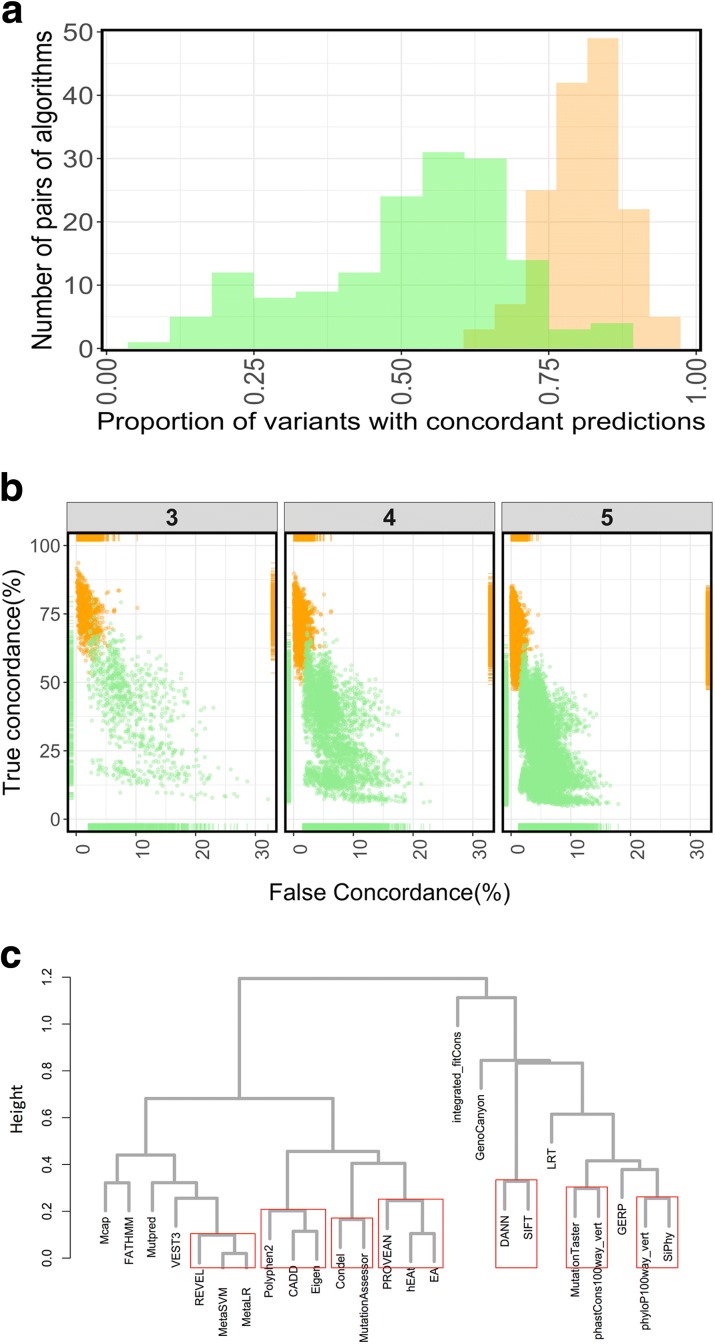
“All the largely evolutionary conservation algorithms such as phyloP [25], phastCons [26], GERP [27], and Siphy [28] belong to different clusters from the metapredictors REVEL, MetaSVM, and MetaLR (Fig.”
MethodMutationTaster evaluates disease-causing potential of sequence alterations
Schwarz, J. M., Rödelsperger, C., Schuelke, M., & Seelow, D. (2010) · Nature Methods · doi:10.1038/nmeth0810-575 · Cited by 2,975
REVEL: An Ensemble Method for Predicting the Pathogenicity of Rare Missense Variants
Ioannidis, N. M., Rothstein, J. H., Pejaver, V., Middha, S., McDonnell, S. K., Baheti, S., Musolf, A., Li, Q., Holzinger, E., Karyadi, D., et al. (2016) · The American Journal of Human Genetics · doi:10.1016/j.ajhg.2016.08.016 · Cited by 2,908
Predicting the Functional Effect of Amino Acid Substitutions and Indels
Choi, Y., Sims, G. E., Murphy, S., Miller, J. R., & Chan, A. P. (2012) · PLoS ONE · doi:10.1371/journal.pone.0046688 · Cited by 2,890
ClinVar: public archive of interpretations of clinically relevant variants
Landrum, M. J., Lee, J. M., Benson, M., Brown, G., Chao, C., Chitipiralla, S., Gu, B., Hart, J., Hoffman, D., Hoover, J., et al. (2016) · Nucleic Acids Research · doi:10.1093/nar/gkv1222 · Cited by 2,758
Pvclust: an R package for assessing the uncertainty in hierarchical clustering
Suzuki, R., & Shimodaira, H. (2006) · Bioinformatics · doi:10.1093/bioinformatics/btl117 · Cited by 2,482
dendextend: an R package for visualizing, adjusting and comparing trees of hierarchical clustering
Galili, T. (2015) · Bioinformatics · doi:10.1093/bioinformatics/btv428 · Cited by 1,826
Identifying a High Fraction of the Human Genome to be under Selective Constraint Using GERP++
Davydov, E. V., Goode, D. L., Sirota, M., Cooper, G. M., Sidow, A., & Batzoglou, S. (2010) · PLoS Computational Biology · doi:10.1371/journal.pcbi.1001025 · Cited by 1,757
Distribution and intensity of constraint in mammalian genomic sequence
Cooper, G. M., Stone, E. A., Asimenos, G., Green, E. D., Batzoglou, S., & Sidow, A. (2005) · Genome Research · doi:10.1101/gr.3577405 · Cited by 1,359
Shihab, H. A., Gough, J., Cooper, D. N., Stenson, P. D., Barker, G., Edwards, K. J., Day, I. N. M., & Gaunt, T. R. (2012) · Human Mutation · doi:10.1002/humu.22225 · Cited by 1,353
Dong, C., Wei, P., Jian, X., Gibbs, R. A., Boerwinkle, E., Wang, K., & Liu, X. (2014) · Human Molecular Genetics · doi:10.1093/hmg/ddu733 · Cited by 1,151
Liu, X., Wu, C., Li, C., & Boerwinkle, E. (2015) · Human Mutation · doi:10.1002/humu.22932 · Cited by 977
Jagadeesh, K. A., Wenger, A. M., Berger, M. J., Guturu, H., Stenson, P. D., Cooper, D. N., Bernstein, J. A., & Bejerano, G. (2016) · Nature Genetics · doi:10.1038/ng.3703 · Cited by 852
dbNSFP: A lightweight database of human nonsynonymous SNPs and their functional predictions
Liu, X., Jian, X., & Boerwinkle, E. (2011) · Human Mutation · doi:10.1002/humu.21517 · Cited by 834
Automated inference of molecular mechanisms of disease from amino acid substitutions
Li, B., Krishnan, V. G., Mort, M. E., Xin, F., Kamati, K. K., Cooper, D. N., Mooney, S. D., & Predrag Radivojac, A. (2009) · Bioinformatics · doi:10.1093/bioinformatics/btp528 · Cited by 818
González-Pérez, A., & López-Bigas, N. (2011) · The American Journal of Human Genetics · doi:10.1016/j.ajhg.2011.03.004 · Cited by 772
Tavtigian, S. V., Deffenbaugh, A. M., Yin, L., Judkins, T., Scholl, T., Samollow, P. B., de Silva, D., Zharkikh, A., & Thomas, A. (2005) · Journal of Medical Genetics · doi:10.1136/jmg.2005.033878 · Cited by 665
A spectral approach integrating functional genomic annotations for coding and noncoding variants
Ionita‐Laza, I., McCallum, K., Xu, B., & Buxbaum, J. D. (2016) · Nature Genetics · doi:10.1038/ng.3477 · Cited by 602
Identifying Mendelian disease genes with the Variant Effect Scoring Tool
Carter, H. K., Douville, C. B., Stenson, P. D., Cooper, D. N., & Karchin, R. (2013) · BMC Genomics · doi:10.1186/1471-2164-14-s3-s3 · Cited by 593
Amendola, L. M., Jarvik, G. P., Leo, M. C., McLaughlin, H. M., Akkari, Y. M. N., Amaral, M. D., Berg, J. S., Biswas, S., Bowling, K. M., Conlin, L. K., et al. (2016) · The American Journal of Human Genetics · doi:10.1016/j.ajhg.2016.03.024 · Cited by 572
Self-citationPerformance of mutation pathogenicity prediction methods on missense variants
Thusberg, J., Olatubosun, A., & Vihinen, M. (2011) · Human Mutation · doi:10.1002/humu.21445 · Cited by 537
Sawyer, S. L., Hartley, T., Dyment, D. A., Beaulieu, C. L., Schwartzentruber, J., Smith, A. C., Bedford, H. M., Bernard, G., Bernier, F. P., Brais, B., et al. (2015) · Clinical Genetics · doi:10.1111/cge.12654 · Cited by 384
Identifying novel constrained elements by exploiting biased substitution patterns
Garber, M., Guttman, M., Clamp, M., Zody, M. C., Friedman, N., & Xie, X. (2009) · Bioinformatics · doi:10.1093/bioinformatics/btp190 · Cited by 370
Grimm, D. G., Azencott, C., Aicheler, F., Gieraths, U., MacArthur, D. G., Samocha, K. E., Cooper, D. N., Stenson, P. D., Daly, M. J., Smoller, J. W., et al. (2015) · Human Mutation · doi:10.1002/humu.22768 · Cited by 356
Natural Selection on Genes that Underlie Human Disease Susceptibility
Blekhman, R., Man, O., Herrmann, L., Boyko, A. R., Indap, A. R., Kosiol, C., Bustamante, C. D., Teshima, K. M., & Przeworski, M. (2008) · Current Biology · doi:10.1016/j.cub.2008.04.074 · Cited by 233
Hicks, S., Wheeler, D. A., Plon, S. E., & Kimmel, M. (2011) · Human Mutation · doi:10.1002/humu.21490 · Cited by 223
Self-citationAn informatics approach to analyzing the incidentalome
Berg, J., Adams, M. C., Nassar, N., Bizon, C., Lee, K., Schmitt, C., Wilhelmsen, K., & Evans, J. P. (2012) · Genetics in Medicine · doi:10.1038/gim.2012.112 · Cited by 175
Single-nucleotide evolutionary constraint scores highlight disease-causing mutations
Cooper, G. M., Goode, D. L., Ng, S. B. H., Sidow, A., Bamshad, M. J., Shendure, J., & Nickerson, D. A. (2010) · Nature Methods · doi:10.1038/nmeth0410-250 · Cited by 170
Amendola, L. M., Jarvik, G. P., Leo, M. C., McLaughlin, H. M., Akkari, Y. M. N., Amaral, M. D., Berg, J. S., Biswas, S., Bowling, K. M., Conlin, L. K., et al. (2016) · The American Journal of Human Genetics · doi:10.1016/j.ajhg.2016.06.001 · Cited by 142
Self-citationKatsonis, P., & Lichtarge, O. (2014) · Genome Research · doi:10.1101/gr.176214.114 · Cited by 137
Maxwell, K. N., Hart, S. N., Vijai, J., Schrader, K. A., Slavin, T. P., Thomas, T., Wubbenhorst, B. S., Ravichandran, V., Moore, R. M., Hu, C., et al. (2016) · The American Journal of Human Genetics · doi:10.1016/j.ajhg.2016.02.024 · Cited by 129
Bailey, J. N., Patterson, C., de Nijs, L., Durón, R. M., Nguyen, V.-H. V., Tanaka, M., Medina, M. T., Jara‐Prado, A., Martínez-Juárez, I. E., Ochoa, A., et al. (2016) · Genetics in Medicine · doi:10.1038/gim.2016.86 · Cited by 33
Ghosh, R., Oak, N., & Plon, S. E. (2017) · Zenodo (CERN European Organization for Nuclear Research) · doi:10.5281/zenodo.1009575 · Cited by 1
Self-citation
Cited by
Sorted by citations
CADD: predicting the deleteriousness of variants throughout the human genome
Rentzsch, P., Witten, D., Cooper, G. M., Shendure, J., & Kircher, M. (2019) · Nucleic Acids Research · doi:10.1093/nar/gky1016 · Cited by 3,534
Accurate classification of BRCA1 variants with saturation genome editing
Findlay, G. M., Daza, R. M., Martin, B., Zhang, M. D., Leith, A. P., Gasperini, M., Janizek, J. D., Huang, X., Starita, L. M., & Shendure, J. (2018) · Nature · doi:10.1038/s41586-018-0461-z · Cited by 843
Pejaver, V., Byrne, A. B., Feng, B.-J., Pagel, K. A., Mooney, S. D., Karchin, R., O’Donnell-Luria, A., Harrison, S. M., Tavtigian, S. V., Greenblatt, M. S., et al. (2022) · The American Journal of Human Genetics · doi:10.1016/j.ajhg.2022.10.013 · Cited by 589
Self-citationExpert specification of the ACMG/AMP variant interpretation guidelines for genetic hearing loss
Oza, A. M., DiStefano, M. T., Hemphill, S. E., Cushman, B. J., Grant, A. R., Siegert, R. K., Shen, J., Chapin, A., Boczek, N. J., Schimmenti, L. A., et al. (2018) · Human Mutation · doi:10.1002/humu.23630 · Cited by 487
Horak, P., Griffith, M., Danos, A. M., Pitel, B. A., Madhavan, S., Liu, X., Chow, C., Williams, H. E., Carmody, L., Barrow-Laing, L., et al. (2022) · Genetics in Medicine · doi:10.1016/j.gim.2022.01.001 · Cited by 268
Self-citation
Metadata
- Authors
- Ghosh, R., Oak, N., & Plon, S. E.
- Affiliations
- Baylor College of Medicine (US)
- Venue
- Genome biology
- Published
- 2017-11-28
- Volume
- 18
- Issue
- 1
- Pages
- 225-225
- ISSN
- 1465-6906 (ISSN-L)
- 1474-760X
- PMC
- PMC5704597
- OpenAlex
- W2949886398
- Cited by
- 233
- References
- 41
- Citations by year
- 2026: 16 · 2025: 22 · 2024: 20 · 2023: 24 · 2022: 31 · 2021: 30 · 2020: 30 · 2019: 36 · 2018: 22 · 2017: 1
- FWCI
- 16.16
- Type
- journal article
- Language
- en
- Open access
- gold
- doi.org
- Locations
- Genome biology (publishedVersion, cc-by)
- bioRxiv (Cold Spring Harbor Laboratory) (acceptedVersion, cc-by)
- Europe PMC (PubMed Central) (publishedVersion, cc-by)
- PubMed Central (publishedVersion, cc-by)
- PubMed (publishedVersion)
- DOAJ (DOAJ: Directory of Open Access Journals) (submittedVersion)
- Funders
- National Human Genome Research Institute (5 U01 HG007436)
- Topics
- Life Sciences › Biochemistry, Genetics and Molecular Biology › Genetics › Genomics and Rare Diseases
- Life Sciences › Biochemistry, Genetics and Molecular Biology › Genetics › Genetic Associations and Epidemiology
- Life Sciences › Biochemistry, Genetics and Molecular Biology › Molecular Biology › Genomics and Phylogenetic Studies
- Keywords
- clinical variant interpretation, missense mutations, ClinVar, pathogenic variants, benign variants, disease mechanisms, mode of inheritance, algorithm comparison
- MeSH terms
- Algorithms, Humans, Software, Genetic Variation, Reproducibility of Results, Genome, Human, Guidelines as Topic, Computational Biology, Databases, Genetic, Genetic Association Studies
About these checks
Registry, retraction, Cites and statistics results are computed, not judged, with one exception: a printed reference that no index lists is read once by a model before it counts as a citation error. Claims are extracted by a model and kept only when their quote appears verbatim in the text; each cited source is then checked, with a model’s help, for whether it says what the claim relies on. Those verdicts can be wrong — read the claim’s quote and the cited source before relying on one.
Statistics and arithmetic are recomputed, not judged.
Confidence bands are shown only for fields calibrated on our annotated test set. None is calibrated yet, so no band is shown.
What counts as a claim ›How we measure confidence ›How we check this ›
Are you an author, or do you see a problem with this page? Request a review
