

RefSeq database growth influences the accuracy of k-mer-based lowest common ancestor species identification
Open accessPublished version of a preprint
The DOI matches its Crossref record; 52 of the 54 references it cites were found in a registry or an index.
Abstract
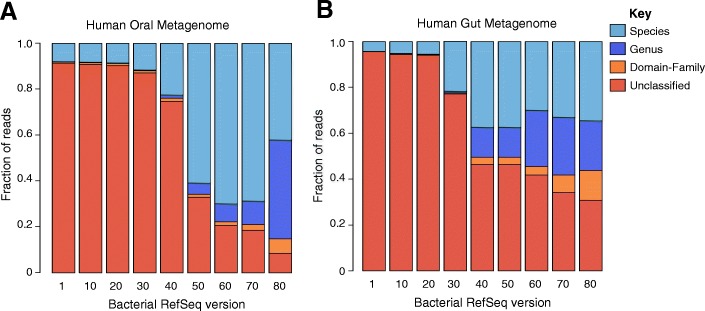
Accurate species-level taxonomic classification and profiling of complex microbial communities remains a challenge due to homologous regions shared among closely related species and a sparse representation of non-human associated microbes in the database. Although the database undoubtedly has a strong influence on the sensitivity of taxonomic classifiers and profilers, to date, no study has carefully explored this topic on historical RefSeq releases and explored its impact on accuracy. In this study, we examined the influence of the database, over time, on k -mer based sequence classification and profiling. We present three major findings: ( i ) database growth over time resulted in more classified reads, but fewer species-level classifications and more species-level misclassifications; ( ii ) Bayesian re-estimation of abundance helped to recover species-level classifications when the exact target strain was present; and ( iii ) Bayesian reestimation struggled when the database lacked the target strain, resulting in a notable decrease in accuracy. In summary, our findings suggest that the growth of RefSeq over time has strongly influenced the accuracy of k -mer based classification and profiling methods, resulting in different classification results depending on the particular database used. These results suggest a need for new algorithms specially adapted for large genome collections and better measures of classification uncertainty.
Overview
The claims and statistics of this paper haven’t been checked yet.
Free: it reads the open-access text and checks the first 5 claims that cite a source we can check. Create a free account to check every claim.
Integrity signals
Registry
Cites
Statistics
Figures
Verification
Claims the paper makes
The claims and statistics of this paper haven’t been checked yet.
Free: it reads the open-access text and checks the first 5 claims that cite a source we can check. Create a free account to check every claim.
Claims other papers make about this one
Each is checked against this paper’s own text: does it say what the citing paper says it does?
In the citing paper
“As genome reference databases expand, historical, microbiology-based taxonomic assignments do not reflect population-level relationships inferred from genome sequencing.”
From Gut microbiome stability and dynamics in healthy donors and patients with non-gastrointestinal cancers (2021) · cites this paper as Nasko et al., 2018
Self-check
Percentages, sums and reported differences re-computed from the paper’s own numbers.
The self-check needs the paper’s full text.
Citations
Cites
Trimmomatic: a flexible trimmer for Illumina sequence data
Bolger, A. M., Lohse, M., & Usadel, B. (2014) · Bioinformatics · doi:10.1093/bioinformatics/btu170 · Cited by 65,548 · cited 1×
“0.23 (leading:20, trailing:20, slidingwindow:4:30 minlen:40) [40].”
InfluentialQIIME allows analysis of high-throughput community sequencing data
Caporaso, J. G., Kuczynski, J., Stombaugh, J., Bittinger, K., Bushman, F. D., Costello, E. K., Fierer, N., Peña, A. G., Goodrich, J. K., Gordon, J. I., et al. (2010) · Nature Methods · doi:10.1038/nmeth.f.303 · Cited by 34,887 · cited 1×
“MacQIIME 1.9.1-20150604) [41].”
InfluentialStructure, function and diversity of the healthy human microbiome
The Human Microbiome Project Consortium (2012) · Nature · doi:10.1038/nature11234 · Cited by 11,726 · cited 1×
“To assess classification trends in real metagenomic data, two shotgun metagenomes were used: a fecal metagen-ome (SRS105153) and oral metagenome (SRS050029) from the Human Microbiome Project [37].”
MethodNear-optimal probabilistic RNA-seq quantification
Bray, N. L., Pimentel, H., Melsted, P., & Pachter, L. (2016) · Nature Biotechnology · doi:10.1038/nbt.3519 · Cited by 9,723 · cited 1×
“Lastly, alternative approaches to traditional k-mer-based LCA identification methods, such as those featured within KrakenHLL [23], Kallisto [35], and DUDes [36], will be required to maximize the benefit of longer reads coupled with ever-increasing reference sequence databases and improve sequence classification accur…”
MethodShifting the genomic gold standard for the prokaryotic species definition
Richter, M., & Rosselló-Móra, R. (2009) · Proceedings of the National Academy of Sciences · doi:10.1073/pnas.0906412106 · Cited by 6,359 · cited 1×
“This, coupled with an often ambiguous species concept in microbial genomes due to horizontal gene transfer and mobile elements [27, 28], brings into question the reliance on the current taxonomic structure for assigning names to microbes sequenced and identified in metagenomic samples.”
BackgroundUniProt: a hub for protein information
The UniProt Consortium (2015) · Nucleic Acids Research · doi:10.1093/nar/gku989 · Cited by 5,106
Kraken: ultrafast metagenomic sequence classification using exact alignments
Wood, D. E., & Salzberg, S. L. (2014) · Genome Biology · doi:10.1186/gb-2014-15-3-r46 · Cited by 4,521
A standardized bacterial taxonomy based on genome phylogeny substantially revises the tree of life
Parks, D. H., Chuvochina, M., Waite, D. W., Rinke, C., Skarshewski, A., Chaumeil, P.-A., & Hugenholtz, P. (2018) · Nature Biotechnology · doi:10.1038/nbt.4229 · Cited by 3,603
MEGAN analysis of metagenomic data
Huson, D. H., Auch, A. F., Qi, J., & Schuster, S. C. (2007) · Genome Research · doi:10.1101/gr.5969107 · Cited by 3,312
Bracken: estimating species abundance in metagenomics data
(2016) · doi:10.7717/peerj-cs.104 · Cited by 2,333 · cited 3×
“Bracken, a Bayesian method that refines Kraken results, is capable of estimating how much of each species is present among a set of ambiguous species classifications by probabilistically re-distributing reads in a taxonomic tree [10].”
BackgroundMethodInfluential
Research works printed but not linked: 1
- NBACC. Genome sequencing and assembly of 11 Bacillus cereus sensu lato isolates from various quarters of the International Space Station. [Data set] https://www.ncbi.nlm.nih.gov/sra/?term=SRR3954740. Accessed 13 July 2018.
Cited by
Szklarczyk, D., Kirsch, R., Koutrouli, M., Nastou, K., Mehryary, F., Hachilif, R., Gable, A. L., Fang, T., Doncheva, N. T., Pyysalo, S., et al. (2023) · Nucleic Acids Research · doi:10.1093/nar/gkac1000 · Cited by 9,726
“However, new genomes are sequenced and assembled daily, and existing genomes are re-sequenced or reannotated; overall, the number of taxonomically distinct species that are being sequenced has been doubling roughly every 3 years (56).”
BackgroundLi, W., O’Neill, K. R., Haft, D. H., DiCuccio, M., Chetvernin, V., Badretdin, A., Coulouris, G., Chitsaz, F., Derbyshire, M. K., Durkin, A. S., et al. (2021) · Nucleic Acids Research · doi:10.1093/nar/gkaa1105 · Cited by 1,116
“This poses a challenge for some uses, such as sequence homology searching, or k -mer indexing (20,21).”
MethodMetagenome analysis using the Kraken software suite
Lu, J., Rincon, N., Wood, D. E., Breitwieser, F. P., Pockrandt, C., Langmead, B., Salzberg, S. L., & Steinegger, M. (2022) · Nature Protocols · doi:10.1038/s41596-022-00738-y · Cited by 756
Benchmarking Metagenomics Tools for Taxonomic Classification
Ye, S. H., Siddle, K. J., Park, D. J., & Sabeti, P. C. (2019) · Cell · doi:10.1016/j.cell.2019.07.010 · Cited by 593
“The growth of reference databases such as RefSeq can result in methods changing performance characteristics over time, as exemplified by the decrease in accuracy of k-mer based methods (Nasko et al., 2018).”
MethodBaseline human gut microbiota profile in healthy people and standard reporting template
King, C. H., Desai, H., Sylvetsky, A. C., LoTempio, J., Ayanyan, S., Carrie, J., Crandall, K. A., Fochtman, B. C., Gasparyan, L., Gulzar, N., et al. (2019) · PLOS ONE · doi:10.1371/journal.pone.0206484 · Cited by 235
Sunbeam: an extensible pipeline for analyzing metagenomic sequencing experiments
Clarke, E. L., Taylor, L. J., Zhao, C., Connell, A., Lee, J.-J., Fett, B., Bushman, F. D., & Bittinger, K. (2019) · Microbiome · doi:10.1186/s40168-019-0658-x · Cited by 217
Nanopore sequencing and its application to the study of microbial communities
Ciuffreda, L., Rodríguez-Pérez, H., & Flores, C. (2021) · Computational and Structural Biotechnology Journal · doi:10.1016/j.csbj.2021.02.020 · Cited by 196
Marcelino, V. R., Clausen, P. T. L. C., Buchmann, J. P., Wille, M., Iredell, J. R., Meyer, W., Lund, O., Sorrell, T. C., & Holmes, E. C. (2020) · Genome Biology · doi:10.1186/s13059-020-02014-2 · Cited by 185
Strain-level metagenomic assignment and compositional estimation for long reads with MetaMaps
Dilthey, A. T., Jain, C., Koren, S., & Phillippy, A. M. (2019) · Nature Communications · doi:10.1038/s41467-019-10934-2 · Cited by 169
Self-citationPearman, W. S., Freed, N. E., & Silander, O. K. (2020) · BMC Bioinformatics · doi:10.1186/s12859-020-3528-4 · Cited by 114
“Novel statistical approaches, such as Bayesian re-estimation of species frequencies, may mitigate the problem (21); however, improved methods are required to address this problem (36).”
Exploring bacterial diversity via a curated and searchable snapshot of archived DNA sequences
Blackwell, G. A., Hunt, M., Malone, K. M., Lima, L., Horesh, G., Alako, B. T. F., Thomson, N. R., & Iqbal, Z. (2021) · PLOS Biology · doi:10.1371/journal.pbio.3001421 · Cited by 111
“coli, which is based on clinical imperative rather than a true taxonomic distinction [15,16].”
BackgroundMetagenomics: a path to understanding the gut microbiome
Yen, S., & Johnson, J. S. (2021) · Mammalian Genome · doi:10.1007/s00335-021-09889-x · Cited by 104
Metagenomic profiling pipelines improve taxonomic classification for 16S amplicon sequencing data
Odom-Mabey, A. R., Faits, T., Castro‐Nallar, E., Crandall, K. A., & Johnson, W. E. (2023) · Scientific Reports · doi:10.1038/s41598-023-40799-x · Cited by 109
Ten common issues with reference sequence databases and how to mitigate them
Chorlton, S. D. (2024) · Frontiers in Bioinformatics · doi:10.3389/fbinf.2024.1278228 · Cited by 116
In Silico Toxicology Data Resources to Support Read-Across and (Q)SAR
Pawar, G. V., Madden, J. C., Ebbrell, D. J., Firman, J. W., & Cronin, M. (2019) · Frontiers in Pharmacology · doi:10.3389/fphar.2019.00561 · Cited by 100
“RefSeq (Nasko et al., 2018) is a comprehensive, integrated, non-redundant, well-annotated set of sequences, including genomic DNA, 20,905,608 transcripts, and 100,043,962 proteins, and 73,996 organisms.”
Backgroundganon: precise metagenomics classification against large and up-to-date sets of reference sequences
Piro, V. C., Dadi, T. H., Seiler, E., Reinert, K., & Renard, B. Y. (2020) · Bioinformatics · doi:10.1093/bioinformatics/btaa458 · Cited by 87
Lightweight compositional analysis of metagenomes with FracMinHash and minimum metagenome coversPreprint
Irber, L. C., Brooks, P., Reiter, T. E., Pierce‐Ward, N. T., Hera, M. R., Koslicki, D., & Brown, C. T. (2022) · bioRxiv (Cold Spring Harbor Laboratory) · doi:10.1101/2022.01.11.475838 · Cited by 81
Byrd, A. L., Liu, M., Fujimura, K. E., Lyalina, S., Nagarkar, D. R., Charbit, B., Bergstedt, J., Patin, E., Harrison, O. J., Quintana-Murci, L., et al. (2021) · Journal of Experimental Medicine · doi:10.1084/jem.20200606 · Cited by 63
“This is particularly problematic for k-mer–based analyses, which use sequence similarity between closely related genomes to infer which taxa are present (Nasko et al., 2018).”
BackgroundSrinivas, M., O’Sullivan, Ó., Cotter, P. D., van Sinderen, D., & Kenny, J. G. (2022) · Foods · doi:10.3390/foods11203297 · Cited by 75
“However, as databases expand with a high number of metagenomic studies being conducted currently, assembly-free methods will need to be redesigned to enable their application with such large datasets [141,142].”
BackgroundStability and dynamics of the human gut microbiome and its association with systemic immune traits
(2020) · doi:10.1101/2020.01.17.909853 · Cited by 63
Alser, M., Lindegger, J., Fırtına, C., Alserr, N. A., Mao, H., Singh, G., Gómez-Luna, J., & Mutlu, O. (2022) · Computational and Structural Biotechnology Journal · doi:10.1016/j.csbj.2022.08.019 · Cited by 89
“There are also a large number of reference genome sequences, as FASTA files, for more than 108,257 distinct organisms publicly available in the NCBI Reference Sequence Database (RefSeq) database [73], which is doubling in the number of organisms every 3 years [74].”
BackgroundGschwind, R., Fournier, T., Kennedy, S., Tsatsaris, V., Cordier, A., Barbut, F., Butel, M., & Wydau-Dematteis, S. (2020) · PLoS ONE · doi:10.1371/journal.pone.0237232 · Cited by 73
“Earlier versions of the RefSeq catalog were reconstructed following the procedure described previously [37].”
MethodKMCP: accurate metagenomic profiling of both prokaryotic and viral populations by pseudo-mapping
Shen, W., Xiang, H., Huang, T., Tang, H. D., Peng, M., Cai, D., Hu, P., & Ren, H. G. (2022) · Bioinformatics · doi:10.1093/bioinformatics/btac845 · Cited by 60
“And the taxonomic assignment algorithm based on the Lowest Common Ancestor (LCA) often has low accuracy at low taxonomic ranks due to closely related species sharing a large fraction of k-mers, and further decreasing with the increasing number of reference genomes [18].”
BackgroundMethodSmith, R. H., Glendinning, L., Walker, A. W., & Watson, M. (2022) · Animal Microbiome · doi:10.1186/s42523-022-00207-7 · Cited by 77
“demonstrated that classification accuracy is impacted by the version of the 92 popular publicly available sequence database [33] RefSeq that is used [34], and Marcelino 93”
MethodContamination in Reference Sequence Databases: Time for Divide-and-Rule Tactics
Lupo, V., Vlierberghe, M. V., Vanderschuren, H., Kerff, F., Baurain, D., & Cornet, L. (2021) · Frontiers in Microbiology · doi:10.3389/fmicb.2021.755101 · Cited by 61
“, 2018), not only because this resource is frequently used by many researchers (Nasko et al., 2018), but also because it has been reported to be affected by sequence contamination (Cornet et al.”
BackgroundParks, D. H., Rigato, F., Vera-Wolf, P., Krause, L., Hugenholtz, P., Tyson, G. W., & Wood, D. (2021) · Frontiers in Microbiology · doi:10.3389/fmicb.2021.643682 · Cited by 57
Bai, D., Chen, T., Xun, J., Ma, C., Luo, H., Yang, H., Cao, C., Cao, X., Cui, J., Deng, Y., et al. (2025) · iMeta · doi:10.1002/imt2.70001 · Cited by 65
“Each of these tools or R packages has multiple parameters or reference databases that can influence the final output and downstream analysis, presenting a challenge to comparability and reproducibility across studies [29, 30].”
Simplitigs as an efficient and scalable representation of de Bruijn graphs
Břinda, K., Baym, M., & Kucherov, G. (2021) · Genome biology · doi:10.1186/s13059-021-02297-z · Cited by 67
“While the growth of public databases negatively impacts the accuracy of algorithms using inexact representations (e.g., those based on LCA) [90], simplitigs provide a promising solution offering both exactness and scalability.”
BackgroundDe novo identification of microbial contaminants in low microbial biomass microbiomes with Squeegee
Liu, Y., Elworth, R. A. L., Jochum, M. D., Aagaard, K. M., & Treangen, T. J. (2022) · Nature Communications · doi:10.1038/s41467-022-34409-z · Cited by 48
Self-citationBell, K. L., Petit, R. A., Cutler, A. J., Dobbs, E. K., Macpherson, J. M., Read, T. D., Burgess, K. S., & Brosi, B. J. (2021) · Ecology and Evolution · doi:10.1002/ece3.8281 · Cited by 43
“As more genome sequence data become available and reference genome quality improves, false- negative and false- positive reads in WGS are likely to diminish, as has been recorded for bacterial metagenomics (Nasko et al., 2018).”
BackgroundMinot, S. S., & Willis, A. D. (2019) · Microbiome · doi:10.1186/s40168-019-0722-6 · Cited by 46
“Taxonomic analysis is constrained by the 78 size and quality of reference databases, which have started to provide decreasing taxonomic 79 precision as the number of sequenced genomes grows [1].”
BackgroundMetabuli: sensitive and specific metagenomic classification via joint analysis of amino acid and DNA
Kim, J., & Steinegger, M. (2024) · Nature Methods · doi:10.1038/s41592-024-02273-y · Cited by 50
Microbiota and kidney disease: the road ahead
Bloom, P. P., Garrett, W. S., Penniston, K. L., Winkler, M. K. H., Hazen, S. L., Agudelo, J., Suryavanshi, M. V., Babiker, A. Y. M., Dodd, D., Fischbach, M. A., et al. (2025) · Nature Reviews Nephrology · doi:10.1038/s41581-025-00988-5 · Cited by 55
“…amplicon sequence variant (ASV; that is, sequences unique to the nucleotide level) instead of operational taxonomic units (OTUs; that is, clusters of similar sequences, often with 97% similarity threshold)-based clustering approaches may improve accuracy and reproducibility across studies 56,57 .”
Cornet, L., Cleenwerck, I., Praet, J., Léonard, R. R., Vereecken, N. J., Michez, D., Smagghe, G. J., Baurain, D., & Vandamme, P. A. R. (2022) · mSystems · doi:10.1128/msystems.01500-21 · Cited by 45
“To this end, all Snodgrassella genomes from the Reference Sequence database of NCBI (RefSeq) (61, 62) were downloaded on 25 June 2021.”
MethodSong, L., & Langmead, B. (2024) · Genome biology · doi:10.1186/s13059-024-03244-4 · Cited by 50
“No.”
Sanderson, N. D., Swann, J., Barker, L., Kavanagh, J., Hoosdally, S., Crook, D. W., the GonFast Investigators Group, Street, T. L., & Eyre, D. W. (2020) · Genome Research · doi:10.1101/gr.262865.120 · Cited by 40
“of reads, there is a risk of missing regions of the genome by filtering reads that assign to a lower taxon (Nasko et al. 2018).”
BackgroundStruo: a pipeline for building custom databases for common metagenome profilers
de la Cuesta-Zuluaga, J., Ley, R. E., & Youngblut, N. D. (2020) · Bioinformatics · doi:10.1093/bioinformatics/btz899 · Cited by 36
SPUMONI 2: improved classification using a pangenome index of minimizer digests
Ahmed, O., Rossi, M., Gagie, T., Boucher, C. A., & Langmead, B. (2023) · Genome biology · doi:10.1186/s13059-023-02958-1 · Cited by 52
“On the other hand, larger genomic databases have been shown to affect k -mer based approaches due to decreasing levels of k -mer specificity [22].”
BackgroundA critical assessment of gene catalogs for metagenomic analysis
Commichaux, S., Shah, N., Ghurye, J., Stoppel, A., Goodheart, J. A., Luque, G. G., Cummings, M. P., & Pop, M. (2021) · Bioinformatics · doi:10.1093/bioinformatics/btab216 · Cited by 35
LEMMI: a continuous benchmarking platform for metagenomics classifiers
Seppey, M., Manni, M., & Zdobnov, E. M. (2020) · Genome Research · doi:10.1101/gr.260398.119 · Cited by 42
“S6; Nasko et al. 2018).”
Correcting index databases improves metagenomic studies
Méric, G., Wick, R. R., Watts, S. C., Holt, K. E., & Inouye, M. (2019) · doi:10.1101/712166 · Cited by 34
“Recent efforts showed that the addition of new genomes to NCBI RefSeq could influence 72 metagenomic classification performance, with indices built on most recent releases of NCBI RefSeq 73 able to classify more reads overall, but fewer at the species level [20].”
BackgroundTIPP2: metagenomic taxonomic profiling using phylogenetic markers
Shah, N., Molloy, E. K., Pop, M., & Warnow, T. J. (2021) · Bioinformatics · doi:10.1093/bioinformatics/btab023 · Cited by 34
Chopyk, J., Nasko, D. J., Allard, S. M., Bui, A. Q., Treangen, T. J., Pop, M., Mongodin, E. F., & Sapkota, A. R. (2019) · Water Research · doi:10.1016/j.watres.2019.115250 · Cited by 35
Self-citationImproving the usability and comprehensiveness of microbial databases
Loeffler, C., Karlsberg, A., Martin, L. S., Eskin, E., Koslicki, D., & Mangul, S. (2020) · BMC Biology · doi:10.1186/s12915-020-0756-z · Cited by 37
Efficient and robust search of microbial genomes via phylogenetic compression
Břinda, K., Lima, L., Pignotti, S., Quinones‐Olvera, N., Salikhov, K., Chikhi, R., Kucherov, G., Iqbal, Z., & Baym, M. (2025) · Nature Methods · doi:10.1038/s41592-025-02625-2 · Cited by 43
Tian, Q., Zhang, P., Zhai, Y., Wang, Y., & Zou, Q. (2024) · Genome Biology and Evolution · doi:10.1093/gbe/evae102 · Cited by 28
“Moreover, while all the database methods utilized NCBI’s public reference database, we modified it by removing certain species to allow ML methods a chance to showcase their strengths (Nasko et al. 2018).”
MethodKeeping up with the genomes: efficient learning of our increasing knowledge of the tree of life
Zhao, Z., Cristian, A., & ROSEN, G. L. (2020) · BMC Bioinformatics · doi:10.1186/s12859-020-03744-7 · Cited by 30
Nõlvak, H., Dang, N. P., Truu, M., Peeb, A., Tiirik, K., O’Sadnick, M., & Truu, J. (2021) · Microorganisms · doi:10.3390/microorganisms9122425 · Cited by 31
“These taxa are represented by disproportionally high numbers of closely related reference sequences in databases (especially Pseudomonas in Standard Kraken2 and MARDB and Cycloclasticus in MARDB), leading to oversampling and the decreased accuracy of classifiers [48].”
BackgroundSunbeam: an extensible pipeline for analyzing metagenomic sequencing experimentsPreprint
Clarke, E., Taylor, L. J., Zhao, C., Connell, A. J., Lee, J., Fett, B., Bushman, F. D., & Bittinger, K. L. (2018) · bioRxiv (Cold Spring Harbor Laboratory) · doi:10.1101/326363 · Cited by 26
Stamouli, S., Beber, M. E., Normark, T., Christensen, T. A., Li, L., Borry, M., Jamy, M., community, N.-C., & Yates, J. A. F. (2023) · bioRxiv (Cold Spring Harbor Laboratory) · doi:10.1101/2023.10.20.563221 · Cited by 36
The landscape of microbial associations in human cancer
Gihawi, A., Wood, H. M., Clark, J., O’Grady, J., Eeles, R. A., Wedge, D. C., Jakobsdottir, G. M., Magiorkinis, G., Schache, A. G., Masterson, L. M., et al. (2025) · Science Translational Medicine · doi:10.1126/scitranslmed.ads6166 · Cited by 29
Pérez‐Losada, M., Narayanan, D. B., Kolbe, A. R., Ramos-Tapia, I., Castro‐Nallar, E., Crandall, K. A., & Domínguez, J. (2022) · Frontiers in Microbiology · doi:10.3389/fmicb.2022.854423 · Cited by 28
Towards standardized and reproducible research in skin microbiomes
Ruuskanen, M. O., Vats, D., Potbhare, R., RaviKumar, A., Munukka, E., Ashma, R., & Lahti, L. (2022) · Environmental Microbiology · doi:10.1111/1462-2920.15945 · Cited by 27
“ing enables the identification of new species for improving reference databases (Nasko et al., 2018).”
BackgroundCONSULT: accurate contamination removal using locality-sensitive hashing
Rachtman, E., Bafna, V., & Mirarab, S. (2021) · NAR Genomics and Bioinformatics · doi:10.1093/nargab/lqab071 · Cited by 24
“A shortcoming of metagenomic tools is their reduced ability to match reads when evolutionary close species are not available in the reference set (40, 41, 42, 43).”
ContScout: sensitive detection and removal of contamination from annotated genomes
Bálint, B., Merényi, Z., Hegedüs, B., Grigoriev, I. V., Hou, Z., Földi, C., & Nagy, L. G. (2024) · Nature Communications · doi:10.1038/s41467-024-45024-5 · Cited by 28
Literature on Applied Machine Learning in Metagenomic Classification: A Scoping Review
Tonkovic, P., Kalajdziski, S., Zdravevski, E., Lameski, P., Corizzo, R., Pires, I. M., García, N. M., Lončar-Turukalo, T., & Trajkovik, V. (2020) · Biology · doi:10.3390/biology9120453 · Cited by 28
“Non-K-mer-Based Approaches One of the biggest weaknesses of k-mer-based classifiers is the weak scalability for large amounts of data [46], as the size of the data set influences both the training time and the accuracy of the models.”
BackgroundManaging false positives during detection of pathogen sequences in shotgun metagenomics datasets
Bradford, L. M., Carrillo, C. D., & Wong, A. (2024) · BMC Bioinformatics · doi:10.1186/s12859-024-05952-x · Cited by 27
“One growing concern with species-level identification is that, as reference databases grow, fewer reads can be classified at the species level when using k-mer-based taxonomic classifiers [44].”
geneshot: gene-level metagenomics identifies genome islands associated with immunotherapy response
Minot, S. S., Barry, K. C., Kasman, C., Golob, J. L., & Willis, A. D. (2021) · Genome biology · doi:10.1186/s13059-021-02355-6 · Cited by 19
“Identifying candidate mechanisms from observational studies is challenging because of the immense diversity of bacteria [1], the limitations of reference genome databases [2], widespread horizontal gene transfer [3], and the difficulty of accurately predicting the biological function of microbial genes [4].”
BackgroundInferring Species Compositions of Complex Fungal Communities from Long- and Short-Read Sequence Data
Hu, Y., Irinyi, L., Hoang, M. T. V., Eenjes, T., Graetz, A., Stone, E. A., Meyer, W., Schwessinger, B., & Rathjen, J. P. (2022) · mBio · doi:10.1128/mbio.02444-21 · Cited by 21
“Next to the right classification tool, chosen the appropriate database significantly influences 360 analysis outcomes [33,34].”
MethodGeneration of accurate, expandable phylogenomic trees with uDance
Balaban, M., Jiang, Y., Zhu, Q., McDonald, D. T., Knight, R. D., & Mirarab, S. (2023) · Nature Biotechnology · doi:10.1038/s41587-023-01868-8 · Cited by 25
“Because the accuracy of downstream microbiome analyses often depends on the density of the reference 39 , trees like this have the potential to improve downstream microbiome analyses.”
Uncovering the genomic and metagenomic research potential in old ethanol-preserved snakes
Zacho, C. M., Bager, M. A., Margaryan, A., Gravlund, P., Galatius, A., Rasmussen, A. R., & Allentoft, M. E. (2021) · PLoS ONE · doi:10.1371/journal.pone.0256353 · Cited by 20
Commichaux, S., Luan, T., Muralidharan, H. S., & Pop, M. (2024) · PLoS Computational Biology · doi:10.1371/journal.pcbi.1012343 · Cited by 22
Ghiasi, N. M., Sadrosadati, M., Mustafa, H., Gollwitzer, A., Fırtına, C., Eudine, J., Mao, H., Lindegger, J., Cavlak, M. B., Alser, M., et al. (2024) · Proceedings - International Symposium on Computer Architecture/Proceedings · doi:10.1109/isca59077.2024.00054 · Cited by 35
“For example, recent trends show the doubling of different important databases in only several months [25, 40, 42].”
BackgroundInfluentialAsim, M. N., Ibrahim, M. A., Asif, T., & Dengel, A. R. (2025) · Heliyon · doi:10.1016/j.heliyon.2024.e41488 · Cited by 21
Gihawi, A., Rallapalli, G., Hurst, R., Cooper, C. S., Leggett, R. M., & Brewer, D. S. (2019) · Genome biology · doi:10.1186/s13059-019-1819-8 · Cited by 20
“A recent study has shown that the increasing size of databases such as NCBI RefSeq has also resulted in more misclassified reads at species level with reliable classifications being pushed higher up the taxonomic tree [17].”
BackgroundExploring bacterial diversity via a curated and searchable snapshot of archived DNA sequencesPreprint
Blackwell, G. A., Hunt, M., Malone, K. M., Lima, L., Horesh, G., Alako, B., Thomson, N. R., & Iqbal, Z. (2021) · bioRxiv (Cold Spring Harbor Laboratory) · doi:10.1101/2021.03.02.433662 · Cited by 16
ganon2: up-to-date and scalable metagenomics analysis
Piro, V. C., & Reinert, K. (2025) · NAR Genomics and Bioinformatics · doi:10.1093/nargab/lqaf094 · Cited by 21
Chakoory, O., Comtet-Marre, S., & Peyret, P. (2022) · NAR Genomics and Bioinformatics · doi:10.1093/nargab/lqac070 · Cited by 16
“As closely related species share very similar or identical genome segments, short reads often map to multiple species in the reference dataset restraining classification efficiency (18).”
BackgroundMethodMarcelino, V. R., Clausen, P. T. L. C., Buchmann, J. P., Wille, M., Iredell, J. R., Meyer, W., Lund, O., Sorrell, T. C., & Holmes, E. C. (2019) · bioRxiv (Cold Spring Harbor Laboratory) · doi:10.1101/641332 · Cited by 15
Petit, R. A., Hogan, J. M., Ezewudo, M. N., Joseph, S. J., & Read, T. D. (2018) · PeerJ · doi:10.7717/peerj.5515 · Cited by 16
A primer and discussion on DNA-based microbiome data and related bioinformatics analyses
Douglas, G. M., & Langille, M. G. I. (2021) · Peer Community Journal · doi:10.24072/pcjournal.2 · Cited by 17
Large scale microbiome profiling in the cloud
Valdes, C., Stebliankin, V., & Narasimhan, G. (2019) · Bioinformatics · doi:10.1093/bioinformatics/btz356 · Cited by 12
Accelerating range minimum queries with ray tracing cores
Meneses, E., Navarro, C. A., Ferrada, H., & Quezada, F. A. (2024) · Future Generation Computer Systems · doi:10.1016/j.future.2024.03.040 · Cited by 21
The Naïve Bayes classifier++ for metagenomic taxonomic classification—query evaluation
Duan, H. (., Hearne, G., Robi Polikar, A., & ROSEN, G. L. (2024) · Bioinformatics · doi:10.1093/bioinformatics/btae743 · Cited by 12
“To assess a real sample, we again use the data from human gut sample analyzed in Nasko et al. (2018) and Zhao et al. (2020).”
Jurado-Rueda, F., Alonso, L., Perea-Chamblee, T. E., Elliott, O., Filip, I., Rabadán, R., & Malats, N. (2023) · Bioinformatics Advances · doi:10.1093/bioadv/vbad014 · Cited by 12
CONSULT-II: accurate taxonomic identification and profiling using locality-sensitive hashing
Şapcı, A. O. B., Rachtman, E., & Mirarab, S. (2024) · Bioinformatics · doi:10.1093/bioinformatics/btae150 · Cited by 12
“Classification methods often exhibit reduced accuracy for novel sequences, which lack representation in reference sets (Nasko et al. 2018, von Meijenfeldt et al. 2019, Pachiadaki et al. 2019, Liang et al. 2020).”
BackgroundMeisel, J. S., Nasko, D. J., Brubach, B., Cepeda-Espinoza, V. P., Chopyk, J., Bravo, H. C., Fedarko, M. W., Ghurye, J., Javkar, K. G., Olson, N. D., et al. (2018) · Microbiome · doi:10.1186/s40168-018-0582-5 · Cited by 13
Self-citationEmbracing Ambiguity in the Taxonomic Classification of Microbiome Sequencing Data
Shah, N., Meisel, J. S., & Pop, M. (2019) · Frontiers in Genetics · doi:10.3389/fgene.2019.01022 · Cited by 16
“Our findings support the idea that the choice of database plays a huge role in classification accuracy (Nasko et al., 2018).”
ResultKCOSS: an ultra-fast k-mer counter for assembled genome analysis
Tang, D., Li, Y., Tan, D., Fu, J., Tang, Y., Lin, J., Zhao, R., Du, H., & Zhao, Z. (2021) · Bioinformatics · doi:10.1093/bioinformatics/btab797 · Cited by 12
From air to insight: the evolution of airborne DNA sequencing technologies
Berelson, M. F. G., Heavens, D., Nicholson, P., Clark, M. D., & Leggett, R. M. (2025) · Microbiology · doi:10.1099/mic.0.001564 · Cited by 14
“As a result, the LCA approach is more likely than it was to assign reads at the genus level rather than the species level [101].”
The National Ecological Observatory Network’s soil metagenomes: assembly and basic analysis
Werbin, Z. R., Hackos, B., Lopez-Nava, J., Dietze, M. C., & Bhatnagar, J. M. (2021) · F1000Research · doi:10.12688/f1000research.51494.1 · Cited by 12
TreeSAPP: the Tree-based Sensitive and Accurate Phylogenetic Profiler
Morgan‐Lang, C., McLaughlin, R. J., Armstrong, Z., Zhang, G., Chan, K. E., & Hallam, S. (2020) · Bioinformatics · doi:10.1093/bioinformatics/btaa588 · Cited by 10
A rapid and simple method for assessing and representing genome sequence relatedness
Briand, M., Bouzid, M., Hunault, G., Legeay, M., Saux, M. F., & Barret, M. (2021) · Peer Community Journal · doi:10.24072/pcjournal.37 · Cited by 15
Microbiome-based classification models for fresh produce safety and quality evaluation
Liao, C., Wang, L., & Quon, G. (2024) · Microbiology Spectrum · doi:10.1128/spectrum.03448-23 · Cited by 10
“In addition, a larger k size of k -mer improves the specificity of different bases among sequences (78).”
BackgroundMicrobiome maps: Hilbert curve visualizations of metagenomic profiles
Valdes, C., Stebliankin, V., Ruiz-Perez, D., Park, J. I., Lee, H., & Narasimhan, G. (2023) · Frontiers in Bioinformatics · doi:10.3389/fbinf.2023.1154588 · Cited by 9
Efficient taxa identification using a pangenome indexPreprint
Ahmed, O. Y., Rossi, M., Boucher, C., & Langmead, B. (2023) · Genome Research · doi:10.1101/gr.277642.123 · Cited by 8
Wesdorp, E., Rotte, L. G. Y., Chen, L., Jager, M., Besselink, N. J. M., Vermeulen, C., Hagen, F., van der Bruggen, T., Lindemans, C. A., Wolfs, T. F. W., et al. (2025) · npj Genomic Medicine · doi:10.1038/s41525-025-00482-8 · Cited by 9
“We show that these factors, all re fi ned in this study, can impact Aspergillus classi fi cation accuracy 17,22 – 25 .”
CAIM: coverage-based analysis for identification of microbiome
Acheampong, D. A., Jenjaroenpun, P., Wongsurawat, T., Kurilung, A., Pomyen, Y., Kandel, S., Kunadirek, P., Chuaypen, N., Kusonmano, K., & Nookaew, I. (2024) · Briefings in Bioinformatics · doi:10.1093/bib/bbae424 · Cited by 10
“Expansion in the number of genomes in reference databases has contributed to the identification of previously unidentified species and strains present in metagenomic samples, which would not be captured otherwise [12, 13].”
BackgroundRAPiD: a rapid and accurate plant pathogen identification pipeline for on-site nanopore sequencing
Knobloch, S., Salimi, F., Buaya, A., Ploch, S., & Thines, M. (2024) · PeerJ · doi:10.7717/peerj.17893 · Cited by 8
Filtering out the noise: metagenomic classifiers optimize ancient DNA mapping
Ravishankar, S., Pérez, V., Davidson, R., Roca‐Rada, X., Lan, D. M., Souilmi, Y., & Llamas, B. (2024) · Briefings in Bioinformatics · doi:10.1093/bib/bbae646 · Cited by 11
Diversified RACE Sampling on Data Streams Applied to Metagenomic Sequence AnalysisPreprint
Coleman, B., Geordie, B., Chou, L., Elworth, R. A. L., Treangen, T. J., & Shrivastava, A. (2019) · bioRxiv (Cold Spring Harbor Laboratory) · doi:10.1101/852889 · Cited by 9
“While relying on Kraken2 to label metagenomic reads has been previously shown to be both sensitive and accurate, this process can induce bias if applied to microbiomes with poor representation in the Kraken2 database [22].”
MethodSelf-citationKATKA: A KRAKEN-Like Tool with k Given at Query Time
Gagie, T., Kashgouli, S., & Langmead, B. (2022) · Lecture notes in computer science · doi:10.1007/978-3-031-20643-6_14 · Cited by 6
HiTaxon: a hierarchical ensemble framework for taxonomic classification of short reads
Verma, B., & Parkinson, J. (2024) · Bioinformatics Advances · doi:10.1093/bioadv/vbae016 · Cited by 5
“…species-level classification, we found that Kraken2-RefSeq-DB and Kaiju-RefSeq-DB left fewer reads unclassified at the genus-level when compared to the HiTaxon-DB databases (1.68% ± 0.081 and 0.59% ± 0.41 additional reads identified using Kraken2-RefSeq-DB and Kaiju-RefSeq-DB, (Nasko et al. 2018).”
BackgroundMethodResultInfluentialmKmer: an unbiased K -mer embedding of microbiomic single-microbe RNA sequencing data
Mo, F., Qian, Q., Lu, X., Zheng, D., Cai, W., Yao, J., Chen, H., Huang, Y., Zhang, X., Wu, S., et al. (2025) · Briefings in Bioinformatics · doi:10.1093/bib/bbaf227 · Cited by 6
“Based on this, we consider the high-frequency K -mers before the inflection point as conservative K -mers (i.e. HCKs), and cells containing these K -mers are likely derived from a common ancestor (i.e. LCA) [52].”
Lui, W. W., Leung, A. W.-S., Leung, H. C. M., Yan, X., Teng, J. L. L., Woo, P. C. Y., Lam, T., & Luo, R. (2020) · IEEE International Conference on Bioinformatics and Biomedicine (BIBM) · doi:10.1109/bibm49941.2020.9313313 · Cited by 5
“2) The human-repetitive region masker masks all regions within the RefSeq references with similarity over 80% in the human genome reference.”
BackgroundInfluentialRumore, J., Walker, M., Pagotto, F., Forbes, J. D., Peterson, C.-L., Tyler, A. D., Graham, M., Domselaar, G. V., Nadon, C. A., Reimer, A. R., et al. (2023) · BMC Genomics · doi:10.1186/s12864-023-09338-w · Cited by 7
“, RefSeq), it will be important to continuously re-evaluate how classification performance is impacted by changes in the distribution of reference genomes per taxon [63].”
BackgroundHernández‐Guzmán, M., Pérez-Hernández, V., Gómez-Acata, S., Jiménez-Bueno, N. G., Verhulst, N., Muñoz-Arenas, L. C., Navarro‐Noya, Y. E., Luna-Guido, M. L., & Dendooven, L. (2022) · Archives of Microbiology · doi:10.1007/s00203-022-03060-z · Cited by 5
“Additionally, the fungal diversity might be affected by a limited number of molecular data included in the reference database used in this study (Nasko et al. 2018; Loeffler et al. 2020).”
BackgroundTeo, J. J. Y., Ho, E. X. P., Ng, A. H. Q., How, S. H. C., Chng, K. R., Ateş, Y. C., Fau’di, M. T., Aung, K. T., & Nagarajan, N. (2025) · npj Antimicrobials and Resistance · doi:10.1038/s44259-025-00132-0 · Cited by 4
“Furtheradvancesindatabasesofmicrobialandnon-microbialgenomes 49,50 , development of taxonomic classi fi ers that are more speci fi c and sensitive 51 , long-read sequencing and genome-resolved metagenomics 52,53 are expected to further aid such studies.”
Mem-based pangenome indexing for k-mer queries
Hwang, S., Brown, N. K., Ahmed, O. Y., Jenike, K. M., Kovaka, S., Schatz, M. C., & Langmead, B. (2025) · Algorithms for Molecular Biology · doi:10.1186/s13015-025-00272-y · Cited by 5
“PanKmer [9] supports only 31-mer queries, whereas length-31 substrings may not be the correct resolution at which to understand conservation across all genes or pangenomes [10].”
Zhao, Z., Zhao, Y., Hua, M., Yao, X., & Hu, B. (2025) · Water Research · doi:10.1016/j.watres.2025.124937 · Cited by 4
Metadata
- Authors
- Nasko, D. J., Koren, S., Phillippy, A. M., & Treangen, T. J.
- Affiliations
- University of Maryland, College Park (US)
- National Institutes of Health (US)
- Corresponding author
- Treangen, Todd J.
- Venue
- Genome Biology
- Published
- 2018-10-30
- Volume
- 19
- Issue
- 1
- Pages
- 165-165
- ISSN
- 1465-6906 (ISSN-L)
- 1474-760X
- PMC
- PMC6206640
- OpenAlex
- W2897603717
- Semantic Scholar
- 8aa3aaf4fba6baba75f831def2aca67da3e9e0d1
- Cited by
- 170
- References
- 51
- Citations by year
- 2026: 16 · 2025: 23 · 2024: 30 · 2023: 14 · 2022: 19 · 2021: 23 · 2020: 23 · 2019: 15 · 2018: 7
- FWCI
- 6.05
- Type
- journal article
- Language
- en
- Open access
- gold
- doi.org
- Licence
- cc-by
- creativecommons.org/licenses/by/4.0/ (tdm)
- creativecommons.org/licenses/by/4.0/ (vor)
- Locations
- Genome biology (publishedVersion, cc-by)
- bioRxiv (Cold Spring Harbor Laboratory) (acceptedVersion, cc-by)
- Europe PMC (PubMed Central) (publishedVersion, other-oa)
- PubMed Central (publishedVersion, cc-by)
- PubMed (publishedVersion)
- DOAJ (DOAJ: Directory of Open Access Journals) (submittedVersion, cc-by-sa)
- Rice Research Repository (Rice University) (submittedVersion, cc-by)
- Funders
- Army Research Office (W911NF-17-2-0089)
- Topics
- Life Sciences › Biochemistry, Genetics and Molecular Biology › Molecular Biology › Genomics and Phylogenetic Studies
- Physical Sciences › Environmental Science › Ecology › Environmental DNA in Biodiversity Studies
- Physical Sciences › Environmental Science › Ecology › Microbial Community Ecology and Physiology
- Keywords
- NCBI RefSeq, lowest common ancestor, species-level classification, metagenomic reads
- MeSH terms
- Algorithms, Bacillus, Computer Simulation, Species Specificity, Time Factors, Genetic Variation, Sequence Analysis, DNA, Databases, Genetic, Metagenome
About these checks
Registry, retraction, Cites and statistics results are computed, not judged, with one exception: a printed reference that no index lists is read once by a model before it counts as a citation error. Claims are extracted by a model and kept only when their quote appears verbatim in the text; each cited source is then checked, with a model’s help, for whether it says what the claim relies on. Those verdicts can be wrong — read the claim’s quote and the cited source before relying on one.
Statistics and arithmetic are recomputed, not judged.
Confidence bands are shown only for fields calibrated on our annotated test set. None is calibrated yet, so no band is shown.
What counts as a claim ›How we measure confidence ›How we check this ›
Are you an author, or do you see a problem with this page? Request a review
Data sources
Bibliographic data: Semantic Scholar, OpenAlex, Crossref.
Contains information from the Semantic Scholar Academic Graph Datasets, made available under the ODC Attribution License (ODC-BY 1.0).
Semantic Scholar’s data is described in: Kinney, R., et al. (2023). The Semantic Scholar Open Data Platform. arXiv:2301.10140.
