

RefSeq database growth influences the accuracy of k-mer-based lowest common ancestor species identification
Open accessPublished version of a preprint
The DOI matches its Crossref record; 52 of the 54 references it cites were found in a registry or an index.
Abstract
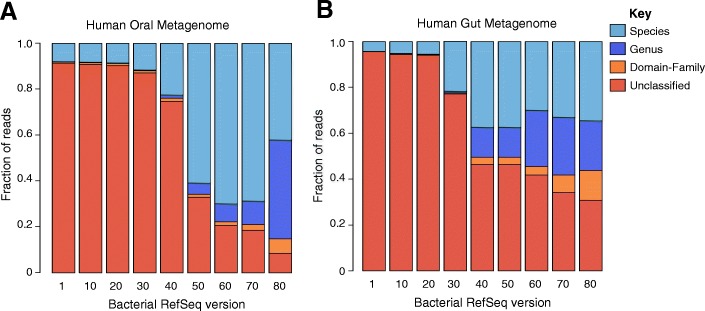
Accurate species-level taxonomic classification and profiling of complex microbial communities remains a challenge due to homologous regions shared among closely related species and a sparse representation of non-human associated microbes in the database. Although the database undoubtedly has a strong influence on the sensitivity of taxonomic classifiers and profilers, to date, no study has carefully explored this topic on historical RefSeq releases and explored its impact on accuracy. In this study, we examined the influence of the database, over time, on k -mer based sequence classification and profiling. We present three major findings: ( i ) database growth over time resulted in more classified reads, but fewer species-level classifications and more species-level misclassifications; ( ii ) Bayesian re-estimation of abundance helped to recover species-level classifications when the exact target strain was present; and ( iii ) Bayesian reestimation struggled when the database lacked the target strain, resulting in a notable decrease in accuracy. In summary, our findings suggest that the growth of RefSeq over time has strongly influenced the accuracy of k -mer based classification and profiling methods, resulting in different classification results depending on the particular database used. These results suggest a need for new algorithms specially adapted for large genome collections and better measures of classification uncertainty.
Overview
The claims and statistics of this paper haven’t been checked yet.
Free: it reads the open-access text and checks the first 5 claims that cite a source we can check. Create a free account to check every claim.
Integrity signals
Registry
Cites
Statistics
Figures
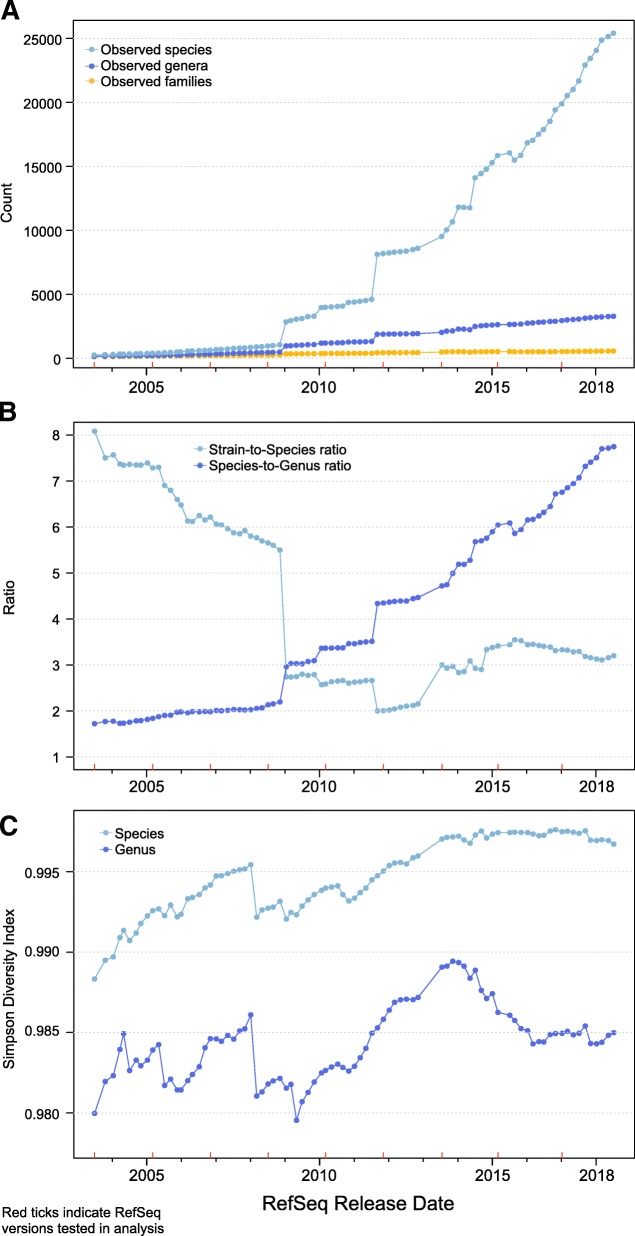
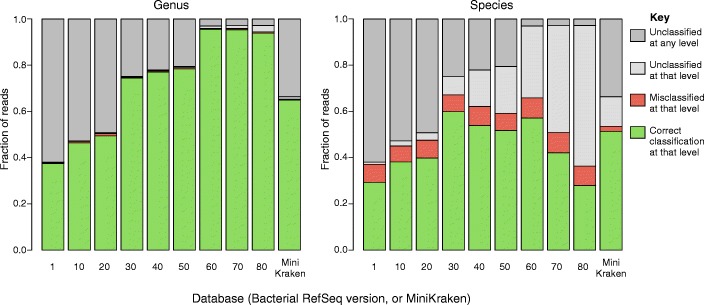
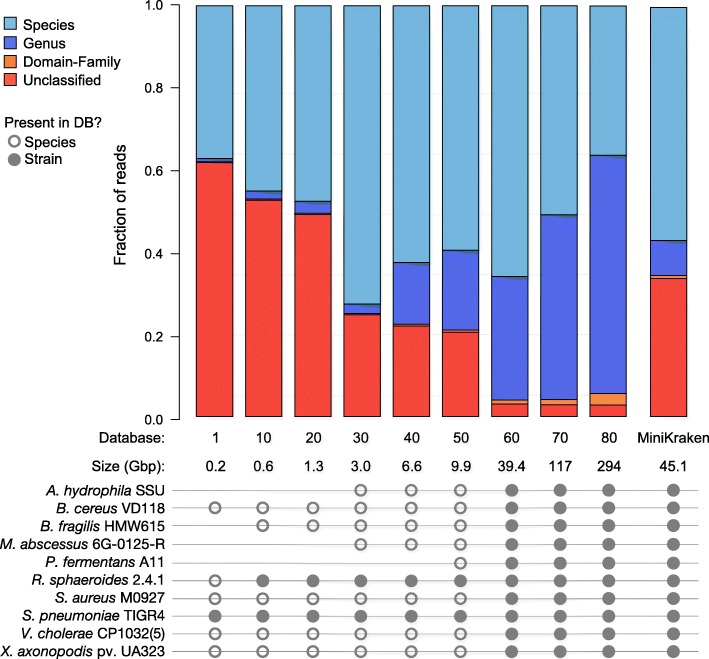
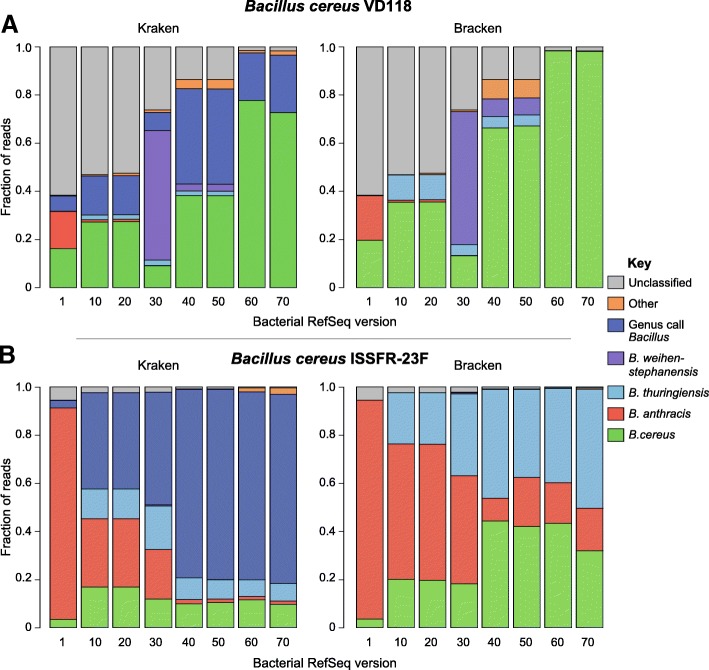
Verification
Claims the paper makes
The claims and statistics of this paper haven’t been checked yet.
Free: it reads the open-access text and checks the first 5 claims that cite a source we can check. Create a free account to check every claim.
Claims other papers make about this one
Each is checked against this paper’s own text: does it say what the citing paper says it does?
In the citing paper
“As genome reference databases expand, historical, microbiology-based taxonomic assignments do not reflect population-level relationships inferred from genome sequencing.”
From Gut microbiome stability and dynamics in healthy donors and patients with non-gastrointestinal cancers (2021) · cites this paper as Nasko et al., 2018
Self-check
Percentages, sums and reported differences re-computed from the paper’s own numbers.
The self-check needs the paper’s full text.
Citations
Cites
Trimmomatic: a flexible trimmer for Illumina sequence data
Bolger, A. M., Lohse, M., & Usadel, B. (2014) · Bioinformatics · doi:10.1093/bioinformatics/btu170 · Cited by 65,548 · cited 1×
“0.23 (leading:20, trailing:20, slidingwindow:4:30 minlen:40) [40].”
InfluentialQIIME allows analysis of high-throughput community sequencing data
Caporaso, J. G., Kuczynski, J., Stombaugh, J., Bittinger, K., Bushman, F. D., Costello, E. K., Fierer, N., Peña, A. G., Goodrich, J. K., Gordon, J. I., et al. (2010) · Nature Methods · doi:10.1038/nmeth.f.303 · Cited by 34,887 · cited 1×
“MacQIIME 1.9.1-20150604) [41].”
InfluentialStructure, function and diversity of the healthy human microbiome
The Human Microbiome Project Consortium (2012) · Nature · doi:10.1038/nature11234 · Cited by 11,726 · cited 1×
“To assess classification trends in real metagenomic data, two shotgun metagenomes were used: a fecal metagen-ome (SRS105153) and oral metagenome (SRS050029) from the Human Microbiome Project [37].”
MethodNear-optimal probabilistic RNA-seq quantification
Bray, N. L., Pimentel, H., Melsted, P., & Pachter, L. (2016) · Nature Biotechnology · doi:10.1038/nbt.3519 · Cited by 9,723 · cited 1×
“Lastly, alternative approaches to traditional k-mer-based LCA identification methods, such as those featured within KrakenHLL [23], Kallisto [35], and DUDes [36], will be required to maximize the benefit of longer reads coupled with ever-increasing reference sequence databases and improve sequence classification accur…”
MethodShifting the genomic gold standard for the prokaryotic species definition
Richter, M., & Rosselló-Móra, R. (2009) · Proceedings of the National Academy of Sciences · doi:10.1073/pnas.0906412106 · Cited by 6,359 · cited 1×
“This, coupled with an often ambiguous species concept in microbial genomes due to horizontal gene transfer and mobile elements [27, 28], brings into question the reliance on the current taxonomic structure for assigning names to microbes sequenced and identified in metagenomic samples.”
BackgroundUniProt: a hub for protein information
The UniProt Consortium (2015) · Nucleic Acids Research · doi:10.1093/nar/gku989 · Cited by 5,106
Kraken: ultrafast metagenomic sequence classification using exact alignments
Wood, D. E., & Salzberg, S. L. (2014) · Genome Biology · doi:10.1186/gb-2014-15-3-r46 · Cited by 4,521
A standardized bacterial taxonomy based on genome phylogeny substantially revises the tree of life
Parks, D. H., Chuvochina, M., Waite, D. W., Rinke, C., Skarshewski, A., Chaumeil, P.-A., & Hugenholtz, P. (2018) · Nature Biotechnology · doi:10.1038/nbt.4229 · Cited by 3,603
MEGAN analysis of metagenomic data
Huson, D. H., Auch, A. F., Qi, J., & Schuster, S. C. (2007) · Genome Research · doi:10.1101/gr.5969107 · Cited by 3,312
Bracken: estimating species abundance in metagenomics data
(2016) · doi:10.7717/peerj-cs.104 · Cited by 2,333 · cited 3×
“Bracken, a Bayesian method that refines Kraken results, is capable of estimating how much of each species is present among a set of ambiguous species classifications by probabilistically re-distributing reads in a taxonomic tree [10].”
BackgroundMethodInfluential
Research works printed but not linked: 1
- NBACC. Genome sequencing and assembly of 11 Bacillus cereus sensu lato isolates from various quarters of the International Space Station. [Data set] https://www.ncbi.nlm.nih.gov/sra/?term=SRR3954740. Accessed 13 July 2018.
Cited by
Items 101–171 of 171
Gray, M., Zhao, Z., & ROSEN, G. L. (2022) · Frontiers in Signal Processing · doi:10.3389/frsip.2022.842513 · Cited by 5
Kumar, A., Robertsen, E. M., Willassen, N. P., Fu, J., & Hjerde, E. (2023) · Genomics & Informatics · doi:10.5808/gi.23072 · Cited by 3
GenesLove.Me 2.0: Improving the Prioritization of Genetic Variations
Román, J. F. R., Alberto García, S., Rueda, U., & Pastor, Ó. (2019) · Communications in computer and information science · doi:10.1007/978-3-030-22559-9_14 · Cited by 4
Freed, N. E., Pearman, W. S., Smith, A. N. H., Breckell, G., Dale, J., & Silander, O. (2018) · bioRxiv (Cold Spring Harbor Laboratory) · doi:10.1101/363622 · Cited by 5
QuaID: Enabling Earlier Detection of Recently Emerged SARS-CoV-2 Variants of Concern in WastewaterPreprint
Sapoval, N., Liu, Y., Lou, E. G., Hopkins, L., Ensor, K. B., Schneider, R., Stadler, L. B., & Treangen, T. J. (2021) · medRxiv · doi:10.1101/2021.09.08.21263279 · Cited by 4
Self-citationOCTOPUS: Disk-based, Multiplatform, Mobile-friendly Metagenomics ClassifierPreprint
Marini, S., Barquero, A. D., Wadhwani, A. A., Bian, J., Ruiz, J., Boucher, C. A., & Prosperi, M. (2024) · bioRxiv (Cold Spring Harbor Laboratory) · doi:10.1101/2024.03.15.585215 · Cited by 3
“However, this approach presents a major drawback: When a species’ reference database contains several organisms with high intra-species similarity, Kraken2 often cannot decide on the species and reports results at the genus level [27].”
BackgroundKalamari: a representative set of genomes of public health concern
Katz, L. S., Griswold, T., Lindsey, R. L., Lauer, A. C., Im, M. S., Williams, G. M., Halpin, J. L., Gómez, G. A., Kučerová, Z., Morrison, S. S., et al. (2025) · Microbiology Resource Announcements · doi:10.1128/mra.00963-24 · Cited by 3
Precise and scalable metagenomic profiling with sample-tailored minimizer libraries
Nyström-Persson, J., Bapatdhar, N., & Ghosh, S. (2025) · NAR Genomics and Bioinformatics · doi:10.1093/nargab/lqaf076 · Cited by 4
Run-length compressed metagenomic read classification with SMEM-finding and tagging
Depuydt, L., Ahmed, O. Y., Fostier, J., Langmead, B., & Gagie, T. (2025) · iScience · doi:10.1016/j.isci.2025.114029 · Cited by 9
Scaling DEPP phylogenetic placement to ultra-large reference trees: a tree-aware ensemble approach
Jiang, Y., McDonald, D. T., Perry, D. S., Knight, R. D., & Mirarab, S. (2024) · Bioinformatics · doi:10.1093/bioinformatics/btae361 · Cited by 8
“A main lesson learned in analyses using existing tools, one that should not be surprising, is that the accuracy of the placements and downstream analyses both depend on the density of the backbone tree (e.g., Nasko et al. 2018, McDonald et al. 2023).”
Scaling deep phylogenetic embedding to ultra-large reference trees: a tree-aware ensemble approachPreprint
Jiang, Y., McDonald, D. T., Knight, R. D., & Mirarab, S. (2023) · bioRxiv (Cold Spring Harbor Laboratory) · doi:10.1101/2023.03.27.534201 · Cited by 3
Memory-bound k -mer selection for large and evolutionarily diverse reference librariesPreprint
Şapcı, A. O. B., & Mirarab, S. (2024) · Genome Research · doi:10.1101/gr.279339.124 · Cited by 3
Vieira, L. D., dos Santos, J. S., Hasui, É., Benvindo‐Souza, M., Silva, D. D. M. E., & Collevatti, R. G. (2025) · Agriculture Ecosystems & Environment · doi:10.1016/j.agee.2025.109807 · Cited by 2
Ludwig, D. W., Guptil, C., Alexander, N. R., Zhalnina, K., Wipf, E. M. L., Khasanova, A., Barber, N. A., Swingley, W. D., Walker, D. M., & Phillips, J. L. (2025) · Bioinformatics · doi:10.1093/bioinformatics/btaf370 · Cited by 8
“While it is known that a considerable portion of the taxa in an environment is unknown (Nasko et al. 2018), we rely on the robustness of SetBERT to generalize to these unknown taxa during inference (and other downstream tasks working with the actual raw data).”
Conservation Genetics of Crustaceans
Crandall, K. A. (2025) · Oxford University Press eBooks · doi:10.1093/oso/9780197768242.003.0012 · Cited by 2
The Importance of Being Imperfect: Structure and Function of Bacterial Amyloid
Peña‐Díaz, S., Jiang, Y., Zhang, Z., Daugberg, A. O. H., Ferreira, P., Hernández, M. L., Mittal, C., Ramos, M. J., Pedersen, J. S., Dueholm, M. S., et al. (2025) · Advanced Science · doi:10.1002/advs.202517090 · Cited by 4
Mokoena, M. I., Nkuna, R., & Matambo, T. S. (2026) · Environments · doi:10.3390/environments13030125 · Cited by 2
Perseus: lineage-aware refinement of Kraken2 taxonomic classification for long read metagenomes
Nguyen, M. H., & Schatz, M. C. (2026) · Bioinformatics · doi:10.1093/bioinformatics/btag687 · Cited by 3
“Several strategies have been proposed to address this problem, including expanded reference databases (Nasko et al. 2018, Edwin et al. 2024), confidence thresholds (Wood et al. 2019, Sun and Fodor 2025, Oskolkov 2026), and unique k -mer support metrics such as KrakenUniq (Breitwieser et al. 2018).”
Sapoval, N., Tanevski, M., & Treangen, T. J. (2023) · Pacific Symposium on Biocomputing (PSB) · doi:10.1142/9789811286421_0039 · Cited by 3
“Additionally, similarly to de novo assembly methods, KOMB is a database independent tool, and hence it avoids database biases [28].”
MethodSelf-citationCrispr-Cas9 Technology: Applications and Trends in Bioinformatics and Machine Learning
Bora, A., & Banupriya, G. (2024) · International Journal of Research Publication and Reviews · doi:10.55248/gengpi.5.0624.1404 · Cited by 2
Şapcı, A. O. B., & Mirarab, S. (2026) · Genome biology · doi:10.1186/s13059-026-03999-y · Cited by 4
“Since the human microbiome is relatively well-studied, we next analyzed more novel microbial communities where queries often lack sufficient representation in reference sets [47, 57].”
Cornet, L., Cleenwerck, I., Praet, J., Léonard, R. R., Vereecken, N. J., Michez, D., Smagghe, G. J., Baurain, D., & Vandamme, P. A. R. (2021) · bioRxiv (Cold Spring Harbor Laboratory) · doi:10.1101/2021.12.10.472130 · Cited by 2
Fulke, A. B., Eranezhath, S., Raut, S., & Jadhav, H. S. (2024) · Regional Studies in Marine Science · doi:10.1016/j.rsma.2024.103728 · Cited by 1
Uffelen, A. V., Gobbo, A., Fraiture, M., Posadas, A., Roosens, N. H. C., Marchal, K., Keersmaecker, S. C. J. D., & Vanneste, K. (2026) · BMC Genomics · doi:10.1186/s12864-026-12668-0 · Cited by 1
“Notably, the more species are sampled and added to reference databases over time, the less straightforward species boundaries will become [20].”
Lazzaro, L., Rossignolo, E., & Comin, M. (2026) · BIO Web of Conferences · doi:10.1051/bioconf/202623201002 · Cited by 1
Ghiasi, N. M., & Mutlu, O. (2026) · International Conference on Supercomputing · doi:10.1145/3774895.3815157 · Cited by 2
“…reasons for this growth are 1) the rapid evolution of viruses and bacteria [429], which necessitates frequent updates with new reference genomes [430–432], and 2) the fact that databases may include sequences from both highly curated reference genomes and from less curated metagenomic sample…”
CONSULT-II: Taxonomic Identification Using Locality Sensitive Hashing
Şapcı, A. O. B., Rachtman, E., & Mirarab, S. (2023) · Lecture notes in computer science · doi:10.1007/978-3-031-36911-7_13 · Cited by 1
Memory-bound k -mer selection for large and evolutionary diverse reference librariesPreprint
Şapcı, A. O. B., & Mirarab, S. (2024) · bioRxiv (Cold Spring Harbor Laboratory) · doi:10.1101/2024.02.12.580015 · Cited by 1
“On the one hand, sampling of taxonomic groups in public libraries is very imbalanced, which can become a challenge as noted by Nasko et al. (2018).”
BackgroundPhoronids and their tubes harbor distinct microbiomes compared to surrounding sedimentPreprint
Ettinger, C. L., & Eisen, J. A. (2024) · bioRxiv (Cold Spring Harbor Laboratory) · doi:10.1101/2024.05.28.596327 · Cited by 1
“…factors including 16S rRNA gene primer bias [91,92], different naming conventions between 16S rRNA gene and genomic databases [93,94], database age [101,102], and methodological limitations of short read-based taxonomic classifiers [95], which can be complicated by low coverage or host-dominated…”
Poplar: A Phylogenetics PipelinePreprint
Koning, E. R., & Krishnakumar, R. (2024) · bioRxiv (Cold Spring Harbor Laboratory) · doi:10.1101/2024.11.11.623070 · Cited by 1
Tian, Q., Zhang, P., Wei, Y., Zou, Q., Wang, Y., & Luo, X. (2025) · bioRxiv (Cold Spring Harbor Laboratory) · doi:10.1101/2025.03.26.645388 · Cited by 1
A comprehensive benchmark of discrepancies across microbial genome reference databasesPreprint
Boldirev, G., Aguma, P., Munteanu, V., Koslicki, D., Alser, M., Zelikovsky, A., & Mangul, S. (2026) · bioRxiv (Cold Spring Harbor Laboratory) · doi:10.64898/2026.03.02.709103 · Cited by 1
Scalable Profiling and Visualization for Characterizing Microbiomes
Valdes, C. (2020) · FIU - Digital Commons (Florida International University) · doi:10.25148/etd.fidc008938
Tang, D., Tan, D., Xiao, W., Lin, J., & Fu, J. (2022) · Algorithms · doi:10.3390/a15040107
Perplexity: evaluating transcript abundance estimation in the absence of ground truth
Fan, J., Chan, S. S., & Patro, R. (2022) · Algorithms for Molecular Biology · doi:10.1186/s13015-022-00214-y
Alignment-free microbiome-based classification of fresh produce safety and qualityPreprint
Liao, C., Wang, L., & Quon, G. (2022) · bioRxiv (Cold Spring Harbor Laboratory) · doi:10.1101/2022.08.25.505309
A Guide to Gene‐Centric Analysis Using TreeSAPP
Morgan‐Lang, C., & Hallam, S. (2023) · Current Protocols · doi:10.1002/cpz1.671
Memory-Bound and Taxonomy-Aware K-Mer Selection for Ultra-Large Reference Libraries
Şapcı, A. O. B., & Mirarab, S. (2024) · Lecture notes in computer science · doi:10.1007/978-1-0716-3989-4_26
MEM-based pangenome indexing for k -mer queriesPreprint
Hwang, S., Brown, N. K., Ahmed, O. Y., Jenike, K. M., Kovaka, S., Schatz, M. C., & Langmead, B. (2024) · bioRxiv (Cold Spring Harbor Laboratory) · doi:10.1101/2024.05.20.595044
“PanKmer [4] supports only 31-mer queries, whereas length-31 substrings may not be the correct resolution at which to understand conservation across all genes or pangenomes [21].”
Teo, J. J. Y., Ho, E. X. P., Ng, A. H. Q., How, S. H. C., Chng, K. R., Ateş, Y. C., Fau’di, M. T., Aung, K. T., & Nagarajan, N. (2024) · medRxiv · doi:10.1101/2024.07.28.24310840
Seppey, M., Benavides, A., Berkeley, M., Manni, M., & Zdobnov, E. M. (2026) · Genome biology · doi:10.1186/s13059-026-04089-9
“Inter-estingly, this led to a negative impact on recall for some tools like Kraken, as previously observed by Nasko et al. [37].”
Poplar: a phylogenomics pipeline
Koning, E. R., Subedi, A., & Krishnakumar, R. (2024) · Bioinformatics Advances · doi:10.1093/bioadv/vbaf104 · Cited by 1
“These methods are extremely helpful for fast examination of relationships between genomes, particularly large numbers of large genomes (Nasko et al. 2018, Manekar and Sathe 2018, Moeckel et al. 2024).”
Kannan, E. P., Venkatachalam, P., Gopal, J., Ponmariappan, S., & Muthu, M. (2025) · Journal of Applied Microbiology · doi:10.1093/jambio/lxaf199 · Cited by 2
The Naïve Bayes Classifier++ as an Out-of-Distribution Detector of Novel TaxaPreprint
Ramjattun, K., & ROSEN, G. L. (2025) · bioRxiv (Cold Spring Harbor Laboratory) · doi:10.1101/2025.10.18.683227
“The results of this evaluation are then used to assess our framework’s practical application on the human gut metagenome described in Zhao et al. [2020] and Nasko et al. [2018].”
Insights of Biological Databases
Asim, M. N., Ahmed, S., & Dengel, A. (2025) · Springer eBooks · doi:10.1007/978-3-031-90450-9_4
Marcelino, V. R., Clausen, P. T. L. C., Buchmann, J. P., Wille, M., Iredell, J. R., Meyer, W., Lund, O., Sorrell, T. C., & Holmes, E. C. (2020) · Figshare · doi:10.6084/m9.figshare.12211688
Minot, S. S., Barry, K. C., Kasman, C., Golob, J. L., & Willis, A. D. (2021) · Figshare · doi:10.6084/m9.figshare.14545105
Zhao, Z., Cristian, A., & Rosen, G. (2020) · Figshare · doi:10.6084/m9.figshare.12986773
Minot, S. S., Barry, K. C., Kasman, C., Golob, J. L., & Willis, A. D. (2021) · Figshare · doi:10.6084/m9.figshare.14545096
Song, L., & Langmead, B. (2024) · Figshare · doi:10.6084/m9.figshare.26712308
Marcelino, V. R., Clausen, P. T. L. C., Buchmann, J. P., Wille, M., Iredell, J. R., Meyer, W., Lund, O., Sorrell, T. C., & Holmes, E. C. (2020) · Figshare · doi:10.6084/m9.figshare.12211673
Zhao, Z., Cristian, A., & Rosen, G. (2020) · Figshare · doi:10.6084/m9.figshare.12986776
Marcelino, V. R., Clausen, P. T. L. C., Buchmann, J. P., Wille, M., Iredell, J. R., Meyer, W., Lund, O., Sorrell, T. C., & Holmes, E. C. (2020) · Figshare · doi:10.6084/m9.figshare.12211724
Additional file 2 of SPUMONI 2: improved classification using a pangenome index of minimizer digests
Ahmed, O. Y., Rossi, M., Gagie, T., Boucher, C., & Langmead, B. (2023) · Figshare · doi:10.6084/m9.figshare.22949448
Additional file 1 of Improving the usability and comprehensiveness of microbial databases
Loeffler, C., Karlsberg, A., Martin, L. S., Eskin, E., Koslicki, D., & Mangul, S. (2020) · Figshare · doi:10.6084/m9.figshare.12096312
Song, L., & Langmead, B. (2024) · Figshare · doi:10.6084/m9.figshare.26712311
Zhao, Z., Cristian, A., & Rosen, G. (2020) · Figshare · doi:10.6084/m9.figshare.12986791
Pearman, W. S., Freed, N. E., & Silander, O. (2020) · Figshare · doi:10.6084/m9.figshare.12398942
Zhao, Z., Cristian, A., & Rosen, G. (2020) · Figshare · doi:10.6084/m9.figshare.12986788
Additional file 7 of Simplitigs as an efficient and scalable representation of de Bruijn graphs
Břinda, K., Baym, M., & Kucherov, G. (2021) · Figshare · doi:10.6084/m9.figshare.14379368
Izabel‐Shen, D., Sandberg, H., Ahmed, M. I., Broman, E., Holovachov, O. V., & Nascimento, F. J. A. (2026) · bioRxiv (Cold Spring Harbor Laboratory) · doi:10.64898/2026.02.09.704827
“However, this method has drawbacks, including high costs and reliance on the availability and quality of reference genomes for genome assembly and taxonomic annotation (Elliott and Coissac, 2025; Nasko et al., 2018).”
MGtree: A Fast and Flexible Alignment-Based Metagenomics Pipeline
Sholes, S. L., Norton, S., Gonzalez, A., & Gaspar, J. M. (2026) · Viruses · doi:10.3390/v18060643
“These limitations are exacerbated by the rapid growth in reference databases [5].”
Lee, S., Agarwal, V., O'Brien, W., & Eskin, E. (2026) · bioRxiv (Cold Spring Harbor Laboratory) · doi:10.64898/2026.06.05.730319
“They have been growing rapidly; for instance, the number of observed species in RefSeq has doubled approximately every three years[9].”
Ghiasi, N. M., Mustafa, H., Güloglu, T., Nadig, R., Koliogeorgi, K., Ruiz, S. R., Rautmann, M., Eris, F., Sadrosadati, M., Park, J., et al. (2026) · Proceedings - International Symposium on Computer Architecture/Proceedings · doi:10.1109/isca66397.2026.00066 · Cited by 5
When bigger is not better: the impact of RefSeq growth on Kraken2 classification accuracy
Lazzaro, L., Rossignolo, E., & Comin, M. (2026) · Frontiers in High Performance Computing · doi:10.3389/fhpcp.2026.1860848
When current taxids make historical taxa look new
Mahjoubi, H. (2026) · Journal of Bioinformatics and Computational Biology · doi:10.1142/s0219720026710046
Song, L. (2026) · bioRxiv (Cold Spring Harbor Laboratory) · doi:10.64898/2026.09.17.752512
“When the database grows large, a fixed-size k-mer can be found in distantly related species by chance, and loses classifica9on specificity, i.e., the capability to classify at the lower taxonomic ranks like the species level 14,15 .”
Reference Incompleteness in Human Gut Metagenomics Is a Geographically Structured Measurement Bias
Sadhu, S., & Dahal, R. H. (2026) · Journal of Genome Biotechnology and Genetics · doi:10.3390/jgbg1030018
Metadata
- Authors
- Nasko, D. J., Koren, S., Phillippy, A. M., & Treangen, T. J.
- Affiliations
- University of Maryland, College Park (US)
- National Institutes of Health (US)
- Corresponding author
- Treangen, Todd J.
- Venue
- Genome Biology
- Published
- 2018-10-30
- Volume
- 19
- Issue
- 1
- Pages
- 165-165
- ISSN
- 1465-6906 (ISSN-L)
- 1474-760X
- PMC
- PMC6206640
- OpenAlex
- W2897603717
- Semantic Scholar
- 8aa3aaf4fba6baba75f831def2aca67da3e9e0d1
- Cited by
- 170
- References
- 51
- Citations by year
- 2026: 16 · 2025: 23 · 2024: 30 · 2023: 14 · 2022: 19 · 2021: 23 · 2020: 23 · 2019: 15 · 2018: 7
- FWCI
- 6.05
- Type
- journal article
- Language
- en
- Open access
- gold
- doi.org
- Licence
- cc-by
- creativecommons.org/licenses/by/4.0/ (tdm)
- creativecommons.org/licenses/by/4.0/ (vor)
- Locations
- Genome biology (publishedVersion, cc-by)
- bioRxiv (Cold Spring Harbor Laboratory) (acceptedVersion, cc-by)
- Europe PMC (PubMed Central) (publishedVersion, other-oa)
- PubMed Central (publishedVersion, cc-by)
- PubMed (publishedVersion)
- DOAJ (DOAJ: Directory of Open Access Journals) (submittedVersion, cc-by-sa)
- Rice Research Repository (Rice University) (submittedVersion, cc-by)
- Funders
- Army Research Office (W911NF-17-2-0089)
- Topics
- Life Sciences › Biochemistry, Genetics and Molecular Biology › Molecular Biology › Genomics and Phylogenetic Studies
- Physical Sciences › Environmental Science › Ecology › Environmental DNA in Biodiversity Studies
- Physical Sciences › Environmental Science › Ecology › Microbial Community Ecology and Physiology
- Keywords
- NCBI RefSeq, lowest common ancestor, species-level classification, metagenomic reads
- MeSH terms
- Algorithms, Bacillus, Computer Simulation, Species Specificity, Time Factors, Genetic Variation, Sequence Analysis, DNA, Databases, Genetic, Metagenome
About these checks
Registry, retraction, Cites and statistics results are computed, not judged, with one exception: a printed reference that no index lists is read once by a model before it counts as a citation error. Claims are extracted by a model and kept only when their quote appears verbatim in the text; each cited source is then checked, with a model’s help, for whether it says what the claim relies on. Those verdicts can be wrong — read the claim’s quote and the cited source before relying on one.
Statistics and arithmetic are recomputed, not judged.
Confidence bands are shown only for fields calibrated on our annotated test set. None is calibrated yet, so no band is shown.
What counts as a claim ›How we measure confidence ›How we check this ›
Are you an author, or do you see a problem with this page? Request a review
Data sources
Bibliographic data: Semantic Scholar, OpenAlex, Crossref.
Contains information from the Semantic Scholar Academic Graph Datasets, made available under the ODC Attribution License (ODC-BY 1.0).
Semantic Scholar’s data is described in: Kinney, R., et al. (2023). The Semantic Scholar Open Data Platform. arXiv:2301.10140.
