

OrthoFinder: phylogenetic orthology inference for comparative genomics
Open accessPublished version of a preprint
The DOI matches its Crossref record; 51 of the 51 references it cites were found in a registry or an index; 39 of the 42 sources its claims cite were checked for support.
Abstract
Here, we present a major advance of the OrthoFinder method. This extends OrthoFinder’s high accuracy orthogroup inference to provide phylogenetic inference of orthologs, rooted gene trees, gene duplication events, the rooted species tree, and comparative genomics statistics. Each output is benchmarked on appropriate real or simulated datasets, and where comparable methods exist, OrthoFinder is equivalent to or outperforms these methods. Furthermore, OrthoFinder is the most accurate ortholog inference method on the Quest for Orthologs benchmark test. Finally, OrthoFinder’s comprehensive phylogenetic analysis is achieved with equivalent speed and scalability to the fastest, score-based heuristic methods. OrthoFinder is available at https://github.com/davidemms/OrthoFinder .
Overview
CoChat Summary
TL;DR
OrthoFinder is updated to perform fully phylogenetic orthology inference from protein sequences, inferring orthogroups, rooted gene trees, a rooted species tree, gene duplication events, orthologs, and comparative genomics statistics. It reports the highest ortholog inference accuracy on Quest for Orthologs benchmarks while remaining fast and scalable, with some accuracy–speed trade-offs and rooting limitations.
Key findings
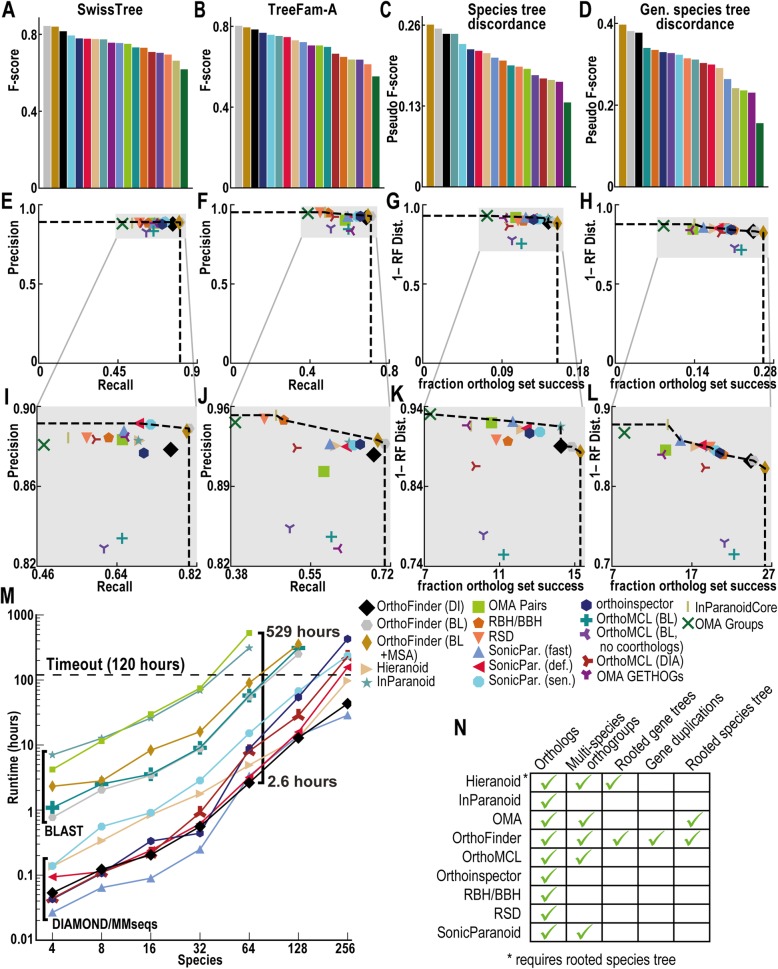
- On Quest for Orthologs 2011_04, the default fastest OrthoFinder was 3–24% more accurate on SwissTree and 2–30% more accurate on TreeFam-A than any other method; other OrthoFinder configurations were a further 1–3% more accurate.
- On the Species Tree Discordance Tests, all OrthoFinder versions had equal or higher pseudo-F-score than all other methods; the default version scored 0–45% higher on STDT and 10–59% higher on GSTDT.
- Default OrthoFinder ran in 192 s on 4 fungal species and 1.8 days on 256 species with 16 threads, making it the second quickest method; SonicParanoid was fastest at 1.2 days on 256 species.
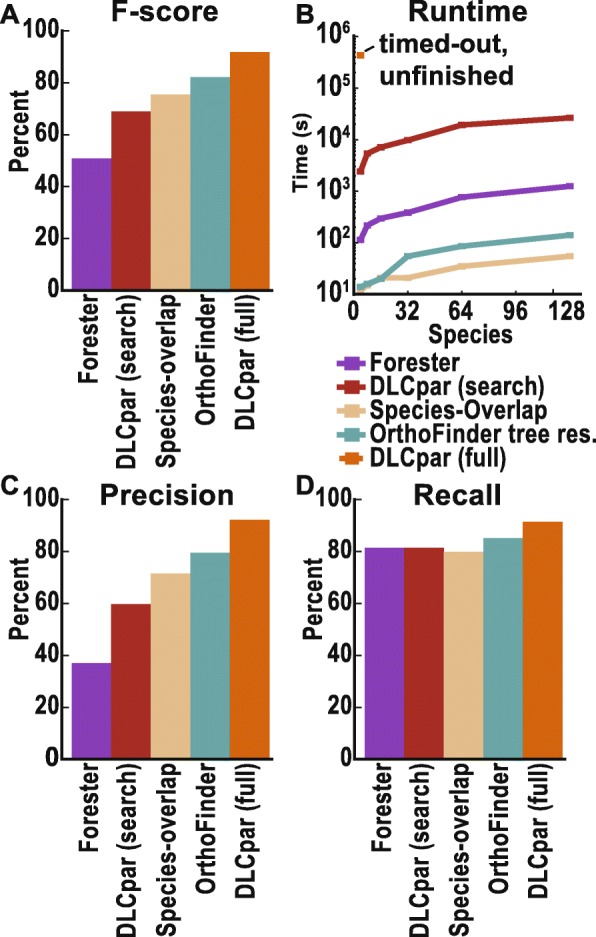
- The novel hybrid duplication-loss-coalescence algorithm raised duplication F-score from 72% with species-overlap to 80%; DLCpar (full) was most accurate at 91.8% but could not process a 4-species dataset (2259 trees, 12,958 genes) in 120 h, while OrthoFinder analyzed 18,651 trees and 948,449 genes from 128 fungi in 141 s.
Methods
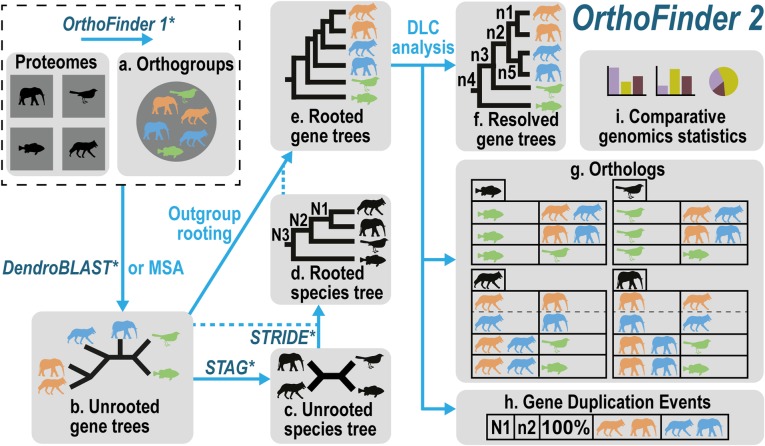
- Input is one FASTA file per species; orthogroups are inferred with the original OrthoFinder algorithm, unrooted gene trees with DendroBLAST, the species tree with STAG, the species tree root with STRIDE, gene trees are rooted using the species tree, and orthologs/duplications are inferred with a novel hybrid species-overlap plus duplication-loss-coalescence algorithm.
- Benchmarks used Quest for Orthologs 2011_04 on 66 species across Eukarya, Bacteria, and Archaea; simulated flies (12,000 trees, 12 species, 12,032 duplications), primates (7500 trees, 17 species, 16,066 duplications), and metazoa (2000 trees, 40 species, 4967 duplications); performance was tested on 4–256 fungal proteomes.
- Analyses compared precision, recall, F-score, pseudo-F-score, Robinson-Foulds agreement, and runtime against methods including Forester, DLCpar (full/search), species-overlap, Notung, and other orthology inference tools.
Limitations
- Stated: STRIDE may fail to identify the species tree root, or only exclude the root from clades, when gene trees contain few duplications; DLCpar (full) was more accurate but not scalable; the default fastest OrthoFinder is less accurate than other OrthoFinder configurations; the authors cannot test all possible multiple sequence alignment and tree inference combinations.
- Evident: STDT and GSTDT lack ground-truth orthologs, so pseudo-F-score substitutes for standard precision/recall; benchmarking is limited to specific Quest for Orthologs datasets and simulated data; OrthoFinder is second fastest, not fastest, on the 256-species dataset; no competitor method also provides gene trees or identifies gene duplication events, so the data-richness advantage is not an accuracy comparison.
Model-written summary. Check it against the paper before relying on it.
Integrity signals
Registry
Cites
Statistics
Figures
Verification
Claims the paper makes
23 Valid · 10 Not valid · 1 Not checked · 62 Own results and interpretations
The cited sources support only part of this claim — read each source’s verdict below.
In the paper
“STRIDE was developed to enable the rooting of the species tree using only information available in the set of gene trees.”
§ OrthoFinder: phylogenetic orthology inference for comparative genomics > Methods > Species tree inference and rooting
What the sources say
- Partly supportedcites [22] Emms DM Kelly S STRIDE: species tree root inference from gene duplication events Mol Biol Evol 2017 34 12 3267 3278 10.1093/molbev/msx259 29029342 PMC5850722 sourceExperimental — accuracy not yet measured
The Introduction says STRIDE uses duplication events from unrooted gene trees to locate the root. But the Results (Application of STRIDE to Real Species Data Sets; page unavailable) say it was run with both gene trees and a published unrooted species tree, so the claim that it uses only information in the gene trees omits a required input. (LLM, conf=0.88)
plainstates a cause- Asserted: passes — The authors put it forward as true.
- Checkable: passes — It can be checked against evidence.
- Load-bearing: passes — The paper’s conclusions depend on it.
- Based: passes — The paper gives a reason why it holds.
- Partly supported
The cited sources support only part of this claim — read each source’s verdict below.
In the paper
“The original OrthoFinder orthogroup inference method is still the most accurate method on the independent Orthobench test set [10] and thus is used for this step.”
§ OrthoFinder: phylogenetic orthology inference for comparative genomics > Methods > Use of orthogroups for gene tree inference
What the sources say
- Partly supportedcites [10] Emms DM Kelly S OrthoFinder: solving fundamental biases in whole genome comparisons dramatically improves orthogroup inference accuracy Genome Biol 2015 16 157 10.1186/s13059-015-0721-2 26243257 PMC4531804 sourceExperimental — accuracy not yet measured
The ‘OrthoFinder outperforms all other methods from the OrthoBench analysis’ section reports that OrthoFinder had the highest F-score among methods applied to OrthoBench, and the Evaluation section describes the dataset as independently evaluated. The 2015 paper does not establish that the original method is *still* the most accurate after that comparison. (LLM, conf=0.84)
plain- Asserted: passes — The authors put it forward as true.
- Checkable: passes — It can be checked against evidence.
- Load-bearing: passes — The paper’s conclusions depend on it.
- Based: passes — The paper gives a reason why it holds.
- Partly supported
The cited sources support only part of this claim — read each source’s verdict below.
In the paper
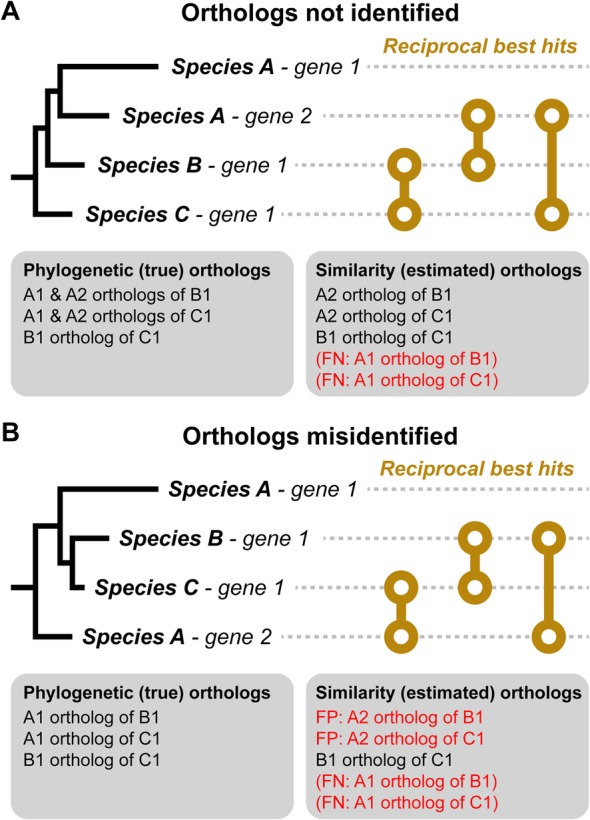
“However, such score-based estimates of the phylogenetic relationship between genes are confounded by multiple factors. For example, variable sequence evolution rates between genes frequently lead to both false-positive and false-negative errors [14, 15] (Fig. 1).”
§ OrthoFinder: phylogenetic orthology inference for comparative genomics > Background
What the sources say
- Partly supportedcites [14] Lafond M Miardan MM Sankoff D Accurate prediction of orthologs in the presence of divergence after duplication Bioinformatics 2018 34 366 375 10.1093/bioinformatics/bty242 PMC6022570 29950018 sourceExperimental — accuracy not yet measured
The Introduction (page unavailable) explains that accelerated mutation after duplication can make orthologous genes dissimilar, so similarity-based methods may fail to identify them—a false negative. It does not establish that variable evolutionary rates frequently cause false-positive errors as well, or support that frequency claim. (LLM, conf=0.82)
- Not checked — no full text of the sourcecites [15] Fitch WM Distinguishing homologous from analogous proteins Sys Zool 1970 19 99 10.2307/2412448 5449325 source
plainstates a cause- Asserted: passes — The authors put it forward as true.
- Checkable: passes — It can be checked against evidence.
- Load-bearing: passes — The paper’s conclusions depend on it.
- Based: passes — The paper gives a reason why it holds.
- Partly supported
Every source the paper cites for this claim was checked and supports it.
In the paper
“A new algorithm, Species Tree from All Genes (STAG), was developed to allow species tree inference even for species sets with few or no complete sets of one-to-one orthologs present in all species [33].”
§ OrthoFinder: phylogenetic orthology inference for comparative genomics > Methods > Species tree inference and rooting
What the sources say
- Supportedcites [33] Emms D, Kelly S. STAG: species tree inference from all genes. bioRxiv. 2018. https://www.biorxiv.org/content/10.1101/267914v1. source
The Discussion says complete one-to-one orthogroups are comparatively rare and that STAG uses orthogroups containing all species regardless of gene copy number. This supports the claim that STAG enables species-tree inference when few or no complete one-to-one ortholog sets are available. Page numbers are not provided in our copy. (LLM, conf=0.94)
plainstates a cause- Asserted: passes — The authors put it forward as true.
- Checkable: passes — It can be checked against evidence.
- Load-bearing: passes — The paper’s conclusions depend on it.
- Based: passes — The paper gives a reason why it holds.
- Supported
The sources with a verdict support this claim; the rest weren’t checked yet, have no full text we could read, or their verdicts aren’t rated yet.
In the paper
“The accuracy of key component algorithms of OrthoFinder has been independently assessed in this work and in dedicated publications [5, 10, 22, 24, 33].”
§ OrthoFinder: phylogenetic orthology inference for comparative genomics > Results > OrthoFinder has the highest ortholog inference accuracy
What the sources say
- Not checked — no full text of the sourcecites [5] Buchfink B Xie C Huson DH Fast and sensitive protein alignment using DIAMOND Nat Methods 2015 12 59 60 10.1038/nmeth.3176 25402007 source
- Supportedcites [10] Emms DM Kelly S OrthoFinder: solving fundamental biases in whole genome comparisons dramatically improves orthogroup inference accuracy Genome Biol 2015 16 157 10.1186/s13059-015-0721-2 26243257 PMC4531804 source
The ‘An improved method for orthogroup delimitation improves overall accuracy’ section assesses the accuracy of OrthoFinder’s gene-pair selection and clustering approach and reports precision, recall, and F-score. The Evaluation section describes testing against the independently evaluated OrthoBench dataset. This dedicated publication therefore supports the citation’s contribution to the statement about assessed component-algorithm accuracy. (LLM, conf=0.88)
- Supportedcites [22] Emms DM Kelly S STRIDE: species tree root inference from gene duplication events Mol Biol Evol 2017 34 12 3267 3278 10.1093/molbev/msx259 29029342 PMC5850722 source
The Results section, “STRIDE Identifies the Correct Root of Species Trees Given Simulated Gene Tree Data Sets” (page not provided), assesses STRIDE’s rooting accuracy on three simulated datasets and reports its duplication-detection precision and recall. This supports citing the dedicated STRIDE publication for an accuracy assessment of an algorithm used in the OrthoFinder workflow; the paper does not assess every OrthoFinder component. (LLM, conf=0.86)
- Supportedcites [24] Kelly S Maini PK DendroBLAST: approximate phylogenetic trees in the absence of multiple sequence alignments PLoS One 2013 8 e58537 10.1371/journal.pone.0058537 23554899 PMC3598851 source
The Methods section, “Comparison of DendroBLAST against other inference methods,” describes an accuracy evaluation against reference trees using five metrics. The Results sections report DendroBLAST’s performance relative to other tree-inference methods. This supports the citation’s role as a dedicated publication assessing the accuracy of a component algorithm; it does not need to assess every OrthoFinder component. (LLM, conf=0.91)
- Supportedcites [33] Emms D, Kelly S. STAG: species tree inference from all genes. bioRxiv. 2018. https://www.biorxiv.org/content/10.1101/267914v1. source
The paper evaluates the accuracy of STAG species-tree inference against literature-derived trees across 12 biological datasets (Results and Discussion; page numbers unavailable). The Discussion also states that STAG was designed to integrate with OrthoFinder and can run directly from its results. This supports citing the publication as a dedicated assessment of a component algorithm. (LLM, conf=0.91)
plain- Asserted: passes — The authors put it forward as true.
- Checkable: passes — It can be checked against evidence.
- Load-bearing: passes — The paper’s conclusions depend on it.
- Based: passes — The paper gives a reason why it holds.
39 more claims · 8 with their cited sources checked
Create a free account to see all 96 claims and every source verdict.
- Probably not a substantial claim. 18
- It may state two separate claims as one. 40
- The quote only partly states this claim. 2
Claims other papers make about this one
Each is checked against this paper’s own text: does it say what the citing paper says it does?
The source backs part of the claim, not all of it — or backs it for a different population, condition or comparison.
In the citing paper
“The original OrthoFinder algorithm applied a per-species-pair gene-length normalization that accounted for both evolutionary distance and gene-length dependence in pairwise bit scores between sequences12.”
From OrthoFinder: improved phylogenetic orthology inference with enhanced accuracy and scalability (2026) · cites this paper as [12]
Experimental — accuracy not yet measuredThe source backs part of the claim, not all of it — or backs it for a different population, condition or comparison.
In the citing paper
“In previous versions of OrthoFinder, orthologs were defined phylogenetically, whereas orthogroups were defined solely based on Markov Cluster Algorithm (MCL) clustering of sequence similarity search results12,16.”
From OrthoFinder: improved phylogenetic orthology inference with enhanced accuracy and scalability (2026) · cites this paper as [12]
Experimental — accuracy not yet measuredThe source backs part of the claim, not all of it — or backs it for a different population, condition or comparison.
In the citing paper
“Other sequence similarity approaches such as OrthoFinder (Emms and Kelly, 2019; Emms and Kelly, 2015) leverage graphs and gene trees to test for orthology, permitting more robust analyses in systems with gene copy number (CNV) or presence–absence variation (PAV).”
From GENESPACE tracks regions of interest and gene copy number variation across multiple genomes (2022) · cites this paper as Emms and Kelly, 2019
Experimental — accuracy not yet measuredThe cited source says what the claim attributes to it.
In the citing paper
“We used two different methods for identifying orthologues—a simple mutual-best-hits method and an alternative orthologue-clustering approach (OrthoFinder47; Supplementary Information 10 and 11), and obtained comparable results using both approaches”
From Ancient gene linkages support ctenophores as sister to other animals (2023) · cites this paper as [47]
The cited source says what the claim attributes to it.
In the citing paper
“Gene tree-based methods determine whether the evolutionary lineages of two genes coalesce in a speciation or a duplication node (12–14).”
From Integrating gene annotation with orthology inference at scale (2023) · cites this paper as [12]
4 more claims about this paper
Create a free account to see every claim other papers make about this one.
Self-check
Percentages, sums and reported differences re-computed from the paper’s own numbers.
Each contradiction between two passages listed here was confirmed by an independent check.
Rated minor: it would not touch a result — a value no result rests on, a p-value that stays on the same side of the significance level, or a conflict that is clerical, resolved elsewhere in the paper, or outside its own findings.
In the paper
§ OrthoFinder: phylogenetic orthology inference for comparative genomics > Methods > Ortholog inference and identification of gene duplication events from gene trees
“The hybrid algorithm was able to analyze the complete set of orthogroup trees for the 128 fungi species in 141 s; this was 9 times faster than Forester and 187 times faster than DLCpar (search) (Fig. 5d).”
§ OrthoFinder: phylogenetic orthology inference for comparative genomics > Results > OrthoFinder implements a novel duplication-loss-coalescent algorithm for identifying gene duplication events and orthologs
“Figure: Fig. 5 a Duplication F-score, on simulated gene trees. b Runtime to analyse all trees from the 4 to 128 species Fungi datasets (see Methods), a maximum time of 120 hours (4.3x10 seconds) was allowed. DLCpar (full) did not complete the smallest dataset in this time limit and so only the lower bound for the first time point is shown. c-d Precision and recall”
Rated minor: it would not touch a result — a value no result rests on, a p-value that stays on the same side of the significance level, or a conflict that is clerical, resolved elsewhere in the paper, or outside its own findings.
In the paper
§ OrthoFinder: phylogenetic orthology inference for comparative genomics > Methods > Chordata dataset
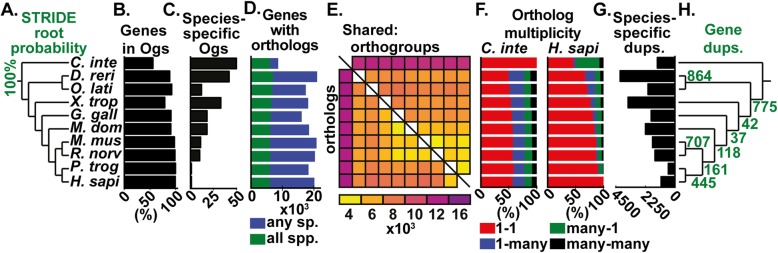
“The data for the OrthoFinder analysis of the ten Chordata species for the illustration of the results of an OrthoFinder analysis (Fig. 2a–h)”
§ OrthoFinder: phylogenetic orthology inference for comparative genomics > Results > OrthoFinder algorithm overview and summary of results files
“Figure: Fig. 3 Summary of OrthoFinder analysis of a set of Chordata species:”
Citations
Cites
MAFFT Multiple Sequence Alignment Software Version 7: Improvements in Performance and Usability
Katoh, K., & Standley, D. M. (2013) · Molecular Biology and Evolution · doi:10.1093/molbev/mst010 · Cited by 46,209 · cited 4×
“Katoh K, Standley DM. MAFFT multiple sequence alignment software version 7: improvements in performance and usability.”
MethodInfluentialRAxML version 8: a tool for phylogenetic analysis and post-analysis of large phylogenies
Stamatakis, A. (2014) · Bioinformatics · doi:10.1093/bioinformatics/btu033 · Cited by 32,291 · cited 4×
“For each successful ortholog set, an MSA is constructed and a gene tree inferred using RAxML [28].”
MethodInfluentialIQ-TREE: A Fast and Effective Stochastic Algorithm for Estimating Maximum-Likelihood Phylogenies
Nguyen, L.-T., Schmidt, H. A., von Haeseler, A., & Minh, B. Q. (2015) · Molecular Biology and Evolution · doi:10.1093/molbev/msu300 · Cited by 26,046
BLAST+: architecture and applications
Camacho, C., Coulouris, G., Avagyan, V., Ma, N., Papadopoulos, J., Bealer, K., & Madden, T. L. (2009) · BMC Bioinformatics · doi:10.1186/1471-2105-10-421 · Cited by 22,074 · cited 3×
“Currently, supported methods for step 1 include BLAST [4] and MMseqs2 [6].”
MethodFastTree 2 – Approximately Maximum-Likelihood Trees for Large Alignments
Price, M. N., Dehal, P. S., & Arkin, A. P. (2010) · PLoS ONE · doi:10.1371/journal.pone.0009490 · Cited by 14,894
Fast and sensitive protein alignment using DIAMOND
Buchfink, B., Xie, C., & Huson, D. H. (2015) · Nature Methods · doi:10.1038/nmeth.3176 · Cited by 14,201
OrthoMCL: Identification of Ortholog Groups for Eukaryotic Genomes
Li, L., Stoeckert, C. J., & Roos, D. S. (2003) · Genome Research · doi:10.1101/gr.1224503 · Cited by 5,707
MMseqs2 enables sensitive protein sequence searching for the analysis of massive data sets
Steinegger, M., & Söding, J. (2017) · Nature Biotechnology · doi:10.1038/nbt.3988 · Cited by 4,840
Emms, D. M., & Kelly, S. (2015) · Genome Biology · doi:10.1186/s13059-015-0721-2 · Cited by 3,408
Self-citationETE 3: Reconstruction, Analysis, and Visualization of Phylogenomic Data
Huerta-Cepas, J., Serra, F., & Bork, P. (2016) · Molecular Biology and Evolution · doi:10.1093/molbev/msw046 · Cited by 2,231
Cited by
Items 501–600 of 7,986
da Silva, K. J. G., Lucini, F., Santos, R., Santos, D. A., Meis, J. F. G. M., Melhem, M. D. S. C., Peres, N. T. A., Bastos, R. W., & Rossato, L. L. (2025) · Clinical Microbiology and Infection · doi:10.1016/j.cmi.2025.04.003 · Cited by 56
Composition and organization of kinetochores show plasticity in apicomplexan chromosome segregation
Brusini, L., Dos Santos Pacheco, N., Tromer, E. C., Soldati-Favre, D., & Brochet, M. (2022) · Journal of Cell Biology · doi:10.1083/jcb.202111084 · Cited by 44
“HMMs for all apicomplexan orthologous groups were also generated and defined by OrthoFinder (Emms and Kelly, 2019), using the default settings (MAFFT for alignments and FastTree for tree inference).”
Young, N. D., Stroehlein, A. J., Wang, T., Korhonen, P. K., Mentink‐Kane, M. M., Stothard, J. R., Rollinson, D., & Gasser, R. B. (2022) · Nature Communications · doi:10.1038/s41467-022-28634-9 · Cited by 75
The genome of Areca catechu provides insights into sex determination of monoecious plants
Zhou, G., Yin, H., Chen, F., Wang, Y., Gao, Q., Yang, F., He, C., Zhang, L., & Wan, Y. (2022) · New Phytologist · doi:10.1111/nph.18471 · Cited by 48
Hulin, M. T., Rabiey, M., Zeng, Z., Dieguez, A. V., Bellamy, S., Swift, P., Mansfıeld, J. W., Jackson, R. W., & Harrison, R. J. (2022) · New Phytologist · doi:10.1111/nph.18573 · Cited by 44
“P ROKKA (Seemann, 2014) was utilised for annotation and O RTHO F INDER (Emms & Kelly, 2019) to cluster proteins by orthology.”
Park, S. I., Cho, C. H., Ciniglia, C., Huang, T., Liu, S., Bustamante, D. E., Calderón, M. S., Mansilla, A., McDermott, T. R., Andersen, R. A., et al. (2023) · Journal of Phycology · doi:10.1111/jpy.13322 · Cited by 46
“The orthologous gene groups were constructed using OrthoFinder version 2.2.6 (Emms & Kelly, 2019).”
MethodInfluentialZhang, H., Wang, X., An, Y., Deng, J., Xie, Y., Liu, S., Liu, D., He, L., Weng, J., & Xu, J. (2023) · International Journal of Molecular Sciences · doi:10.3390/ijms24043858 · Cited by 47
“The phylogenetic analysis was constructed via OrthoFinder [67] based on the singlecopy genes identified in all the plant genomes.”
MethodLiu, Y., Wang, H., Qian, X., Gu, J., Chen, W., Shen, X., Tao, S., Jiao, S., & Wei, G. (2023) · Microbiome · doi:10.1186/s40168-023-01511-3 · Cited by 56
“To explore functional differences and similarity among isolates, their pan-genome was constructed using Orthofinder2 software with the default parameters [81].”
MethodProposed minimal standards for description of new taxa of the class Halobacteria
Cui, H., Hou, J., Amoozegar, M. A., Dyall‐Smith, M., de la Haba, R. R., Minegishi, H., Montalvo‐Rodríguez, R., Oren, A., Sánchez‐Porro, C., Ventosa, A., et al. (2024) · INTERNATIONAL JOURNAL OF SYSTEMATIC AND EVOLUTIONARY MICROBIOLOGY · doi:10.1099/ijsem.0.006290 · Cited by 44
“Other state- of- the-art pangenome analysis tools such as the Enveomics collection [63], Anvi’o [64], get_homologues [65], and OrthoFinder [66] are also useful.”
Ivanković, M., Brand, J. N., Pandolfini, L., Brown, T., Pippel, M., Rozanski, A., Schubert, T., Grohme, M. A., Winkler, S., Robledillo, L. Á., et al. (2024) · Nature Communications · doi:10.1038/s41467-024-52380-9 · Cited by 49
The evolutionary advantage of artemisinin production by Artemisia annua
Yin, Q., Li, X., Han, X., Zhang, Y., Lyu, R., Yuan, L., & Chen, S. (2024) · Trends in Plant Science · doi:10.1016/j.tplants.2024.09.006 · Cited by 50
The Silene latifolia genome and its giant Y chromosome
Moraga, C., Branco, C., Rougemont, Q., Veltsos, P., Jedlička, P., Muyle, A., Hanique, M., Tannier, É., Liu, X., Mendoza-Galindo, E., et al. (2025) · Science · doi:10.1126/science.adj7430 · Cited by 58
Gavriouchkina, D., Tan, Y., Parey, E., Ziadi‐Künzli, F., Hasegawa, Y., Piovani, L., Zhang, L., Sugimoto, C., Luscombe, N. M., Marlétaz, F., et al. (2025) · Nature Ecology & Evolution · doi:10.1038/s41559-025-02720-9 · Cited by 52
Grynberg, P., Togawa, R. C., de Freitas, L. D., Antonino, J. D., Rancurel, C., Costa, M. M. D. C., Grossi‐de‐Sá, M. F., Miller, R. G., Brasileiro, A. C. M., Guimarães, P. M., et al. (2020) · Genes · doi:10.3390/genes11111347 · Cited by 45
Moody, L. A., Kelly, S. L., Clayton, R., Weeks, Z., Emms, D., & Langdale, J. A. (2020) · Current Biology · doi:10.1016/j.cub.2020.10.077 · Cited by 44
Self-citationSteenwyk, J. L., Mead, M. E., de Castro, P. A., Valero, C., Damásio, A., Santos, R., LaBella, A. L., Li, Y., Knowles, S. L., Raja, H. A., et al. (2021) · Microbiology Spectrum · doi:10.1128/spectrum.00010-21 · Cited by 43
Evolutionary Implications of the RNA N6-Methyladenosine Methylome in Plants
Miao, Z., Zhang, T., Xie, B., Qi, Y., & Ma, C. (2021) · Molecular Biology and Evolution · doi:10.1093/molbev/msab299 · Cited by 42
“Identification of OGs and SGs among 13 Species The protein sequences of 611,220 protein-coding genes from 13 species were used to construct orthogroups using OrthoFinder v.2.4.0 (Emms and Kelly 2019) with default parameters.”
MethodInfluentialOrthoFinder: scalable phylogenetic orthology inference for comparative genomicsPreprint
Emms, D., Liu, Y., Belcher, L. J., Holmes, J., & Kelly, S. L. (2025) · bioRxiv (Cold Spring Harbor Laboratory) · doi:10.1101/2025.07.15.664860 · Cited by 44
“The original OrthoFinder algorithm applied a per-species-pair gene length normalisation that accounted for both evolutionary-distance and gene-length dependence in pairwise bit-scores between sequences (Emms and Kelly, 2019).”
InfluentialSelf-citationZhang, Y., Guan, F., Xu, G., Liu, X., Zhang, Y., Sun, J., Yao, B., Huang, H., Wu, N., & Tian, J. (2022) · Bioresources and Bioprocessing · doi:10.1186/s40643-022-00543-1 · Cited by 44
“7) (Emms and Kelly 2019) was used to identify the orthologs among all of the proteins in the three classes (psychrophilic, mesophilic or thermophilic proteins).”
MethodInfluentialMyriapod genomes reveal ancestral horizontal gene transfer and hormonal gene loss in millipedes
So, W. L., Nong, W., Xie, Y., Baril, T., Ma, H.-Y., Qu, Z., Haimovitz, J., Swale, T., Gaitán‐Espitía, J. D., Lau, K., et al. (2022) · Nature Communications · doi:10.1038/s41467-022-30690-0 · Cited by 42
Sun, M., & Zhang, J. (2022) · Science Advances · doi:10.1126/sciadv.abl9812 · Cited by 49
Zeng, Z., Liu, Y., Feng, X.-Y., Li, S., Jiang, X., Chen, J., & Shao, Z. (2022) · Plant Communications · doi:10.1016/j.xplc.2022.100429 · Cited by 43
“2 with the parameter ‘-M msa’ (Emms and Kelly, 2019), as described by Rich et al.”
MethodSun, Y., Shao, J., Liu, H., Wang, H., Wang, G., Li, J., Mao, Y., Chen, Z., Ma, K., Xu, L., et al. (2022) · Molecular Plant · doi:10.1016/j.molp.2022.12.007 · Cited by 43
Tralamazza, S. M., Gluck‐Thaler, E., Feurtey, A., & Croll, D. (2024) · Nature Communications · doi:10.1038/s41467-024-49913-7 · Cited by 51
“Orthologs were searched among the chromosome-level assemblies ( n =19) and four sister species of Z. tritici with Ortho fi nder v.2.2 130 .”
InfluentialKusch, S., Larrouy, J., Ibrahim, H. M. M., Mounichetty, S., Gasset, N., Navaud, O., Mbengué, M., Zanchetta, C., Lopez‐Roques, C., Donnadieu, C., et al. (2021) · The ISME Journal · doi:10.1038/s41396-021-01058-x · Cited by 44
“10 [50], and S. trifoliorum SwB9 were compared via OrthoFinder [51].”
Nagy, L. G., Merényi, Z., Hegedüs, B., & Bálint, B. (2020) · Nucleic Acids Research · doi:10.1093/nar/gkz1241 · Cited by 43
“It uses gene trees to infer gene duplication/loss events (based on the species (91,92) overlap principle), taking into account the complex one-tomany orthology/paralogy relationships (64–65,91,93) characteristic of eukaryotic gene families.”
MethodRaharimalala, N. E., Rombauts, S., McCarthy, A. A., Garavito, A., Orozco-Arias, S., Bellanger, L., Morales-Correa, A. Y., Froger, S., Michaux, S., Berry, V., et al. (2021) · Scientific Reports · doi:10.1038/s41598-021-87419-0 · Cited by 58
Ou, M., Huang, R., Yang, C., Gui, B., Luo, Q., Zhao, J., Li, Y., Liao, L., Zhu, Z., Wang, Y., et al. (2021) · GigaScience · doi:10.1093/gigascience/giab070 · Cited by 48
“3.7 (OrthoFinder, RRID:SCR 017118) [41], the protein sequences of these 14 species were classified into families, and the PANTHER v15 (PANTHER, RRID:SCR 004869) database [42] was used to annotate the obtained gene families.”
InfluentialFarhat, S., Bonnivard, É., Espinosa, E. P., Tanguy, A., Boutet, I., Guiglielmoni, N., Flot, J., & Allam, B. (2022) · BMC Genomics · doi:10.1186/s12864-021-08262-1 · Cited by 42
“For that, OrthoFinder was used on 20 species (including both M. mercenaria strains).”
BackgroundMethodInfluentialEtten, J. V., Cho, C. H., Yoon, H. S., & Bhattacharya, D. (2022) · Seminars in Cell and Developmental Biology · doi:10.1016/j.semcdb.2022.03.007 · Cited by 47
Kruse, L. H., Weigle, A. T., Irfan, M., Martínez‐Gómez, J., Chobirko, J. D., Schaffer, J. E., Bennett, A. A., Specht, C. D., Jez, J. M., Shukla, D., et al. (2022) · The Plant Journal · doi:10.1111/tpj.15902 · Cited by 58
Chakraborty, A., Mahajan, S., Bisht, M. S., & Sharma, V. K. (2022) · iScience · doi:10.1016/j.isci.2022.105100 · Cited by 42
“The resultant protein sequences were used to construct the orthologous gene sets using OrthoFinder v2.”
InfluentialBehavioral and genomic divergence between a generalist and a specialist fly
Wang, Y., Fang, G., Xu, P., Gao, B., Liu, X., Qi, X., Zhang, G., Cao, S., Li, Z., Ren, X., et al. (2022) · Cell Reports · doi:10.1016/j.celrep.2022.111654 · Cited by 46
Zhang, H., He, Q., Xing, L., Wang, R., Wang, Y., Liu, Y., Zhou, Q., Li, X., Zheng, J., Liu, Z., et al. (2023) · Plant Communications · doi:10.1016/j.xplc.2023.100677 · Cited by 47
“5.4) (Emms and Kelly, 2019) with default parameters.”
InfluentialScaphopoda is the sister taxon to Bivalvia: Evidence of ancient incomplete lineage sorting
Song, H., Wang, Y., Shao, H., Li, Z., Hu, P., Yap-Chiongco, M. K., Shi, P., Zhang, T., Li, C., Wang, Y., et al. (2023) · Proceedings of the National Academy of Sciences · doi:10.1073/pnas.2302361120 · Cited by 52
Genomic evolution and insights into agronomic trait innovations of Sesamum species
Miao, H., Wang, L., Qu, L., Liu, H., Sun, Y., Le, M., Wang, Q., Shuangling, W., Zheng, Y., Lin, W., et al. (2023) · Plant Communications · doi:10.1016/j.xplc.2023.100729 · Cited by 46
“Orthologousgeneclustersbetweencultivatedsesameandwild Sesamum species and 15 crop species were identified using OrthoFinder (v.2.3.3) (Emms and Kelly, 2019).”
MethodInfluentialPopulation comparative genomics discovers gene gain and loss during grapevine domestication
Long, Q., Cao, S., Huang, G., Wang, X., Liu, Z., Liu, W., Wang, Y., Xiao, H., Peng, Y., & Zhou, Y. (2024) · PLANT PHYSIOLOGY · doi:10.1093/plphys/kiae039 · Cited by 48
Adaptive gene loss in the common bean pan-genome during range expansion and domestication
Cortinovis, G., Vincenzi, L., Anderson, R., Marturano, G., Marsh, J. I., Bayer, P. E., Rocchetti, L., Frascarelli, G., Lanzavecchia, G., Pieri, A., et al. (2024) · Nature Communications · doi:10.1038/s41467-024-51032-2 · Cited by 50
“The identi fi ed genes were classi fi ed based on their frequency as core genes if present in all the accessions or PAVs if partially shared or private to a single genotype (Supplementary Table 2 and Supplementary Data 1).”
Pan-genome and phylogenomic analyses highlight Hevea species delineation and rubber trait evolution
Fang, Y., Xiao, X., Lin, J., Lin, Q., Wang, J., Liu, K., Li, Z., Xing, J., Liu, Z., Wang, B., et al. (2024) · Nature Communications · doi:10.1038/s41467-024-51031-3 · Cited by 46
Time-resolved oxidative signal convergence across the algae–embryophyte divide
Rieseberg, T. P., Dadras, A., Darienko, T., Post, S., Herrfurth, C., Fürst‐Jansen, J. M. R., Hohnhorst, N., Petroll, R., Rensing, S. A., Pröschold, T., et al. (2025) · Nature Communications · doi:10.1038/s41467-025-56939-y · Cited by 49
Recruitment, rewiring and deep conservation in flowering plant gene regulation
Baumgart, L. A., Greenblum, S. I., Morales‐Cruz, A., Wang, P., Zhang, Y., Yang, L., Chen, C., Dilworth, D. J., Garretson, A., Grosjean, N., et al. (2025) · Nature Plants · doi:10.1038/s41477-025-02047-0 · Cited by 48
“We assigned all protein-coding genes from all species to orthogroups (an assignment based on shared amino acid sequences) 5 .”
Teterina, A. A., Willis, J. H., & Phillips, P. C. (2020) · Genetics · doi:10.1534/genetics.119.303018 · Cited by 45
Colomer, M. S., Chailyan, A., Fennessy, R. T., Olsson, K. F., Johnsen, L. G., Solodovnikova, N., & Förster, J. (2020) · Frontiers in Microbiology · doi:10.3389/fmicb.2020.00637 · Cited by 50
Kingdom-wide analysis of the evolution of the plant type III polyketide synthase superfamily
Naake, T., Maeda, H. A., Proost, S., Tohge, T., & Fernie, A. R. (2020) · PLANT PHYSIOLOGY · doi:10.1093/plphys/kiaa086 · Cited by 42
“The phylogenetic species tree was obtained by OrthoFinder via species tree inference from All Genes (STAG)(100) using the processed proteome files and midpoint rooting in FigTree (v1.”
MethodXiao, S., Xu, P., Deng, Y., Dai, X., Zhao, L., Heider, B., Zhang, A., Zhou, Z., & Cao, Q. (2021) · BMC Genomics · doi:10.1186/s12864-021-07544-y · Cited by 46
“14) pipeline [53] was sequentially applied to the ten genomes with all-to-all BLASTP (E-value ≤1e− 5), reciprocity best hit, pairs connected by orthology and in-paraolgy, normalize the E-value and cluster pairs by OrthoFinder.”
MethodMa, Y., Wariss, H. M., Liao, R., Zhang, R., Yun, Q., Olmstead, R. G., Chau, J. H., MILNE, R. I., de Peer, Y. V., & Sun, W. (2021) · New Phytologist · doi:10.1111/nph.17637 · Cited by 44
“M msa’ (Emms and Kelly, 2019).”
Circadian dynamics of the teleost skin immune-microbiome interface
Ellison, A., Wilcockson, D. C., & Cable, J. (2021) · Microbiome · doi:10.1186/s40168-021-01160-4 · Cited by 52
“nomes (Flavobacterium = 33, Pseudomonas = 92), using Orthofinder [104].”
MethodWang, J., Li, J., Li, Z., Liu, B., Zhang, L., Guo, D., Huang, S., Qian, W., & Guo, L. (2022) · Horticulture Research · doi:10.1093/hr/uhac021 · Cited by 52
InParanoid-DIAMOND: faster orthology analysis with the InParanoid algorithm
Persson, E., & Sonnhammer, E. L. L. (2022) · Bioinformatics · doi:10.1093/bioinformatics/btac194 · Cited by 43
“The runtime of the tools was measured using versions 4.2 for InParanoid-BLAST, 1.3.5 for SonicParanoid, 6.0.31 for Proteinortho and 2.5.4 for OrthoFinder.”
MethodInfluentialLi, J., Zhang, Y., Ruhsam, M., MILNE, R. I., Wang, Y., Wu, D., Jia, S., Tao, T., & Mao, K. (2021) · Cladistics · doi:10.1111/cla.12491 · Cited by 43
“Peptide sequences of these six species were used in OrthoFinder v 2.3.11 (Emms & Kelly, 2015, 2019) to perform the orthogroup search.”
MethodInfluentialYe, X., Yang, Y., Zhao, C., Xiao, S., Sun, Y. H., He, C. L., Xiong, S., Zhao, X., Zhang, B., Lin, H., et al. (2022) · Nature Communications · doi:10.1038/s41467-022-34202-y · Cited by 42
Jia, C., Guo, B., Wang, B., Li, X., Yang, T., Li, N., Wang, J., & Yu, Q. (2022) · BMC Plant Biology · doi:10.1186/s12870-022-03953-7 · Cited by 54
Valach, M., Moreira, S., Petitjean, C., Benz, C., Butenko, A., Flegontova, O., Nenarokova, A., Prokopchuk, G., Batstone, T., Lapébie, P., et al. (2023) · BMC Biology · doi:10.1186/s12915-023-01563-9 · Cited by 47
Moggioli, G., Panossian, B., Sun, Y., Thiel, D. J., Martín-Zamora, F. M., Tran, M., Clifford, A. M., Goffredi, S. K., Rimskaya-Korsakova, N. N., Jékely, G., et al. (2023) · Nature Communications · doi:10.1038/s41467-023-38521-6 · Cited by 43
Cryogenian Origins of Multicellularity in Archaeplastida
Bowles, A. M. C., Williamson, C. J., Williams, T. A., & Donoghue, P. C. J. (2024) · Genome Biology and Evolution · doi:10.1093/gbe/evae026 · Cited by 40
“OrthoFinder (Version 2.3.7) was used to cluster protein coding genes into orthogroups (Emms and Kelly 2019), using default settings (orthofinder -f data_folder).”
MethodInfluentialMendieta, J. P., Tu, X., Jiang, D., Yan, H., Zhang, X., Marand, A. P., Zhong, S., & Schmitz, R. J. (2024) · Proceedings of the National Academy of Sciences · doi:10.1073/pnas.2402781121 · Cited by 46
A phylogenetic approach to comparative genomics
Dewar, A. E., Belcher, L. J., & West, S. A. (2025) · Nature Reviews Genetics · doi:10.1038/s41576-024-00803-0 · Cited by 41
Ke, Y., Pujol, V., Staut, J., Pollaris, L., Seurinck, R., Eekhout, T., Seyfferth, C., Saura-Sánchez, M., Bel, M. V., Vuylsteke, M., et al. (2025) · Cell Reports · doi:10.1016/j.celrep.2025.115240 · Cited by 47
An Overview of Genomics, Phylogenomics and Proteomics Approaches in Ascomycota
Muggia, L., Ametrano, C. G., Sterflinger, K., & Tesei, D. (2020) · Life · doi:10.3390/life10120356 · Cited by 49
Penin, A. A., Kasianov, A. S., Klepikova, A. V., Kirov, I. V., Gerasimov, E. S., Fesenko, A. N., & Logacheva, M. D. (2021) · Frontiers in Plant Science · doi:10.3389/fpls.2021.612382 · Cited by 43
“0 (Emms and Kelly, 2019).”
Sun, Y., Debeljak, P., & Obernosterer, I. (2021) · The ISME Journal · doi:10.1038/s41396-021-00973-3 · Cited by 44
Chromosome‐level reference genome for European flat oyster ( Ostrea edulis L.)
Gundappa, M. K., Peñaloza, C., Regan, T. W., Boutet, I., Tanguy, A., Houston, R. D., Bean, T. P., & Macqueen, D. J. (2022) · Evolutionary Applications · doi:10.1111/eva.13460 · Cited by 44
“However, these efforts are strongly hampered by parasitic disease, especially bonamiosis (Engelsma et al., 2010; Pogoda et al., 2019a).”
BackgroundThe Gossypium longicalyx Genome as a Resource for Cotton Breeding and Evolution
Grover, C. E., Pan, M., Yuan, D., Arick, M. A., Hu, G., Brase, L., Stelly, D. M., Lu, Z., Schmitz, R. J., Peterson, D. G., et al. (2020) · G3 Genes Genomes Genetics · doi:10.1534/g3.120.401050 · Cited by 46
Pootakham, W., Sonthirod, C., Naktang, C., Nawae, W., Yoocha, T., Kongkachana, W., Sangsrakru, D., Jomchai, N., U‐thoomporn, S., Sheedy, J. R., et al. (2020) · Molecular Ecology Resources · doi:10.1111/1755-0998.13240 · Cited by 41
“phylogenetic analysis We used OrthoFinder (Emms & Kelly, 2019) to identify orthologous groups in L. acutangula, L. cylindrica and six other cucurbits (melon, cucumber, bottle gourd, watermelon, squash, pumpkin, bitter melon), three rosid species (peach, Arabidopsis, grape), one asteroid species (tomato) and one monoco…”
MethodInfluentialPopulation differentiation of Rhodobacteraceae along with coral compartments
Luo, D., Wang, X., Feng, X., Tian, M., Wang, S., Tang, S., Ang, P. O., Yan, A., & Luo, H. (2021) · The ISME Journal · doi:10.1038/s41396-021-01009-6 · Cited by 46
“1 [43] and the maximum likelihood phylogenomic tree was constructed based on the concatenated single-copy gene alignments at the amino acid level using IQ-TREE v1.”
Methodorthofisher: a broadly applicable tool for automated gene identification and retrieval
Steenwyk, J. L., & Rokas, A. (2021) · G3 Genes Genomes Genetics · doi:10.1093/g3journal/jkab250 · Cited by 41
A high‐quality reference genome forFraxinus pennsylvanicafor ash species restoration and research
Huff, M. L., Seaman, J., Wu, D., Zhebentyayeva, T. N., Kelly, L. J., Faridi, N., Nelson, C. D., Cooper, E. D., Best, T., Steiner, K. C., et al. (2021) · Molecular Ecology Resources · doi:10.1111/1755-0998.13545 · Cited by 40
Abramson, B. W., Novotny, M. A., Hartwick, N. T., Colt, K., Aevermann, B. D., Scheuermann, R. H., & Michael, T. P. (2021) · PLANT PHYSIOLOGY · doi:10.1093/plphys/kiab564 · Cited by 43
“Orthofinder results were parsed and used for CAFE5 by modifying the species tree with “make_ultrametric.py” and filtering orthocounts.tsv with “clade_and_size_filter.py.””
InfluentialStevens, L., Moya, N. D., Tanny, R. E., Gibson, S. B., Tracey, A., Na, H., Chitrakar, R., Dekker, J., Walhout, A. J. M., Baugh, L. R., et al. (2022) · Genome Biology and Evolution · doi:10.1093/gbe/evac042 · Cited by 40
“5.4 (Emms and Kelly 2019): one containing only the sel fi ng/outcrossing species pairs ( C. elegans , C. inopinata , C. briggsae , and C. nigoni ) and a second that also included C. remanei .”
InfluentialLiu, C., Smit, S. J., Dang, J., Zhou, P., Godden, G. T., Jiang, Z., Liu, W., Liu, L., Lin, W., Duan, J., et al. (2023) · Molecular Plant · doi:10.1016/j.molp.2023.01.004 · Cited by 41
Hoang, N. V., Sogbohossou, D. E. O., Xiong, W., Simpson, C. J. C., Singh, P., Walden, N., van den Bergh, E., Becker, F. F. M., Li, Z., Zhu, X., et al. (2023) · The Plant Cell · doi:10.1093/plcell/koad018 · Cited by 42
“5.4 (Emms and Kelly, 2019) with default settings.”
BackgroundMethodInfluentialIdentification of a deep-branching thermophilic clade sheds light on early bacterial evolution
Leng, H., Wang, Y., Zhao, W., Sievert, S. M., & Xiao, X. (2023) · Nature Communications · doi:10.1038/s41467-023-39960-x · Cited by 40
Stander, E. A., Lehka, B. J., Carqueijeiro, I., Cuello, C., Hansson, F. G., Jansen, H. J., de Bernonville, T. D., Birer-Williams, C. M. C., Vergès, V., Lezin, E., et al. (2023) · Communications Biology · doi:10.1038/s42003-023-05574-8 · Cited by 44
Scoary2: rapid association of phenotypic multi-omics data with microbial pan-genomes
Röder, T., Pimentel, G., Fuchsmann, P., Stern, M. T., von Ah, U., Vergères, G., Peischl, S., Brynildsrud, O. B., Bruggmann, R., & Bär, C. (2024) · Genome biology · doi:10.1186/s13059-024-03233-7 · Cited by 46
“OrthoFinder Hierarchical orthogroups were called using OrthoFinder [33] version 2.”
MethodInfluentialAnnelid adult cell type diversity and their pluripotent cellular origins
Álvarez‐Campos, P., García-Castro, H., Emili, E., Pérez-Posada, A., del Olmo, I., Péron, S., Salamanca-Díaz, D. A., Mason, V., Metzger, B. M., Bely, A. E., et al. (2024) · Nature Communications · doi:10.1038/s41467-024-47401-6 · Cited by 48
“The resulting TransDecoder-translated proteome of Pristina was queried for evidence of Transcription Factor (TF) homology using (i) InterProScan 96 against the Pfam 97 , PANTHER 98 , and (ii) SUPERFAMILY 99,100 domain databases with standard parameters, (iii) using BLAST reciprocal best hits 101 against swissprot tran…”
Su, Y., Yang, X., Wang, Y., Li, J., Long, Q., Cao, S., Wang, X., Liu, Z., Huang, S., Chen, Z., et al. (2024) · PLANT PHYSIOLOGY · doi:10.1093/plphys/kiae258 · Cited by 52
Singh, P. P., Reeves, G. A., Contrepois, K., Papsdorf, K., Miklas, J. W., Ellenberger, M., Hu, C., Snyder, M. P., & Brunet, A. (2024) · Cell · doi:10.1016/j.cell.2024.04.048 · Cited by 46
A transcriptomic hourglass in brown algae
Lotharukpong, J. S., Zheng, M., Luthringer, R., Liesner, D., Drost, H., & Coelho, S. M. (2024) · Nature · doi:10.1038/s41586-024-08059-8 · Cited by 41
Colli‐Silva, M., Pérez-Escobar, O. A., Ferreira, C. D. M., Costa, M. T. R., Gerace, S., Coutinho, T. S., Yoshikawa, V. N., Antonio-Domingues, H., Hernández, R., Bovini, M. G., et al. (2025) · Taxon · doi:10.1002/tax.13300 · Cited by 50
Genomic Insights Into the Mycobacterium kansasii Complex: An Update
Jagielski, T., Borówka, P., Bakuła, Z., Lach, J., Marciniak, B., Brzostek, A. M., Dziadek, J., Dziurzyński, M., Pennings, L. J., van Ingen, J., et al. (2020) · Frontiers in Microbiology · doi:10.3389/fmicb.2019.02918 · Cited by 42
“310) were used to create core-genome concatemers for the analyzed genomes (Katoh and Standley, 2013; Emms and Kelly, 2019), which were submitted to FastTree (version 2.”
MethodA chromosome-scale reference genome of Aquilegia oxysepala var. kansuensis
Xie, J., Zhao, H., Li, K., Zhang, R., Jiang, Y., Wang, M., Guo, X., Yu, B., Kong, H., Jiao, Y., et al. (2020) · Horticulture Research · doi:10.1038/s41438-020-0328-y · Cited by 47
Two novel loci underlie natural differences in Caenorhabditis elegans abamectin responses
Evans, K. S., Wit, J., Stevens, L., Hahnel, S. R., Rodriguez, B. C., Park, G., Zamanian, M., Brady, S. C., Chao, E., Introcaso, K., et al. (2021) · PLoS Pathogens · doi:10.1371/journal.ppat.1009297 · Cited by 40
“0; using the parameter -og) [79] and one-to-one OGs were selected.”
MethodHua, L., Stevenson, S. R., Reyna‐Llorens, I., Xiong, H., Kopřiva, S., & Hibberd, J. M. (2021) · The Plant Journal · doi:10.1111/tpj.15292 · Cited by 45
Genome and transcriptome assemblies of the kuruma shrimp,Marsupenaeus japonicus
Kawato, S., Nishitsuji, K., Arimoto, A., Hisata, K., Kawamitsu, M., Nozaki, R., Kondo, H., Shinzato, C., Ohira, T., Satoh, N., et al. (2021) · G3 Genes Genomes Genetics · doi:10.1093/g3journal/jkab268 · Cited by 47
Yin, Y., Guo, C., Shi, H., Zhao, J., Ma, F., An, W., He, X., Luo, Q., Cao, Y., & Zhan, X. (2022) · International Journal of Molecular Sciences · doi:10.3390/ijms23042259 · Cited by 44
“OrthoFinder [65] constructed the taxonomy tree of the five Solanaceae species, which was visualized using the iTOL [61] online tool and Figtree v1.”
MethodWen, M., Pan, Q., Jouanno, E., Montfort, J., Zahm, M., Cabau, C., Klopp, C., Iampietro, C., Lopez‐Roques, C., Bouchez, O., et al. (2022) · Molecular Ecology Resources · doi:10.1111/1755-0998.13620 · Cited by 41
“Orthogroups were identified using OrthoFinder (Emms & Kelly, 2019), followed by multiple sequence alignment of concatenated one-to-one orthologs (n = 8151) using MAFFT version 7.475 (Katoh & Standley, 2013).”
MethodInfluentialDong, W.-G., Wang, Z., Feng, X., Zhang, R., Shen, D.-Y., ShuangTian, D., Gao, J., & Qi, J. (2022) · Microbiology Spectrum · doi:10.1128/spectrum.02439-22 · Cited by 40
“4) (60) with the parameters as “-S diamond -M msa -T raxml-ng.”
BackgroundNgugi, D. K., Salcher, M. M., Andrei, A., Ghai, R., Klotz, F., Chiriac, M., Ionescu, D., Büsing, P., Grossart, H., Xing, P., et al. (2023) · Science Advances · doi:10.1126/sciadv.adc9392 · Cited by 38
“Last, we focused on 108 Nitrosopumilus species from fresh ( n = 48), brackish ( n = 25), and marine ( n = 35) waters and inferred orthologous gene families using OrthoFinder2 ( 61 ) to assess the genomic basis for the apparent clonality of Ca .”
Targeted Down Regulation Of Core Mitochondrial Genes During SARS-CoV-2 InfectionPreprint
Guarnieri, J. W., Dybas, J. M., Fazelinia, H., Kim, M. S., Frere, J. J., Zhang, Y., Albrecht, Y. E. S., Murdock, D. G., Angelin, A., Singh, L. N., et al. (2022) · bioRxiv (Cold Spring Harbor Laboratory) · doi:10.1101/2022.02.19.481089 · Cited by 40
“(mROS) production, decreased oxidative phosphorylation (OXPHOS) complex I subunit NDUFA4, and decreased mitochondrial inner membrane protein TIMM23 (6).”
BackgroundMethodInfluentialLi, X., Mank, J. E., & Ban, L. (2024) · Genome Research · doi:10.1101/gr.278794.123 · Cited by 49
Mullins, A. J., & Mahenthiralingam, E. (2021) · Frontiers in Microbiology · doi:10.3389/fmicb.2021.726847 · Cited by 42
Phylogenomics and Comparative Genomics Highlight Specific Genetic Features in Ganoderma Species
Sun, Y.-F., Lebreton, A., Xing, J., Fang, Y.-X., Si, J., Morin, E., Miyauchi, S., Drula, É., Ahrendt, S. R., Cobaugh, K., et al. (2022) · Journal of Fungi · doi:10.3390/jof8030311 · Cited by 40
“The selected sequences were annotated by searching homologous sequences against the fungal references in REPBASE v.22.08 (http://www.girinst.org/server/RepBase/index. php, accessed on 16 January 2022) using tBLASTx [58].”
MethodInfluentialEvolutionary assembly of cooperating cell types in an animal chemical defense system
Brückner, A., Badroos, J. M., Learsch, R. W., Yousefelahiyeh, M., Kitchen, S. A., & Parker, J. (2021) · Cell · doi:10.1016/j.cell.2021.11.014 · Cited by 39
Liu, J., Zhang, Y., Zheng, Y., Zhu, Y., Shi, Y., Guan, Z., Lang, K., Shen, D., Huang, W., & Dou, D. (2022) · Nucleic Acids Research · doi:10.1093/nar/gkac917 · Cited by 44
“We identified orthologous gene groups based on the longest protein sequences of genes using orthofinder (23).”
MethodToward kingdom-wide analyses of gene expression
Julca, I., Tan, Q. W., & Mutwil, M. (2022) · Trends in Plant Science · doi:10.1016/j.tplants.2022.09.007 · Cited by 44
Comparative phyloproteomics identifies conserved plasmodesmal proteins
Johnston, M. G., Breakspear, A., Samwald, S., Zhang, D., Papp, D., Faulkner, C. R., & de Keijzer, J. (2023) · Journal of Experimental Botany · doi:10.1093/jxb/erad022 · Cited by 44
“Therefore, we tried a third, many-to-many approach by forming de novo orthogroups using the OrthoFinder software (Emms and Kelly, 2019).”
MethodInfluentialZheng, W., Zhang, W., Liu, D., Yin, M., Wang, X., Wang, S., Shen, S., Liu, S., Huang, Y., Li, X., et al. (2023) · Plant Biotechnology Journal · doi:10.1111/pbi.14058 · Cited by 40
“Thegene families were identified by OrthoFinder (Emms and Kelly, 2019).”
Adaptations to a cold climate promoted social evolution in Asian colobine primates
Qi, X., Wu, J., Zhao, L., Wang, L., Guang, X., Garber, P. A., Opie, C., Yuan, Y., Diao, R., Li, G., et al. (2023) · Science · doi:10.1126/science.abl8621 · Cited by 52
Blueberry and cranberry pangenomes as a resource for future genetic studies and breeding efforts
Yocca, A. E., Platts, A. E., Alger, E. I., Teresi, S. J., Mengist, M. F., Benevenuto, J., Ferrão, L. F. V., Jacobs, M. L., Babinski, M., Magallanes‐Lundback, M., et al. (2023) · Horticulture Research · doi:10.1093/hr/uhad202 · Cited by 44
“We then identified orthologs between all cranberry and all blueberry proteomes using Orthofinder2 version 2.4.1 using default parameters (only the working directory specified) [43].”
MethodInfluentialPhylogenomics reveals extensive misidentification of fungal strains from the genus Aspergillus
Steenwyk, J. L., Balamurugan, C., Raja, H. A., Gonçalves, C., Li, N., Martin, F. N., Berman, J. G., Oberlies, N. H., Gibbons, J. G., Goldman, G. H., et al. (2024) · Microbiology Spectrum · doi:10.1128/spectrum.03980-23 · Cited by 52
“8 (Emms and Kelly, 2019), was used to identify single-copy orthologous genes by clustering protein sequences into groups of orthologs.”
Method
Metadata
- Authors
- Emms, D. M., & Kelly, S.
- Affiliations
- University of Oxford (GB)
- Corresponding author
- Kelly, Steven
- Venue
- Genome Biology
- Published
- 2019-11-14
- Volume
- 20
- Issue
- 1
- Pages
- 238-238
- ISSN
- 1465-6906 (ISSN-L)
- 1474-760X
- PMC
- PMC6857279
- OpenAlex
- W2988396470
- Semantic Scholar
- 94eb4b5f09b5767b3d2f2f0a1c10604f517f2381
- Cited by
- 7,676
- References
- 49
- Citations by year
- 2026: 1354 · 2025: 1592 · 2024: 1601 · 2023: 1155 · 2022: 984 · 2021: 689 · 2020: 263 · 2019: 32
- FWCI
- 168.65
- Type
- journal article
- Language
- en
- Open access
- gold
- doi.org
- Licence
- cc-by
- creativecommons.org/licenses/by/4.0/ (tdm)
- creativecommons.org/licenses/by/4.0/ (vor)
- Locations
- Genome biology (publishedVersion, cc-by)
- bioRxiv (Cold Spring Harbor Laboratory) (acceptedVersion, cc-by)
- PubMed Central (publishedVersion, cc-by)
- PubMed (publishedVersion)
- DOAJ (DOAJ: Directory of Open Access Journals) (submittedVersion, cc-by-sa)
- Funders
- ERC (637765)
- Royal Society (UF140484)
- Topics
- Life Sciences › Biochemistry, Genetics and Molecular Biology › Molecular Biology › Genomics and Phylogenetic Studies
- Life Sciences › Biochemistry, Genetics and Molecular Biology › Genetics › Chromosomal and Genetic Variations
- Life Sciences › Biochemistry, Genetics and Molecular Biology › Molecular Biology › Bioinformatics and Genomic Networks
- Keywords
- OrthoFinder, orthogroups, phylogenetic inference, gene trees, gene duplication, comparative genomics, benchmarking
- MeSH terms
- Algorithms, Animals, Phylogeny, Software, Genomics
About these checks
Registry, retraction, Cites and statistics results are computed, not judged, with one exception: a printed reference that no index lists is read once by a model before it counts as a citation error. Claims are extracted by a model and kept only when their quote appears verbatim in the text; each cited source is then checked, with a model’s help, for whether it says what the claim relies on. Those verdicts can be wrong — read the claim’s quote and the cited source before relying on one.
The claim verdicts this report counts are experimental: their accuracy is not yet measured.
A language model drew the claims from the paper on 2026-11-02, under version 3 of the claim definition (model deepseek-v4.1-flash, prompt extract-v3).
A second model labelled each claim on 2026-11-02 (model jev-1.13-20260917, definition revision gold-guideline-v0.2).
Cited sources are checked with a language model’s help (gpt-6-sol).
Statistics and arithmetic are recomputed, not judged.
Confidence bands are shown only for fields calibrated on our annotated test set. None is calibrated yet, so no band is shown.
What counts as a claim ›How we measure confidence ›How we check this ›
Are you an author, or do you see a problem with this page? Request a review
Data sources
Bibliographic data: Semantic Scholar, OpenAlex, Crossref.
Contains information from the Semantic Scholar Academic Graph Datasets, made available under the ODC Attribution License (ODC-BY 1.0).
Semantic Scholar’s data is described in: Kinney, R., et al. (2023). The Semantic Scholar Open Data Platform. arXiv:2301.10140.
