

The DOI matches its Crossref record; 56 of the 56 references it cites were found in a registry or an index.
Paragraph: a graph-based structural variant genotyper for short-read sequence data
Open accessPublished version of a preprint
Abstract
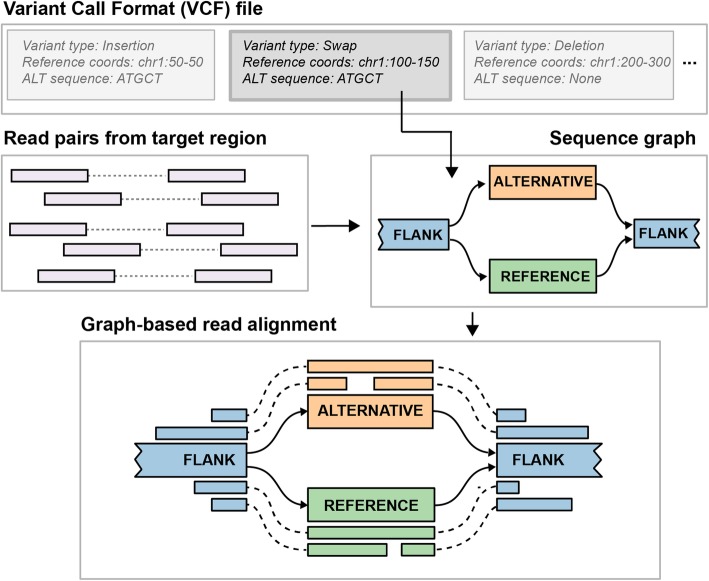
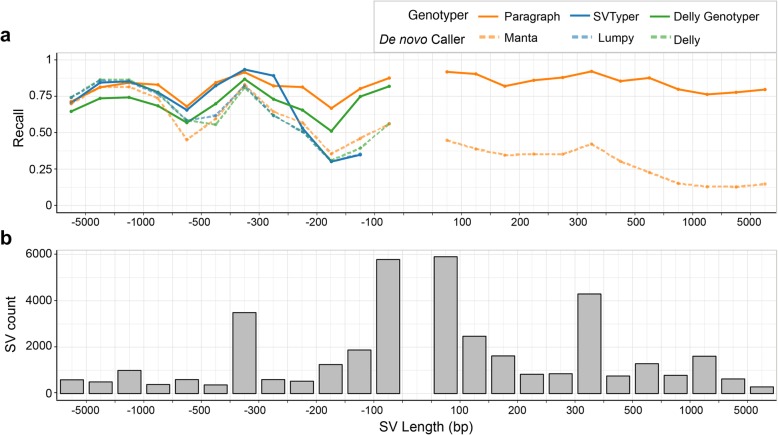
Accurate detection and genotyping of structural variations (SVs) from short-read data is a long-standing area of development in genomics research and clinical sequencing pipelines. We introduce Paragraph, an accurate genotyper that models SVs using sequence graphs and SV annotations. We demonstrate the accuracy of Paragraph on whole-genome sequence data from three samples using long-read SV calls as the truth set, and then apply Paragraph at scale to a cohort of 100 short-read sequenced samples of diverse ancestry. Our analysis shows that Paragraph has better accuracy than other existing genotypers and can be applied to population-scale studies.
Overview
The claims and statistics of this paper haven’t been checked yet.
Free: it reads the open-access text and checks the first 5 claims that cite a source we can check. Create a free account to check every claim.
Integrity signals
Registry
Cites
Statistics
Figures
Verification
Claims the paper makes
The claims and statistics of this paper haven’t been checked yet.
Free: it reads the open-access text and checks the first 5 claims that cite a source we can check. Create a free account to check every claim.
Claims other papers make about this one
Each is checked against this paper’s own text: does it say what the citing paper says it does?
The cited source says what the claim attributes to it.
In the citing paper
“Interestingly, what these sequencing technologies have demonstrated is that the alleles that are identifiable using their long reads are also often present and identifiable in short reads13.”
From Comprehensive genome analysis and variant detection at scale using DRAGEN (2025) · cites this paper as [13]
Self-check
Percentages, sums and reported differences re-computed from the paper’s own numbers.
The self-check needs the paper’s full text.
Citations
Cites
The Sequence Alignment/Map format and SAMtools
Li, H., Handsaker, B., Wysoker, A., Fennell, T., Ruan, J., Homer, N., Marth, G., Abecasis, G., Durbin, R., & 1000 Genome Project Data Processing Subgroup (2009) · Bioinformatics · doi:10.1093/bioinformatics/btp352 · Cited by 62,041
A framework for variation discovery and genotyping using next-generation DNA sequencing data
DePristo, M. A., Banks, E., Poplin, R., Garimella, K. V., Maguire, J. R., Hartl, C., Philippakis, A. A., del Angel, G., Rivas, M. A., Hanna, M., et al. (2011) · Nature Genetics · doi:10.1038/ng.806 · Cited by 11,456
Canu: scalable and accurate long-read assembly via adaptive k -mer weighting and repeat separation
Koren, S., Walenz, B. P., Berlin, K., Miller, J. R., Bergman, N. H., & Phillippy, A. M. (2017) · Genome Research · doi:10.1101/gr.215087.116 · Cited by 7,304
Biopython: freely available python tools for computational molecular biology and bioinformatics
Cock, P. J. A., Antao, T., Chang, J. T., Chapman, B. A., Cox, C. J., Dalke, A., Friedberg, I., Hamelryck, T., Kauff, F., Wilczynski, B., et al. (2009) · Bioinformatics · doi:10.1093/bioinformatics/btp163 · Cited by 6,080
Coming of age: ten years of next-generation sequencing technologies
Goodwin, S., McPherson, J. D., & McCombie, W. R. (2016) · Nature Reviews Genetics · doi:10.1038/nrg.2016.49 · Cited by 4,352
ABySS: A parallel assembler for short read sequence data
Simpson, J. T., Wong, K., Jackman, S. D., Schein, J. E., Jones, S. J. M., & Birol, İ. (2009) · Genome Research · doi:10.1101/gr.089532.108 · Cited by 3,608
De novo assembly of human genomes with massively parallel short read sequencing
Li, R., Zhu, H., Ruan, J., Qian, W., Fang, X., Shi, Z., Li, Y., Li, S., Shan, G., Kristiansen, K., et al. (2010) · Genome Research · doi:10.1101/gr.097261.109 · Cited by 2,926
DELLY: structural variant discovery by integrated paired-end and split-read analysis
Rausch, T., Zichner, T., Schlattl, A., Stütz, A. M., Benes, V., & Korbel, J. O. (2012) · Bioinformatics · doi:10.1093/bioinformatics/bts378 · Cited by 2,459
An integrated map of structural variation in 2,504 human genomes
Sudmant, P. H., Rausch, T., Gardner, E. J., Handsaker, R. E., Abyzov, A., Huddleston, J., Zhang, Y., Ye, K., Jun, G., Hsi-Yang Fritz, M., et al. (2015) · Nature · doi:10.1038/nature15394 · Cited by 2,354
(2015) · doi:10.1093/bioinformatics/btv710 · Cited by 2,234
Self-citation
Research works printed but not linked: 3
- Pacific Biosciences. WGS of HG001/NA12878 with PacBio CCS on the Sequel II System. 2019; https://www.ncbi.nlm.nih.gov/bioproject/PRJNA540705. Accessed 10 Dec 2019.
- Wenger AM, et al. Highly-accurate long-read sequencing of HG002/NA24385. 2019; https://www.ncbi.nlm.nih.gov/bioproject/PRJNA529679. Accessed 10 Dec 2019.
- Pacific Biosciences. WGS of HG005/NA24631 with PacBio CCS on the Sequel II System. 2019; https://www.ncbi.nlm.nih.gov/bioproject/PRJNA540706. Accessed 10 Dec 2019.
Cited by
Byrska-Bishop, M., Evani, U. S., Zhao, X., Basile, A. O., Abel, H. J., Regier, A. A., Corvelo, A., Clarke, W. E., Musunuri, R., Nagulapalli, K., et al. (2022) · Cell · doi:10.1016/j.cell.2022.08.004 · Cited by 1,094
Haplotype-resolved diverse human genomes and integrated analysis of structural variation
Ebert, P., Audano, P. A., Zhu, Q., Rodriguez-Martin, B., Porubsky, D., Bonder, M. J., Sulovari, A., Ebler, J., Zhou, W., Serra Mari, R., et al. (2021) · Science · doi:10.1126/science.abf7117 · Cited by 702
Graph pangenome captures missing heritability and empowers tomato breeding
Zhou, Y., Zhang, Z., Bao, Z., Li, H., Lyu, Y., Zan, Y., Wu, Y., Cheng, L., Fang, Y., Wu, K., et al. (2022) · Nature · doi:10.1038/s41586-022-04808-9 · Cited by 511
The Human Pangenome Project: a global resource to map genomic diversity
Wang, T., Antonacci-Fulton, L., Howe, K., Lawson, H. A., Lucas, J. K., Phillippy, A. M., Popejoy, A. B., Asri, M., Carson, C., Chaisson, M. J. P., et al. (2022) · Nature · doi:10.1038/s41586-022-04601-8 · Cited by 494
The design and construction of reference pangenome graphs with minigraph
Li, H., Feng, X., & Chu, C. (2020) · Genome Biology · doi:10.1186/s13059-020-02168-z · Cited by 455
“itions are sensitive to alignment and SV callers. The more consistent SV representation implied by a pangenome graph will help to alleviate the issue and subsequently facilitate the genotyping of SVs [49,34,50]. While we believe a reference pangenome graph will make complex variations more accessible by geneticists an…”
Background
Metadata
- Authors
- Chen, S., Krusche, P., Dolzhenko, E., Sherman, R. M., Petrovski, R., Schlesinger, F., Kirsche, M., Bentley, D. R., Schatz, M. C., Sedlazeck, F. J., & Eberle, M. A.
- Affiliations
- Illumina (United States) (US)
- Novartis (Switzerland) (CH)
- Johns Hopkins University (US)
- Illumina (United Kingdom) (GB)
- Baylor College of Medicine (US)
- Corresponding author
- Eberle, Michael A.
- ORCID
- Venue
- Genome Biology
- Published
- 2019-12
- Volume
- 20
- Issue
- 1
- Pages
- 291-291
- ISSN
- 1465-6906 (ISSN-L)
- 1474-760X
- PMC
- PMC6921448
- OpenAlex
- W2997001777
- Cited by
- 196
- References
- 52
- Citations by year
- 2026: 17 · 2025: 32 · 2024: 31 · 2023: 27 · 2022: 29 · 2021: 40 · 2020: 16 · 2019: 3
- FWCI
- 15.37
- Type
- journal article
- Language
- en
- Open access
- gold
- doi.org
- Licence
- cc-by
- creativecommons.org/licenses/by/4.0/ (tdm)
- creativecommons.org/licenses/by/4.0/ (vor, 18 d)
- Locations
- Genome biology (publishedVersion, cc-by)
- bioRxiv (Cold Spring Harbor Laboratory) (acceptedVersion, cc-by-nc-nd)
- PubMed Central (publishedVersion, cc-by)
- PubMed (publishedVersion)
- Cold Spring Harbor Laboratory Institutional Repository (Cold Spring Harbor Laboratory) (acceptedVersion)
- DOAJ (DOAJ: Directory of Open Access Journals) (submittedVersion, cc-by-sa)
- Funders
- Division of Biological Infrastructure (DBI-1350041 to MCS)
- Foundation for the National Institutes of Health (R01-HG006677, UM1-HG008898)
- Topics
- Life Sciences › Biochemistry, Genetics and Molecular Biology › Genetics › Genomic variations and chromosomal abnormalities
- Life Sciences › Biochemistry, Genetics and Molecular Biology › Molecular Biology › Genomics and Phylogenetic Studies
- Life Sciences › Biochemistry, Genetics and Molecular Biology › Genetics › Genome Rearrangement Algorithms
- Keywords
- structural variant genotyping, structural variants, sequence graphs, short-read sequencing, population-scale genomics, whole genome sequencing
- MeSH terms
- Humans, Genome, Human, Genomic Structural Variation, Genotyping Techniques
About these checks
Registry, retraction, Cites and statistics results are computed, not judged, with one exception: a printed reference that no index lists is read once by a model before it counts as a citation error. Claims are extracted by a model and kept only when their quote appears verbatim in the text; each cited source is then checked, with a model’s help, for whether it says what the claim relies on. Those verdicts can be wrong — read the claim’s quote and the cited source before relying on one.
Statistics and arithmetic are recomputed, not judged.
Confidence bands are shown only for fields calibrated on our annotated test set. None is calibrated yet, so no band is shown.
What counts as a claim ›How we measure confidence ›How we check this ›
Are you an author, or do you see a problem with this page? Request a review
How to cite
Cite CoChat for the checks on this page, and the paper for its own findings.
- This page
- CoChat. (2026). Citation check: Paragraph: a graph-based structural variant genotyper for short-read sequence data. https://app.cochat.ai/papers/10.1186/s13059-019-1909-7
- The paper
- Chen, S., Krusche, P., Dolzhenko, E., Sherman, R. M., Petrovski, R., Schlesinger, F., Kirsche, M., Bentley, D. R., Schatz, M. C., Sedlazeck, F. J., & Eberle, M. A. (2019). Paragraph: a graph-based structural variant genotyper for short-read sequence data. Genome Biology. https://doi.org/10.1186/s13059-019-1909-7
Data sources
Bibliographic data: Semantic Scholar, OpenAlex, Crossref.
Contains information from the Semantic Scholar Academic Graph Datasets, made available under the ODC Attribution License (ODC-BY 1.0).
Semantic Scholar’s data is described in: Kinney, R., et al. (2023). The Semantic Scholar Open Data Platform. arXiv:2301.10140.
