

The DOI matches its Crossref record; 169 of the 169 references it cites were found in a registry or an index.
Opportunities and challenges in long-read sequencing data analysis
Open accessAbstract
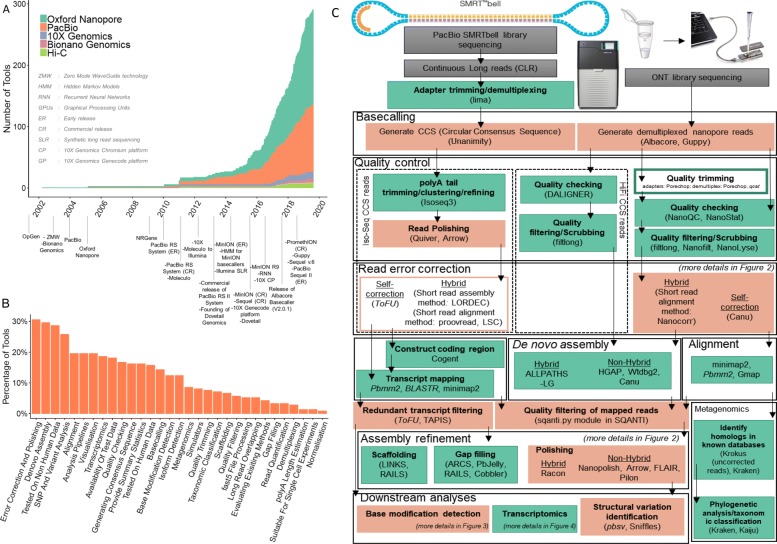
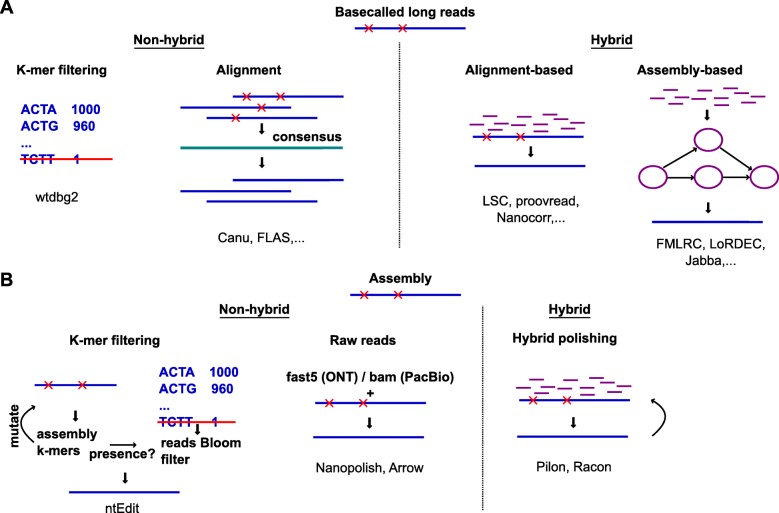
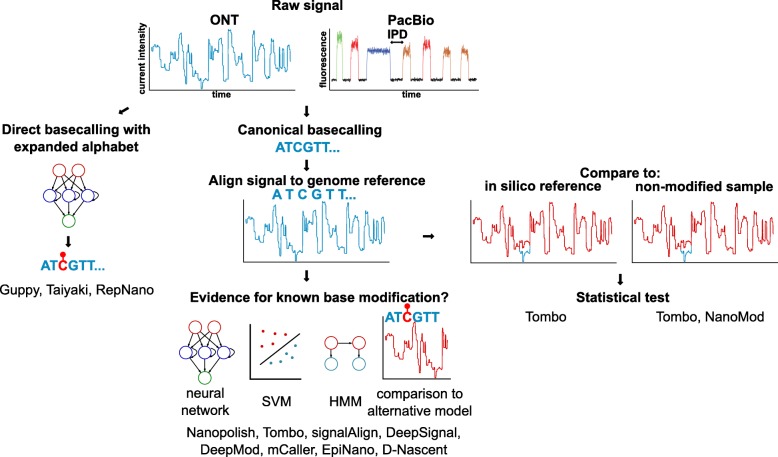
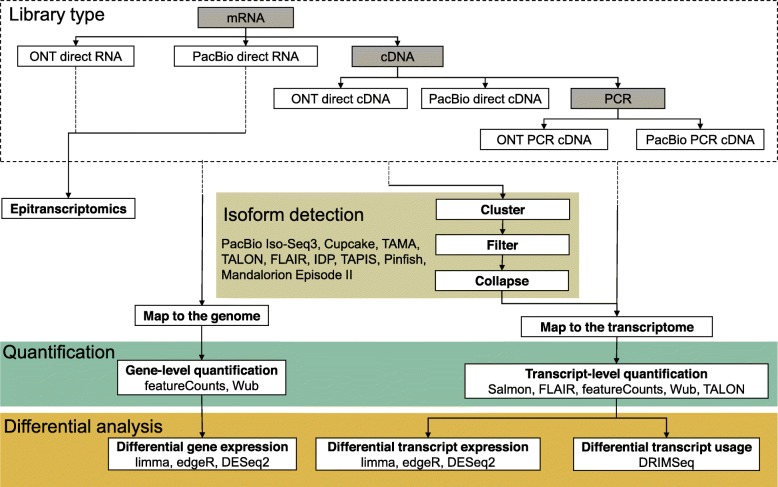
Long-read technologies are overcoming early limitations in accuracy and throughput, broadening their application domains in genomics. Dedicated analysis tools that take into account the characteristics of long-read data are thus required, but the fast pace of development of such tools can be overwhelming. To assist in the design and analysis of long-read sequencing projects, we review the current landscape of available tools and present an online interactive database, long-read-tools.org, to facilitate their browsing. We further focus on the principles of error correction, base modification detection, and long-read transcriptomics analysis and highlight the challenges that remain.
Overview
The claims and statistics of this paper haven’t been checked yet.
Run the check — free, no account needed. It reads the open-access text and checks the sources it cites.
Integrity signals
Registry
Cites
Statistics
Figures
Verification
Claims the paper makes
The claims and statistics of this paper haven’t been checked yet.
Run the check — free, no account needed. It reads the open-access text and checks the sources it cites.
Claims other papers make about this one
Each is checked against this paper’s own text: does it say what the citing paper says it does?
The source backs part of the claim, not all of it — or backs it for a different population, condition or comparison.
In the citing paper
“Conventional single-cell transcriptomics assays capture information at the gene level, thereby missing much of the biological diversity and regulatory mechanisms that occurs at the isoform level.30”
From hdWGCNA identifies co-expression networks in high-dimensional transcriptomics data (2023) · cites this paper as [30]
Experimental — accuracy not yet measuredIn the citing paper
“Although there exist batch-effect correction methods, it's still challenging to distinguish true biological diversity from technical differences and thus preserve important biological variations 13 .”
From scBERT as a Large-scale Pretrained Deep Language Model for Cell Type Annotation of Single-cell RNA-seq Data (2021) · cites this paper as [13]
Self-check
Percentages, sums and reported differences re-computed from the paper’s own numbers.
The self-check needs the paper’s full text.
Citations
Cites
Moderated estimation of fold change and dispersion for RNA-seq data with DESeq2
Love, M. I., Huber, W., & Anders, S. (2014) · Genome Biology · doi:10.1186/s13059-014-0550-8 · Cited by 95,106
Robinson, M. D., McCarthy, D. J., & Smyth, G. K. (2010) · Bioinformatics · doi:10.1093/bioinformatics/btp616 · Cited by 41,364
limma powers differential expression analyses for RNA-sequencing and microarray studies
Ritchie, M. E., Phipson, B., Wu, D., Hu, Y., Law, C. W., Shi, W., & Smyth, G. K. (2015) · Nucleic Acids Research · doi:10.1093/nar/gkv007 · Cited by 40,458
Self-citationfeatureCounts: an efficient general purpose program for assigning sequence reads to genomic features
Liao, Y., Smyth, G. K., & Shi, W. (2014) · Bioinformatics · doi:10.1093/bioinformatics/btt656 · Cited by 27,219
Salmon provides fast and bias-aware quantification of transcript expression
Patro, R., Duggal, G., Love, M. I., Irizarry, R. A., & Kingsford, C. (2017) · Nature Methods · doi:10.1038/nmeth.4197 · Cited by 12,700
Walker, B. J., Abeel, T., Shea, T., Priest, M., Abouelliel, A., Sakthikumar, S., Cuomo, C. A., Zeng, Q., Wortman, J. R., Young, S., et al. (2014) · PLoS ONE · doi:10.1371/journal.pone.0112963 · Cited by 9,130
Unicycler: Resolving bacterial genome assemblies from short and long sequencing reads
Wick, R. R., Judd, L. M., Gorrie, C. L., & Holt, K. E. (2017) · PLoS Computational Biology · doi:10.1371/journal.pcbi.1005595 · Cited by 8,728
Canu: scalable and accurate long-read assembly via adaptive k -mer weighting and repeat separationPreprint
Koren, S., Walenz, B. P., Berlin, K., Miller, J. R., Bergman, N. H., & Phillippy, A. M. (2017) · Genome Research · doi:10.1101/gr.215087.116 · Cited by 7,260
Assembly of long, error-prone reads using repeat graphs
Kolmogorov, M., Yuan, J., Lin, Y., & Pevzner, P. A. (2019) · Nature Biotechnology · doi:10.1038/s41587-019-0072-8 · Cited by 5,986
McCarthy, D. J., Chen, Y., & Smyth, G. K. (2012) · Nucleic Acids Research · doi:10.1093/nar/gks042 · Cited by 5,195
Research works printed but not linked: 1
- Oxford Nanopore Technologies. Clive Brown’s keynote at Nanopore Community Meeting 2018. 2018. https://nanoporetech.com/resource-centre/clive-brown-ncm-2018. Accessed 6 June 2019.
Cited by
Sorted by citations
Items 1,001–1,003 of 1,003
Chakrawarti, A., Eckstrom, K. M., Laaguiby, P., & Barlow, J. (2024) · Access Microbiology · doi:10.1099/acmi.0.000766.v3 · Cited by 9
Noguerales, V., Arjona, Y., García‐Olivares, V., Machado, A., López, H., Patiño, J., & Emerson, B. C. (2024) · Molecular Ecology · doi:10.1111/mec.17341 · Cited by 9
da Silva, R. P., Suphavilai, C., & Nagarajan, N. (2024) · BMC Bioinformatics · doi:10.1186/s12859-024-05760-3 · Cited by 9
Metadata
- Authors
- Amarasinghe, S. L., Su, S., Dong, X., Zappia, L., Ritchie, M. E., & Gouil, Q.
- Affiliations
- The University of Melbourne (AU)
- Corresponding author
- Gouil, Quentin
- Venue
- Genome Biology
- Published
- 2020-02-07
- Volume
- 21
- Issue
- 1
- Pages
- 30-30
- ISSN
- 1465-6906 (ISSN-L)
- 1474-760X
- PMC
- PMC7006217
- OpenAlex
- W3007172120
- Cited by
- 2,530
- References
- 167
- Citations by year
- 2026: 253 · 2025: 439 · 2024: 498 · 2023: 437 · 2022: 441 · 2021: 356 · 2020: 100
- FWCI
- 32.42
- Type
- journal article
- Language
- en
- Open access
- gold
- doi.org
- Locations
- Genome biology (publishedVersion, cc-by)
- Europe PMC (PubMed Central) (publishedVersion, cc-by)
- PubMed Central (publishedVersion, cc-by)
- PubMed (publishedVersion)
- Minerva Access (University of Melbourne) (submittedVersion, cc-by)
- DOAJ (DOAJ: Directory of Open Access Journals) (submittedVersion)
- Topics
- Life Sciences › Biochemistry, Genetics and Molecular Biology › Molecular Biology › Genomics and Phylogenetic Studies
- Life Sciences › Biochemistry, Genetics and Molecular Biology › Molecular Biology › Single-cell and spatial transcriptomics
- Life Sciences › Biochemistry, Genetics and Molecular Biology › Genetics › Genomic variations and chromosomal abnormalities
- Keywords
- long-read sequencing, error correction, sequencing accuracy, sequencing throughput
- MeSH terms
- Whole Genome Sequencing, Data Science, Nanopore Sequencing, Animals, Humans, Genomics
About these checks
Registry, retraction, Cites and statistics results are computed, not judged, with one exception: a printed reference that no index lists is read once by a model before it counts as a citation error. Claims are extracted by a model and kept only when their quote appears verbatim in the text; each cited source is then checked, with a model’s help, for whether it says what the claim relies on. Those verdicts can be wrong — read the claim’s quote and the cited source before relying on one.
Statistics and arithmetic are recomputed, not judged.
Confidence bands are shown only for fields calibrated on our annotated test set. None is calibrated yet, so no band is shown.
What counts as a claim ›How we measure confidence ›How we check this ›
Are you an author, or do you see a problem with this page? Request a review
