

Combining different CRISPR nucleases for simultaneous knock-in and base editing prevents translocations in multiplex-edited CAR T cells
Open accessPublished version of a preprint
The DOI matches its Crossref record; 79 of the 79 references it cites were found in a registry or an index.
Abstract
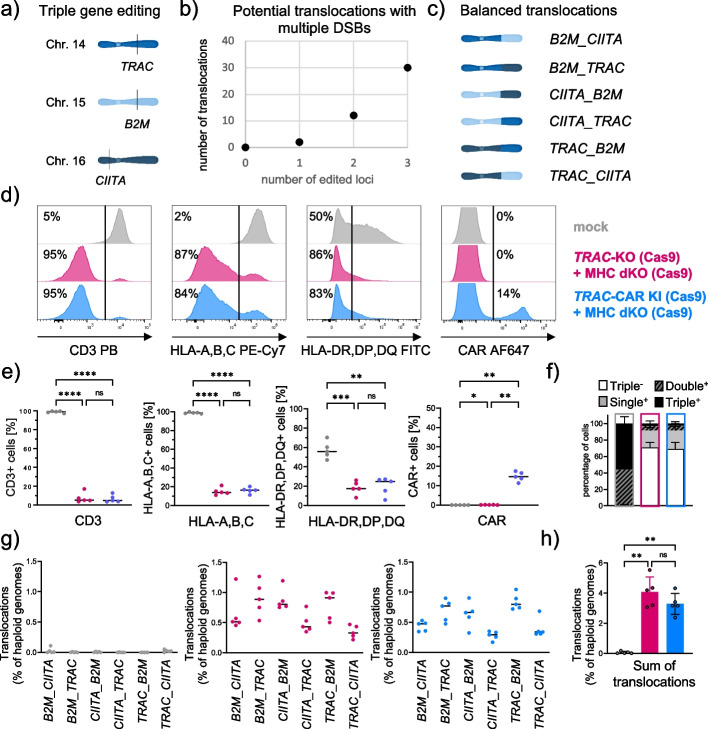
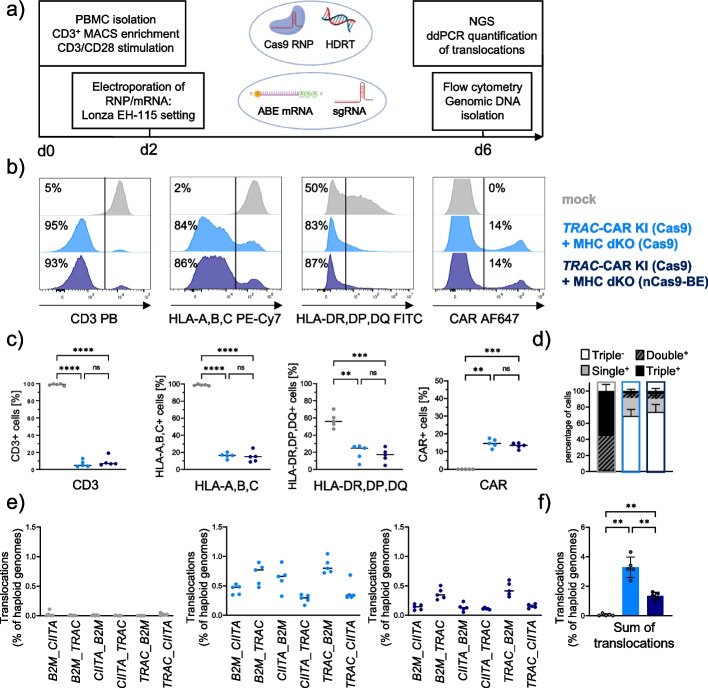
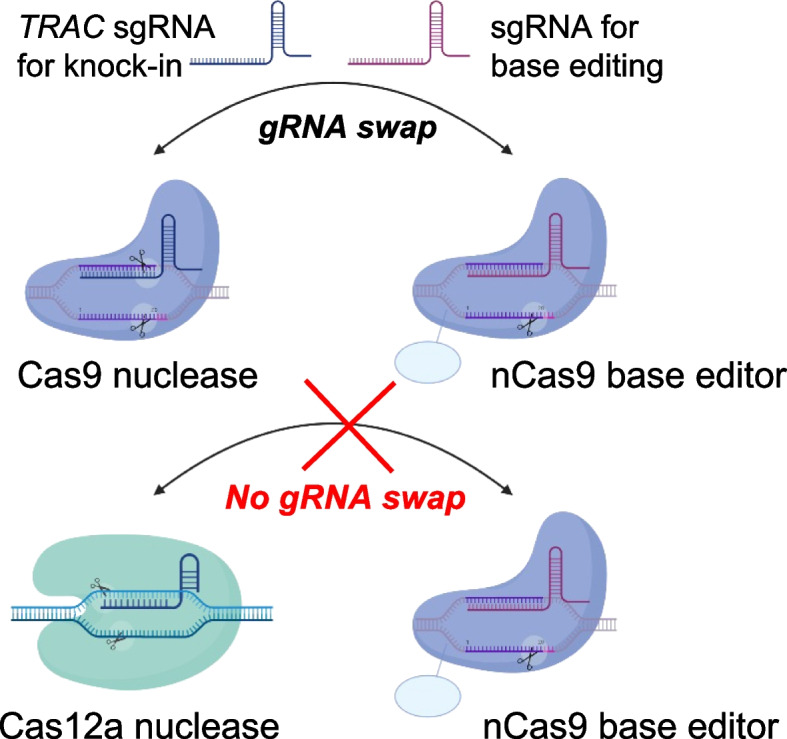
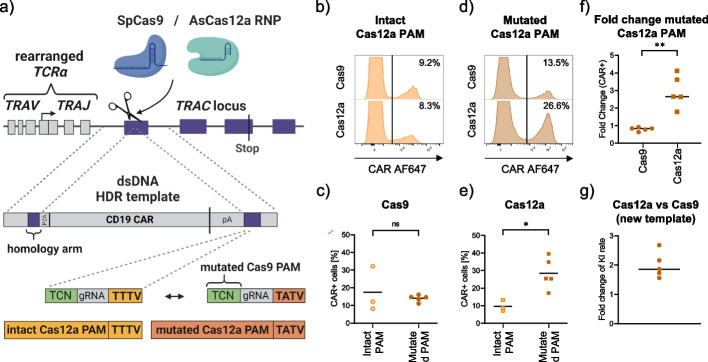
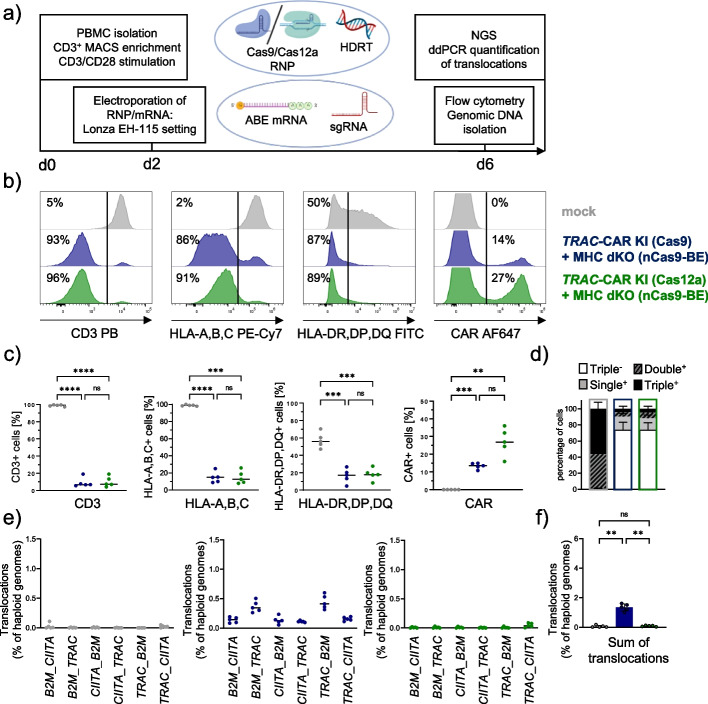
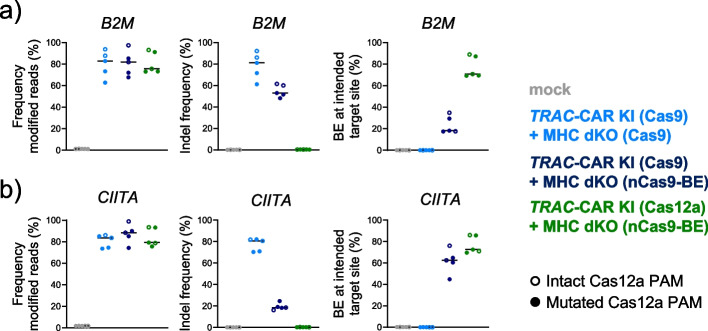
BACKGROUND: Multiple genetic modifications may be required to develop potent off-the-shelf chimeric antigen receptor (CAR) T cell therapies. Conventional CRISPR-Cas nucleases install sequence-specific DNA double-strand breaks (DSBs), enabling gene knock-out or targeted transgene knock-in. However, simultaneous DSBs provoke a high rate of genomic rearrangements which may impede the safety of the edited cells. RESULTS: Here, we combine a non-viral CRISPR-Cas9 nuclease-assisted knock-in and Cas9-derived base editing technology for DSB free knock-outs within a single intervention. We demonstrate efficient insertion of a CAR into the T cell receptor alpha constant (TRAC) gene, along with two knock-outs that silence major histocompatibility complexes (MHC) class I and II expression. This approach reduces translocations to 1.4% of edited cells. Small insertions and deletions at the base editing target sites indicate guide RNA exchange between the editors. This is overcome by using CRISPR enzymes of distinct evolutionary origins. Combining Cas12a Ultra for CAR knock-in and a Cas9-derived base editor enables the efficient generation of triple-edited CAR T cells with a translocation frequency comparable to unedited T cells. Resulting TCR- and MHC-negative CAR T cells resist allogeneic T cell targeting in vitro. CONCLUSIONS: We outline a solution for non-viral CAR gene transfer and efficient gene silencing using different CRISPR enzymes for knock-in and base editing to prevent translocations. This single-step procedure may enable safer multiplex-edited cell products and demonstrates a path towards off-the-shelf CAR therapeutics.
Overview
The claims and statistics of this paper haven’t been checked yet.
Free: it reads the open-access text and checks the first 5 claims that cite a source we can check. Create a free account to check every claim.
Integrity signals
Registry
Cites
Statistics
Figures
Verification
Claims the paper makes
The claims and statistics of this paper haven’t been checked yet.
Free: it reads the open-access text and checks the first 5 claims that cite a source we can check. Create a free account to check every claim.
Claims other papers make about this one
Each is checked against this paper’s own text: does it say what the citing paper says it does?
The source backs part of the claim, not all of it — or backs it for a different population, condition or comparison.
In the citing paper
“ABE has also been shown to induce translocations at a significantly lower rate than Cas9 when multiple genes are targeted.30”
From Adenine base editor for knockout of proteins: A practical guide from design to analysis with updated MultiEditRbatch (2026) · cites this paper as [30]
Experimental — accuracy not yet measuredThe source backs part of the claim, not all of it — or backs it for a different population, condition or comparison.
In the citing paper
“The use of more than one base editor variant leads to a reduction of on-target efficiency due to gRNA exchange and potential for unintended edits.30,62”
From Adenine base editor for knockout of proteins: A practical guide from design to analysis with updated MultiEditRbatch (2026) · cites this paper as [30]
Experimental — accuracy not yet measured
Self-check
Percentages, sums and reported differences re-computed from the paper’s own numbers.
The self-check needs the paper’s full text.
Citations
Cites
A Programmable Dual-RNA–Guided DNA Endonuclease in Adaptive Bacterial Immunity
Jinek, M., Chylinski, K., Fonfara, I., Hauer, M., Doudna, J. A., & Charpentier, E. (2012) · Science · doi:10.1126/science.1225829 · Cited by 17,116 · cited 1×
“Programmable nucleases, such as zinc finger nucleases [4], TALE nucleases [5], or CRISPR-Cas [6, 7], enable the induction of DNA double-strand breaks (DSBs) at precise locations in the genome.”
Primer-BLAST: A tool to design target-specific primers for polymerase chain reaction
Ye, J., Coulouris, G., Zaretskaya, I., Cutcutache, I., Rozen, S., & Madden, T. L. (2012) · BMC Bioinformatics · doi:10.1186/1471-2105-13-134 · Cited by 6,111
Programmable editing of a target base in genomic DNA without double-stranded DNA cleavage
Komor, A. C., Kim, Y. B., Packer, M. S., Zuris, J. A., & Liu, D. R. (2016) · Nature · doi:10.1038/nature17946 · Cited by 5,437 · cited 2×
“Further, advanced gene editing enzymes are being developed that allow programmable changes of distinct bases [9, 10], epigenetic states [11–13], or larger sequence changes, diversifying our toolbox to engineer the genome.”
Cpf1 Is a Single RNA-Guided Endonuclease of a Class 2 CRISPR-Cas System
Zetsche, B., Gootenberg, J. S., Abudayyeh, O. O., Slaymaker, I. M., Makarova, K. S., Essletzbichler, P., Volz, S. E., Joung, J., van der Oost, J., Regev, A., et al. (2015) · Cell · doi:10.1016/j.cell.2015.09.038 · Cited by 4,761
Programmable base editing of A•T to G•C in genomic DNA without DNA cleavage
Gaudelli, N. M., Komor, A. C., Rees, H. A., Packer, M. S., Badran, A. H., Bryson, D. I., & Liu, D. R. (2017) · Nature · doi:10.1038/nature24644 · Cited by 4,184 · cited 2×
“Further, advanced gene editing enzymes are being developed that allow programmable changes of distinct bases [9, 10], epigenetic states [11–13], or larger sequence changes, diversifying our toolbox to engineer the genome.”
Double nicking by RNA-guided CRISPR Cas9 for enhanced genome editing specificity
Ran, F. A., Hsu, P. D., Lin, C.-Y., Gootenberg, J. S., Konermann, S., Trevino, A. E., Scott, D. A., Inoue, A., Matoba, S., Zhang, Y., et al. (2013) · Cell · doi:10.1016/j.cell.2013.08.021 · Cited by 3,299 · cited 1×
“Future studies should optimize double nicking [50, 51] with the Cas9 BE to install a DSB for HDR alongside other KO, which should avoid translocations as well, but it may be less efficient than use of a bona-fide nuclease for KI.”
Gasiunas, G., Barrangou, R., Horvath, P., & Siksnys, V. (2012) · Proceedings of the National Academy of Sciences · doi:10.1073/pnas.1208507109 · Cited by 2,769 · cited 2×
“Programmable nucleases, such as zinc finger nucleases [4], TALE nucleases [5], or CRISPR-Cas [6, 7], enable the induction of DNA double-strand breaks (DSBs) at precise locations in the genome.”
Genome editing with CRISPR–Cas nucleases, base editors, transposases and prime editors
Anzalone, A. V., Koblan, L. W., & Liu, D. R. (2020) · Nature Biotechnology · doi:10.1038/s41587-020-0561-9 · Cited by 2,237 · cited 1×
“Further, new technologies for site-specific gene delivery without DNA DSBs, such as PASTE [52] (which is a combination of CRISPR prime editing [53] and serine integrases [54]), CRISPR-associated transposases (CAST) [55, 56], or designer recombinases [57], may allow translocation-free multiplex gene editing after optim…”
Hybrid restriction enzymes: zinc finger fusions to Fok I cleavage domain.
Kim, Y. G., Cha, J., & Chandrasegaran, S. (1996) · Proceedings of the National Academy of Sciences · doi:10.1073/pnas.93.3.1156 · Cited by 1,889
Targeting DNA Double-Strand Breaks with TAL Effector Nucleases
Christian, M., Cermak, T., Doyle, E. L., Schmidt, C., Zhang, F., Hummel, A., Bogdanove, A. J., & Voytas, D. F. (2010) · Genetics · doi:10.1534/genetics.110.120717 · Cited by 1,869
Cited by
Development of NK cell-based cancer immunotherapies through receptor engineering
Page, A., Chuvin, N., Valladeau-Guilemond, J., & Depil, S. (2024) · Cellular & Molecular Immunology · doi:10.1038/s41423-024-01145-x · Cited by 219
“Recently, several manufacturing protocols have been developed to overcome some of the abovementioned limitations and, if approved, could become standard practices to minimize chromosome loss and translocations in manufactured products [174 – 176].”
BackgroundLei, T., Wang, Y., Zhang, Y., Yang, Y., Cao, J., Huang, J., Chen, J., Chen, H., Zhang, J., wang, L., et al. (2024) · Leukemia · doi:10.1038/s41375-024-02444-y · Cited by 177
Allogeneic CAR-T Therapy Technologies: Has the Promise Been Met?
Lonez, C., & Breman, E. (2024) · Cells · doi:10.3390/cells13020146 · Cited by 125
Base-editing mutagenesis maps alleles to tune human T cell functions
Schmidt, R. L. J., Ward, C. C., Dajani, R., Armour-Garb, Z., Ota, M., Allain, V., Hernandez, R., Layeghi, M., Xing, G., Goudy, L., et al. (2023) · Nature · doi:10.1038/s41586-023-06835-6 · Cited by 107
Cavazza, A., Molina-Estévez, F. J., Reyes, Á. P., Ronco-Díaz, V., Naseem, A., Malenšek, Š., Pečan, P., Santini, A., Heredia, P., Aguilar-González, A., et al. (2025) · Molecular Therapy — Nucleic Acids · doi:10.1016/j.omtn.2025.102457 · Cited by 80
Recent updates on allogeneic CAR-T cells in hematological malignancies
Mansoori, S., Noei, A., Maali, A., Seyed-Motahari, S. S., & Sharifzadeh, Z. (2024) · Cancer Cell International · doi:10.1186/s12935-024-03479-y · Cited by 65
Integration of ζ-deficient CARs into the CD3 ζ gene conveys potent cytotoxicity in T and NK cells
Kath, J., Franke, C., Drosdek, V., Du, W., Glaser, V., Fuster‐García, C., Stein, M., Zittel, T., Schulenberg, S., Porter, C. E., et al. (2024) · Blood · doi:10.1182/blood.2023020973 · Cited by 57
Self-citationRavichandran, M., & Maddalo, D. (2023) · Frontiers in Genetics · doi:10.3389/fgene.2023.1273994 · Cited by 53
Altered cancer metabolism and implications for next-generation CAR T-cell therapies
Ramapriyan, R., Vykunta, V. S., Vandecandelaere, G., Richardson, L. G., Sun, J. M., Curry, W. T., & Choi, B. D. (2024) · Pharmacology & Therapeutics · doi:10.1016/j.pharmthera.2024.108667 · Cited by 49
Chen, X., Tan, B., Xing, H., Zhao, X., Ping, Y., Zhang, Z., Huang, J., Shi, X., Zhang, N., Lin, B., et al. (2024) · Cancer Immunology Immunotherapy · doi:10.1007/s00262-023-03586-1 · Cited by 48
Mapping variant effects on anti-tumor hallmarks of primary human T cells with base-editing screens
Walsh, Z. H., Shah, P., Kothapalli, N., Shah, S. B., Nikolényi, G., Brodtman, D. Z., Leuzzi, G., Rogava, M., Mu, M., Ho, P., et al. (2024) · Nature Biotechnology · doi:10.1038/s41587-024-02235-x · Cited by 45
Recent advances in universal chimeric antigen receptor T cell therapy
Jiang, N., Yang, Z., Miao, H., Xing, S., Wang, S., & Li, N. (2025) · Journal of Hematology & Oncology · doi:10.1186/s13045-025-01737-8 · Cited by 45
Current Non-Viral-Based Strategies to Manufacture CAR-T Cells
Gehrke, L., Gonçalves, V. D. R., Andrae, D., Raskó, T., Ho, P., Einsele, H., Hudecek, M., & Friedel, S. R. (2024) · International Journal of Molecular Sciences · doi:10.3390/ijms252413685 · Cited by 36
Petri, K., D’Ippolito, E., Künkele, A., Koehl, U., Busch, D. H., Einsele, H., & Hudecek, M. (2025) · Nature Reviews Clinical Oncology · doi:10.1038/s41571-025-01072-4 · Cited by 36
Development of multiplexed orthogonal base editor (MOBE) systems
Cowan, Q. T., Gu, S., Gu, W., Ranzau, B. L., Simonson, T. S., & Komor, A. C. (2025) · Nature Biotechnology · doi:10.1038/s41587-024-02240-0 · Cited by 26
“However, intracellular gRNA exchange, which would result in gRNA crosstalk, has been reported to be quite efficient 28,29 .”
Expanding the horizon of CAR T cell therapy: from cancer treatment to autoimmune diseases and beyond
Yang, Z., Ha, B., Wu, Q., Ren, F., Yin, Z., & Zhang, H. (2025) · Frontiers in Immunology · doi:10.3389/fimmu.2025.1544532 · Cited by 24
McCallion, O., Du, W., Glaser, V., Milward, K. F., Short, S., Bilici, M., Cross, A. R., Stark, H. L., Franke, C., Kath, J., et al. (2025) · Nature Communications · doi:10.1038/s41467-025-64945-3 · Cited by 22
Self-citationWen, P., Ai, Q., Fan, X., Gu, Z., 陈波, & Qian, H. (2026) · Cancer Letters · doi:10.1016/j.canlet.2026.218257 · Cited by 21
Gene editing of CD3 epsilon to redirect regulatory T cells for adoptive T cell transfer
Du, W., Noyan, F., McCallion, O., Drosdek, V., Kath, J., Glaser, V., Fuster‐García, C., Yang, M., Stein, M., Franke, C., et al. (2025) · Molecular Therapy · doi:10.1016/j.ymthe.2025.01.045 · Cited by 21
Self-citationMikkelsen, N. S., Ravendran, S., Broksø, A. D., Skjelbostad, S. F., Pedersen, M. G., Fang, H., Terkelsen, T., Thomsen, M. K., & Bak, R. O. (2025) · Molecular Therapy · doi:10.1016/j.ymthe.2025.08.032 · Cited by 20
Porreca, I., Blassberg, R. A., Harbottle, J. A., Joubert, B. C., Mielczarek, O., Stombaugh, J., Hemphill, K., Sumner, J., Pazeraitis, D., Touza, J. L., et al. (2024) · Molecular Therapy · doi:10.1016/j.ymthe.2024.06.033 · Cited by 19
Kruglova, N. A., & Shepelev, M. V. (2024) · Biomedicines · doi:10.3390/biomedicines12010119 · Cited by 18
Non-viral vectors for chimeric antigen receptor immunotherapy
Tretbar, S., Rurik, J. G., Rustad, E. H., Sürün, D., Koehl, U., Olweus, J., Buchholz, F., Ivics, Z., Fricke, S., & Blache, U. (2024) · Nature Reviews Methods Primers · doi:10.1038/s43586-024-00348-w · Cited by 16
Large-scale manufacturing of base-edited chimeric antigen receptor T cells
Woodruff, R., Parekh, F., Lamb, K., Mekkaoui, L., Allen, C. G., Smetanova, K., Huang, J. L., Williams, A., Toledo, G. S., Lilova, K., et al. (2023) · Molecular Therapy — Methods & Clinical Development · doi:10.1016/j.omtm.2023.101123 · Cited by 16
Srivastava, S., Tyagi, A., Pawar, V. A., Khan, N. H., Arora, K., Verma, C., & Kumar, V. (2024) · ImmunoTargets and Therapy · doi:10.2147/itt.s474659 · Cited by 15
Orthogonal transcriptional modulation and gene editing using multiple CRISPR-Cas systems
Broksø, A. D., Bendixen, L., Fammé, S., Mikkelsen, K., Jensen, T. I., & Bak, R. O. (2024) · Molecular Therapy · doi:10.1016/j.ymthe.2024.11.024 · Cited by 14
Applications of CRISPR technology in cellular immunotherapy
Zhou, X., Renauer, P. A., Zhou, L., Fang, S., & Chen, S. (2023) · Immunological Reviews · doi:10.1111/imr.13241 · Cited by 15
From Bench to Bedside: Ethical and Clinical Best Practices for Genome Editing Applications
Ortiz-Bueno, M., Zinghirino, F., Puig-Serra, P., Paschoudi, K., Montoliu, L., Atilla, E., Luo, Y., Cavazza, A., Lederer, C. W., & Benabdellah, K. (2026) · International Journal of Molecular Sciences · doi:10.3390/ijms27031484 · Cited by 13
Winterhalter, P. M., Warmuth, L., Hilgendorf, P., Schütz, J. M., Dötsch, S., Tonn, T., Čičin‐Šain, L., Busch, D. H., & Schober, K. (2024) · Blood Advances · doi:10.1182/bloodadvances.2023011496 · Cited by 13
Fine tuning towards the next generation of engineered T cells
Nguyen, T. T., Ho, P., Staudt, S., Grégoire, C., Ziegler-Martin, K., Jassin, M., Block, A., Hudecek, M., Melenhorst, J. J., Caers, J., et al. (2025) · Nature Biomedical Engineering · doi:10.1038/s41551-025-01492-8 · Cited by 12
Non-viral expression of chimeric antigen receptors with multiplex gene editing in primary T cells
Cappabianca, D., Li, J., Zheng, Y., Tran, C., Kasparek, K., Mendez, P., Thu, R., Maures, T. J., Capitini, C. M., Deans, R., et al. (2024) · Frontiers in Bioengineering and Biotechnology · doi:10.3389/fbioe.2024.1379900 · Cited by 11
Chen, C., Zheng, P., Chen, P., & Wu, D. (2023) · Biotechnology for Biofuels and Bioproducts · doi:10.1186/s13068-023-02443-8 · Cited by 10
Naert, T., Yamamoto, T., Han, S., Röck, R., Horn, M., Bethge, P., Vladimirov, N., Voigt, F. F., Figueiro‐Silva, J., Bachmann‐Gagescu, R., et al. (2025) · Nature Biotechnology · doi:10.1038/s41587-025-02771-0 · Cited by 9
CRISPR tools for T cells: targeting the genome, epigenome, and transcriptome
Wachsmann, T. L. A., & Qi, L. S. (2025) · Trends in cancer · doi:10.1016/j.trecan.2025.08.001 · Cited by 9
Premchandani, T., Qutub, M., Tatode, A., Umekar, M. J., Taksande, J., Hussain, U., & Khidkikar, S. R. (2025) · Immunologic Research · doi:10.1007/s12026-025-09687-6 · Cited by 9
Enhancing the potency of CAR-T cells against solid tumors through transcription factor engineering
Chen, R., Chen, L., Tang, Y. R., Xiaolin, S., Wang, Y., Tang, P., Shentu, X., & Sun, J. (2025) · JCI Insight · doi:10.1172/jci.insight.193048 · Cited by 9
N-glycosylation engineering in chimeric antigen receptor T cells enhances anti-tumor activityPreprint
Bousser, E. D., Festjens, N., Plets, E., Meuris, L., Vuylsteke, L., Fijalkowska, D., Hecke, A. V., Wyseure, E., Goossens, M., Pryck, L. D., et al. (2023) · bioRxiv (Cold Spring Harbor Laboratory) · doi:10.1101/2023.01.23.525164 · Cited by 7
Jia, Z., Wu, J., Zhang, J., Zheng, P., Zhang, H., Lin, Y., Pan, T., Wu, M., & Song, Y. (2025) · International Journal of Biological Sciences · doi:10.7150/ijbs.124144 · Cited by 6
Safe CAR-T: shedding light on CAR-related T-cell malignancies
Liao, Q., & Xu, J. (2025) · EMBO Molecular Medicine · doi:10.1038/s44321-025-00205-7 · Cited by 6
Simultaneous orthogonal cell engineering by a single CRISPR-Cas9 polyfunctional editor
Cipria, D., Baccega, T., Rizzo, M., Quarato, P., Reschigna, A., Khoury, R. E., Cappelluti, M. A., Ammann, S., Poeta, V. M., Conti, M., et al. (2026) · Nature Communications · doi:10.1038/s41467-026-72846-2 · Cited by 5
Glaser, V., Jo, B. L., Fuster‐García, C., Aird, E. J., Huth, L., Nitulescu, A.-M., Pu, Y., Kassing, I., Hartmann, L. M., Flugel, C., et al. (2026) · Molecular Therapy · doi:10.1016/j.ymthe.2026.07.034 · Cited by 5
Self-citationA singular base-editing platform for polyfunctional multiplex engineering of immune cells
Skeate, J. G., Slipek, N. J., Lahr, W. S., Roy, S., Wick, B. J., Kar, B., Chang, J.-W., Stelljes, E. M., Gilkey, A. K., Thenge, P. P., et al. (2026) · Molecular Therapy · doi:10.1016/j.ymthe.2026.07.033 · Cited by 3
Bringing base editing to the clinic: The next generation of genome editors
Flugel, C., & Abou‐El‐Enein, M. (2023) · Molecular Therapy — Methods & Clinical Development · doi:10.1016/j.omtm.2023.101138 · Cited by 3
Self-citationKassing, I., Kath, J., Nitulescu, A.-M., Glaser, V., Hartmann, L. M., Pu, Y., Huth, L., Kārkliņš, R., Shaji, S. M., Ringel, A. R., et al. (2025) · bioRxiv (Cold Spring Harbor Laboratory) · doi:10.1101/2025.09.10.675267 · Cited by 3
Self-citationEaton, E. J., Wick, B. J., Chacón, J. S., Wang, A. J., Kluesner, M., Barnes, J. T., Kar, B., Wang, M., Johnson, M. J., Skeate, J. G., et al. (2026) · Molecular Therapy Nucleic Acids · doi:10.1016/j.omtn.2026.102908 · Cited by 2
Tao, J., Zhang, J., Tang, C., Duan, J., Zhong, W., Zhang, C.-Y., Liu, Y., Ling, J., Li, H., Zhou, Y., et al. (2025) · Cancer Gene Therapy · doi:10.1038/s41417-025-00957-x · Cited by 2
Multiplex genome engineering: Methodologies and applications
Peng, S., Xie, W., Zhu, J., & Bao, Z. (2026) · Cell Systems · doi:10.1016/j.cels.2026.101614 · Cited by 2
Base-editing a single missense mutation in A20 enhances CAR-T cell efficacyPreprint
Blaisdell, A., Bachl, S., Sandoval, L. R., Ching, C., Bowman, C., Kale, N., Prabandham, M., Diolaiti, M. E., Havig, C. C., Advincula, R., et al. (2025) · bioRxiv (Cold Spring Harbor Laboratory) · doi:10.1101/2025.10.05.680562 · Cited by 2
Next frontier in cancer treatment: an iPSC supported CAR-T cell therapies
Sona, T. (2024) · Asia-Pacific Journal of Oncology · doi:10.32948/ajo.2024.12.23 · Cited by 1
Improving resolution with single-cell detection of CRISPR off-target events
Lee, C. M. (2025) · Molecular Therapy — Methods & Clinical Development · doi:10.1016/j.omtm.2025.101498 · Cited by 1
CRISPR/methotrexate-integrated strategy for TCR-T cell engineering with reduced chromosome 14 loss
Xu, J., Shen, L., Chen, Z., Zhang, C., Ding, X., He, Q., Zhou, X., Jiang, P., Liu, J., Li, L., et al. (2025) · Molecular Therapy — Methods & Clinical Development · doi:10.1016/j.omtm.2025.101635 · Cited by 1
Strategies to eliminate native T cell receptors for adoptive T cell therapies
Flumens, D., Campillo-Davó, D., Oers, F. V., Shaw, P. A. G., & Lion, E. (2026) · Molecular Therapy · doi:10.1016/j.ymthe.2026.01.017 · Cited by 1
Top advances of the year in autologous cellular therapy in melanoma and solid tumors
Loo, K., & Warner, A. B. (2026) · Cancer · doi:10.1002/cncr.70612 · Cited by 1
L’ingénierie cellulaire au service de l’optimisation des CAR-T cells
Galatioto, A., Fredon, M., & Galaine, J. (2024) · Bulletin de l Académie Nationale de Médecine · doi:10.1016/j.banm.2024.07.005 · Cited by 1
Deneault, É. (2025) · Genetics. · doi:10.5772/intechopen.1013143 · Cited by 1
Glaser, V., Flugel, C., Kath, J., Du, W., Drosdek, V., Franke, C., Stein, M., Prüß, A., Schmueck‐Henneresse, M., Volk, H., et al. (2025) · Genome biology · doi:10.1186/s13059-025-03548-z
Self-citationCosta, C. N. M., dos Santos, J. M., dos Santos, A. M., dos Santos, M. C. M., Campos, A. L. A., Santos, V. C., Awar, U. G. E., Franco, E. C. S., & Correa, R. M. D. S. (2025) · Contribuciones a las Ciencias Sociales · doi:10.55905/revconv.18n.7-037
Advancing cell therapy manufacturing through precision genome engineering
Flugel, C., Cadiñanos-Garai, A., & Abou‐El‐Enein, M. (2025) · Elsevier eBooks · doi:10.1016/b978-0-443-14064-8.00052-7
Self-citationZhang, Q., Wu, Y., Yang, J., Zhou, K., Manoharan, E. N. E. A., Wentz, T., Su, L., Yu, A., Wang, H., Bruhn, L., et al. (2025) · Blood Immunology & Cellular Therapy · doi:10.1016/j.bict.2025.100019
Chen, C., Zheng, P., Chen, P., & Wu, D. (2024) · Figshare · doi:10.6084/m9.figshare.26652738
Gene Expression - From Code to Cure
Dabas, P., Maia, R. T., Oliveira, C., Martins, G. V. F., & Campos, M. D. A. (2025) · Genetics. · doi:10.5772/intechopen.1008065
CRISPR/methotrexate-integrated strategy for TCR-T cell engineering with reduced chromosome 14 loss
Xu, J., Shen, L., Chen, Z., Zhang, C., Ding, X., He, Q., Zhou, X., Jiang, P., Liu, J., Li, L., et al. (2026) · Molecular Therapy Advances · doi:10.1016/j.omta.2026.201676
Kleid, J.-M., Damrat, M., Darguzyte, M., Rhiel, M., Stumpf, N. E., Kleitke, T., Ammann, S., Cornu, T. I., Khan, F., Wollmann, T., et al. (2026) · Research Square · doi:10.21203/rs.3.rs-8902221/v1
Self-citationAre entirely virus-free CAR T cells as good as lentiviral transduced universal cells?
Gough, O., Georgiadis, C., Preece, R., Kadirkamanathan, R., & Qasim, W. (2026) · Molecular Therapy · doi:10.64898/2026.04.30.721956
A Non-Viral CRISPR/Cas9 HDR Platform for Stable Engineering of Solid Tumor ModelsPreprint
Afzal, S., Pilgram, M., Macos, J., Ohlendorf, E., Raab, L. O., Kath, J., Glaser, V., Nitulescu, A.-M., van der Ven, C. F. T., Lachiheb, C., et al. (2026) · bioRxiv (Cold Spring Harbor Laboratory) · doi:10.64898/2026.06.01.729035
Self-citationCRISPR integration of an FLT3 CAR into the TRAC locus generates CAR T cells for AML
Noer, M. G., Christensen, K. B., Mikkelsen, N. S., Skjelbostad, S. F., Rothemejer, F. H., Wittenborn, T. R., Fammé, S., Mikkelsen, K., Barington, T., Thomsen, M. K., et al. (2026) · Genome Medicine · doi:10.1186/s13073-026-01718-7
Onyekweli, S. O., Omoruyi, G. O., Akintayo, C. O., & Olaniyi, K. S. (2026) · Oncoscience · doi:10.18632/oncoscience.666
Human T cell engineering via serial delivery of mRNA encapsulated within lipid nanoparticles
Ramamurthy, A., Scimonelli, G., Murphy, W. L., & Saha, K. (2026) · Molecular Therapy Nucleic Acids · doi:10.1016/j.omtn.2026.103081
“24,75,76 While electroporation and SM102-DD LNPs could both deliver mRNA in a serial fashion, transfected cells died at higher rates in the electroporated samples.”
Allehyani, N., Alissa, M., Alghamdi, A., Alshehri, M. A., Abusalim, G. S., Alhegaili, A. S., Juraybi, T. N., & Alsuwat, M. A. (2026) · Reviews in Medical Virology · doi:10.1002/rmv.70199
Electroporation-Mediated Delivery of CRISPR Technologies for Liver Disease Cell Therapy and Modeling
Cottle, R. N. (2026) · Springer eBooks · doi:10.1007/978-3-319-26779-1_289-1
Antonov, D., Loguinova, M. Y., Fan, H., Sazonova, E. V., Sosnovtseva, A. O., Karpov, D. S., Molchanov, A. D., Nikolenko, V. N., Chekhonin, V. P., & Mokrysheva, N. G. (2026) · Cells · doi:10.3390/cells15201902
Launspach, M., Raab, L. O., Glaser, V., Nitulescu, A.-M., Beez, S., Stein, M., Hartmann, L. M., Afzal, S., Macos, J., Quilalang, C. J., et al. (2026) · bioRxiv (Cold Spring Harbor Laboratory) · doi:10.64898/2026.10.25.761665
Self-citationZhu, X., Murshed, I. A. S., Li, Y., Yin, Y., Han, Y., Hu, Z., & Wu, X. (2026) · Frontiers in Oncology · doi:10.3389/fonc.2026.2010859
Metadata
- Authors
- Glaser, V., Flugel, C., Kath, J., Du, W., Drosdek, V., Franke, C., Stein, M., Pruß, A., Schmueck-Henneresse, M., Volk, H.-D., Reinke, P., & Wagner, D. L.
- Affiliations
- Humboldt-Universität zu Berlin (DE)
- Corresponding author
- Wagner, Dimitrios L.
- ORCID
- Venue
- Genome biology
- Published
- 2023-04-24
- Volume
- 24
- Issue
- 1
- Pages
- 89-89
- ISSN
- 1465-6906 (ISSN-L)
- 1474-760X
- PMC
- PMC10123993
- OpenAlex
- W4366826630
- Semantic Scholar
- c67153043c3bcccb4df8ec42d0283ad57bbf8fd1
- Cited by
- 65
- References
- 79
- Citations by year
- 2026: 12 · 2025: 23 · 2024: 20 · 2023: 10
- FWCI
- 5.77
- Type
- journal article
- Language
- en
- Update notices
- correction (2025-03-26)
- Open access
- gold
- doi.org
- Licence
- cc-by
- creativecommons.org/licenses/by/4.0 (tdm)
- creativecommons.org/licenses/by/4.0 (vor)
- Locations
- Genome biology (publishedVersion, cc-by)
- bioRxiv (Cold Spring Harbor Laboratory) (acceptedVersion, cc-by-nc-nd)
- PubMed Central (publishedVersion, cc-by)
- PubMed (publishedVersion)
- Refubium (Universitätsbibliothek der Freien Universität Berlin) (submittedVersion, cc-by)
- DOAJ (DOAJ: Directory of Open Access Journals) (submittedVersion, cc-by-sa)
- Universitätsbibliothek der FU Berlin Hochschulschriftenstelle u. Dokumentenserver (cc-by)
- Funders
- H2020 Societal Challenges (No 825392)
- Berlin Institute of Health (New Crossfield "Genome Engineering", SPARK-BIH)
- Charité - Universitätsmedizin Berlin
- Topics
- Life Sciences › Biochemistry, Genetics and Molecular Biology › Molecular Biology › CRISPR and Genetic Engineering
- Health Sciences › Medicine › Oncology › CAR-T cell therapy research
- Life Sciences › Biochemistry, Genetics and Molecular Biology › Genetics › Virus-based gene therapy research
- Keywords
- chimeric antigen receptor T cells, CRISPR/Cas9, base editing, multiplex genome editing, non-viral gene delivery
- MeSH terms
- Gene Editing, T-Lymphocytes, Genome, DNA Breaks, Double-Stranded, CRISPR-Cas Systems
About these checks
Registry, retraction, Cites and statistics results are computed, not judged, with one exception: a printed reference that no index lists is read once by a model before it counts as a citation error. Claims are extracted by a model and kept only when their quote appears verbatim in the text; each cited source is then checked, with a model’s help, for whether it says what the claim relies on. Those verdicts can be wrong — read the claim’s quote and the cited source before relying on one.
Statistics and arithmetic are recomputed, not judged.
Confidence bands are shown only for fields calibrated on our annotated test set. None is calibrated yet, so no band is shown.
What counts as a claim ›How we measure confidence ›How we check this ›
Are you an author, or do you see a problem with this page? Request a review
Data sources
Bibliographic data: Semantic Scholar, OpenAlex, Crossref.
Contains information from the Semantic Scholar Academic Graph Datasets, made available under the ODC Attribution License (ODC-BY 1.0).
Semantic Scholar’s data is described in: Kinney, R., et al. (2023). The Semantic Scholar Open Data Platform. arXiv:2301.10140.
