

Combining different CRISPR nucleases for simultaneous knock-in and base editing prevents translocations in multiplex-edited CAR T cells
Open accessPublished version of a preprint
The DOI matches its Crossref record; 78 of the 79 references it cites were found in a registry or an index.
Abstract
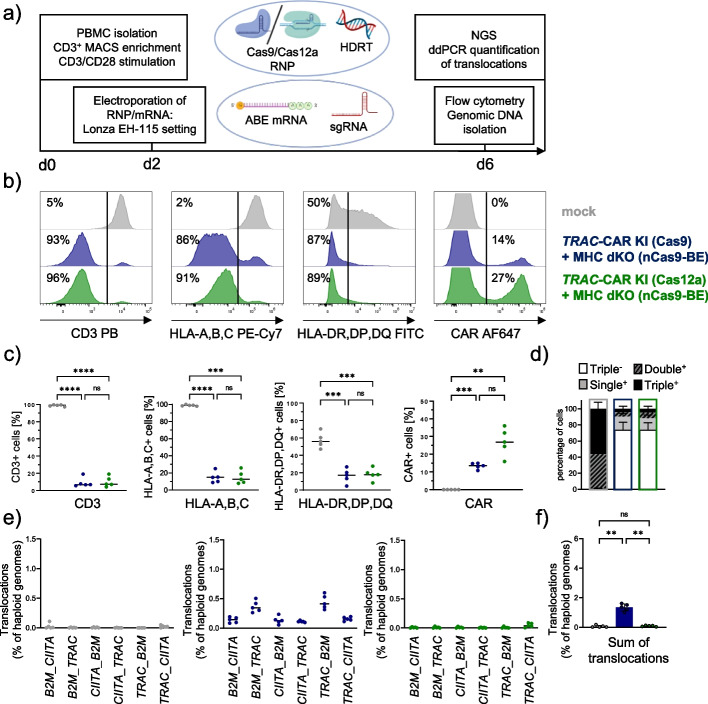
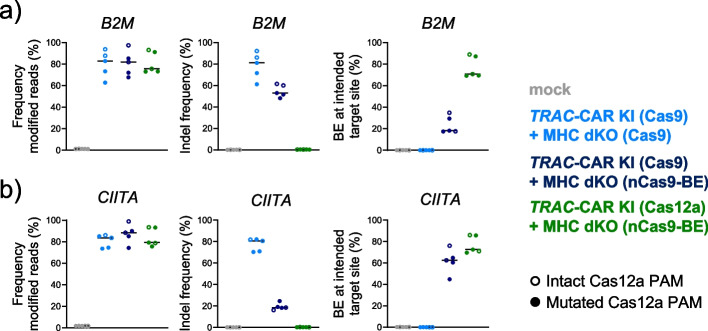
BACKGROUND: Multiple genetic modifications may be required to develop potent off-the-shelf chimeric antigen receptor (CAR) T cell therapies. Conventional CRISPR-Cas nucleases install sequence-specific DNA double-strand breaks (DSBs), enabling gene knock-out or targeted transgene knock-in. However, simultaneous DSBs provoke a high rate of genomic rearrangements which may impede the safety of the edited cells. RESULTS: Here, we combine a non-viral CRISPR-Cas9 nuclease-assisted knock-in and Cas9-derived base editing technology for DSB free knock-outs within a single intervention. We demonstrate efficient insertion of a CAR into the T cell receptor alpha constant (TRAC) gene, along with two knock-outs that silence major histocompatibility complexes (MHC) class I and II expression. This approach reduces translocations to 1.4% of edited cells. Small insertions and deletions at the base editing target sites indicate guide RNA exchange between the editors. This is overcome by using CRISPR enzymes of distinct evolutionary origins. Combining Cas12a Ultra for CAR knock-in and a Cas9-derived base editor enables the efficient generation of triple-edited CAR T cells with a translocation frequency comparable to unedited T cells. Resulting TCR- and MHC-negative CAR T cells resist allogeneic T cell targeting in vitro. CONCLUSIONS: We outline a solution for non-viral CAR gene transfer and efficient gene silencing using different CRISPR enzymes for knock-in and base editing to prevent translocations. This single-step procedure may enable safer multiplex-edited cell products and demonstrates a path towards off-the-shelf CAR therapeutics.
Overview
The claims and statistics of this paper haven’t been checked yet.
Free: it reads the open-access text and checks the first 5 claims that cite a source we can check. Create a free account to check every claim.
Integrity signals
Registry
Cites
Statistics
Figures
Verification
Claims the paper makes
The claims and statistics of this paper haven’t been checked yet.
Free: it reads the open-access text and checks the first 5 claims that cite a source we can check. Create a free account to check every claim.
Claims other papers make about this one
Each is checked against this paper’s own text: does it say what the citing paper says it does?
The source backs part of the claim, not all of it — or backs it for a different population, condition or comparison.
In the citing paper
“ABE has also been shown to induce translocations at a significantly lower rate than Cas9 when multiple genes are targeted.30”
From Adenine base editor for knockout of proteins: A practical guide from design to analysis with updated MultiEditRbatch (2026) · cites this paper as [30]
Experimental — accuracy not yet measuredThe source backs part of the claim, not all of it — or backs it for a different population, condition or comparison.
In the citing paper
“The use of more than one base editor variant leads to a reduction of on-target efficiency due to gRNA exchange and potential for unintended edits.30,62”
From Adenine base editor for knockout of proteins: A practical guide from design to analysis with updated MultiEditRbatch (2026) · cites this paper as [30]
Experimental — accuracy not yet measured
Self-check
Percentages, sums and reported differences re-computed from the paper’s own numbers.
The self-check needs the paper’s full text.
Citations
Cites
A Programmable Dual-RNA–Guided DNA Endonuclease in Adaptive Bacterial Immunity
Jinek, M., Chylinski, K., Fonfara, I., Hauer, M., Doudna, J. A., & Charpentier, E. (2012) · Science · doi:10.1126/science.1225829 · Cited by 17,116 · cited 1×
“Programmable nucleases, such as zinc finger nucleases [4], TALE nucleases [5], or CRISPR-Cas [6, 7], enable the induction of DNA double-strand breaks (DSBs) at precise locations in the genome.”
Primer-BLAST: A tool to design target-specific primers for polymerase chain reaction
Ye, J., Coulouris, G., Zaretskaya, I., Cutcutache, I., Rozen, S., & Madden, T. L. (2012) · BMC Bioinformatics · doi:10.1186/1471-2105-13-134 · Cited by 6,111
Programmable editing of a target base in genomic DNA without double-stranded DNA cleavage
Komor, A. C., Kim, Y. B., Packer, M. S., Zuris, J. A., & Liu, D. R. (2016) · Nature · doi:10.1038/nature17946 · Cited by 5,437 · cited 2×
“Further, advanced gene editing enzymes are being developed that allow programmable changes of distinct bases [9, 10], epigenetic states [11–13], or larger sequence changes, diversifying our toolbox to engineer the genome.”
Cpf1 Is a Single RNA-Guided Endonuclease of a Class 2 CRISPR-Cas System
Zetsche, B., Gootenberg, J. S., Abudayyeh, O. O., Slaymaker, I. M., Makarova, K. S., Essletzbichler, P., Volz, S. E., Joung, J., van der Oost, J., Regev, A., et al. (2015) · Cell · doi:10.1016/j.cell.2015.09.038 · Cited by 4,761
Programmable base editing of A•T to G•C in genomic DNA without DNA cleavage
Gaudelli, N. M., Komor, A. C., Rees, H. A., Packer, M. S., Badran, A. H., Bryson, D. I., & Liu, D. R. (2017) · Nature · doi:10.1038/nature24644 · Cited by 4,184 · cited 2×
“Further, advanced gene editing enzymes are being developed that allow programmable changes of distinct bases [9, 10], epigenetic states [11–13], or larger sequence changes, diversifying our toolbox to engineer the genome.”
Double nicking by RNA-guided CRISPR Cas9 for enhanced genome editing specificity
Ran, F. A., Hsu, P. D., Lin, C.-Y., Gootenberg, J. S., Konermann, S., Trevino, A. E., Scott, D. A., Inoue, A., Matoba, S., Zhang, Y., et al. (2013) · Cell · doi:10.1016/j.cell.2013.08.021 · Cited by 3,299 · cited 1×
“Future studies should optimize double nicking [50, 51] with the Cas9 BE to install a DSB for HDR alongside other KO, which should avoid translocations as well, but it may be less efficient than use of a bona-fide nuclease for KI.”
Gasiunas, G., Barrangou, R., Horvath, P., & Siksnys, V. (2012) · Proceedings of the National Academy of Sciences · doi:10.1073/pnas.1208507109 · Cited by 2,769 · cited 2×
“Programmable nucleases, such as zinc finger nucleases [4], TALE nucleases [5], or CRISPR-Cas [6, 7], enable the induction of DNA double-strand breaks (DSBs) at precise locations in the genome.”
Genome editing with CRISPR–Cas nucleases, base editors, transposases and prime editors
Anzalone, A. V., Koblan, L. W., & Liu, D. R. (2020) · Nature Biotechnology · doi:10.1038/s41587-020-0561-9 · Cited by 2,237 · cited 1×
“Further, new technologies for site-specific gene delivery without DNA DSBs, such as PASTE [52] (which is a combination of CRISPR prime editing [53] and serine integrases [54]), CRISPR-associated transposases (CAST) [55, 56], or designer recombinases [57], may allow translocation-free multiplex gene editing after optim…”
Hybrid restriction enzymes: zinc finger fusions to Fok I cleavage domain.
Kim, Y. G., Cha, J., & Chandrasegaran, S. (1996) · Proceedings of the National Academy of Sciences · doi:10.1073/pnas.93.3.1156 · Cited by 1,889
Targeting DNA Double-Strand Breaks with TAL Effector Nucleases
Christian, M., Cermak, T., Doyle, E. L., Schmidt, C., Zhang, F., Hummel, A., Bogdanove, A. J., & Voytas, D. F. (2010) · Genetics · doi:10.1534/genetics.110.120717 · Cited by 1,869
Targeting a CAR to the TRAC locus with CRISPR/Cas9 enhances tumour rejection
Eyquem, J., Mansilla-Soto, J., Giavridis, T., van der Stegen, S. J. C., Hamieh, M., Cunanan, K. M., Odak, A., Gönen, M., & Sadelain, M. (2017) · Nature · doi:10.1038/nature21405 · Cited by 1,831 · cited 2×
“A universal T cell therapy from healthy human donors must overcome multiple hurdles: The T cells must (1) be effectively reprogrammed towards the cancer via a CAR (or transgenic TCR), (2) avoid Graft-versus-Host disease (GvHD) caused by allo-reactive endogenous donor TCRs [14], and (3) be protected from immediate allo…”
CRISPResso2 provides accurate and rapid genome editing sequence analysis
Clement, K., Rees, H., Canver, M. C., Gehrke, J. M., Farouni, R., Hsu, J. Y., Cole, M. A., Liu, D. R., Joung, J. K., Bauer, D. E., et al. (2019) · Nature Biotechnology · doi:10.1038/s41587-019-0032-3 · Cited by 1,660
Highly efficient endogenous human gene correction using designed zinc-finger nucleases
Urnov, F. D., Miller, J. C., Lee, Y.-L., Beausejour, C. M., Rock, J. M., Augustus, S., Jamieson, A. C., Porteus, M. H., Gregory, P. D., & Holmes, M. C. (2005) · Nature · doi:10.1038/nature03556 · Cited by 1,641
Chromosomal translocations in human cancer
Rabbitts, T. H. (1994) · Nature · doi:10.1038/372143a0 · Cited by 1,503
CRISPR-engineered T cells in patients with refractory cancer
Stadtmauer, E. A., Fraietta, J. A., Davis, M. M., Cohen, A. D., Weber, K. L., Lancaster, E., Mangan, P. A., Kulikovskaya, I., Gupta, M., Chen, F., et al. (2020) · Science · doi:10.1126/science.aba7365 · Cited by 1,478 · cited 2×
“In addition to the presented off-the-shelf solution, the same combination of Cas12a and Cas9 BE could be used to create autologous CAR/TCR-redirected cell products with additional drug resistance [68, 69], silenced immune checkpoints [16, 23, 24], modifications to avoid fratricide [70, 71] or enhance antitumor effects…”
CRISPR–Cas9 genome editing induces a p53-mediated DNA damage response
Haapaniemi, E., Botla, S., Persson, J., Schmierer, B., & Taipale, J. (2018) · Nature Medicine · doi:10.1038/s41591-018-0049-z · Cited by 1,264 · cited 2×
“This can lead to selection and enrichment of these clones after a population has been subject to CRISPR-induced DNA DSBs [20].”
‘Off-the-shelf’ allogeneic CAR T cells: development and challenges
Depil, S., Duchateau, P., Grupp, S. A., Mufti, G., & Poirot, L. (2020) · Nature Reviews Drug Discovery · doi:10.1038/s41573-019-0051-2 · Cited by 1,227
Thakore, P. I., D'Ippolito, A. M., Song, L., Safi, A., Shivakumar, N. K., Kabadi, A. M., Reddy, T. E., Crawford, G. E., & Gersbach, C. A. (2015) · Nature Methods · doi:10.1038/nmeth.3630 · Cited by 1,012 · cited 1×
“Further, advanced gene editing enzymes are being developed that allow programmable changes of distinct bases [9, 10], epigenetic states [11–13], or larger sequence changes, diversifying our toolbox to engineer the genome.”
Multiplex genome editing to generate universal CAR T cells resistant to PD1 inhibition
Ren, J., Liu, X., Fang, C., Jiang, S., June, C. H., & Zhao, Y. (2017) · Clinical Cancer Research · doi:10.1158/1078-0432.ccr-16-1300 · Cited by 942
Molecular remission of infant B-ALL after infusion of universal TALEN gene-edited CAR T cells
Qasim, W., Zhan, H., Samarasinghe, S., Adams, S., Amrolia, P., Stafford, S., Butler, K., Rivat, C., Wright, G., Somana, K., et al. (2017) · Science Translational Medicine · doi:10.1126/scitranslmed.aaj2013 · Cited by 902 · cited 3×
“A universal T cell therapy from healthy human donors must overcome multiple hurdles: The T cells must (1) be effectively reprogrammed towards the cancer via a CAR (or transgenic TCR), (2) avoid Graft-versusHost disease (GvHD) caused by allo-reactive endogenous donor TCRs [14], and (3) be protected from immediate allo-…”
Reprogramming human T cell function and specificity with non-viral genome targeting
Roth, T. L., Puig-Saus, C., Yu, R., Shifrut, E., Carnevale, J., Li, P. J., Hiatt, J., Saco, J., Krystofinski, P., Li, H., et al. (2018) · Nature · doi:10.1038/s41586-018-0326-5 · Cited by 839
Deuse, T., Hu, X., Gravina, A., Wang, D., Tediashvili, G., De, C., Thayer, W. O., Wahl, A., Garcia, J. V., Reichenspurner, H., et al. (2019) · Nature Biotechnology · doi:10.1038/s41587-019-0016-3 · Cited by 758
HLA-E-expressing pluripotent stem cells escape allogeneic responses and lysis by NK cells
Gornalusse, G. G., Hirata, R. K., Funk, S. E., Riolobos, L., Lopes, V. S., Manske, G., Prunkard, D., Colunga, A. G., Hanafi, L.-A., Clegg, D. O., et al. (2017) · Nature Biotechnology · doi:10.1038/nbt.3860 · Cited by 639 · cited 1×
“Loss of MHC class I and II protects from allo-specific CD8 + and CD4 + T cell responses and, thereby, should improve the persistence of allogeneic cell therapies [16, 32–34].”
Transposon-encoded CRISPR–Cas systems direct RNA-guided DNA integration
Klompe, S. E., Vo, P. L. H., Halpin-Healy, T. S., & Sternberg, S. H. (2019) · Nature · doi:10.1038/s41586-019-1323-z · Cited by 627
EditR: A Method to Quantify Base Editing from Sanger Sequencing
Kluesner, M. G., Nedveck, D. A., Lahr, W. S., Garbe, J. R., Abrahante, J. E., Webber, B. R., & Moriarity, B. S. (2018) · The CRISPR Journal · doi:10.1089/crispr.2018.0014 · Cited by 565
Lu, Y., Xue, J., Deng, T., Zhou, X., Yu, K., Deng, L., Huang, M., Yi, X., Liang, M., Wang, Y., et al. (2020) · Nature Medicine · doi:10.1038/s41591-020-0840-5 · Cited by 539
Directed evolution of adenine base editors with increased activity and therapeutic application
Gaudelli, N. M., Lam, D. K., Rees, H. A., Solá-Esteves, N. M., Barrera, L. A., Born, D. A., Edwards, A., Gehrke, J. M., Lee, S.-J., Liquori, A. J., et al. (2020) · Nature Biotechnology · doi:10.1038/s41587-020-0491-6 · Cited by 524
CRISPR-Cas9 genome editing induces megabase-scale chromosomal truncations
Cullot, G., Boutin, J., Toutain, J., Prat, F., Pennamen, P., Rooryck, C., Teichmann, M., Rousseau, E., Lamrissi-Garcia, I., Guyonnet-Duperat, V., et al. (2019) · Nature Communications · doi:10.1038/s41467-019-09006-2 · Cited by 474 · cited 1×
“As HDR is still required for the KI of the CAR construct, the necessary DSB leaves an inherent risk for large deletions, homology-mediated translocations, and aneuploidy at the on-target site [46, 47].”
Yarnall, M. T. N., Ioannidi, E. I., Schmitt-Ulms, C., Krajeski, R. N., Lim, J., Villiger, L., Zhou, W., Jiang, K., Garushyants, S. K., Roberts, N., et al. (2023) · Nature Biotechnology · doi:10.1038/s41587-022-01527-4 · Cited by 469
CD7-edited T cells expressing a CD7-specific CAR for the therapy of T-cell malignancies
Gomes-Silva, D., Srinivasan, M., Sharma, S., Lee, C. M., Wagner, D. L., Davis, T. H., Rouce, R. H., Bao, G., Brenner, M. K., & Mamonkin, M. (2017) · Blood · doi:10.1182/blood-2017-01-761320 · Cited by 462
Self-citationCRISPR technologies for precise epigenome editing
Nakamura, M., Gao, Y., Dominguez, A. A., & Qi, L. S. (2021) · Nature Cell Biology · doi:10.1038/s41556-020-00620-7 · Cited by 444
CD4 CTL, a cytotoxic subset of CD4(+) T cells, their differentiation and function
Takeuchi, A., & Saito, T. (2017) · Frontiers in Immunology · doi:10.3389/fimmu.2017.00194 · Cited by 431
COSMID: A Web-based Tool for Identifying and Validating CRISPR/Cas Off-target Sites
Cradick, T. J., Qiu, P., Lee, C. M., Fine, E. J., & Bao, G. (2014) · Molecular Therapy - Nucleic Acids · doi:10.1038/mtna.2014.64 · Cited by 408
Benjamin, R., Graham, C., Yallop, D., Jozwik, A., Mirci-Danicar, O. C., Lucchini, G., Pinner, D., Jain, N., Kantarjian, H., Boissel, N., et al. (2020) · The Lancet · doi:10.1016/s0140-6736(20)32334-5 · Cited by 368
The genetics and molecular biology of T-ALL
Girardi, T., Vicente, C., Cools, J., & De Keersmaecker, K. (2017) · Blood · doi:10.1182/blood-2016-10-706465 · Cited by 355
Deleting DNMT3A in CAR T cells prevents exhaustion and enhances antitumor activity
Prinzing, B., Zebley, C. C., Petersen, C. T., Fan, Y., Anido, A. A., Yi, Z., Nguyen, P., Houke, H., Bell, M., Haydar, D., et al. (2021) · Science Translational Medicine · doi:10.1126/scitranslmed.abh0272 · Cited by 349 · cited 1×
“In addition to the presented off-the-shelf solution, the same combination of Cas12a and Cas9 BE could be used to create autologous CAR/TCR-redirected cell products with additional drug resistance [68, 69], silenced immune checkpoints [16, 23, 24], modifications to avoid fratricide [70, 71] or enhance antitumor effects…”
CRISPR RNA-guided integrases for high-efficiency, multiplexed bacterial genome engineering
Vo, P. L. H., Ronda, C., Klompe, S. E., Chen, E. E., Acree, C., Wang, H. H., & Sternberg, S. H. (2021) · Nature Biotechnology · doi:10.1038/s41587-020-00745-y · Cited by 343
Nguyen, D. N., Roth, T. L., Li, P. J., Chen, P. A., Apathy, R., Mamedov, M. R., Vo, L. T., Tobin, V. R., Goodman, D., Shifrut, E., et al. (2020) · Nature Biotechnology · doi:10.1038/s41587-019-0325-6 · Cited by 312
Immunogenicity of CAR T cells in cancer therapy
Wagner, D. L., Fritsche, E., Pulsipher, M. A., Ahmed, N., Hamieh, M., Hegde, M., Ruella, M., Savoldo, B., Shah, N. N., Turtle, C. J., et al. (2021) · Nature Reviews Clinical Oncology · doi:10.1038/s41571-021-00476-2 · Cited by 303
Self-citationMacLeod, D. T., Antony, J., Martin, A. J., Moser, R. J., Hekele, A., Wetzel, K. J., Brown, A. E., Triggiano, M. A., Hux, J. A., Pham, C. D., et al. (2017) · Molecular Therapy · doi:10.1016/j.ymthe.2017.02.005 · Cited by 276
RASA2 ablation in T cells boosts antigen sensitivity and long-term function
Carnevale, J., Shifrut, E., Kale, N., Nyberg, W. A., Blaeschke, F., Chen, Y. Y., Li, Z., Bapat, S. P., Diolaiti, M. E., O’Leary, P., et al. (2022) · Nature · doi:10.1038/s41586-022-05126-w · Cited by 239
Webber, B. R., Lonetree, C.-L., Kluesner, M. G., Johnson, M. J., Pomeroy, E. J., Diers, M. D., Lahr, W. S., Draper, G. M., Slipek, N. J., Smeester, B. A., et al. (2019) · Nature Communications · doi:10.1038/s41467-019-13007-6 · Cited by 232 · cited 3×
“This can be used to introduce stop codons or edit splice sites and consequently disrupt gene expression in T cells [26, 27].”
Shy, B. R., Vykunta, V. S., Ha, A., Talbot, A., Roth, T. L., Nguyen, D. N., Pfeifer, W. G., Chen, Y. Y., Blaeschke, F., Shifrut, E., et al. (2023) · Nature Biotechnology · doi:10.1038/s41587-022-01418-8 · Cited by 219
Frequent aneuploidy in primary human T cells after CRISPR–Cas9 cleavage
Nahmad, A. D., Reuveni, E., Goldschmidt, E., Tenne, T., Liberman, M., Horovitz-Fried, M., Khosravi, R., Kobo, H., Reinstein, E., Madi, A., et al. (2022) · Nature Biotechnology · doi:10.1038/s41587-022-01377-0 · Cited by 212
The minute chromosome (Ph1) in chronic granulocytic leukemia
Nowell, C. (1962) · Blut Zeitschrift für die Gesamte Blutforschung · doi:10.1007/bf01630378 · Cited by 199
Wang, B., Iriguchi, S., Waseda, M., Ueda, N., Ueda, T., Xu, H., Minagawa, A., Ishikawa, A., Yano, H., Ishi, T., et al. (2021) · Nature Biomedical Engineering · doi:10.1038/s41551-021-00730-z · Cited by 189 · cited 1×
“Additionally, deletion of NK cell activating receptors, such as CD155, has been proposed to protect hypoimmunogenic cells [67].”
Wang, D., Quan, Y., Yan, Q., Morales, J. E., & Wetsel, R. A. (2015) · Stem Cells Translational Medicine · doi:10.5966/sctm.2015-0049 · Cited by 180
Kagoya, Y., Guo, T., Yeung, B., Saso, K., Anczurowski, M., Wang, C.-H., Murata, K., Sugata, K., Saijo, H., Matsunaga, Y., et al. (2020) · Cancer Immunology Research · doi:10.1158/2326-6066.cir-18-0508 · Cited by 178
Endowing universal CAR T-cell with immune-evasive properties using TALEN-gene editing
Jo, S., Das, S., Williams, A., Chretien, A.-S., Pagliardini, T., Le Roy, A., Fernandez, J. P., Le Clerre, D., Jahangiri, B., Chion-Sotinel, I., et al. (2022) · Nature Communications · doi:10.1038/s41467-022-30896-2 · Cited by 159
Base-edited CAR T cells for combinational therapy against T cell malignancies
Georgiadis, C., Rasaiyaah, J., Gkazi, S. A., Preece, R., Etuk, A., Christi, A., & Qasim, W. (2021) · Leukemia · doi:10.1038/s41375-021-01282-6 · Cited by 150
Cytosine base editing enables quadruple-edited allogeneic CART cells for T-ALL
Diorio, C. J., Murray, R. C., Naniong, M., Barrera, L. A., Camblin, A. J., Chukinas, J. A., Coholan, L. J., Edwards, A., Fuller, T. J., Gonzales, C., et al. (2022) · Blood · doi:10.1182/blood.2022015825 · Cited by 145
Serine Integrases: Advancing Synthetic Biology
Merrick, C. A., Zhao, J., & Rosser, S. J. (2018) · ACS Synthetic Biology · doi:10.1021/acssynbio.7b00308 · Cited by 137
Kluesner, M. G., Lahr, W. S., Lonetree, C.-L., Smeester, B. A., Qiu, X., Slipek, N. J., Claudio Vázquez, P. N., Pitzen, S. P., Pomeroy, E. J., Vignes, M. J., et al. (2021) · Nature Communications · doi:10.1038/s41467-021-22009-2 · Cited by 121 · cited 1×
“This can be used to introduce stop codons or edit splice sites and consequently disrupt gene expression in T cells [26, 27].”
Timed inhibition of CDC7 increases CRISPR-Cas9 mediated templated repair
Wienert, B., Nguyen, D. N., Guenther, A., Feng, S. J., Locke, M. N., Wyman, S. K., Shin, J., Kazane, K. R., Gregory, G. L., Carter, M. A. M., et al. (2020) · Nature Communications · doi:10.1038/s41467-020-15845-1 · Cited by 108
Kressler, C., Gasparoni, G., Nordström, K. J. V., Hamo, D., Salhab, A., Dimitropoulos, C., Tierling, S., Reinke, P., Volk, H., Walter, J., et al. (2021) · Frontiers in Immunology · doi:10.3389/fimmu.2020.609891 · Cited by 104
Self-citationTCRαβ/CD3 disruption enables CD3-specific antileukemic T cell immunotherapy
Rasaiyaah, J., Georgiadis, C., Preece, R., Mock, U., & Qasim, W. (2018) · JCI Insight · doi:10.1172/jci.insight.99442 · Cited by 101
Pharmacological interventions enhance virus-free generation of TRAC-replaced CAR T cells
Kath, J., Du, W., Pruene, A., Braun, T., Thommandru, B., Turk, R., Sturgeon, M. L., Kurgan, G. L., Amini, L., Stein, M., et al. (2022) · Molecular Therapy - Methods & Clinical Development · doi:10.1016/j.omtm.2022.03.018 · Cited by 99
Self-citationCas9 exo-endonuclease eliminates chromosomal translocations during genome editing
Yin, J., Lu, R., Xin, C., Wang, Y., Ling, X., Li, D., Zhang, W., Liu, M., Xie, W., Kong, L., et al. (2022) · Nature Communications · doi:10.1038/s41467-022-28900-w · Cited by 98
High-efficiency nonviral CRISPR/Cas9-mediated gene editing of human T cells using plasmid donor DNA
Oh, S. A., Senger, K., Madireddi, S., Akhmetzyanova, I., Ishizuka, I. E., Tarighat, S., Lo, J. H., Shaw, D., Haley, B., & Rutz, S. (2022) · Journal of Experimental Medicine · doi:10.1084/jem.20211530 · Cited by 88 · cited 1×
“S3) which may be reduced by careful titration of the dsDNA template, small-molecule drugs to temporarily prevent DNA sensing [41] or the use of nanoplasmids [59], circularized ssDNA [60], or linear ssDNA [61] as donor templates.”
Efficient Gene Disruption in Cultured Primary Human Endothelial Cells by CRISPR/Cas9
Abrahimi, P., Chang, W. G., Kluger, M. S., Qyang, Y., Tellides, G., Saltzman, W. M., & Pober, J. S. (2015) · Circulation Research · doi:10.1161/circresaha.117.306290 · Cited by 86
HLA-D region-associated determinants serve as targets for human cell-mediated lysis.
Feighery, C., & Stastny, P. (1979) · The Journal of Experimental Medicine · doi:10.1084/jem.149.2.485 · Cited by 83
Wen, W., Quan, Z.-J., Li, S.-A., Yang, Z.-X., Fu, Y.-W., Zhang, F., Li, G., Zhao, M., Yin, M., Xu, J., et al. (2021) · Genome biology · doi:10.1186/s13059-021-02462-4 · Cited by 81
Guide Swap enables genome-scale pooled CRISPR-Cas9 screening in human primary cells
Ting, P. Y., Parker, A. E., Lee, J. S., Trussell, C., Sharif, O., Luna, F., Federe, G., Barnes, S. W., Walker, J. R., Vance, J., et al. (2018) · Nature Methods · doi:10.1038/s41592-018-0149-1 · Cited by 80 · cited 1×
“2 and 6) as previously proposed [45].”
Cellular transduction mechanisms of adeno-associated viral vectors
Berry, G. E., & Asokan, A. (2016) · Current Opinion in Virology · doi:10.1016/j.coviro.2016.08.001 · Cited by 78
Wiebking, V., Lee, C. M., Mostrel, N., Lahiri, P., Bak, R., Bao, G., Roncarolo, M. G., Bertaina, A., & Porteus, M. H. (2020) · Haematologica · doi:10.3324/haematol.2019.233882 · Cited by 71
Efficient Homology-Directed Repair with Circular Single-Stranded DNA Donors
Iyer, S., Mir, A., Vega‐Badillo, J., Roscoe, B. P., Ibraheim, R., Zhu, L. J., Lee, J., Liu, P., Luk, K., Mintzer, E., et al. (2022) · The CRISPR Journal · doi:10.1089/crispr.2022.0058 · Cited by 69
Wagner, D. L., Koehl, U., Chmielewski, M., Scheid, C., & Stripecke, R. (2022) · Frontiers in Immunology · doi:10.3389/fimmu.2022.865424 · Cited by 65
Self-citationAmini, L., Wagner, D. L., Rössler, U., Zarrinrad, G., Wagner, L. F., Vollmer, T., Wendering, D. J., Kornak, U., Volk, H., Reinke, P., et al. (2020) · Molecular Therapy · doi:10.1016/j.ymthe.2020.09.011 · Cited by 64
Self-citationSuper-Treg: Toward a New Era of Adoptive Treg Therapy Enabled by Genetic Modifications
Amini, L., Greig, J., Schmueck‐Henneresse, M., Volk, H., Bézie, S., Reinke, P., Guillonneau, C., Wagner, D. L., & Anegón, I. (2021) · Frontiers in Immunology · doi:10.3389/fimmu.2020.611638 · Cited by 62
Self-citationDetection and Modulation of DNA Translocations During Multi-Gene Genome Editing in T Cells
Bothmer, A., Gareau, K. W., Abdulkerim, H. S., Buquicchio, F., Cohen, L., Viswanathan, R., Zuris, J. A., Marco, E., Fernandez, C. A., Myer, V. E., et al. (2020) · The CRISPR Journal · doi:10.1089/crispr.2019.0074 · Cited by 54
Multiplex ddPCR assay for screening copy number variations in BRCA1 gene
Oscorbin, I. P., Андреевич, К. А., Boyarskikh, U. A., & Филипенко, М. Л. (2019) · Breast Cancer Research and Treatment · doi:10.1007/s10549-019-05425-3 · Cited by 51
Tran, N. T., Danner, E., Li, X., Graf, R., Lebedin, M., de la Rosa, K., Kühn, R., Rajewsky, K., & Chu, V. T. (2022) · Science Advances · doi:10.1126/sciadv.abm9106 · Cited by 49
Prediction of designer-recombinases for DNA editing with generative deep learning
Schmitt, L. T., Paszkowski-Rogacz, M., Jug, F., & Buchholz, F. (2022) · Nature Communications · doi:10.1038/s41467-022-35614-6 · Cited by 45
Scharer, C. D., Choi, N. M., Barwick, B. G., Majumder, P., Lohsen, S., & Boss, J. M. (2015) · Nucleic Acids Research · doi:10.1093/nar/gkv182 · Cited by 41
Detection of chromosomal alteration after infusion of gene-edited allogeneic CAR T cells
Sasu, B. J., Opiteck, G. J., Gopalakrishnan, S., Kaimal, V., Furmanak, T., Huang, D., Goswami, A., He, Y., Chen, J., Nguyen, T. A., et al. (2022) · Molecular Therapy · doi:10.1016/j.ymthe.2022.12.004 · Cited by 35
Başar, R., Daher, M., Uprety, N., Gokdemir, E., Alsuliman, A., Ensley, E. L., Ozcan, G., Mendt, M. C., Sanabria, M. H., Kerbauy, L. N., et al. (2020) · Blood Advances · doi:10.1182/bloodadvances.2020001977 · Cited by 34
Jing, R., Jiao, P., Chen, J., Meng, X., Wu, X., Duan, Y., Shang, K., Qian, L., Huang, Y., Liu, J., et al. (2021) · Small Methods · doi:10.1002/smtd.202100071 · Cited by 34
Zhang, L., Zuris, J. A., Viswanathan, R., Edelstein, J., Turk, R., Thommandru, B., Rube, H. T., Glenn, S. E., Collingwood, M. A., Bode, N. M., et al. (2021) · Nature Communications · doi:10.1038/s41467-021-24770-w · Cited by 9
Research works printed but not linked: 1
- Glaser V, Flugel C, Kath J, Du W, Drosdek V, Franke C, et al. Combining different CRISPR nucleases for simultaneous knock-in and base editing prevents translocations in multiplex-edited CAR T cells. NCBI Bioproject PRJNA950050. 2023. https://www.ncbi.nlm.nih.gov/bioproject/PRJNA950050. PMC10123993 37095570 · doi:10.1101/2022.11.11.516008
Cited by
Development of NK cell-based cancer immunotherapies through receptor engineering
Page, A., Chuvin, N., Valladeau-Guilemond, J., & Depil, S. (2024) · Cellular & Molecular Immunology · doi:10.1038/s41423-024-01145-x · Cited by 219
Lei, T., Wang, Y., Zhang, Y., Yang, Y., Cao, J., Huang, J., Chen, J., Chen, H., Zhang, J., wang, L., et al. (2024) · Leukemia · doi:10.1038/s41375-024-02444-y · Cited by 177
Allogeneic CAR-T Therapy Technologies: Has the Promise Been Met?
Lonez, C., & Breman, E. (2024) · Cells · doi:10.3390/cells13020146 · Cited by 125
Base-editing mutagenesis maps alleles to tune human T cell functions
Schmidt, R. L. J., Ward, C. C., Dajani, R., Armour-Garb, Z., Ota, M., Allain, V., Hernandez, R., Layeghi, M., Xing, G., Goudy, L., et al. (2023) · Nature · doi:10.1038/s41586-023-06835-6 · Cited by 107
Cavazza, A., Molina-Estévez, F. J., Reyes, Á. P., Ronco-Díaz, V., Naseem, A., Malenšek, Š., Pečan, P., Santini, A., Heredia, P., Aguilar-González, A., et al. (2025) · Molecular Therapy — Nucleic Acids · doi:10.1016/j.omtn.2025.102457 · Cited by 80
Metadata
- Authors
- Glaser, V., Flugel, C., Kath, J., Du, W., Drosdek, V., Franke, C., Stein, M., Pruß, A., Schmueck-Henneresse, M., Volk, H.-D., Reinke, P., & Wagner, D. L.
- Affiliations
- Humboldt-Universität zu Berlin (DE)
- Corresponding author
- Wagner, Dimitrios L.
- ORCID
- Venue
- Genome biology
- Published
- 2023-04-24
- Volume
- 24
- Issue
- 1
- Pages
- 89-89
- ISSN
- 1465-6906 (ISSN-L)
- 1474-760X
- PMC
- PMC10123993
- OpenAlex
- W4366826630
- Cited by
- 65
- References
- 79
- Citations by year
- 2026: 12 · 2025: 23 · 2024: 20 · 2023: 10
- FWCI
- 5.77
- Type
- journal article
- Language
- en
- Update notices
- correction (2025-03-26)
- Open access
- gold
- doi.org
- Licence
- cc-by
- creativecommons.org/licenses/by/4.0 (tdm)
- creativecommons.org/licenses/by/4.0 (vor)
- Locations
- Genome biology (publishedVersion, cc-by)
- bioRxiv (Cold Spring Harbor Laboratory) (acceptedVersion, cc-by-nc-nd)
- PubMed Central (publishedVersion, cc-by)
- PubMed (publishedVersion)
- Refubium (Universitätsbibliothek der Freien Universität Berlin) (submittedVersion, cc-by)
- DOAJ (DOAJ: Directory of Open Access Journals) (submittedVersion, cc-by-sa)
- Universitätsbibliothek der FU Berlin Hochschulschriftenstelle u. Dokumentenserver (cc-by)
- Funders
- H2020 Societal Challenges (No 825392)
- Berlin Institute of Health (New Crossfield "Genome Engineering", SPARK-BIH)
- Charité - Universitätsmedizin Berlin
- Topics
- Life Sciences › Biochemistry, Genetics and Molecular Biology › Molecular Biology › CRISPR and Genetic Engineering
- Health Sciences › Medicine › Oncology › CAR-T cell therapy research
- Life Sciences › Biochemistry, Genetics and Molecular Biology › Genetics › Virus-based gene therapy research
- Keywords
- chimeric antigen receptor T cells, CRISPR/Cas9, base editing, multiplex genome editing, non-viral gene delivery
- MeSH terms
- Gene Editing, T-Lymphocytes, Genome, DNA Breaks, Double-Stranded, CRISPR-Cas Systems
About these checks
Registry, retraction, Cites and statistics results are computed, not judged, with one exception: a printed reference that no index lists is read once by a model before it counts as a citation error. Claims are extracted by a model and kept only when their quote appears verbatim in the text; each cited source is then checked, with a model’s help, for whether it says what the claim relies on. Those verdicts can be wrong — read the claim’s quote and the cited source before relying on one.
Statistics and arithmetic are recomputed, not judged.
Confidence bands are shown only for fields calibrated on our annotated test set. None is calibrated yet, so no band is shown.
What counts as a claim ›How we measure confidence ›How we check this ›
Are you an author, or do you see a problem with this page? Request a review
Data sources
Bibliographic data: Semantic Scholar, OpenAlex, Crossref.
Contains information from the Semantic Scholar Academic Graph Datasets, made available under the ODC Attribution License (ODC-BY 1.0).
Semantic Scholar’s data is described in: Kinney, R., et al. (2023). The Semantic Scholar Open Data Platform. arXiv:2301.10140.
