

Demuxafy: improvement in droplet assignment by integrating multiple single-cell demultiplexing and doublet detection methods
Open accessPublished version of a preprint
The DOI matches its Crossref record; 23 of the 23 references it cites were found in a registry or an index.
Abstract
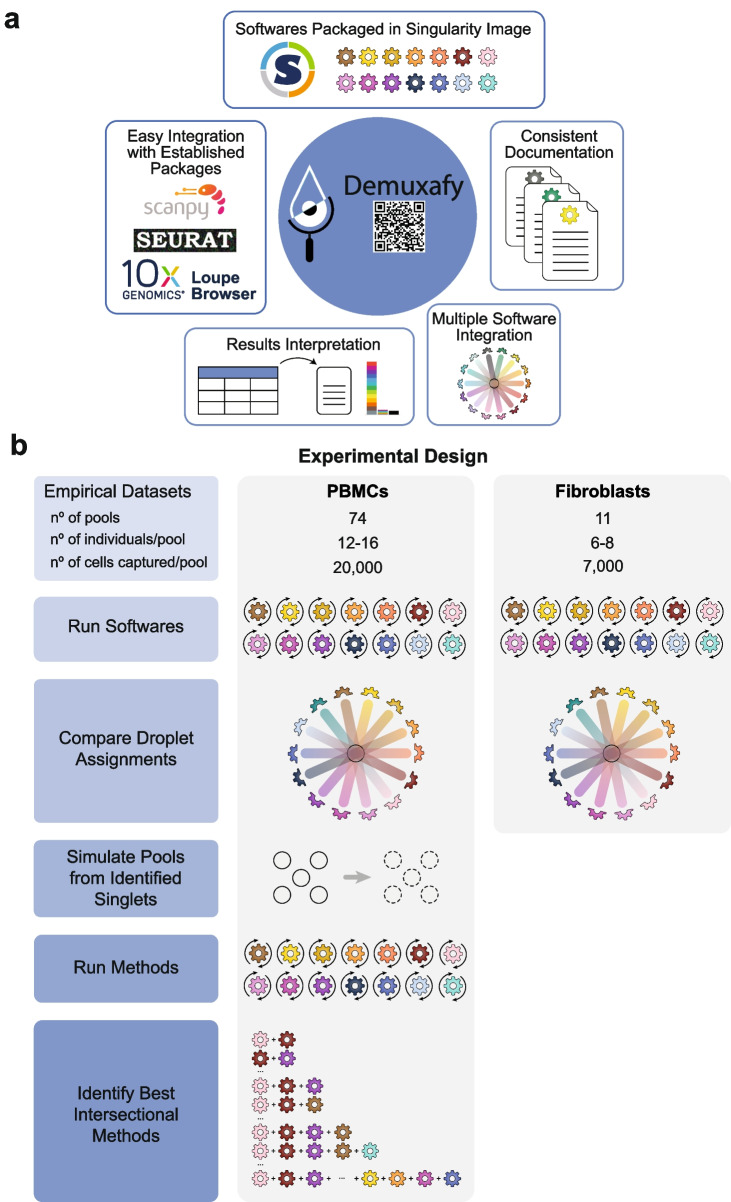
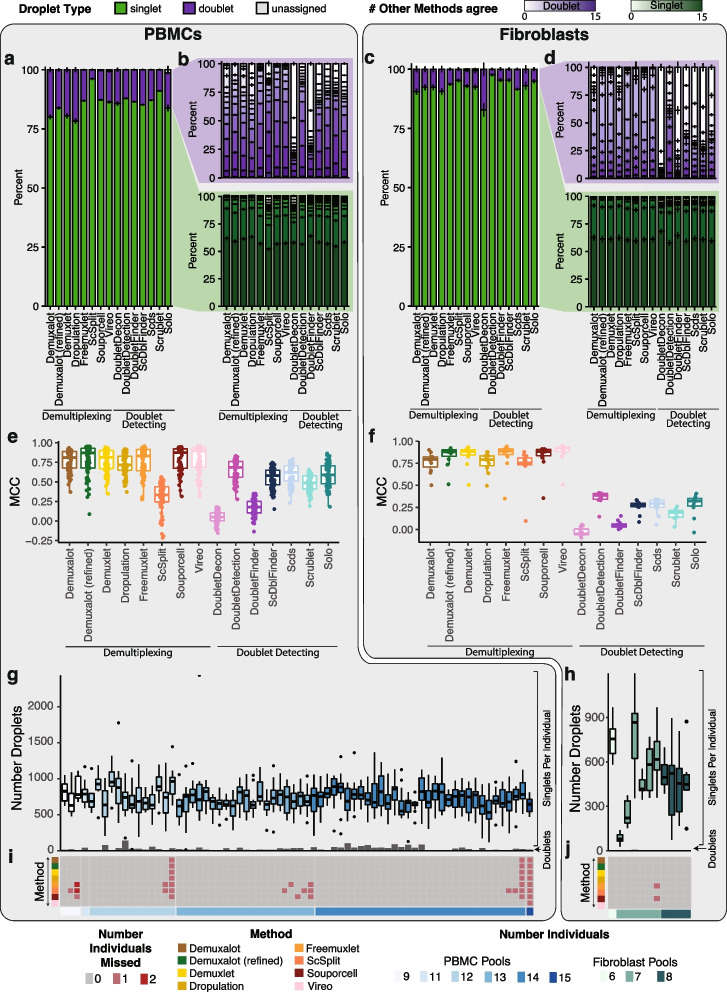
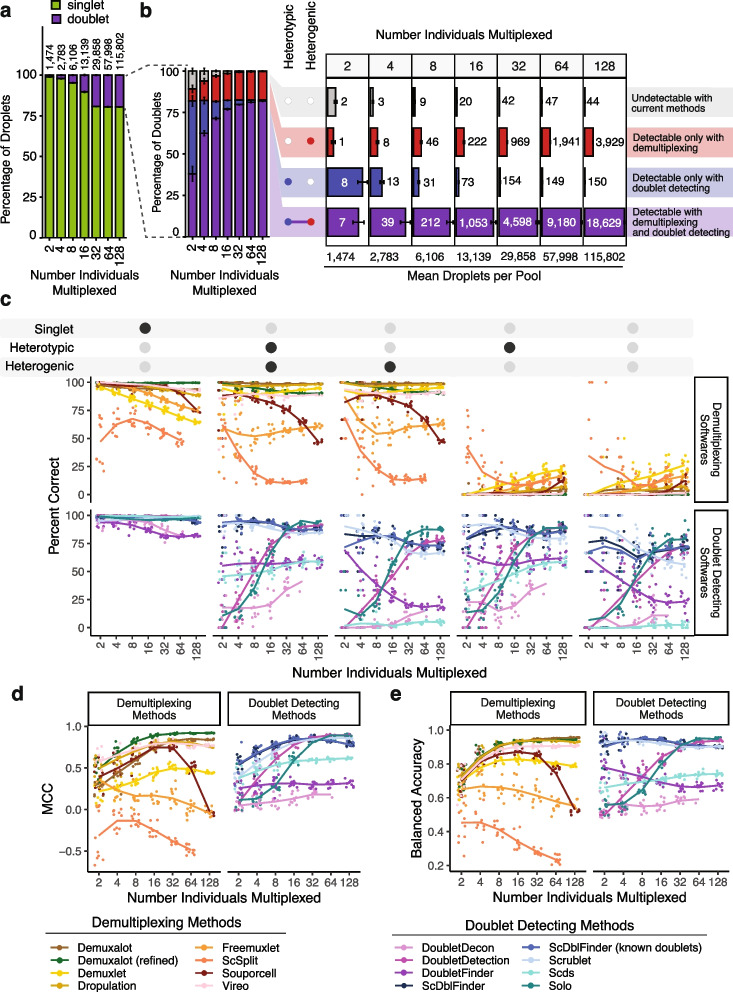
Recent innovations in single-cell RNA-sequencing (scRNA-seq) provide the technology to investigate biological questions at cellular resolution. Pooling cells from multiple individuals has become a common strategy, and droplets can subsequently be assigned to a specific individual by leveraging their inherent genetic differences. An implicit challenge with scRNA-seq is the occurrence of doublets—droplets containing two or more cells. We develop Demuxafy, a framework to enhance donor assignment and doublet removal through the consensus intersection of multiple demultiplexing and doublet detecting methods. Demuxafy significantly improves droplet assignment by separating singlets from doublets and classifying the correct individual.
Overview
The claims and statistics of this paper haven’t been checked yet.
Free: it reads the open-access text and checks the first 5 claims that cite a source we can check. Create a free account to check every claim.
Integrity signals
Registry
Cites
Statistics
Figures
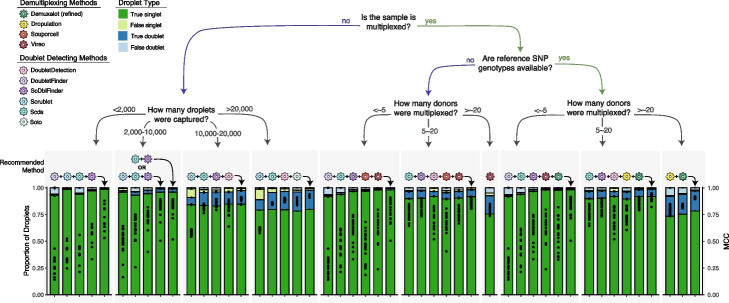
Verification
Claims the paper makes
The claims and statistics of this paper haven’t been checked yet.
Free: it reads the open-access text and checks the first 5 claims that cite a source we can check. Create a free account to check every claim.
Claims other papers make about this one
Each is checked against this paper’s own text: does it say what the citing paper says it does?
The source backs part of the claim, not all of it — or backs it for a different population, condition or comparison.
In the citing paper
“These doublets may comprise 2 nuclei of the same cell type (homotypic) or may be of different cell types (heterotypic) and may together constitute as many as 40% of droplets [24].”
From Benchmarking of computational demultiplexing methods for single-nucleus RNA sequencing data (2025) · cites this paper as [24]
Experimental — accuracy not yet measured
Self-check
Percentages, sums and reported differences re-computed from the paper’s own numbers.
The self-check needs the paper’s full text.
Citations
Cites
Integrated analysis of multimodal single-cell data
Hao, Y., Hao, S., Andersen-Nissen, E., Mauck, W. M., Zheng, S., Butler, A., Lee, M. J., Wilk, A. J., Darby, C., Zagar, M., et al. (2020) · doi:10.1101/2020.10.12.335331 · Cited by 15,508 · cited 1×
“We used azimuth to classify the PBMC cell types for each droplet used to generate the in silico pools [19] (Additional file 2: Fig S4).”
MethodComprehensive Integration of Single-Cell Data
Stuart, T., Butler, A., Hoffman, P., Hafemeister, C., Papalexi, E., Mauck, W. M., Hao, Y., Stoeckius, M., Smibert, P., & Satija, R. (2019) · Cell · doi:10.1016/j.cell.2019.05.031 · Cited by 15,453
Massively parallel digital transcriptional profiling of single cells
Zheng, G. X. Y., Terry, J. M., Belgrader, P., Ryvkin, P., Bent, Z. W., Wilson, R., Ziraldo, S. B., Wheeler, T. D., McDermott, G. P., Zhu, J., et al. (2017) · Nature Communications · doi:10.1038/ncomms14049 · Cited by 7,353
McGinnis, C. S., Murrow, L. M., & Gartner, Z. J. (2019) · Cell Systems · doi:10.1016/j.cels.2019.03.003 · Cited by 4,521
Hafemeister, C., & Satija, R. (2019) · Genome Biology · doi:10.1186/s13059-019-1874-1 · Cited by 4,479 · cited 1×
“SCTransform [21] from Seurat [22] version 3.2.2 was used to preprocess the scRNA-seq data and then the Improved_Seurat_Pre_Process function was used to process the SCTransformed scRNA-seq data.”
MethodInfluentialScrublet: computational identification of cell doublets in single-cell transcriptomic data
Wolock, S. L., Lopez, R., & Klein, A. M. (2018) · doi:10.1101/357368 · Cited by 2,758 · cited 2×
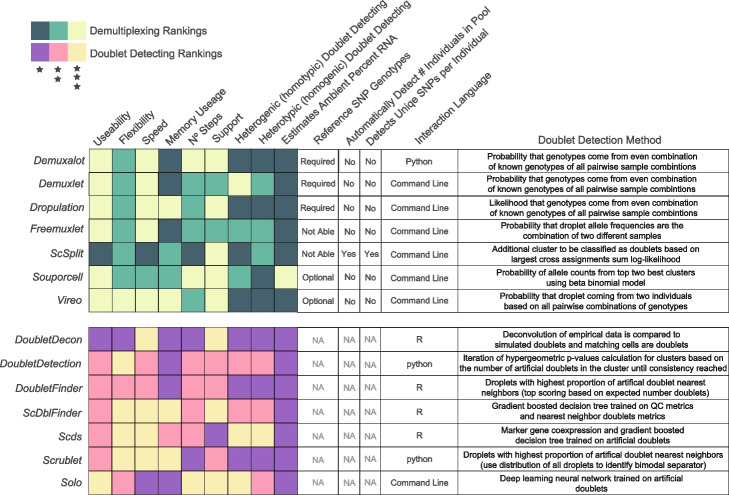
“The seven remaining methods ( DoubletDecon [9], DoubletDetection [14], DoubletFinder [10], ScDblFinder [11], Scds [12], Scrublet [13], and Solo [15]) identify doublets based on their similarity to simulated doublets generated by adding the transcriptional profiles of two randomly selected droplets…”
MethodScrublet: computational identification of cell doublets in single-cell transcriptomic data
Wolock, S. L., Lopez, R., & Klein, A. M. (2019) · Cell Systems · doi:10.1016/j.cels.2018.11.005 · Cited by 2,758
Multiplexed droplet single-cell RNA-sequencing using natural genetic variation
Kang, H. M., Subramaniam, M., Targ, S., Nguyen, M., Maliskova, L., McCarthy, E., Wan, E., Wong, S., Byrnes, L., Lanata, C. M., et al. (2018) · Nature Biotechnology · doi:10.1038/nbt.4042 · Cited by 1,101 · cited 2×
“Seven of those are demultiplexing methods ( Demuxalot [6], Demuxlet [3], Dropulation [5], Freemuxlet [16], ScSplit [7], Souporcell [4], and Vireo [2]) which leverage the common genetic variation between individuals to identify cells that came from each individual and to identify heterogenic…”
MethodSelf-citationDoublet identification in single-cell sequencing data using scDblFinder
Germain, P.-L., Lun, A., Garcia Meixide, C., Macnair, W., & Robinson, M. D. (2022) · F1000Research · doi:10.12688/f1000research.73600.2 · Cited by 684
Single-cell eQTL mapping identifies cell type–specific genetic control of autoimmune disease
Yazar, S., Alquicira-Hernandez, J., Wing, K., Senabouth, A., Gordon, M. G., Andersen, S., Lu, Q., Rowson, A., Taylor, T. R. P., Clarke, L., et al. (2022) · Science · doi:10.1126/science.abf3041 · Cited by 682 · cited 3×
“To compare the demultiplexing and doublet detecting methods, we utilised two large, multiplexed datasets—one that contained ~1.4 million peripheral blood mononuclear cells (PBMCs) from 1,034 donors [17] and one with ~94,000 fibroblasts from 81 donors [18].”
MethodInfluentialSelf-citation
Research works printed but not linked: 1
- Powell JE. Single-cell eQTL mapping identifies cell type specific genetic control of autoimmune disease. Datasets. Gene Expression Omnibus. 2022. https://www.ncbi.nlm.nih.gov/geo/query/acc.cgi?acc=GSE196830. 35389779
Cited by
Best practices for single-cell analysis across modalities
Heumos, L., Schaar, A. C., Lance, C., Litinetskaya, A., Drost, F., Zappia, L., Lücken, M. D., Strobl, D. C., Henao, J., Curion, F., et al. (2023) · Nature Reviews Genetics · doi:10.1038/s41576-023-00586-w · Cited by 1,051
Doublet identification in single-cell sequencing data using scDblFinder
Germain, P.-L., Lun, A., Garcia Meixide, C., Macnair, W., & Robinson, M. D. (2022) · F1000Research · doi:10.12688/f1000research.73600.2 · Cited by 684
Expanding the human proteome with microproteins and peptideins
Deutsch, E. W., Kok, L. W., Mudge, J. M., Valls, C., Jungreis, I., Ruiz‐Orera, J., Sun, Z., Kusebauch, U., Fierro-Monti, I., Abelin, J. G., et al. (2026) · Nature · doi:10.1038/s41586-026-10459-x · Cited by 125
“Cell line identity deconvolution was performed using a combination of packages: demuxalot and dropulation, leveraging SNP profiles curated from DepMap (release 25Q2) and CellLineProject and genotype-free approach using scSplit 86 .”
A village in a dish model system for population-scale hiPSC studies
Neavin, D. R., Steinmann, A. M., Farbehi, N., Chiu, H. S., Daniszewski, M. S., Arora, H., Bermudez, Y., Moutinho, C., Chan, C.-L., Bax, M., et al. (2023) · Nature Communications · doi:10.1038/s41467-023-38704-1 · Cited by 72
“The single cell village pools were demultiplexed with Demuxafy 21 to combine droplet calls between different methods.”
InfluentialSelf-citationMacropinocytosis maintains CAF subtype identity under metabolic stress in pancreatic cancer
Zhang, Y., Li, L., Murad, R., Maganti, S., Manceau, A., Faso, H. A., Neff, M., Galapate, C. M., Grenier, S. F., Carrette, F., et al. (2025) · Cancer Cell · doi:10.1016/j.ccell.2025.06.021 · Cited by 68
Metadata
- Authors
- Neavin, D., Senabouth, A., Arora, H., Lee, J. T. H., Ripoll-Cladellas, A., sc-eQTLGen Consortium, Franke, L., Prabhakar, S., Ye, C. J., McCarthy, D. J., Melé, M., Hemberg, M., & Powell, J. E.
- Affiliations
- Garvan Institute of Medical Research (AU)
- Wellcome Sanger Institute (GB)
- Barcelona Supercomputing Center (ES)
- University Medical Center Groningen (NL)
- Agency for Science, Technology and Research (SG)
- University of California, San Francisco (US)
- The University of Melbourne (AU)
- Brigham and Women's Hospital (US)
- Corresponding author
- Neavin, Drew
- Powell, Joseph E.
- ORCID
- Venue
- Genome Biology
- Published
- 2024-04-15
- Volume
- 25
- Issue
- 1
- Pages
- 94-94
- ISSN
- 1465-6906 (ISSN-L)
- 1474-760X
- PMC
- PMC11020463
- OpenAlex
- W4394808545
- Semantic Scholar
- fd03c3d7d8cd3d1a4e8f17ab8a12b71d1f66734f
- Cited by
- 90
- References
- 21
- Citations by year
- 2026: 32 · 2025: 31 · 2024: 17
- FWCI
- 10.89
- Type
- journal article
- Language
- en
- Open access
- gold
- doi.org
- Licence
- cc-by
- creativecommons.org/licenses/by/4.0 (tdm)
- creativecommons.org/licenses/by/4.0 (vor)
- Locations
- Genome biology (publishedVersion, cc-by)
- bioRxiv (Cold Spring Harbor Laboratory) (acceptedVersion, cc-by-nc)
- PubMed Central (publishedVersion, cc-by)
- PubMed (publishedVersion)
- DR-NTU (Nanyang Technological University) (publishedVersion, cc-by)
- UPCommons institutional repository (Universitat Politècnica de Catalunya) (submittedVersion, cc-by-nc-nd)
- DOAJ (DOAJ: Directory of Open Access Journals) (submittedVersion)
- Minerva Access (University of Melbourne) (submittedVersion, cc-by)
- University of Groningen research database (University of Groningen / Centre for Information Technology) (submittedVersion, cc-by)
- Funders
- Medical Research Council
- National Health and Medical Research Council (1175781)
- National Institute of Arthritis and Musculoskeletal and Skin Diseases (P30AR070155)
- Topics
- Life Sciences › Biochemistry, Genetics and Molecular Biology › Molecular Biology › Single-cell and spatial transcriptomics
- Life Sciences › Biochemistry, Genetics and Molecular Biology › Molecular Biology › Genomics and Phylogenetic Studies
- Physical Sciences › Chemical Engineering › Fluid Flow and Transfer Processes › Innovative Microfluidic and Catalytic Techniques Innovation
- Keywords
- single-cell RNA sequencing, doublet detection
- MeSH terms
- Humans, Sequence Analysis, RNA, Single-Cell Analysis
About these checks
Registry, retraction, Cites and statistics results are computed, not judged, with one exception: a printed reference that no index lists is read once by a model before it counts as a citation error. Claims are extracted by a model and kept only when their quote appears verbatim in the text; each cited source is then checked, with a model’s help, for whether it says what the claim relies on. Those verdicts can be wrong — read the claim’s quote and the cited source before relying on one.
Statistics and arithmetic are recomputed, not judged.
Confidence bands are shown only for fields calibrated on our annotated test set. None is calibrated yet, so no band is shown.
What counts as a claim ›How we measure confidence ›How we check this ›
Are you an author, or do you see a problem with this page? Request a review
How to cite
Cite CoChat for the checks on this page, and the paper for its own findings.
- This page
- CoChat. (2026). Citation check: Demuxafy: improvement in droplet assignment by integrating multiple single-cell demultiplexing and doublet detection methods. https://app.cochat.ai/papers/10.1186/s13059-024-03224-8
- The paper
- Neavin, D., Senabouth, A., Arora, H., Lee, J. T. H., Ripoll-Cladellas, A., sc-eQTLGen Consortium, Franke, L., Prabhakar, S., Ye, C. J., McCarthy, D. J., Melé, M., Hemberg, M., & Powell, J. E. (2024). Demuxafy: improvement in droplet assignment by integrating multiple single-cell demultiplexing and doublet detection methods. Genome Biology. https://doi.org/10.1186/s13059-024-03224-8
Data sources
Bibliographic data: Semantic Scholar, OpenAlex, Crossref.
Contains information from the Semantic Scholar Academic Graph Datasets, made available under the ODC Attribution License (ODC-BY 1.0).
Semantic Scholar’s data is described in: Kinney, R., et al. (2023). The Semantic Scholar Open Data Platform. arXiv:2301.10140.
