

The DOI matches its Crossref record; 104 of the 105 references it cites were found in a registry or an index; 42 of the 125 sources its claims cite were checked for support.
An Internet-based Acceptance and Commitment Therapy intervention for older adults with anxiety complaints: study protocol for a cluster randomized controlled trial.
Open accessAbstract
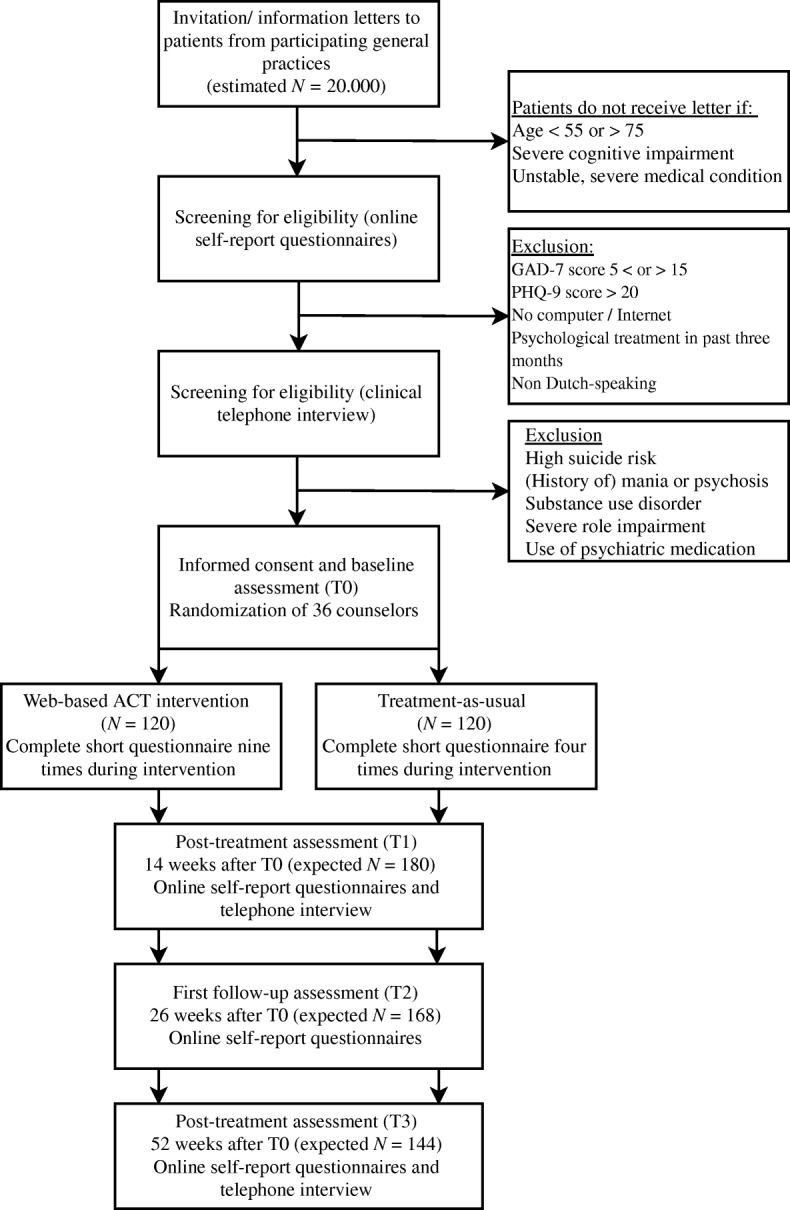
Background: Anxiety is among the most prevalent and disabling mental health problems in older adults. Few older adults with mild to moderately severe anxiety symptoms receive adequate interventions, putting them at risk for developing anxiety disorders, depression, and various somatic problems. Effective, low-threshold interventions should be developed. Blended care, in which a web-based intervention is combined with a limited amount of face-to-face contacts with a mental healthcare counselor at the general practice, is a promising option. The online self-help intervention "Living to the Full"-an Acceptance and Commitment Therapy (ACT) intervention-has been proven to reduce depression and anxiety in several patient groups, but has not yet been investigated in older adults. The aim of this study is to evaluate the (cost-)effectiveness of a blended form of "Living to the Full" in reducing anxiety symptoms in adults aged 55 to 75 years. Furthermore, moderators and mediators of the treatment effect are investigated.Methods/design: The (cost-)effectiveness of the ACT intervention will be investigated in a cluster single-blind randomized controlled trial (RCT). The blended intervention will be compared to treatment-as-usual. Thirty-six mental health counselors working at general practices in the Netherlands will be randomized to deliver blended care or treatment as usual. A total of 240 participants (aged 55-75 years) with mild to moderately severe anxiety complaints (defined as a total score of 5-15 on the GAD-7) will be recruited. There are four measurements consisting of online questionnaires (primary outcome: GAD-7) and a telephone interview: before the start of the intervention; directly following the intervention (14 weeks after baseline); and six and twelve months after baseline. Possible mediator variables will be assessed multiple times basis during the intervention.Discussion: This RCT will evaluate the effectiveness of a blended ACT intervention for older adults with anxiety symptoms. If the intervention is shown to be effective, it will be implemented, thereby improving the accessibility and quality of preventive interventions for older adults with anxiety problems.Trial Registration: Netherlands Trial Register, NTR6270 . Registered on 21 March 2017.
Overview
CoChat Summary
## TL;DR
This paper is a study protocol for a cluster randomized controlled trial testing whether a blended internet-based Acceptance and Commitment Therapy (ACT) program (“Living to the Full”) can reduce anxiety symptoms in adults aged 55–75 years with mild to moderate anxiety complaints. It will compare the intervention with optimized treatment-as-usual in Dutch general practices and also examine moderators, mediators, and cost-effectiveness.
## Key findings
- Not stated in the paper.
- The planned trial will randomize 36 mental health counselors at general practices and recruit 240 participants aged 55–75 years with GAD-7 scores of 5–15 indicating mild to moderately severe anxiety complaints.
- The primary endpoint is anxiety symptom severity measured by the GAD-7 at 14 weeks after baseline; follow-up assessments are planned at 6 months and 12 months after baseline.
- Sample size planning assumes a medium effect size (d = 0.45), alpha = 0.05, power = 0.80, and 25% anticipated dropout, leading to a target baseline sample of 240.
## Methods
- Design: Pragmatic, cluster single-blind randomized controlled trial; randomization occurs at the level of mental health counselors to reduce contamination, with participants receiving either blended ACT or optimized treatment-as-usual.
- Sample/data: General practices across the Netherlands (with focus on Leiden and The Hague area) will recruit adults 55–75 years with mild to moderate anxiety complaints, Dutch language proficiency, internet access, and ability/motivation to spend up to 30 min/day on the intervention.
- Analysis: Intention-to-treat analyses using multilevel regression to account for clustering and repeated measures; moderators tested via interaction terms, mediators via bivariate latent difference score models, and cost-effectiveness via non-parametric bootstraps (2500 replications).
## Limitations
- The paper states that the online screening and intervention may exclude people not proficient with computers, which could reduce sample representativeness; it notes this may especially affect older and lower-educated individuals.
- The paper states recruitment may be difficult because recruiting older adults is challenging and the cluster design requires more participants than an individually randomized trial.
- Evident from the protocol: because this is a study protocol, the paper reports planned methods and no trial results.
Model-written summary. Check it against the paper before relying on it.
Integrity signals
Registry
Cites
Statistics
Figures
Verification
Claims the paper makes
29 Valid · 3 Not valid · 33 Not checked · 27 Own results and interpretations
Some cited sources support this claim and some don’t — read each source’s verdict below.
In the paper
“Assuming a mean cluster size of five patients per counselor, an intraclass correlation coefficient of 0.01 [52] and a coefficient of variation of 0.30 [53], 18 mental health counselors in each intervention arm and 90 participants per study arm are needed to detect a between group difference on the GAD-7 with a medium effect size (d = 0.45) with an alpha of 0.05 (two-tailed) and a power of 0.80.”
§ An Internet-based Acceptance and Commitment Therapy intervention for older adults with anxiety complaints: study protocol for a cluster randomized controlled trial > Methods/design > Sample size Cluster randomization will be applied at the level of the participating mental health counselors. Assuming a mean cluster size of five patients per counselor, an intraclass correlation coefficient of 0.01 [52] and a coefficient of variation of 0.30 [53], 18 mental health counselors in each intervention arm and 90 participants per study arm are needed to detect a between group difference on the GAD-7 with a medium effect size (d = 0.45) with an alpha of 0.05 (two-tailed) and a power of 0.80. Compensating for an anticipated dropout of 25% (based on trials similar to the proposed study with regard to either the treatment approach [40, 54] or the study population [26]), 240 participants will have to be included at baseline. The endpoint for this sample size is 14 weeks. In the most recent and comprehensive Cochrane meta-analysis of 101 studies of media-delivered CBT for anxiety disorders in adults, moderate-quality evidence showed medium effect sizes for CBT compared to control conditions (d = 0.67; 95% confidence interval = 0.55–0.80) [23]. These effects were somewhat smaller than those reported in other recent reviews [17, 19–22] and also smaller than the large effect sizes for Internet-based ACT (0.80 and 0.87) in the study of Fledderus et al. [40] and for Internet-based CBT for anxiety complaints in older adults (1.43) in the study of Dear et al. [26]. These last two studies both compared active treatment to a waiting list control condition. Furthermore, Pots et al. reported an effect size of 0.41 for web-based ACT (with e-mail support) compared to an active control group (expressive writing) [41]. Based on these studies, a moderate effect size of d = 0.45 is estimated for the difference between the ACT online intervention and treatment-as-usual.
What the sources say
- Disputedcites [52] Van der Weele GM, de Waal MWM, van den Hout WB, de Craen HJM, Spinhoven P, Stijnen T, et al. Effects of a stepped-care intervention programme among older subjects who screened positive for depressive symptoms in general practice: the PROMODE randomised controlled trial. Age Aging. 2012;41(4):482–8. sourceExperimental — accuracy not yet measured
The citation is attached to the assumed intraclass correlation coefficient of 0.01. The paper’s Sample size calculation section instead states that it assumed an ICC of 0.2 for its cluster-randomised trial; it does not support the cited value of 0.01. (LLM, conf=0.90)
Checked by a reasoning model — may be wrong.
- Partly supportedcites [53] Eldridge SM, Ashby D, Kerry S. Sample size for cluster randomized trials:effect of coefficient of variation of cluster size and analysis method. Int J Epidemiol. 2006;35:1292–300. sourceExperimental — accuracy not yet measured
The paper's section on estimating the coefficient of variation of cluster size supports using an estimated coefficient in cluster-trial sample-size calculations. It does not establish 0.30 for patients per mental health counselor; its illustrative general-practice trials had coefficients of 0.42–0.75. Citation [53] is attached to the 0.30 assumption, not to the sentence's GAD-7 sample-size result. (LLM, conf=0.82)
plainn = 90- Asserted: passes — The authors put it forward as true.
- Checkable: passes — It can be checked against evidence.
- Load-bearing: passes — The paper’s conclusions depend on it.
- Based: passes — The paper gives a reason why it holds.
- Disputed
The cited sources support only part of this claim — read each source’s verdict below.
In the paper
“However, researchers suggest investigating other treatment approaches as well, since the effect sizes for CBT in anxious older adults are relatively small and several analyses suggest that older adults benefit less from CBT for anxiety than the younger adult population [2, 6, 28, 31, 32].”
§ An Internet-based Acceptance and Commitment Therapy intervention for older adults with anxiety complaints: study protocol for a cluster randomized controlled trial > Background
What the sources say
- Supportedcites [2] Wolitzky-Taylor KB, Castriotta N, Lenze EJ, Ma S, Craske MG. Anxiety disorders in older adults: a comprehensive review. Depress Anxiety. 2010;27(2):190–211. source
The Treatment Efficacy section reports moderate, statistically significant effects for CBT in older adults with anxiety, but says those effects are smaller than effects reported for the general adult population. This supports “relatively small” as a comparison, not as a claim that CBT has little effect. (LLM, conf=0.91)
- Partly supportedcites [6] Voshaar RC. Lack of interventions for anxiety in older people. Br J Psychiatry. 2013;203(1):8–9. sourceExperimental — accuracy not yet measured
In “Towards treatment possibilities in later life” (page unavailable), the paper says CBT might be less effective in older than younger people and that antidepressants may be more effective than CBT in later life. It does not report CBT effect sizes or establish that they are relatively small; the “relatively small” studies discussed in “Available evidence” refer to sample sizes, not treatment effects. (LLM, conf=0.82)
- Not checked — no full text of the sourcecites [28] Gould RL, Coulson MC, Howard RJ. Efficacy of cognitive behavioral therapy for anxiety disorders in older people: a meta-analysis and meta-regression of randomized controlled trials. J Am Geriatr Soc. 2012;60(2):218–29. source
- Not checked — no full text of the sourcecites [31] Thorp SR, Ayers CR, Nuevo R, Stoddard JA, Sorrell JT, Wetherell JL. Meta-analysis comparing different behavioral treatments for late-life anxiety. Am J Geriatric Psychiatry. 2009;17(2):105–15. source
- Partly supportedcites [32] Wetherell JL, Petkus AJ, Thorp SR, Stein MB, Chavira DA, Campbell-Sills L, et al. Age differences in treatment response to a collaborative care intervention for anxiety disorders. Br J Psychiatry. 2013;203(1):65–72. sourceExperimental — accuracy not yet measured
The Discussion reports weaker effects of the collaborative care intervention in older than younger adults and says prior findings suggest CBT may be less effective for older people. It does not establish that effect sizes for CBT itself in anxious older adults are relatively small; the authors note that their study does not address the efficacy of specific treatments. (LLM, conf=0.82)
hedged- Asserted: passes — The authors put it forward as true.
- Checkable: passes — It can be checked against evidence.
- Load-bearing: passes — The paper’s conclusions depend on it.
- Based: passes — The paper gives a reason why it holds.
- Supported
The sources with a verdict support this claim; the rest weren’t checked yet, have no full text we could read, or their verdicts aren’t rated yet.
In the paper
“Several meta-analyses support the effectiveness of CBT for elderly adults with an anxiety disorder [27–31].”
§ An Internet-based Acceptance and Commitment Therapy intervention for older adults with anxiety complaints: study protocol for a cluster randomized controlled trial > Background
What the sources say
- Not checked — no full text of the sourcecites [27] Ayers CR, Sorrell JT, Thorp SR, Wetherell JL. Evidence-based psychological treatments for late-life anxiety. Psychol Aging. 2007;22(1):8–17. source
- Not checked — no full text of the sourcecites [28] Gould RL, Coulson MC, Howard RJ. Efficacy of cognitive behavioral therapy for anxiety disorders in older people: a meta-analysis and meta-regression of randomized controlled trials. J Am Geriatr Soc. 2012;60(2):218–29. source
- Supportedcites [29] Hendriks GJ, Oude Voshaar RC, Keijsers GPJ, Hoogduin CAL, van Balkom AJLM. Cognitive-behavioural therapy for late-life anxiety disorders: a systematic review and meta-analysis. Acta Psychiat Scand. 2008;117(6):403–11. source
The paper’s Results report significantly greater reductions in anxiety symptoms after CBT than after either waiting-list or active control conditions in patients over 60 with anxiety disorders. Its Clinical implications section concludes that CBT is effective for this group. This paper is one of the meta-analyses cited for the collective statement. (LLM, conf=0.93)
- Not checked — no full text of the sourcecites [30] Pinquart M, Duberstein PR. Treatment of anxiety disorders in older adults: a meta- analytic comparison of behavioral and pharmacological interventions. Am J Geriatric Psychiatry. 2007;15(8):639–51. source
- Not checked — no full text of the sourcecites [31] Thorp SR, Ayers CR, Nuevo R, Stoddard JA, Sorrell JT, Wetherell JL. Meta-analysis comparing different behavioral treatments for late-life anxiety. Am J Geriatric Psychiatry. 2009;17(2):105–15. source
plainstates a cause- Asserted: passes — The authors put it forward as true.
- Checkable: passes — It can be checked against evidence.
- Load-bearing: passes — The paper’s conclusions depend on it.
- Based: passes — The paper gives a reason why it holds.
The cited sources support only part of this claim — read each source’s verdict below.
In the paper
“Evidence so far suggests that a combination of an online self-help module and therapist support (either online, by telephone, or face-to-face) is the most effective form of Internet-based therapy [25].”
§ An Internet-based Acceptance and Commitment Therapy intervention for older adults with anxiety complaints: study protocol for a cluster randomized controlled trial > Background
What the sources say
- Partly supportedcites [25] Spek V, Cuijpers P, Nyklicek I, Riper H, Keyzer J, Pop V. Internet-based cognitive behaviour therapy for symptoms of depression and anxiety: a meta-analysis. Psychol Med. 2007;37:319–28. sourceExperimental — accuracy not yet measured
The indexed Abstract reports larger effect sizes for Internet-based CBT interventions with therapist support than for those without it. It does not establish that this is the most effective form of Internet-based therapy overall or address the specified online, telephone, and face-to-face modes of support. (LLM, conf=0.83)
hedgedstates a cause- Asserted: passes — The authors put it forward as true.
- Checkable: passes — It can be checked against evidence.
- Load-bearing: passes — The paper’s conclusions depend on it.
- Based: passes — The paper gives a reason why it holds.
- Partly supported
The sources with a verdict support this claim; the rest weren’t checked yet, have no full text we could read, or their verdicts aren’t rated yet.
In the paper
“Another possible benefit of ACT is its transdiagnostic approach, since anxiety and depression are highly co-morbid in older adults [1, 2, 45].”
§ An Internet-based Acceptance and Commitment Therapy intervention for older adults with anxiety complaints: study protocol for a cluster randomized controlled trial > Background
What the sources say
- Not checked — no full text of the sourcecites [1] Bryant C, Jackson H, Ames D. The prevalence of anxiety in older adults: methodological issues and a review of the literature. J Affect Disord. 2008;109(3):233–50. source
- Supportedcites [2] Wolitzky-Taylor KB, Castriotta N, Lenze EJ, Ma S, Craske MG. Anxiety disorders in older adults: a comprehensive review. Depress Anxiety. 2010;27(2):190–211. source
The review’s Psychiatric comorbidity section concludes that anxiety disorders in older adults often occur alongside other disorders, particularly major depressive disorder. It also reports substantial rates of co-occurring anxiety and depression in older-adult samples, supporting the citing sentence’s broad claim. (LLM, conf=0.94)
- Not checked — no full text of the sourcecites [45] Beekman AT, de Beurs E, van Balkom AJ, Deeg DJ, van Dyck R, van Tilburg W. Anxiety and depression in later life: co-occurrence and communality of risk factors. Am J Psychiatry. 2000;157(1):89–95. source
plainstates an association- Asserted: passes — The authors put it forward as true.
- Checkable: passes — It can be checked against evidence.
- Load-bearing: passes — The paper’s conclusions depend on it.
- Based: passes — The paper gives a reason why it holds.
32 more claims · 12 with their cited sources checked
Create a free account to see all 92 claims and every source verdict.
- Probably not a substantial claim. 45
- It may state two separate claims as one. 25
Claims other papers make about this one
Each is checked against this paper’s own text: does it say what the citing paper says it does?
The source backs part of the claim, not all of it — or backs it for a different population, condition or comparison.
In the citing paper
“some provide telehealth-delivered Cognitive Behavioral Therapy (CBT) or ACT-based treatments tailored to older adults [e.g., (66–68)], however, these often target specific mental health concerns, such as anxiety or depression, in isolation, and for some programs research has mostly explored their feasibility and acceptability rather than their effectiveness.”
From Telephone-based group mental health support for older adults in central Canada: pilot acceptability and effectiveness findings of The CONNECT Program (2025) · cites this paper as [67]
Experimental — accuracy not yet measuredThe source backs part of the claim, not all of it — or backs it for a different population, condition or comparison.
In the citing paper
“even though sub-clinical anxiety in older adults leads to worsened quality of life and wellbeing (Witlox et al . 2018).”
From Effectiveness of a training programme based on acceptance and commitment therapy aimed at older adults – no moderating role of cognitive functioning (2021) · cites this paper as Witlox et al . 2018
Experimental — accuracy not yet measuredThe cited source says what the claim attributes to it.
In the citing paper
“18 mental health counselors (or 90 participants) were required in each of the two study arms to detect a between-group difference on the Generalized Anxiety Disorder-7 (GAD-7) at posttreatment with a medium effect size (Cohen d = 0.45), a 2-tailed α of .05, and a power of 0.80 [23].”
The cited source says what the claim attributes to it.
In the citing paper
“Previous studies on in terventions based on ACT have brought promising results [22, 25-31].”
From The effectiveness of acceptance and commitment therapy-based intervention in therapy for mental health disorders - case study (2020) · cites this paper as [26]
Citations
Cites
The PHQ-9: Validity of a brief depression severity measure
Kroenke, K., Spitzer, R. L., & Williams, J. B. W. (2001) · Journal of General Internal Medicine · doi:10.1046/j.1525-1497.2001.016009606.x · Cited by 44,910
A Brief Measure for Assessing Generalized Anxiety Disorder: The GAD-7
Spitzer, R. L., Kroenke, K., Williams, J. B. W., & Löwe, B. (2006) · Archives of Internal Medicine · doi:10.1001/archinte.166.10.1092 · Cited by 31,765
(1998) · The Journal of Clinical Psychiatry · Cited by 19,139
EuroQol: a new facility for the measurement of health-related quality of life
(1990) · Health Policy · doi:10.1016/0168-8510(90)90421-9 · Cited by 15,736
(1998) · PubMed · Cited by 10,216
Development and preliminary testing of the new five-level version of EQ-5D (EQ-5D-5L)
Herdman, M., Gudex, C., Lloyd, A., Janssen, M., Kind, P., Parkin, D., Bonsel, G., & Badia, X. (2011) · Quality of Life Research · doi:10.1007/s11136-011-9903-x · Cited by 9,795
(2008) · Medical Entomology and Zoology · Cited by 7,477
Emotion-regulation strategies across psychopathology: A meta-analytic review
Aldao, A., Nolen-Hoeksema, S., & Schweizer, S. (2010) · Clinical Psychology Review · doi:10.1016/j.cpr.2009.11.004 · Cited by 6,686
Anxiety disorders in primary care: prevalence, impairment, comorbidity, and detection
Kroenke, K., Spitzer, R. L., Williams, J. B. W., Monahan, P. O., & Löwe, B. (2007) · Annals of Internal Medicine · doi:10.7326/0003-4819-146-5-200703060-00004 · Cited by 4,741
An Ultra-Brief Screening Scale for Anxiety and Depression: The PHQ–4
Kroenke, K., Spitzer, R. L., Williams, J. B. W., & Löwe, B. (2009) · Psychosomatics · doi:10.1016/s0033-3182(09)70864-3 · Cited by 4,261
Research works printed but not linked: 7
- Bohlmeijer ET, Hulsbergen M. Voluit leven. Mindfulness of de kunst van het aanvaarden. Amsterdam: Boom; 2008.
- Bohlmeijer ET, Hulsbergen M. A beginners’ guide to mindfulness, live in the moment. Oxford: McGraw-Hill; 2015.
- Jacobs N, Kleen M, de Groot F, A-Tjak J. De Nederlandse versie van de acceptance and action questionnaire-II (AAQ-II). Gedragstherapie. 2008;41:349–61.
- Hakkaart-van Roijen L, Van Straten A, Donker M, Tiemens B. Manual Trimbos/Imta Questionnaire for Costs Associated with Psychiatric Illness (TIC-P, in Dutch). Rotterdam: Erasmus University; 2002.
- Lambert MJ, Bergin AE. Garfie1d SL. Bergin and Garfield's handbook of psychotherapy and behaviour change. New York: John Wiley & Sons; 2004.
- Johnson LD, Miller SD, Duncan BL. The session rating scale 3.0. Chicago: Author; 2000.
- Duncan BL, Miller SD, Sparks JA, Claud DA, Reynolds LR, Brown J, et al. The session rating scale: preliminary psychometric properties of a “working” alliance measure. J Brief Therapy. 2003;3:3–12.
Cited by
Witlox, M., Garnefski, N., Kraaij, V., de Waal, M. W. M., Smit, F., Bohlmeijer, E., & Spinhoven, P. (2021) · Journal of Medical Internet Research · doi:10.2196/24366 · Cited by 43
“A detailed description of the study protocol has been published [37].”
Self-citationAcceptance and Commitment Therapy
Mendoza-Ruvalcaba, N. M., von Humboldt, S., Arias‐Merino, E. D., & Leal, I. M. P. (2021) · Springer eBooks · doi:10.1007/978-3-030-22009-9_70 · Cited by 38
Leong, Q. Y., Sridhar, S., Blasiak, A., Tadeo, X., Yeo, G., Remus, A., & Ho, D. (2021) · Journal of Medical Internet Research · doi:10.2196/27388 · Cited by 40
Volz, H., Saliger, J., Kasper, S. F., Möller, H., & Seifritz, E. (2021) · International Journal of Psychiatry in Clinical Practice · doi:10.1080/13651501.2021.1941120 · Cited by 40
“…et al. 2020), GAI (Rawtaer et al. 2015), DASS (Kanuri et al. 2015), HADS-A (van der Aa et al. 2015), GAD-7 (Jones et al. 2016; Bolinski et al. 2018; Witlox et al. 2018; Weisel et al. 2019), AGECAT (Kang et al. 2016), HAMA (M€oller et al. 2019), and PSWQ (Kanuri et al. 2015; Korte and Schmidt 2020;…”
Witlox, M., Kraaij, V., Garnefski, N., Bohlmeijer, E., Smit, F., & Spinhoven, P. (2022) · PLoS ONE · doi:10.1371/journal.pone.0262220 · Cited by 31
Self-citation
Metadata
- Authors
- Witlox, M., Kraaij, V., Garnefski, N., de Waal, M. W. M., Smit, F., Hoencamp, E., Gussekloo, J., Bohlmeijer, E. T., & Spinhoven, P.
- Affiliations
- Leiden University (NL)
- Trimbos Institute (NL)
- Parnassia Groep (NL)
- Leiden University Medical Center (NL)
- University of Twente (NL)
- Corresponding author
- Witlox, Maartje
- ORCID
- Venue
- Trials
- Published
- 2018-09-17
- Volume
- 19
- Issue
- 1
- Pages
- 502-502
- ISSN
- 1745-6215 (ISSN-L)
- PMC
- PMC6142346
- OpenAlex
- W2890519997
- Cited by
- 23
- References
- 105
- Citations by year
- 2026: 2 · 2025: 5 · 2024: 2 · 2023: 3 · 2022: 4 · 2021: 5 · 2020: 1 · 2019: 1
- FWCI
- 2.21
- Type
- journal article
- Language
- en
- Open access
- gold
- doi.org
- Licence
- cc-by
- creativecommons.org/licenses/by/4.0/ (tdm)
- Locations
- Trials (publishedVersion, cc-by)
- Europe PMC (PubMed Central) (publishedVersion, other-oa)
- PubMed Central (publishedVersion, cc-by)
- PubMed (publishedVersion)
- University of Twente Research Information (publishedVersion, cc-by)
- Leiden Repository (Leiden University) (submittedVersion)
- Data Archiving and Networked Services (DANS) (submittedVersion, other-oa)
- DOAJ (DOAJ: Directory of Open Access Journals) (submittedVersion, cc-by-sa)
- Data Archiving and Networked Services (DANS) (submittedVersion, cc-by)
- University of Twente Research Information (submittedVersion, cc-by)
- Funders
- ZonMw (531001205)
- Topics
- Social Sciences › Psychology › Applied Psychology › Digital Mental Health Interventions
- Social Sciences › Psychology › Clinical Psychology › Mindfulness and Compassion Interventions
- Social Sciences › Psychology › Experimental and Cognitive Psychology › Anxiety, Depression, Psychometrics, Treatment, Cognitive Processes
- Keywords
- acceptance and commitment therapy, older adults, anxiety, blended care, cost-effectiveness, mediators and moderators, GAD-7
- MeSH terms
- Age Factors, Aged, Aging, Anxiety, Cost-Benefit Analysis, Female, Humans, Male, Middle Aged, Netherlands, Therapy, Computer-Assisted, Time Factors, Multicenter Studies as Topic, Randomized Controlled Trials as Topic, Single-Blind Method, Treatment Outcome, Health Care Costs, Internet, Pragmatic Clinical Trials as Topic, Acceptance and Commitment Therapy
About these checks
Registry, retraction, Cites and statistics results are computed, not judged, with one exception: a printed reference that no index lists is read once by a model before it counts as a citation error. Claims are extracted by a model and kept only when their quote appears verbatim in the text; each cited source is then checked, with a model’s help, for whether it says what the claim relies on. Those verdicts can be wrong — read the claim’s quote and the cited source before relying on one.
The claim verdicts this report counts are experimental: their accuracy is not yet measured.
A language model drew the claims from the paper on 2026-10-11, under version 3 of the claim definition (model deepseek-v4.1-flash, prompt extract-v3).
A second model labelled each claim on 2026-10-11 (model jev-1.13-20260917, definition revision gold-guideline-v0.2).
Cited sources are checked with a language model’s help (gpt-6-sol).
Statistics and arithmetic are recomputed, not judged.
Confidence bands are shown only for fields calibrated on our annotated test set. None is calibrated yet, so no band is shown.
What counts as a claim ›How we measure confidence ›How we check this ›
Are you an author, or do you see a problem with this page? Request a review
How to cite
Cite CoChat for the checks on this page, and the paper for its own findings.
- This page
- CoChat. (2026). Citation check: An Internet-based Acceptance and Commitment Therapy intervention for older adults with anxiety complaints: study protocol for a cluster randomized controlled trial. https://app.cochat.ai/papers/10.1186/s13063-018-2731-3
- The paper
- Witlox, M., Kraaij, V., Garnefski, N., de Waal, M. W. M., Smit, F., Hoencamp, E., Gussekloo, J., Bohlmeijer, E. T., & Spinhoven, P. (2018). An Internet-based Acceptance and Commitment Therapy intervention for older adults with anxiety complaints: study protocol for a cluster randomized controlled trial. Trials. https://doi.org/10.1186/s13063-018-2731-3
Data sources
Bibliographic data: Semantic Scholar, OpenAlex, Crossref.
Contains information from the Semantic Scholar Academic Graph Datasets, made available under the ODC Attribution License (ODC-BY 1.0).
Semantic Scholar’s data is described in: Kinney, R., et al. (2023). The Semantic Scholar Open Data Platform. arXiv:2301.10140.
