

The DOI matches its Crossref record; 46 of the 46 references it cites were found in a registry or an index; 20 of the 66 sources its claims cite were checked for support.
Personalized exposure and experience sampling method feedback versus exposure as usual for obsessive–compulsive disorder: a study protocol for a randomized controlled trial
Open accessPublished version of a preprint
Abstract
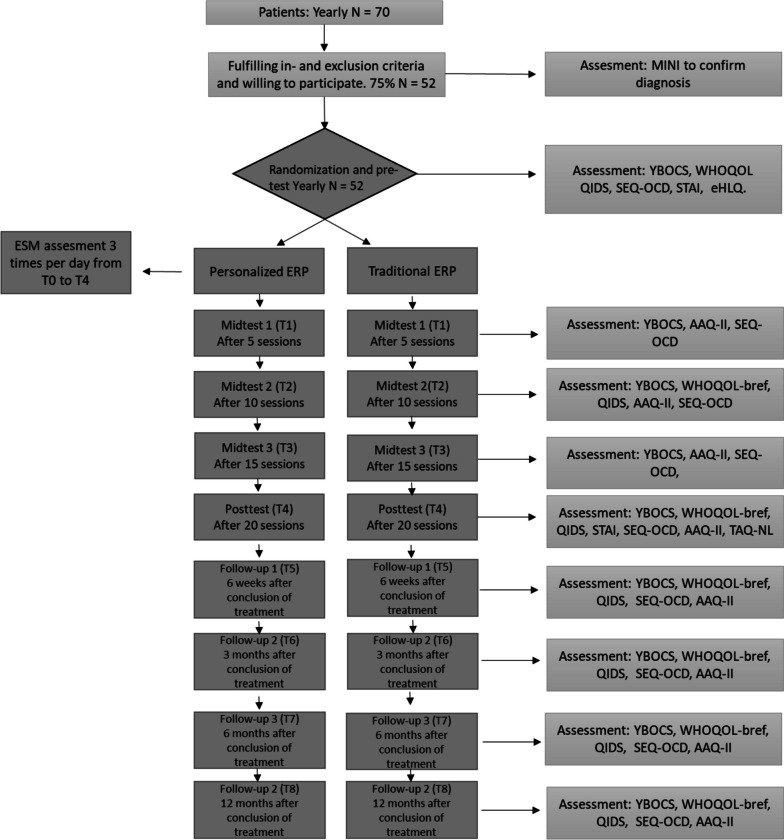
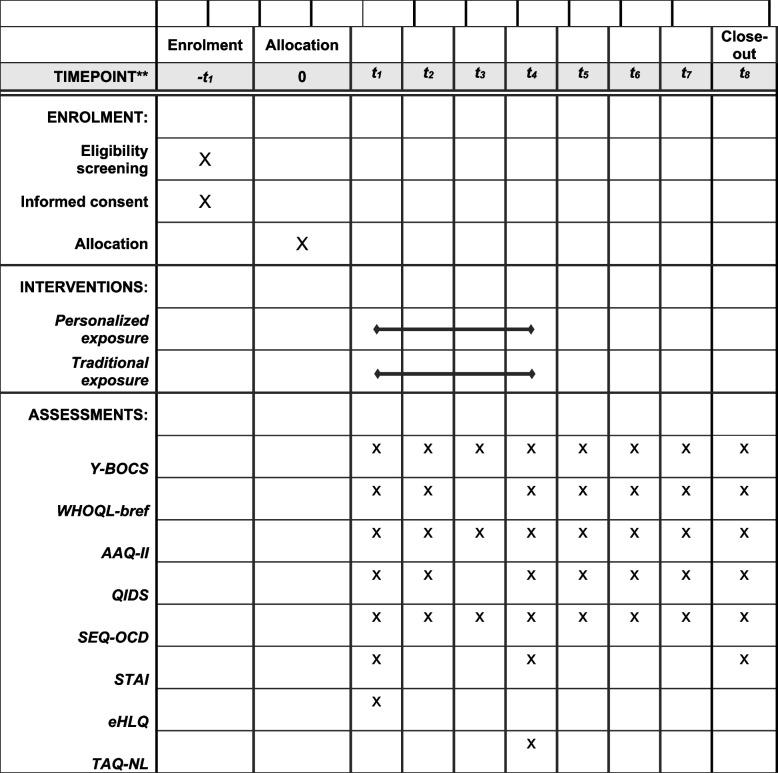
Background: Patients with obsessive–compulsive disorder (OCD) suffer from repetitive fearful intrusions which they try to neutralize by performing compulsions. OCD is considered to be the most resistant anxiety disorder with a remission rate of only 53% after a year of an evidence-based treatment. Therefore, it remains an obligation to develop and investigate more effective treatment interventions. This study aims to compare personalized exposure with response prevention (ERP) using experience sampling methodology-based feedback to ERP as usual in patients with OCD. Personalized exposure will be provided screen-to-screen in an ecologically valid (real time and real place) context by means of a smartphone application. This app will also be used to collect both objective and subjective data by means of experience sampling methodology (ESM). This ESM data will be used to identify triggers and protective factors for symptom severity, provide personalized feedback and optimize the effect of ERP. The primary goal of this RCT is to compare the effectiveness of personalized ERP to ERP as usual in the traditional context of a therapist’s room in patients with OCD in OCD symptom severity, as well as differences in quality of life, depressive symptoms and anxiety states. Since both self-efficacy and experiential avoidance are known to influence symptom severity in OCS, a secondary goal is to examine if a possible treatment effect is mediated by self-efficacy or experiential avoidance. Methods: This study involves a randomized controlled trial with 20 weekly sessions by 2 groups (ERP as usual versus personalized ERP), repeated measurements at baseline (T0), 5 weeks of treatment (T1), 10 weeks of treatment (T2), 15 weeks of treatment (T3), posttest at 20 weeks (T4), 6 weeks follow-up (T5), 3 months follow-up (T6), 6 months follow-up (T7) and a year follow-up (T8). A hundred and sixty patients with an OCD diagnosis according to DSM-5 criteria will participate. Half of the group will receive exposure with response prevention as usual, the other half will receive personalized exposure with response prevention with a smartphone application and personalized feedback sessions based on experience sampling data. Multilevel mixed modelling analysis will be used to investigate differences in treatment effect, as well as differences in quality of life, depressive symptoms and anxiety states. We will use the macro of Preacher and Hayes and apply bootstrapping methods to assess the possible mediating effect of changes in self-efficacy and experiential avoidance on subsequent treatment effects. Discussion: This randomized controlled trial is the first to assess the influence of delivering ERP through video-calling and the use of an ESM intervention on the symptom severity of OCD. Since the global pandemic COVID-19, the use of video-calling to deliver psychological treatments has become more common, increasing the relevance of this study. Trial registration: ICTRP Trial NL8254. Registered on 2019–12-24. © 2024, The Author(s).
Overview
CoChat Summary
TL;DR
This is a randomized controlled trial protocol comparing 20 weeks of standard ERP with a personalized ERP version delivered by video-calling and supported by experience sampling method (ESM) feedback for adults with OCD. The primary outcome is change in OCD severity on the Y-BOCS, with secondary outcomes including quality of life, depressive symptoms, anxiety, and mediation by self-efficacy and experiential avoidance.
Key findings
- Not stated in the paper.
- The trial is designed for 160 patients with an OCD diagnosis according to DSM-5 criteria, randomized 1:1 to ERP as usual versus personalized ERP.
- Outcomes are measured repeatedly at baseline (T0), 5, 10, 15, and 20 weeks, then at 6 weeks, 3 months, 6 months, and 1 year follow-up.
- The sample size calculation targeted detection of a small-to-medium effect (f = 0.35) with alpha = 0.05, power = 0.85, and an estimated correlation of 0.5 between measurements.
Methods
- Randomized controlled trial with 2 active treatment groups: exposure with response prevention as usual versus personalized exposure with response prevention.
- Planned sample: 160 patients with OCD; inclusion required no OCD treatment in the prior 3 months, stable medication for at least 3 months, and willingness to avoid other OCD treatment during the experimental phase.
- Main analysis: multilevel mixed modelling for repeated measures; mediation tested with the Preacher and Hayes macro and bootstrapping for self-efficacy and experiential avoidance.
Limitations
- The paper itself states this is a “black-box design” because the experimental condition combines video-calling and an ESM intervention, so any effect cannot be attributed to either component separately.
- Participants are not blinded to treatment allocation, which the paper says may create attrition bias; it notes pre-treatment attrition was N = 1.
- The paper states there is no waitlist condition, which may affect internal validity and makes it impossible to separate treatment effects from time effects; this is the paper’s stated limitation.
- Evident from the text: the article is a study protocol, so it reports planned methods and outcomes rather than results; no efficacy findings are stated.
Model-written summary. Check it against the paper before relying on it.
Integrity signals
Registry
Cites
Statistics
Figures
Verification
Claims the paper makes
9 Valid · 7 Not valid · 23 Not checked · 24 Own results and interpretations
The cited sources that could be checked couldn’t confirm or dispute this claim.
In the paper
“Also, self-efficacy, someone’s belief in his or her capacity to perform actions necessary to attain certain goals, has found to be positively correlated with symptom severity in OCD [20, 21].”
§ Personalized exposure and experience sampling method feedback versus exposure as usual for obsessive–compulsive disorder: a study protocol for a randomized controlled trial > Introduction > Background and rationale {6a}
What the sources say
- Could not verifycites [20] Corchs F, Corregiari F, Ferrão YA, Takakura T, Mathis ME, Lopes AC, et al. Personality traits and treatment outcome in obsessive-compulsive disorder. Rev Bras Psiquiatr. 2008;30:246–50. sourceExperimental — accuracy not yet measured
The Results report a negative correlation between self-directedness and OCD symptom severity among treatment responders, and no such correlation among non-responders. Self-directedness is not the same measure as self-efficacy; a search for self-efficacy found no passage testing its correlation with symptom severity. (LLM, conf=0.75)
- Not checked — no full text of the sourcecites [21] Cruz-Fuentes C, Blas C, Gonzalez L, Camarena B, Nicolini H. Severity of obsessive-compulsive symptoms is related to self-directedness character trait in obsessive-compulsive disorder. CNS Spectr. 2004;9:607–12. source
plainstates an association- Asserted: passes — The authors put it forward as true.
- Checkable: passes — It can be checked against evidence.
- Load-bearing: passes — The paper’s conclusions depend on it.
- Based: passes — The paper gives a reason why it holds.
- Could not verify
The cited sources that could be checked couldn’t confirm or dispute this claim.
In the paper
“In clinical practice, OCD is considered as the most resistant anxiety disorder; a finding that is empirically supported by several meta-analyses which show that remission rate of OCD 1 year after conclusion of an evidence-based treatment with a SSRI or a cognitive behavioral approach is about 53% and that treatment effect diminished rapidly after the acute treatment phase [8–10].”
§ Personalized exposure and experience sampling method feedback versus exposure as usual for obsessive–compulsive disorder: a study protocol for a randomized controlled trial > Introduction > Background and rationale {6a}
What the sources say
- Could not verifycites [8] Hofmann SG, Smits JAJ. Cognitive-behavioral therapy for adult anxiety disorders: a meta-analysis of randomized placebo-controlled trials. J Clin Psychiatry. 2008;69:621–32. sourceExperimental — accuracy not yet measured
The Results report OCD treatment response during the studied trials, but do not compare outcomes during acute treatment with outcomes afterward. Searches for follow-up, relapse, remission, and long-term effects found no passage establishing that OCD treatment effects diminish rapidly after the acute phase. The Conclusions discuss OCD’s acute treatment effect, not its durability. (LLM, conf=0.76)
- Not checked — no full text of the sourcecites [9] Olatunji BO, Kauffman BY, Meltzer S, Davis ML, Smits JAJ, Powers MB. Cognitive-behavioral therapy for hypochondriasis/health anxiety: a meta-analysis of treatment outcome and moderators. Behav Res Ther. 2014;58:65–74. source
- Not checked — no full text of the sourcecites [10] Sharma E, Thennarasu K, Reddy YCJ. Long-term outcome of obsessive-compulsive disorder in adults. J Clin Psychiatry. 2014;75:1019–27. source
boostedstates a cause- Asserted: passes — The authors put it forward as true.
- Checkable: passes — It can be checked against evidence.
- Load-bearing: passes — The paper’s conclusions depend on it.
- Based: passes — The paper gives a reason why it holds.
- Could not verify
The cited sources support only part of this claim — read each source’s verdict below.
In the paper
“Different studies found that internet-based delivery of exposure with response prevention leads to a clinical significant decrease in symptoms [11–13].”
§ Personalized exposure and experience sampling method feedback versus exposure as usual for obsessive–compulsive disorder: a study protocol for a randomized controlled trial > Introduction > Background and rationale {6a}
What the sources say
- Supportedcites [11] Andersson E, Enander J, Andrén P, Hedman E, Ljótsson B, Hursti T, et al. Internet-based cognitive behaviour therapy for obsessive-compulsive disorder: a randomized controlled trial. Psychol Med. 2012;42:2193–203. source
The Methods (Interventions; page unavailable) describe an internet-based CBT programme with daily exposure and response prevention exercises. The Results (Primary outcome measure; page unavailable) report clinically significant improvement in OCD symptoms for 60% of participants receiving that programme, versus 6% in the control group. (LLM, conf=0.93)
- Supportedcites [12] Feusner JD, Farrell NR, Kreyling J, McGrath PB, Rhode A, Faneuff T, et al. Online video teletherapy treatment of obsessive-compulsive disorder using exposure and response prevention: clinical outcomes from a retrospective longitudinal observational study. J Med Internet Res. 2022;24(5):e36431 (https://www.jmir.org/2022/5/e36431). source
The Discussion states that ERP delivered through technology-assisted video teletherapy results in clinically significant symptom improvements in a real-world sample. The Results report a 43.4% mean reduction in OCD symptoms, supporting the cited claim about internet-based delivery. (LLM, conf=0.94)
- Partly supportedcites [13] Fletcher TL, Boykin DM, Helm A, Dawson DB, Ecker AH, Freshour J, et al. A pilot open trial of video telehealth-delivered exposure and response prevention for obsessive-compulsive disorder in rural Veterans. APA. 2021;34:83–90. sourceExperimental — accuracy not yet measured
The Video delivery and Quantitative outcomes sections show that ERP was delivered by live video and that six of nine treatment completers had clinically significant improvement in OCD symptoms. But this was a small, uncontrolled pilot trial in rural Veterans; its Conclusions call the effectiveness preliminary, so the broader causal claim that internet-based ERP leads to such improvement overstates the evidence. (LLM, conf=0.84)
plainstates a cause- Asserted: passes — The authors put it forward as true.
- Checkable: passes — It can be checked against evidence.
- Load-bearing: passes — The paper’s conclusions depend on it.
- Based: passes — The paper gives a reason why it holds.
- Supported
The sources with a verdict support this claim; the rest weren’t checked yet, have no full text we could read, or their verdicts aren’t rated yet.
In the paper
“In clinical practice, OCD is considered as the most resistant anxiety disorder; a finding that is empirically supported by several meta-analyses which show that remission rate of OCD 1 year after conclusion of an evidence-based treatment with a SSRI or a cognitive behavioral approach is about 53% and that treatment effect diminished rapidly after the acute treatment phase [8–10].”
§ Personalized exposure and experience sampling method feedback versus exposure as usual for obsessive–compulsive disorder: a study protocol for a randomized controlled trial > Introduction > Background and rationale {6a}
What the sources say
- Supportedcites [8] Hofmann SG, Smits JAJ. Cognitive-behavioral therapy for adult anxiety disorders: a meta-analysis of randomized placebo-controlled trials. J Clin Psychiatry. 2008;69:621–32. source
The Conclusions describe a general notion that OCD is the most treatment-resistant anxiety disorder and distinguish clinical experience from the study’s empirical results. This supports the quoted claim about how OCD is considered in practice; the paper does not endorse that notion as an empirical finding. (LLM, conf=0.91)
- Not checked — no full text of the sourcecites [9] Olatunji BO, Kauffman BY, Meltzer S, Davis ML, Smits JAJ, Powers MB. Cognitive-behavioral therapy for hypochondriasis/health anxiety: a meta-analysis of treatment outcome and moderators. Behav Res Ther. 2014;58:65–74. source
- Not checked — no full text of the sourcecites [10] Sharma E, Thennarasu K, Reddy YCJ. Long-term outcome of obsessive-compulsive disorder in adults. J Clin Psychiatry. 2014;75:1019–27. source
boosted- Asserted: passes — The authors put it forward as true.
- Checkable: passes — It can be checked against evidence.
- Load-bearing: passes — The paper’s conclusions depend on it.
- Based: passes — The paper gives a reason why it holds.
- Supported
The cited sources that could be checked couldn’t confirm or dispute this claim.
In the paper
“In clinical practice, OCD is considered as the most resistant anxiety disorder; a finding that is empirically supported by several meta-analyses which show that remission rate of OCD 1 year after conclusion of an evidence-based treatment with a SSRI or a cognitive behavioral approach is about 53% and that treatment effect diminished rapidly after the acute treatment phase [8–10].”
§ Personalized exposure and experience sampling method feedback versus exposure as usual for obsessive–compulsive disorder: a study protocol for a randomized controlled trial > Introduction > Background and rationale {6a}
What the sources say
- Could not verifycites [8] Hofmann SG, Smits JAJ. Cognitive-behavioral therapy for adult anxiety disorders: a meta-analysis of randomized placebo-controlled trials. J Clin Psychiatry. 2008;69:621–32. sourceExperimental — accuracy not yet measured
The Results report CBT treatment-response effect sizes, and the Conclusions discuss OCD treatment resistance, but neither gives a one-year remission rate. Searches for 53% remission and 12-month follow-up after SSRI or CBT treatment found no passage addressing that estimate in our copy. (LLM, conf=0.76)
- Not checked — no full text of the sourcecites [9] Olatunji BO, Kauffman BY, Meltzer S, Davis ML, Smits JAJ, Powers MB. Cognitive-behavioral therapy for hypochondriasis/health anxiety: a meta-analysis of treatment outcome and moderators. Behav Res Ther. 2014;58:65–74. source
- Not checked — no full text of the sourcecites [10] Sharma E, Thennarasu K, Reddy YCJ. Long-term outcome of obsessive-compulsive disorder in adults. J Clin Psychiatry. 2014;75:1019–27. source
plain- Asserted: passes — The authors put it forward as true.
- Checkable: passes — It can be checked against evidence.
- Load-bearing: passes — The paper’s conclusions depend on it.
- Based: passes — The paper gives a reason why it holds.
- Could not verify
16 more claims · 1 with their cited sources checked
Create a free account to see all 63 claims and every source verdict.
- It may state two separate claims as one. 17
- Probably not a substantial claim. 32
Self-check
Percentages, sums and reported differences re-computed from the paper’s own numbers.
Each contradiction between two passages listed here was confirmed by an independent check.
Rated minor: it would not touch a result — a value no result rests on, a p-value that stays on the same side of the significance level, or a conflict that is clerical, resolved elsewhere in the paper, or outside its own findings.
In the paper
§ Personalized exposure and experience sampling method feedback versus exposure as usual for obsessive–compulsive disorder: a study protocol for a randomized controlled trial > Abstract > Trial registration
“ICTRP Trial NL8254. Registered on 2019–12–24.”
§ Personalized exposure and experience sampling method feedback versus exposure as usual for obsessive–compulsive disorder: a study protocol for a randomized controlled trial > Trial status
“This trial is registered in the Netherlands trial register on December 19, 2019.”
Citations
Cites
Diagnostic and Statistical Manual of Mental Disorders
American Psychiatric Association (2013) · doi:10.1176/appi.books.9780890425596 · Cited by 116,369
User Acceptance of Information Technology: Toward A Unified View1
Venkatesh, V., Morris, M. G., Davis, G. B., & Davis, F. D. (2003) · MIS Quarterly · doi:10.2307/30036540 · Cited by 45,035 · cited 1×
“The TAQ is adapted from the Technology Accept-ance Model and extended with constructs from the Unified theory of Acceptance and Use of Technology [39].”
MethodJacobson, N. S., & Truax, P. (1991) · Journal of Consulting and Clinical Psychology · doi:10.1037/0022-006x.59.1.12 · Cited by 7,770 · cited 1×
“Effect sizes and clinical significant change according to the Jacobson and Truax criteria will be calculated to estimate respectively the magnitude of the treatment effect and the significance of the results for clinical practice [49].”
MethodThe Yale-Brown Obsessive Compulsive Scale: I. Development, Use, and Reliability
Goodman, W. K. (1989) · Archives of General Psychiatry · doi:10.1001/archpsyc.1989.01810110048007 · Cited by 7,712
Bond, F. W., Hayes, S. C., Baer, R. A., Carpenter, K. M., Guenole, N., Orcutt, H. K., Waltz, T., & Zettle, R. D. (2011) · Behavior Therapy · doi:10.1016/j.beth.2011.03.007 · Cited by 3,950 · cited 1×
“The AAQ-II [37] is a 7-item measure of psychological inflexibility/experiential avoidance.”
BackgroundRush, A. J., Trivedi, M. H., Ibrahim, H. M., Carmody, T. J., Arnow, B., Klein, D. N., Markowitz, J. C., Ninan, P. T., Kornstein, S., Manber, R., et al. (2003) · Biological Psychiatry · doi:10.1016/s0006-3223(02)01866-8 · Cited by 3,829 · cited 2×
“Furthermore, the QIDS-SR16 is sensitive to symptom change and has highly acceptable psychometric properties [32].”
MethodState-Trait Anxiety Inventory for Adults
Spielberger, C. D. (2012) · PsycTESTS Dataset · doi:10.1037/t06496-000 · Cited by 3,479
User Acceptance of Information Technology: Toward a Unified View
Venkatesh, V., Morris, M. G., Davis, G. B., & Davis, F. D. (2003) · Cited by 3,068
The epidemiology of obsessive-compulsive disorder in the National Comorbidity Survey Replication
Ruscio, A. M., Stein, D. J., Chiu, W. T., & Kessler, R. C. (2010) · Molecular Psychiatry · doi:10.1038/mp.2008.94 · Cited by 2,771 · cited 1×
“The life-time prevalence of OCD is 2.3%, and its course—when untreated—is mostly chronic with symptoms waxing and waning [2, 3].”
BackgroundInfluentialMaximizing exposure therapy: An inhibitory learning approach
Craske, M. G., Treanor, M., Conway, C. C., Zbozinek, T., & Vervliet, B. (2014) · Behaviour Research and Therapy · doi:10.1016/j.brat.2014.04.006 · Cited by 2,339 · cited 2×
“Although traditionally habituation was seen as the primary mechanism in ERP, this focus shifted to inhibitory learning in the past decade [6, 24].”
Background
Research works printed but not linked: 4
- Vervliet B, Depreeuw B, Craske MG. Exposuretherapie. Gedragstherapie. 2014;47:296–339.
- van der Ploeg HM. De Zelf-Beoordelings Vragenlijst angst. Tijdschr Psychiatr. 1982;24:576–88.
- Jacobs N, Kleen M, De Groot F, A-Tjak J. Het meten van experiëntiële vermijding: De Nederlandstalige versie van de acceptance and action Ouestionnaire-II (AAO-II). PsycNET Tijdschr voor Gedragstherapie. 2008;41:349–61.
- Peter Diggle, Department of mathematics and statistics. Patrick J. Heagerty, Kung-Yee Liang SZ. Analysis of Longitudinal Data -. 2nd edition. Oxford; 2013.
Cited by
Soleimani, G., Nitsche, M. A., Hanlon, C. A., Lim, K. O., Opitz, A., & Ekhtiari, H. (2025) · Neuropsychopharmacology · doi:10.1038/s41386-025-02094-3 · Cited by 32
Metadata
- Authors
- Hoogerwerf, E., Greeven, A., Goekoop, R., & Spinhoven, P.
- Affiliations
- Leiden University (NL)
- Parnassia Groep Academie (NL)
- Corresponding author
- Hoogerwerf, Elena
- Venue
- Trials
- Published
- 2024-01-12
- Volume
- 25
- Issue
- 1
- Pages
- 43-43
- ISSN
- 1745-6215 (ISSN-L)
- PMC
- PMC10785525
- OpenAlex
- W4390789368
- Cited by
- 1
- References
- 45
- Citations by year
- 2025: 1
- FWCI
- 0.50
- Type
- journal article
- Language
- en
- Open access
- gold
- doi.org
- Licence
- cc-by
- creativecommons.org/licenses/by/4.0 (tdm)
- creativecommons.org/licenses/by/4.0 (vor)
- Locations
- Trials (publishedVersion, cc-by)
- Research Square (acceptedVersion, cc-by)
- PubMed Central (publishedVersion, cc-by)
- PubMed (publishedVersion)
- Leiden Repository (Leiden University) (submittedVersion, cc-by)
- DOAJ (DOAJ: Directory of Open Access Journals) (submittedVersion, cc-by-sa)
- Topics
- Social Sciences › Psychology › Clinical Psychology › Obsessive-Compulsive Spectrum Disorders
- Social Sciences › Psychology › Experimental and Cognitive Psychology › Anxiety, Depression, Psychometrics, Treatment, Cognitive Processes
- Social Sciences › Psychology › Applied Psychology › Digital Mental Health Interventions
- Keywords
- obsessive-compulsive disorder, exposure and response prevention, ecological momentary assessment, mobile application, personalized feedback, self-efficacy, experiential avoidance, quality of life, depressive symptoms, anxiety states, symptom severity, medication adherence, relapse prevention, relapse prevention training
- MeSH terms
- Ecological Momentary Assessment, Feedback, Humans, Obsessive-Compulsive Disorder, Quality of Life, Cognitive Behavioral Therapy, Randomized Controlled Trials as Topic, Treatment Outcome
About these checks
Registry, retraction, Cites and statistics results are computed, not judged, with one exception: a printed reference that no index lists is read once by a model before it counts as a citation error. Claims are extracted by a model and kept only when their quote appears verbatim in the text; each cited source is then checked, with a model’s help, for whether it says what the claim relies on. Those verdicts can be wrong — read the claim’s quote and the cited source before relying on one.
The claim verdicts this report counts are experimental: their accuracy is not yet measured.
A language model drew the claims from the paper on 2026-10-11, under version 3 of the claim definition (model deepseek-v4.1-flash, prompt extract-v3).
A second model labelled each claim on 2026-10-11 (model jev-1.13-20260917, definition revision gold-guideline-v0.2).
Cited sources are checked with a language model’s help (gpt-6-sol).
Statistics and arithmetic are recomputed, not judged.
Confidence bands are shown only for fields calibrated on our annotated test set. None is calibrated yet, so no band is shown.
What counts as a claim ›How we measure confidence ›How we check this ›
Are you an author, or do you see a problem with this page? Request a review
How to cite
Cite CoChat for the checks on this page, and the paper for its own findings.
- This page
- CoChat. (2026). Citation check: Personalized exposure and experience sampling method feedback versus exposure as usual for obsessive–compulsive disorder: a study protocol for a randomized controlled trial. https://app.cochat.ai/papers/10.1186/s13063-023-07780-5
- The paper
- Hoogerwerf, E., Greeven, A., Goekoop, R., & Spinhoven, P. (2024). Personalized exposure and experience sampling method feedback versus exposure as usual for obsessive–compulsive disorder: a study protocol for a randomized controlled trial. Trials. https://doi.org/10.1186/s13063-023-07780-5
Data sources
Bibliographic data: Semantic Scholar, OpenAlex, Crossref.
Contains information from the Semantic Scholar Academic Graph Datasets, made available under the ODC Attribution License (ODC-BY 1.0).
Semantic Scholar’s data is described in: Kinney, R., et al. (2023). The Semantic Scholar Open Data Platform. arXiv:2301.10140.
