

Hydrocarbon bio-jet fuel from bioconversion of poplar biomass: life cycle assessment
Open accessThe DOI matches its Crossref record; 31 of the 32 references it cites were found in a registry or an index; 7 of the 60 sources its claims cite were checked for support.
Abstract
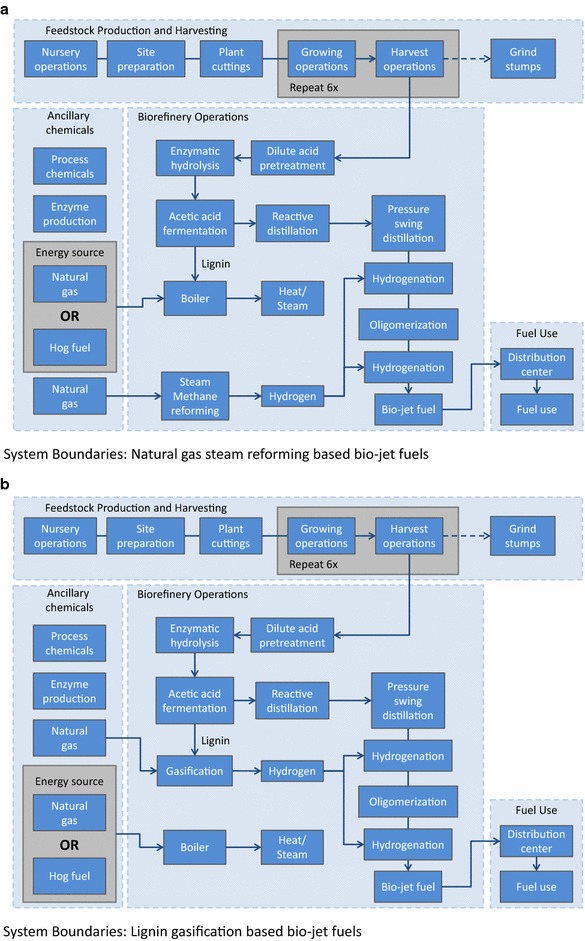
BACKGROUND: Bio-jet fuels compatible with current aviation infrastructure are needed as an alternative to petroleum-based jet fuel to lower greenhouse gas emissions and reduce dependence on fossil fuels. Cradle to grave life cycle analysis is used to investigate the global warming potential and fossil fuel use of converting poplar biomass to drop-in bio-jet fuel via a novel bioconversion platform. Unique to the biorefinery designs in this research is an acetogen fermentation step. Following dilute acid pretreatment and enzymatic hydrolysis, poplar biomass is fermented to acetic acid and then distilled, hydroprocessed, and oligomerized to jet fuel. Natural gas steam reforming and lignin gasification are proposed to meet hydrogen demands at the biorefineries. Separate well to wake simulations are performed using the hydrogen production processes to obtain life cycle data. Both biorefinery designs are assessed using natural gas and hog fuel to meet excess heat demands. RESULTS: Global warming potential of the natural gas steam reforming and lignin gasification bio-jet fuel scenarios range from CO2 equivalences of 60 to 66 and 32 to 73 g MJ(-1), respectively. Fossil fuel usage of the natural gas steam reforming and lignin gasification bio-jet fuel scenarios range from 0.78 to 0.84 and 0.71 to 1.0 MJ MJ(-1), respectively. Lower values for each impact category result from using hog fuel to meet excess heat/steam demands. Higher values result from using natural gas to meet the excess heat demands. CONCLUSION: Bio-jet fuels produced from the bioconversion of poplar biomass reduce the global warming potential and fossil fuel use compared with petroleum-based jet fuel. Production of hydrogen is identified as a major source of greenhouse gas emissions and fossil fuel use in both the natural gas steam reforming and lignin gasification bio-jet simulations. Using hog fuel instead of natural gas to meet heat demands can help lower the global warming potential and fossil fuel use at the biorefineries.
Overview
CoChat Summary
TL;DR
Cradle-to-grave life cycle assessment of four poplar-biomass bio-jet fuel biorefinery designs using acetogen fermentation, hydrogen from natural gas steam reforming or lignin gasification, and heat from natural gas or hog fuel. All bio-jet scenarios had lower global warming potential and fossil fuel use than petroleum jet fuel, with the lignin gasification plus hog fuel case performing best.
Key findings
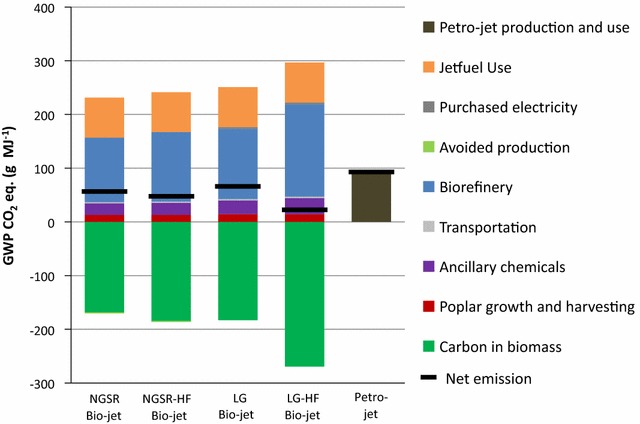
- Net GWP ranged from 60 to 66 g CO2 eq. MJ−1 for natural gas steam reforming scenarios and 32 to 73 g CO2 eq. MJ−1 for lignin gasification scenarios, versus 93 g CO2 eq. MJ−1 for petro-jet.
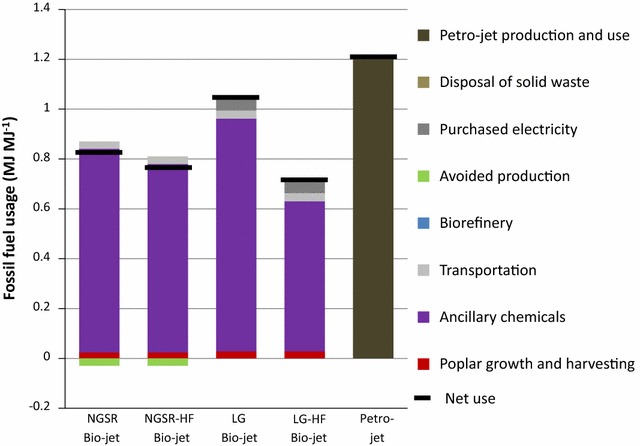
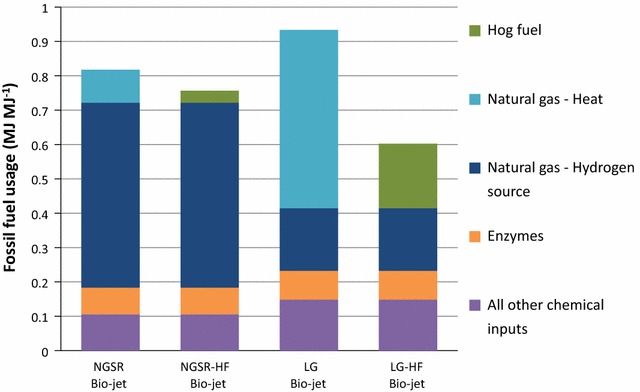
- Net fossil fuel use ranged from 0.78 to 0.84 MJ MJ−1 for NGSR scenarios and 0.71 to 1.0 MJ MJ−1 for LG scenarios, versus 1.2 MJ MJ−1 for petro-jet.
- Using hog fuel instead of natural gas for excess heat/steam lowered impacts: NGSR-HF had 9% lower net GWP and 8% lower net FFU than NGSR; LG-HF had 56% lower net GWP and 46% lower FFU than LG.
- Hydrogen production was a major source of GHG emissions and fossil fuel use; 93% of all hydrogen required in the NGSR and LG simulations was needed to convert acetic acid to ethanol.
Methods
- ISO 14040/14044 cradle-to-grave LCA using SimaPro v.8.0, assessing 100-year GWP and fossil fuel use per 1 MJ jet fuel combusted in a jet engine.
- Four biorefinery simulations were modeled with ASPEN-Plus at 3200 tonnes bone-dry biomass per day: NGSR, NGSR-HF, LG, and LG-HF; feedstock production and harvesting were modeled over 21 years with coppice harvest every 3 years for 6 cycles.
- Data sources included industry operational data, literature, USLCI, Ecoinvent, NREL corn stover model modifications, GREET for petro-jet and jet engine emissions, and direct land-use change from the Forest Industry Carbon Assessment Tool; indirect land-use change was excluded.
Limitations
- The paper states that the research only assesses impacts targeting climate change and fossil fuel use/dependence; additional research is needed on regional environmental impacts such as air quality and water degradation.
- The paper states that indirect land-use change is excluded from system boundaries due to uncertainty associated with these models.
- Evident from the text: no commercial facilities are producing bio-jet fuel via this bioconversion process, so biorefinery results rely on ASPEN-Plus simulations and projected yields/titers rather than commercial operating data.
Model-written summary. Check it against the paper before relying on it.
Integrity signals
Registry
Cites
Statistics
Figures
Verification
Claims the paper makes
6 Valid · 4 Not valid · 34 Not checked · 62 Own results and interpretations
The cited sources support only part of this claim — read each source’s verdict below.
In the paper
“The reductions of GWPs compared to petro-jet reported in this study are not as large as those reported in the literature (except for LG-HF) [4–8].”
§ Hydrocarbon bio-jet fuel from bioconversion of poplar biomass: life cycle assessment > Discussion
What the sources say
- Not checked yetcites [4] Stratton RW, Wong HM, Hileman JI. Life cycle greenhouse gas emissions from alternative jet fuels. Cambridge (MA): Massachusetts Institute of Technology; 2010 June. PARTNER Project 28 Report PARTNER-COE-2010-001. source
Checked before — its earlier verdict is held back until a new check runs.
- Not checked — no full text of the sourcecites [5] Agusdinata DB Zhao F Ilelji K DeLaurentis D Life cycle assessment of potential biojet fuel production in the United States Environ Sci Technol 2011 45 21 9133 9143 10.1021/es202148g 21958200 source
- Partly supportedcites [6] Elgowainy A, Han J, Wang M, Carter N, Stratton R, Hileman J, et al. Life-cycle analysis of alternative aviation fuels in GREET. Lemont (IL): Argonne National Laboratory; 2012 June. Technical Report ANL/ESD/12-8. sourceExperimental — accuracy not yet measured
Section 5 reports that alternative bio-jet fuels can reduce life-cycle GHG emissions by 55–85% relative to petroleum jet fuel, supporting the citation as an example of reductions reported in the literature. The source does not compare those reductions with the citing study’s results or address its LG-HF exception, so it does not establish the full comparison. (LLM, conf=0.79)
- Not checked — no full text of the sourcecites [7] Han J Elgowainy A Cai H Wang MQ Life-cycle analysis of bio-based aviation fuels Biores Technol 2013 150 447 456 10.1016/j.biortech.2013.07.153 23978607 source
- Not checked — no full text of the sourcecites [8] Staples MD Malina R Olcay H Pearlson MN Hileman JI Boies A Lifecycle greenhouse gas footprint and minimum selling price of renewable diesel and jet fuel from fermentation and advanced fermentation production technologies Energy Environ Sci 2014 7 1545 1554 10.1039/c3ee43655a source
plain- Asserted: passes — The authors put it forward as true.
- Checkable: passes — It can be checked against evidence.
- Load-bearing: passes — The paper’s conclusions depend on it.
- Based: passes — The paper gives a reason why it holds.
- Not checked yet
A result the paper reports from its own data — it cites no other source for it, so there is none to check. The quote shows it is in the paper.
In the paper
“Processes associated with manufacturing nitrogen fertilizer and N2O emissions resulting from its use generate GWP CO2 eq. of 5 g MJ−1 for each bio-jet fuel simulation.”
§ Hydrocarbon bio-jet fuel from bioconversion of poplar biomass: life cycle assessment > Results > Global warming potential
plainstates a cause- Asserted: passes — The authors put it forward as true.
- Checkable: passes — It can be checked against evidence.
- Load-bearing: unclear — It is unclear whether the paper’s conclusions depend on it.
- Based: passes — The paper gives a reason why it holds.
A result the paper states — it cites no source for it, so there is none to check. The quote shows it is in the paper.
In the paper
“Direct land-use change emissions contribute GWP CO2 eq. of 12 g MJ−1 of bio-jet fuel to each simulation.”
§ Hydrocarbon bio-jet fuel from bioconversion of poplar biomass: life cycle assessment > Results > Global warming potential
plainstates a cause- Asserted: passes — The authors put it forward as true.
- Checkable: passes — It can be checked against evidence.
- Load-bearing: unclear — It is unclear whether the paper’s conclusions depend on it.
- Based: passes — The paper gives a reason why it holds.
A result the paper reports from its own data — it cites no other source for it, so there is none to check. The quote shows it is in the paper.
In the paper
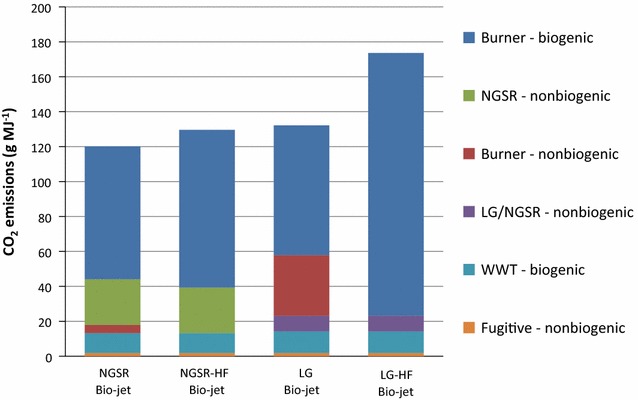
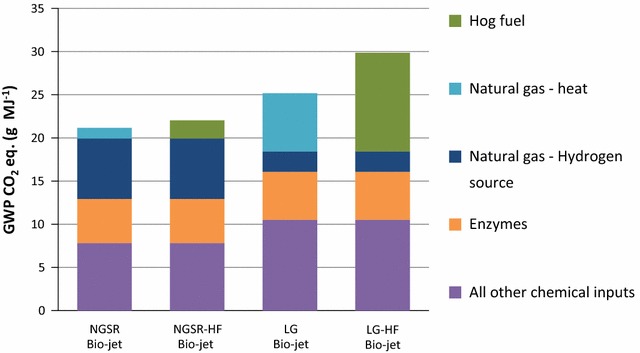
“In the LG-HF bio-jet process, the ancillary chemicals group has the largest impact on the GWP when biogenic CO2 emissions are removed.”
§ Hydrocarbon bio-jet fuel from bioconversion of poplar biomass: life cycle assessment > Results > Global warming potential
plain- Asserted: passes — The authors put it forward as true.
- Checkable: passes — It can be checked against evidence.
- Load-bearing: unclear — It is unclear whether the paper’s conclusions depend on it.
- Based: passes — The paper gives a reason why it holds.
A result the paper reports from its own data — it cites no other source for it, so there is none to check. The quote shows it is in the paper.
In the paper
“Acquisition/manufacturing of products within the ancillary chemicals use 85–97 % of the fossil fuels consumed in the making of the bio-jet fuels.”
§ Hydrocarbon bio-jet fuel from bioconversion of poplar biomass: life cycle assessment > Results > Fossil fuel use
plain- Asserted: passes — The authors put it forward as true.
- Checkable: passes — It can be checked against evidence.
- Load-bearing: unclear — It is unclear whether the paper’s conclusions depend on it.
- Based: passes — The paper gives a reason why it holds.
46 more claims
Create a free account to see all 106 claims and to verify the 10 references still open.
- Probably not a substantial claim. 32
- It may state two separate claims as one. 30
Self-check
Percentages, sums and reported differences re-computed from the paper’s own numbers.
Each contradiction between two passages listed here was confirmed by an independent check.
Rated minor: it would not touch a result — a value no result rests on, a p-value that stays on the same side of the significance level, or a conflict that is clerical, resolved elsewhere in the paper, or outside its own findings.
In the paper
§ Hydrocarbon bio-jet fuel from bioconversion of poplar biomass: life cycle assessment > Results > Fossil fuel use
“Natural gas for heating consumes 0.096 MJ MJ−1 and is the third largest consumer of fossil fuels in NGSR bio-jet.”
§ Hydrocarbon bio-jet fuel from bioconversion of poplar biomass: life cycle assessment > Results > Fossil fuel use
“Acquisition/production of natural gas for hydrogen production and enzyme production use 0.54 and 0.077 MJ MJ−1, respectively.”
Citations
Cites
Climate change 2007: the physical science basis
Solomon, S., Qin, D., Manning, M., Marquis, M. C., Averyt, K. B., Tignor, M., Miller, H. L., & Chen, Z. (2007) · Cited by 24,695
Klüppel, H.-J. (2005) · The International Journal of Life Cycle Assessment · doi:10.1065/lca2005.03.001 · Cited by 4,639
Environmental, economic, and energetic costs and benefits of biodiesel and ethanol biofuels
Hill, J., Nelson, E., Tilman, D., Polasky, S., & Tiffany, D. (2006) · Proceedings of the National Academy of Sciences · doi:10.1073/pnas.0604600103 · Cited by 2,871 · cited 1×
“A benefit of this platform is the ability to use a wide range of feedstocks such as corn, sugarcane, switchgrass, corn stover, and short rotation woody crops (SRWC) [1, 2, 8]; many of which—such as switchgrass and SWRC—can be cultivated on marginal lands [9, 10].”
BackgroundHumbird, D., Davis, R., Tao, L., Kinchin, C., Hsu, D., Aden, A., Schoen, P., Lukas, J., Olthof, B., Worley, M., et al. (2011) · doi:10.2172/1013269 · Cited by 1,641
Substrate and Enzyme Characteristics that Limit Cellulose Hydrolysis
Mansfield, S. D., Mooney, C., & Saddler, J. N. (1999) · Biotechnology Progress · doi:10.1021/bp9900864 · Cited by 869 · cited 1×
“The lignocellulosic material in the wood can also be fractionated without extensive pretreatment [12], and hardwoods do not exhibit the recalcitrance reported in softwoods [13].”
BackgroundPoplar as a feedstock for biofuels: A review of compositional characteristics
Sannigrahi, P., Ragauskas, A. J., & Tuskan, G. A. (2010) · Biofuels, Bioproducts and Biorefining · doi:10.1002/bbb.206 · Cited by 688 · cited 3×
“7 % dry wood weight [30] (Tables 2, 3).”
BackgroundInfluentialSurrogate Mixtures to Represent Complex Aviation and Rocket Fuels
Edwards, T., & Maurice, L. Q. (2001) · Journal of Propulsion and Power · doi:10.2514/2.5765 · Cited by 495
Development of an Experimental Database and Kinetic Models for Surrogate Diesel Fuels
Farrell, J. T., Cernansky, N. P., Dryer, F. L., Law, C. K., Friend, D. G., Hergart, C. A., McDavid, R. M., Patel, A. K., Mueller, C. J., & Pitsch, H. (2007) · SAE Technical Paper Series · doi:10.4271/2007-01-0201 · Cited by 486 · cited 1×
“Dodecane also has similar density, viscosity, thermal conductivity, and heat capacity to kerosene-based jet fuel [20].”
BackgroundLand Availability for Biofuel Production
Cai, X., Zhang, X., & Wang, D. (2011) · Environmental Science & Technology · doi:10.1021/es103338e · Cited by 444 · cited 1×
“It is estimated that there is enough marginal/abandoned land to meet 26–55 % of the current world liquid fuel demand using second-generation biofuel production methods [21].”
BackgroundSurrogate mixtures to represent complex aviation and rocket fuels
Edwards, T., & Maurice, L. (1999) · 35th Joint Propulsion Conference and Exhibit · doi:10.2514/6.1999-2217 · Cited by 371 · cited 1×
“n-Dodecane, C12H26, is a good first approximation for kerosene-type jet fuel and has an appropriate carbon number of 12 [19].”
BackgroundKeoleian, G. A., & Volk, T. A. (2005) · Critical Reviews in Plant Sciences · doi:10.1080/07352680500316334 · Cited by 346 · cited 3×
“In general, they require little fertilizer input, have the ability to resprout after multiple harvests, and have a high biomass production [9].”
BackgroundDevelopment of an Experimental Database and Kinetic Models for Surrogate Jet Fuels
Edwards, T., Colket, M., Cernansky, N., Dryer, F., Egolfopoulos, F., Friend, D., Law, E., Lenhert, D., Lindstedt, P., Pitsch, H., et al. (2007) · 45th AIAA Aerospace Sciences Meeting and Exhibit · doi:10.2514/6.2007-770 · Cited by 225
Andreesen, J. R., Schaupp, A., Neurauter, C., Brown, A., & Ljungdahl, L. G. (1973) · Journal of Bacteriology · doi:10.1128/jb.114.2.743-751.1973 · Cited by 200
Environmental life cycle assessment of lignocellulosic conversion to ethanol: A review
Borrion, A. L., McManus, M. C., & Hammond, G. P. (2012) · Renewable and Sustainable Energy Reviews · doi:10.1016/j.rser.2012.04.016 · Cited by 198 · cited 4×
“Biorefinery heat and steam demands cannot be entirely met from combustion of lignin, as is commonplace in many second-generation ethanol biorefineries [1, 18], and energy must be imported.”
BackgroundInfluentialLife Cycle Assessment of Potential Biojet Fuel Production in the United States
Agusdinata, D. B., Zhao, F., Ileleji, K., & DeLaurentis, D. (2011) · Environmental Science & Technology · doi:10.1021/es202148g · Cited by 184 · cited 2×
“[5] project a median GWP reduction of 74 %, compared with petro-jet, for hydroprocessed and Fischer–Tropsch biojet fuels in 2050.”
BackgroundMethodLife-cycle analysis of bio-based aviation fuels
Han, J., Elgowainy, A., Cai, H., & Wang, M. Q. (2013) · Bioresource Technology · doi:10.1016/j.biortech.2013.07.153 · Cited by 175 · cited 15×
“Land-use change (both direct and indirect) emissions have been left out of many biofuel life cycle assessment (LCA) studies as there is still a great deal of uncertainty in land-use change models, especially for oil seed feedstocks [7].”
BackgroundMethodResultInfluentialAlternative jet fuel feasibility
Hileman, J. I., & Stratton, R. W. (2014) · Transport Policy · doi:10.1016/j.tranpol.2014.02.018 · Cited by 166 · cited 1×
“dollars [3].”
LCA of second generation bioethanol: A review and some issues to be resolved for good LCA practice
Wiloso, E. I., Heijungs, R., & de Snoo, G. R. (2012) · Renewable and Sustainable Energy Reviews · doi:10.1016/j.rser.2012.04.035 · Cited by 164 · cited 5×
“Cultivating marginal lands for growing biomass for biofuels can potentially help limit direct and indirect land-use change emissions [2].”
BackgroundInfluentialStaples, M. D., Malina, R., Olcay, H., Pearlson, M. N., Hileman, J. I., Boies, A., & Barrett, S. R. H. (2014) · Energy Environ. Sci. · doi:10.1039/c3ee43655a · Cited by 119 · cited 9×
“As noted above, the authors predict significant GWP reductions, but that the results vary and are dependent on the feedstock and conversion methods used [8].”
BackgroundInfluentialAccounting for indirect land-use change in the life cycle assessment of biofuel supply chains
Sanchez, S. T., Woods, J., Akhurst, M., Brander, M., O'Hare, M., Dawson, T. P., Edwards, R., Liska, A. J., & Malpas, R. (2012) · Journal of The Royal Society Interface · doi:10.1098/rsif.2011.0769 · Cited by 113 · cited 2×
“Indirect land-use change is excluded from the system boundaries due to uncertainty associated with these models [31].”
BackgroundMethodCaputo, J., Balogh, S. B., Volk, T. A., Johnson, L., Puettmann, M., Lippke, B., & Oneil, E. (2014) · BioEnergy Research · doi:10.1007/s12155-013-9347-y · Cited by 91 · cited 1×
“Feedstock The feedstock production and harvesting model is supported by operational data from industry (GreenWood Resources, personal communication, 2011–2014), literature [26], and LCA databases [27, 28].”
MethodSteam pretreatment of Salix with and without SO2 impregnation for production of bioethanol.
Sassner, P., Galbe, M., & Zacchi, G. (2005) · PubMed · Cited by 88
Hydrocarbon bio-jet fuel from bioconversion of poplar biomass: techno-economic assessment
Crawford, J. T., Shan, C. W., Budsberg, E., Morgan, H., Bura, R., & Gustafson, R. (2016) · Biotechnology for Biofuels · doi:10.1186/s13068-016-0545-7 · Cited by 80
Self-citation(2014) · Cited by 77
Cherubini, F., & Stro̷mman, A. H. (2010) · Energy & Fuels · doi:10.1021/ef901379s · Cited by 70
Steam Pretreatment of Salix with and without SO2 Impregnation for Production of Bioethanol
Sassner, P., Galbe, M., & Zacchi, G. (2005) · Applied Biochemistry and Biotechnology · doi:10.1385/abab:124:1-3:1101 · Cited by 69
Fermentation of lignocellulosic sugars to acetic acid byMoorella thermoacetica
Ehsanipour, M., Suko, A. V., & Bura, R. (2016) · Journal of Industrial Microbiology & Biotechnology · doi:10.1007/s10295-016-1756-4 · Cited by 66
Self-citationLife-Cycle Analysis of Alternative Aviation Fuels in GREET
USDOE Office of Energy Efficiency and Renewable Energy (EERE), O. O. S. T. V. T. O. (., Elgowainy, A., USDOE Office of Energy Efficiency and Renewable Energy (EERE), O. O. S. T. B. T. O. (., US Air Force Office of Scientific Research (AFOSR), (FAA), U. F. A. A., USDOD, Argonne National Laboratory (ANL), A., Han, J., Wang, M., Carter, N., et al. (2012) · doi:10.2172/1046913 · Cited by 60
Ethanologens vs. acetogens: Environmental impacts of two ethanol fermentation pathways
Budsberg, E., Crawford, J., Gustafson, R., Bura, R., & Puettmann, M. (2015) · Biomass and Bioenergy · doi:10.1016/j.biombioe.2015.08.019 · Cited by 39 · cited 5×
“It is the same feedstock model used in [18] and is discussed in more detail in that publication.”
BackgroundMethodInfluentialSelf-citationUS marginal electricity grid mixes and EV greenhouse gas emissions
(Sandy) Thomas, C. E. (2012) · International Journal of Hydrogen Energy · doi:10.1016/j.ijhydene.2012.09.146 · Cited by 38 · cited 1×
“An avoided production credit is generated for displacing electricity produced from natural gas, a likely candidate for marginal electricity [33].”
Background
Research works printed but not linked: 1
- Stratton RW, Wong HM, Hileman JI. Life cycle greenhouse gas emissions from alternative jet fuels. Cambridge (MA): Massachusetts Institute of Technology; 2010 June. PARTNER Project 28 Report PARTNER-COE-2010-001.
Cited by
Renewable bio-jet fuel production for aviation: a review
Wei, H., Liu, W., Chen, X., Yang, Q., Li, J., & Chen, H. (2019) · Fuel · doi:10.1016/j.fuel.2019.06.007 · Cited by 435
Kargbo, H., Harris, J. S., & Phan, A. N. (2021) · Renewable and Sustainable Energy Reviews · doi:10.1016/j.rser.2020.110168 · Cited by 333
Sustainable aviation fuel technologies, costs, emissions, policies, and markets: A critical review
Watson, M. J., Machado, P. G., da Silva, A. V., Saltar, Y., Ribeiro, C. O., Nascimento, C. A. O., & Dowling, A. W. (2024) · Journal of Cleaner Production · doi:10.1016/j.jclepro.2024.141472 · Cited by 279
Shahriar, M. F., & Khanal, A. (2022) · Fuel · doi:10.1016/j.fuel.2022.124905 · Cited by 255
Beaucamp, A., Muddasar, M., Amiinu, I. S., Moraes Leite, M., Culebras, M., Latha, K., Gutiérrez, M. C., Rodriguez-Padron, D., del Monte, F., Kennedy, T., et al. (2022) · Green Chemistry · doi:10.1039/d2gc02724k · Cited by 241
Metadata
- Authors
- Budsberg, E., Crawford, J. T., Morgan, H., Chin, W. S., Bura, R., & Gustafson, R.
- Affiliations
- University of Washington (US)
- Corresponding author
- Gustafson, Rick
- Venue
- Biotechnology for Biofuels
- Published
- 2016-08-11
- Volume
- 9
- Issue
- 1
- Pages
- 170-170
- ISSN
- 1754-6834 (ISSN-L)
- PMC
- PMC4982110
- OpenAlex
- W2510402938
- Semantic Scholar
- 666ddaec6ee24252720d360dbec04f6b9c1e6ede
- Cited by
- 76
- References
- 32
- Citations by year
- 2026: 6 · 2025: 8 · 2024: 10 · 2023: 4 · 2022: 16 · 2021: 10 · 2020: 6 · 2019: 4 · 2018: 6 · 2017: 5 · 2016: 1
- FWCI
- 3.95
- Type
- journal article
- Language
- en
- Open access
- gold
- doi.org
- Licence
- cc-by
- creativecommons.org/licenses/by/4.0/ (tdm)
- creativecommons.org/licenses/by/4.0/ (vor)
- Locations
- Biotechnology for Biofuels (publishedVersion, cc-by)
- PubMed Central (publishedVersion, cc-by)
- PubMed (publishedVersion)
- Funders
- National Institute of Food and Agriculture (2011-68005-30407)
- Topics
- Physical Sciences › Engineering › Aerospace Engineering › Advanced Aircraft Design and Technologies
- Physical Sciences › Engineering › Biomedical Engineering › Biofuel production and bioconversion
- Physical Sciences › Environmental Science › Environmental Engineering › Environmental Impact and Sustainability
- Keywords
- biojet fuel, poplar biomass, biorefinery, global warming potential, fossil fuel consumption, steam reforming of natural gas, hydrogen production, hog fuel, dilute acid pretreatment, enzymatic hydrolysis, hydroprocessing, oligomerization, greenhouse gas emissions
About these checks
Registry, retraction, Cites and statistics results are computed, not judged, with one exception: a printed reference that no index lists is read once by a model before it counts as a citation error. Claims are extracted by a model and kept only when their quote appears verbatim in the text; each cited source is then checked, with a model’s help, for whether it says what the claim relies on. Those verdicts can be wrong — read the claim’s quote and the cited source before relying on one.
The claim verdicts this report counts are experimental: their accuracy is not yet measured.
A language model drew the claims from the paper on 2026-10-10, under version 3 of the claim definition (model deepseek-v4.1-flash, prompt extract-v3).
A second model labelled each claim on 2026-10-10 (model jev-1.13-20260917, definition revision gold-guideline-v0.2).
Cited sources are checked with a language model’s help (gpt-6-sol).
Statistics and arithmetic are recomputed, not judged.
Confidence bands are shown only for fields calibrated on our annotated test set. None is calibrated yet, so no band is shown.
What counts as a claim ›How we measure confidence ›How we check this ›
Are you an author, or do you see a problem with this page? Request a review
Data sources
Bibliographic data: Semantic Scholar, OpenAlex, Crossref.
Contains information from the Semantic Scholar Academic Graph Datasets, made available under the ODC Attribution License (ODC-BY 1.0).
Semantic Scholar’s data is described in: Kinney, R., et al. (2023). The Semantic Scholar Open Data Platform. arXiv:2301.10140.
