

Signatures of early frailty in the gut microbiota
Open accessThe DOI matches its Crossref record; 86 of the 86 references it cites were found in a registry or an index.
Abstract
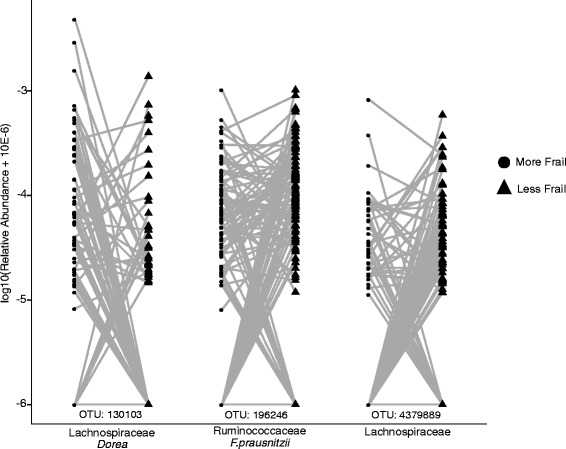
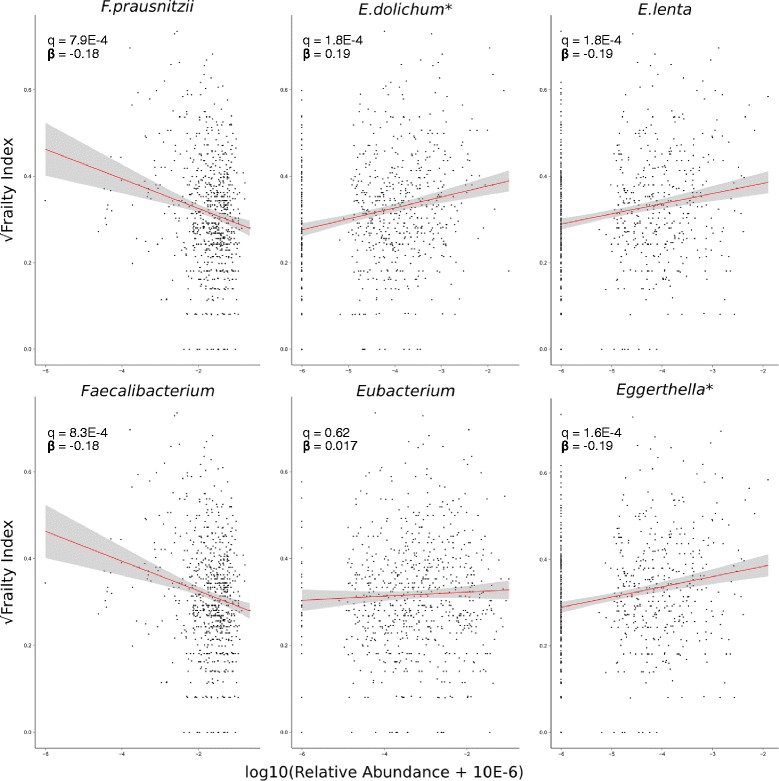
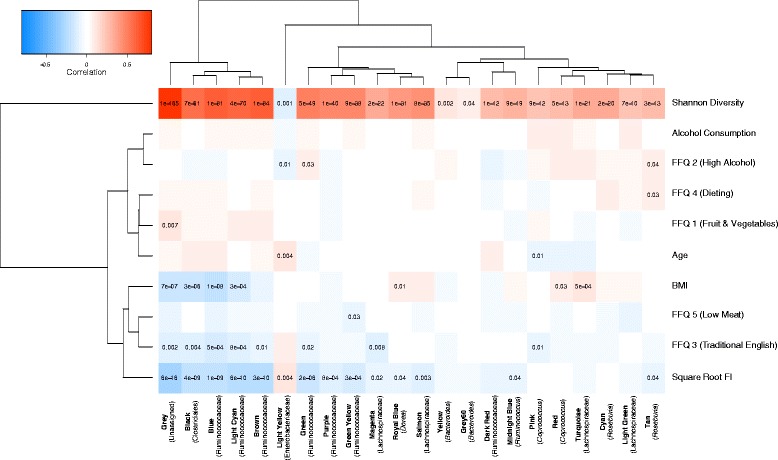
BACKGROUND: Frailty is arguably the biggest problem associated with population ageing, and associates with gut microbiome composition in elderly and care-dependent individuals. Here we characterize frailty associations with the gut microbiota in a younger community dwelling population, to identify targets for intervention to encourage healthy ageing. METHOD: We analysed 16S rRNA gene sequence data derived from faecal samples obtained from 728 female twins. Frailty was quantified using a frailty index (FI). Mixed effects models were used to identify associations with diversity, operational taxonomic units (OTUs) and taxa. OTU associations were replicated in the Eldermet cohort. Phenotypes were correlated with modules of OTUs collapsed by co-occurrence. RESULTS: Frailty negatively associated with alpha diversity of the gut microbiota. Models considering a number of covariates identified 637 OTUs associated with FI. Twenty-two OTU associations were significant independent of alpha diversity. Species more abundant with frailty included Eubacterium dolichum and Eggerthella lenta. A Faecalibacterium prausnitzii OTU was less abundant in frailer individuals, and retained significance in discordant twin analysis. Sixty OTU associations were replicated in the Eldermet cohort. OTU co-occurrence modules had mutually exclusive associations between frailty and alpha diversity. CONCLUSIONS: There was a striking negative association between frailty and gut microbiota diversity, underpinned by specific taxonomic associations. Whether these relationships are causal or consequential is unknown. Nevertheless, they represent targets for diagnostic surveillance, or for intervention studies to improve vitality in ageing.
Overview
The claims and statistics of this paper haven’t been checked yet.
Free: it reads the open-access text and checks the first 5 claims that cite a source we can check. Create a free account to check every claim.
Integrity signals
Registry
Cites
Statistics
Figures
Verification
Claims the paper makes
The claims and statistics of this paper haven’t been checked yet.
Free: it reads the open-access text and checks the first 5 claims that cite a source we can check. Create a free account to check every claim.
Claims other papers make about this one
Each is checked against this paper’s own text: does it say what the citing paper says it does?
The cited source says what the claim attributes to it.
In the citing paper
“Namely, frailty was associated with reduced microbiota biodiversity, and lower representation of butyrate-producing bacteria.”
From Gut Microbiota, Muscle Mass and Function in Aging: A Focus on Physical Frailty and Sarcopenia (2019) · cites this paper as [115]
In the citing paper
“Frailty was also associated with reduced abundance of bacteria known for their anti-inflammatory properties, such as Faecalibacterium prausnitzii, and overexpression of other species, including Eubacterium, Eggerthella, Ruminococcus and Coprobacillus [115,116].”
From Gut Microbiota, Muscle Mass and Function in Aging: A Focus on Physical Frailty and Sarcopenia (2019) · cites this paper as [115]
In the citing paper
“In large population studies conducted on both fit community-dwellers and frail nursing home residents, frailty was associated with reduced biodiversity of the fecal microbiota, that was partly dependent on different dietary patterns [114,115].”
From Gut Microbiota, Muscle Mass and Function in Aging: A Focus on Physical Frailty and Sarcopenia (2019) · cites this paper as [115]
Self-check
Percentages, sums and reported differences re-computed from the paper’s own numbers.
The self-check needs the paper’s full text.
Citations
Cites
Moderated estimation of fold change and dispersion for RNA-seq data with DESeq2
Love, M. I., Huber, W., & Anders, S. (2014) · Genome Biology · doi:10.1186/s13059-014-0550-8 · Cited by 95,106
Fitting Linear Mixed-Effects Models Using lme4
Bates, D., Mächler, M., Bolker, B., & Walker, S. (2015) · Journal of Statistical Software · doi:10.18637/jss.v067.i01 · Cited by 86,835
QIIME allows analysis of high-throughput community sequencing data
Caporaso, J. G., Kuczynski, J., Stombaugh, J., Bittinger, K., Bushman, F. D., Costello, E. K., Fierer, N., Peña, A. G., Goodrich, J. K., Gordon, J. I., et al. (2010) · Nature Methods · doi:10.1038/nmeth.f.303 · Cited by 34,887 · cited 1×
“Quality filtering and phylogenetic analysis was performed using QIIME 1.7.0 [20].”
InfluentialSelf-citationWGCNA: an R package for weighted correlation network analysis
Langfelder, P., & Horvath, S. (2008) · BMC Bioinformatics · doi:10.1186/1471-2105-9-559 · Cited by 27,252
Frailty in Older Adults: Evidence for a Phenotype
Fried, L. P., Tangen, C. M., Walston, J., Newman, A. B., Hirsch, C., Gottdiener, J., Seeman, T., Tracy, R., Kop, W. J., Burke, G., et al. (2001) · The Journals of Gerontology Series A: Biological Sciences and Medical Sciences · doi:10.1093/gerona/56.3.m146 · Cited by 24,907
Welch, P. (1967) · IEEE Transactions on Audio and Electroacoustics · doi:10.1109/tau.1967.1161901 · Cited by 12,277
Structure, function and diversity of the healthy human microbiome
The Human Microbiome Project Consortium (2012) · Nature · doi:10.1038/nature11234 · Cited by 11,726 · cited 1×
“It is highly variable between individuals [6], with substantial heritable elements [7], and relatively stable within a healthy adult over time [8].”
Diet rapidly and reproducibly alters the human gut microbiome
David, L. A., Maurice, C. F., Carmody, R. N., Gootenberg, D. B., Button, J. E., Wolfe, B. E., Ling, A. V., Devlin, A. S., Varma, Y., Fischbach, M. A., et al. (2014) · Nature · doi:10.1038/nature12820 · Cited by 10,100 · cited 1×
“This could be achieved through lifestyle interventions to alter factors known to influence diversity, such as diet [32, 33].”
A global clinical measure of fitness and frailty in elderly people
Rockwood, K. (2005) · Canadian Medical Association Journal · doi:10.1503/cmaj.050051 · Cited by 8,968 · cited 1×
“The FI followed the expected gamma distribution (Additional file 2: Figure S2) [18], had a mean of 0.116, with 103 pre-frail individuals (FI >0.20) [27].”
InfluentialA core gut microbiome in obese and lean twins
Turnbaugh, P. J., Hamady, M., Yatsunenko, T., Cantarel, B. L., Duncan, A., Ley, R. E., Sogin, M. L., Jones, W. J., Roe, B. A., Affourtit, J. P., et al. (2009) · Nature · doi:10.1038/nature07540 · Cited by 7,823
Self-citation
Cited by
Items 401–469 of 469
Dietary Protein and Muscle in Aging People
Cesari, M., & Marzetti, E. (2018) · MDPI eBooks · doi:10.3390/books978-3-03897-458-1
Liu, Y., Zhang, C., Zhang, Y., Pang, J., Zhang, J., Li, J., Shi, H., He, X., Kang, Y., & Shen, J. (2026) · The journal of nutrition health & aging · doi:10.1016/j.jnha.2026.100945
Sadoughi, B. (2023) · eDiss (Georg-August-Universität Göttingen) · doi:10.53846/goediss-10248
Lee, S. Y. (2020) · DR-NTU (Nanyang Technological University) · doi:10.32657/10356/136835
The connection between diet, gut microbes, and cognitive decline
Kumar, A., Singh, S., & Chaurasia, R. N. (2022) · Elsevier eBooks · doi:10.1016/b978-0-12-822238-6.00006-6
Siow, T. Y., Wong, A. M., Fang, J., Chiu, C., Yeh, Y., Cheng, M., Lo, C.-J., Lin, S.-N., Lin, C., & Toh, C. (2026) · Communications Medicine · doi:10.1038/s43856-026-01566-x
Associação entre microbioma intestinal e ocorrência de delirium em idosos agudamente enfermos
Carvalho, F. B. G. (2021) · Digital Library of Theses and Dissertations (Universidade de São Paulo) · doi:10.11606/t.5.2021.tde-09082021-085157
Targeting pathological changes in the gut protects the CNS from neuropathology.
Charpentier, B. (2022) · ThinkIR: The University of Louisville's Institutional Repository (University of Louisville) · doi:10.18297/etd/3966
Microbiota and Aging Solutions
Sobti, R. C., Negi, R. K., & Rana, A. (2026) · Springer eBooks · doi:10.1007/978-981-95-9031-5_5
The microbiome-gut-brain axis: a new perspective on the pathogenesis and intervention of frailty
Su, Q., & 牛慧彦 (2026) · Frontiers in Cellular and Infection Microbiology · doi:10.3389/fcimb.2026.1859069
Barry, D., Farragher, J. B., Betik, A. C., Fyfe, J. J., Convit, L., & Cooke, M. B. (2024) · Figshare · doi:10.6084/m9.figshare.25770492
Barry, D., Farragher, J. B., Betik, A. C., Fyfe, J. J., Convit, L., & Cooke, M. B. (2024) · Figshare · doi:10.6084/m9.figshare.25770411
Barry, D., Farragher, J. B., Betik, A. C., Fyfe, J. J., Convit, L., & Cooke, M. B. (2024) · Figshare · doi:10.6084/m9.figshare.26717271
Ghosh, T. S., Shanahan, F., & O’Toole, P. W. (2024) · Elsevier eBooks · doi:10.1016/b978-0-323-99971-7.00005-9
Self-citationMora-Ortiz, M., Ibraheim, H., Kottoor, S. H., Bowyer, R. C. E., Metrustry, S., Sanderson, J. D., Powell, N., Spector, T. D., Small, K. S., & Steves, C. J. (2020) · Wellcome Open Research · doi:10.12688/wellcomeopenres.15632.1
Self-citationMicrobiota–brain interactions in aging and neurodegeneration
Foster, J. A., & Clarke, G. A. (2024) · Elsevier eBooks · doi:10.1016/b978-0-12-814800-6.00009-1
Nuță, C. R., Băjenaru, L., Sovarel, A. M. M., & Băjenaru, O. L. (2026) · Applied Biosciences · doi:10.3390/applbiosci5040089
Keebaugh, E. S., Williams, L. D., & Ja, W. W. (2019) · Springer eBooks · doi:10.1007/978-3-030-28737-5_12
Nikhra, V. (2019) · Current Trends in Biomedical Engineering & Biosciences · doi:10.19080/ctbeb.2019.19.556003
Du besoin de revisiter l’ostéosarcopénie par l’apport du microbiote intestinal
Cailleaux, P. (2025) · Revue du Rhumatisme · doi:10.1016/j.rhum.2025.11.004
Meza, J., Mejia, I. I., Noyola-Villalobos, H. F., Vargas-Hernández, M. A., & Ibarra, A. (2025) · Gaceta Médica de México · doi:10.24875/gmm.25000049
The role of probiotics on slowing down the aging process [pdf]
Şanlıbaba, P., Toprak, Z. T., & TEZEL, B. U. (2022) · Acta Scientiarum Polonorum Technologia Alimentaria · doi:10.17306/j.afs.2022.1013
Gu, Y., Li, L., Zhang, H. S., Ye, T., Zhu, Q., Zhao, X., Xie, K., Ge, R., Han, J., & Qin, Y. (2026) · Food & Function · doi:10.1039/d6fo00039h
Boone, A. W. (2018) · NC Digital Online Collection of Knowledge and Scholarship (The University of North Carolina at Greensboro)
Mingyan, L., & Wang, Z. (2026) · Healthcare · doi:10.3390/healthcare14131896
She, X., Yang, H., Zhao, X., & Yang, L. (2026) · Journal of Clinical Medicine · doi:10.3390/jcm15197514
Physical activity regulates the intestinal microbiota composition
Jurdana, M., & Barlič‐Maganja, D. (2019) · Annales Kinesiologiae · doi:10.35469/ak.2019.185
Suri, M. (2021) · MOJ Gerontology & Geriatrics · doi:10.15406/mojgg.2021.06.00269
Cosquer, G. L., Gilletta, C., Kochar, B. D., Ananthakrishnan, A. N., & Buisson, A. (2026) · Inflammatory Bowel Diseases · doi:10.1093/ibd/izag031
Ageing-related bacterial features in different segments of the mice gastrointestinal tractPreprint
Zhou, Q., Sun, L., Li, L., Gong, H., Zhang, Y., Chen, C., Li, J., & Yang, Z. (2019) · Research Square · doi:10.21203/rs.2.13401/v1
Hussien, H., Nastasa, A., Apetrii, M., Nistor, I., Petrovic, M., & Covic, A. (2021) · Figshare · doi:10.6084/m9.figshare.14863636
Hussien, H., Nastasa, A., Apetrii, M., Nistor, I., Petrovic, M., & Covic, A. (2021) · Figshare · doi:10.6084/m9.figshare.14863633
Examination of the impact of environmental and dietary exposures on the health of Puerto Ricans
Wurth (2017) · Digital Repository Service (Northeastern University) · doi:10.17760/d20285525
Gut microbiota characteristics in patients with inguinal hernia: a prospective observational study
Jin, Z., Li, L., & Li, B. (2026) · Hernia · doi:10.1007/s10029-026-03888-0
Huang, C., Lu, I.-C., Lin, C., Hsieh, M.-T., Chiang, I.-H., Lai, P.-H., Liu, I.-T., & Chen, J. (2026) · GeroScience · doi:10.1007/s11357-026-02376-8
Lactoferrin and Healthy Aging: Gut, Immune, Iron, and Mitochondrial Mechanisms
Evans, C., Naddafha, S., & Peterson, R. (2026) · Nutrients · doi:10.3390/nu18203319
1) Gut Microbiota and Lifestyle-related Diseases: Prospects for Prevention and Treatment
Naito, Y., Takagi, T., & Matoba, S. (2024) · Nihon Naika Gakkai Zasshi · doi:10.2169/naika.113.355
Liu, X., Zou, Y., Zhang, Y., Liu, L., Duan, Y., Zhang, A., Zhang, X. Y., Zhang, R., Zhao, B., Li, X., et al. (2021) · Figshare · doi:10.6084/m9.figshare.16960673
Does Dysbiosis Play a Role in Age-Related Hearing Impairment?
Cherny, S. S., Livshits, G., Freidin, M. B., Wadge, S., Nessa, A., & Williams, F. M. K. (2023) · The Hearing Journal · doi:10.1097/01.hj.0000997252.36683.93
Fasano, A. (2020) · Faculty Opinions – Post-Publication Peer Review of the Biomedical Literature · doi:10.3410/f.729075020.793570036
Ruiz‐Rico, M., Ye, H., & O’Toole, P. W. (2026) · Journal of Agriculture and Food Research · doi:10.1016/j.jafr.2026.103164
Self-citationThe interplay between microbial dysbiosis and immune dysfunction with age
Thevaranjan, N. (2016) · MacSphere (McMaster University) · doi:10.71548/20561
Gastrointestinal microbiome: The two-way communication within us
Kaur, D., Narang, P. K., & Goyal, B. (2026) · Journal of Applied Biology & Biotechnology · doi:10.7324/jabb.2026.270878
The Application of Metabolomics in Frailty: Trends, Challenges, and Future Directions
Fang, K., Niu, B., Zhang, Z., Jiang, Y., Zhao, Y., & Wang, Z. (2026) · Metabolites · doi:10.3390/metabo16060380
Intake of Live Microorganisms in Adults and Its Impact on Microbiota and Health Parameters
Gómez-Pérez, E., Zapico, A., Arboleya, S., Salazar, N., Reyes‐Gavilán, C. G. D. L., González, S., & Gueimonde, M. (2026) · Fermentation · doi:10.3390/fermentation12070308
[Research progress on the correlation between cirrhosis and frailty].
Zhao, Y. F., Zheng, M., Zhu, H. L., & Yang, J. (2023) · PubMed Central · doi:10.3760/cma.j.cn501113-20221229-00614
Zhang, P., Shao, L., Zhang, J., Wang, L., Yuan, H., Pang, X., Fan, G., Peng, L., Guanghan, K. A. N., 李文炯, et al. (2021) · Research Square · doi:10.21203/rs.3.rs-142735/v1
Giron, M., Thomas, M., Jarzaguet, M., Mayeur, C., Ferrere, G., Noordine, M.-L., Bornes, S., Dardevet, D., Chassard, C., & Savary-Auzeloux, I. (2022) · doi:10.3389/fnut.2022.928798.s001
Edwards, H. (2023) · ThinkTech (Texas Tech University)
Microbiota in development and stress management
Murphy, A. (2021) · Arrow@dit (Dublin Institute of Technology)
Sepp, E., Smidt, I., Rööp, T., Štšepetova, J., Kõljalg, S., Mikelsaar, M., Soidla, I., Ainsaar, M., Kolk, H., Vallas, M., et al. (2022) · doi:10.3389/fcimb.2022.851404.s002
Structural basis of anaphylatoxin receptor activation and signaling bias
Yadav, R., Yadav, M. K., Maharana, J., Saha, S., Sarma, P., Banerjee, R., Shukla, A. K., & Gati, C. (2024) · Biophysical Journal · doi:10.1016/j.bpj.2023.11.240
Zhu, H., Deuser, J. T., Stern, T., & O’Shaughnessy, B. (2024) · Biophysical Journal · doi:10.1016/j.bpj.2023.11.3330
Bray, M. B., Mishra, P., Solieva, S. O., Kelly, D. G., Woodward, C. H., Park, J., & Bowman, G. R. (2026) · Biophysical Journal · doi:10.1016/j.bpj.2025.11.368
Comparison of oral and gut microflora in octogenarians and centenarians in relation to independence
Ma, X. (2022) · Institutional Repositories DataBase (IRDB)
Chronic diarrhoea in older adults: prevalence and dietary solutions
O’Brien, L. (2024) · Otago University Research Archive (University of Otago)
Sruthi, K., Parbhankar, K., Gupta, U., & Maurya, S. (2026) · Journal of Ayurveda and Integrated Medical Sciences · doi:10.21760/jaims.10.12.34
Assoziation zwischen dem menschlichen Mikrobiom und Gebrechlichkeit
Frommhagen, K. (2024) · MACAU: Open Access Repository of Kiel University (University Library Kiel)
Late-life depletion of the gut microbiome attenuates aging-induced frailty in male mice
Chandra, F., Olson, C. A., Lum, G. R., Ha, S. M., Liberty, N., Paramo, J., Yang, X., & Hsiao, E. Y. (2026) · Gut Microbes Reports · doi:10.1080/29933935.2026.2763224
Li, S., Chen, M., Yang, H., Zhao, X., Tian, Y., Cheng, Y., Wu, Q., Feng, Y., Chen, L., Yi, A., et al. (2026) · International Journal of Molecular Sciences · doi:10.3390/ijms272110043
The Fountain of Youth: Gut Microbiome and Its Role in Healthy Aging
Ross, S. M. (2023) · Holistic Nursing Practice · doi:10.1097/hnp.0000000000000585
Hay, M. C., Hinsu, A. T., Koringa, P. G., Pandit, R. J., Liu, P.-Y., Parekh, M. J., Jakhesara, S. J., Dai, X., Crotta, M., Fosso, B., et al. (2023) · doi:10.3389/frmbi.2023.1301609.s001
Metadata
- Authors
- Jackson, M. A., Jeffery, I. B., Beaumont, M., Bell, J. T., Clark, A. G., Ley, R. E., O’Toole, P. W., Spector, T. D., & Steves, C. J.
- Affiliations
- St Thomas' Hospital (GB)
- University College Cork (IE)
- Cornell University (US)
- Corresponding author
- Steves, Claire J.
- ORCID
- Venue
- Genome Medicine
- Published
- 2016-01-29
- Volume
- 8
- Issue
- 1
- Pages
- 8-8
- ISSN
- 1756-994X (ISSN-L)
- PMC
- PMC4731918
- OpenAlex
- W2263333073
- Cited by
- 436
- References
- 47
- Citations by year
- 2026: 27 · 2025: 28 · 2024: 47 · 2023: 54 · 2022: 53 · 2021: 61 · 2020: 38 · 2019: 42 · 2018: 41 · 2017: 33 · 2016: 11
- FWCI
- 21.99
- Type
- journal article
- Language
- en
- Update notices
- correction (2016-02-17)
- Open access
- gold
- doi.org
- Licence
- cc-by
- creativecommons.org/licenses/by/4.0/ (tdm)
- creativecommons.org/licenses/by/4.0/ (vor)
- Locations
- Genome Medicine (publishedVersion, cc-by)
- PubMed Central (publishedVersion, cc-by)
- PubMed (publishedVersion)
- Cork Open Research Archive (University College Cork, Ireland) (acceptedVersion, cc-by)
- Arrow@dit (Dublin Institute of Technology) (submittedVersion, cc-by)
- Cork Open Research Archive (University College Cork, Ireland) (submittedVersion, cc-by)
- Research Portal (King's College London) (submittedVersion, cc-by)
- Funders
- National Institutes of Health (RO1 DK093595 DP2 OD007444)
- Wellcome Trust
- Seventh Framework Programme
- National Institute for Health Research
- Science Foundation Ireland
- Topics
- Life Sciences › Biochemistry, Genetics and Molecular Biology › Molecular Biology › Gut microbiota and health
- Health Sciences › Medicine › Geriatrics and Gerontology › Frailty in Older Adults
- Health Sciences › Dentistry › Periodontics › Oral microbiology and periodontitis research
- Keywords
- frailty, gut microbiota, frailty index, alpha diversity, operational taxonomic units, Eggerthella lenta, Faecalibacterium prausnitzii, healthy aging, community-dwelling older adults, fecal microbiota
- MeSH terms
- Gastrointestinal Microbiome, Adult, Aged, Aged, 80 and over, Aging, Bacteria, Feces, Female, Humans, Middle Aged, Phylogeny, Risk Factors, RNA, Ribosomal, 16S, Twins, Frail Elderly, Sequence Analysis, RNA
About these checks
Registry, retraction, Cites and statistics results are computed, not judged, with one exception: a printed reference that no index lists is read once by a model before it counts as a citation error. Claims are extracted by a model and kept only when their quote appears verbatim in the text; each cited source is then checked, with a model’s help, for whether it says what the claim relies on. Those verdicts can be wrong — read the claim’s quote and the cited source before relying on one.
Statistics and arithmetic are recomputed, not judged.
Confidence bands are shown only for fields calibrated on our annotated test set. None is calibrated yet, so no band is shown.
What counts as a claim ›How we measure confidence ›How we check this ›
Are you an author, or do you see a problem with this page? Request a review
Data sources
Bibliographic data: Semantic Scholar, OpenAlex, Crossref.
Contains information from the Semantic Scholar Academic Graph Datasets, made available under the ODC Attribution License (ODC-BY 1.0).
Semantic Scholar’s data is described in: Kinney, R., et al. (2023). The Semantic Scholar Open Data Platform. arXiv:2301.10140.
