

Frequent mutations in acetylation and ubiquitination sites suggest novel driver mechanisms of cancer
Open accessThe DOI matches its Crossref record; 80 of the 80 references it cites were found in a registry or an index.
Abstract
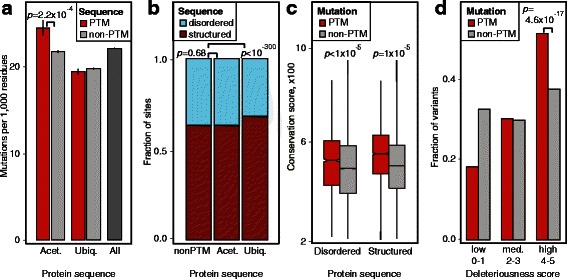
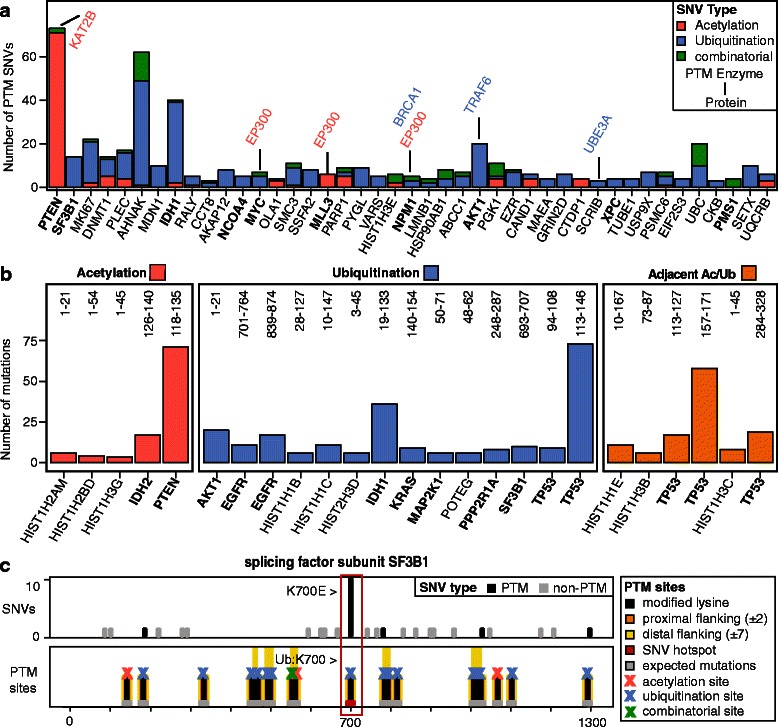
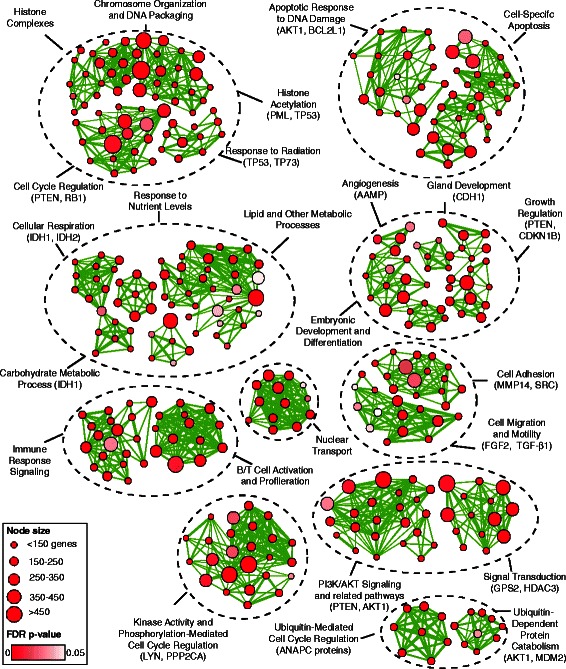
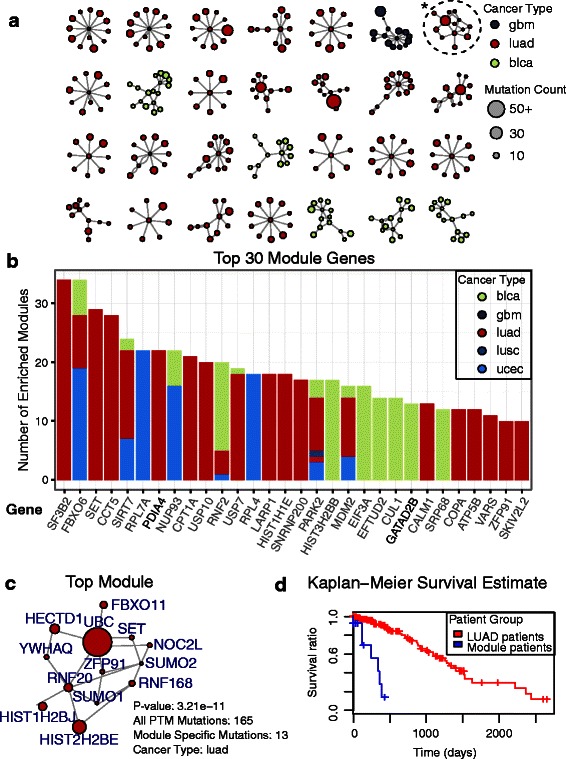
BACKGROUND: Discovery of cancer drivers is a major goal of cancer research. Driver genes and pathways are often predicted using mutation frequency, assuming that statistically significant recurrence of specific somatic mutations across independent samples indicates their importance in cancer. However, many mutations, including known cancer drivers, are not observed at high frequency. Fortunately, abundant information is available about functional "active sites" in proteins that can be integrated with mutations to predict cancer driver genes, even based on low frequency mutations. Further, considering active site information predicts detailed biochemical mechanisms impacted by the mutations. Post-translational modifications (PTMs) are active sites that are regulatory switches in proteins and pathways. We analyzed acetylation and ubiquitination, two important PTM types often involved in chromatin organization and protein degradation, to find proteins that are significantly affected by tumor somatic mutations. METHODS: We performed computational analyses of acetylation and ubiquitination sites in a pan-cancer dataset of 3200 tumor samples from The Cancer Genome Atlas (TCGA). These analyses were targeted at different levels of biological organization including individual genes, pathway annotated gene sets, and protein-protein interaction networks. RESULTS: Acetylation and ubiquitination site mutations are enriched in cancer with significantly stronger evolutionary conservation and accumulation in protein domains. Gene-focused analysis with the ActiveDriver method reveals significant co-occurrences of acetylation and ubiquitination PTMs and mutation hotspots in known oncoproteins (TP53, AKT1, IDH1) and highlights candidate cancer driver genes with PTM-related mechanisms (e.g. several histone proteins and the splicing factor SF3B1). Pathway analysis shows that PTM mutations in acetylation and ubiquitination sites accumulate in cancer-related processes such as cell cycle, apoptosis, chromatin regulation, and metabolism. Integrated mutation analysis of clinical information and protein interaction networks suggests that many PTM-specific mutations associate with decreased patient survival. CONCLUSIONS: Mutation analysis of acetylation and ubiquitination PTM sites reveals their importance in cancer. As PTM networks are increasingly mapped and related enzymes are often druggable, deeper investigation of specific associated mutations may lead to the discovery of treatment-relevant cellular mechanisms.
Overview
The claims and statistics of this paper haven’t been checked yet.
Free: it reads the open-access text and checks the first 5 claims that cite a source we can check. Create a free account to check every claim.
Integrity signals
Registry
Cites
Statistics
Figures
Verification
Claims the paper makes
The claims and statistics of this paper haven’t been checked yet.
Free: it reads the open-access text and checks the first 5 claims that cite a source we can check. Create a free account to check every claim.
Claims other papers make about this one
Each is checked against this paper’s own text: does it say what the citing paper says it does?
The source backs part of the claim, not all of it — or backs it for a different population, condition or comparison.
In the citing paper
“mutations at acetylation sites are commonly found in tumor tissues within key cellular pathways, such as the cell cycle, metabolism, and apoptosis [14].”
From Acetylation: a new target for protein degradation in cancer (2025) · cites this paper as [14]
Experimental — accuracy not yet measured
Self-check
Percentages, sums and reported differences re-computed from the paper’s own numbers.
The self-check needs the paper’s full text.
Citations
Cites
Hallmarks of Cancer: The Next Generation
Hanahan, D., & Weinberg, R. A. (2011) · Cell · doi:10.1016/j.cell.2011.02.013 · Cited by 66,590 · cited 2×
“These cancer driver events modify cellular pathways and provide cells with selective advantages such as uncontrolled growth, suppressed apoptosis, replicative immortality, and mobility [1].”
BackgroundCytoscape: A software Environment for integrated models of biomolecular interaction networks
Shannon, P., Markiel, A., Ozier, O., Baliga, N. S., Wang, J. T., Ramage, D., Amin, N., Schwikowski, B., & Ideker, T. (2003) · Genome Research · doi:10.1101/gr.1239303 · Cited by 51,888
Gene Ontology: tool for the unification of biology
Ashburner, M., Ball, C. A., Blake, J. A., Botstein, D., Butler, H., Cherry, J. M., Davis, A. P., Dolinski, K., Dwight, S. S., Eppig, J. T., et al. (2000) · Nature Genetics · doi:10.1038/75556 · Cited by 43,206 · cited 6×
“We studied biological processes from Gene Ontology [43], pathways from Reactome [44], and protein complexes from CORUM [45].”
MethodInfluentialANNOVAR: functional annotation of genetic variants from high-throughput sequencing data
Wang, K., Li, M., & Hakonarson, H. (2010) · Nucleic Acids Research · doi:10.1093/nar/gkq603 · Cited by 14,621 · cited 2×
“Chromosomal coordinates of mutations were converted to protein-level substitutions using the Annovar software [36] and filtered for the longest isoforms defined above.”
MethodThe Pfam Protein Families Database
Bateman, A. (2002) · Nucleic Acids Research · doi:10.1093/nar/30.1.276 · Cited by 14,000
A method and server for predicting damaging missense mutations.
Adzhubei, I. A., Schmidt, S., Peshkin, L., Ramensky, V. E., Gerasimova, A., Bork, P., Kondrashov, A. S., & Sunyaev, S. R. (2010) · Nature Methods · doi:10.1038/nmeth0410-248 · Cited by 13,194 · cited 1×
“We also scored PTM-related mutations by integrating results from five predictors of variant function (SIFT [56], PolyPhen2 [57], LRT [58], PhyloP [59], MutationTaster [60]), as collected by the Annovar software [36].”
MethodJenuwein, T., & Allis, C. D. (2001) · Science · doi:10.1126/science.1063127 · Cited by 9,756
Signatures of mutational processes in human cancer
Initiative, A. P. C. G., Alexandrov, L. B., ICGC Breast Cancer Consortium, ICGC MMML-Seq Consortium, PedBrain, I., Nik-Zainal, S., Wedge, D. C., Aparicio, S. A. J. R., Behjati, S., Biankin, A. V., et al. (2013) · Nature · doi:10.1038/nature12477 · Cited by 9,660 · cited 1×
“Such approaches are complicated by mutational heterogeneity, as mutation rates vary across genes, and nucleotide signatures [8, 10, 11], and are influenced by factors such as gene expression intensity [12], DNA replication timing [13], and chromatin organization [14].”
BackgroundThe cancer genome atlas pan-cancer analysis project
The Cancer Genome Atlas Research Network, Weinstein, J. N., Collisson, E. A., Mills, G. B., Shaw, K. R. M., Ozenberger, B. A., Ellrott, K., Shmulevich, I., Sander, C., & Stuart, J. M. (2013) · Nature Genetics · doi:10.1038/ng.2764 · Cited by 9,092 · cited 5×
“We retrieved the pre-processed pan-cancer dataset of somatic mutations in 3185 tumor samples curated by the TCGA for 12 different cancer types [5, 35] from the Synapse repository (ID syn1729383).”
BackgroundMethodInfluentialVogelstein, B., Papadopoulos, N., Velculescu, V. E., Zhou, S., Diaz, L. A., & Kinzler, K. W. (2013) · Science · doi:10.1126/science.1235122 · Cited by 7,863
Cited by
Mutations in Disordered Regions Can Cause Disease by Creating Dileucine Motifs
Meyer, K., Kirchner, M., Uyar, B., Cheng, J.-Y., Russo, G., Hernandez-Miranda, L. R., Szymborska, A., Zauber, H., Rudolph, I.-M., Willnow, T. E., et al. (2018) · Cell · doi:10.1016/j.cell.2018.08.019 · Cited by 132
“For each of these classes, the number of disease-causing variants and the number of polymorphisms that lead to a gain of SLiMs was counted and a two-sided Fisher’s Exact Test was applied to see if there is a statistically significant difference for the likelihood of a given class of SLiMs to be gained via disease-caus…”
InfluentialBioinformatics in translational drug discovery
Wooller, S. K., Benstead-Hume, G., Chen, X., Ali, Y., & Pearl, F. M. G. (2017) · Bioscience Reports · doi:10.1042/bsr20160180 · Cited by 149
Krassowski, M., Paczkowska, M., Cullion, K., Huang, T., Dzneladze, I., Ouellette, B. F. F., Yamada, J. T., Fradet-Turcotte, A., & Reimand, J. (2018) · Nucleic Acids Research · doi:10.1093/nar/gkx973 · Cited by 95
“To address this limitation, we developed the ActiveDriverDB database, a proteo-genomics resource for interpreting human genome variation using information on post-translational modification sites in proteins (24-27).”
BackgroundMethodSelf-citationModeling the process of human tumorigenesis
Balani, S., Nguyen, L. V., & Eaves, C. J. (2017) · Nature Communications · doi:10.1038/ncomms15422 · Cited by 86
Novel Serine 176 Phosphorylation of YBX1 Activates NF-κB in Colon Cancer
Martin, M., Hua, L., Wang, B., Han, W., Prabhu, L., Hartley, A.-V., Jiang, G., Liu, Y., & Lu, T. (2017) · Journal of Biological Chemistry · doi:10.1074/jbc.m116.740258 · Cited by 64
“PTM is one of the key approaches that mammalian cells use to control gene expression and cellular functions in a sophisticated manner (21, 22).”
BackgroundMuto, T., Guillamot, M., Yeung, J., Fang, J., Bennett, J. R., Nadorp, B., Lasry, A., Zea-Redondo, L., Choi, K., Gong, Y., et al. (2022) · Cell stem cell · doi:10.1016/j.stem.2021.12.007 · Cited by 62
“We utilized a focused shRNA library targeting regulators of ubiquitination and proteasomal function as dysregulation of these processes and somatic mutations at ubiquitin sites are frequently associated with blood cancer (Narayan et al., 2016)(Table S1).”
Mishra, D., Mishra, A., Nand, S., Vamanu, E., & Singh, M. P. (2023) · Diagnostics · doi:10.3390/diagnostics13050965 · Cited by 63
“Figure 3 (a) Biological Processes (BP) based on p-values drawn from Revigo in which the hub genes are enriched (b) KEGG pathways corresponding to the enrichment of hub genes based on p-values and fold change Epigenetic Regulation of Gene Expression of Hub Genes by Promoter Methylation Validation of promoter methylatio…”
MethodInfluentialAwan, F. M., Obaid, A., Ikram, A., & Janjua, H. A. (2017) · International Journal of Molecular Sciences · doi:10.3390/ijms18010139 · Cited by 65
“It is considered as the best characterized PTM after phosphorylation [39].”
BackgroundProteome-wide acetylation dynamics in human cells
Kori, Y., Sidoli, S., Yuan, Z., Lund, P. J., Zhao, X., & Garcia, B. A. (2017) · Scientific Reports · doi:10.1038/s41598-017-09918-3 · Cited by 59
Post-translational Modifications (PTMs), from a Cancer Perspective: An Overview
Sharma, B. S., Prabhakaran, V., Desai, A. P., Bajpai, J., Verma, R. J., & Swain, P. K. (2019) · Oncogen · doi:10.35702/onc.10012 · Cited by 49
“A recent study found 2106 acetylation-related single nucleotide variants (SNVs), 6405 ubiquitination-related SNVs, and 883 SNVs in shared sites of the two PTMs, covering cancer samples of various types, in this study, several known oncoproteins (TP53, AKT1 and IDH1) were shown to be modified for acetylation in cancer…”
BackgroundIntegrating molecular networks with genetic variant interpretation for precision medicine
Capriotti, E., Öztürk, K., & Carter, H. K. (2018) · WIREs Systems Biology and Medicine · doi:10.1002/wsbm.1443 · Cited by 45
“Frequent cancer mutations were reported at acetylation and ubiquitination sites as well (Narayan, Bader, & Reimand, 2016).”
BackgroundLeveraging protein dynamics to identify cancer mutational hotspots using 3D structures
Kumar, S., Clarke, D., & Gerstein, M. B. (2019) · Proceedings of the National Academy of Sciences · doi:10.1073/pnas.1901156116 · Cited by 37
“One potential remedy is to quantify recurrence over functional elements, such as posttranslational modification sites (27, 28) and protein interaction interfaces (30).”
Membrane localization of acetylated CNK1 mediates a positive feedback on RAF/ERK signaling
Fischer, A., Mühlhäuser, W. W. D., Warscheid, B., & Radziwill, G. (2017) · Science Advances · doi:10.1126/sciadv.1700475 · Cited by 38
“Mutants in acetylation sites occur frequently and are suggested as a driver mechanism of cancer (40).”
BackgroundProtein post-translational modifications and tumor immunity: A pan-cancer perspective
Zhang, H., Yan, Q., Jiang, S., Hu, D., Lu, P., Li, S., Sandai, D. A., Zhang, H., Zhang, W., & Zhu, C. (2025) · Physics of Life Reviews · doi:10.1016/j.plrev.2025.10.001 · Cited by 45
Krassowski, M., Pellegrina, D. V. D. S., Mee, M. W., Fradet‐Turcotte, A., Bhat, M., & Reimand, J. (2021) · Frontiers in Cell and Developmental Biology · doi:10.3389/fcell.2021.626821 · Cited by 32
“For example, the sequence motifs targeted by the ubiquitination system and controlling the degradation of cancer driver proteins are commonly affected by somatic mutations (Martínez-Jiménez et al., 2020; Narayan et al., 2016).”
BackgroundResultSelf-citationGenetic variants and protein–protein interactions: a multidimensional network-centric view
Laddach, A., Ng, J. C.-F., Chung, S. S., & Fraternali, F. (2018) · Current Opinion in Structural Biology · doi:10.1016/j.sbi.2017.12.006 · Cited by 25
Acetylation: a new target for protein degradation in cancer
Crawford, C. E. W., & Burslem, G. M. (2025) · Trends in Cancer · doi:10.1016/j.trecan.2025.01.013 · Cited by 20
Novel hypoxia-induced HIF-1αactivation in asthma pathogenesis
Wan, M., Yu, Q., Xu, F., You, L. X., Liang, X., Ren, K., & Zhou, J. (2024) · Respiratory Research · doi:10.1186/s12931-024-02869-0 · Cited by 23
“In the aforementioned experiment, it was demonstrated that the upregulation of HIF-1α could inhibit the expression of the P53 protein, but the mechanism by which where ubiquitination can regulate its biological function through promoting P53 degradation [64–66].”
BackgroundDecoding the functional impact of the cancer genome through protein–protein interactions
Fu, H., Mo, X., & Ivanov, A. A. (2025) · Nature reviews. Cancer · doi:10.1038/s41568-024-00784-6 · Cited by 41
“Mutations in structural domains, such as SLIMs or IDRs, can modulate PPIs by affecting domain–domain interactions, motif interactions, protein folding, protein stability or motifs involved in post-translational modifications (PTMs) 84,85 .”
Ju, M., Qi, A., Bi, J., Zhao, L., Jiang, L., Zhang, Q., Wei, Q., Guan, Q., Li, X., Wang, L., et al. (2020) · Journal of Cellular and Molecular Medicine · doi:10.1111/jcmm.15270 · Cited by 19
Xiang, Z., Hou, G., Zheng, S., Lu, M., Li, T., Lin, Q., Liu, H., Wang, X., Guan, T., Wei, Y., et al. (2024) · Proceedings of the National Academy of Sciences · doi:10.1073/pnas.2403038121 · Cited by 23
“Gene - focused analysis using the ActiveDriver method has revealed significant co - occurrence of acetylation and ubiquitination posttranslational modifications (PTMs) and mutation hotspots in known oncoproteins (e.g., TP53, AKT1, and IDH1) ( 57 ).”
Vellosillo, P., & Mínguez, P. (2021) · iScience · doi:10.1016/j.isci.2021.102917 · Cited by 18
The importance of protein domain mutations in cancer therapy
Chitluri, K. K., & Emerson, I. A. (2024) · Heliyon · doi:10.1016/j.heliyon.2024.e27655 · Cited by 18
“These PTM mutations disrupt the control of protein deterioration, causing a buildup of oncogenic proteins that aid in the development of cancer [102].”
BackgroundIsotopic Labeling and Quantitative Proteomics of Acetylation on Histones and Beyond
Lund, P. J., Kori, Y., Zhao, X., Sidoli, S., Yuan, Z., & Garcia, B. A. (2019) · Methods in molecular biology · doi:10.1007/978-1-4939-9232-4_5 · Cited by 17
Zhang, Z., Wen, B., Li, D., Deng, D.-X., Wu, X., Cheng, Y., Liao, L., Long, L., Dong, G., Xu, L., et al. (2022) · The International Journal of Biochemistry & Cell Biology · doi:10.1016/j.biocel.2022.106188 · Cited by 14
Crotonylation of IDH1 alleviates MASLD progression by enhancing the TCA cycle
Liu, S., Ji, Y., Wei, L., Zhang, Y., Zeng, L., Min, Y., Yin, D., Liu, K., Guan, C., Liu, S., et al. (2025) · Nature Communications · doi:10.1038/s41467-025-62731-9 · Cited by 15
“We are also aware that K58, K151, K212 and K345 have been described previously as ubiquitylated (K58 and K345 are also acetylated and K151 is also SUMOylated) by proteomicstudies, though their functions have not been characterized 43,45 .”
Zhang, T., Wang, B., Gu, B., Su, F., Xiang, L., Liu, L., Li, X., Wang, X., Gao, L., & Chen, H. (2022) · Journal of Oncology · doi:10.1155/2022/3938652 · Cited by 17
“Genes do not function in isolation, and previous studies have shown the collaboration between HAT and HDAC genes in the context of cancer [1, 24].”
BackgroundResultUtkarsh, K., Kumar, A., Aditi, Khan, A. U., Nayyar, A., Haque, S., & Iqbal, S. I. (2022) · Genes & Diseases · doi:10.1016/j.gendis.2022.07.004 · Cited by 14
“According to a recent study, 6405 ubiquitination-related SNVs, 2106 acetylation-related single nucleotide variants, and 883 SNVs in shared sites of the two PTMs were discovered in the cancer samples of various types.(124) In this study, oncoproteins like TP53, AKT1, and IDHI were found to be modified for acetylation i…”
BackgroundPeng, D., Li, H., Hu, B., Zhang, H., Chen, L., Lin, S., Zuo, Z., Xue, Y., Ren, J. M., & Xie, Y. (2020) · Frontiers in Cell and Developmental Biology · doi:10.3389/fcell.2020.593661 · Cited by 13
“…instance, ActiveDriver revealed a set of candidate cancer driver genes harboring mutation hotspots proximal to known phosphorylation, acetylation and ubiquitination sites that may cause the dysfunction of PTM-related mechanisms (Reimand and Bader, 2013; Reimand et al., 2013; Narayan et al., 2016).”
BackgroundShi, S., Wang, L., Cao, M., Chen, G., & Yu, J. (2018) · Briefings in Bioinformatics · doi:10.1093/bib/bby036 · Cited by 9
Martín-Bernabé, A., Tarragó‐Celada, J., Cunin, V., Michelland, S., Cortés, R., Poignant, J., Boyault, C., Rachidi, W., Bourgoin‐Voillard, S., Cascante, M., et al. (2021) · International Journal of Molecular Sciences · doi:10.3390/ijms22073378 · Cited by 8
“Indeed, protein acetylation and ubiquitination sites have now been considered cancer driver mechanisms per se [56].”
BackgroundZhou, X., Sang, X., Jiang, L., Zhang, S., Jiang, C., Gu, Y., Fu, Y., Yang, G., Zhang, J. Q., Chi, H., et al. (2025) · Discover Oncology · doi:10.1007/s12672-025-02617-w · Cited by 10
“Studies have shown that alterations in acetylation levels in cancer cells are often correlated with poor clinical prognosis, and mutations in certain acetylation sites may contribute to cancer progression and chemotherapy resistance [13, 14].”
Deng, L., Zhu, F., He, Y., & Meng, F. (2022) · Expert Systems with Applications · doi:10.1016/j.eswa.2022.118593 · Cited by 6
Pan, Y., Yan, C., Hu, Y., Fan, Y., Pan, Q., Wan, Q., Torcivia-Rodriguez, J., & Mazumder, R. (2017) · Scientific Reports · doi:10.1038/srep42169 · Cited by 6
Zhang, N., Dong, L., Ning, T., Du, F., Zhao, M., Xu, J., Xie, S.-A., Liu, S., Sun, X., Li, P., et al. (2024) · Oncogenesis · doi:10.1038/s41389-024-00514-5 · Cited by 7
“Collectively, these fi ndings imply that RIOK3 plays a pivotal role in mediating the maintenance of redox balance and regulation of ROS levels in colon cancer cells through HSP90 α - and IDH1-dependent mechanisms.”
BackgroundWang, C., Jiang, Q., Yu, D., Guan, J., Chen, Z., Lu, X., Yan, B., Qin, J., Liu, Y., & Wang, J. (2026) · Briefings in Bioinformatics · doi:10.1093/bib/bbag321 · Cited by 5
“For example, aberrant acetylation and ubiquitination contribute to tumor progression in cancer [ 6], while defective hydroxylation impairs cardiovascular function [ 7, 8].”
Singleton mutations in large-scale cancer genome studies: uncovering the tail of cancer genome
Desai, S., Ahmad, S., Bawaskar, B., Rashmi, S., Mishra, R., Lakhwani, D., & Dutt, A. (2024) · NAR Cancer · doi:10.1093/narcan/zcae010 · Cited by 4
“These methods are built upon diverse layers of biological information, including enrichment in post-translational modifications ( 55 ,56 ), 3D geometric structures ( 57–59 ), cell signaling pathways ( 56 , 60–62 ), interaction interfaces ( 58 , 63 ) and protein networks ( 60 , 61 , 64 ).”
MethodThe language of posttranslational modifications and deciphering it from proteomics data
Aggarwal, S., Gupta, P., Dhawan, U., & Yadav, A. K. (2023) · Elsevier eBooks · doi:10.1016/b978-0-323-99521-4.00012-x · Cited by 4
Merico, D. (2016) · LymphoSign Journal · doi:10.14785/lymphosign-2016-0011 · Cited by 4
Overexpressed somatic alleles are enriched in functional elements in Breast Cancer
Restrepo, P., Movassagh, M., Alomran, N., Miller, C., Li, M., Trenkov, C., Manchev, Y. T., Bahl, S., Warnken, S., Spurr, L. F., et al. (2017) · Scientific Reports · doi:10.1038/s41598-017-08416-w · Cited by 3
Integrating Clinical Cancer and PTM Proteomics Data Identifies a Mechanism of ACK1 Kinase Activation
Balasooriya, E. R., Madhusanka, D., López-Palacios, T. P., Eastmond, R. J., Jayatunge, D., Owen, J. J., Gashler, J. S., Egbert, C. M., Bulathsinghalage, C., Liu, L., et al. (2023) · Molecular Cancer Research · doi:10.1158/1541-7786.mcr-23-0153 · Cited by 3
“Approaching this problem from the perspective of PTMs disrupted by disease-associated mutations has the potential of narrowing the focus further to quickly identify functional and perhaps targetable PTM signaling nodes (62, 91).”
Mostert, D., Bubeneck, W. A., Rauh, T., Kielkowski, P., Itzen, A., Jung, K., & Sieber, S. A. (2024) · Biochemistry · doi:10.1021/acs.biochem.3c00568 · Cited by 3
Genetic Contexts Characterize Dynamic Histone Modification Patterns Among Cell Types
Lin, Y., Li, Y., Zhu, X., Huang, Y., Li, M., & Li, M. (2019) · Interdisciplinary Sciences Computational Life Sciences · doi:10.1007/s12539-019-00338-7 · Cited by 2
Loss of conserved ubiquitylation sites in conserved proteins during human evolution
Park, D., Goh, C. J., Kim, H., Lee, J. H., & Hahn, Y. (2018) · International Journal of Molecular Medicine · doi:10.3892/ijmm.2018.3772 · Cited by 3
Zhang, J., Zhang, C., Jiang, H., Jiang, H., & Yuan, Y. (2021) · Frontiers in Oncology · doi:10.3389/fonc.2021.647221 · Cited by 1
The Role of Post-Translational Modifications in Cancer
Cohen, C., Lewis, T. R., & Wang, R. E. (2022) · Springer eBooks · doi:10.1007/978-3-030-80962-1_288-1 · Cited by 1
Assessing the Functional Properties of the TMCO1 Sequence Variants by Using In Silico Analyses
Pirim, D., Ulusoy, E., Kurt, Z. A., Kaya, N., & Uz, E. (2019) · Düzce Üniversitesi Bilim ve Teknoloji Dergisi · doi:10.29130/dubited.571528
Kaushik, A. C., & Sahi, S. (2021) · Elsevier eBooks · doi:10.1016/b978-0-12-821748-1.00007-5
Chernapalli, V., Komanduri, M., & Sabbella, S. (2017) · Research Journal of Life Sciences Bioinformatics Pharmaceutical and Chemical Sciences · doi:10.26479/2017.0205.17
Tupchi, F., Farrokh, P., & Lashkarbolouki, T. (2025) · Indian Journal of Clinical Biochemistry · doi:10.1007/s12291-025-01333-0
The Role of Post-translational Modifications in Cancer
Cohen, C., Lewis, T. R., & Wang, R. E. (2025) · Springer eBooks · doi:10.1007/978-3-032-00773-5_288
A proteomic approach for understanding the metabolic adaptations in non-small cell lung cancer
Martín-Bernabé, A. (2018) · theses.fr (ABES) · doi:10.70675/426e7b40z057az4326z8cfez7da3a5c12c7e
Outissint, I., Pan, H., Lu, P., Tang, M., & Gong, X. (2026) · Pathology - Research and Practice · doi:10.1016/j.prp.2026.156485
Metadata
- Authors
- Narayan, S., Bader, G. D., & Reimand, J.
- Affiliations
- University of Toronto (CA)
- Ontario Institute for Cancer Research (CA)
- Corresponding author
- Bader, Gary D.
- Reimand, Jüri
- Venue
- Genome Medicine
- Published
- 2016-05-12
- Volume
- 8
- Issue
- 1
- Pages
- 55-55
- ISSN
- 1756-994X (ISSN-L)
- PMC
- PMC4864925
- OpenAlex
- W2352710988
- Cited by
- 54
- References
- 80
- Citations by year
- 2026: 2 · 2025: 7 · 2024: 6 · 2023: 3 · 2022: 6 · 2021: 5 · 2020: 3 · 2019: 5 · 2018: 6 · 2017: 10 · 2016: 1
- FWCI
- 3.05
- Type
- journal article
- Language
- en
- Open access
- gold
- doi.org
- Licence
- cc-by
- Locations
- Genome Medicine (publishedVersion, cc-by)
- PubMed Central (publishedVersion, cc-by)
- PubMed (publishedVersion)
- TSpace (University of Toronto) (submittedVersion)
- Funders
- Canadian Institutes of Health Research (MOP-84324)
- Topics
- Life Sciences › Biochemistry, Genetics and Molecular Biology › Cancer Research › Cancer Genomics and Diagnostics
- Life Sciences › Biochemistry, Genetics and Molecular Biology › Molecular Biology › Chromatin Remodeling and Cancer
- Life Sciences › Biochemistry, Genetics and Molecular Biology › Genetics › Genomics and Rare Diseases
- Keywords
- cancer driver genes, somatic mutations, acetylation sites, ubiquitination sites, post-translational modification, mutational hotspots, histone acetylation, SF3B1, TP53, AKT1, IDH1, chromatin regulation, protein-protein interaction network, patient survival, pan-cancer analysis
- MeSH terms
- Acetylation, Humans, Mutation, Neoplasm Proteins, Neoplasms, Protein Processing, Post-Translational, Survival Analysis, Computational Biology, Genetic Predisposition to Disease, Databases, Genetic, Gene Regulatory Networks, Ubiquitination, Mutation Rate, Protein Interaction Maps
About these checks
Registry, retraction, Cites and statistics results are computed, not judged, with one exception: a printed reference that no index lists is read once by a model before it counts as a citation error. Claims are extracted by a model and kept only when their quote appears verbatim in the text; each cited source is then checked, with a model’s help, for whether it says what the claim relies on. Those verdicts can be wrong — read the claim’s quote and the cited source before relying on one.
Statistics and arithmetic are recomputed, not judged.
Confidence bands are shown only for fields calibrated on our annotated test set. None is calibrated yet, so no band is shown.
What counts as a claim ›How we measure confidence ›How we check this ›
Are you an author, or do you see a problem with this page? Request a review
Data sources
Bibliographic data: Semantic Scholar, OpenAlex, Crossref.
Contains information from the Semantic Scholar Academic Graph Datasets, made available under the ODC Attribution License (ODC-BY 1.0).
Semantic Scholar’s data is described in: Kinney, R., et al. (2023). The Semantic Scholar Open Data Platform. arXiv:2301.10140.
