

The DOI matches its Crossref record; 46 of the 46 references it cites were found in a registry or an index.
Improved precision of epigenetic clock estimates across tissues and its implication for biological ageing
Open accessAbstract
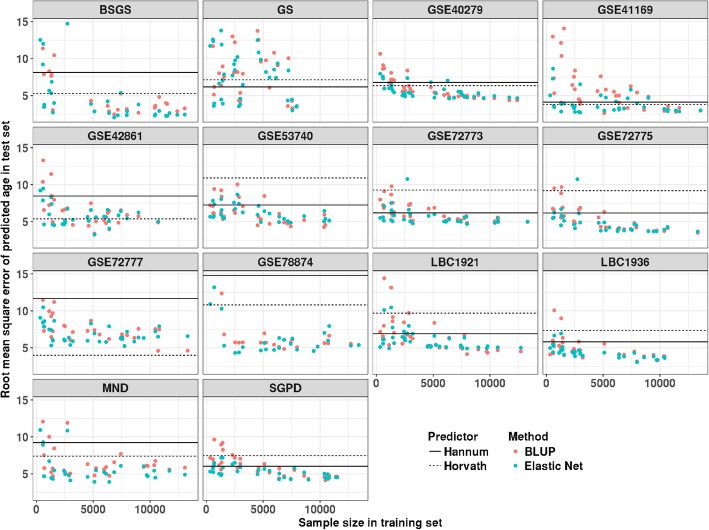
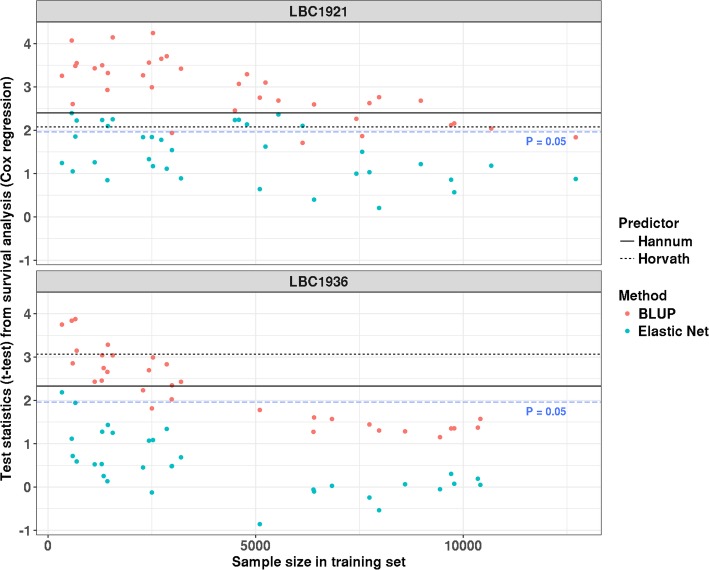
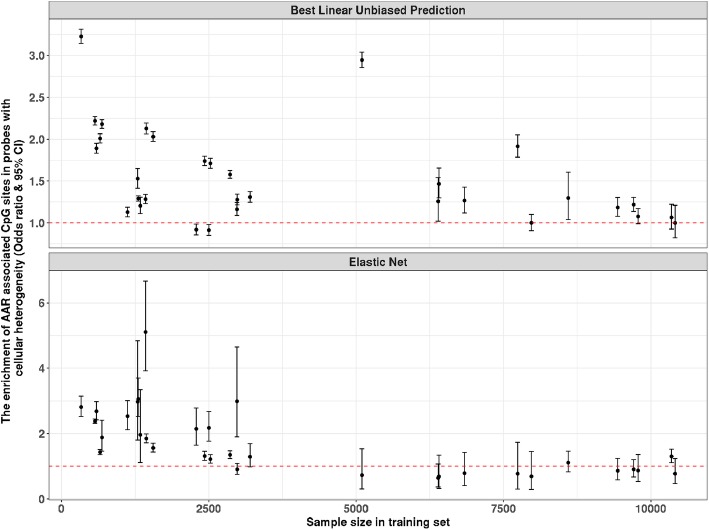
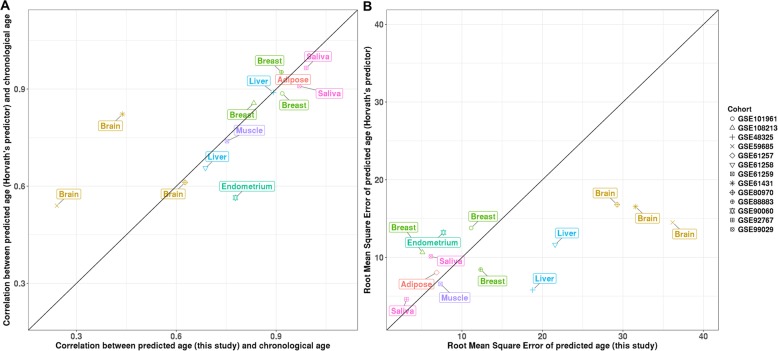
BACKGROUND: DNA methylation changes with age. Chronological age predictors built from DNA methylation are termed 'epigenetic clocks'. The deviation of predicted age from the actual age ('age acceleration residual', AAR) has been reported to be associated with death. However, it is currently unclear how a better prediction of chronological age affects such association. METHODS: In this study, we build multiple predictors based on training DNA methylation samples selected from 13,661 samples (13,402 from blood and 259 from saliva). We use the Lothian Birth Cohorts of 1921 (LBC1921) and 1936 (LBC1936) to examine whether the association between AAR (from these predictors) and death is affected by (1) improving prediction accuracy of an age predictor as its training sample size increases (from 335 to 12,710) and (2) additionally correcting for confounders (i.e., cellular compositions). In addition, we investigated the performance of our predictor in non-blood tissues. RESULTS: We found that in principle, a near-perfect age predictor could be developed when the training sample size is sufficiently large. The association between AAR and mortality attenuates as prediction accuracy increases. AAR from our best predictor (based on Elastic Net, https://github.com/qzhang314/DNAm-based-age-predictor ) exhibits no association with mortality in both LBC1921 (hazard ratio = 1.08, 95% CI 0.91-1.27) and LBC1936 (hazard ratio = 1.00, 95% CI 0.79-1.28). Predictors based on small sample size are prone to confounding by cellular compositions relative to those from large sample size. We observed comparable performance of our predictor in non-blood tissues with a multi-tissue-based predictor. CONCLUSIONS: This study indicates that the epigenetic clock can be improved by increasing the training sample size and that its association with mortality attenuates with increased prediction of chronological age.
Overview
The claims and statistics of this paper haven’t been checked yet.
Run the check — free, no account needed. It reads the open-access text and checks the sources it cites.
Integrity signals
Registry
Cites
Statistics
Figures
Verification
Claims the paper makes
The claims and statistics of this paper haven’t been checked yet.
Run the check — free, no account needed. It reads the open-access text and checks the sources it cites.
Claims other papers make about this one
Each is checked against this paper’s own text: does it say what the citing paper says it does?
The source backs part of the claim, not all of it — or backs it for a different population, condition or comparison.
In the citing paper
“This study demonstrates an important paradox in the training of first-generation ageing clocks: increasingly perfect prediction of chronological age by a clock trained only on chronological age reduces its ability to discover drivers of variation in biological ageing between people.”
From Measuring biological age using omics data (2022) · cites this paper as [61]
Experimental — accuracy not yet measuredIn the citing paper
“In support of this notion, a large meta-analysis in 14 cohorts demonstrated that, taken to the extreme, improving a methylation clock’s accuracy to extremely high levels actually reduced its associations with mortality risk61.”
From Measuring biological age using omics data (2022) · cites this paper as [61]
In the citing paper
“Supporting noise as a large factor in these models, a recent analysis showed that training first-generation methylation clocks on increasing sample sizes can increase the age prediction accuracy to virtually perfect, which in turn erases the associations between age gap and biological ageing61.”
From Measuring biological age using omics data (2022) · cites this paper as [61]
Self-check
Percentages, sums and reported differences re-computed from the paper’s own numbers.
The self-check needs the paper’s full text.
Citations
Cites
Regularization and Variable Selection Via the Elastic Net
Zou, H., & Hastie, T. (2005) · Journal of the Royal Statistical Society Series B: Statistical Methodology · doi:10.1111/j.1467-9868.2005.00503.x · Cited by 20,957
DNA methylation age of human tissues and cell types
Horvath, S. (2013) · Genome Biology · doi:10.1186/gb-2013-14-10-r115 · Cited by 7,075
Common SNPs explain a large proportion of the heritability for human height
Yang, J., Benyamin, B., McEvoy, B. P., Gordon, S., Henders, A. K., Nyholt, D. R., Madden, P. A., Heath, A. C., Martin, N. G., Montgomery, G. W., et al. (2010) · Nature Genetics · doi:10.1038/ng.608 · Cited by 4,446
Self-citationGenome-wide methylation profiles reveal quantitative views of human aging rates
Hannum, G., Guinney, J., Zhao, L., Zhang, L., Hughes, G., Sadda, S., Klotzle, B., Bibikova, M., Fan, J.-B., Gao, Y., et al. (2013) · Molecular Cell · doi:10.1016/j.molcel.2012.10.016 · Cited by 4,270
CpG-rich islands and the function of DNA methylation
Bird, A. P. (1986) · Nature · doi:10.1038/321209a0 · Cited by 3,777
An epigenetic biomarker of aging for lifespan and healthspan
Levine, M. E., Lu, A. T., Quach, A., Chen, B. H., Assimes, T. L., Bandinelli, S., Hou, L., Baccarelli, A. A., Stewart, J. D., Li, Y., et al. (2018) · Aging · doi:10.18632/aging.101414 · Cited by 3,675
DNA methylation arrays as surrogate measures of cell mixture distribution
Houseman, E. A., Accomando, W. P., Koestler, D. C., Christensen, B. C., Marsit, C. J., Nelson, H. H., Wiencke, J. K., & Kelsey, K. T. (2012) · BMC Bioinformatics · doi:10.1186/1471-2105-13-86 · Cited by 3,175
DNA methylation GrimAge strongly predicts lifespan and healthspan
Lu, A. T., Quach, A., Wilson, J. G., Reiner, A. P., Aviv, A., Raj, K., Hou, L., Baccarelli, A. A., Li, Y., Stewart, J. D., et al. (2019) · Aging · doi:10.18632/aging.101684 · Cited by 2,540
Ridge Regression and Other Kernels for Genomic Selection with R Package rrBLUP
Endelman, J. B. (2011) · The Plant Genome · doi:10.3835/plantgenome2011.08.0024 · Cited by 2,094
That BLUP is a Good Thing: The Estimation of Random Effects
Robinson, G. K. (1991) · Statistical Science · doi:10.1214/ss/1177011926 · Cited by 1,694
Research works printed but not linked: 1
- Therneau TM. A package for survival analysis in S. 2.38 edition; 2015.
Cited by
Sorted by citations
Items 401–496 of 496
Domingo‐Relloso, A., Riffo‐Campos, Á. L., Powers, M., Tellez-Plaza, M., Haack, K., Brown, R. H., Umans, J. G., Fallin, M. D., Cole, S. A., Navas-Acien, A., et al. (2022) · Figshare · doi:10.6084/m9.figshare.20047013
Ori, A. P. S., Loohuis, L. M. O., Guintivano, J., Hannon, E. J., Dempster, E., St. Clair, D., Bass, N., McQuillin, A., Mill, J., Sullivan, P. F., et al. (2024) · Figshare · doi:10.6084/m9.figshare.26703769
Lee, Y., Haftorn, K. L., Denault, W. R. P., Nustad, H. E., Page, C. M., Lyle, R., Lee-Ødegård, S., Moen, G.-H., Prasad, R. B., Groop, L. C., et al. (2020) · Figshare · doi:10.6084/m9.figshare.13151967
McCartney, D. L., Min, J. L., Richmond, R. C., Lu, A. T., Sobczyk, M. K., Davies, G., Broer, L., Guo, X., Jeong, A., Jung, J., et al. (2021) · Figshare · doi:10.6084/m9.figshare.14880981
Self-citationAdditional file 1 of Epigenetics insights from perceived facial aging
Vladimir, K., Perišić, M. M., Štorga, M., Mostashari, A., & Khanin, R. (2024) · Figshare · doi:10.6084/m9.figshare.26635365
Ori, A. P. S., Loohuis, L. M. O., Guintivano, J., Hannon, E. J., Dempster, E., St. Clair, D., Bass, N., McQuillin, A., Mill, J., Sullivan, P. F., et al. (2024) · Figshare · doi:10.6084/m9.figshare.26703760
Ori, A. P. S., Loohuis, L. M. O., Guintivano, J., Hannon, E. J., Dempster, E., St. Clair, D., Bass, N., McQuillin, A., Mill, J., Sullivan, P. F., et al. (2024) · Figshare · doi:10.6084/m9.figshare.26703763
Ori, A. P. S., Lu, A. T., Horvath, S., & Ophoff, R. A. (2022) · Figshare · doi:10.6084/m9.figshare.21393661
Hillary, R. F., McCartney, D. L., McRae, A. F., Campbell, A., Walker, R. M., Hayward, C., Horvath, S., Porteous, D. J., Evans, K. L., & Marioni, R. E. (2022) · Figshare · doi:10.6084/m9.figshare.20469635
Self-citationAdditional file 1 of Refining epigenetic prediction of chronological and biological age
Bernabeu, E., McCartney, D. L., Gadd, D. A., Hillary, R. F., Lu, A. T., Murphy, L., Wrobel, N., Campbell, A., Harris, S. E., Liewald, D. C. M., et al. (2024) · Figshare · doi:10.6084/m9.figshare.26571940
Self-citationAdditional file 1 of Distinct sex-specific DNA methylation differences in Alzheimer’s disease
C. Silva, T., Zhang, W., Young, J. I., Gomez, L., Schmidt, M. A., Varma, A., Chen, X. S., Martin, E. R., & Wang, L. (2022) · Figshare · doi:10.6084/m9.figshare.21129953
Steg, L. C., Shireby, G. L., Imm, J. L., Davies, J. P., Franklin, A., Flynn, R., Namboori, S. C., Bhinge, A., Jeffries, A. R., Burrage, J., et al. (2021) · Figshare · doi:10.6084/m9.figshare.14853123
Domingo‐Relloso, A., Riffo‐Campos, Á. L., Powers, M., Téllez-Plaza, M., Haack, K., Brown, R. H., Umans, J. G., Fallin, M. D., Cole, S. A., Navas-Acien, A., et al. (2022) · Figshare · doi:10.6084/m9.figshare.20047010
Additional file 2 of Refining epigenetic prediction of chronological and biological age
Bernabeu, E., McCartney, D. L., Gadd, D. A., Hillary, R. F., Lu, A. T., Murphy, L., Wrobel, N., Campbell, A., Harris, S. E., Liewald, D. C. M., et al. (2024) · Figshare · doi:10.6084/m9.figshare.26571943
Self-citationAdditional file 5 of Epigenetics insights from perceived facial aging
Vladimir, K., Perišić, M. M., Štorga, M., Mostashari, A., & Khanin, R. (2024) · Figshare · doi:10.6084/m9.figshare.26635377
Additional file 3 of Refining epigenetic prediction of chronological and biological age
Bernabeu, E., McCartney, D. L., Gadd, D. A., Hillary, R. F., Lu, A. T., Murphy, L., Wrobel, N., Campbell, A., Harris, S. E., Liewald, D. C. M., et al. (2024) · Figshare · doi:10.6084/m9.figshare.26571946
Self-citationOri, A. P. S., Lu, A. T., Horvath, S., & Ophoff, R. A. (2022) · Figshare · doi:10.6084/m9.figshare.21393676
Domingo‐Relloso, A., Riffo‐Campos, Á. L., Powers, M., Téllez-Plaza, M., Haack, K., Brown, R. H., Umans, J. G., Fallin, M. D., Cole, S. A., Navas-Acien, A., et al. (2022) · Figshare · doi:10.6084/m9.figshare.20047016
Ori, A. P. S., Loohuis, L. M. O., Guintivano, J., Hannon, E. J., Dempster, E., St. Clair, D., Bass, N., McQuillin, A., Mill, J., Sullivan, P. F., et al. (2024) · Figshare · doi:10.6084/m9.figshare.26703766
Sluiskes, M. H., Goeman, J. J., Beekman, M., Slagboom, P. E., Putter, H., & Rodríguez-Girondo, M. (2024) · Figshare · doi:10.6084/m9.figshare.25374849
McCartney, D. L., Min, J. L., Richmond, R. C., Lu, A. T., Sobczyk, M. K., Davies, G., Broer, L., Guo, X., Jeong, A., Jung, J., et al. (2021) · Figshare · doi:10.6084/m9.figshare.14880969
Self-citationAdditional file 2 of Altered immune phenotype and DNA methylation in panic disorder
Petersen, C. L., Chen, J.-Q., Salas, L. A., & Christensen, B. C. (2020) · Figshare · doi:10.6084/m9.figshare.13257575
Additional file 3 of Epigenetics insights from perceived facial aging
Vladimir, K., Perišić, M. M., Štorga, M., Mostashari, A., & Khanin, R. (2024) · Figshare · doi:10.6084/m9.figshare.26635371
Additional file 4 of Refining epigenetic prediction of chronological and biological age
Bernabeu, E., McCartney, D. L., Gadd, D. A., Hillary, R. F., Lu, A. T., Murphy, L., Wrobel, N., Campbell, A., Harris, S. E., Liewald, D. C. M., et al. (2024) · Figshare · doi:10.6084/m9.figshare.26571949
Self-citationOri, A. P. S., Lu, A. T., Horvath, S., & Ophoff, R. A. (2022) · Figshare · doi:10.6084/m9.figshare.21393688
Steg, L. C., Shireby, G. L., Imm, J. L., Davies, J. P., Franklin, A., Flynn, R., Namboori, S. C., Bhinge, A., Jeffries, A. R., Burrage, J., et al. (2021) · Figshare · doi:10.6084/m9.figshare.14853120
Ori, A. P. S., Loohuis, L. M. O., Guintivano, J., Hannon, E. J., Dempster, E., St. Clair, D., Bass, N., McQuillin, A., Mill, J., Sullivan, P. F., et al. (2024) · Figshare · doi:10.6084/m9.figshare.26703775
Ori, A. P. S., Lu, A. T., Horvath, S., & Ophoff, R. A. (2022) · Figshare · doi:10.6084/m9.figshare.21393685
Ori, A. P. S., Lu, A. T., Horvath, S., & Ophoff, R. A. (2022) · Figshare · doi:10.6084/m9.figshare.21393664
Additional file 3 of A comprehensive map of the aging blood methylome in humans
Seale, K., Teschendorff, A. E., Reiner, A. P., Voisin, S. A. C., & Eynon, N. (2024) · Figshare · doi:10.6084/m9.figshare.26962444
Sluiskes, M. H., Goeman, J. J., Beekman, M., Slagboom, P. E., Putter, H., & Rodríguez-Girondo, M. (2024) · Figshare · doi:10.6084/m9.figshare.25374707
Ori, A. P. S., Lu, A. T., Horvath, S., & Ophoff, R. A. (2022) · Figshare · doi:10.6084/m9.figshare.21393673
Ori, A. P. S., Loohuis, L. M. O., Guintivano, J., Hannon, E. J., Dempster, E., St. Clair, D., Bass, N., McQuillin, A., Mill, J., Sullivan, P. F., et al. (2024) · Figshare · doi:10.6084/m9.figshare.26703772
McCartney, D. L., Min, J. L., Richmond, R. C., Lu, A. T., Sobczyk, M. K., Davies, G., Broer, L., Guo, X., Jeong, A., Jung, J., et al. (2021) · Figshare · doi:10.6084/m9.figshare.14880984
Self-citationOri, A. P. S., Lu, A. T.-H., Horvath, S., & Ophoff, R. A. (2022) · Figshare · doi:10.6084/m9.figshare.21393682
Steg, L. C., Shireby, G. L., Imm, J. L., Davies, J. P., Franklin, A., Flynn, R., Namboori, S. C., Bhinge, A., Jeffries, A. R., Burrage, J., et al. (2021) · Figshare · doi:10.6084/m9.figshare.14853117
McCartney, D. L., Min, J. L., Richmond, R. C., Lu, A. T., Sobczyk, M. K., Davies, G., Broer, L., Guo, X., Jeong, A., Jung, J., et al. (2021) · Figshare · doi:10.6084/m9.figshare.14880978
Self-citationLee, Y., Haftorn, K. L., Denault, W. R. P., Nustad, H. E., Page, C. M., Lyle, R., Lee-Ødegård, S., Moen, G.-H., Prasad, R. B., Groop, L. C., et al. (2020) · Figshare · doi:10.6084/m9.figshare.13151973
Additional file 1 of A comprehensive map of the aging blood methylome in humans
Seale, K., Teschendorff, A. E., Reiner, A. P., Voisin, S. A. C., & Eynon, N. (2024) · Figshare · doi:10.6084/m9.figshare.26962435
Additional file 2 of Epigenetics insights from perceived facial aging
Vladimir, K., Perišić, M. M., Štorga, M., Mostashari, A., & Khanin, R. (2024) · Figshare · doi:10.6084/m9.figshare.26635368
DNA methylation clocks and cognitive status among older adults in the US, NHANES 1999–2002
Walker, E., Cockell, S., Needham, B. L., Cárdenas, A., Park, S. K., & Bakulski, K. M. (2025) · Epigenetics Reports · doi:10.1080/28361512.2025.2599769
Xu, Y., Gong, Y., Ding, C., Zhang, H., Hao, D., Zhao, X., Wang, J., 童天朗, & Li, X. (2025) · International Journal of Environmental Health Research · doi:10.1080/09603123.2025.2604163
Accelerating epigenetic age in right-sided colon cancer predicts a favorable outcome
Ye, Q., Song, P., Hu, W., & Zhang, G. Y. (2025) · Clinical Epigenetics · doi:10.1186/s13148-025-02025-5
Olay yeri biyolojik örneklerinden yaş tahminini belirlemede DNA metilasyonunun etkinliği
Tezel, A., & Kilicaslan, D. Y. (2025) · The Bulletin of Legal Medicine · doi:10.17986/blm.1762
Khan, S., LaHue, S. C., Perkins, A. J., Haouili, M., Baechle, J. J., Fuentealba, M., Jawaid, S., Lavadia, L., Wang, S., Diaz, S. R., et al. (2026) · The Journals of Gerontology Series A · doi:10.1093/gerona/glag015
Kuang, Z., Geng, K., Zhao, J., Shi, L., Wang, H., & Sun, H. (2025) · IEEE International Conference on Bioinformatics and Biomedicine (BIBM) · doi:10.1109/bibm66473.2025.11356186
Multi-output learning for systematic missing value imputation in DNA methylation arrays
Ma, T., Nie, J. J., Huang, J., Zhang, Y.-B., Biernacka, J. M., & Wang, L. (2026) · Bioinformatics Advances · doi:10.1093/bioadv/vbag052
Balfour, D., Mittinty, M., Nguyen, D. P., & Cohen‐Woods, S. (2026) · European Neuropsychopharmacology · doi:10.64898/2026.02.17.26346504
Christofidou, P., & Bell, C. G. (2026) · bioRxiv (Cold Spring Harbor Laboratory) · doi:10.64898/2026.02.20.707043
Methods for analysing wildlife DNA methylation data
Photopoulou, T., Durbach, I. N., Pirotta, E., Barratclough, A., Schwacke, L. H., Takeshita, R., Boor, G. K. H., Harris, C. M., Tyack, P. L., & Thomas, L. (2025) · Conservation Physiology · doi:10.1093/conphys/coaf091
Gunter, N. D., Cárdenas, A., Kobor, M. S., Gladish, N., MacIsaac, J. L., Dever, K., Rehkopf, D. H., Dow, W. H., Rosero‐Bixby, L., & Hubbard, A. (2026) · medRxiv · doi:10.64898/2026.03.02.26346901
Jabin, N., Wang, G., Hong, X., Rusk, S. A., Cheng, T. L., & Wang, X. (2026) · GeroScience · doi:10.1007/s11357-026-02168-0
Arsenic exposure at birth, socioeconomic status, and epigenetic aging among adults in northern Chile
Kwon, D., Bozack, A. K., Catterina Ferreccio, R., McCormick, N. M., Steinmaus, C., de la Rosa, R., & Cárdenas, A. (2026) · Environmental Research · doi:10.1016/j.envres.2026.124377
Yusupov, N., Fietz, J., Karlbauer, V. N., Maurus, I., Falkai, P., & Binder, E. B. (2026) · Biological Psychiatry Global Open Science · doi:10.1016/j.bpsgos.2026.100726
Yang, N.-Y., Huang, Y., Park, C. S., Ke, T., Tilston, G., Manias, G., Kyriazis, D., Young, J., Hart, S., Fulford, G., et al. (2026) · Epigenomes · doi:10.3390/epigenomes10020022
Lv, M., Jiang, Z., Deng, C., Du, Z., Bai, B., Wang, Z., Adilijiang, A., Zheng, Y.-Y., & Xie, X. J. (2026) · Clinical Epigenetics · doi:10.1186/s13148-026-02141-w
Shen, H., Gladish, N., Fan, T., Cárdenas, A., Needham, B. L., & Rehkopf, D. H. (2026) · Aging · doi:10.18632/aging.206377
Sun, Y., Urbárová, I., Jiang, L., Nøst, T. H., & Mai, X. (2026) · Clinical Epigenetics · doi:10.1186/s13148-026-02070-8
Exposure to size-specific particulate matter accelerates DNA methylation aging in people with HIV
Liang, W., Zhang, L., Wang, B., Ben, H., Ji, Z., Xie, Z., & Hou, D. (2026) · AIDS · doi:10.1097/qad.0000000000004554
Accelerated epigenetic ageing in congenital heart disease: the AccelerAGE study
Tournoy, T. K., Daelman, B., Demulier, L., Brooke, R. T., Bruaene, A. V. D., Budts, W., Moons, P., & Backer, J. F. A. D. (2026) · European Heart Journal · doi:10.1093/eurheartj/ehag455
Using kidney transplantation to explore epigenetic markers of frailty
Yang, Y., Giddens, F., Neupane, S., Tran, L., Tannenberg, R. K., Reid, N., Hubbard, R. E., Shaw, A. A., Francis, R. S., Gratten, J., et al. (2026) · GeroScience · doi:10.1007/s11357-026-02344-2
Self-citation[These authors contributed equally: Y. E. Willems, A. D. Rezaki.]
Willems, Y., Rezaki, A. D., Aikins, M., Bahl, A., Wu, Q., Belsky, D. W., & Raffington, L. (2026) · MPG.PuRe (Max Planck Society)
Milicic, L., Vacher, M. A., Doré, V., Bourgeat, P., Shishegar, R., Doecke, J. D., Maruff, P. T., Rowe, C. C., Villemagne, V. L., Initiative, A. D. N., et al. (2026) · GeroScience · doi:10.1007/s11357-026-02346-0
Development of a precise saliva-based epigenetic clock using a six-CpG-marker panel
Teng, W., Chu, X., Sun, W., Huang, A., Wang, Z., Zhu, B., & Liu, X. (2026) · International Journal of Legal Medicine · doi:10.1007/s00414-026-03873-3
Ensaya: An ensemble age model for prediction of chronological age in adolescents and young adults
Stenløkk, K., Dahlberg, P. S., Rolseth, V., Bernitz, H., Gamieldien, M. Y., Gholmieh, M. N., Robinson, L., Saadé, A., Uys, A., & Bleka, Ø. (2026) · Forensic Science International Genetics · doi:10.1016/j.fsigen.2026.103579
Cheng, S., & Xu, S. (2026) · Molecular Biology and Evolution · doi:10.1093/molbev/msag160
Kalyakulina, A., Yusipov, I., Botasheva, F., Bujlova, N., Вадимовна, З. Е., Franceschi, C., & Ivanchenko, M. (2026) · Clinical Epigenetics · doi:10.1186/s13148-026-02195-w
Awuah, J., Dallmeier, D., Boehm, F., Herdtle, L., Rothenbacher, D., Perez-Correa, J.-F., & Wagner, W. (2026) · Clinical Epigenetics · doi:10.1186/s13148-026-02196-9
Enhancing the performance and interpretability of epigenetic clocks
Patel, T., Schwarz, R. J., Riege, K., Varshavsky, M., Richmond, A., Marioni, R. E., Kestler, H. A., Kaplan, T., Hoffmann, S., & van Bömmel, A. (2026) · Nucleic Acids Research · doi:10.1093/nar/gkag661
Self-citationUehara, O., Umeda, K., Morikawa, T., Yoshida, K., & Abiko, Y. (2026) · Odontology · doi:10.1007/s10266-026-01494-1
Menopause transition timing reflects systemic biological aging
Komar, D. N., Baudin, J., Costa, A., Tadeo-Orellana, L., García, L., Gordevičius, J., Giménez, J. R., Calderón-Pérez, L., Domingo, A., Crescenti, A., et al. (2026) · doi:10.6019/s-bsst3201
Biomarkers of aging. Part 1. General state of the problem and approaches to assessing biological age
Зуева, М. В., Kotelin, V. I., Neroeva, N. V., Chesnokova, N. B., Zhuravleva, A. K., Balatskaya, N. V., & Ryabina, M. V. (2026) · Russian Ophthalmological Journal · doi:10.21516/2072-0076-2026-19-2-203-211
Decoding aging clocks from a metabolomic perspective
Qu, X., You, Q., Fan, M., & Xu, S. (2026) · PeerJ · doi:10.7717/peerj.21508
Genome-wide multi-layered epigenomic profiling across human agingPreprint
Steiger, M., Krüger, R., Shaigan, M., Puri, D., Fornero, G., Klump, H., Meissner, A., Costa, I. G., Kretzmer, H., & Wagner, W. (2026) · bioRxiv (Cold Spring Harbor Laboratory) · doi:10.64898/2026.07.27.740934
Limitations of Deep Ageing Clocks and Strategies to Circumvent themPreprint
Feng, J. (2026) · SSRN Electronic Journal · doi:10.2139/ssrn.6967918
Pileggi, C. A., Mohottalage, D., Kennedy, L. S., Nikpay, M., Hamilton, L. M. K., Roffé, M., Kanaan, M. N., Jarrar, A., Kolozsvari, N., Wang, D., et al. (2026) · EBioMedicine · doi:10.1016/j.ebiom.2026.106410
Pryor, N., Dokshina, D., Shen, H., Gladish, N., Smith, J. A., Rehkopf, D. H., & Needham, B. L. (2026) · Clinical Epigenetics · doi:10.1186/s13148-026-02218-6
Brain aging clocks: From methodological advances to cellular mechanisms
Suk, K. (2026) · Experimental Gerontology · doi:10.1016/j.exger.2026.113260
Author response: Methylation clocks fail to generalize across genetically admixed individuals
Cruz-González, S., Okpala, O., Gu, E., Gomez, L., Mews, M., Vance, J. M., Cuccaro, M. L., Cornejo‐Olivas, M., Feliciano‐Astacio, B. E., Byrd, G. S., et al. (2026) · eLife · doi:10.7554/elife.105343.3.sa2
Zhang, X., Chen, Z., Cheng, Z., Zhang, H., Xu, Y.-Q., Ding, C., An, T., Gong, Y., Hao, D., Xu, J., et al. (2026) · Biomedicines · doi:10.3390/biomedicines14081792
DNA Methylation Biomarkers Capture Residual Biological Risk Beyond PREVENTPreprint
Xing, D. G., Bhuiyan, M. S., Conrad, S. A., Yurdagul, A., Rom, O., Orr, A. W., Kevil, C. G., Islam, S. M. A., & Bhuiyan, M. A. N. (2026) · medRxiv · doi:10.64898/2026.08.07.26359993
Conformal uncertainty quantification for BayesAge epigenetic age predictions
Mitchell, M., Mboning, L., Bouchard, L.-S., & Pellegrini, M. A. (2026) · GeroScience · doi:10.1007/s11357-026-02600-5
Guvatova, Z. G., Kobelyatskaya, A. A., Gorbunov, A., Pudova, E. A., & Moskalev, A. (2026) · International Journal of Molecular Sciences · doi:10.3390/ijms27177580
Du, Z., Luo, Q., Guo, X., Peng, Q., Li, Z., Huang, D., Singh, R., Wang, S., Marioni, R. E., & Teschendorff, A. E. (2026) · Research Square · doi:10.21203/rs.3.rs-10584417/v1
Self-citationFermín‐Martínez, C. A., Garcia-Gonzalez, S. B., Castañeda, E. G. L., Ramirez-Rivera, D. L., Carrillo-Herrera, K. B., Cabrera-Quintana, L. A., López-Teros, M. T., Antonio‐Villa, N. E., Gonçalves, N. G., García‐Peña, C., et al. (2026) · Revista de investigaci�n Cl�nica · doi:10.1016/j.ric.2026.100053
Mahdiani, S., Talasaz, A. H., AlAzzeh, O., Tassell, B. W. V., & McClay, J. L. (2026) · Epigenomics · doi:10.1080/17501911.2026.2732421
Han, J., Liu, H., Arsang-Jang, S., Xu, Z., Rentscher, K. E., Mathison, A., Tschannen, M., Sun, F., Auer, P. L., Kerns, S. L., et al. (2026) · Cells · doi:10.3390/cells15191722
Associations between socioeconomic position index and epigenetic aging in NHANES
Caunca, M. R., Kezios, K., Schneider, A. L. C., Shen, H., Rehkopf, D. H., Torres, J. M., & Chen, B. H. (2026) · GeroScience · doi:10.1007/s11357-026-02565-5
Exercise slows biological aging in breast cancer survivors: secondary analysis of a randomized trial
Daniel, C., Ott, O., Sears, D. D., Ahles, T. A., Desplats, P., & Hartman, S. J. (2026) · JNCI Journal of the National Cancer Institute · doi:10.1093/jnci/djag296
Menopause timing, epigenetic aging and blood-cell traitsPreprint
Fang, X., & Schwartz, J. D. (2026) · medRxiv · doi:10.64898/2026.10.05.26364790
Cao, L., Chen, Y., Zhang, W., Jiang, H., Huang, H., Xu, Y., Li, X., Xu, W. L., Qian, K., & Pu, J. (2026) · Science Translational Medicine · doi:10.1126/scitranslmed.adz4815
Tay, J. H., Barros, D., Dong, J., Choudhury, S., Bakulaite, A., Wang, W., & Maier, A. B. (2026) · medRxiv · doi:10.64898/2026.10.20.26365864
Beyond age prediction: a task-oriented framework for evaluating molecular aging clocks
Simayijiang, H., Ye, P., 张流利, Wu, J., Li, Z., & Long, Y. (2026) · Biogerontology · doi:10.1007/s10522-026-10535-9
Metadata
- Authors
- Zhang, Q., Vallerga, C. L., Walker, R. M., Lin, T., Henders, A. K., Montgomery, G. W., He, J., Fan, D., Fowdar, J., Kennedy, M., Pitcher, T., Pearson, J., Halliday, G., Kwok, J. B., Hickie, I., Lewis, S., Anderson, T., Silburn, P. A., Mellick, G. D., Harris, S. E., Redmond, P., Murray, A. D., Porteous, D. J., Haley, C. S., Evans, K. L., McIntosh, A. M., Yang, J., Gratten, J., Marioni, R. E., Wray, N. R., Deary, I. J., McRae, A. F., & Visscher, P. M.
- Affiliations
- The University of Queensland (AU)
- Institute of Genetics and Cancer (GB)
- Peking University (CN)
- Griffith University (AU)
- University of Otago (NZ)
- New Zealand Brain Research Institute (NZ)
- The University of Sydney (AU)
- University of Edinburgh (GB)
- University of Aberdeen (GB)
- Royal Edinburgh Hospital (GB)
- Corresponding author
- Visscher, Peter M.
- ORCID
- Zhang, Qian
- Vallerga, Costanza L.
- Walker, Rosie M.
- Lin, Tian
- Henders, Anjali K.
- Montgomery, Grant W.
- He, Ji
- Fan, Dongsheng
- Fowdar, Javed
- Kennedy, Martin
- Pitcher, Toni
- Pearson, John
- Halliday, Glenda
- Kwok, John B.
- Hickie, Ian
- Lewis, Simon
- Anderson, Tim
- Mellick, George D.
- Harris, Sarah E.
- Redmond, Paul
- Murray, Alison D.
- Porteous, David J.
- Evans, Kathryn L.
- McIntosh, Andrew M.
- Yang, Jian
- Gratten, Jacob
- Marioni, Riccardo E.
- Wray, Naomi R.
- Deary, Ian J.
- McRae, Allan F.
- Visscher, Peter M.
- Venue
- Genome Medicine
- Published
- 2019-08-23
- Volume
- 11
- Issue
- 1
- Pages
- 54-54
- ISSN
- 1756-994X (ISSN-L)
- PMC
- PMC6708158
- OpenAlex
- W2969410982
- Cited by
- 487
- References
- 42
- Citations by year
- 2026: 81 · 2025: 117 · 2024: 102 · 2023: 47 · 2022: 52 · 2021: 54 · 2020: 30 · 2019: 4
- FWCI
- 11.74
- Type
- journal article
- Language
- en
- Open access
- gold
- doi.org
- Locations
- Genome Medicine (publishedVersion, cc-by)
- PubMed Central (publishedVersion, cc-by)
- PubMed (publishedVersion)
- Aberdeen University Research Archive (Aberdeen University) (submittedVersion, cc-by)
- Griffith Research Online (submittedVersion, cc-by)
- DOAJ (DOAJ: Directory of Open Access Journals) (submittedVersion, cc-by-sa)
- Edinburgh Research Explorer (University of Edinburgh) (submittedVersion, cc-by-nc)
- Funders
- Australian National Health and Medical Research Council (1078037, 1078901, 1103418, 1107258, 1127440 and 1113400)
- Chief Scientist Office of the Scottish Government Health Directorates (CZD/16/6)
- Scottish Funding Council (HR03006)
- Medical Research Council UK and the Wellcome Trust (104036/Z/14/Z)
- Australian Research Council (DP160102400)
- Alzheimer’s Research UK Major Project Grant (RUK-PG2017B-10)
- Topics
- Life Sciences › Biochemistry, Genetics and Molecular Biology › Molecular Biology › Epigenetics and DNA Methylation
- Life Sciences › Biochemistry, Genetics and Molecular Biology › Aging › Genetics, Aging, and Longevity in Model Organisms
- Life Sciences › Biochemistry, Genetics and Molecular Biology › Cell Biology › Telomeres, Telomerase, and Senescence
- Keywords
- epigenetic clocks, DNA methylation, biological aging, mortality, training sample size, saliva, elastic net, age prediction
- MeSH terms
- Aging, Humans, Organ Specificity, Saliva, Reproducibility of Results, Proportional Hazards Models, DNA Methylation, Genetic Predisposition to Disease, Epigenesis, Genetic, Genome-Wide Association Study, Epigenomics
About these checks
Registry, retraction, Cites and statistics results are computed, not judged, with one exception: a printed reference that no index lists is read once by a model before it counts as a citation error. Claims are extracted by a model and kept only when their quote appears verbatim in the text; each cited source is then checked, with a model’s help, for whether it says what the claim relies on. Those verdicts can be wrong — read the claim’s quote and the cited source before relying on one.
Statistics and arithmetic are recomputed, not judged.
Confidence bands are shown only for fields calibrated on our annotated test set. None is calibrated yet, so no band is shown.
What counts as a claim ›How we measure confidence ›How we check this ›
Are you an author, or do you see a problem with this page? Request a review
