

The DOI matches its Crossref record; 46 of the 46 references it cites were found in a registry or an index.
Improved precision of epigenetic clock estimates across tissues and its implication for biological ageing
Open accessAbstract
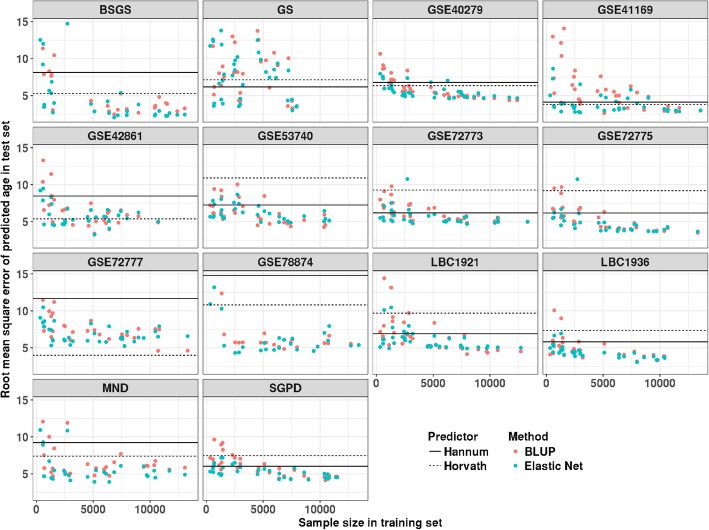
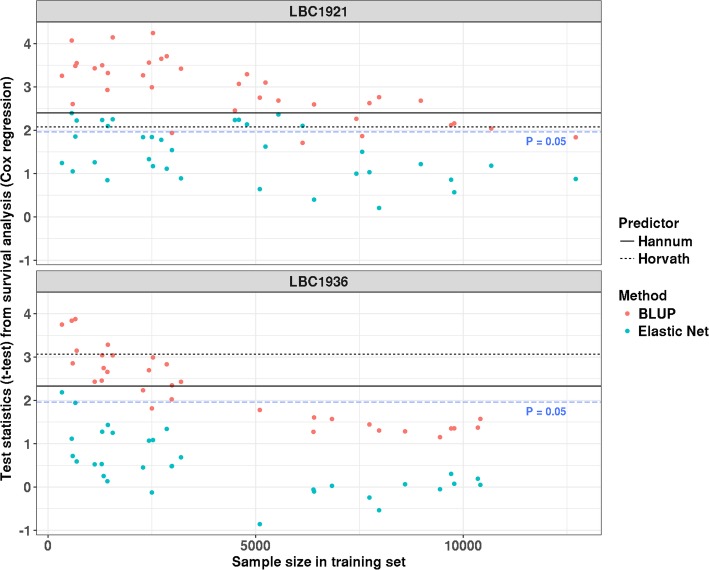
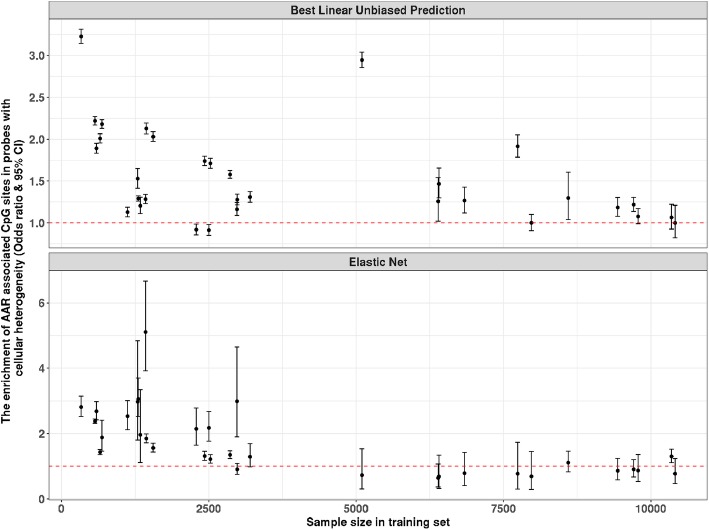
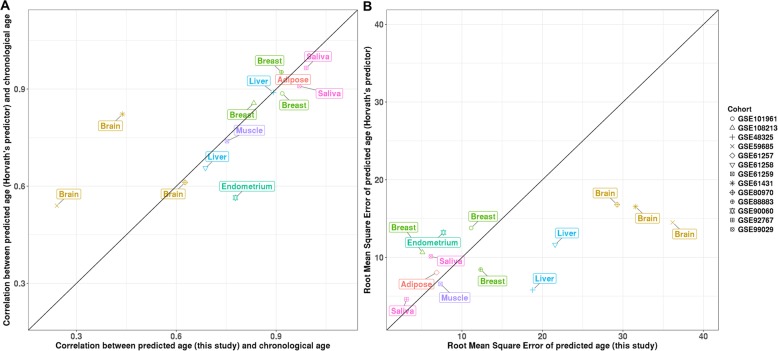
BACKGROUND: DNA methylation changes with age. Chronological age predictors built from DNA methylation are termed 'epigenetic clocks'. The deviation of predicted age from the actual age ('age acceleration residual', AAR) has been reported to be associated with death. However, it is currently unclear how a better prediction of chronological age affects such association. METHODS: In this study, we build multiple predictors based on training DNA methylation samples selected from 13,661 samples (13,402 from blood and 259 from saliva). We use the Lothian Birth Cohorts of 1921 (LBC1921) and 1936 (LBC1936) to examine whether the association between AAR (from these predictors) and death is affected by (1) improving prediction accuracy of an age predictor as its training sample size increases (from 335 to 12,710) and (2) additionally correcting for confounders (i.e., cellular compositions). In addition, we investigated the performance of our predictor in non-blood tissues. RESULTS: We found that in principle, a near-perfect age predictor could be developed when the training sample size is sufficiently large. The association between AAR and mortality attenuates as prediction accuracy increases. AAR from our best predictor (based on Elastic Net, https://github.com/qzhang314/DNAm-based-age-predictor ) exhibits no association with mortality in both LBC1921 (hazard ratio = 1.08, 95% CI 0.91-1.27) and LBC1936 (hazard ratio = 1.00, 95% CI 0.79-1.28). Predictors based on small sample size are prone to confounding by cellular compositions relative to those from large sample size. We observed comparable performance of our predictor in non-blood tissues with a multi-tissue-based predictor. CONCLUSIONS: This study indicates that the epigenetic clock can be improved by increasing the training sample size and that its association with mortality attenuates with increased prediction of chronological age.
Overview
The claims and statistics of this paper haven’t been checked yet.
Run the check — free, no account needed. It reads the open-access text and checks the sources it cites.
Integrity signals
Registry
Cites
Statistics
Figures
Verification
Claims the paper makes
The claims and statistics of this paper haven’t been checked yet.
Run the check — free, no account needed. It reads the open-access text and checks the sources it cites.
Claims other papers make about this one
Each is checked against this paper’s own text: does it say what the citing paper says it does?
The source backs part of the claim, not all of it — or backs it for a different population, condition or comparison.
In the citing paper
“This study demonstrates an important paradox in the training of first-generation ageing clocks: increasingly perfect prediction of chronological age by a clock trained only on chronological age reduces its ability to discover drivers of variation in biological ageing between people.”
From Measuring biological age using omics data (2022) · cites this paper as [61]
Experimental — accuracy not yet measuredIn the citing paper
“In support of this notion, a large meta-analysis in 14 cohorts demonstrated that, taken to the extreme, improving a methylation clock’s accuracy to extremely high levels actually reduced its associations with mortality risk61.”
From Measuring biological age using omics data (2022) · cites this paper as [61]
In the citing paper
“Supporting noise as a large factor in these models, a recent analysis showed that training first-generation methylation clocks on increasing sample sizes can increase the age prediction accuracy to virtually perfect, which in turn erases the associations between age gap and biological ageing61.”
From Measuring biological age using omics data (2022) · cites this paper as [61]
Self-check
Percentages, sums and reported differences re-computed from the paper’s own numbers.
The self-check needs the paper’s full text.
Citations
Cites
Regularization and Variable Selection Via the Elastic Net
Zou, H., & Hastie, T. (2005) · Journal of the Royal Statistical Society Series B: Statistical Methodology · doi:10.1111/j.1467-9868.2005.00503.x · Cited by 20,957
DNA methylation age of human tissues and cell types
Horvath, S. (2013) · Genome Biology · doi:10.1186/gb-2013-14-10-r115 · Cited by 7,075
Common SNPs explain a large proportion of the heritability for human height
Yang, J., Benyamin, B., McEvoy, B. P., Gordon, S., Henders, A. K., Nyholt, D. R., Madden, P. A., Heath, A. C., Martin, N. G., Montgomery, G. W., et al. (2010) · Nature Genetics · doi:10.1038/ng.608 · Cited by 4,446
Self-citationGenome-wide methylation profiles reveal quantitative views of human aging rates
Hannum, G., Guinney, J., Zhao, L., Zhang, L., Hughes, G., Sadda, S., Klotzle, B., Bibikova, M., Fan, J.-B., Gao, Y., et al. (2013) · Molecular Cell · doi:10.1016/j.molcel.2012.10.016 · Cited by 4,270
CpG-rich islands and the function of DNA methylation
Bird, A. P. (1986) · Nature · doi:10.1038/321209a0 · Cited by 3,777
An epigenetic biomarker of aging for lifespan and healthspan
Levine, M. E., Lu, A. T., Quach, A., Chen, B. H., Assimes, T. L., Bandinelli, S., Hou, L., Baccarelli, A. A., Stewart, J. D., Li, Y., et al. (2018) · Aging · doi:10.18632/aging.101414 · Cited by 3,675
DNA methylation arrays as surrogate measures of cell mixture distribution
Houseman, E. A., Accomando, W. P., Koestler, D. C., Christensen, B. C., Marsit, C. J., Nelson, H. H., Wiencke, J. K., & Kelsey, K. T. (2012) · BMC Bioinformatics · doi:10.1186/1471-2105-13-86 · Cited by 3,175
DNA methylation GrimAge strongly predicts lifespan and healthspan
Lu, A. T., Quach, A., Wilson, J. G., Reiner, A. P., Aviv, A., Raj, K., Hou, L., Baccarelli, A. A., Li, Y., Stewart, J. D., et al. (2019) · Aging · doi:10.18632/aging.101684 · Cited by 2,540
Ridge Regression and Other Kernels for Genomic Selection with R Package rrBLUP
Endelman, J. B. (2011) · The Plant Genome · doi:10.3835/plantgenome2011.08.0024 · Cited by 2,094
That BLUP is a Good Thing: The Estimation of Random Effects
Robinson, G. K. (1991) · Statistical Science · doi:10.1214/ss/1177011926 · Cited by 1,694
Research works printed but not linked: 1
- Therneau TM. A package for survival analysis in S. 2.38 edition; 2015.
Cited by
Sorted by citations
DNA methylation aging clocks: challenges and recommendations
Bell, C. G., Lowe, R., Adams, P. D., Baccarelli, A. A., Beck, S., Bell, J. T., Christensen, B. C., Gladyshev, V. N., Heijmans, B. T., Horvath, S., et al. (2019) · Genome Biology · doi:10.1186/s13059-019-1824-y · Cited by 1,025
Self-citationBiomarkers of aging for the identification and evaluation of longevity interventions
Moqri, M., Herzog, C., Poganik, J. R., Justice, J., Belsky, D. W., Higgins-Chen, A., Moskalev, A., Fuellen, G., Cohen, A. A., Bautmans, I., et al. (2023) · Cell · doi:10.1016/j.cell.2023.08.003 · Cited by 736
Measuring biological age using omics data
Rutledge, J., Oh, H., & Wyss-Coray, T. (2022) · Nature Reviews Genetics · doi:10.1038/s41576-022-00511-7 · Cited by 570
McCrory, C., Fiorito, G., Hernandez, B., Polidoro, S., O’Halloran, A. M., Hever, A., Ni Cheallaigh, C., Lu, A. T., Horvath, S., Vineis, P., et al. (2021) · The Journals of Gerontology: Series A · doi:10.1093/gerona/glaa286 · Cited by 464
Kwon, D., & Belsky, D. W. (2021) · GeroScience · doi:10.1007/s11357-021-00480-5 · Cited by 410
Metadata
- Authors
- Zhang, Q., Vallerga, C. L., Walker, R. M., Lin, T., Henders, A. K., Montgomery, G. W., He, J., Fan, D., Fowdar, J., Kennedy, M., Pitcher, T., Pearson, J., Halliday, G., Kwok, J. B., Hickie, I., Lewis, S., Anderson, T., Silburn, P. A., Mellick, G. D., Harris, S. E., Redmond, P., Murray, A. D., Porteous, D. J., Haley, C. S., Evans, K. L., McIntosh, A. M., Yang, J., Gratten, J., Marioni, R. E., Wray, N. R., Deary, I. J., McRae, A. F., & Visscher, P. M.
- Affiliations
- The University of Queensland (AU)
- Institute of Genetics and Cancer (GB)
- Peking University (CN)
- Griffith University (AU)
- University of Otago (NZ)
- New Zealand Brain Research Institute (NZ)
- The University of Sydney (AU)
- University of Edinburgh (GB)
- University of Aberdeen (GB)
- Royal Edinburgh Hospital (GB)
- Corresponding author
- Visscher, Peter M.
- ORCID
- Zhang, Qian
- Vallerga, Costanza L.
- Walker, Rosie M.
- Lin, Tian
- Henders, Anjali K.
- Montgomery, Grant W.
- He, Ji
- Fan, Dongsheng
- Fowdar, Javed
- Kennedy, Martin
- Pitcher, Toni
- Pearson, John
- Halliday, Glenda
- Kwok, John B.
- Hickie, Ian
- Lewis, Simon
- Anderson, Tim
- Mellick, George D.
- Harris, Sarah E.
- Redmond, Paul
- Murray, Alison D.
- Porteous, David J.
- Evans, Kathryn L.
- McIntosh, Andrew M.
- Yang, Jian
- Gratten, Jacob
- Marioni, Riccardo E.
- Wray, Naomi R.
- Deary, Ian J.
- McRae, Allan F.
- Visscher, Peter M.
- Venue
- Genome Medicine
- Published
- 2019-08-23
- Volume
- 11
- Issue
- 1
- Pages
- 54-54
- ISSN
- 1756-994X (ISSN-L)
- PMC
- PMC6708158
- OpenAlex
- W2969410982
- Cited by
- 487
- References
- 42
- Citations by year
- 2026: 81 · 2025: 117 · 2024: 102 · 2023: 47 · 2022: 52 · 2021: 54 · 2020: 30 · 2019: 4
- FWCI
- 11.74
- Type
- journal article
- Language
- en
- Open access
- gold
- doi.org
- Locations
- Genome Medicine (publishedVersion, cc-by)
- PubMed Central (publishedVersion, cc-by)
- PubMed (publishedVersion)
- Aberdeen University Research Archive (Aberdeen University) (submittedVersion, cc-by)
- Griffith Research Online (submittedVersion, cc-by)
- DOAJ (DOAJ: Directory of Open Access Journals) (submittedVersion, cc-by-sa)
- Edinburgh Research Explorer (University of Edinburgh) (submittedVersion, cc-by-nc)
- Funders
- Australian National Health and Medical Research Council (1078037, 1078901, 1103418, 1107258, 1127440 and 1113400)
- Chief Scientist Office of the Scottish Government Health Directorates (CZD/16/6)
- Scottish Funding Council (HR03006)
- Medical Research Council UK and the Wellcome Trust (104036/Z/14/Z)
- Australian Research Council (DP160102400)
- Alzheimer’s Research UK Major Project Grant (RUK-PG2017B-10)
- Topics
- Life Sciences › Biochemistry, Genetics and Molecular Biology › Molecular Biology › Epigenetics and DNA Methylation
- Life Sciences › Biochemistry, Genetics and Molecular Biology › Aging › Genetics, Aging, and Longevity in Model Organisms
- Life Sciences › Biochemistry, Genetics and Molecular Biology › Cell Biology › Telomeres, Telomerase, and Senescence
- Keywords
- epigenetic clocks, DNA methylation, biological aging, mortality, training sample size, saliva, elastic net, age prediction
- MeSH terms
- Aging, Humans, Organ Specificity, Saliva, Reproducibility of Results, Proportional Hazards Models, DNA Methylation, Genetic Predisposition to Disease, Epigenesis, Genetic, Genome-Wide Association Study, Epigenomics
About these checks
Registry, retraction, Cites and statistics results are computed, not judged, with one exception: a printed reference that no index lists is read once by a model before it counts as a citation error. Claims are extracted by a model and kept only when their quote appears verbatim in the text; each cited source is then checked, with a model’s help, for whether it says what the claim relies on. Those verdicts can be wrong — read the claim’s quote and the cited source before relying on one.
Statistics and arithmetic are recomputed, not judged.
Confidence bands are shown only for fields calibrated on our annotated test set. None is calibrated yet, so no band is shown.
What counts as a claim ›How we measure confidence ›How we check this ›
Are you an author, or do you see a problem with this page? Request a review
