

Comprehensive pharmacogenomic characterization of gastric cancer
Open accessThe DOI matches its Crossref record; 75 of the 76 references it cites were found in a registry or an index.
Abstract
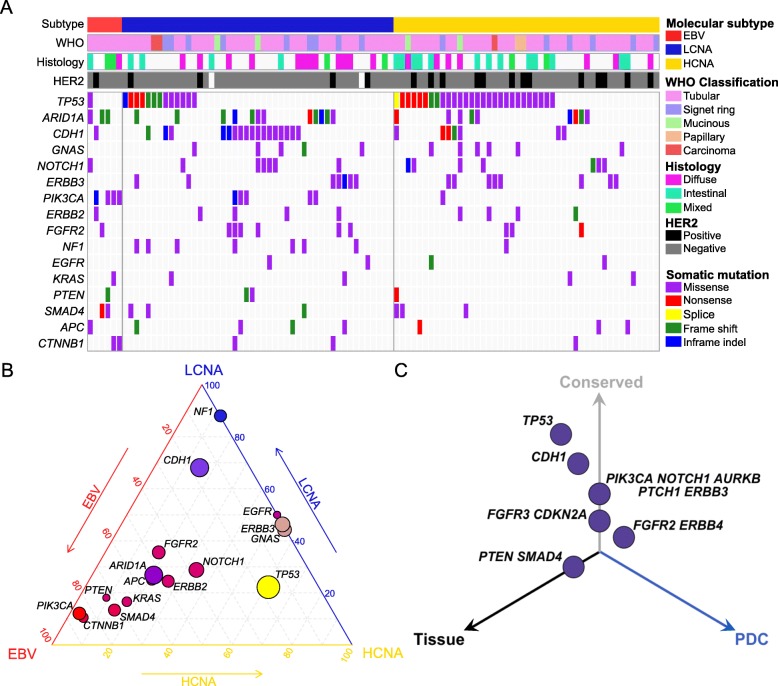
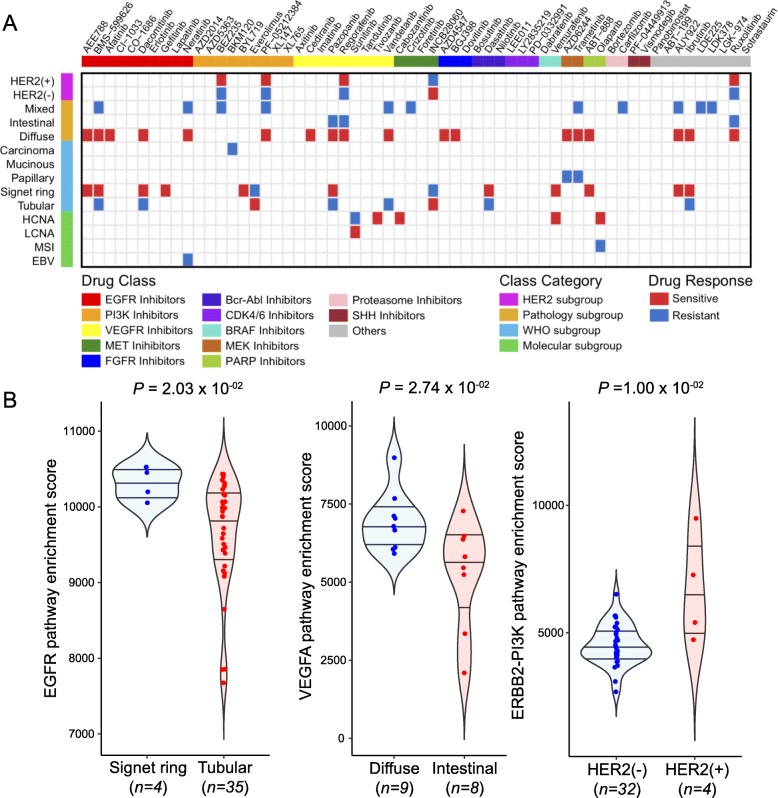
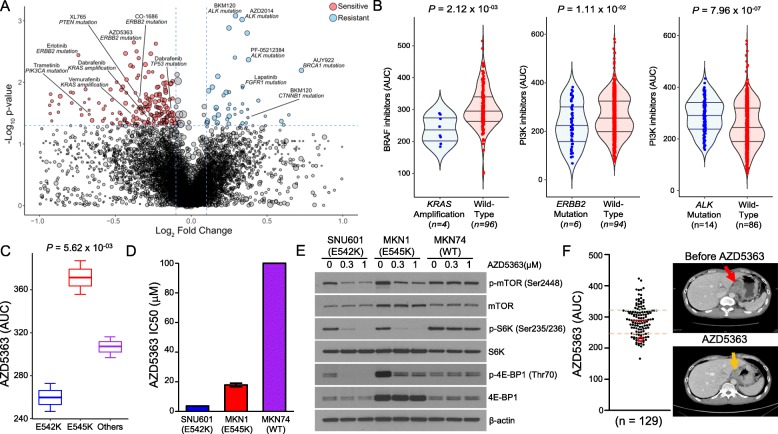
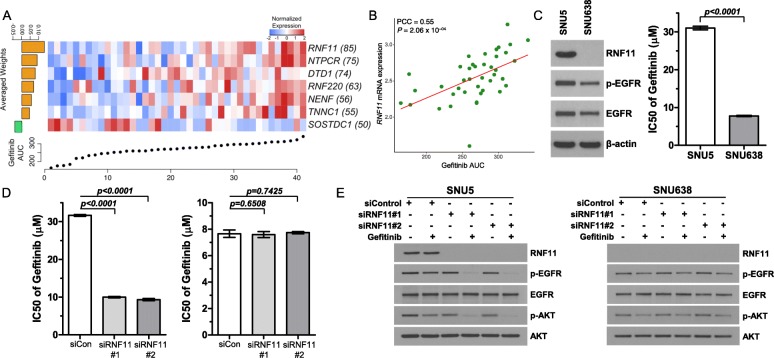
Background: Gastric cancer is among the most lethal human malignancies. Previous studies have identified molecular aberrations that constitute dynamic biological networks and genomic complexities of gastric tumors. However, the clinical translation of molecular-guided targeted therapy is hampered by challenges. Notably, solid tumors often harbor multiple genetic alterations, complicating the development of effective treatments. Methods: To address such challenges, we established a comprehensive dataset of molecularly annotated patient derivatives coupled with pharmacological profiles for 60 targeted agents to explore dynamic pharmacogenomic interactions in gastric cancers. Results: We identified lineage-specific drug sensitivities based on histopathological and molecular subclassification, including substantial sensitivities toward VEGFR and EGFR inhibition therapies in diffuse- and signet ring-type gastric tumors, respectively. We identified potential therapeutic opportunities for WNT pathway inhibitors in ALK-mutant tumors, a significant association between PIK3CA-E542K mutation and AZD5363 response, and transcriptome expression of RNF11 as a potential predictor of response to gefitinib. Conclusions: Collectively, our results demonstrate the feasibility of drug screening combined with tumor molecular characterization to facilitate personalized therapeutic regimens for gastric tumors.
Overview
The claims and statistics of this paper haven’t been checked yet.
Free: it reads the open-access text and checks the first 5 claims that cite a source we can check. Create a free account to check every claim.
Integrity signals
Registry
Cites
Statistics
Figures
Verification
Claims the paper makes
The claims and statistics of this paper haven’t been checked yet.
Free: it reads the open-access text and checks the first 5 claims that cite a source we can check. Create a free account to check every claim.
Claims other papers make about this one
Each is checked against this paper’s own text: does it say what the citing paper says it does?
The source backs part of the claim, not all of it — or backs it for a different population, condition or comparison.
In the citing paper
“The large-scale pharmacogenetic study using a drug sensitivity dataset based on patient-derived GC specimens identified the lineage-specific drug sensitivities, including the effect of epidermal growth factor receptor inhibitors for signet-ring cells, vascular endothelial growth factor receptor inhibitors for diffuse-type tumors, PARP inhibitors for tumors with BRCA2 mutation, WNT inhibitors for”
From Bioinformatics Analysis and Validation of Potential Markers Associated with Prediction and Prognosis of Gastric Cancer (2024) · cites this paper as [68]
Experimental — accuracy not yet measured
Self-check
Percentages, sums and reported differences re-computed from the paper’s own numbers.
The self-check needs the paper’s full text.
Citations
Cites
van der Togt, H. (2003) · Journal of Network and Computer Applications · doi:10.1016/s1084-8045(02)00061-9 · Cited by 304,492
Slamon, D. J., Leyland-Jones, B., Shak, S., Fuchs, H., Paton, V., Bajamonde, A., Fleming, T., Eiermann, W., Wolter, J., Pegram, M., et al. (2001) · New England Journal of Medicine · doi:10.1056/nejm200103153441101 · Cited by 11,500
The cancer genome atlas pan-cancer analysis project
The Cancer Genome Atlas Research Network, Weinstein, J. N., Collisson, E. A., Mills, G. B., Shaw, K. R. M., Ozenberger, B. A., Ellrott, K., Shmulevich, I., Sander, C., & Stuart, J. M. (2013) · Nature Genetics · doi:10.1038/ng.2764 · Cited by 9,092
The Cancer Cell Line Encyclopedia enables predictive modelling of anticancer drug sensitivity
Barretina, J., Caponigro, G., Stransky, N., Venkatesan, K., Margolin, A. A., Kim, S., Wilson, C. J., Lehár, J., Kryukov, G. V., Sonkin, D., et al. (2012) · Nature · doi:10.1038/nature11003 · Cited by 7,950
Self-citationIntegrated genomic analyses of ovarian carcinoma
Perou, C. M. (2019) · Carolina Digital Repository (University of North Carolina at Chapel Hill) · doi:10.17615/hvp3-wg08 · Cited by 7,925
Comprehensive genomic characterization defines human glioblastoma genes and core pathways
The Cancer Genome Atlas Research Network (2008) · Nature · doi:10.1038/nature07385 · Cited by 7,735
Self-citationImproved survival with vemurafenib in melanoma with BRAF V600E mutation
Chapman, P. B., Hauschild, A., Robert, C., Haanen, J. B., Ascierto, P., Larkin, J., Dummer, R., Garbe, C., Testori, A., Maio, M., et al. (2011) · New England Journal of Medicine · doi:10.1056/nejmoa1103782 · Cited by 7,720
Bang, Y.-J., Van Cutsem, E., Feyereislova, A., Chung, H. C., Shen, L., Sawaki, A., Lordick, F., Ohtsu, A., Omuro, Y., Satoh, T., et al. (2010) · The Lancet · doi:10.1016/s0140-6736(10)61121-x · Cited by 7,302
Zhang, J.-H., Chung, T. D. Y., & Oldenburg, K. R. (1999) · SLAS Discovery · doi:10.1177/108705719900400206 · Cited by 6,847
Comprehensive molecular characterization of gastric adenocarcinoma
The Cancer Genome Atlas Research Network (2014) · Nature · doi:10.1038/nature13480 · Cited by 6,498
Self-citation
Cited by
Matsuoka, T., & Yashiro, M. (2024) · International Journal of Molecular Sciences · doi:10.3390/ijms25115880 · Cited by 83
“…the effect of epidermal growth factor receptor inhibitors for signet-ring cells, vascular endothelial growth factor receptor inhibitors for diffuse-type tumors, PARP inhibitors for tumors with BRCA2 mutation, WNT inhibitors for ALK-mutant tumors, and AKT blockade for PIK3CA-E542K mutation [68].”
BackgroundAn overview of epithelial growth factor receptor (EGFR) inhibitors in cancer therapy
Alharbi, K. S., Shaikh, M. A. J., Afzal, O., Altamimi, A. S. A., Almalki, W. H., Alzarea, S. I., Kazmi, I. A., Al-Abbasi, F. A., Singh, S. K., Dua, K., et al. (2022) · Chemico-Biological Interactions · doi:10.1016/j.cbi.2022.110108 · Cited by 77
Gu, Z., Yao, Y., Yang, G., Zhu, G., Tian, Z., Wang, R., Wu, Q., Wang, Y., Wu, Y., Chen, L., et al. (2022) · Science Translational Medicine · doi:10.1126/scitranslmed.abo5987 · Cited by 84
Cao, X., Ge, S., Hua, W., Zhou, X., Lu, W., Gu, Y., Li, Z., & Qian, Y. (2022) · Journal of Nanobiotechnology · doi:10.1186/s12951-022-01481-y · Cited by 56
“Moreover, the PIK3CA E542K mutation (G70271A in exon 9) is also common in GC [10].”
BackgroundSong, X.-H., Cai, H., Shi, Z., Li, Z., Zheng, X., Yang, K., Gong, Q., Gu, Z., Hu, J., & Luo, K. (2023) · Advanced Science · doi:10.1002/advs.202306230 · Cited by 43
Li, Y., Tian, L., Zhao, T., & Zhang, J. (2023) · Cancer Immunology Immunotherapy · doi:10.1007/s00262-022-03355-6 · Cited by 27
Nam, Y., Koo, H., Yang, Y., Shin, S. H., Zhu, Z., Kim, D., Cho, H. J., Mu, Q., Choi, S. W., Sa, J. K., et al. (2023) · Genome Medicine · doi:10.1186/s13073-023-01165-8 · Cited by 25
Self-citationYu, N., Hwang, M., Lee, Y., Song, B., Kang, E. H., Sim, H., Ahn, B., Hwang, K. H., Kim, J., Hong, S. H., et al. (2023) · Journal of Experimental & Clinical Cancer Research · doi:10.1186/s13046-023-02606-3 · Cited by 28
“Fortunately, models derived from short-term–cultured patientderived cells (PDCs) retain the genomic characteristics of solid tumor biopsy better than immortalized cell lines [3, 7, 8].”
BackgroundMethodSelf-citationKim, S. T., Sa, J. K., Oh, S. Y., Kim, K., Hong, J. Y., Kang, W. K., Kim, K.-M., & Lee, J. (2021) · Genome Medicine · doi:10.1186/s13073-021-00826-w · Cited by 28
“This molecular-based classification system has emerged as an important concept in comprehending the biological behavior and genomic complexity of GC [4, 5, 28].”
BackgroundSelf-citationHuang, B., Lin, M.-H., Lu, L.-S., Chen, W., Tan, J., Zhao, J.-Y., Cao, Z.-Y., Zhu, X.-Q., & Lin, J.-M. (2020) · Journal of Cellular and Molecular Medicine · doi:10.1111/jcmm.16062 · Cited by 22
Liu, R.-Y., Wang, S.-G., Tan, X., & Zou, X.-F. (2022) · Applied Mathematical Modelling · doi:10.1016/j.apm.2022.03.004 · Cited by 16
Awuah, W. A., Roy, S., Tan, J. K., Adebusoye, F. T., Qiang, Z., Ferreira, T., Ahluwalia, A., Shet, V., Yee, A. L. W., Abdul‐Rahman, T., et al. (2024) · Journal of Cellular and Molecular Medicine · doi:10.1111/jcmm.18159 · Cited by 19
“28 Network analysis of transcriptomic data has identified the transforming growth factor-β (TGF-β ) pathway as a driver of mesenchymal behaviour in GC, which is associated with poor prognosis.”
BackgroundRNF11 at the Crossroads of Protein Ubiquitination
Mattioni, A., Castagnoli, L., & Santonico, E. (2020) · Biomolecules · doi:10.3390/biom10111538 · Cited by 20
A novel prognostic model based on migrasome-related LncRNAs for gastric cancer
Jiang, W., Shi, J., Zhu, Y., Yin, L., Song, Y. Q., Zhang, J., Lin, X., Zhong, J., Lu, Y., & Ma, Y. (2025) · Scientific Reports · doi:10.1038/s41598-025-99781-4 · Cited by 12
“Gefitinib inhibits EGFR tyrosine kinase activity, suppressing tumor cell proliferation, invasion, and metastasis while promoting apoptosis, which is relevant given EGFR overexpression in GC 80 .”
Xi, W., Zhou, C., Xu, F., Sun, D., Wang, S., Chen, Y., Ji, J. F., Ma, T., Wu, J., Shangguan, C., et al. (2022) · Journal of Translational Medicine · doi:10.1186/s12967-022-03567-5 · Cited by 12
Huo, J., Wu, L., & Zang, Y. (2021) · Journal of Translational Medicine · doi:10.1186/s12967-021-02846-x · Cited by 15
“In recent years, comprehensive genomic research of GC has received growing attention [25], but the valuable biomarkers can be assisted in clinical diagnosis and treatment were still lacking [26].”
BackgroundPiper, A., Penney, C., Holliday, J., Tincknell, G., Ma, Y., Napaki, S., Pantel, K., Brungs, D., & Ranson, M. (2024) · International Journal of Molecular Sciences · doi:10.3390/ijms25105565 · Cited by 7
“Both cell lines were sensitive to PI3K inhibition using the highly selective and potent p100 α PI3K subunit inhibitor experimental drug PIK-75 [55].”
MethodDrug Response of Patient-Derived Lung Cancer Cells Predicts Clinical Outcomes of Targeted Therapy
Kim, S., Lee, Y., Song, B., Sim, H., Kang, E. H., Hwang, M., Yu, N., Hong, S. H., Park, C., Ahn, B., et al. (2024) · Cancers · doi:10.3390/cancers16040778 · Cited by 8
“This weakness of the PDC model led to the proposal of a short-term PDC model that can accurately represent the original tumor [15–17].”
MethodSelf-citationWang, D.-J., & Lei, J. (2025) · Journal of Mathematical Biology · doi:10.1007/s00285-025-02220-1 · Cited by 6
“These variations suggest the potential for adjusting drug doses to accommodate individual patient differences, aligning with clinical findings that under-score considerable variability in drug sensitivity across patient populations (Sa et al. 2020).”
Cheng, Q.-L., Li, Y.-C., Guo, X.-H., & Li, H. (2020) · Journal of Ethnopharmacology · doi:10.1016/j.jep.2020.113437 · Cited by 6
Synergistic effects of bloom helicase (BLM) inhibitor AO/854 with cisplatin in prostate cancer
Ma, X., Tian, F., Xiao, Y.-P., Huang, M., Song, D., Chen, X., & Xu, H. (2024) · Scientific Reports · doi:10.1038/s41598-024-75938-5 · Cited by 5
“The newly published foundational research on the PARP inhibitor olaparib in molecularly unselected patients with extensively pretreated CRPC demonstrated excellent antitumor responses in patients with DNA repair gene abnormalities 56 .”
Oh, J.-W., Oh, Y. J., Han, S., Her, N.-G., & Nam, D. (2021) · Cancers · doi:10.3390/cancers13030372 · Cited by 9
“A recent high throughput screening using a pan-cancer tumor spheroid reported the first large-scale pharmacogenetic study [17], and cancer types were expanded to gynecologic and gastric cancers [18,19].”
BackgroundSelf-citationWang, G., Liu, L., Zhao, Y., Lin, Y., & Er, L. (2025) · Medicine · doi:10.1097/md.0000000000040332 · Cited by 4
Wei, C., Li, X., Wei, Z., Kang, B., Fu, J., Wang, X., Chen, M., Zhou, X., Wei, Q., & Wang, C. (2025) · Cellular Signalling · doi:10.1016/j.cellsig.2025.112088 · Cited by 3
Xu, R., He, D., Sun, R., Zhou, J., Xin, M., Liu, Q., Dai, Y., Li, H., Zhang, Y., Li, J., et al. (2025) · Journal of Translational Medicine · doi:10.1186/s12967-025-06222-x · Cited by 2
“We collected data on drugs that are highly resistant or highly sensitive in DGC and IGC from published studies [35] and evaluated their efficacy using the half maximal inhibitory concentration (IC50) values.”
Precision medicine for gastric cancer patients guided by molecular classifications
Shin, M., & Cheong, J. (2023) · Foregut Surgery · doi:10.51666/fs.2023.3.e8
Metadata
- Authors
- Sa, J. K., Hong, J. Y., Lee, I.-K., Kim, J.-S., Sim, M.-H., Kim, H. J., An, J. Y., Sohn, T. S., Lee, J. H., Bae, J. M., Kim, S., Kim, K.-M., Kim, S. T., Park, S. H., Park, J. O., Lim, H. Y., Kang, W. K., Her, N.-G., Lee, Y., Cho, H. J., Shin, Y. J., Kim, M., Koo, H., Kim, M., Seo, Y. J., Kim, J. Y., Choi, M.-G., Nam, D.-H., & Lee, J.
- Affiliations
- Korea University (KR)
- Samsung Medical Center (KR)
- Corresponding author
- Lee, Joon Ho
- Choi, Min-Gew
- Nam, Do-Hyun
- Lee, Jeeyun
- ORCID
- Venue
- Genome Medicine
- Published
- 2020-02-18
- Volume
- 12
- Issue
- 1
- Pages
- 17-17
- ISSN
- 1756-994X (ISSN-L)
- PMC
- PMC7029441
- OpenAlex
- W3011823531
- Semantic Scholar
- 9468426ad1b496c8c1427162aa7f3ee1151532cf
- Cited by
- 46
- References
- 76
- Citations by year
- 2025: 6 · 2024: 6 · 2023: 7 · 2022: 14 · 2021: 9 · 2020: 4
- FWCI
- 5.78
- Type
- journal article
- Language
- en
- Open access
- gold
- doi.org
- Licence
- cc-by
- creativecommons.org/licenses/by/4.0/ (tdm)
- creativecommons.org/licenses/by/4.0/ (vor)
- Locations
- Genome Medicine (publishedVersion, cc-by)
- Europe PMC (PubMed Central) (publishedVersion, cc-by)
- PubMed Central (publishedVersion, cc-by)
- PubMed (publishedVersion)
- DOAJ (DOAJ: Directory of Open Access Journals) (submittedVersion, cc-by-sa)
- Funders
- Ministry of Health and Welfare (HI14C3418)
- Topics
- Health Sciences › Medicine › Oncology › Gastric Cancer Management and Outcomes
- Life Sciences › Biochemistry, Genetics and Molecular Biology › Cancer Research › Cancer Genomics and Diagnostics
- Health Sciences › Medicine › Pulmonary and Respiratory Medicine › Lung Cancer Treatments and Mutations
- Keywords
- gastric cancer, pharmacogenomics, drug sensitivity, targeted therapy, VEGFR inhibitors, EGFR inhibitors, diffuse-type gastric cancer, signet ring cell carcinoma, Wnt pathway inhibitors, ALK mutations, AZD5363, gefitinib, RNF11, drug screening, personalized treatment
- MeSH terms
- Pharmacogenomic Variants, Gefitinib, Antineoplastic Agents, DNA-Binding Proteins, Humans, Mutation, Pyrimidines, Pyrroles, Stomach Neoplasms, Tumor Cells, Cultured, Drug Resistance, Neoplasm, Receptors, Vascular Endothelial Growth Factor, Cell Line, Tumor, Protein Kinase Inhibitors, Class I Phosphatidylinositol 3-Kinases, Transcriptome, Wnt Signaling Pathway, ErbB Receptors
About these checks
Registry, retraction, Cites and statistics results are computed, not judged, with one exception: a printed reference that no index lists is read once by a model before it counts as a citation error. Claims are extracted by a model and kept only when their quote appears verbatim in the text; each cited source is then checked, with a model’s help, for whether it says what the claim relies on. Those verdicts can be wrong — read the claim’s quote and the cited source before relying on one.
Statistics and arithmetic are recomputed, not judged.
Confidence bands are shown only for fields calibrated on our annotated test set. None is calibrated yet, so no band is shown.
What counts as a claim ›How we measure confidence ›How we check this ›
Are you an author, or do you see a problem with this page? Request a review
Data sources
Bibliographic data: Semantic Scholar, OpenAlex, Crossref.
Contains information from the Semantic Scholar Academic Graph Datasets, made available under the ODC Attribution License (ODC-BY 1.0).
Semantic Scholar’s data is described in: Kinney, R., et al. (2023). The Semantic Scholar Open Data Platform. arXiv:2301.10140.
