

Role of the intestinal microbiome and microbial-derived metabolites in immune checkpoint blockade immunotherapy of cancer
Open accessThe DOI matches its Crossref record; 70 of the 70 references it cites were found in a registry or an index.
Abstract
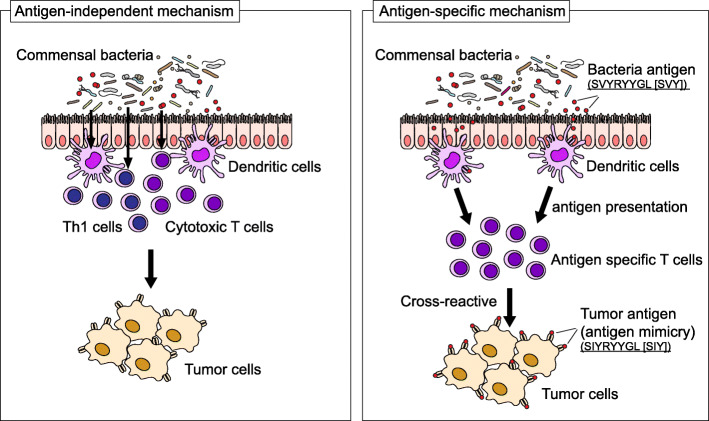
Immune checkpoint inhibitors (ICIs) are monoclonal antibodies that block immune inhibitory pathways. Administration of ICIs augments T cell-mediated immune responses against tumor, resulting in improved overall survival in cancer patients. It has emerged that the intestinal microbiome can modulate responses to ICIs via the host immune system and that the use of antibiotics can lead to reduced efficacy of ICIs. Recently, reports that fecal microbiota transplantation can lead to ICI therapy responses in patients previously refractory to therapy suggest that targeting the microbiome may be a viable strategy to reprogram the tumor microenvironment and augment ICI therapy. Intestinal microbial metabolites may also be linked to response rates to ICIs. In addition to response rates, certain toxicities that can arise during ICI therapy have also been found to be associated with the intestinal microbiome, including in particular colitis. A key mechanistic question is how certain microbes can enhance anti-tumor responses or, alternatively, predispose to ICI-associated colitis. Evidence has emerged that the intestinal microbiome can modulate outcomes to ICI therapies via two major mechanisms, including those that are antigen-specific and those that are antigen-independent. Antigen-specific mechanisms occur when epitopes are shared between microbial and tumor antigens that could enhance, or, alternatively, reduce anti-tumor immune responses via cross-reactive adaptive immune cells. Antigen-independent mechanisms include modulation of responses to ICIs by engaging innate and/or adaptive immune cells. To establish microbiome-based biomarkers of outcomes and specifically modulate the intestinal microbiome to enhance efficacy of ICIs in cancer immunotherapy, further prospective interventional studies will be required.
Overview
The claims and statistics of this paper haven’t been checked yet.
Free: it reads the open-access text and checks the first 5 claims that cite a source we can check. Create a free account to check every claim.
Integrity signals
Registry
Cites
Statistics
Figures
Verification
Claims the paper makes
The claims and statistics of this paper haven’t been checked yet.
Free: it reads the open-access text and checks the first 5 claims that cite a source we can check. Create a free account to check every claim.
Claims other papers make about this one
Each is checked against this paper’s own text: does it say what the citing paper says it does?
In the citing paper
“SCFAs, such as acetate, propionate, and butyrate, are products of microbial conversion of ingested dietary fiber and mucosal glycans and exert an impact on immune responses [73].”
From A Clinical Outcome of the Anti-PD-1 Therapy of Melanoma in Polish Patients Is Mediated by Population-Specific Gut Microbiome Composition (2022) · cites this paper as [73]
Self-check
Percentages, sums and reported differences re-computed from the paper’s own numbers.
The self-check needs the paper’s full text.
Citations
Cites
1 retracted
RETRACTED ARTICLE: Microbiome analyses of blood and tissues suggest cancer diagnostic approach
Poore, G. D., Kopylova, E., Zhu, Q., Carpenter, C., Fraraccio, S., Wandro, S., Kosciolek, T., Janssen, S., Metcalf, J., Song, S. J., et al. (2020) · Nature · doi:10.1038/s41586-020-2095-1 · Cited by 989 · cited 1×
“While sequencing center heterogeneity in technical and computational procedures are known to impact substantially on microbiome readouts [31, 32], this is primarily a challenge only when attempting to combine microbiome results from different groups and should not impact on single-center study results.”
BackgroundRetractedAdverse Renal Effects of Immune Checkpoint Inhibitors: A Narrative Review
Wanchoo, R., Karam, S., Uppal, N. N., Barta, V. S., Deray, G., Devoe, C., Launay-Vacher, V., Jhaveri, K. D., & on behalf of Cancer and Kidney International Network Workgroup on Immune Checkpoint Inhibitors (2017) · American Journal of Nephrology · doi:10.1159/000455014 · Cited by 15,256
Improved Survival with Ipilimumab in Patients with Metastatic Melanoma
Hodi, F. S., O'Day, S. J., McDermott, D. F., Weber, R. W., Sosman, J. A., Haanen, J. B., Gonzalez, R., Robert, C., Schadendorf, D., Hassel, J. C., et al. (2010) · New England Journal of Medicine · doi:10.1056/nejmoa1003466 · Cited by 15,155
Combined Nivolumab and Ipilimumab or Monotherapy in Untreated Melanoma
Larkin, J., Chiarion-Sileni, V., Gonzalez, R., Grob, J. J., Cowey, C. L., Lao, C. D., Schadendorf, D., Dummer, R., Smylie, M., Rutkowski, P., et al. (2015) · New England Journal of Medicine · doi:10.1056/nejmoa1504030 · Cited by 8,157
Safety and activity of anti-PD-L1 antibody in patients with advanced cancer
Brahmer, J. R., Tykodi, S. S., Chow, L. Q. M., Hwu, W.-J., Topalian, S. L., Hwu, P., Drake, C. G., Camacho, L. H., Kauh, J., Odunsi, K., et al. (2012) · New England Journal of Medicine · doi:10.1056/nejmoa1200694 · Cited by 7,945 · cited 1×
“treatments have been found to improve overall survival in patients with multiple cancer types [3, 5].”
BackgroundGut microbiome influences efficacy of PD-1-based immunotherapy against epithelial tumors
Routy, B., Le Chatelier, E., Derosa, L., Duong, C. P. M., Alou, M. T., Daillère, R., Fluckiger, A., Messaoudene, M., Rauber, C., Roberti, M. P., et al. (2018) · Science · doi:10.1126/science.aan3706 · Cited by 5,671
Gut microbiome modulates response to anti-PD-1 immunotherapy in melanoma patients
Gopalakrishnan, V., Spencer, C. N., Nezi, L., Reuben, A., Andrews, M. C., Karpinets, T. V., Prieto, P. A., Vicente, D., Hoffman, K., Wei, S. C., et al. (2018) · Science · doi:10.1126/science.aan4236 · Cited by 4,812 · cited 1×
“Ruminococcaceae family members in melanoma patients responding to anti-PD-1 antibody [26].”
BackgroundSelf-citationNivolumab plus Ipilimumab in Advanced Melanoma
Wolchok, J. D., Kluger, H., Callahan, M. K., Postow, M. A., Rizvi, N. A., Lesokhin, A. M., Segal, N. H., Ariyan, C. E., Gordon, R.-A., Reed, K., et al. (2013) · New England Journal of Medicine · doi:10.1056/nejmoa1302369 · Cited by 4,230
Interactions Between the Microbiota and the Immune System
Hooper, L. V., Littman, D. R., & Macpherson, A. J. (2012) · Science · doi:10.1126/science.1223490 · Cited by 4,173 · cited 1×
“The intestinal microbiome plays a particularly important role in shaping systemic immune responses [14, 15].”
BackgroundCommensal Bifidobacterium promotes antitumor immunity and facilitates anti–PD-L1 efficacy
Sivan, A., Corrales, L., Hubert, N., Williams, J. B., Aquino-Michaels, K., Earley, Z. M., Benyamin, F. W., Man Lei, Y., Jabri, B., Alegre, M.-L., et al. (2015) · Science · doi:10.1126/science.aac4255 · Cited by 3,888 · cited 1×
“Profiling of the intestinal bacterial composition of these mice using 16S ribosomal RNA (16S rRNA) analysis found that intestinal Bifidobacterium was associated with superior anti-tumor effects of antiPD-L1 antibody [25].”
Background
Cited by
Items 101–154 of 154
Intra-tumoral microbiota: Key modulators of tumor immunity and therapeutic potential
He, J., Tan, H. Z., Qiu, Y., Dan, Y., Wan, Q., Li, L., Wu, J., Song, Q., Chen, H., & Xu, B. (2025) · Genes & Diseases · doi:10.1016/j.gendis.2025.101963 · Cited by 5
Kashyap, S., & Das, A. (2023) · Acta Microbiologica et Immunologica Hungarica · doi:10.1556/030.2023.02054 · Cited by 5
Fang, X., Tong, W., Wu, S., Zhu, Z., & Zhu, J. (2024) · ONCOLOGIE · doi:10.1515/oncologie-2023-0511 · Cited by 5
Effects of antibiotics on the anti-tumor efficacy of immune checkpoint inhibitor therapy
Nie, F., Guo, J., Pan, J., Guo, Z., Wang, C., Yan, J., & Ma, W. (2024) · Clinical and Translational Oncology · doi:10.1007/s12094-024-03615-0 · Cited by 4
“Intestinal microbiota has recently been explored as a predictor of immunotherapy efficacy [17–19].”
Mechanisms and therapeutic strategies for immunotherapy resistance in gastric cancer
Zhang, Z., Wu, C., Hu, X., Zhang, L., & Dong, X. (2025) · Cancer Cell International · doi:10.1186/s12935-025-04110-4 · Cited by 4
An overview of the role of the gut microbiota in rheumatoid arthritis
Poznyak, A. V., Vatlin, A. A., Pavshintsev, V. V., Mitkin, N. A., Maltseva, O. N., Utkina, A. S., & Orekhov, A. N. (2026) · Microbiome Research Reports · doi:10.20517/mrr.2025.69 · Cited by 4
Machado, A. P., Shatila, M., Aujla, P., Huey, R. W., Wang, Y., & Thomas, A. S. (2024) · Annals of Gastroenterology · doi:10.20524/aog.2024.0935 · Cited by 4
Unveiling the gut-pancreas axis: microbial influence on stemness and tumor microenvironment of PDAC
Arikath, K., Batra, S. K., & Ponnusamy, M. P. (2025) · Stem Cells · doi:10.1093/stmcls/sxaf064 · Cited by 4
Development and treatment of colorectal cancer: Insights from multi‐kingdom microbiota
Hong, Y.-M., Song, D., Liu, N., & Wang, H. (2023) · Aging and Cancer · doi:10.1002/aac2.12063 · Cited by 3
Koustas, E., Trifylli, E.-M., Oraiopoulos, V., Karamouzis, M. V., & Sarantis, P. (2026) · Genes · doi:10.3390/genes17060674 · Cited by 3
Clinical characteristics and therapies of multi-organ immune related adverse events
Wang, D., Zhou, Y., Li, H., Xin, Y., Yuan, M., Mu, W., Qu, X., Liu, Y., Shen, L., Liu, Y., et al. (2026) · Clinical and Experimental Medicine · doi:10.1007/s10238-026-02052-3 · Cited by 3
Ukpoju-Ebonyi, O. M., Ebonyi, J.-M. A., Ogunjobi, T. T., Obasi, D. E., Ugwu, D. C., Anyanwu, G. O., & Abolade, S. O. (2025) · Medinformatics · doi:10.47852/bonviewmedin52025831 · Cited by 3
Bi, Q., Zhang, L., Wan, H., & Zhang, J. (2026) · Molecular Biology Reports · doi:10.1007/s11033-026-11988-4 · Cited by 2
Microbiome therapeutics for the cancer management
Punetha, A., & Punetha, A. K. (2023) · Elsevier eBooks · doi:10.1016/b978-0-323-99336-4.00012-4 · Cited by 2
Ziogas, D. C., Theocharopoulos, C., Martinos, A., Lyrarakis, G., Stefanou, D. T., Anastasopoulou, A. N., & Gogas, H. (2026) · Current Oncology Reports · doi:10.1007/s11912-026-01744-z · Cited by 2
Petouhoff, A., Hicks, R., Husain, M., Hoyd, R., Xu, M., Dravillas, C. E., Patel, S. H., Johns, A. C., Grogan, M. M., Li, M., et al. (2026) · Cancer Immunology Immunotherapy · doi:10.1007/s00262-026-04346-7 · Cited by 2
Valaei, A., Zahmatkesh, N., Aghaei, R., Maleki, M., Meskini, M., & Siadat, S. D. (2026) · New Microbes and New Infections · doi:10.1016/j.nmni.2026.101805 · Cited by 2
Kawuribi, V., Awere‐Duodu, A., Adjei, F. A., Osman, A.-H., Bomansaan, H., Madadi, M. M., Tampuri, J. U., & Adu‐Amankwaah, J. (2026) · Critical Reviews in Oncology/Hematology · doi:10.1016/j.critrevonc.2026.105280 · Cited by 2
Федосова, Н. І., Черемшенко, Н. Л., Gogol, S., Bezdieniezhnykh, N., Tikhonov, V. G., Voyeykova, I. M., Konovalenko, V. F., & Chekhun, V. F. (2024) · Experimental Oncology · doi:10.15407/exp-oncology.2024.03.228 · Cited by 2
The Potential Anticancer Mechanisms of Probiotics: A Comprehensive Review
Tang, C., Qian, Y., Jia, S., Zhang, J., Zhang, Y., Ren, Y., Yong, H., Xu, J., Kan, J., & Liu, J. (2025) · Probiotics and Antimicrobial Proteins · doi:10.1007/s12602-025-10753-6 · Cited by 2
Emerging roles of Notch signaling in the tumor microenvironment of digestive system cancers
Shi, Q., Yang, S., Fu, L., & Chen, X. F. (2026) · Frontiers in Molecular Biosciences · doi:10.3389/fmolb.2026.1840769 · Cited by 2
Mechanistic insights and therapeutic innovation in immune-related adverse events
Zhou, Z., Mao, Z., Li, H., Zeng, W., Tan, C., Zhang, H., & Mei, L. (2026) · International Immunopharmacology · doi:10.1016/j.intimp.2026.116801 · Cited by 2
Decoding the link between microbial secondary metabolites and colorectal cancer
Wang, S., & Wu, M. (2025) · Computational Biology and Chemistry · doi:10.1016/j.compbiolchem.2025.108372 · Cited by 2
Lu, Z., Chen, G., Qiu, J., Huo, X., & Xu, X. (2026) · Frontiers in Immunology · doi:10.3389/fimmu.2026.1862118 · Cited by 2
Engineering oral commensal nanovaccines to activate mucosal-systemic immune cascades against tumor
Dong, Z., Li, S., Wei, Y., Zhao, J., Kong, W., Liu, W., Chen, J. Y., He, H., Yang, J., & Qi, J. (2026) · Cell Host & Microbe · doi:10.1016/j.chom.2026.06.021 · Cited by 2
Long, D., Ding, Y., Wang, P., Wei, L. S., & Ma, K. (2025) · International Journal of Molecular Sciences · doi:10.3390/ijms26031066 · Cited by 2
Burakova, I. Y., Dmitrievna, S. Y., Dmitrievna, M. P., Pogorelova, S. V., Kryukova, O. N., Kislova, T. A., Korneeva, O. S., & Syromyatnikov, M. (2026) · Experimental Biology and Medicine · doi:10.3389/ebm.2026.10894 · Cited by 2
Immunotherapeutic strategies in hepatopancreatobiliary cancers
Salati, M., Rizzo, A., Ricci, A. D., Petrillo, A., & Parisi, A. (2024) · Elsevier eBooks · doi:10.1016/b978-0-443-13376-3.00014-9 · Cited by 1
Predictors of response for hepatocellular carcinoma immunotherapy: is there anything on the horizon?
Rizzo, A., & Ricci, A. D. (2022) · Expert Review of Precision Medicine and Drug Development · doi:10.1080/23808993.2022.2075724 · Cited by 1
Shatila, M., Abdul-Baki, K., Rivera, A. C. U., Takigawa, K., Lee, I. J.-A., Sullivan, A., Gupta, T., Lu, L., Menon, R., Khan, A., et al. (2025) · Cancer Medicine · doi:10.1002/cam4.71123 · Cited by 1
Gut microbiota and acute kidney injury: immunological crosstalk link
Ali, A. M. M., Wu, L., & Ali, S. S. (2023) · International Urology and Nephrology · doi:10.1007/s11255-023-03760-5 · Cited by 1
Molecular and Immunological Mechanisms Underlying the Anticancer Effects of Bifidobacterium
Ravichandran, N., Uvarajan, D., Karuppusamy, P. A., Gnanarajan, R., Govindharaj, J., Mohanraj, S. V. P., Ravikumar, M., Mahendran, K., Vellingiri, B., & Narayanasamy, A. (2026) · Probiotics and Antimicrobial Proteins · doi:10.1007/s12602-026-11057-z · Cited by 1
Krasnow, N. A., Chute, D. F., Falade, A. S., North, C. M., Reynolds, K. L., & Dougan, M. L. (2023) · Immunotherapy · doi:10.2217/imt-2022-0245 · Cited by 1
Sanabria, A. M., Bjørnetrø, T., Fuglestad, A. J., Meltzer, S., Køstner, A. H., Lüders, T., Kersten, C., & Ree, A. H. (2026) · Frontiers in Microbiology · doi:10.3389/fmicb.2026.1802448 · Cited by 1
Feng, N., Wang, S., Liu, C., Xu, Z., Song, Z., Li, K., & Yu, Z. (2022) · Frontiers in Genetics · doi:10.3389/fgene.2022.1069780 · Cited by 1
Park, A., Park, Y.-H., Kang, Y., Park, J., Park, G.-S., Ju, Y.-H., Hwang, W., & Kang, J. L. (2024) · bioRxiv (Cold Spring Harbor Laboratory) · doi:10.1101/2024.04.25.591046 · Cited by 1
Vitetta, L. (2023) · Medical Oncology · doi:10.1007/s12032-023-02006-9 · Cited by 1
Zhou, Y., Bi, Y., Wan, M., Xu, N., Xu, Y., Liu, P., Jiang, H., Fang, H., Hu, H., Xu, S., et al. (2024) · International Journal of Radiation Research · doi:10.61186/ijrr.22.2.463 · Cited by 1
Moeckli, B., Rocha, M., Wassmer, C., Hajji, S. E., Collet, T., Lacotte, S., & Toso, C. (2026) · Cancer Epidemiology · doi:10.1016/j.canep.2026.103079
Molecular orchestra of microbiotic metabolites in the scenario of carcinogenesis
Shatova, O. P., Zabolotneva, A. A., & Shestopalov, A. V. (2023) · Biochemistry (Moscow) · doi:10.31857/s0320972523070023
Bacteriophages as emerging modulators of antitumor immunity in the tumor microenvironment
Chen, X., Zhang, J., Gao, F., & Du, H. (2026) · Microbiological Research · doi:10.1016/j.micres.2026.128700
Introduction on Personalized Immune-Oncology
Abadi, B., & Rezaei, N. (2022) · Springer eBooks · doi:10.1007/978-3-030-80962-1_286-1
Introduction on Personalized Immune-Oncology
Abadi, B., & Rezaei, N. (2025) · Springer eBooks · doi:10.1007/978-3-032-00773-5_286
Bohm, M. S., Yarbro, J. R., Torres, C. F., Mustafa, Z. T., Chaib, M., Mims, T. S., Joseph, S., Elasy, J. H., Sipe, L. M., Cook, K. L., et al. (2026) · Scientific Reports · doi:10.1038/s41598-026-59669-3
Zhu, C., Wang, Y., Zhu, R., Wang, S., Xue, J., Zhang, D., Lan, Z., Zhang, C., Liang, Y., Zhang, N., et al. (2024) · Figshare · doi:10.6084/m9.figshare.26729359
Role of chemokines and chemokine receptors in cancer immunology
Babu, D., Natarajan, K., Rajaram, G., Arulsamy, S., & Natarajan, K. (2026) · Elsevier eBooks · doi:10.1016/b978-0-443-41551-7.00020-5
Duttagupta, S. (2026) · Papyrus : Institutional Repository (Université de Montréal) · doi:10.71781/36317
Spessotto, P., Orbosuè, F., Mongiat, M., Maiero, S., Sartori, M., Guardascione, M., Foltran, L., Fumagalli, A., de Scordilli, M., Bearz, A., et al. (2026) · Nutrients · doi:10.3390/nu18183086
Withaferin A and Immune Checkpoint Blocker Therapy for the Treatment of Non-Small Cell Lung Cancer
Khalil, R. (2023) · Digital Commons - University of South Florida (University of South Florida)
Luo, S., Huang, L., Hou, E., Liu, S., Li, Y., Xiao, S., Wang, Y., Wang, Y., & Zong, X. (2026) · Science China Life Sciences · doi:10.1007/s11427-025-3364-1
Li, R., Huang, X., Yang, L., Liang, X., Huang, W., Lai, K. P., & Zhou, L. (2022) · doi:10.3389/fnut.2022.867692.s001
Immunotherapy response may be modulated by microbiome
Kämmerer, S. (2022) · doi:10.55788/45197538
The Role of Microbiome-Immune Crosstalk in Personalized Immunotherapy
-, A. B. (2025) · International Journal For Multidisciplinary Research · doi:10.36948/ijfmr.2025.v07i02.38704
Metadata
- Authors
- Hayase, E., & Jenq, R. R.
- Affiliations
- The University of Texas MD Anderson Cancer Center (US)
- Corresponding author
- Jenq, Robert R.
- Venue
- Genome Medicine
- Published
- 2021-06-23
- Volume
- 13
- Issue
- 1
- Pages
- 107-107
- ISSN
- 1756-994X (ISSN-L)
- PMC
- PMC8220726
- OpenAlex
- W3173553906
- Cited by
- 145
- References
- 70
- Citations by year
- 2026: 21 · 2025: 20 · 2024: 33 · 2023: 33 · 2022: 31 · 2021: 7
- FWCI
- 3.15
- Type
- journal article
- Language
- en
- Open access
- gold
- doi.org
- Licence
- cc-by
- creativecommons.org/licenses/by/4.0 (tdm)
- creativecommons.org/licenses/by/4.0 (vor)
- Locations
- Genome Medicine (publishedVersion, cc-by)
- PubMed Central (publishedVersion, cc-by)
- PubMed (publishedVersion)
- DOAJ (DOAJ: Directory of Open Access Journals) (submittedVersion, cc-by-sa)
- Funders
- Cancer Prevention and Research Institute of Texas (RR160089)
- Foundation for the National Institutes of Health (R01HL124112 and P30CA016672)
- Topics
- Health Sciences › Medicine › Oncology › Cancer Immunotherapy and Biomarkers
- Life Sciences › Biochemistry, Genetics and Molecular Biology › Molecular Biology › Gut microbiota and health
- Life Sciences › Immunology and Microbiology › Immunology › Immunotherapy and Immune Responses
- Keywords
- gut microbiota, immune checkpoint inhibitors, cancer immunotherapy, microbial metabolites, fecal microbiota transplantation, tumor microenvironment, microbiome biomarkers, immune checkpoint blockade
- MeSH terms
- Gastrointestinal Microbiome, Antineoplastic Agents, Immunological, Host Microbial Interactions, Immune Checkpoint Inhibitors, Anti-Bacterial Agents, Antineoplastic Combined Chemotherapy Protocols, Colitis, Humans, Models, Biological, Neoplasms, Metabolomics, Metabolome, Dysbiosis
About these checks
Registry, retraction, Cites and statistics results are computed, not judged, with one exception: a printed reference that no index lists is read once by a model before it counts as a citation error. Claims are extracted by a model and kept only when their quote appears verbatim in the text; each cited source is then checked, with a model’s help, for whether it says what the claim relies on. Those verdicts can be wrong — read the claim’s quote and the cited source before relying on one.
Statistics and arithmetic are recomputed, not judged.
Confidence bands are shown only for fields calibrated on our annotated test set. None is calibrated yet, so no band is shown.
What counts as a claim ›How we measure confidence ›How we check this ›
Are you an author, or do you see a problem with this page? Request a review
Data sources
Bibliographic data: Semantic Scholar, OpenAlex, Crossref.
Contains information from the Semantic Scholar Academic Graph Datasets, made available under the ODC Attribution License (ODC-BY 1.0).
Semantic Scholar’s data is described in: Kinney, R., et al. (2023). The Semantic Scholar Open Data Platform. arXiv:2301.10140.
