

The DOI matches its Crossref record; 20 of the 20 references it cites were found in a registry or an index.
Sirukumab in rheumatoid arthritis refractory to sulfasalazine or methotrexate: a randomized phase 3 safety and efficacy study in Japanese patients
Abstract
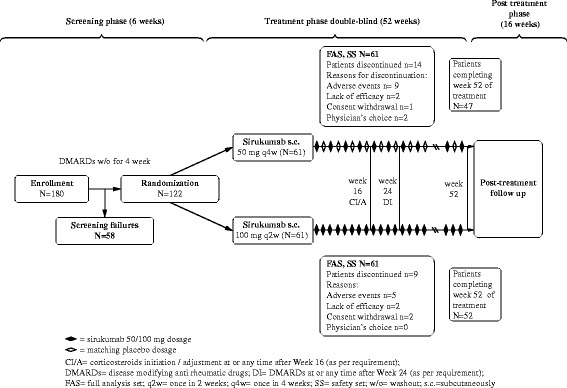
BACKGROUND: Sirukumab, a high-affinity human monoclonal antibody that selectively binds to interleukin-6, has demonstrated efficacy in the treatment of rheumatoid arthritis (RA) in global phase 1 and phase 2 studies. The present study evaluated the safety and efficacy of sirukumab, as monotherapy in Japanese patients with RA refractory to methotrexate or sulfasalazine. METHODS: In this phase 3, double-blind study, 122 patients (age ≥ 20 years) were randomized (1:1, 61 patients in each arm) to sirukumab administered subcutaneously: 50 mg once every 4 weeks (q4w) or 100 mg once every 2 weeks (q2w) through 52 weeks. Disease-modifying anti-rheumatic drugs were allowed after 24 weeks. Safety was assessed and efficacy was evaluated using American College of Rheumatology (ACR) responses, Disease Activity Score C-reactive protein (DAS28-CRP) and Health Assessment Questionnaire-Disability Index (HAQ-DI). RESULTS: Amongst the 122 randomized patients, 99 (81.1%) patients completed the study. Adverse events (AEs) were reported in 114/122 (93.4%) patients and serious AEs were reported in 9/122 (7.4%) patients. No deaths, major cardiovascular AEs, serious gastrointestinal perforations or tuberculosis cases were reported during this study period. Grade 3 hematologic abnormalities (neutropenia and leukopenia) were reported in seven patients and no grade 4 abnormalities were observed. ACR20 responses were observed within 2 weeks, achieved in 47/61 (77.0%, 50 mg q4w) patients and 44/61 (72.1%, 100 mg q2w) patients at week 16 and maintained through week 52. ACR50/70, DAS28-CRP and HAQ-DI responses were also maintained through week 52 in both groups. CONCLUSIONS: Safety findings were comparable between the two treatment groups. The 52-week administration of sirukumab at 50 mg q4w and 100 mg q2w was generally tolerable and with measurable efficacy in Japanese patients with RA refractory to methotrexate and sulfasalazine. TRIAL REGISTRATION: NCT01689532 . Registered 18 September 2012.
Overview
The claims and statistics of this paper haven’t been checked yet.
Run the check — free, no account needed. It reads the open-access text and checks the sources it cites.
Integrity signals
Registry
Cites
Statistics
Figures
Verification
Claims the paper makes
The claims and statistics of this paper haven’t been checked yet.
Run the check — free, no account needed. It reads the open-access text and checks the sources it cites.
Claims other papers make about this one
Each is checked against this paper’s own text: does it say what the citing paper says it does?
In the citing paper
“a study of 122 RA patients treated with sirukumab for 52 weeks in Japan reported no deaths, major cardiovascular events, or serious gastrointestinal perforation”
From Targeting Interleukin-6 Signaling in Clinic (2019) · cites this paper as Takeuchi et al., 2018
Self-check
Percentages, sums and reported differences re-computed from the paper’s own numbers.
The self-check needs the paper’s full text.
Citations
Cites
Smolen, J. S., Beaulieu, A., Rubbert-Roth, A., Ramos-Remus, C., Rovensky, J., Alecock, E., Woodworth, T., & Alten, R. (2008) · The Lancet · doi:10.1016/s0140-6736(08)60453-5 · Cited by 1,399
Maini, R. N., Taylor, P. C., Szechinski, J., Pavelka, K., Bröll, J., Balint, G., Emery, P., Raemen, F., Petersen, J., Smolen, J., et al. (2006) · Arthritis & Rheumatism · doi:10.1002/art.22033 · Cited by 790
Excessive production of interleukin 6/B cell stimulatory factor-2 in rheumatoid arthritis
Hirano, T., Matsuda, T., Turner, M., Miyasaka, N., Buchan, G., Tang, B., Sato, K., Shimi, M., Maid, R., Feldmann, M., et al. (1988) · European Journal of Immunology · doi:10.1002/eji.1830181122 · Cited by 784
Methotrexate for Rheumatoid Arthritis
Kremer, J. M., Alarcón, G. S., Lightfoot, R. W., Willkens, R. F., Furst, D. E., Williams, H. J., Dent, P. B., & Weinblatt, M. E. (1994) · Arthritis & Rheumatism · doi:10.1002/art.1780370304 · Cited by 607
Anti-TNF biologic agents: still the therapy of choice for rheumatoid arthritis
Taylor, P. C., & Feldmann, M. (2009) · Nature Reviews Rheumatology · doi:10.1038/nrrheum.2009.181 · Cited by 389
Nishimoto, N., Miyasaka, N., Yamamoto, K., Kawai, S., Takeuchi, T., & Azuma, J. (2009) · Annals of the Rheumatic Diseases · doi:10.1136/ard.2008.092866 · Cited by 337
Self-citationBurmester, G., Rubbert-Roth, A., Cantagrel, A., Hall, S., Leszczyński, P., Feldman, D., Rangaraj, M. J., Roane, G., Ludivico, C., Lu, P., et al. (2013) · Annals of the Rheumatic Diseases · doi:10.1136/annrheumdis-2013-203523 · Cited by 243
Huizinga, T. W. J., Fleischmann, R., Jasson, M., Radin, A. R., van Adelsberg, J., Fiore, S., Huang, X., Yancopoulos, G. D., Stahl, N., & Genovese, M. C. (2013) · Annals of the Rheumatic Diseases · doi:10.1136/annrheumdis-2013-204405 · Cited by 226
Ogata, A., Tanimura, K., Sugimoto, T., Inoue, H., Urata, Y., Matsubara, T., Kondo, M., Ueki, Y., Iwahashi, M., Tohma, S., et al. (2014) · Arthritis Care & Research · doi:10.1002/acr.22110 · Cited by 140
Smolen, J. S., Weinblatt, M. E., Sheng, S., Zhuang, Y., & Hsu, B. (2014) · Annals of the Rheumatic Diseases · doi:10.1136/annrheumdis-2013-205137 · Cited by 139
Self-citation
Cited by
Targeting Interleukin-6 Signaling in Clinic
Kang, S., Tanaka, T., Narazaki, M., & Kishimoto, T. (2019) · Immunity · doi:10.1016/j.immuni.2019.03.026 · Cited by 904
Targeting IL-6 or IL-6 Receptor in Rheumatoid Arthritis: What Have We Learned?
Avci, A. B., Feist, E., & Burmester, G. R. (2024) · BioDrugs · doi:10.1007/s40259-023-00634-1 · Cited by 50
Metadata
- Authors
- Takeuchi, T., Yamanaka, H., Harigai, M., Tamamura, R., Kato, Y., Ukyo, Y., Nakano, T., Hsu, B., & Tanaka, Y.
- Venue
- Arthritis Research & Therapy
- Published
- 2018-03-07
- Volume
- 20
- Issue
- 1
- ISSN
- 1478-6362
- PMC
- PMC5842593
- Cited by
- 18
- References
- 20
- Language
- en
- Funders
- Janssen Pharmaceutical K.K.
- Glaxo SmithKline
About these checks
Registry, retraction, Cites and statistics results are computed, not judged, with one exception: a printed reference that no index lists is read once by a model before it counts as a citation error. Claims are extracted by a model and kept only when their quote appears verbatim in the text; each cited source is then checked, with a model’s help, for whether it says what the claim relies on. Those verdicts can be wrong — read the claim’s quote and the cited source before relying on one.
Statistics and arithmetic are recomputed, not judged.
Confidence bands are shown only for fields calibrated on our annotated test set. None is calibrated yet, so no band is shown.
What counts as a claim ›How we measure confidence ›How we check this ›
Are you an author, or do you see a problem with this page? Request a review
Data sources
Bibliographic data: Semantic Scholar, OpenAlex, Crossref.
Contains information from the Semantic Scholar Academic Graph Datasets, made available under the ODC Attribution License (ODC-BY 1.0).
Semantic Scholar’s data is described in: Kinney, R., et al. (2023). The Semantic Scholar Open Data Platform. arXiv:2301.10140.
