

Meta-analysis of GWAS on both Chinese and European populations identifies GPR173 as a novel X chromosome susceptibility gene for SLE
Open accessThe DOI matches its Crossref record; 32 of the 32 references it cites were found in a registry or an index.
Abstract
BACKGROUND: Systemic lupus erythematous (SLE) is a complex autoimmune disease with female predominance, particularly affecting those of childbearing age. We performed analysis of three genome-wide genotyping datasets of populations of both Chinese and European origin. METHODS: This study involved 5695 cases and 10,357 controls in the discovery stage. The lead signal on chromosome X was followed by replication in three additional Asian cohorts, with 2300 cases and 4244 controls in total. Conditional analysis of the known associated loci on chromosome X was also performed to further explore independent signals. RESULTS: = 1.16), whereas conditional analysis provided evidence of a potential independent signal in the L1CAM-IRAK1-MECP2 region in Asian populations (rs5987175 [LCA10]). CONCLUSIONS: We identified a novel SLE susceptibility locus on the X chromosome. This finding emphasizes the importance of the X chromosome in disease pathogenesis and highlights the role of sex chromosomes in the female bias of SLE.
Overview
The claims and statistics of this paper haven’t been checked yet.
Free: it reads the open-access text and checks the first 5 claims that cite a source we can check. Create a free account to check every claim.
Integrity signals
Registry
Cites
Statistics
Figures
Verification
Claims the paper makes
The claims and statistics of this paper haven’t been checked yet.
Free: it reads the open-access text and checks the first 5 claims that cite a source we can check. Create a free account to check every claim.
Claims other papers make about this one
Each is checked against this paper’s own text: does it say what the citing paper says it does?
The source backs part of the claim, not all of it — or backs it for a different population, condition or comparison.
In the citing paper
“It is well known that autoimmune diseases in general and SLE, predominantly affect women.22–26”
From Longitudinal study of patients with discrepant results in CLIFT and a solid-phase dsDNA antibody assay: Does a gold standard dsDNA assay exist? (2023) · cites this paper as [24]
Experimental — accuracy not yet measured
Self-check
Percentages, sums and reported differences re-computed from the paper’s own numbers.
The self-check needs the paper’s full text.
Citations
Cites
METAL: fast and efficient meta-analysis of genomewide association scans
Willer, C. J., Li, Y., & Abecasis, G. R. (2010) · Bioinformatics · doi:10.1093/bioinformatics/btq340 · Cited by 5,205 · cited 3×
“Meta-analysis was conducted using METAL [17], which employs a method based on inverse variance and weights the effect size estimates of each SNP by its SE.”
MethodSystematic Localization of Common Disease-Associated Variation in Regulatory DNA
Maurano, M. T., Humbert, R., Rynes, E., Thurman, R. E., Haugen, E., Wang, H., Reynolds, A. P., Sandstrom, R., Qu, H., Brody, J., et al. (2012) · Science · doi:10.1126/science.1222794 · Cited by 3,716 · cited 1×
“Among all the disease- or trait-associated variants detected by GWAS, a majority are located in noncoding regions and enriched in regulatory DNA sequences marked by DNase I-hypersensitive sites [24].”
BackgroundAnnotation of functional variation in personal genomes using RegulomeDB
Boyle, A. P., Hong, E. L., Hariharan, M., Cheng, Y., Schaub, M. A., Kasowski, M., Karczewski, K. J., Park, J., Hitz, B. C., Weng, S., et al. (2012) · Genome Research · doi:10.1101/gr.137323.112 · Cited by 2,722 · cited 3×
“Boyle AP, Hong EL, Hariharan M, Cheng Y, Schaub MA, Kasowski M, Karczewski KJ, Park J, Hitz BC, Weng S, et al. Annotation of functional variation in personal genomes using RegulomeDB.”
BackgroundInfluentialLocusZoom: regional visualization of genome-wide association scan results
Pruim, R. J., Welch, R. P., Sanna, S., Teslovich, T. M., Chines, P. S., Gliedt, T. P., Boehnke, M., Abecasis, G. R., & Willer, C. J. (2010) · Bioinformatics · doi:10.1093/bioinformatics/btq419 · Cited by 2,707 · cited 1×
“LocusZoom [22] was used to plot the regional (± 200 kb) association signal (Additional file 1: Figure S2).”
Franke, A., McGovern, D. P. B., Barrett, J. C., Wang, K., Radford-Smith, G. L., Ahmad, T., Lees, C. W., Balschun, T., Lee, J., Roberts, R., et al. (2010) · Nature Genetics · doi:10.1038/ng.717 · Cited by 2,520
X-inactivation profile reveals extensive variability in X-linked gene expression in females
Carrel, L., & Willard, H. F. (2005) · Nature · doi:10.1038/nature03479 · Cited by 2,097
Genotype imputation for genome-wide association studies
Marchini, J., & Howie, B. (2010) · Nature Reviews Genetics · doi:10.1038/nrg2796 · Cited by 1,627 · cited 3×
“The X chromosomal SNPs passing quality control were analyzed for association using SNPTEST [16], fitting a logistic regression model in males and females separately.”
MethodA User's Guide to the Encyclopedia of DNA Elements (ENCODE)
The ENCODE Project Consortium (2011) · PLoS Biology · doi:10.1371/journal.pbio.1001046 · Cited by 1,506
Anderson, C. A., Boucher, G., Lees, C. W., Franke, A., D'Amato, M., Taylor, K. D., Lee, J. C., Goyette, P., Imielinski, M., Latiano, A., et al. (2011) · Nature Genetics · doi:10.1038/ng.764 · Cited by 1,320
Landscape of X chromosome inactivation across human tissues
GTEx Consortium, Tukiainen, T., Villani, A.-C., Yen, A., Rivas, M. A., Marshall, J. L., Satija, R., Aguirre, M., Gauthier, L., Fleharty, M., et al. (2017) · Nature · doi:10.1038/nature24265 · Cited by 1,138 · cited 1×
“of the genes on the inactivated X chromosome escape inactivation [5].”
BackgroundBentham, J., Morris, D. L., Cunninghame Graham, D. S., Pinder, C. L., Tombleson, P., Behrens, T. W., Martín, J., Fairfax, B. P., Knight, J. C., Chen, L., et al. (2015) · Nature Genetics · doi:10.1038/ng.3434 · Cited by 1,020 · cited 16×
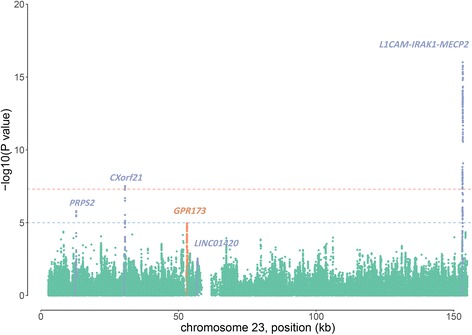
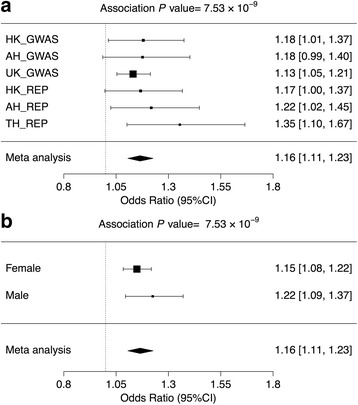
“After analysis of the replication results together with the GWAS data, the selected SNP (rs13440883) showed a final Pmeta value of 7.53 × 10 − 9, reaching genome-wide significance (Fig.”
BackgroundMethodInfluentialSelf-citationHan, J.-W., Zheng, H.-F., Cui, Y., Sun, L.-D., Ye, D.-Q., Hu, Z., Xu, J.-H., Cai, Z.-M., Huang, W., Zhao, G.-P., et al. (2009) · Nature Genetics · doi:10.1038/ng.472 · Cited by 936 · cited 9×
“6Department of Epidemiology and Biostatistics, School of Public Health, Anhui Medical University, Hefei, Anhui, China.”
MethodInfluentialSelf-citationLinking disease associations with regulatory information in the human genome
Schaub, M. A., Boyle, A. P., Kundaje, A., Batzoglou, S., & Snyder, M. (2012) · Genome Research · doi:10.1101/gr.136127.111 · Cited by 713 · cited 1×
“For most associations, the SNP most strongly supported by functional annotation is often the one in high LD with the reported SNP [25].”
BackgroundA General Approach for Haplotype Phasing across the Full Spectrum of Relatedness
O'Connell, J., Gurdasani, D., Delaneau, O., Pirastu, N., Ulivi, S., Cocca, M., Traglia, M., Huang, J., Huffman, J. E., Rudan, I., et al. (2014) · PLoS Genetics · doi:10.1371/journal.pgen.1004234 · Cited by 593 · cited 3×
“First, SHAPEIT [15] was used to prephase each of the datasets.”
MethodScofield, R. H., Bruner, G. R., Namjou, B., Kimberly, R. P., Ramsey‐Goldman, R., Petri, M., Reveille, J. D., Alarcón, G. S., Vilá, L. M., Reid, J., et al. (2008) · Arthritis & Rheumatism · doi:10.1002/art.23701 · Cited by 417
Yang, W., Shen, N., Ye, D.-Q., Liu, Q., Zhang, Y., Qian, X.-X., Hirankarn, N., Ying, D., Pan, H.-F., Mok, C. C., et al. (2010) · PLoS Genetics · doi:10.1371/journal.pgen.1000841 · Cited by 404 · cited 3×
“Our study consisted of three sets of GWAS data, including two GWASs from China [13, 14] and one from the United Kingdom [10] (Table 1).”
BackgroundMethodSelf-citationCowper-Sal·lari, R., Zhang, X., Wright, J. B., Bailey, S. D., Cole, M. D., Eeckhoute, J., Moore, J. H., & Lupien, M. (2012) · Nature Genetics · doi:10.1038/ng.2416 · Cited by 355
Self-citationShen, N., Fu, Q., Deng, Y., Qian, X., Zhao, J., Kaufman, K. M., Wu, Y. L., Yu, C. Y., Tang, Y., Chen, J.-Y., et al. (2010) · Proceedings of the National Academy of Sciences · doi:10.1073/pnas.1001337107 · Cited by 346 · cited 2×
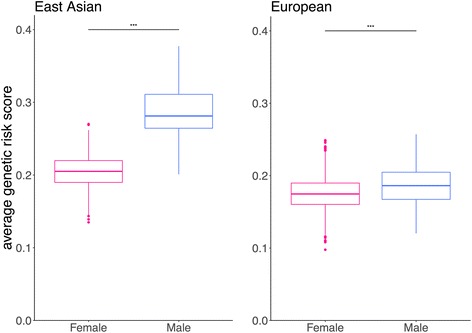
“2b), which is consistent with previous X-linked studies [8, 9], and again suggests that these X-linked variants are not involved in escaping X inactivation and do not contribute to the female bias of SLE.”
BackgroundResultSelf-citationFormation of the sex chromatin by a single X-chromosome in liver cells of Rattus norvegicus
Ohno, S., Kaplan, W. D., & Kinosita, R. (1959) · Experimental Cell Research · doi:10.1016/0014-4827(59)90031-x · Cited by 336
Morris, D. L., Sheng, Y., Zhang, Y., Wang, Y.-F., Zhu, Z., Tombleson, P., Chen, L., Cunninghame Graham, D. S., Bentham, J., Roberts, A. L., et al. (2016) · Nature Genetics · doi:10.1038/ng.3603 · Cited by 310 · cited 1×
“[19], a genetic risk score was calculated using the effect size of the risk alleles and the number of copies carried by each individual.”
MethodSelf-citationPadyukov, L., Seielstad, M., Ong, R. T. H., Ding, B., Rönnelid, J., Seddighzadeh, M., Alfredsson, L., & Klareskog, L. (2011) · Annals of the Rheumatic Diseases · doi:10.1136/ard.2009.126821 · Cited by 281
Boddaert, J., Huong, D. L. T., Amoura, Z., Wechsler, B., Godeau, P., & Piette, J.-C. (2004) · Medicine · doi:10.1097/01.md.0000147737.57861.7c · Cited by 261
Overexpression of X-Linked genes in T cells from women with lupus
Hewagama, A., Gorelik, G., Patel, D., Liyanarachchi, P., Joseph McCune, W., Somers, E., Gonzalez-Rivera, T., Cohort, T. M. L., Strickland, F., & Richardson, B. (2013) · Journal of Autoimmunity · doi:10.1016/j.jaut.2012.12.006 · Cited by 213 · cited 1×
“genes and microRNAs were found to be overexpressed in T cells of female patients with SLE [7].”
BackgroundDuma, D., Collins, J. B., Chou, J. W., & Cidlowski, J. A. (2010) · Science Signaling · doi:10.1126/scisignal.2001077 · Cited by 178 · cited 1×
“SMARCA4 is involved in the glucocorticoid receptor regulatory network, which was reported to affect sex differences in the prevalence of inflammatory disease [23].”
BackgroundKaufman, K. M., Zhao, J., Kelly, J. A., Hughes, T. K., Adler, A., Sánchez, E., Ojwang, J. O., Langefeld, C. D., Ziegler, J. T., Williams, A. H., et al. (2012) · Annals of the Rheumatic Diseases · doi:10.1136/annrheumdis-2012-201851 · Cited by 130 · cited 1×
“identified rs1059702 as the casual variant in the IRAK1-MECP2 region, whereas the neighboring L1CAM-NAA10-TMEM187 region showed distinct signals in multiple populations [12].”
BackgroundSelf-citationHughes, T. K., Adler, A., Merrill, J. T., Kelly, J. A., Kaufman, K. M., Williams, A. H., Langefeld, C. D., Gilkeson, G. S., Sánchez, E., Martin, J. J., et al. (2011) · Annals of the Rheumatic Diseases · doi:10.1136/annrheumdis-2011-200385 · Cited by 114
Self-citationZhao, S.-X., Xue, L.-Q., Liu, W., Gu, Z.-H., Pan, C.-M., Yang, S.-Y., Zhan, M., Wang, H.-N., Liang, J., Gao, G.-Q., et al. (2013) · Human Molecular Genetics · doi:10.1093/hmg/ddt183 · Cited by 95
Self-citationA Novel Sarcoidosis Risk Locus for Europeans on Chromosome 11q13.1
Fischer, A., Schmid, B., Ellinghaus, D., Nothnagel, M., Gaede, K. I., Schürmann, M., Lipinski, S., Rosenstiel, P. C., Zissel, G., Höhne, K., et al. (2012) · American Journal of Respiratory and Critical Care Medicine · doi:10.1164/rccm.201204-0708oc · Cited by 67
A genome-wide association study of brain lesion distribution in multiple sclerosis
Gourraud, P., Sdika, M., Khankhanian, P., Henry, R. G., Beheshtian, A., Matthews, P. M., Hauser, S. L., Oksenberg, J. R., Pelletier, D., & Baranzini, S. E. (2013) · Brain · doi:10.1093/brain/aws363 · Cited by 64
Huang, J., Hung, J.-J., Wu, K.-C., Lee, W., Chan, C., & Ou, L.-S. (2006) · Seminars in Arthritis and Rheumatism · doi:10.1016/j.semarthrit.2006.04.003 · Cited by 57 · cited 1×
“In addition, premenstrual and postmenopausal women show a higher prevalence of SLE than men of an identical age group [1, 2], suggesting mechanisms for the disease other than hormone modulation.”
BackgroundDiscovery of a novel genetic susceptibility locus on X chromosome for systemic lupus erythematosus
Zhu, Z., Liang, Z., Liany, H., Yang, C., Wen, L., Lin, Z., Sheng, Y., Lin, Y., Ye, L., Cheng, Y., et al. (2015) · Arthritis Research & Therapy · doi:10.1186/s13075-015-0857-1 · Cited by 48 · cited 1×
“More recently, a study in European populations identified a prominent signal in CXorf21 [10] on chromosome X as being associated with SLE, and a study on multiple Chinese cohorts identified LINC01420 [11] as being associated with the disease.”
BackgroundSelf-citationZhang, Y., Zhang, J., Yang, J., Wang, Y., Zhang, L., Zuo, X., Sun, L., Pan, H.-F., Hirankarn, N., Wang, T., et al. (2015) · Human Molecular Genetics · doi:10.1093/hmg/ddu429 · Cited by 44 · cited 6×
“in the L1CAM-TMEM187 region (rs2071128 on NAA10 and rs17422 on TMEM187) as being independently associated with SLE [9].”
BackgroundMethodResultInfluentialSelf-citation
Cited by
Update on the Genetics of Systemic Lupus Erythematosus: Genome-Wide Association Studies and Beyond
Kwon, Y.-C., Chun, S., Kim, K.-W., & Mak, A. (2019) · Cells · doi:10.3390/cells8101180 · Cited by 170
X-Chromosome Inactivation and Related Diseases
Sun, Z., Fan, J., & Wang, Y. (2022) · Genetics Research · doi:10.1155/2022/1391807 · Cited by 114
“Overexpression of several X-linked genes has been shown to be involved in SLE pathogenesis, such as CD40LG [99], CXCR3 [100], KDM6A [101], CXorf21 [98], MECP2 [102, 103], IRAK1 [75, 103], TLR7(Toll-like receptor 7) [104, 105], GPR173 [106], and PRPS2.”
BackgroundSelf-citationSystemic lupus erythematosus as a genetic disease
Harley, I. T. W., & Sawalha, A. H. (2022) · Clinical Immunology · doi:10.1016/j.clim.2022.108953 · Cited by 75
Figgett, W. A., Monaghan, K., Ng, M., Alhamdoosh, M., Maraskovsky, E., Wilson, N. J., Hoi, A. Y.-B., Morand, E. F., & Mackay, F. (2019) · Clinical & Translational Immunology · doi:10.1002/cti2.1093 · Cited by 70
Wang, J., Zheng, B., Tang, X., Tang, X., Wang, J., & Wei, D. (2020) · Inflammation Research · doi:10.1007/s00011-020-01355-9 · Cited by 67
Metadata
- Authors
- Zhang, H., Zhang, Y., Wang, Y.-F., Morris, D., Hirankarn, N., Sheng, Y., Shen, J., Pan, H.-F., Yang, J., Yang, S., Cui, Y., Ye, D.-Q., Vyse, T. J., Zhang, X., Lau, Y. L., & Yang, W.
- Affiliations
- Queen Mary Hospital (CN)
- Guangzhou Women and Children Medical Center (CN)
- King's College London (GB)
- Chulalongkorn University (TH)
- Anhui Medical University (CN)
- China-Japan Friendship Hospital (CN)
- Corresponding author
- Zhang, Yan
- Yang, Wanling
- ORCID
- Venue
- Arthritis Research & Therapy
- Published
- 2018-05-03
- Volume
- 20
- Issue
- 1
- Pages
- 92-92
- ISSN
- 1478-6354 (ISSN-L)
- 1478-6362
- PMC
- PMC5934841
- OpenAlex
- W2805180585
- Cited by
- 25
- References
- 32
- Citations by year
- 2026: 2 · 2025: 1 · 2024: 4 · 2023: 2 · 2022: 3 · 2021: 3 · 2020: 5 · 2019: 4 · 2018: 1
- FWCI
- 0.54
- Type
- journal article
- Language
- en
- Open access
- gold
- doi.org
- Licence
- cc-by
- creativecommons.org/licenses/by/4.0/ (tdm)
- Locations
- Arthritis Research & Therapy (publishedVersion, cc-by)
- Europe PMC (PubMed Central) (publishedVersion, other-oa)
- PubMed Central (publishedVersion, cc-by)
- PubMed (publishedVersion)
- DOAJ (DOAJ: Directory of Open Access Journals) (submittedVersion, cc-by-sa)
- Research Portal (King's College London) (submittedVersion, cc-by)
- Funders
- Research Grants Council, University Grants Committee (GRF 17146616, GRF 17125114)
- National Natural Science Foundation of China (81601423)
- Health and Medical Research Fund (12133701)
- Topics
- Health Sciences › Medicine › Rheumatology › Systemic Lupus Erythematosus Research
- Life Sciences › Biochemistry, Genetics and Molecular Biology › Genetics › Genetic Associations and Epidemiology
- Health Sciences › Medicine › Rheumatology › Systemic Sclerosis and Related Diseases
- Keywords
- systemic lupus erythematosus, X chromosome, GPR173, genetic susceptibility, autoimmune disease, sex differences, conditional analysis, Chinese population, European populations, Asian populations
- MeSH terms
- Female, Genotype, Humans, Lupus Erythematosus, Systemic, Genetic Predisposition to Disease, Polymorphism, Single Nucleotide, Receptors, G-Protein-Coupled, White People, Asian People, Genes, X-Linked, Genome-Wide Association Study
About these checks
Registry, retraction, Cites and statistics results are computed, not judged, with one exception: a printed reference that no index lists is read once by a model before it counts as a citation error. Claims are extracted by a model and kept only when their quote appears verbatim in the text; each cited source is then checked, with a model’s help, for whether it says what the claim relies on. Those verdicts can be wrong — read the claim’s quote and the cited source before relying on one.
Statistics and arithmetic are recomputed, not judged.
Confidence bands are shown only for fields calibrated on our annotated test set. None is calibrated yet, so no band is shown.
What counts as a claim ›How we measure confidence ›How we check this ›
Are you an author, or do you see a problem with this page? Request a review
Data sources
Bibliographic data: Semantic Scholar, OpenAlex, Crossref.
Contains information from the Semantic Scholar Academic Graph Datasets, made available under the ODC Attribution License (ODC-BY 1.0).
Semantic Scholar’s data is described in: Kinney, R., et al. (2023). The Semantic Scholar Open Data Platform. arXiv:2301.10140.
