

Longitudinal study of patients with discrepant results in CLIFT and a solid-phase dsDNA antibody assay: does a gold standard dsDNA assay exist?
Open accessThe DOI matches its Crossref record; 32 of the 33 references it cites were found in a registry or an index; 8 of the 27 sources its claims cite were checked for support.
Abstract
Objective: Antidouble-stranded DNA (dsDNA) antibodies are essential for diagnosis and follow-up of systemic lupus erythematous (SLE). To ensure the best diagnostic approach, most healthcare laboratories opt for a combination of highly sensitive methods, such as solid-phase immunoassays, and highly specific methods, such as the Crithidia luciliae indirect immunofluorescence test (CLIFT). Even so, discordant results are common, thus hindering the diagnostic process. Therefore, this study aimed to characterise a cohort of patients with discrepant results for a dsDNA fluorescence enzyme immunoassay (FEIA) and CLIFT during 2016–2018 and to follow patients up until December 2021. Methods: We performed an observational, longitudinal and retrospective study on 417 samples from 257 patients who had been referred for suspected connective tissue diseases or followed up after diagnosis. All of them were positive for antinuclear antibodies (ANAs) using an indirect immunofluorescence assay (IFA) on Hep-2 cells, the entry criterion in our laboratory, and positive for FEIA dsDNA. Samples were then tested with CLIFT according to our routine protocol, which includes CLIFT testing after FEIA dsDNA results ≥10 UI/ml. After the assessment of data quality, the final analysis was based on 222 patients. Results: Eighty-three patients (37.4%) had positive results in both tests and met the diagnostic criteria for SLE. However, 139 patients (62.6%) had discrepant results (FEIA+, CLIFT–). Of these, 58 patients (41.7%) had a diagnosis of SLE, with 47 (33.8%) having been previously diagnosed and under treatment. The remaining 11 patients (7.9%) had a new diagnosis of SLE, which was made up within 4 years of the initial screening. A total of 81 of the 139 patients (57.5%) with discrepant results did not meet lupus criteria during the follow-up period. Conclusions: The study showed that CLIFT could be negative in both treated and newly diagnosed SLE, thus underlining the importance of follow-up of dsDNA-positive results using solid-phase tests. Therefore, quantitative tests such as FEIA could add value to the diagnosis and management of patients with suspected SLE.
Overview
CoChat Summary
TL;DR
This retrospective longitudinal study characterized 222 patients with positive dsDNA FEIA results and either concordant or discrepant CLIFT results, following them through December 2021. It found that CLIFT-negative, FEIA-positive results occurred in both treated and newly diagnosed SLE, so such discrepancies should not be dismissed as false positives and warrant long-term follow-up.
Key findings
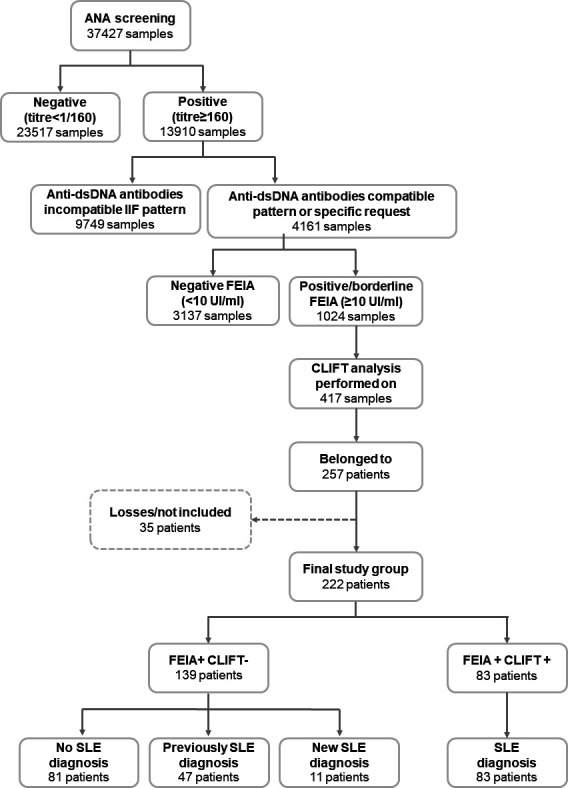
- Of 222 patients, 83 (37.4%) were FEIA+/CLIFT+ and met SLE criteria; 139 (62.6%) were discrepant (FEIA+, CLIFT−). Among the discrepant group, 58 (41.7%) had SLE: 47 (33.8%) were previously diagnosed and under treatment, and 11 (7.9%) were newly diagnosed within up to 4 years; 81/139 (57.5%) did not meet lupus criteria during follow-up.
- CLIFT-positive patients were significantly younger (p=0.005), had higher ANA titres (p<0.001), higher dsDNA FEIA values (p<0.001), and more often had the AC-1 homogeneous ANA pattern (p<0.001) than CLIFT-negative patients.
- Among CLIFT-negative patients newly diagnosed with SLE, 3 had FEIA values in the 10–15 IU/mL grey zone, and one was diagnosed 4 years after testing. dsDNA FEIA values were below 50 IU/mL in 37 patients (78.7%) with previously diagnosed CLIFT-negative SLE; among double-positive patients, 11 (13.25%) had grey-zone values.
- Eleven patients (14.8%) had solid-phase dsDNA values ≥50 IU/mL without SLE after follow-up.
Methods
- Observational, longitudinal, retrospective study at a tertiary hospital. From 2016–2018, 37,427 samples were referred for ANA screening; 13,910 were ANA-positive; 4,161 underwent dsDNA FEIA; 1,024 were borderline/positive; 417 samples from 257 patients were also tested with CLIFT. After exclusions, 222 patients were analyzed, with follow-up to December 2021.
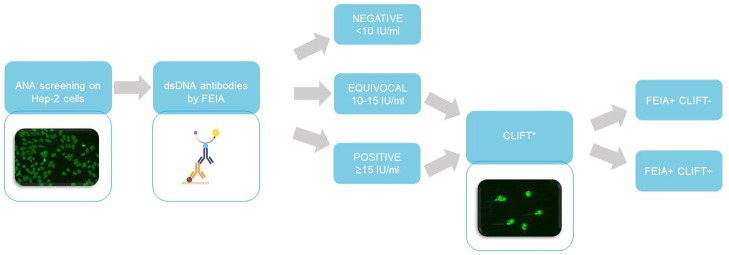
- ANA screening used indirect immunofluorescence on HEp-2 cells (entry ≥1/160). dsDNA was measured with EliA FEIA on Phadia 250 (negative <10 IU/mL, equivocal 10–15 IU/mL, positive >15 IU/mL), and positive/borderline samples were tested with CLIFT. SLE diagnosis was based on physician global assessment using 2016 and subsequently 2019 EULAR/ACR criteria.
- Statistical analysis used descriptive statistics, Kolmogorov-Smirnov/Shapiro-Wilk tests, t-test, Mann-Whitney, Kruskal-Wallis, and Pearson’s χ² test, with significance at p<0.05 and 95% CI.
Limitations
- The paper states the main limitation is the retrospective design based on actual clinical practice, with notable losses of specific patient groups, including patients with a positive CLIFT result before the study period who were not retested per the center’s algorithm. It also states that diagnostic performance of both tests could not be calculated without including negative dsDNA solid-phase and CLIFT-negative/positive patients, and that samples were not initially categorized by suspected diagnosis or disease stage.
- The paper states that because the study was performed in a single center in southern Spain, extrapolation outside that setting is difficult.
- Evident from the text: the newly diagnosed SLE group was small (n=11), limiting statistical comparisons; the authors also note that treatment can reduce antibody titres, which may affect interpretation of low FEIA values.
Model-written summary. Check it against the paper before relying on it.
Integrity signals
Registry
Cites
Statistics
Figures
Verification
Claims the paper makes
4 Valid · 1 Not valid · 11 Not checked · 39 Own results and interpretations
At least one cited source doesn’t support this claim or points to a different paper, and none confirmed it — see the verdicts below.
In the paper
“Diagnosis of SLE was based on the physician’s global assessment according to the 2016 and, subsequently, 2019 EULAR/ACR criteria.2”
§ Longitudinal study of patients with discrepant results in CLIFT and a solid-phase dsDNA antibody assay: does a gold standard dsDNA assay exist? > Methods > Laboratory assays
What the sources say
- Disputedcites [2] Aringer M, Costenbader K, Daikh D, et al. European league against rheumatism/American college of rheumatology classification criteria for systemic lupus erythematosus. Ann Rheum Dis 2019; 78: 1151– 9. 10.1136/annrheumdis-2018-214819 31383717 sourceExperimental — accuracy not yet measured
The Discussion (page not available in our copy) says the 2019 EULAR/ACR criteria are for classification, not diagnosis, and that diagnosis remains the responsibility of an appropriately trained physician. Thus it supports physician evaluation but contradicts the claim that diagnosis was made according to those criteria. The paper does not describe 2016 EULAR/ACR criteria. (LLM, conf=0.88)
Checked by a reasoning model — may be wrong.
plain- Asserted: passes — The authors put it forward as true.
- Checkable: passes — It can be checked against evidence.
- Load-bearing: passes — The paper’s conclusions depend on it.
- Based: passes — The paper gives a reason why it holds.
- Disputed
A result the paper reports from its own data — it cites no other source for it, so there is none to check. The quote shows it is in the paper.
In the paper
“However, 139 patients (62.6%) had discrepant results (FEIA+, CLIFT–).”
§ Longitudinal study of patients with discrepant results in CLIFT and a solid-phase dsDNA antibody assay: does a gold standard dsDNA assay exist? > Abstract > Results
plainn = 139- Asserted: passes — The authors put it forward as true.
- Checkable: passes — It can be checked against evidence.
- Load-bearing: passes — The paper’s conclusions depend on it.
- Based: passes — The paper gives a reason why it holds.
A result the paper reports from its own data — it cites no other source for it, so there is none to check. The quote shows it is in the paper.
In the paper
“Of these, 58 patients (41.7%) had a diagnosis of SLE”
§ Longitudinal study of patients with discrepant results in CLIFT and a solid-phase dsDNA antibody assay: does a gold standard dsDNA assay exist? > Abstract > Results
plainn = 139- Asserted: passes — The authors put it forward as true.
- Checkable: passes — It can be checked against evidence.
- Load-bearing: passes — The paper’s conclusions depend on it.
- Based: passes — The paper gives a reason why it holds.
A result the paper reports from its own data — it cites no other source for it, so there is none to check. The quote shows it is in the paper.
In the paper
“Eighty-three patients (37.4%) had positive results in both tests and met the diagnostic criteria for SLE.”
§ Longitudinal study of patients with discrepant results in CLIFT and a solid-phase dsDNA antibody assay: does a gold standard dsDNA assay exist? > Abstract > Results
plainn = 3- Asserted: passes — The authors put it forward as true.
- Checkable: passes — It can be checked against evidence.
- Load-bearing: passes — The paper’s conclusions depend on it.
- Based: passes — The paper gives a reason why it holds.
A result the paper reports from its own data — it cites no other source for it, so there is none to check. The quote shows it is in the paper.
In the paper
“When the results for FEIA were categorised, the values for the CLIFT-positive patients showed significantly higher values than the other three groups (p<0.001) (table 1).”
§ Longitudinal study of patients with discrepant results in CLIFT and a solid-phase dsDNA antibody assay: does a gold standard dsDNA assay exist? > Results
plainstates an association- Asserted: passes — The authors put it forward as true.
- Checkable: passes — It can be checked against evidence.
- Load-bearing: passes — The paper’s conclusions depend on it.
- Based: passes — The paper gives a reason why it holds.
22 more claims
Create a free account to see all 55 claims and to verify the 19 references still open.
- Probably not a substantial claim. 17
- It may state two separate claims as one. 15
Claims other papers make about this one
Each is checked against this paper’s own text: does it say what the citing paper says it does?
The cited source says what the claim attributes to it.
In the citing paper
“It is known to be highly specific for SLE but offers low sensitivity [7].”
From Comparison of Five Assays for the Detection of Anti-dsDNA Antibodies and Their Correlation with Complement Consumption (2025) · cites this paper as [7]
Self-check
Percentages, sums and reported differences re-computed from the paper’s own numbers.
Each contradiction between two passages listed here was confirmed by an independent check.
Rated minor: it would not touch a result — a value no result rests on, a p-value that stays on the same side of the significance level, or a conflict that is clerical, resolved elsewhere in the paper, or outside its own findings.
In the paper
§ Longitudinal study of patients with discrepant results in CLIFT and a solid-phase dsDNA antibody assay: does a gold standard dsDNA assay exist? > Discussion
“Eleven patients (14.8%) are at the opposite side of the spectrum, with solid-phase dsDNA values ≥50 IU/mL without SLE after the follow-up period”
§ Longitudinal study of patients with discrepant results in CLIFT and a solid-phase dsDNA antibody assay: does a gold standard dsDNA assay exist? > Results
“| ≥50 IU/ml | 57 | 12 (14.8) | 2 (18.2) | 10 (21.3) | 33 (39.8) |”
Rated minor: it would not touch a result — a value no result rests on, a p-value that stays on the same side of the significance level, or a conflict that is clerical, resolved elsewhere in the paper, or outside its own findings.
In the paper
“| 16-49 IU/ml | 110 | 40 (49.4) | 6 (54.6) | 25 (53.2) | 39 (46.1) |”
§ Longitudinal study of patients with discrepant results in CLIFT and a solid-phase dsDNA antibody assay: does a gold standard dsDNA assay exist? > Results
Reported 46.1 · recomputed 46.987952
Rated minor: it would not touch a result — a value no result rests on, a p-value that stays on the same side of the significance level, or a conflict that is clerical, resolved elsewhere in the paper, or outside its own findings.
In the paper
§ Longitudinal study of patients with discrepant results in CLIFT and a solid-phase dsDNA antibody assay: does a gold standard dsDNA assay exist? > Methods > Study design and participants
“1024 samples were borderline (10–15 IU/mL) or positive (≥ 15 IU/mL).”
§ Longitudinal study of patients with discrepant results in CLIFT and a solid-phase dsDNA antibody assay: does a gold standard dsDNA assay exist? > Methods > Laboratory assays
“The variable results were also categorised as negative (<10 IU/mL), equivocal (10–15 IU/mL) and positive (>15 IU/mL), according to the manufacturer’s instructions.”
Rated minor: it would not touch a result — a value no result rests on, a p-value that stays on the same side of the significance level, or a conflict that is clerical, resolved elsewhere in the paper, or outside its own findings.
In the paper
§ Longitudinal study of patients with discrepant results in CLIFT and a solid-phase dsDNA antibody assay: does a gold standard dsDNA assay exist? > Results
“| Ana titter; median (IQR) | 1/320 (1/160- 1/640) | 1/160 (1/80- 1/640) | 1/320 (1/160- 1/640) | 1/160 (1/60-1/320) | 1/640 (1/320- 1/1280) |”
§ Longitudinal study of patients with discrepant results in CLIFT and a solid-phase dsDNA antibody assay: does a gold standard dsDNA assay exist? > Results
“| CLIFT−/previously diagnosed SLE | 46 | | | | | | | | 1/160 | | 1/160–1/320 |”
Citations
Cites
Aringer, M., Costenbader, K., Daikh, D., Brinks, R., Mosca, M., Ramsey-Goldman, R., Smolen, J. S., Wofsy, D., Boumpas, D. T., Kamen, D. L., et al. (2019) · Annals of the Rheumatic Diseases · doi:10.1136/annrheumdis-2018-214819 · Cited by 1,612
TLR7 gain-of-function genetic variation causes human lupus
Brown, G. J., Cañete, P. F., Wang, H., Medhavy, A., Bones, J., Roco, J. A., He, Y., Qin, Y., Cappello, J., Ellyard, J. I., et al. (2022) · Nature · doi:10.1038/s41586-022-04642-z · Cited by 596 · cited 1×
“26 However, the inclusion criterion in our cohort of patients was not a specific disease but positive dsDNA findings in a solid-phase assay.”
BackgroundChan, E. K. L., Damoiseaux, J., Carballo, O. G., Conrad, K., de Melo Cruvinel, W., Francescantonio, P. L. C., Fritzler, M. J., Garcia-De La Torre, I., Herold, M., Mimori, T., et al. (2015) · Frontiers in Immunology · doi:10.3389/fimmu.2015.00412 · Cited by 383
Romero‐Diaz, J., Isenberg, D., & Ramsey‐Goldman, R. (2011) · Arthritis Care & Research · doi:10.1002/acr.20572 · Cited by 225
Anti-double Stranded DNA Antibodies: Origin, Pathogenicity, and Targeted Therapies
Wang, X., & Xia, Y. (2019) · Frontiers in Immunology · doi:10.3389/fimmu.2019.01667 · Cited by 182
Pyfrom, S., Paneru, B., Knox, J. J., Cancro, M. P., Posso, S., Buckner, J. H., & Anguera, M. C. (2021) · Proceedings of the National Academy of Sciences · doi:10.1073/pnas.2024624118 · Cited by 126
Autoantibody Detection Using Indirect Immunofluorescence on HEp‐2 Cells
Sack, U., Conrad, K., Csernok, E., Frank, I., Hiepe, F., Krieger, T., Kromminga, A., Von Landenberg, P., Messer, G., Witte, T., et al. (2009) · Annals of the New York Academy of Sciences · doi:10.1111/j.1749-6632.2009.04735.x · Cited by 98
Mummert, E., Fritzler, M. J., Sjöwall, C., Bentow, C., & Mahler, M. (2018) · Journal of Immunological Methods · doi:10.1016/j.jim.2018.05.014 · Cited by 86 · cited 1×
“10 The Farr radioimmunoassay (Farr-RIA) is considered the gold standard for detecting anti-dsDNA antibodies.”
BackgroundEnocsson, H., Sjöwall, C., Wirestam, L., Dahle, C., Kastbom, A., Rönnelid, J., Wetterö, J., & Skogh, T. (2015) · The Journal of Rheumatology · doi:10.3899/jrheum.140677 · Cited by 73 · cited 1×
“8 28 In any case, the focus of our work was to study the discrepancies that challenge us in daily practice, mainly solid-phase positivity versus CLIFT negativity.”
BackgroundAntico, A., Platzgummer, S., Bassetti, D., Bizzaro, N., Tozzoli, R., Villalta, D., & Study Group on Autoimmune Diseases of the Italian Society of Laboratory Medicine (SIMeL) (2010) · Lupus · doi:10.1177/0961203310362995 · Cited by 70 · cited 3×
“Additionally, comparisons were made between the groups of interest, as follows: (A) CLIFT-negative and CLIFT-positive; (B) The three CLIFT-negative groups; (C) CLIFT-negative without SLE and CLIFT-negative with newly diagnosed SLE; (D) CLIFT-negative with newly diagnosed SLE and CLIFT-positive; (E) The four groups wit…”
Background
Research works printed but not linked: 1
- Abbas AK, Lichtman AH, Pillai S. B cell activation and antibody production. In cellular and molecular immunology,10Th Ed Philadelphia, USA Elsevier Eds.; Jeremy Bowes; 2022. 451.
Cited by
Ricchiuti, V., Obney, J., Holloway, B., Aure, M. A., Shapiro, M., Bentow, C., & Mahler, M. (2025) · Diagnostics · doi:10.3390/diagnostics15192430 · Cited by 3
“It is known to be highly specific for SLE but offers low sensitivity [7].”
Papale, M., Paolillo, C., Iafelice, L., Trivisano, T., Netti, G. S., Ranieri, E., & Corso, G. (2026) · Antibodies · doi:10.3390/antib15020023 · Cited by 4
Ortega, J. M. L., Mayo-Juanatey, A., Sanz-García, P., et al. (2024) · Lupus Science & Medicine · doi:10.1136/lupus-2024-001250
Early diagnosis of systemic lupus erythematosus
Aringer, M., & Bertsias, G. K. (2025) · Rare Disease and Orphan Drugs Journal · doi:10.20517/rdodj.2024.59 · Cited by 1
Clinical performance of three anti-dsDNA antibody immunoassays in systemic lupus erythematosus
Uto, K., Yoshida, N., Okano, T., Yamashita, M., Hayashi, N., Imanishi, T., Yano, Y., Saegusa, J., & Sendo, S. (2026) · Modern Rheumatology · doi:10.1093/mr/roag018 · Cited by 1
Metadata
- Authors
- Trujillo Aguilera, A., Bernardo Serrano, R., Navas, A., Alcaide Molina, J., Alvarez Romero, P., & Jurado Roger, A.
- Affiliations
- Instituto Maimónides de Investigación Biomédica de Córdoba (ES)
- Corresponding author
- Navas, Ana
- Venue
- Lupus Science & Medicine
- Publisher
- BMJ
- Published
- 2023-10
- Volume
- 10
- Issue
- 2
- Pages
- e000984
- ISSN
- 2053-8790 (ISSN-L)
- PMC
- PMC10618974
- OpenAlex
- W4388033843
- Semantic Scholar
- c8d178fd9f8b71dfbd16ef5c0a801560a66b54ec
- Cited by
- 6
- References
- 33
- Citations by year
- 2026: 3 · 2025: 2 · 2024: 1
- FWCI
- 1.26
- Type
- journal article
- Language
- en
- Open access
- gold
- doi.org
- Licence
- Locations
- Lupus Science & Medicine (publishedVersion, cc-by-nc)
- PubMed Central (publishedVersion, cc-by-nc)
- PubMed (publishedVersion)
- DOAJ (DOAJ: Directory of Open Access Journals) (submittedVersion, cc-by-sa)
- Topics
- Health Sciences › Medicine › Rheumatology › Systemic Lupus Erythematosus Research
- Health Sciences › Medicine › Rheumatology › Systemic Sclerosis and Related Diseases
- Health Sciences › Medicine › Rheumatology › Vasculitis and related conditions
- Keywords
- systemic lupus erythematosus, anti-dsDNA antibodies, fluorescence enzyme immunoassay, indirect immunofluorescence, antinuclear antibodies, connective tissue diseases, lupus diagnosis
- MeSH terms
- Antibodies, Antinuclear, Crithidia, DNA, Fluorescent Antibody Technique, Humans, Longitudinal Studies, Lupus Erythematosus, Systemic, Retrospective Studies, Fluorescent Antibody Technique, Indirect
About these checks
Registry, retraction, Cites and statistics results are computed, not judged, with one exception: a printed reference that no index lists is read once by a model before it counts as a citation error. Claims are extracted by a model and kept only when their quote appears verbatim in the text; each cited source is then checked, with a model’s help, for whether it says what the claim relies on. Those verdicts can be wrong — read the claim’s quote and the cited source before relying on one.
The claim verdicts this report counts are experimental: their accuracy is not yet measured.
A language model drew the claims from the paper on 2026-10-10, under version 3 of the claim definition (model deepseek-v4.1-flash, prompt extract-v3).
A second model labelled each claim on 2026-10-10 (model jev-1.13-20260917, definition revision gold-guideline-v0.2).
Cited sources are checked with a language model’s help (gpt-6-sol).
Statistics and arithmetic are recomputed, not judged.
Confidence bands are shown only for fields calibrated on our annotated test set. None is calibrated yet, so no band is shown.
What counts as a claim ›How we measure confidence ›How we check this ›
Are you an author, or do you see a problem with this page? Request a review
How to cite
Cite CoChat for the checks on this page, and the paper for its own findings.
- This page
- CoChat. (2026). Citation check: Longitudinal study of patients with discrepant results in CLIFT and a solid-phase dsDNA antibody assay: does a gold standard dsDNA assay exist? https://app.cochat.ai/papers/10.1136/lupus-2023-000984
- The paper
- Trujillo Aguilera, A., Bernardo Serrano, R., Navas, A., Alcaide Molina, J., Alvarez Romero, P., & Jurado Roger, A. (2023). Longitudinal study of patients with discrepant results in CLIFT and a solid-phase dsDNA antibody assay: does a gold standard dsDNA assay exist? Lupus Science & Medicine. https://doi.org/10.1136/lupus-2023-000984
Data sources
Bibliographic data: Semantic Scholar, OpenAlex, Crossref.
Contains information from the Semantic Scholar Academic Graph Datasets, made available under the ODC Attribution License (ODC-BY 1.0).
Semantic Scholar’s data is described in: Kinney, R., et al. (2023). The Semantic Scholar Open Data Platform. arXiv:2301.10140.
