

Inhibition of Nrf2/HO-1 signaling leads to increased activation of the NLRP3 inflammasome in osteoarthritis
Open accessThe DOI matches its Crossref record; 42 of the 42 references it cites were found in a registry or an index.
Abstract
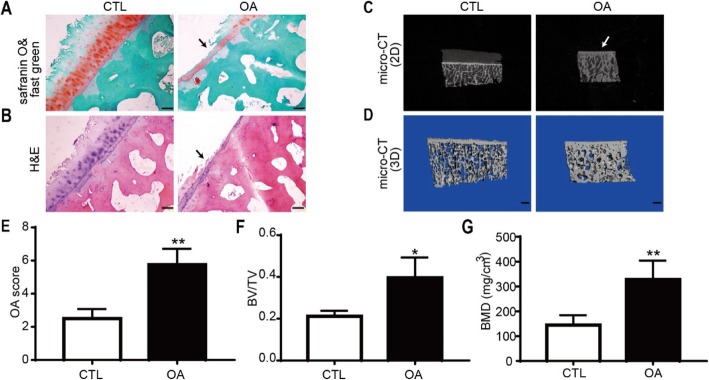
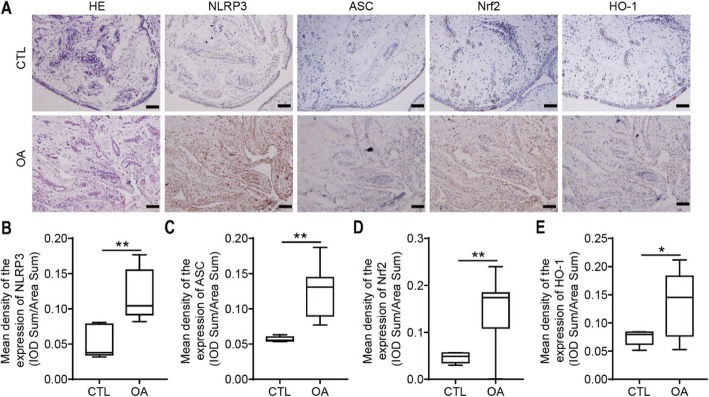
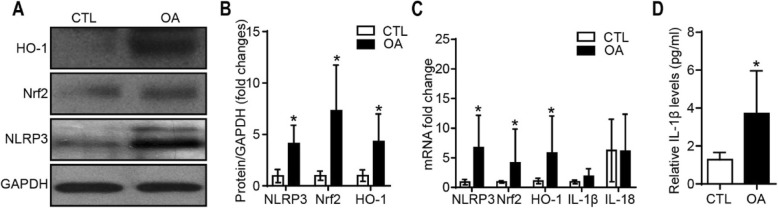
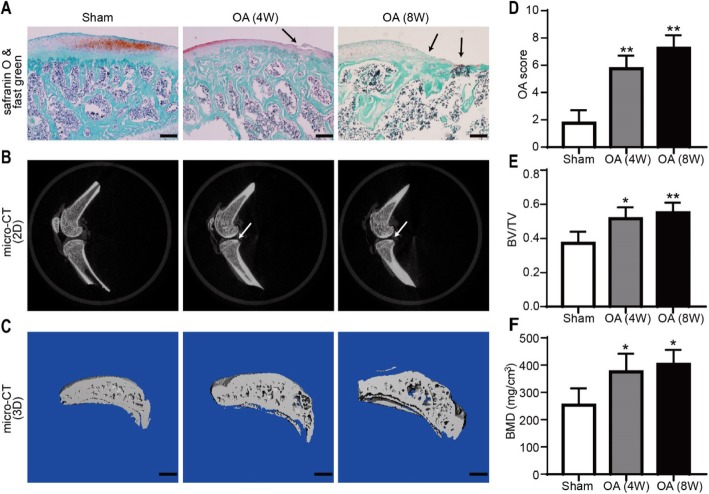
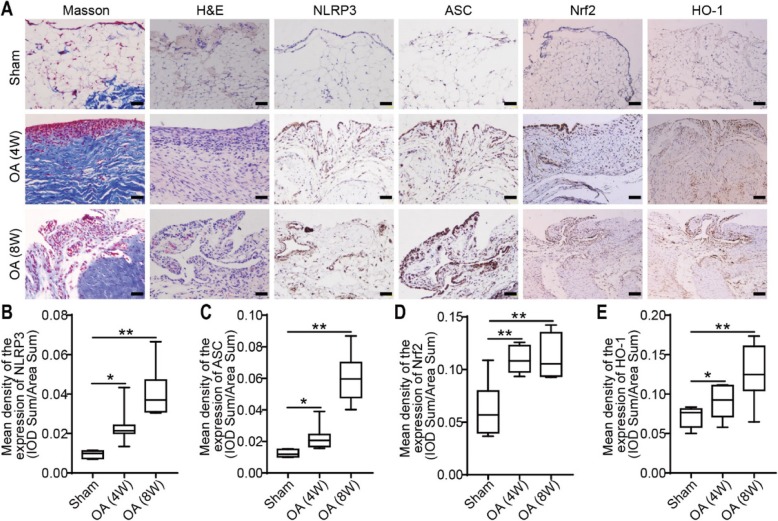
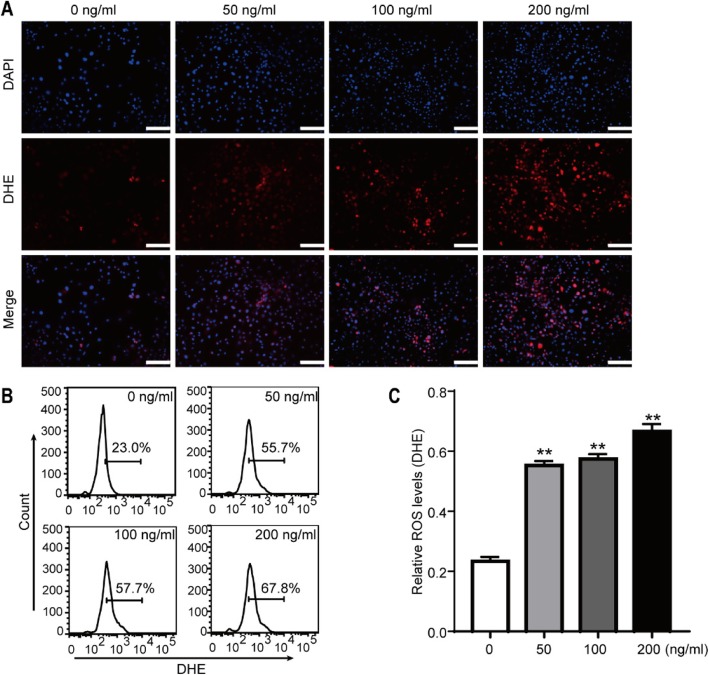
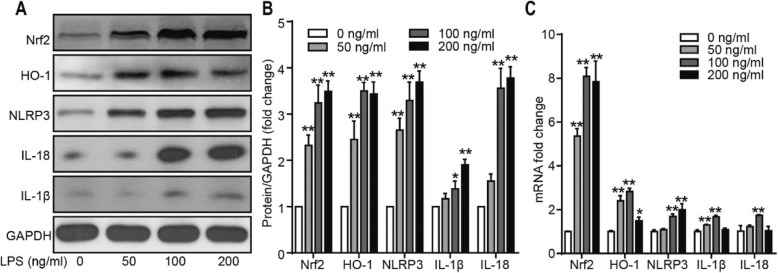
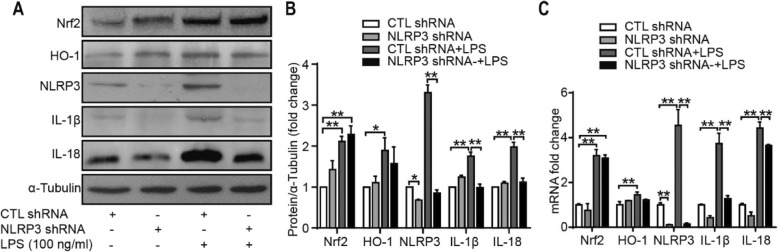
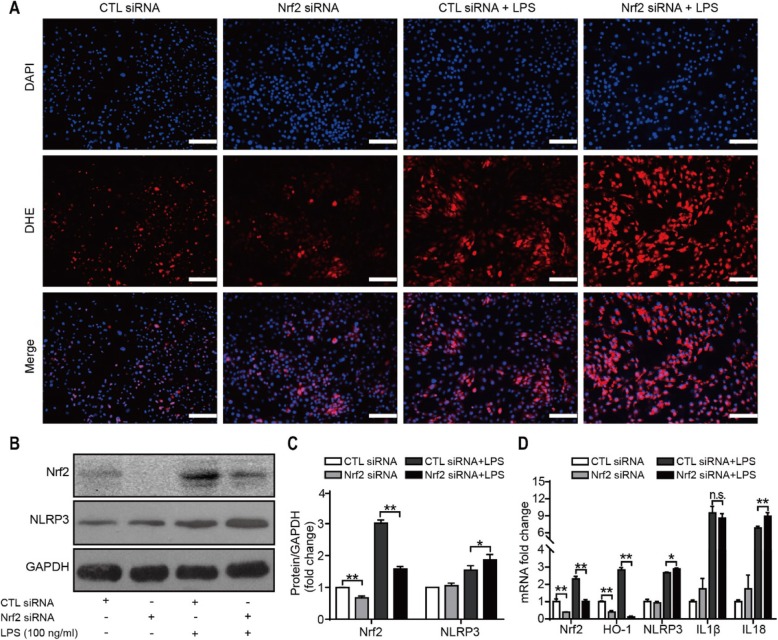
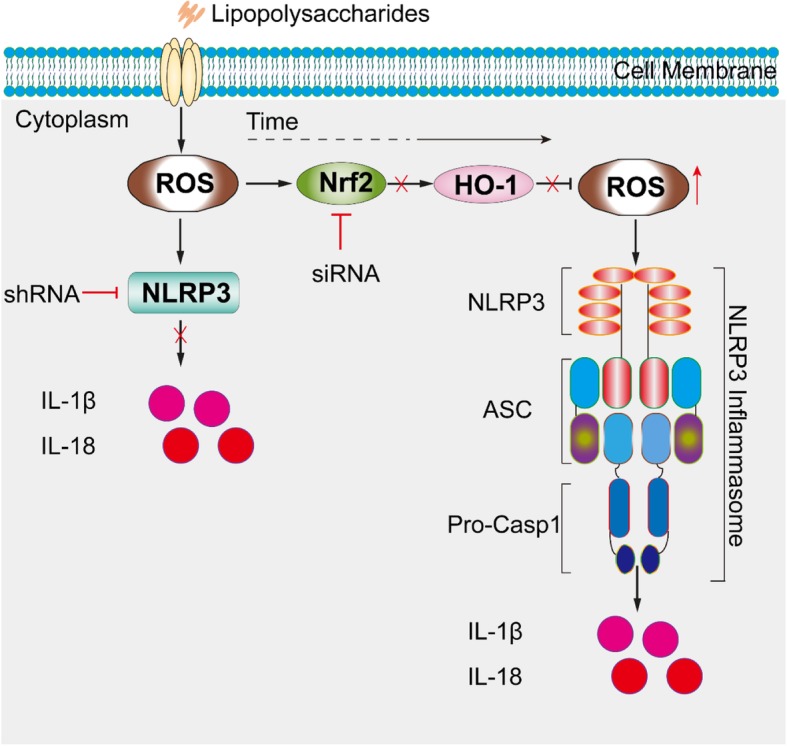
Introduction: Osteoarthritis (OA) is an inflammatory disease of the joints that causes progressive disability in the elderly. Reactive oxygen species (ROS) play an important role in OA development; they may activate the NLRP3 inflammasome, thereby inducing the secretion of proinflammatory IL-1β and IL-18, leading to the aggravation of the downstream inflammatory response. Nrf2 is a key transcription factor that regulates the expression of antioxidant enzymes that protect against oxidative stress and tissue damage. We aimed to explore the underlying mechanism of OA development by investigating NLRP3, ASC, Nrf2, and HO-1 expression in synovia and their regulatory networks in OA. Methods: Human total knee replacement samples were subjected to histology and micro-CT analysis to determine the pathological changes in the cartilage and subchondral bone and to assess the expression of inflammation-related markers in the synovial tissue by immunohistochemistry (IHC), qRT-PCR, and Western blot. To investigate these pathological changes in an OA animal model, adult Sprague-Dawley rats were subjected to anterior cruciate ligament transection and medial meniscectomy. Articular cartilage and subchondral bone changes and synovial tissue were also determined by the same methods used for the human samples. Finally, SW982 cells were stimulated with lipopolysaccharide (LPS) as an in vitro inflammatory cell model. The correlation between NLRP3 and Nrf2 expression was confirmed by knocking down NLRP3 or Nrf2. Results: Cartilage destruction and subchondral bone sclerosis were found in the OA patients and OA model rats. Significantly increased expression levels of NLRP3, ASC, Nrf2, and HO-1 were found in the synovial tissue from OA patients. NLRP3, ASC, Nrf2, and HO-1 expression in the synovium was also upregulated in the OA group compared with the sham group. Furthermore, the NLRP3, Nrf2, HO-1, IL-1β, and IL-18 expression in LPS-treated SW982 cells was increased in a dose-dependent manner. As expected, the expression of NLRP3 was upregulated, and the expression of IL-1β and IL-18 was downregulated after Nrf2 silencing. However, knocking down NLRP3 did not affect the expression of Nrf2. Conclusions: ROS-induced oxidative stress may be the main cause of NLRP3 inflammasome activation and subsequent release of downstream factors during OA development. Nrf2/HO-1 signaling could be a key pathway for the activation of the NLRP3 inflammasome, which may contribute to the progression of OA. Herein, we discovered a novel role of Nrf2/HO-1 signaling in the production of NLRP3, which may facilitate the prevention and treatment of OA.
Overview
The claims and statistics of this paper haven’t been checked yet.
Free: it reads the open-access text and checks the first 5 claims that cite a source we can check. Create a free account to check every claim.
Integrity signals
Registry
Cites
Statistics
Figures
Verification
Claims the paper makes
The claims and statistics of this paper haven’t been checked yet.
Free: it reads the open-access text and checks the first 5 claims that cite a source we can check. Create a free account to check every claim.
Claims other papers make about this one
Each is checked against this paper’s own text: does it say what the citing paper says it does?
The source backs part of the claim, not all of it — or backs it for a different population, condition or comparison.
In the citing paper
“Remarkably, the levels of NLRP3 in individuals with osteoarthritis (OA) have been detected to exceed those in healthy subjects by a factor of more than five [23,24]”
From Picroside II suppresses chondrocyte pyroptosis through MAPK/NF-κB/NLRP3 signaling pathway alleviates osteoarthritis (2024) · cites this paper as [24]
Experimental — accuracy not yet measured
Self-check
Percentages, sums and reported differences re-computed from the paper’s own numbers.
The self-check needs the paper’s full text.
Citations
Cites
1 retracted
Zhou, J., Zhao, Y., Wu, G., Lin, B., Li, Z., & Liu, X. (2018) · Molecular Medicine Reports · doi:10.3892/mmr.2018.9385 · Cited by 13
RetractedAltman, R., Asch, E., Bloch, D., Bole, G., Borenstein, D., Brandt, K., Christy, W., Cooke, T. D., Greenwald, R., Hochberg, M., et al. (1986) · Arthritis & Rheumatism · doi:10.1002/art.1780290816 · Cited by 6,777 · cited 1×
“All patients satisfied the American College of Rheumatology clinical criteria for primary knee OA [16].”
BackgroundInflammasomes: mechanism of action, role in disease, and therapeutics
Guo, H., Callaway, J. B., & Ting, J. P.-Y. (2015) · Nature Medicine · doi:10.1038/nm.3893 · Cited by 3,340
Mechanism and Regulation of NLRP3 Inflammasome Activation
He, Y., Hara, H., & Núñez, G. (2016) · Trends in Biochemical Sciences · doi:10.1016/j.tibs.2016.09.002 · Cited by 2,759
The role of synovitis in osteoarthritis pathogenesis
Scanzello, C. R., & Goldring, S. R. (2012) · Bone · doi:10.1016/j.bone.2012.02.012 · Cited by 1,302
Inflammatory caspases and inflammasomes: master switches of inflammation
Martinon, F., & Tschopp, J. (2007) · Cell Death & Differentiation · doi:10.1038/sj.cdd.4402038 · Cited by 820
Kobayashi, M., Squires, G. R., Mousa, A., Tanzer, M., Zukor, D. J., Antoniou, J., Feige, U., & Poole, A. R. (2005) · Arthritis & Rheumatism · doi:10.1002/art.20776 · Cited by 497 · cited 1×
“These play crucial roles in OA pathogenesis resulting in the release of cartilage-degrading enzymes, such as aggrecanases and metalloproteinases, from chondrocytes [11, 12].”
BackgroundCurrent research on pharmacologic and regenerative therapies for osteoarthritis
Zhang, W., Ouyang, H., Dass, C. R., & Xu, J. (2016) · Bone Research · doi:10.1038/boneres.2015.40 · Cited by 495
Suzuki, T., & Yamamoto, M. (2017) · Journal of Biological Chemistry · doi:10.1074/jbc.r117.800169 · Cited by 400
Rahmati, M., Mobasheri, A., & Mozafari, M. (2016) · Bone · doi:10.1016/j.bone.2016.01.019 · Cited by 374
Cited by
Sun, Y.-Y., Zhu, H.-J., Zhao, R.-Y., Zhou, S.-Y., Wang, M.-Q., Yang, Y., & Guo, Z.-N. (2023) · Redox Biology · doi:10.1016/j.redox.2023.102852 · Cited by 279
Lv, Z., Xu, X., Sun, Z., Yang, Y. X., Guo, H., Li, J., Sun, K., Wu, R., Xu, J., Jiang, Q., et al. (2021) · Cell Death & Disease · doi:10.1038/s41419-021-03792-8 · Cited by 253
Riegger, J., Schoppa, A., Ruths, L., Haffner-Luntzer, M., & Ignatius, A. (2023) · Cellular & Molecular Biology Letters · doi:10.1186/s11658-023-00489-y · Cited by 235
“to promote pyroptosis in OA [175], while enhanced Nrf2 signaling by the addition of the antihistamine loratadine or the flavonoid licochalcone A was described to alleviate NLRP3-related pyroptosis as well as consequent inflammation and OA progression”
BackgroundXiao, L., Dai, Z., Tang, W., Liu, C., & Tang, B. (2021) · Oxidative Medicine and Cellular Longevity · doi:10.1155/2021/9925561 · Cited by 135
“Thus far, several lines of study have shown that Nrf2 prevents NLRP3 inflammasome activation by regulating reactive oxygen species (ROS) levels, the thioredoxin system, and the glutathione protein system, decreasing the oxidative stress level [14, 15].”
BackgroundZhang, L., Xu, L.-Y., Tang, F., Liu, D., Zhao, X.-L., Zhang, J.-N., Xia, J., Wu, J.-J., Yang, Y., Peng, C. Y., et al. (2024) · Journal of Pharmaceutical Analysis · doi:10.1016/j.jpha.2023.12.020 · Cited by 157
Metadata
- Authors
- Chen, Z., Zhong, H., Wei, J., Lin, S., Zong, Z., Gong, F., Huang, X., Sun, J., Li, P., Lin, H., Wei, B., & Chu, J.
- Affiliations
- Guangdong Medical College (CN)
- Corresponding author
- Chu, Jiaqi
- ORCID
- Venue
- Arthritis Research & Therapy
- Published
- 2019-12
- Volume
- 21
- Issue
- 1
- Pages
- 300-300
- ISSN
- 1478-6354 (ISSN-L)
- 1478-6362
- PMC
- PMC6929452
- OpenAlex
- W2995540455
- Cited by
- 275
- References
- 42
- Citations by year
- 2026: 31 · 2025: 47 · 2024: 57 · 2023: 52 · 2022: 44 · 2021: 32 · 2020: 11
- FWCI
- 16.50
- Type
- journal article
- Language
- en
- Open access
- gold
- doi.org
- Licence
- cc-by
- creativecommons.org/licenses/by/4.0/ (tdm)
- creativecommons.org/licenses/by/4.0/ (vor, 22 d)
- Locations
- Arthritis Research & Therapy (publishedVersion, cc-by)
- PubMed Central (publishedVersion, cc-by)
- PubMed (publishedVersion)
- DOAJ (DOAJ: Directory of Open Access Journals) (submittedVersion)
- Funders
- National Natural Science Foundation of China (81771612)
- the Affiliated Hospital of Guangdong Medical University (2018PSSC005)
- Topics
- Health Sciences › Medicine › Rheumatology › Osteoarthritis Treatment and Mechanisms
- Life Sciences › Biochemistry, Genetics and Molecular Biology › Molecular Biology › Inflammasome and immune disorders
- Health Sciences › Medicine › Rheumatology › Rheumatoid Arthritis Research and Therapies
- Keywords
- osteoarthritis, Nrf2/HO-1 pathway, NLRP3 inflammasome, reactive oxygen species, oxidative stress, synovium, IL-1β, IL-18, ASC, articular cartilage degeneration, subchondral sclerosis, lipopolysaccharide-induced inflammation
- MeSH terms
- NLR Family, Pyrin Domain-Containing 3 Protein, Adult, Aged, Animals, Cartilage, Articular, Female, Humans, Lipopolysaccharides, Male, Middle Aged, Osteoarthritis, Signal Transduction, Gene Expression, Rats, Sprague-Dawley, Interleukin-18, RNA Interference, Cell Line, Tumor, NF-E2-Related Factor 2, Heme Oxygenase-1, Interleukin-1beta, X-Ray Microtomography, Inflammasomes
About these checks
Registry, retraction, Cites and statistics results are computed, not judged, with one exception: a printed reference that no index lists is read once by a model before it counts as a citation error. Claims are extracted by a model and kept only when their quote appears verbatim in the text; each cited source is then checked, with a model’s help, for whether it says what the claim relies on. Those verdicts can be wrong — read the claim’s quote and the cited source before relying on one.
Statistics and arithmetic are recomputed, not judged.
Confidence bands are shown only for fields calibrated on our annotated test set. None is calibrated yet, so no band is shown.
What counts as a claim ›How we measure confidence ›How we check this ›
Are you an author, or do you see a problem with this page? Request a review
How to cite
Cite CoChat for the checks on this page, and the paper for its own findings.
- This page
- CoChat. (2026). Citation check: Inhibition of Nrf2/HO-1 signaling leads to increased activation of the NLRP3 inflammasome in osteoarthritis. https://app.cochat.ai/papers/10.1186/s13075-019-2085-6
- The paper
- Chen, Z., Zhong, H., Wei, J., Lin, S., Zong, Z., Gong, F., Huang, X., Sun, J., Li, P., Lin, H., Wei, B., & Chu, J. (2019). Inhibition of Nrf2/HO-1 signaling leads to increased activation of the NLRP3 inflammasome in osteoarthritis. Arthritis Research & Therapy. https://doi.org/10.1186/s13075-019-2085-6
Data sources
Bibliographic data: Semantic Scholar, OpenAlex, Crossref.
Contains information from the Semantic Scholar Academic Graph Datasets, made available under the ODC Attribution License (ODC-BY 1.0).
Semantic Scholar’s data is described in: Kinney, R., et al. (2023). The Semantic Scholar Open Data Platform. arXiv:2301.10140.
