

Double-diabetes in a real-world sample of 2711 individuals: associated with insulin treatment or part of the heterogeneity of type 1 diabetes?
Open accessThe DOI matches its Crossref record; 27 of the 28 references it cites were found in a registry or an index.
Abstract
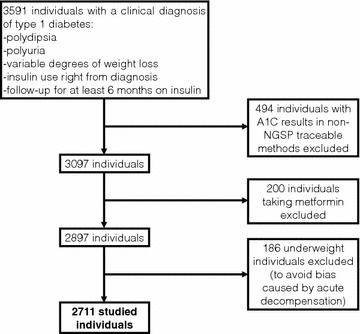
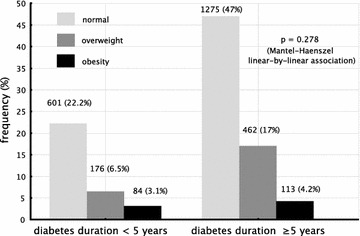
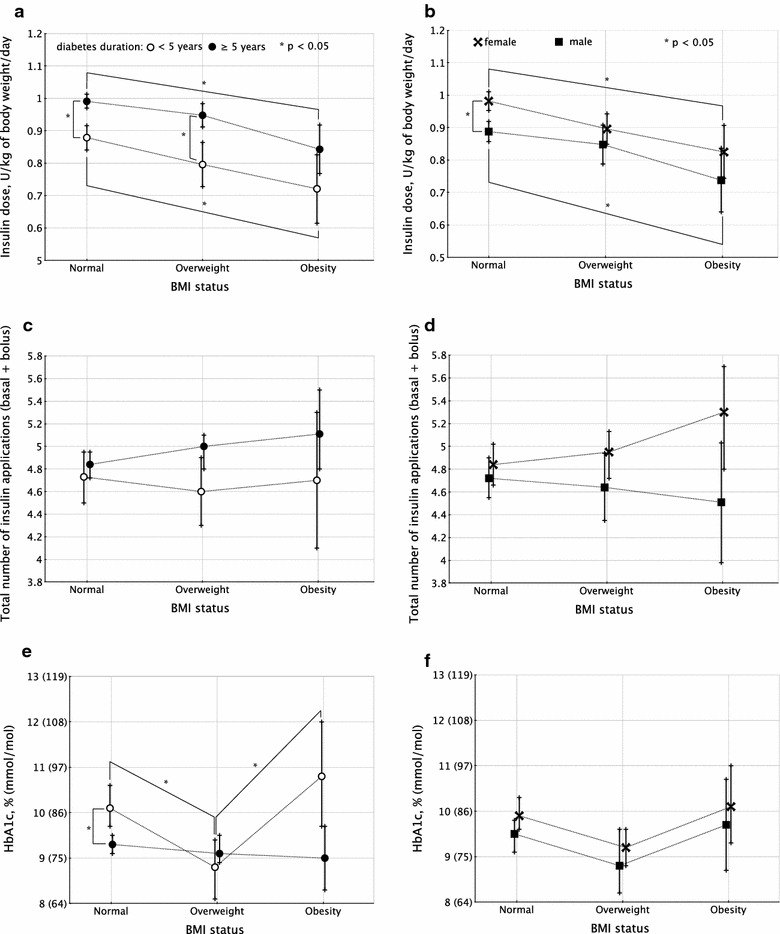
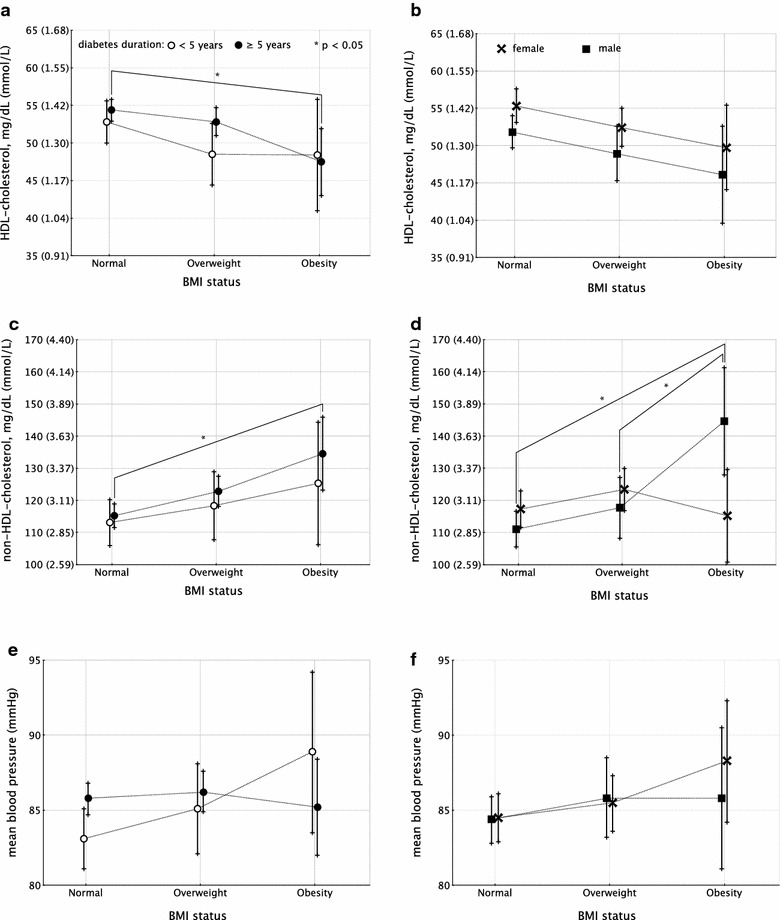
BACKGROUND: Double diabetes (DD) describes both individuals with obesity upon diagnosis of type 1 diabetes and those who have gained weight during follow-up, although cardiovascular risk factors (CVRF) are not well understood in this group. We aim to evaluate the frequency of DD in a real-world type 1 diabetes sample and the interaction of insulin treatment with CVRF. METHODS: Multicentre cross-sectional study of 2711 individuals with clinical diagnosis of type 1 diabetes from secondary diabetes centres in 20 Brazilian cities. RESULTS: Patients with diabetes duration <5 and ≥5 years had similar frequency of overweight (20.4 vs. 25 %) and obesity, (9.8 vs. 6.1 %), p 0.28 for trend. Insulin dose (U/kg/day) was lower in obese individuals compared to normal BMI, with mean (95 % CI) 0.72 (0.62-0.83) vs. 0.88 (0.84-0.92) U/kg/day for diabetes duration <5 years and 0.84 (0.77-0.92) vs. 0.99 (0.97-1.01) U/kg/day for duration ≥5 years. Obese individuals had lower HDL (47.5 vs. 54.4 mg/dL) and higher non-HDL-cholesterol (134.5 vs. 115.2 mg/dL) than lean ones only among those with more than 5 years of diabetes. CONCLUSIONS: Lower insulin doses in obese individuals point to a role of clinical heterogeneity in insulin deficiency rather than normal progression of type 1 diabetes. Early obesity in type 1 diabetes is associated to lower HDL-cholesterol and higher number of CVRF. These data suggest a broad landscape of pathophysiological phenomena in double diabetes, rather than simple progression of a homogeneous clinical entity.
Overview
The claims and statistics of this paper haven’t been checked yet.
Free: it reads the open-access text and checks the first 5 claims that cite a source we can check. Create a free account to check every claim.
Integrity signals
Registry
Cites
Statistics
Figures
Verification
Claims the paper makes
The claims and statistics of this paper haven’t been checked yet.
Free: it reads the open-access text and checks the first 5 claims that cite a source we can check. Create a free account to check every claim.
Self-check
Percentages, sums and reported differences re-computed from the paper’s own numbers.
The self-check needs the paper’s full text.
Citations
Cites
(1998) · Annals of Internal Medicine · doi:10.7326/0003-4819-128-7-199804010-00001 · Cited by 546
(1987) · Diabetes Care · doi:10.2337/diacare.10.1.1 · Cited by 479
Purnell, J. Q., Hokanson, J. E., Marcovina, S. M., Steffes, M. W., Cleary, P. A., & Brunzell, J. D. (1998) · JAMA · doi:10.1001/jama.280.2.140 · Cited by 469
Weight Gain Associated With Intensive Therapy in the Diabetes Control and Complications Trial
The DCCT Research Group (1988) · Diabetes Care · doi:10.2337/diacare.11.7.567 · Cited by 345
(1995) · Diabetes Care · doi:10.2337/diacare.18.11.1415 · Cited by 305
Insulin resistance in type 1 diabetes: what is ‘double diabetes’ and what are the risks?
Cleland, S. J., Fisher, B. M., Colhoun, H. M., Sattar, N., & Petrie, J. R. (2013) · Diabetologia · doi:10.1007/s00125-013-2904-2 · Cited by 238
Epidemiological evidence for "double diabetes"
Teupe, B., & Bergis, K. (1991) · The Lancet · doi:10.1016/0140-6736(91)90988-2 · Cited by 136 · cited 1×
“Double-diabetes (DD) was a term coined to describe individuals with type 1 diabetes showing clinical features compatible with type 2 diabetes [3].”
BackgroundLammi, N., Taskinen, O., Moltchanova, E. V., Notkola, I. ‐., Eriksson, J. G., Tuomilehto, J., & Karvonen, M. (2007) · Diabetologia · doi:10.1007/s00125-007-0690-4 · Cited by 117
Gomes, M. B., Coral, M. H. C., Cobas, R. A., Dib, S. A., Canani, L. H. S., Nery, M., Foss‐Freitas, M. C., Faria, M. D. S., Felício, J. S., da Silva, S. C., et al. (2012) · Diabetes Research and Clinical Practice · doi:10.1016/j.diabres.2012.02.008 · Cited by 105 · cited 2×
“Data were collected from medical records by a standardised medical chart review form [12].”
MethodSelf-citationBarker, A., Lauria, A., Schloot, N., Hosszufalusi, N., Ludvigsson, J., Mathieu, C., Mauricio, D., Nordwall, M., Van der Schueren, B., Mandrup‐Poulsen, T., et al. (2014) · Diabetes, Obesity and Metabolism · doi:10.1111/dom.12216 · Cited by 101 · cited 1×
“Age at diagnosis is known to influence progression of beta-cell failure [21], with individuals diagnosed after 18 years old having higher baseline residual beta-cell function and less pronounced decay after several years of follow-up, when compared Fig.”
ResultPurnell, J. Q., Dev, R. K., Steffes, M. W., Cleary, P. A., Palmer, J. P., Hirsch, I. B., Hokanson, J. E., & Brunzell, J. D. (2003) · Diabetes · doi:10.2337/diabetes.52.10.2623 · Cited by 97
Cardiovascular risk in double diabetes mellitus—when two worlds collide
Cleland, S. J. (2012) · Nature Reviews Endocrinology · doi:10.1038/nrendo.2012.47 · Cited by 93 · cited 1×
“Therefore, this sample is possibly not representative of real-life type 1 diabetes today [7].”
BackgroundDeficiencies of Cardiovascular Risk Prediction Models for Type 1 Diabetes
Zgibor, J. C., Piatt, G. A., Ruppert, K., Orchard, T. J., & Roberts, M. S. (2006) · Diabetes Care · doi:10.2337/dc06-0290 · Cited by 93 · cited 5×
“It showed no solid correlation with coronary artery disease (CAD), either [24].”
BackgroundInfluentialObesity, Autoimmunity, and Double Diabetes in Youth
Pozzilli, P., Guglielmi, C., Caprio, S., & Buzzetti, R. (2011) · Diabetes Care · doi:10.2337/dc11-s213 · Cited by 87 · cited 3×
“Therefore, differences between these two major subtypes of diabetes are becoming hazy [1], leading even to proposals of declassifying the disease [11].”
BackgroundGale, E. A. M. (2006) · Diabetologia · doi:10.1007/s00125-006-0348-7 · Cited by 71 · cited 1×
“Therefore, differences between these two major subtypes of diabetes are becoming hazy [1], leading even to proposals of declassifying the disease [11].”
BackgroundLammi, N., Blomstedt, P., Moltchanova, E. V., Eriksson, J. G., Tuomilehto, J. O., & Karvonen, M. (2008) · Diabetologia · doi:10.1007/s00125-008-0952-9 · Cited by 67
Abdominal adiposity and cardiovascular risk factors in adolescents with type 1 diabetes
Valerio, G., Iafusco, D., Zucchini, S., & Maffeis, C. (2012) · Diabetes Research and Clinical Practice · doi:10.1016/j.diabres.2012.01.022 · Cited by 63
The Increasing Onset of Type 1 Diabetes in Children
Hummel, K., McFann, K., Realsen, J., Messer, L. H., KLINGENSMITH, G. J., & Chase, H. P. (2012) · The Journal of Pediatrics · doi:10.1016/j.jpeds.2012.03.061 · Cited by 54 · cited 1×
“, equivalent to both overweight and obese groups in our sample) upon diagnosis [17].”
BackgroundWing, R. R., Klein, R., & Moss, S. E. (1990) · Diabetes Care · doi:10.2337/diacare.13.11.1106 · Cited by 54 · cited 1×
“This cut point also minimises the impact of recovering weight lost during acute decompensation [13, 14].”
BackgroundLipton, R. B., Drum, M., Burnet, D., Rich, B., Cooper, A., Baumann, E., & Hagopian, W. (2005) · Pediatrics · doi:10.1542/peds.2004-1448 · Cited by 52 · cited 3×
“They had significantly older age of onset and frequency of hypertension than type 1 diabetes [19].”
BackgroundInfluentialGomes, M. B., Cobas, R. A., Matheus, A. S. D. M., Tannus, L. R. M., Negrato, C. A., Rodacki, M., de Araújo, N. B. C., Cordeiro, M. M., Luescher, J. L., Berardo, R. S., et al. (2012) · Diabetology & Metabolic Syndrome · doi:10.1186/1758-5996-4-44 · Cited by 48 · cited 1×
“Moreover, owing to marked social and economic differences observed in our country which have been previously described [23], this sample has a particularly high number of individuals on conventional therapy (i.”
BackgroundSelf-citationGiuffrida, F. M. A., Guedes, A. D., Rocco, E. R., Mory, D. B., Dualib, P. M., Matos, O. S., Fonseca, R. M. C., Cobas, R. A., Negrato, C. A., Gomes, M. B., et al. (2012) · Cardiovascular Diabetology · doi:10.1186/1475-2840-11-156 · Cited by 48 · cited 2×
“Nevertheless, obesity apparently is able to diminish this advantage [5].”
BackgroundSelf-citationEa, G., 陈洁莉, & 邱明才 (2006) · Intern J Endocrinol Metab · doi:10.3760/cma.j.issn.1673-4157.2006.06.002 · Cited by 41
Cedillo, M., Libman, I. M., Arena, V. C., Zhou, L., Trucco, M., Ize-Ludlow, D., Pietropaolo, M., & BECKER, D. J. (2014) · The Journal of Clinical Endocrinology & Metabolism · doi:10.1210/jc.2014-2340 · Cited by 33 · cited 1×
“Longitudinal studies have previously demonstrated that C-peptide levels are higher at onset of type 1 diabetes in individuals with higher weight, although in a short term follow up of recently diagnosed patients [16].”
BackgroundYu, H. W., Lee, Y. J., Cho, W. I., Lee, Y. A., Shin, C. H., & Yang, S. W. (2015) · Annals of Pediatric Endocrinology & Metabolism · doi:10.6065/apem.2015.20.2.92 · Cited by 21 · cited 1×
“There is some evidence in literature showing residual beta-cell function to be higher in DD than in classical type 1 diabetes, though [26].”
BackgroundAtance, E. P., Muiña, P. G., Herrera, M., Cano, R. R., Martín, A. L., & Muiña, J. G. (2012) · Anales de Pediatría · doi:10.1016/j.anpedi.2012.11.011 · Cited by 12 · cited 3×
“In 115 Spanish individuals with type 1 diabetes on intensive therapy, with a mean age of 12 years old and a mean diabetes duration of 5 years, about 30 % were overweight and 20 % were obese [18].”
BackgroundInfluential
Cited by
Nutrition Therapy for Adults With Diabetes or Prediabetes: A Consensus Report
Evert, A. B., Dennison, M., Gardner, C. D., Garvey, W. T., Lau, K. H. K., MacLeod, J., Mitri, J., Pereira, R. F., Rawlings, K., Robinson, S., et al. (2019) · Diabetes Care · doi:10.2337/dci19-0014 · Cited by 1,496
Weight management in patients with type 1 diabetes and obesity
Mottalib, A., Kasetty, M., Mar, J. Y., Elseaidy, T., Ashrafzadeh, S., & Hamdy, O. (2017) · Current Diabetes Reports · doi:10.1007/s11892-017-0918-8 · Cited by 149
Khawandanah, J. (2019) · Nutrition and Diabetes · doi:10.1038/s41387-019-0101-1 · Cited by 154
Moosaie, F., Ghaemi, F., Mechanick, J. I., Shadnoush, M., Firouzabadi, F. D., Kermanchi, J., Poopak, A., Esteghamati, S., Forouzanfar, R., Abhari, S. M. F., et al. (2022) · Primary care diabetes · doi:10.1016/j.pcd.2022.03.009 · Cited by 43
Gomes, M. B., Santos, D. C., Drummond, K. R. G., Mallmann, F., Pinheiro, A. A., Leal, F. S. L., Morales, P. H., & Negrato, C. A. (2022) · Diabetology & Metabolic Syndrome · doi:10.1186/s13098-021-00759-9 · Cited by 37
Self-citation
Metadata
- Authors
- on behalf of the Brazilian Type 1 Diabetes Study Group (BrazDiab1SG), Giuffrida, F. M. A., Bulcão, C., Cobas, R. A., Negrato, C. A., Gomes, M. B., & Dib, S. A.
- Affiliations
- Universidade do Estado da Bahia (BR)
- Universidade do Estado do Rio de Janeiro (BR)
- Corresponding author
- Giuffrida, Fernando M. A.
- Venue
- Diabetology & Metabolic Syndrome
- Published
- 2016-03-22
- Volume
- 8
- Issue
- 1
- Pages
- 28-28
- ISSN
- 1758-5996 (ISSN-L)
- PMC
- PMC4804538
- OpenAlex
- W2262945283
- Cited by
- 20
- References
- 28
- Citations by year
- 2025: 2 · 2024: 1 · 2023: 2 · 2022: 3 · 2021: 3 · 2019: 3 · 2018: 2 · 2017: 3 · 2016: 1
- FWCI
- 3.02
- Type
- journal article
- Language
- en
- Open access
- gold
- doi.org
- Licence
- cc-by
- Locations
- Diabetology & Metabolic Syndrome (publishedVersion, cc-by)
- PubMed Central (publishedVersion, cc-by)
- PubMed (publishedVersion)
- LA Referencia (Red Federada de Repositorios Institucionales de Publicaciones Científicas) (submittedVersion, other-oa)
- Funders
- Cardiovascular Research Foundation
- Universidade Federal de Sergipe
- Universidade Federal do Maranhão
- Topics
- Health Sciences › Medicine › Endocrinology, Diabetes and Metabolism › Diabetes Management and Research
- Health Sciences › Medicine › Endocrinology, Diabetes and Metabolism › Diabetes, Cardiovascular Risks, and Lipoproteins
- Life Sciences › Biochemistry, Genetics and Molecular Biology › Genetics › Diabetes and associated disorders
- Keywords
- double diabetes, type 1 diabetes, obesity, insulin therapy, insulin dose, cardiovascular risk factors, HDL cholesterol, non-HDL cholesterol, diabetes duration, clinical heterogeneity, insulin deficiency, overweight
About these checks
Registry, retraction, Cites and statistics results are computed, not judged, with one exception: a printed reference that no index lists is read once by a model before it counts as a citation error. Claims are extracted by a model and kept only when their quote appears verbatim in the text; each cited source is then checked, with a model’s help, for whether it says what the claim relies on. Those verdicts can be wrong — read the claim’s quote and the cited source before relying on one.
Statistics and arithmetic are recomputed, not judged.
Confidence bands are shown only for fields calibrated on our annotated test set. None is calibrated yet, so no band is shown.
What counts as a claim ›How we measure confidence ›How we check this ›
Are you an author, or do you see a problem with this page? Request a review
Data sources
Bibliographic data: Semantic Scholar, OpenAlex, Crossref.
Contains information from the Semantic Scholar Academic Graph Datasets, made available under the ODC Attribution License (ODC-BY 1.0).
Semantic Scholar’s data is described in: Kinney, R., et al. (2023). The Semantic Scholar Open Data Platform. arXiv:2301.10140.
