

Skin disorders in diabetes mellitus: an epidemiology and physiopathology review
Open accessThe DOI matches its Crossref record; 56 of the 58 references it cites were found in a registry or an index.
Abstract
Skin disorders, usually neglected and frequently underdiagnosed among diabetic patients, are common complications and encounter a broad spectrum of disorders in both type 1 and type 2 diabetes mellitus (DM)-e.g. cutaneous infection, dry skin, pruritus. Skin disorders are highly associated with increased risk of important outcomes, such as skin lesions, ulcerations and diabetic foot, which can lead to major complications and revolve around multifactorial factors besides hyperglycemia and advanced glycation end products. Although diabetic's skin disorders are consistent in the literature, there is limited data regarding early-stage skin disorders in DM patients. Disease control, early-stage treatment (e.g. skin hydration, orthotic devices) and awareness can reduce morbidity of DM patients. Thus, better understanding of the burden of skin disorders in DM patients may raise awareness on prevention and management. Therefore, the aim of this study is to perform a literature review to evaluate the main clinical characteristics and complications of skin disorders in diabetic's patients. Additionally, physiopathology early-stage skin disorders and dermocosmetic management were also reviewed.
Overview
The claims and statistics of this paper haven’t been checked yet.
Free: it reads the open-access text and checks the first 5 claims that cite a source we can check. Create a free account to check every claim.
Integrity signals
Registry
Cites
Statistics
Figures
Verification
Claims the paper makes
The claims and statistics of this paper haven’t been checked yet.
Free: it reads the open-access text and checks the first 5 claims that cite a source we can check. Create a free account to check every claim.
Claims other papers make about this one
Each is checked against this paper’s own text: does it say what the citing paper says it does?
In the citing paper
“The diabetic phenotype includes systemic pathology, such as in the CVS, skeletal muscle, nervous system (central and peripheral), skin, kidneys and gastrointestinal tract (GIT), which further exacerbates the disease phenotype and/or induces post-diagnosis complications.30,193–195”
From A review of current trends with type 2 diabetes epidemiology, aetiology, pathogenesis, treatments and future perspectives (2021) · cites this paper as [193]
Self-check
Percentages, sums and reported differences re-computed from the paper’s own numbers.
The self-check needs the paper’s full text.
Citations
Cites
Wound healing and its impairment in the diabetic foot
Falanga, V. (2005) · The Lancet · doi:10.1016/s0140-6736(05)67700-8 · Cited by 2,639 · cited 1×
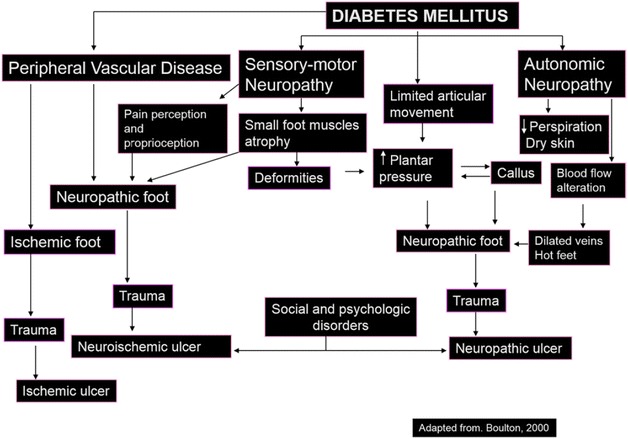
“All the neuropathies, alone or simultaneously, can lead to neuropathic foot ulcer, the most severe cutaneous lesion, in consequence of the poor healing potential of DM skin [42] that frequently become infected, thus leading to amputation [43, 44].”
BackgroundThe global burden of diabetic foot disease
Boulton, A. J., Vileikyte, L., Ragnarson-Tennvall, G., & Apelqvist, J. (2005) · The Lancet · doi:10.1016/s0140-6736(05)67698-2 · Cited by 2,566 · cited 2×
“skin hydration, orthotic devices, patient education) is highly acclaimed by medical society, once the diabetic foot brings severe economic, personal, social, and medical impact [35, 45].”
BackgroundQuantifying the Risk of Infectious Diseases for People With Diabetes
Shah, B. R., & Hux, J. E. (2003) · Diabetes Care · doi:10.2337/diacare.26.2.510 · Cited by 902 · cited 1×
“Although prior studies showed increased risk of infection in DM patients [16], little evidence is found in the literature to support increased risk for cutaneous infectious diseases [9].”
ResultDiabetic Foot Disorders: A Clinical Practice Guideline (2006 Revision)
Frykberg, R. G., Zgonis, T., Armstrong, D. G., Driver, V. R., Giurini, J. M., Kravitz, S. R., Landsman, A. S., Lavery, L. A., Moore, J. C., Schuberth, J. M., et al. (2006) · The Journal of Foot and Ankle Surgery · doi:10.1016/s1067-2516(07)60001-5 · Cited by 831
Advanced glycation end products: Key players in skin aging?
Gkogkolou, P., & Böhm, M. (2012) · Dermato-Endocrinology · doi:10.4161/derm.22028 · Cited by 584
Wound healing and diabetes mellitus
Greenhalgh, D. G. (2003) · Clinics in Plastic Surgery · doi:10.1016/s0094-1298(02)00066-4 · Cited by 510 · cited 1×
“Diabetes-related immunosuppression affects skin wounding, mainly by leukocyte impaired function and misbalanced/malfunction of growth factors [25].”
BackgroundChoosing a Practical Screening Instrument to Identify Patients at Risk for Diabetic Foot Ulceration
Armstrong, D. G., Lavery, L. A., Vela, S. A., Quebedeaux, T. L., & Fleischli, J. G. (1998) · Archives of Internal Medicine · doi:10.1001/archinte.158.3.289 · Cited by 451 · cited 1×
“• Motor neuropathy: causes toe and gait deformity, leading to foot deformity and increased plantar pressure [38, 39].”
BackgroundDiabetic foot disorders: A clinical practice guideline
Frykberg, R. G., Armstrong, D. G., Giurini, J. M., Edwards, A. L., Kravette, M. A., Kravitz, S. R., Ross, C. W., Stavosky, J. W., Stuck, R. M., & Vanore, J. (2000) · The Journal of Foot & Ankle Surgery · Cited by 396
Plantar soft tissue loading under the medial metatarsals in the standing diabetic foot
Gefen, A. (2003) · Medical Engineering & Physics · doi:10.1016/s1350-4533(03)00029-8 · Cited by 247 · cited 1×
“skin hydration, orthotic devices, patient education) is highly acclaimed by medical society, once the diabetic foot brings severe economic, personal, social, and medical impact [35, 45].”
BackgroundGlucose Effects on Skin Keratinocytes
Spravchikov, N., Sizyakov, G., Gartsbein, M., Accili, D., Tennenbaum, T., & Wertheimer, E. (2001) · Diabetes · doi:10.2337/diabetes.50.7.1627 · Cited by 241 · cited 2×
“As an example, keratinocytes, which is the predominant cell type in the epidermis, are downregulated in hyperglycemia conditions, with impairment on its proliferation [26].”
Background
Research works printed but not linked: 3
- Federation ID IDF diabetes atlas 2013 6 Brussels International Diabetes Federation 35914061
- Boulton AJM The Pathway to ulceration: aetiopathogenesis. The foot in diabetes 2002 USA Wiley 19 31
- Nunes S Mosca MM Rosa VP de Macedo GMC Uncontrolled, open-label, single center clinical study to evaluate the perceived efficacy and acceptability of Hidrastar cream and lotion for feet in diabetic patients Revista Brasileira de Medicina 2015 72 195 199
Cited by
From pre-diabetes to diabetes: diagnosis, treatments and translational research
Khan, R., Chua, Z., Tan, J., Yang, Y., Liao, Z., & Zhao, Y. (2019) · Medicina · doi:10.3390/medicina55090546 · Cited by 484
“Although various studies presented different statistical data on skin disorder in diabetic patients, cutaneous infection, xerosis, and inflammatory skin diseases were the most common types of skin disorders reported for diabetic individuals [242,243].”
BackgroundReed, J., Bain, S., & Kanamarlapudi, V. (2021) · Diabetes, Metabolic Syndrome and Obesity: Targets and Therapy · doi:10.2147/dmso.s319895 · Cited by 441
Metabolic orchestration of the wound healing response
Eming, S. A., Murray, P. J., & Pearce, E. J. (2021) · Cell Metabolism · doi:10.1016/j.cmet.2021.07.017 · Cited by 315
Chen, C., Zhang, J., Li, L., Guo, M., He, Y., Dong, Y., Meng, H., & Yi, F. (2022) · Frontiers in Medicine · doi:10.3389/fmed.2022.837222 · Cited by 203
Defining Skin Quality: Clinical Relevance, Terminology, and Assessment
Humphrey, S. D., Brown, S. M., Cross, S. J., & Mehta, R. (2021) · Dermatologic Surgery · doi:10.1097/dss.0000000000003079 · Cited by 135
Metadata
- Authors
- de Macedo, G. M. C., Nunes, S., & Barreto, T.
- Affiliations
- Sociedade Brasileira de Dermatologia (BR)
- ORCID
- Nunes, Samanta
- Venue
- Diabetology & Metabolic Syndrome
- Published
- 2016-08-30
- Volume
- 8
- Issue
- 1
- Pages
- 63-63
- ISSN
- 1758-5996 (ISSN-L)
- PMC
- PMC5006568
- OpenAlex
- W2511073480
- Semantic Scholar
- 814125046d1805572d222d89e75be0f4a5917417
- Cited by
- 176
- References
- 57
- Citations by year
- 2026: 14 · 2025: 15 · 2024: 27 · 2023: 21 · 2022: 20 · 2021: 26 · 2020: 20 · 2019: 12 · 2018: 9 · 2017: 9 · 2016: 3
- FWCI
- 1.56
- Type
- journal article
- Language
- en
- Open access
- gold
- doi.org
- Licence
- cc-by
- Locations
- Diabetology & Metabolic Syndrome (publishedVersion, cc-by)
- PubMed Central (publishedVersion, cc-by)
- PubMed (publishedVersion)
- Funders
- Sanofi
- Topics
- Health Sciences › Medicine › Dermatology › Skin Diseases and Diabetes
- Health Sciences › Medicine › Endocrinology, Diabetes and Metabolism › Diabetic Foot Ulcer Assessment and Management
- Health Sciences › Medicine › Dermatology › Dermatology and Skin Diseases
- Keywords
- skin diseases, diabetes mellitus, diabetic foot, diabetic ulcers, skin infections, dry skin, pruritus, advanced glycation end products, hyperglycemia, skin hydration, orthoses, pathophysiology, epidemiology
About these checks
Registry, retraction, Cites and statistics results are computed, not judged, with one exception: a printed reference that no index lists is read once by a model before it counts as a citation error. Claims are extracted by a model and kept only when their quote appears verbatim in the text; each cited source is then checked, with a model’s help, for whether it says what the claim relies on. Those verdicts can be wrong — read the claim’s quote and the cited source before relying on one.
Statistics and arithmetic are recomputed, not judged.
Confidence bands are shown only for fields calibrated on our annotated test set. None is calibrated yet, so no band is shown.
What counts as a claim ›How we measure confidence ›How we check this ›
Are you an author, or do you see a problem with this page? Request a review
Data sources
Bibliographic data: Semantic Scholar, OpenAlex, Crossref.
Contains information from the Semantic Scholar Academic Graph Datasets, made available under the ODC Attribution License (ODC-BY 1.0).
Semantic Scholar’s data is described in: Kinney, R., et al. (2023). The Semantic Scholar Open Data Platform. arXiv:2301.10140.
