

The DOI matches its Crossref record; 41 of the 41 references it cites were found in a registry or an index.
Mobile phone applications and their use in the self-management of Type 2 Diabetes Mellitus: a qualitative study among app users and non-app users
Open accessAbstract
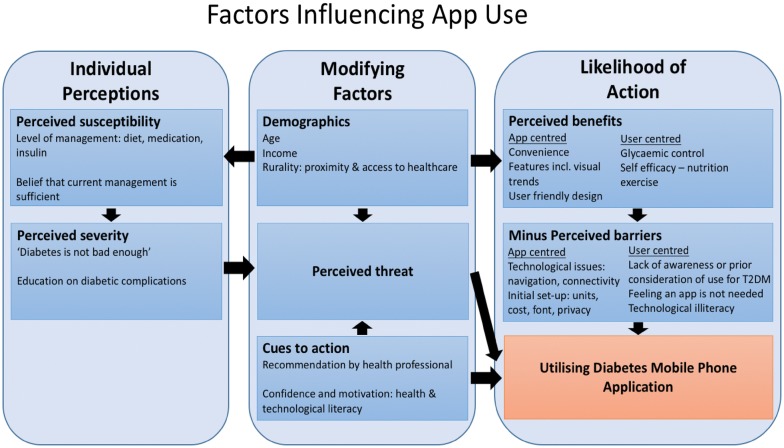
Background: Mobile phone applications (apps) have been shown to successfully facilitate the self-management of chronic disease. This study aims to evaluate firstly the experiences, barriers and facilitators to app usage among people with Type 2 Diabetes Mellitus (T2DM) and secondly determine recommendations to improve usage of diabetes apps. Methods: Participants were aged ≥ 18 years with a diagnosis of T2DM for ≥ 6 months. Semi-structured phone-interviews were conducted with 16 app and 14 non-app users. Interviews were based on the Technology Acceptance Model, Health Information Technology Acceptance Model (HITAM) and the Mobile Application Rating Scale. Data were analysed using deductive content analysis. Results: Most app-users found apps improved their T2DM self-management and health. The recommendation of apps by health professionals, as well as positive interactions with them, improved satisfaction; however, only a minority of patients had practitioners involved in their app use. All non-app users had never had the concept discussed with them by a health professional. Facilitators to app use included the visual representation of trends, intuitive navigation and convenience (for example, discretion and portability). Barriers to app use were participant’s lack of knowledge and awareness of apps as healthcare tools, perceptions of disease severity, technological and health literacy or practical limitations such as rural connectivity. Factors contributing to app use were classified into a framework based on the Health Belief Model and HITAM. Recommendations for future app design centred on educational features, which were currently lacking (e.g. diabetes complications, including organ damage and hypoglycaemic episodes), monitoring and tracking features (e.g. blood glucose level monitoring with trends and dynamic tips and comorbidities) and nutritional features (e.g. carbohydrate counters). Medication reminders were not used by participants. Lastly, participants felt that receiving weekly text-messaging relating to their self-management would be appropriate. Conclusions: The incorporation of user-centred features, which engage T2DM consumers in self-management tasks, can improve health outcomes. The findings may guide app developers and entrepreneurs in improving app design and usability. Given self-management is a significant factor in glycaemic control, these findings are significant for GPs, nurse practitioners and allied health professionals who may integrate apps into a holistic management plan which considers strategies outside the clinical environment.
Overview
The claims and statistics of this paper haven’t been checked yet.
Run the check — free, no account needed. It reads the open-access text and checks the sources it cites.
Integrity signals
Registry
Cites
Statistics
Figures
Verification
Claims the paper makes
The claims and statistics of this paper haven’t been checked yet.
Run the check — free, no account needed. It reads the open-access text and checks the sources it cites.
Self-check
Percentages, sums and reported differences re-computed from the paper’s own numbers.
The self-check needs the paper’s full text.
Citations
Cites
The qualitative content analysis process
Elo, S., & Kyngäs, H. (2008) · Journal of Advanced Nursing · doi:10.1111/j.1365-2648.2007.04569.x · Cited by 22,617
Sampling Knowledge: The Hermeneutics of Snowball Sampling in Qualitative Research
Noy, C. (2008) · International Journal of Social Research Methodology · doi:10.1080/13645570701401305 · Cited by 4,131
The Technology Acceptance Model: Its past and its future in health care
Holden, R. J., & Karsh, B.-T. (2010) · Journal of Biomedical Informatics · doi:10.1016/j.jbi.2009.07.002 · Cited by 2,669
Mobile app rating scale: a new tool for assessing the quality of health mobile apps
Stoyanov, S. R., Hides, L., Kavanagh, D. J., Zelenko, O., Tjondronegoro, D., & Mani, M. (2015) · JMIR mHealth and uHealth · doi:10.2196/mhealth.3422 · Cited by 2,233
Chrvala, C. A., Sherr, D., & Lipman, R. D. (2016) · Patient Education and Counseling · doi:10.1016/j.pec.2015.11.003 · Cited by 914
Mobile medical and health apps: state of the art, concerns, regulatory control and certification
Kamel Boulos, M. N., Brewer, A. C., Karimkhani, C., Buller, D. B., & Dellavalle, R. P. (2014) · Online Journal of Public Health Informatics · doi:10.5210/ojphi.v5i3.4814 · Cited by 659
Applied qualitative research design a total quality framework approach
Roller, M. R., & Lavrakas, P. J. (n.d.) · Cited by 580
Franklin, V. L., Waller, A., Pagliari, C., & Greene, S. A. (2006) · Diabetic Medicine · doi:10.1111/j.1464-5491.2006.01989.x · Cited by 543
Mobile Health Apps to Facilitate Self-Care: A Qualitative Study of User Experiences
Anderson, K., Burford, O., & Emmerton, L. (2016) · PLOS ONE · doi:10.1371/journal.pone.0156164 · Cited by 502
Kim, J., & Park, H.-A. (2012) · Journal of Medical Internet Research · doi:10.2196/jmir.2143 · Cited by 475
Hou, C., Carter, B., Hewitt, J., Francisa, T., & Mayor, S. (2016) · Diabetes Care · doi:10.2337/dc16-0346 · Cited by 411
Mobile Applications for Diabetes Self-Management: Status and Potential
El-Gayar, O., Timsina, P., Nawar, N., & Eid, W. (2013) · Journal of Diabetes Science and Technology · doi:10.1177/193229681300700130 · Cited by 370
Holmen, H., Torbjørnsen, A., Wahl, A. K., Jenum, A. K., Småstuen, M. C., Årsand, E., & Ribu, L. (2014) · JMIR mHealth and uHealth · doi:10.2196/mhealth.3882 · Cited by 294
Bonoto, B. C., de Araújo, V. E., Godói, I. P., de Lemos, L. L. P., Godman, B., Bennie, M., Diniz, L. M., & Junior, A. A. G. (2017) · JMIR mhealth and uhealth · doi:10.2196/mhealth.6309 · Cited by 294
Changes in Age at Diagnosis of Type 2 Diabetes Mellitus in the United States, 1988 to 2000
Koopman, R. J. (2005) · The Annals of Family Medicine · doi:10.1370/afm.214 · Cited by 291
Faridi, Z., Liberti, L., Shuval, K., Northrup, V., Ali, A., & Katz, D. L. (2008) · Journal of Evaluation in Clinical Practice · doi:10.1111/j.1365-2753.2007.00881.x · Cited by 217
Acceptance Factors of Mobile Apps for Diabetes by Patients Aged 50 or Older: A Qualitative Study
Scheibe, M., Reichelt, J., Bellmann, M., & Kirch, W. (2015) · Medicine 2.0 · doi:10.2196/med20.3912 · Cited by 207
DialBetics: A Novel Smartphone-based Self-management Support System for Type 2 Diabetes Patients
Waki, K., Fujita, H., Uchimura, Y., Omae, K., Aramaki, E., Kato, S., Lee, H., Kobayashi, H., Kadowaki, T., & Ohe, K. (2014) · Journal of Diabetes Science and Technology · doi:10.1177/1932296814526495 · Cited by 203
Mobile Applications for Control and Self Management of Diabetes: A Systematic Review
Brzan, P. P., Rotman, E., Pajnkihar, M., & Klanjsek, P. (2016) · Journal of Medical Systems · doi:10.1007/s10916-016-0564-8 · Cited by 161
Farmer, A. J., Perera, R., Ward, A., Heneghan, C., Oke, J., Barnett, A. H., Davidson, M. B., Guerci, B., Coates, V., Schwedes, U., et al. (2012) · BMJ · doi:10.1136/bmj.e486 · Cited by 156
A systematic review of IT for diabetes self-management: Are we there yet?
El-Gayar, O., Timsina, P., Nawar, N., & Eid, W. (2013) · International Journal of Medical Informatics · doi:10.1016/j.ijmedinf.2013.05.006 · Cited by 148
Kebede, M. M., & Pischke, C. R. (2019) · Frontiers in Endocrinology · doi:10.3389/fendo.2019.00135 · Cited by 144
Desveaux, L., Shaw, J., Saragosa, M., Soobiah, C., Marani, H., Hensel, J. M., Agarwal, P., Onabajo, N., Bhatia, R. S., & Jeffs, L. P. (2018) · Journal of Medical Internet Research · doi:10.2196/jmir.8712 · Cited by 141
Pal, K., Dack, C., Ross, J., Michie, S., May, C., Stevenson, F., Farmer, A., Yardley, L., Barnard, M., & Murray, E. (2018) · Journal of Medical Internet Research · doi:10.2196/jmir.8439 · Cited by 139
Dropout from an eHealth intervention for adults with type 2 diabetes: a qualitative study
Lie, S. S., Karlsen, B., Oord, E. R., Graue, M., & Oftedal, B. (2017) · Journal of Medical Internet Research · doi:10.2196/jmir.7479 · Cited by 136
Lyles, C. R., Harris, L. T., Le, T., Flowers, J., Tufano, J., Britt, D., Hoath, J., Hirsch, I. B., Goldberg, H. I., & Ralston, J. D. (2011) · Diabetes Technology & Therapeutics · doi:10.1089/dia.2010.0200 · Cited by 116
Health status differentials across rural and remote Australia
Phillips, A. (2009) · Australian Journal of Rural Health · doi:10.1111/j.1440-1584.2008.01029.x · Cited by 115
Christie, D., Thompson, R. J., Sawtell, M., Allen, E., Cairns, J., Smith, F. J., Jamieson, E., Hargreaves, K., Ingold, A., Brooks, L., et al. (2014) · Health Technology Assessment · doi:10.3310/hta18200 · Cited by 98
Alvarado, M. M., Kum, H.-C., Gonzalez Coronado, K., Foster, M. J., Ortega, P., & Lawley, M. A. (2017) · Journal of Medical Internet Research · doi:10.2196/jmir.6382 · Cited by 95
Peng, W., Yuan, S., & Holtz, B. E. (2016) · Telemedicine and e-Health · doi:10.1089/tmj.2015.0180 · Cited by 94
Boyle, L., Grainger, R., Hall, R. M., & Krebs, J. D. (2017) · JMIR mhealth and uhealth · doi:10.2196/mhealth.7263 · Cited by 86
Wu, X., Kee, J. C. Y., Threapleton, D. E., Ma, R. C. W., Lam, V., Lee, E. K. P., Wong, S. Y. S., & Chung, V. C. (2018) · Obesity Reviews · doi:10.1111/obr.12669 · Cited by 80
Trawley, S. L., Baptista, S. N., Browne, J. L., Pouwer, F., & Speight, J. (2017) · Diabetes Technology & Therapeutics · doi:10.1089/dia.2017.0235 · Cited by 62
Gatwood, J., Balkrishnan, R., Erickson, S. R., An, L. C., Piette, J. D., & Farris, K. B. (2016) · Research in Social and Administrative Pharmacy · doi:10.1016/j.sapharm.2015.04.007 · Cited by 52
What makes a good clinical app? Introducing the RCP Health Informatics Unit checklist
Wyatt, J. C., Thimbleby, H., Rastall, P., Hoogewerf, J., Wooldridge, D., & Williams, J. (2015) · Clinical Medicine · doi:10.7861/clinmedicine.15-6-519 · Cited by 52
Baptista, S., Trawley, S., Pouwer, F., Oldenburg, B., Wadley, G., & Speight, J. (2019) · Diabetes Technology & Therapeutics · doi:10.1089/dia.2019.0086 · Cited by 42
An exploration of attitudes toward the use of patient incentives to support diabetes self-management
Blondon, K., Klasnja, P., Coleman, K., & Pratt, W. (2013) · Psychology and Health · doi:10.1080/08870446.2013.867346 · Cited by 23
Assessing the risk of self-harm in an adult offender population: an incidence cohort study
Horton, M., Wright, N. M. J., Dyer, W., Wright-Hughes, A. M., Farrin, A. J., Bi-Mohammad, Z., Smith, J. B., Heyes, T., Gilbody, S. M., & Tennant, A. (2014) · Health Technology Assessment · doi:10.3310/hta18640 · Cited by 22
DiaFit: The Development of a Smart App for Patients with Type 2 Diabetes and Obesity
Modave, F. P., Bian, J., Rosenberg, E. I., Mendoza, T., Liang, Z., Bhosale, R., Maeztu, C., Rodriguez, C., & Cardel, M. I. (2016) · JMIR Diabetes · doi:10.2196/diabetes.6662 · Cited by 21
Andrews, S. M., Sperber, N. R., Gierisch, J. M., Danus, S. M., Macy, S., Bosworth, H. B., Edelman, D. E., & Crowley, M. J. (2017) · Patient Preference and Adherence · doi:10.2147/ppa.s125673 · Cited by 21
Digital Diabetes Communication
Klonoff, D. C., & Kerr, D. E. (2016) · Journal of Diabetes Science and Technology · doi:10.1177/1932296816660210 · Cited by 14
Research works printed but not linked: 3
- Katz D, Dalton N, Price B. Failing the challenge: diabetes apps & long-term daily adoption. In: 8th International conference on advanced technologies & treatments for diabetes (ATTD 2015), Paris. 2015.
- Skinner CS, Tiro J, Champion VL. The health belief model. Health behavior: theory, research, and practice. 5th ed. San Francisco: Jossey-Bass; 2015. p. 75–94.
- Boyle L, Grainger R, Hall RM, Krebs JD. Use of and beliefs about mobile phone apps for diabetes self-management: surveys of people in a hospital diabetes clinic and diabetes health professionals in New Zealand. JMIR mHealth uHealth. 2017;5(6):e85. · DOI
Cited by
Sorted by citations
Fisk, M., Livingstone, A., & Pit, S. W. (2020) · Journal of Medical Internet Research · doi:10.2196/19264 · Cited by 486
Self-citationKaihlanen, A., Virtanen, L., Buchert, U., Safarov, N., Valkonen, P., Hietapakka, L., Hörhammer, I., Kujala, S., Kouvonen, A. M., & Heponiemi, T. (2022) · BMC Health Services Research · doi:10.1186/s12913-022-07584-4 · Cited by 301
khan, Z. F., & Alotaibi, S. R. (2020) · Journal of Healthcare Engineering · doi:10.1155/2020/8894694 · Cited by 235
Cardiac Autonomic Neuropathy in Type 1 and 2 Diabetes: Epidemiology, Pathophysiology, and Management
Williams, S., Raheim, S. A., Khan, M. I., Rubab, U., Kanagala, P., Zhao, S. S., Worthington, A., Brown, E. E., & Alam, U. (2022) · Clinical Therapeutics · doi:10.1016/j.clinthera.2022.09.002 · Cited by 102
Alfonsi, J., Choi, E., Arshad, T., Sammott, S.-A. S., Pais, V., Nguyen, C., Maguire, B. R., Stinson, J., & Palmert, M. R. (2020) · JMIR mhealth and uhealth · doi:10.2196/22074 · Cited by 84
Metadata
- Authors
- Jeffrey, B., Bagala, M., Creighton, A., Leavey, T., Nicholls, S., Wood, C., Longman, J., Barker, J., & Pit, S.
- Affiliations
- Western Sydney University (AU)
- The University of Sydney (AU)
- Corresponding author
- Pit, Sabrina
- Venue
- Diabetology & Metabolic Syndrome
- Published
- 2019-10-16
- Volume
- 11
- Issue
- 1
- Pages
- 84-84
- ISSN
- 1758-5996 (ISSN-L)
- PMC
- PMC6794726
- OpenAlex
- W2980451355
- Cited by
- 212
- References
- 41
- Citations by year
- 2026: 16 · 2025: 31 · 2024: 29 · 2023: 52 · 2022: 42 · 2021: 31 · 2020: 11
- FWCI
- 28.63
- Type
- journal article
- Language
- en
- Open access
- gold
- doi.org
- Locations
- Diabetology & Metabolic Syndrome (publishedVersion, cc-by)
- PubMed Central (publishedVersion, cc-by)
- PubMed (publishedVersion)
- DOAJ (DOAJ: Directory of Open Access Journals) (submittedVersion)
- Funders
- Diabetes Australia
- Southern Cross University
- Western Sydney University
- Topics
- Health Sciences › Health Professions › General Health Professions › Mobile Health and mHealth Applications
- Health Sciences › Medicine › Endocrinology, Diabetes and Metabolism › Diabetes Management and Education
- Health Sciences › Health Professions › Health Information Management › Health, Technology, Consumer Behavior
- Keywords
- mobile health apps, type 2 diabetes, self-management, provider recommendation, technology acceptance, Health Belief Model, health literacy, text messaging, blood glucose monitoring
About these checks
Registry, retraction, Cites and statistics results are computed, not judged, with one exception: a printed reference that no index lists is read once by a model before it counts as a citation error. Claims are extracted by a model and kept only when their quote appears verbatim in the text; each cited source is then checked, with a model’s help, for whether it says what the claim relies on. Those verdicts can be wrong — read the claim’s quote and the cited source before relying on one.
Statistics and arithmetic are recomputed, not judged.
Confidence bands are shown only for fields calibrated on our annotated test set. None is calibrated yet, so no band is shown.
What counts as a claim ›How we measure confidence ›How we check this ›
Are you an author, or do you see a problem with this page? Request a review
