

The DOI matches its Crossref record; 21 of the 21 references it cites were found in a registry or an index.
Mean amplitude deviation calculated from raw acceleration data: a novel method for classifying the intensity of adolescents’ physical activity irrespective of accelerometer brand
Open accessAbstract
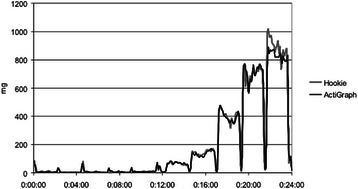
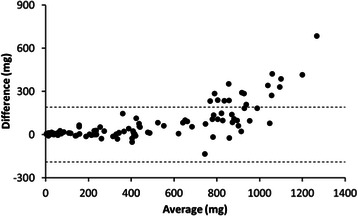
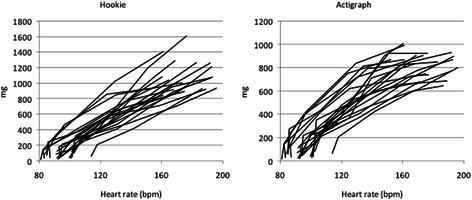
BACKGROUND: Using raw acceleration data to assess the intensity of physical activity enables direct comparisons between studies using different accelerometer brands. Mean amplitude deviation (MAD in mg) calculated from resultant tri-axial raw acceleration signal was recently shown to perform best in classifying the intensity of physical activity in adults irrespective of the accelerometer brand. This study compared MAD values and cut-points between two different accelerometers in adolescents. METHODS: Twenty voluntary participants (10 girls and 10 boys) of average age of 14 wore two accelerometers (Actigraph GTX3, Pensacola FL, USA and Hookie AM13, Espoo, Finland) and heart rate monitors (M61, Polar Electro Oy, Kempele, Finland) while completing ten 2-min patterns of typical activities ranging from sedentary behaviour to light, moderate and vigorous-intensity locomotion. Bland-Altman method examined the agreement of MAD values between the accelerometers. Correlation coefficient between individual heart rates and MAD values indicated the validity of pattern-based intensity classification. Generalized ordinal logistic regression determined the intensity-specific MAD cut-points for both accelerometers. RESULTS: MAD values varied from 3 mg (lying supine) to 1609 mg (running). Hookie gave higher values than Actigraph in accelerations exceeding 700 mg. The correlation coefficient between MAD values and heart rates was 0.96 for Hookie and 0.97 for Actigraph. Respectively, the MAD cut-points were 29 and 27 (light), 338 and 330 (moderate), and 604 and 558 (vigorous). CONCLUSIONS: MAD values and cut-points of Hookie and Actigraph showed excellent agreement. Analysing raw accelerometer data with MAD values may enable the comparison of accelerometer results between different studies also in adolescents.
Overview
The claims and statistics of this paper haven’t been checked yet.
Run the check — free, no account needed. It reads the open-access text and checks the sources it cites.
Integrity signals
Registry
Cites
Statistics
Figures
Verification
Claims the paper makes
The claims and statistics of this paper haven’t been checked yet.
Run the check — free, no account needed. It reads the open-access text and checks the sources it cites.
Claims other papers make about this one
Each is checked against this paper’s own text: does it say what the citing paper says it does?
In the citing paper
“A recent study showed that the standard deviation of the 3D acceleration norm resembles intensity of physical activity of 2 widely used commercial acceleration-based activity trackers with reasonable consensus [29].”
From Mobile Sensing and Support for People With Depression: A Pilot Trial in the Wild (2016) · cites this paper as [29]
Self-check
Percentages, sums and reported differences re-computed from the paper’s own numbers.
The self-check needs the paper’s full text.
Citations
Cites
Janssen, I., & LeBlanc, A. G. (2010) · International Journal of Behavioral Nutrition and Physical Activity · doi:10.1186/1479-5868-7-40 · Cited by 4,829 · cited 1×
“The interest in assessing physical activity and sedentary behaviour in children and adolescents has received increasing attention as obesity and related health risks have become more general also at younger age [2, 3] and the evidence about the health benefits of physical activity in paediatric population has strength…”
BackgroundEvidence Based Physical Activity for School-age Youth
Strong, W. B., Malina, R. M., Blimkie, C. J. R., Daniels, S. R., Dishman, R. K., Gutin, B., Hergenroeder, A. C., Must, A., Nixon, P. A., Pivarnik, J. M., et al. (2005) · The Journal of Pediatrics · doi:10.1016/j.jpeds.2005.01.055 · Cited by 4,222
Prince, S. A., Adamo, K. B., Hamel, M., Hardt, J., Connor Gorber, S., & Tremblay, M. (2008) · International Journal of Behavioral Nutrition and Physical Activity · doi:10.1186/1479-5868-5-56 · Cited by 3,162
Global prevalence and trends of overweight and obesity among preschool children
de Onis, M., Blössner, M., & Borghi, E. (2010) · The American Journal of Clinical Nutrition · doi:10.3945/ajcn.2010.29786 · Cited by 2,182
Comparison of Accelerometer Cut Points for Predicting Activity Intensity in Youth
TROST, S. G., LOPRINZI, P. D., MOORE, R., & PFEIFFER, K. A. (2011) · Medicine & Science in Sports & Exercise · doi:10.1249/mss.0b013e318206476e · Cited by 1,360
Evolution of accelerometer methods for physical activity research
Troiano, R. P., McClain, J. J., Brychta, R. J., & Chen, K. Y. (2014) · British Journal of Sports Medicine · doi:10.1136/bjsports-2014-093546 · Cited by 968
Using Accelerometers in Youth Physical Activity Studies: A Review of Methods
Cain, K. L., Sallis, J. F., Conway, T. L., Dyck, D. V., & Calhoon, L. (2013) · Journal of Physical Activity and Health · doi:10.1123/jpah.10.3.437 · Cited by 735
Assessment of physical activity in youth
Corder, K. L., Ekelund, U., Steele, R. M., Wareham, N. J., & Brage, S. (2008) · Journal of Applied Physiology · doi:10.1152/japplphysiol.00094.2008 · Cited by 582
Adamo, K. B., Prince, S. A., Tricco, A. C., Gorber, S. C., & Tremblay, M. S. (2008) · International Journal of Pediatric Obesity · doi:10.1080/17477160802315010 · Cited by 497
Baquet, G., Stratton, G., Praagh, E. V., & Berthoin, S. (2006) · Preventive Medicine · doi:10.1016/j.ypmed.2006.10.004 · Cited by 370
Cited by
Sorted by citations
Items 101–126 of 126
Reisberg, K., Riso, E., Animägi, L., & Jürimäe, J. (2024) · BMC Pediatrics · doi:10.1186/s12887-024-05336-3 · Cited by 1
Finnegan, O., White, J., Armstrong, B., Adams, E. L., Burkart, S. A., Beets, M. W., Nelakuditi, S., Zhong, Z., Yang, H., Kiely, K., et al. (2025) · Journal for the Measurement of Physical Behaviour · doi:10.1123/jmpb.2025-0002 · Cited by 1
wristpy: Fast, User-Friendly Python Processing of Wrist-worn Accelerometer Data
Santorelli, A., Perez, F., de Wael, R. V., Rupprecht, F., d’Antonio-Bertagnolli, J. V., Franco, A. R., & Kiar, G. (2025) · The Journal of Open Source Software · doi:10.21105/joss.08637 · Cited by 1
Holder, T., Nichols, C., Summers, E., Roberts, D. L., & Bozkurt, A. Y. (2023) · International Conference on Animal-Computer Interaction (ACI) · doi:10.1145/3637882.3637886 · Cited by 1
Yang, W.-W., Lin, Y., Chien, H.-F. C., Shiang, T.-Y., McCullen, M., & Chen, C.-F. (2024) · IEEE Access · doi:10.1109/access.2024.3439773 · Cited by 1
Dewi, N. S., Komatsuzaki, M., 山川, 百., Takahashi, H., Saori, S., Yasue, T., Okayama, T., & Toyoda, A. (2018) · Japanese Journal of Farm Work Research · doi:10.4035/jsfwr.53.164 · Cited by 1
Emerging Technology Applications to Promote Physical Activity and Health
Gao, Z., & Lee, J. (2019) · MDPI eBooks · doi:10.3390/books978-3-03897-709-4 · Cited by 1
Ahmadi, M. N. (2020) · Queensland University of Technology · doi:10.5204/thesis.eprints.206178
Coyle-Asbil, H. J. (2021) · The Atrium (University of Guelph)
Corrigendum: Are Family Physical Activity Habits Passed on to Their Children?
Zovko, V., Djuric, S., Sember, V., & Jurak, G. (2022) · Frontiers in Psychology · doi:10.3389/fpsyg.2022.824595
Mäkituomas, L., Heikkilä, L., Nurkkala, M., Korpelainen, R., Alanko, L., Heinonen, O. J., Kokko, S. P., Kujala, U. M., Parkkari, J. P., Savonen, K. P., et al. (2022) · Research Square · doi:10.21203/rs.3.rs-1814776/v1
Self-citationAnhedonia and 24-hour movement behaviours in adulthood
Karppanen, A., Miettunen, J., Hurtig, T. M., Leinonen, A., Korpelainen, R., & Farrahi, V. (2025) · Journal of Affective Disorders Reports · doi:10.1016/j.jadr.2025.100911
Sociodemographic determinants of the level of physical activity in residents of Eastern Poland
Bergier, M., Bergier, B., Rocha, P. M., Niźnikowska, E. A., Szepeluk, A., Tomczyszyn, D., Baj–Korpak, J., & Stelmach, M. J. (2025) · BMC Public Health · doi:10.1186/s12889-025-25912-1
Aira, T., Vasankari, T., Heinonen Olli, J., Korpelainen, R., Kotkajuuri, J., Parkkari, J. P., Savonen, K. P., Uusitalo, A., Valtonen, M., Villberg, J. J., et al. (2021) · Figshare · doi:10.6084/m9.figshare.14889843
Self-citationAira, T., Vasankari, T., Heinonen Olli, J., Korpelainen, R., Kotkajuuri, J., Parkkari, J. P., Savonen, K. P., Uusitalo, A., Valtonen, M., Villberg, J. J., et al. (2021) · Figshare · doi:10.6084/m9.figshare.14889846
Self-citationAira, T., Vasankari, T., Heinonen Olli, J., Korpelainen, R., Kotkajuuri, J., Parkkari, J. P., Savonen, K. P., Uusitalo, A., Valtonen, M., Villberg, J. J., et al. (2021) · Figshare · doi:10.6084/m9.figshare.14889852
Self-citationMäkituomas, L., Heikkilä, L., Nurkkala, M., Korpelainen, R., Alanko, L., Heinonen Olli, J., Kokko, S., Kujala, U. M., Parkkari, J. P., Savonen, K. P., et al. (2022) · Figshare · doi:10.6084/m9.figshare.21628777
Self-citationAira, T., Vasankari, T., Heinonen Olli, J., Korpelainen, R., Kotkajuuri, J., Parkkari, J. P., Savonen, K. P., Uusitalo, A., Valtonen, M., Villberg, J. J., et al. (2021) · Figshare · doi:10.6084/m9.figshare.14889849
Self-citationAira, T., Vasankari, T., Heinonen Olli, J., Korpelainen, R., Kotkajuuri, J., Parkkari, J. P., Savonen, K. P., Uusitalo, A., Valtonen, M., Villberg, J. J., et al. (2021) · Figshare · doi:10.6084/m9.figshare.14889855
Self-citationBeck, F., Marzi, I., Eisenreich, A., Seemüller, S., Tristram, C., & Reimers, A. K. (2023) · Figshare · doi:10.6084/m9.figshare.24655844
Sun, R., Safundzic, M., Bailey, J. F., Lotz, J. C., Smuck, M. W., & _, _. (2025) · Journal for the Measurement of Physical Behaviour · doi:10.1123/jmpb.2025-0014
Luukkainen, N., Côté, J., Tolvanen, A. J., Sarkkinen, E., Niemistö, D., Sääkslahti, A., & Laukkanen, A. (2026) · Medicine & Science in Sports & Exercise · doi:10.1249/mss.0000000000003999
Estimation de la sollicitation énergétique des patients AVC en situation réelle de vie
Compagnat, M. (2020) · theses.fr (ABES) · doi:10.70675/0e7cd6f4z11f2z4a5dz906fz99e3957dc846
Sameh, A., Nauha, L., Seppänen, M., Niemelä, M., Oussalah, M., Korpelainen, R., & Farrahi, V. (2026) · Psychiatry Research · doi:10.1016/j.psychres.2026.117242 · Cited by 2
How to estimate physical activity prevalence in children and adolescents?
Vähä‐Ypyä, H., Husu, P., Tokola, K., Sievänen, H., Kokko, S. P., & Vasankari, T. J. (2026) · Journal of science and medicine in sport · doi:10.1016/j.jsams.2026.06.009
Self-citationSeemüller, S., Reimers, A. K., Meixner, B. J., Engel, F. A., & Beck, F. (2026) · Journal of NeuroEngineering and Rehabilitation · doi:10.1186/s12984-026-02085-5
Metadata
- Authors
- Aittasalo, M., Vähä-Ypyä, H., Vasankari, T., Husu, P., Jussila, A.-M., & Sievänen, H.
- Affiliations
- Urho Kaleva Kekkonen Institute (FI)
- Corresponding author
- Aittasalo, Minna
- Venue
- BMC Sports Science, Medicine and Rehabilitation
- Published
- 2015-08-07
- Volume
- 7
- Issue
- 1
- Pages
- 18-18
- ISSN
- 2052-1847 (ISSN-L)
- PMC
- PMC4527117
- OpenAlex
- W1689929051
- Cited by
- 126
- References
- 21
- Citations by year
- 2026: 4 · 2025: 8 · 2024: 13 · 2023: 14 · 2022: 20 · 2021: 21 · 2020: 8 · 2019: 11 · 2018: 11 · 2017: 8 · 2016: 7 · 2015: 1
- FWCI
- 6.62
- Type
- journal article
- Language
- en
- Open access
- gold
- doi.org
- Licence
- Locations
- BMC Sports Science Medicine and Rehabilitation (publishedVersion, cc-by)
- Europe PMC (PubMed Central) (publishedVersion, cc-by)
- PubMed Central (publishedVersion, cc-by)
- PubMed (publishedVersion)
- Funders
- Tekes
- Pirkanmaan Sairaanhoitopiiri
- Topics
- Health Sciences › Medicine › Public Health, Environmental and Occupational Health › Physical Activity and Health
- Physical Sciences › Computer Science › Computer Vision and Pattern Recognition › Context-Aware Activity Recognition Systems
- Health Sciences › Medicine › Public Health, Environmental and Occupational Health › Obesity, Physical Activity, Diet
- Keywords
- physical activity intensity classification, adolescents, ActiGraph, heart rate monitors, cut points, sedentary behavior, high-intensity exercise
About these checks
Registry, retraction, Cites and statistics results are computed, not judged, with one exception: a printed reference that no index lists is read once by a model before it counts as a citation error. Claims are extracted by a model and kept only when their quote appears verbatim in the text; each cited source is then checked, with a model’s help, for whether it says what the claim relies on. Those verdicts can be wrong — read the claim’s quote and the cited source before relying on one.
Statistics and arithmetic are recomputed, not judged.
Confidence bands are shown only for fields calibrated on our annotated test set. None is calibrated yet, so no band is shown.
What counts as a claim ›How we measure confidence ›How we check this ›
Are you an author, or do you see a problem with this page? Request a review
