

The DOI matches its Crossref record; 80 of the 81 references it cites were found in a registry or an index.
Four Core Genotypes mouse model: localization of the Sry transgene and bioassay for testicular hormone levels
Open accessAbstract
BACKGROUND: The "four core genotypes" (FCG) mouse model has emerged as a major model testing if sex differences in phenotypes are caused by sex chromosome complement (XX vs. XY) or gonadal hormones or both. The model involves deletion of the testis-determining gene Sry from the Y chromosome and insertion of an Sry transgene onto an autosome. It produces XX and XY mice with testes, and XX and XY mice with ovaries, so that XX and XY mice with the same type of gonad can be compared to assess phenotypic effects of sex chromosome complement in cells and tissues. FINDINGS: We used PCR to amplify the Sry transgene and adjacent genomic sequences, to resolve the location of the Sry transgene to chromosome 3 and confirmed this location by fluorescence in situ hybridization (FISH) of the Sry construct to metaphase chromosomes. Using quantitative PCR, we estimate that 12-14 copies of the transgene were inserted. The anogenital distance (AGD) of FCG pups at 27-29 days after birth was not different in XX vs. XY males, or XX vs. XY females, suggesting that differences between XX and XY mice with the same type of gonad are not caused by difference in prenatal androgen levels. CONCLUSION: The Sry transgene in FCG mice is present in multiple copies at one locus on chromosome 3, which does not interrupt known genes. XX and XY mice with the same type of gonad do not show evidence of different androgen levels prenatally.
Overview
The claims and statistics of this paper haven’t been checked yet.
Run the check — free, no account needed. It reads the open-access text and checks the sources it cites.
Integrity signals
Registry
Cites
Statistics
Figures
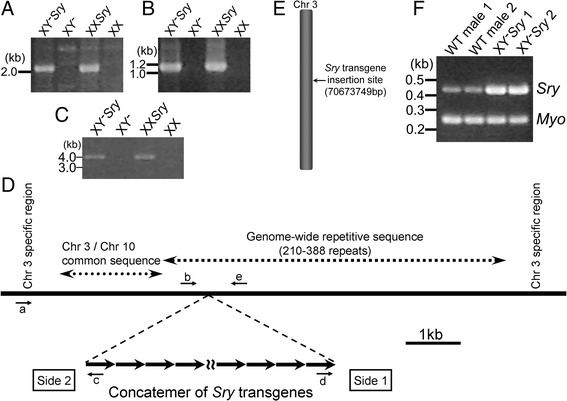
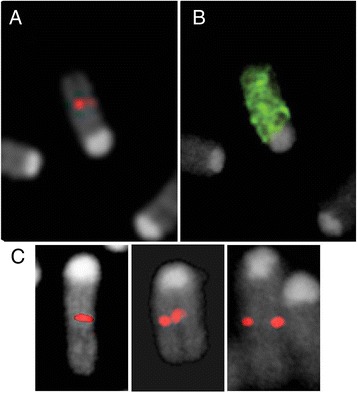
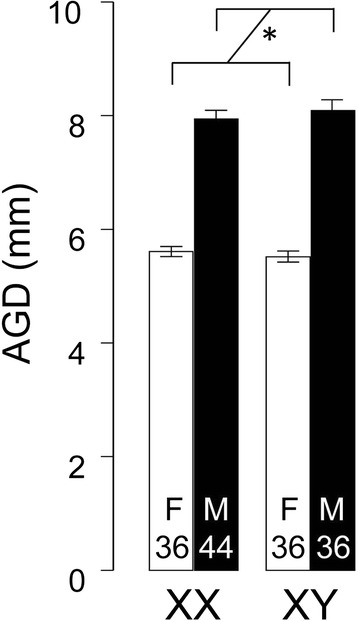
Verification
Claims the paper makes
The claims and statistics of this paper haven’t been checked yet.
Run the check — free, no account needed. It reads the open-access text and checks the sources it cites.
Claims other papers make about this one
Each is checked against this paper’s own text: does it say what the citing paper says it does?
The cited source says what the claim attributes to it.
In the citing paper
“we used the Four Core Genotypes (FCG) mouse model, which allows for an independent assessment of gonadal hormones and sex chromosomal effects [47–49].”
From Sex chromosomes and sex hormones differently shape microglial properties during normal physiological conditions in the adult mouse hippocampus (2025) · cites this paper as [47]
Self-check
Percentages, sums and reported differences re-computed from the paper’s own numbers.
The self-check needs the paper’s full text.
Citations
Cites
Controlling the false discovery rate in behavior genetics research
Benjamini, Y., Drai, D., Elmer, G., Kafkafi, N., & Golani, I. (2001) · Behavioural Brain Research · doi:10.1016/s0166-4328(01)00297-2 · Cited by 4,146
Reframing sexual differentiation of the brain
McCarthy, M. M., & Arnold, A. P. (2011) · Nature Neuroscience · doi:10.1038/nn.2834 · Cited by 728
Self-citationArnold, A. P. (2009) · Hormones and Behavior · doi:10.1016/j.yhbeh.2009.03.011 · Cited by 625
Self-citationArnold, A. P., & Chen, X. (2009) · Frontiers in Neuroendocrinology · doi:10.1016/j.yfrne.2008.11.001 · Cited by 587
Self-citationDe Vries, G. J., Rissman, E. F., Simerly, R. B., Yang, L.-Y., Scordalakes, E. M., Auger, C. J., Swain, A., Lovell-Badge, R., Burgoyne, P. S., & Arnold, A. P. (2002) · The Journal of Neuroscience · doi:10.1523/jneurosci.22-20-09005.2002 · Cited by 509
Self-citationA role for sex chromosome complement in the female bias in autoimmune disease
Smith-Bouvier, D. L., Divekar, A., Manda, S. V., Du, S., Tiwari-Woodruff, S. K., King, J. K., Arnold, A. P., Singh, R. R., & Voskuhl, R. R. (2008) · The Journal of Experimental Medicine · doi:10.1084/jem.20070850 · Cited by 398
Self-citationSex chromosomes and brain gender
Arnold, A. P. (2004) · Nature Reviews Neuroscience · doi:10.1038/nrn1494 · Cited by 368
Self-citationThe Number of X Chromosomes Causes Sex Differences in Adiposity in Mice
Chen, X., McClusky, R., Chen, J., Beaven, S. W., Tontonoz, P., Arnold, A. P., & Reue, K. (2012) · PLoS Genetics · doi:10.1371/journal.pgen.1002709 · Cited by 326
Self-citationXY female mice resulting from a heritable mutation in the primary testis determining gene, Tdy
Lovell-Badge, R., & Robertson, E. (1990) · Development · doi:10.1242/dev.109.3.635 · Cited by 311
Sex chromosome genes directly affect brain sexual differentiation
Carruth, L. L., Reisert, I., & Arnold, A. P. (2002) · Nature Neuroscience · doi:10.1038/nn922 · Cited by 298
Self-citation
Cited by
Sorted by citations
Items 101–144 of 144
Chung, D. D., Mahnke, A. H., Pinson, M. R., Salem, N. A., Lai, M. S., Collins, N. P., Hillhouse, A., & Miranda, R. C. (2024) · Figshare · doi:10.6084/m9.figshare.26582480
Chung, D. D., Mahnke, A. H., Pinson, M. R., Salem, N. A., Lai, M. S., Collins, N. P., Hillhouse, A. E., & Miranda, R. C. (2024) · Figshare · doi:10.6084/m9.figshare.26582432
Chung, D. D., Mahnke, A. H., Pinson, M. R., Salem, N. A., Lai, M. S., Collins, N. P., Hillhouse, A. E., & Miranda, R. C. (2024) · Figshare · doi:10.6084/m9.figshare.26582393
Chung, D. D., Mahnke, A. H., Pinson, M. R., Salem, N. A., Lai, M. S., Collins, N. P., Hillhouse, A. E., & Miranda, R. C. (2024) · Figshare · doi:10.6084/m9.figshare.26582465
Chung, D. D., Mahnke, A. H., Pinson, M. R., Salem, N. A., Lai, M. S., Collins, N. P., Hillhouse, A. E., & Miranda, R. C. (2024) · Figshare · doi:10.6084/m9.figshare.26582441
Chung, D. D., Mahnke, A. H., Pinson, M. R., Salem, N. A., Lai, M. S., Collins, N. P., Hillhouse, A. E., & Miranda, R. C. (2024) · Figshare · doi:10.6084/m9.figshare.26582435
Chung, D. D., Mahnke, A. H., Pinson, M. R., Salem, N. A., Lai, M. S., Collins, N. P., Hillhouse, A. E., & Miranda, R. C. (2024) · Figshare · doi:10.6084/m9.figshare.26582450
Chung, D. D., Mahnke, A. H., Pinson, M. R., Salem, N. A., Lai, M. S., Collins, N. P., Hillhouse, A. E., & Miranda, R. C. (2024) · Figshare · doi:10.6084/m9.figshare.26582456
Chung, D. D., Mahnke, A. H., Pinson, M. R., Salem, N. A., Lai, M. S., Collins, N. P., Hillhouse, A. E., & Miranda, R. C. (2024) · Figshare · doi:10.6084/m9.figshare.26582477
Chung, D. D., Mahnke, A. H., Pinson, M. R., Salem, N. A., Lai, M. S., Collins, N. P., Hillhouse, A., & Miranda, R. C. (2024) · Figshare · doi:10.6084/m9.figshare.26582474
Amato-Menker, C. J., Hopen, Q., Pettit, A., Gandhi, J., Hu, G., Schafer, R., & Franko, J. (2024) · Figshare · doi:10.6084/m9.figshare.26693239
Hamade, A., Li, D., Tyryshkin, K., Xu, M., Conseil, G., Yolmo, P., Hamilton, J., Chenard, S., Robert Siemens, D., & Koti, M. (2022) · Figshare · doi:10.6084/m9.figshare.19704021
Chung, D. D., Mahnke, A. H., Pinson, M. R., Salem, N. A., Lai, M. S., Collins, N. P., Hillhouse, A. E., & Miranda, R. C. (2024) · Figshare · doi:10.6084/m9.figshare.26582459
Amato-Menker, C. J., Hopen, Q., Pettit, A., Gandhi, J., Hu, G., Schafer, R., & Franko, J. (2024) · Figshare · doi:10.6084/m9.figshare.26693245
Amato-Menker, C. J., Hopen, Q., Pettit, A., Gandhi, J., Hu, G., Schafer, R., & Franko, J. (2024) · Figshare · doi:10.6084/m9.figshare.26693233
Amato-Menker, C. J., Hopen, Q., Pettit, A., Gandhi, J., Hu, G., Schafer, R., & Franko, J. (2024) · Figshare · doi:10.6084/m9.figshare.26693242
Chung, D. D., Mahnke, A. H., Pinson, M. R., Salem, N. A., Lai, M. S., Collins, N. P., Hillhouse, A. E., & Miranda, R. C. (2024) · Figshare · doi:10.6084/m9.figshare.26582384
Chung, D. D., Mahnke, A. H., Pinson, M. R., Salem, N. A., Lai, M. S., Collins, N. P., Hillhouse, A. E., & Miranda, R. C. (2024) · Figshare · doi:10.6084/m9.figshare.26582369
Chung, D. D., Mahnke, A. H., Pinson, M. R., Salem, N. A., Lai, M. S., Collins, N. P., Hillhouse, A., & Miranda, R. C. (2024) · Figshare · doi:10.6084/m9.figshare.26582399
Hamade, A., Li, D., Tyryshkin, K., Xu, M., Conseil, G., Yolmo, P., Hamilton, J., Chenard, S., Robert Siemens, D., & Koti, M. (2022) · Figshare · doi:10.6084/m9.figshare.19704006
Chung, D. D., Mahnke, A. H., Pinson, M. R., Salem, N. A., Lai, M. S., Collins, N. P., Hillhouse, A. E., & Miranda, R. C. (2024) · Figshare · doi:10.6084/m9.figshare.26582387
Hamade, A., Li, D., Tyryshkin, K., Xu, M., Conseil, G., Yolmo, P., Hamilton, J., Chenard, S., Robert Siemens, D., & Koti, M. (2022) · Figshare · doi:10.6084/m9.figshare.19704000
Chung, D. D., Mahnke, A. H., Pinson, M. R., Salem, N. A., Lai, M. S., Collins, N. P., Hillhouse, A., & Miranda, R. C. (2024) · Figshare · doi:10.6084/m9.figshare.26582429
Amato-Menker, C. J., Hopen, Q., Pettit, A., Gandhi, J., Hu, G., Schafer, R., & Franko, J. (2024) · Figshare · doi:10.6084/m9.figshare.25414981
Chung, D. D., Mahnke, A. H., Pinson, M. R., Salem, N. A., Lai, M. S., Collins, N. P., Hillhouse, A. E., & Miranda, R. C. (2024) · Figshare · doi:10.6084/m9.figshare.26582471
Chung, D. D., Mahnke, A. H., Pinson, M. R., Salem, N. A., Lai, M. S., Collins, N. P., Hillhouse, A., & Miranda, R. C. (2024) · Figshare · doi:10.6084/m9.figshare.26582396
Chung, D. D., Mahnke, A. H., Pinson, M. R., Salem, N. A., Lai, M. S., Collins, N. P., Hillhouse, A. E., & Miranda, R. C. (2024) · Figshare · doi:10.6084/m9.figshare.26582453
Chung, D. D., Mahnke, A. H., Pinson, M. R., Salem, N. A., Lai, M. S., Collins, N. P., Hillhouse, A., & Miranda, R. C. (2024) · Figshare · doi:10.6084/m9.figshare.26582468
Chung, D. D., Mahnke, A. H., Pinson, M. R., Salem, N. A., Lai, M. S., Collins, N. P., Hillhouse, A. E., & Miranda, R. C. (2024) · Figshare · doi:10.6084/m9.figshare.26582378
Chung, D. D., Mahnke, A. H., Pinson, M. R., Salem, N. A., Lai, M. S., Collins, N. P., Hillhouse, A. E., & Miranda, R. C. (2024) · Figshare · doi:10.6084/m9.figshare.26582390
Chung, D. D., Mahnke, A. H., Pinson, M. R., Salem, N. A., Lai, M. S., Collins, N. P., Hillhouse, A. E., & Miranda, R. C. (2024) · Figshare · doi:10.6084/m9.figshare.26582486
Chung, D. D., Mahnke, A. H., Pinson, M. R., Salem, N. A., Lai, M. S., Collins, N. P., Hillhouse, A. E., & Miranda, R. C. (2024) · Figshare · doi:10.6084/m9.figshare.26582408
Chung, D. D., Mahnke, A. H., Pinson, M. R., Salem, N. A., Lai, M. S., Collins, N. P., Hillhouse, A. E., & Miranda, R. C. (2024) · Figshare · doi:10.6084/m9.figshare.26582414
Chung, D. D., Mahnke, A. H., Pinson, M. R., Salem, N. A., Lai, M. S., Collins, N. P., Hillhouse, A., & Miranda, R. C. (2024) · Figshare · doi:10.6084/m9.figshare.26582426
Chung, D. D., Mahnke, A. H., Pinson, M. R., Salem, N. A., Lai, M. S., Collins, N. P., Hillhouse, A. E., & Miranda, R. C. (2024) · Figshare · doi:10.6084/m9.figshare.26582372
Chung, D. D., Mahnke, A. H., Pinson, M. R., Salem, N. A., Lai, M. S., Collins, N. P., Hillhouse, A. E., & Miranda, R. C. (2024) · Figshare · doi:10.6084/m9.figshare.26582402
Chung, D. D., Mahnke, A. H., Pinson, M. R., Salem, N. A., Lai, M. S., Collins, N. P., Hillhouse, A. E., & Miranda, R. C. (2024) · Figshare · doi:10.6084/m9.figshare.26582444
Chung, D. D., Mahnke, A. H., Pinson, M. R., Salem, N. A., Lai, M. S., Collins, N. P., Hillhouse, A. E., & Miranda, R. C. (2024) · Figshare · doi:10.6084/m9.figshare.26582375
Chung, D. D., Mahnke, A. H., Pinson, M. R., Salem, N. A., Lai, M. S., Collins, N. P., Hillhouse, A. E., & Miranda, R. C. (2024) · Figshare · doi:10.6084/m9.figshare.26582423
Chung, D. D., Mahnke, A. H., Pinson, M. R., Salem, N. A., Lai, M. S., Collins, N. P., Hillhouse, A. E., & Miranda, R. C. (2024) · Figshare · doi:10.6084/m9.figshare.26582483
Sex chromosome genes contribute to cocaine vulnerability in a strain-dependent mannerPreprint
Le, A. L., Dickey, A. N., Duong, T.-B., Rissman, E. F., & Lynch, W. J. (2026) · Research Square · doi:10.21203/rs.3.rs-9519927/v1
Deficiency in circulating T cells in four core genotypes mice with Sry translocation
McKernan, K. E., Cephus, J.-Y., Kuehnle, S. N., Pilier, E. H., Dandy, A. C., Bacharier, T., Polosukhin, V. V., Cahill, K. N., Silveyra, P., & Newcomb, D. C. (2026) · The Journal of Immunology · doi:10.1093/jimmun/vkag207
Gorashi, R. M., Baddour, T., Richter, K., Nguyen, A. K., Faust, M. N., Loud, M. C., Broders, S. L., Zheng, Q., Graner, L., Chen, X., et al. (2026) · bioRxiv (Cold Spring Harbor Laboratory) · doi:10.64898/2026.10.13.758988
Self-citationKCC3a regulation in the distal nephron displays sexual dimorphism
Ferdaus, M. Z., Terker, A. S., Cantalupo, A., Carrisoza‐Gaytan, R., Satlin, L. M., Wall, S. M., Welling, P. A., & Delpire, E. J. (2026) · American Journal of Physiology-Renal Physiology · doi:10.1152/ajprenal.00238.2026
Metadata
- Authors
- Itoh, Y., Mackie, R., Kampf, K., Domadia, S., Brown, J. D., O’Neill, R., & Arnold, A. P.
- Affiliations
- University of California, Los Angeles (US)
- University of Connecticut (US)
- Corresponding author
- Arnold, Arthur P
- Venue
- BMC Research Notes
- Published
- 2015-03-07
- Volume
- 8
- Issue
- 1
- Pages
- 69-69
- ISSN
- 1756-0500 (ISSN-L)
- PMC
- PMC4354741
- OpenAlex
- W2000906752
- Cited by
- 109
- References
- 81
- Citations by year
- 2026: 8 · 2025: 9 · 2024: 22 · 2023: 6 · 2022: 14 · 2021: 6 · 2020: 12 · 2019: 6 · 2018: 8 · 2017: 10 · 2016: 6 · 2015: 2
- FWCI
- 5.96
- Type
- journal article
- Language
- en
- Open access
- gold
- doi.org
- Locations
- BMC Research Notes (publishedVersion, cc-by)
- Europe PMC (PubMed Central) (publishedVersion, cc-by)
- PubMed Central (publishedVersion, cc-by)
- PubMed (publishedVersion)
- Funders
- National Science Foundation
- National Institutes of Health (DK 083561)
- National Institute of Diabetes and Digestive and Kidney Diseases (R56DK083561, R01DK083561, DK083561)
- National Institute of Neurological Disorders and Stroke (NS 043196, R01NS043196)
- Eunice Kennedy Shriver National Institute of Child Health and Human Development (R01HD076125, HD076125)
- Topics
- Life Sciences › Biochemistry, Genetics and Molecular Biology › Genetics › Genetic and Clinical Aspects of Sex Determination and Chromosomal Abnormalities
- Health Sciences › Medicine › Endocrinology, Diabetes and Metabolism › Sexual Differentiation and Disorders
- Health Sciences › Medicine › Reproductive Medicine › Sperm and Testicular Function
- Keywords
- testis-determining gene, sex chromosome complement, gonadal hormones, anogenital distance, transgene copy number, chromosome 3, sex differences in phenotype
- MeSH terms
- Androgens, Animals, Biological Assay, Female, Genotype, Male, Mice, Transgenic, Ovary, Phenotype, Sex Characteristics, Testis, X Chromosome, Y Chromosome, In Situ Hybridization, Fluorescence, Gene Dosage, Transgenes, Genes, sry, Mice
About these checks
Registry, retraction, Cites and statistics results are computed, not judged, with one exception: a printed reference that no index lists is read once by a model before it counts as a citation error. Claims are extracted by a model and kept only when their quote appears verbatim in the text; each cited source is then checked, with a model’s help, for whether it says what the claim relies on. Those verdicts can be wrong — read the claim’s quote and the cited source before relying on one.
Statistics and arithmetic are recomputed, not judged.
Confidence bands are shown only for fields calibrated on our annotated test set. None is calibrated yet, so no band is shown.
What counts as a claim ›How we measure confidence ›How we check this ›
Are you an author, or do you see a problem with this page? Request a review
