

The DOI matches its Crossref record.
A systematic review: the current status of carbapenem resistance in East Africa
Open accessAbstract
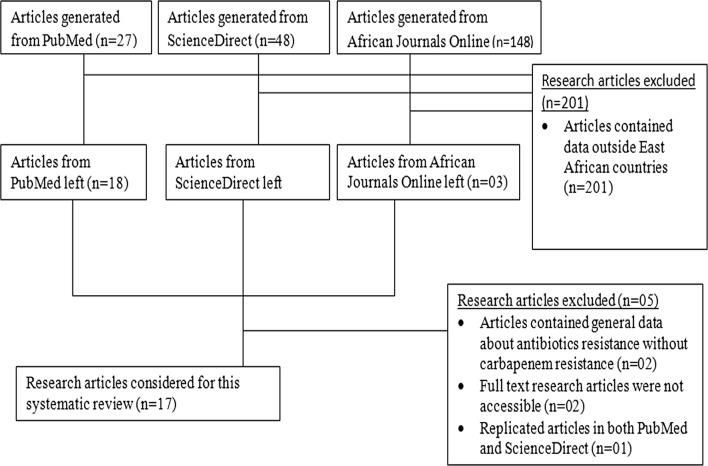
OBJECTIVE: In this systematic review, we present the molecular epidemiology and knowledge gaps of the carbapenem resistance in East Africa as well as the future probable research interventions that can be used to address the emergence of carbapenem resistance in the region. RESULTS: The 17 articles which presented concrete information about the prevalence of carbapenem resistance in East Africa were reviewed. Tanzania exhibited the highest level of carbapenem resistance at 35% while DRC had the lowest level at 0.96%. Uganda was the only country with studies documenting CR obtained amongst hospital environment isolates with incidence ranging from 21% in Pseudomonas aeruginosa to 55% in Acinetobacter baumannii. Carbapenem resistance was more exhibited in A. baumannii (23%), followed by P. aeruginosa (17%), Klebsiella pneumoniae (15%), Proteus mirabilis (14%) and Escherichia coli (12%) mainly isolated from respiratory tract, blood, urine and wound/pus. The regional genetic determinants of carbapenem resistance detected were blaIMP, blaVIM-1 blaSPM-l, blaNDM-1, blaOXA-23 blaOXA-24, blaOXA-58 and blaKPC.
Overview
The claims and statistics of this paper haven’t been checked yet.
Run the check — free, no account needed. It reads the open-access text and checks the sources it cites.
Integrity signals
Registry
Cites
Statistics
Figures
Verification
Claims the paper makes
The claims and statistics of this paper haven’t been checked yet.
Run the check — free, no account needed. It reads the open-access text and checks the sources it cites.
Claims other papers make about this one
Each is checked against this paper’s own text: does it say what the citing paper says it does?
The cited source says what the claim attributes to it.
In the citing paper
“A 2018 study reported that in East Africa, A. baumannii had the highest prevalence (23%) of carbapenem resistance compared to other multidrug-resistant bacteria.148”
From Antimicrobial Resistance Rates and Surveillance in Sub-Saharan Africa: Where Are We Now? (2022) · cites this paper as [148]
Self-check
Percentages, sums and reported differences re-computed from the paper’s own numbers.
The self-check needs the paper’s full text.
Citations
Cites
Still being checked.
Research works printed but not linked: 54
- Livermore DM, Warner M, Mushtaq S, Doumith M, Zhang J, Woodford N. What remains against carbapenem resistant Enterobacteriaceae? Evaluation of chloramphenicol, ciprofloxacin, colistin, fosfomycin, minocycline, nitrofurantoin, temocillin and tigecycline. Int J Antimicrob Agents. 2011;37:415–24. · DOI
- CDC. Facility guidance for control of carbapenem-resistant Enterobacteriaceae (CRE). Atlanta: United States Department of Health and Human Services; 2015.
- European Centre for Disease Prevention and Control-ECDC. Rapid risk assessment-carbapenem-resistant Enterobacteriaceae. Stockholm: ECDC; 2016.
- European Food Safety Authority (EFSA) and European Centre for Disease Prevention and Control (ECDC). EU summary report on antimicrobial resistance in zoonotic and indicator bacteria from humans, animals and food in 2013. EFSA J. 2015;13:4036.
- Nordmann P, Dortet L, Poirel L. Carbapenem resistance in Enterobacteriaceae: here is the storm! Trends Mol Med. 2012;18(5):263–72. · DOI
- Nordmann P, Poirel L, Walsh TR, Livermore DM. The emerging NDM carbapenemases. Trends Microbiol. 2011;19:588–95. · DOI
- Bush K, Fisher JF. Epidemiological expansion, structural studies, and clinical challenges of new beta-lactamases from gram-negative bacteria. Annu Rev Microbiol. 2011;65:455–78. · DOI
- Walsh TR, Weeks J, Livermore DM, Toleman MA. Dissemination of NDM-1 positive bacteria in the New Delhi environment and its implications for human health: an environmental point prevalence study. Lancet Infect Dis. 2011;11:355–62. · DOI
- EFSA. Scientific opinion on carbapenem resistance in food animal ecosystems. EFSA J. 2013;11(12):3501.
- Hattie EW, Bugarel M, Bakker HC, Nightingale KK, Granier SA, Scott MH, Loneragan GH. Carbapenem-resistant bacteria recovered from faeces of dairy cattle in the high plains region of the USA. PLOS ONE. 2016. https://doi.org/10.1371/journal.pone.0147363 . · DOI
- Mollenkopf DF, Stull JW, Mathys DA, Bowman AS, Feicht SM, Grooters SV, Daniels JB, Wittum TE. Carbapenemase-producing Enterobacteriaceae recovered from the environment of a swine farrow-to-finish operation in the United States. Am Soc Microbiol Antimicrob Agents Chemother. 2016;61:e01298-16. · DOI
- Woodford N, Wareham DW, Guerra B, Teale C. Carbapenemase-producing Enterobacteriaceae and non-Enterobacteriaceae from animals and the environment: an emerging public health risk of our own making? J Antimicrob Chemother. 2013;69:287–91. · DOI
- Patel G, Bonomo RA. “Stormy waters ahead”: global emergence of carbapenemases. Front Microbiol. 2013. https://doi.org/10.3389/fmicb.2013.00048 . · DOI
- Ambler RP, Coulson AFW, Frere JM, Ghuysen JM, Joris B, Forsman M, Levesque RC, Tiraby G, Waley SG. A standard numbering scheme for the class A beta lactamases. Biochem J. 1991;276:269–70. · DOI
- Queenan AM, Bush K. Carbapenemases: the versatile lactamases. Clin Microbiol Rev. 2007;20(23):440–58. · DOI
- Poirel L, Naas T, Nordmann P. Diversity, epidemiology, and genetics of class D -lactamases. Antimicrob Agents Chemother. 2010;54:24–38. · DOI
- Ampaire L, Muhindo A, Orikiriza P, Mwanga-Amumpaire J, Bebell L, Boum Y. A review of antimicrobial resistance in East Africa. Afr J Lab Med. 2016;5(1):a432. https://doi.org/10.4102/ajlm.v5i1.432 . · DOI
- Manenzhe RI, Zar HJ, Nicol MP, Kaba M. The spread of carbapenemase-producing bacteria in Africa: a systematic review. J Antimicrob Chemother. 2015;70:23–40. · DOI
- Byarugaba DK, Kisame R, Olet S. Multi-drug resistance in commensal bacteria of food of animal origin in Uganda. AJMR. 2011;5:1539–48.
- Economou V, Gousia P. Agriculture and food animals as a source of antimicrobial-resistant bacteria. Infect Drug Resist. 2015;8:49–61. · DOI
- Warnes SL, Highmore CJ, Keevil CW. Horizontal transfer of antibiotic resistance genes on abiotic touch surfaces: implications for public health. Am Soc Microbiol. 2012;3:6–12.
- Morgan DJ, Okeke IN, Laxminarayan R, et al. Non-prescription antimicrobial use worldwide: a systematic review. Lancet Infect Dis. 2011;11(9):692–701. https://doi.org/10.1016/S1473-3099(11)70054-8 . · DOI · Paper page
- Pitout JDD, Revathi G, Chow BL, Kabera B, Kariuki S, Nordmann P, Poirel L. Metallo beta-lactamase-producing Pseudomonas aeruginosa isolated from a large tertiary centre in Kenya. Clin Microbiol Infect. 2008;14:755–9. · DOI
- Poirel L, Revathi G, Bernabeu S, Nordman P. Detection of NDM-1-producing Klebsiella pneumonia in Kenya. Am Soc Microbiol Antimicrob Agents Chemother. 2011;55:934–6. · DOI
- Revathi G, Siu LK, Po-Liang Lu, Huang L. First report of NDM-1 producing Acinetobacter baumannii in East Africa. Int J Infect Dis. 2013;17:1255–8. · DOI
- Apondi OE, Oduor OC, Gye BK, Kipkoech MK. High prevalence of multi-drug resistant Klebsiella pneumoniae in a tertiary teaching hospital in western Kenya. Afr J Infect Dis. 2016;10:89–95. · DOI
- Henson SP, Boinett CJ, Ellington MJ, Kagia N, Mwarumba S, Nyongesa S, Mturi N, Kariuki S, Scott JAG, Thomson NR, Morpeth SC. Molecular epidemiology of Klebsiella pneumoniae invasive infections over a decade at Kilifi County Hospital in Kenya. Int J Med Microbiol. 2017;307:422–9. · DOI
- Ayoyi OA, Kikuvi G, Bii C, Kariuki S. Prevalence, aetiology and antibiotic sensitivity profile of asymptomatic bacteriuria isolates from pregnant women in selected antenatal clinic from Nairobi, Kenya. Pan Afr Med J. 2017;26:41. https://doi.org/10.11604/pamj.2017.26.41.10975 . · DOI
- Ndungu C, Muigai AWT, Kariuki S. Prevalence and antibiotic resistance patterns of Escherichia coli among hospitalised patients at thika district hospital. East Afr Med J. 2014;91:185–90.
- Okoche D, Asiimwe BB, Katabazi FA, Kato L, Najjuka CF. Prevalence and characterization of carbapenem-resistant Enterobacteriaceae isolated from Mulago National Referral Hospital, Uganda. PLOS ONE. 2015. https://doi.org/10.1371/journal.pone.0135745 . · DOI
- Ampaire ML, Katawera V, Nyehangane D, Yap BI, Bazira J. Epidemiology of carbapenem resistance among multi-drug resistant Enterobacteriaceae. Br Microbiol Res J. 2014;8:418–23. · DOI
- Kateete DP, Nakanjako R, Namugenyi J, Erume J, Joloba ML, Najjuka CF. Carbapenem resistant Pseudomonas aeruginosa and Acinetobacter baumannii at Mulago Hospital in Kampala, Uganda (2007–2009). Springer Plus. 2016;5:1308. https://doi.org/10.1186/s40064-016-2986-7 . · DOI · Paper page
- Kateete DP, Nakanjako R, Okee M, Joloba ML, Najjuka CF. Genotypic diversity among multidrug resistant Pseudomonas aeruginosa and Acinetobacter species at Mulago Hospital in Kampala, Uganda. BMC Res Notes. 2017;10:284. · DOI
- Moyo S, Haldorsen B, Aboud S, Blomberg B, Maselle SY, Sundsfjord A, Langeland N, Samuelsen O. Identification of VIM-2-producing Pseudomonas aeruginosa from Tanzania is associated with sequence types 244 and 640 and the location of blaVIM-2 in an TniC integron. Agents Chemother Antimicrob. 2014. https://doi.org/10.1128/AAC.01436-13 . · DOI
- Mushi MF, Mshana SE, Imirzalioglu C, Bwanga F. Carbapenemase genes among multidrug resistant gram negative clinical isolates from a tertiary hospital in Mwanza, Tanzania. Biomed Res Int. 2014. https://doi.org/10.1155/2014/303104 . · DOI
- Ntirenganya C, Manzi O, Muvunyi CM, Ogbuagu O. High prevalence of antimicrobial resistance among common bacterial isolates in a tertiary healthcare facility in Rwanda. Am J Trop Med Hyg. 2015;92:865–70. · DOI
- Legese MH, Weldearegay GM, Asrat D. Extended-spectrum beta-lactamase- and carbapenemase-producing Enterobacteriaceae among ethiopian children. Infect Drug Resist. 2017;10:27–34. · DOI
- Desta K, Woldeamanuel Y, Azazh A, Mohammod H, Desalegn D, Shimelis D, et al. High gastrointestinal colonization rate with extended-spectrum β-lactamase-producing enterobacteriaceae in Hospitalized patients: emergence of carbapenemase-producing K. pneumoniae in Ethiopia. PLoS ONE. 2016;11(8):e0161685. https://doi.org/10.1371/journal.pone.0161685 . · DOI
- Irenge LM, Kabego L, Vandenberg O, Chirimwami RB, Gala J-L. Antimicrobial resistance in urinary isolates from inpatients and outpatients at a tertiary care hospital in South-Kivu Province (Democratic Republic of Congo). BMC Res Notes. 2014;7:374. · DOI
- CDC. Antibiotic resistance threats in the United States. Atlanta: Centers for Disease Control and Prevention; 2013.
- Ne Gelband H, Miller-petrie M, Suraj P, Gandra S, Levinson J, Barter D, White A, Laxminarayan R. The state of the world’s antibiotics. Washington DC: CDDEP; The centre for disease dynamics, economics and Policy; 2015.
- Pitout JDD, Gregson DB, Poirel L, McClure JA, Le P, Church DL. Detection of Pseudomonas aeruginosa producing metallo-β-lactamases in a large centralized laboratory. J Clin Microbiol. 2005;43(7):3129–35. · DOI
- Henkhoneng MPH, Sulochana DKH, Mamta DKSH, Damrolien S, Lilavati DN, Pratita DP. Prevalence of carbapenem resistance among gram negative bacteria in a Tertiary Care Hospital in North East India. J Dent Med Sci. 2014;13(12 Ver. III):56–60 (p-ISSN: 2279-0861).
- Oduyebo OO, Falayi OM, Oshun P, Ettu AO. Phenotypic determination of carbapenemase producing Enterobacteriaceae isolates from clinical specimens at a Tertiary Hospital in Lagos, Nigeria. Niger Postgrad Med J. 2015;22:223–7. · DOI
- Cai B, Echols R, Magee G, Ferreira JCA, Morgan G, Ariyasu M, Sawada T and Nagata TD (2017). Prevalence of carbapenem resistant gram-negative infections in the United States predominated by Acinetobacter baumannii and Pseudomonas aeruginosa. Open Forum Infectious Diseases-Infectious Diseases Society of America. · DOI
- Singh-Moodley A, Perovic O. Antimicrobial susceptibility testing in predicting the presence of carbapenemase genes in Enterobacteriaceae in South Africa. BMC Infect Dis. 2016;16:1–12. · DOI
- de Oliveira AC, Damasceno QS. Surfaces of the hospital environment as possible deposits of resistant bacteria: a review. Rev Esc Enferm USP. 2010;44(1118–1123):6.
- French GL, Otter JA, Shannon KP, Adams NM, Watling D, Parks MJ. Tackling contamination of the hospital environment by methicillin resistant Staphylococcus aureus (MRSA): a comparison between conventional terminal cleaning and hydrogen peroxide vapour decontamination. J Hosp Infect. 2004;57:31–7. · DOI
- Lerner A, Adler A, Abu-Hanna J, Meitus I, Navon-Venezia S, Carmeli Y. Environmental contamination by carbapenem-resistant Enterobacteriaceae. J Clin Microbiol. 2012;51:177–81. · DOI
- Rocha IV, Ferraz PDM, de Farias TGS, de Oliveira SR. Resistance of bacteria isolated from equipment in an intensive care unit. Acta Paul Enferm. 2015;28:433–9. · DOI
- Picão RC, Cardoso JP, Campana FH, Nicoletti AG, Petrolini FVB, Assis DM, Juliano L, Gales AC. The route of antimicrobial resistance from the hospital effluent to the environment: focus on the occurrence of KPC-producing Aeromonas spp. and Enterobacteriaceae in sewage. Diagn Microbiol Infect Dis. 2013;76:80–5. · DOI
- Nair PK, Vaz MS. Prevalence of carbapenem resistant Enterobacteriaceae from a tertiary care hospital in Mumbai, India. J Microbiol Infect Dis. 2013;3:207–10. · DOI
- Crowley B, Bened VJ, Doménech-Sánchez A. Expression of SHV-2 b-lactamase and of reduced amounts of OmpK36 porin in Klebsiella pneumoniae results in increased resistance to cephalosporins and carbapenems. Antimicrob Agents Chemother. 2002;46:3679–82. · DOI
- Yang D, Guo Y, Zhang Z. Combined porin loss and extended spectrum beta lactamase production is associated with an increasing imipenem minimal inhibitory concentration in clinical Klebsiella pneumoniae strains. Curr Microbiol. 2009;58:366–70. · DOI
Cited by
Sorted by citations
Antimicrobial Resistance Rates and Surveillance in Sub-Saharan Africa: Where Are We Now?
Kariuki, S., Kering, K., Wairimu, C., Onsare, R., & Mbae, C. (2022) · Infection and Drug Resistance · doi:10.2147/idr.s342753 · Cited by 245
Musila, L., Kyany’a, C., Maybank, R., Stam, J., Oundo, V., & Sang, W. (2021) · PLOS ONE · doi:10.1371/journal.pone.0246937 · Cited by 55
Metadata
- Authors
- Ssekatawa, K., Byarugaba, D. K., Wampande, E., & Ejobi, F.
- Affiliations
- Kampala International University (UG)
- Makerere University (UG)
- Corresponding author
- Ssekatawa, Kenneth
- Venue
- BMC Research Notes
- Published
- 2018-08-31
- Volume
- 11
- Issue
- 1
- Pages
- 629-629
- ISSN
- 1756-0500 (ISSN-L)
- PMC
- PMC6119249
- OpenAlex
- W2889088251
- Cited by
- 93
- References
- 0
- Citations by year
- 2026: 7 · 2025: 9 · 2024: 9 · 2023: 14 · 2022: 18 · 2021: 17 · 2020: 17 · 2019: 2
- FWCI
- 0.75
- Type
- journal article
- Language
- en
- Open access
- gold
- doi.org
- Licence
- Locations
- BMC Research Notes (publishedVersion, cc-by)
- Europe PMC (PubMed Central) (publishedVersion, other-oa)
- PubMed Central (publishedVersion, cc-by)
- PubMed (publishedVersion)
- DOAJ (DOAJ: Directory of Open Access Journals) (submittedVersion, cc-by-sa)
- Topics
- Health Sciences › Medicine › Microbiology (medical) › Antibiotic Resistance in Bacteria
- Health Sciences › Medicine › Infectious Diseases › Antibiotic Use and Resistance
- Health Sciences › Medicine › Infectious Diseases › Antimicrobial Resistance in Staphylococcus
- Keywords
- carbapenem resistance, carbapenemase genes, molecular epidemiology, East Africa, Acinetobacter baumannii, Pseudomonas aeruginosa, Klebsiella pneumoniae, Escherichia coli, Proteus mirabilis, blaNDM-1, blaKPC, blaOXA, blaVIM, blaIMP, blaSPM, hospital isolates, antimicrobial resistance
- MeSH terms
- Africa, Eastern, Anti-Bacterial Agents, beta-Lactamases, Escherichia coli, Humans, Microbial Sensitivity Tests, Carbapenems, Drug Resistance, Bacterial, Acinetobacter baumannii
About these checks
Registry, retraction, Cites and statistics results are computed, not judged, with one exception: a printed reference that no index lists is read once by a model before it counts as a citation error. Claims are extracted by a model and kept only when their quote appears verbatim in the text; each cited source is then checked, with a model’s help, for whether it says what the claim relies on. Those verdicts can be wrong — read the claim’s quote and the cited source before relying on one.
Statistics and arithmetic are recomputed, not judged.
Confidence bands are shown only for fields calibrated on our annotated test set. None is calibrated yet, so no band is shown.
What counts as a claim ›How we measure confidence ›How we check this ›
Are you an author, or do you see a problem with this page? Request a review
How to cite
Cite CoChat for the checks on this page, and the paper for its own findings.
- This page
- CoChat. (2026). Citation check: A systematic review: the current status of carbapenem resistance in East Africa. https://app.cochat.ai/papers/10.1186/s13104-018-3738-2
- The paper
- Ssekatawa, K., Byarugaba, D. K., Wampande, E., & Ejobi, F. (2018). A systematic review: the current status of carbapenem resistance in East Africa. BMC Research Notes. https://doi.org/10.1186/s13104-018-3738-2
