

Resistance and virulence determinants of faecal Salmonella spp. isolated from slaughter animals in Benin
Open accessThe DOI matches its Crossref record; 31 of the 31 references it cites were found in a registry or an index.
Abstract
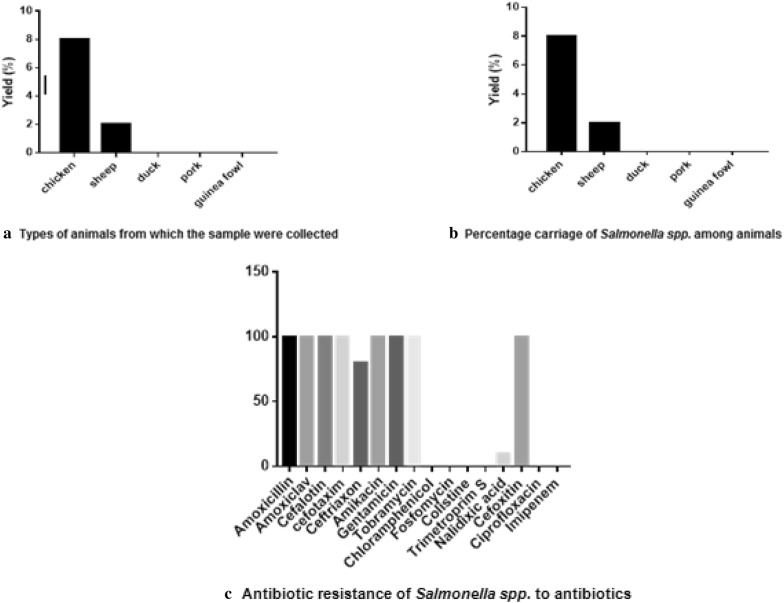
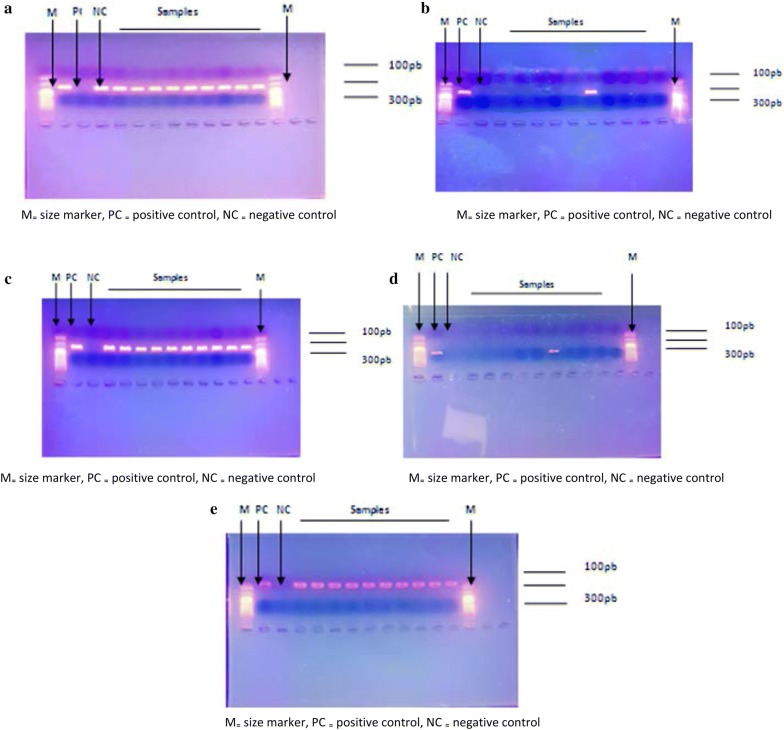
OBJECTIVE: Salmonella spp. are one of the leading foodborne pathogens worldwide naturally found in the intestines of many animals. People that are in direct contact with the infected animals or their cages may become ill. The aim of this study was to determine the prevalence, antibiogram and virulence genes associated with Salmonella serovars from fecal samples of animals intended for consumption in Southern Benin. RESULTS: Out of a total of 406 samples, 2.46% were positive. The isolates identified were multidrug-resistant Salmonella spp. to penicillins, first generation cephalosporins and some aminoglycosides. All Salmonella isolates produced invA gene of 284 bp, fimA of 85 bp and stn of 260 bp. The spvC gene (571 bp) was present in 10% of the isolates whereas the spvR gene (310 bp) was found in 20% of the isolates. The control strain possessed all the tested genes. The invA gene implies that strains are able to invade epithelial cells. The fimA and stn genes present in all isolates show that they are capable of causing gastrointestinal illness in humans. The presence of spvC and spvR genes suggests the possibility of these strains to produce toxins.
Overview
The claims and statistics of this paper haven’t been checked yet.
Free: it reads the open-access text and checks the first 5 claims that cite a source we can check. Create a free account to check every claim.
Integrity signals
Registry
Cites
Statistics
Figures
Verification
Claims the paper makes
The claims and statistics of this paper haven’t been checked yet.
Free: it reads the open-access text and checks the first 5 claims that cite a source we can check. Create a free account to check every claim.
Claims other papers make about this one
Each is checked against this paper’s own text: does it say what the citing paper says it does?
The cited source says what the claim attributes to it.
In the citing paper
“This frequency of spvR is significantly higher than those reported by several authors [24, 31, 48].”
From Characterization of virulence factors of Salmonella isolated from human stools and street food in urban areas of Burkina Faso (2021) · cites this paper as [48]
The cited source says what the claim attributes to it.
In the citing paper
“Elsewhere, published papers [31, 46–48] reveal that invA gene has already been detected in 100% of Salmonella strains.”
From Characterization of virulence factors of Salmonella isolated from human stools and street food in urban areas of Burkina Faso (2021) · cites this paper as [48]
Self-check
Percentages, sums and reported differences re-computed from the paper’s own numbers.
The self-check needs the paper’s full text.
Citations
Cites
Supplement 2003–2007 (No. 47) to the White-Kauffmann-Le Minor scheme
Guibourdenche, M., Roggentin, P., Mikoleit, M., Fields, P. I., Bockemühl, J., Grimont, P. A. D., & Weill, F.-X. (2010) · Research in Microbiology · doi:10.1016/j.resmic.2009.10.002 · Cited by 635 · cited 1×
“enterica serovars have been recognized worldwide, being major causative agents of diseases in humans and animals [5].”
Kumar, V., Mohanty, S., Kumar, A., Misra, R. P., Santosham, M., Awasthi, S., Baqui, A. H., Singh, P., Singh, V., Ahuja, R. C., et al. (2008) · The Lancet · doi:10.1016/s0140-6736(08)61483-x · Cited by 498
Yang, B., Qu, D., Zhang, X., Shen, J., Cui, S., Shi, Y., Xi, M., Sheng, M., Zhi, S., & Meng, J. (2010) · International Journal of Food Microbiology · doi:10.1016/j.ijfoodmicro.2010.04.015 · Cited by 273
Sabbagh, S. C., Forest, C. G., Lepage, C., Leclerc, J.-M., & Daigle, F. (2010) · FEMS Microbiology Letters · doi:10.1111/j.1574-6968.2010.01904.x · Cited by 269
Flint, J. A., Van Duynhoven, Y. T., Angulo, F. J., DeLong, S. M., Braun, P., Kirk, M., Scallan, E., Fitzgerald, M., Adak, G. K., Sockett, P., et al. (2005) · Clinical Infectious Diseases · doi:10.1086/432064 · Cited by 245
The Role of the spv Genes in Salmonella Pathogenesis
Guiney, D. G., & Fierer, J. (2011) · Frontiers in Microbiology · doi:10.3389/fmicb.2011.00129 · Cited by 223
INTEGRATED APPROACHES FOR DETECTION OF PLANT PATHOGENIC BACTERIA AND DIAGNOSIS OF BACTERIAL DISEASES
Alvarez, A. M. (2004) · Annual Review of Phytopathology · doi:10.1146/annurev.phyto.42.040803.140329 · Cited by 202
Oliveira, S. D., Rodenbusch, C. R., Cé, M. C., Rocha, S. L. S., & Canal, C. W. (2003) · Letters in Applied Microbiology · doi:10.1046/j.1472-765x.2003.01294.x · Cited by 176 · cited 1×
“[22] reported that the search for invA, specific for Salmonella spp.”
Salmonella serovars isolated from table eggs: An overview
Martelli, F., & Davies, R. (2011) · Food Research International · doi:10.1016/j.foodres.2011.03.054 · Cited by 143 · cited 1×
“Different animal species, have been detected as carriers of this pathogenic agent [4].”
Cauteren, D. V., Strat, Y. L., Sommen, C., Bruyand, M., Tourdjman, M., Silva, N. J., Couturier, É., Fournet, N., de Valk, H., & Desenclos, J. (2017) · Emerging infectious diseases · doi:10.3201/eid2309.170081 · Cited by 134
DE KNEGT, L. V., PIRES, S. M., & HALD, T. (2015) · Epidemiology and Infection · doi:10.1017/s0950268814001903 · Cited by 118 · cited 1×
“Non-typhoid Salmonella is most often transmitted to humans through contaminated food [6].”
Hennessy, T. W., Har Cheng, L., Kassenborg, H., Ahuja, S. D., Mohle‐Boetani, J., Marcus, R., Shiferaw, B., Angulo, F. J., & the Emerging Infections Program FoodNet Working Group (2004) · Clinical Infectious Diseases · doi:10.1086/381593 · Cited by 116 · cited 1×
“Consumption of raw or undercooked products and out-of-home catering are known risk factors, especially for Salmonella infections [7].”
Chiu, C., Su, L., Chu, C.-H., Wang, M.-H., Yeh, C., Weill, F., & Chu, C. (2006) · Journal of Clinical Microbiology · doi:10.1128/jcm.00171-06 · Cited by 108 · cited 1×
“The rarity of spv genes in the Salmonella genome has also been demonstrated in other studies, which have revealed that they are responsible for the systemic infection and multidrug resistance in humans and animals [28].”
Yanestria, S. M., Rahmaniar, R. P., Wibisono, F. J., & Effendi, M. H. (2019) · Veterinary World · doi:10.14202/vetworld.2019.170-175 · Cited by 107
Chaudhary, J. H., Nayak, J. B., Brahmbhatt, M. N., & Makwana, P. P. (2015) · Veterinary World · doi:10.14202/vetworld.2015.121-124 · Cited by 77
Pasmans, F., Van Immerseel, F., Heyndrickx, M., Martel, A., Godard, C., Wildemauwe, C., Ducatelle, R., & Haesebrouck, F. (2003) · Infection and Immunity · doi:10.1128/iai.71.10.6068-6074.2003 · Cited by 59 · cited 1×
“The amplification of spvR gene was performed using a temperature of 57 °C for 30 s [13].”
Kurita, A., Gotoh, H., Eguchi, M., Okada, N., Matsuura, S., Matsui, H., Danbara, H., & Kikuchi, Y. (2003) · Microbial Pathogenesis · doi:10.1016/s0882-4010(03)00066-4 · Cited by 55 · cited 1×
“They are also involved in intracellular bacterial proliferation [29].”
Salmonella enterotoxin, Stn, regulates membrane composition and integrity
Nakano, M., Yamasaki, E., Ichinose, A., Shimohata, T., Takahashi, A., Akada, J. K., Nakamura, K., Moss, J., Hirayama, T., & Kurazono, H. (2012) · Disease Models & Mechanisms · doi:10.1242/dmm.009324 · Cited by 51
Hung, Y.-T., Lay, C.-J., Wang, C.-L., & Koo, M. (2017) · Journal of Infection and Public Health · doi:10.1016/j.jiph.2016.09.018 · Cited by 49
Gad, A. H., Abo-Shama, U. H., Harclerode, K. K., & Fakhr, M. K. (2018) · Frontiers in Microbiology · doi:10.3389/fmicb.2018.02653 · Cited by 45
Krzyzanowski, F., Zappelini, L., Martone-Rocha, S., Dropa, M., Matté, M. H., Nacache, F., & Razzolini, M. T. P. (2014) · BMC Microbiology · doi:10.1186/s12866-014-0263-x · Cited by 44 · cited 1×
“[27] found a low rate of Salmonella strains possessing spvC gene, suggesting his particularity in the virulence of Salmonella.”
Borriello, G., Lucibelli, M. G., Pesciaroli, M., Carullo, M. R., Graziani, C., Ammendola, S., Battistoni, A., Ercolini, D., Pasquali, P., & Galiero, G. (2012) · BMC Veterinary Research · doi:10.1186/1746-6148-8-201 · Cited by 41
Barilli, E., Bacci, C., Villa, Z. S., Merialdi, G., D’Incau, M., Brindani, F., & Vismarra, A. (2018) · Italian Journal of Food Safety · doi:10.4081/ijfs.2018.7223 · Cited by 41
Bolton, D., O’Neill, C. J., & Fanning, S. (2011) · Zoonoses and Public Health · doi:10.1111/j.1863-2378.2011.01438.x · Cited by 40
Gebreyes, W. A., Thakur, S., Dorr, P., Tadesse, D. A., Post, K., & Wolf, L. (2009) · Journal of Clinical Microbiology · doi:10.1128/jcm.01660-08 · Cited by 39
Marchese, A. E., Esposito, S., Barbieri, R., Bassetti, M., & Debbia, E. A. (2012) · BMC Infectious Diseases · doi:10.1186/1471-2334-12-181 · Cited by 36 · cited 2×
“[14], the stn gene was present in all isolates.”
Araque, M. (2009) · The Journal of Infection in Developing Countries · doi:10.3855/jidc.102 · Cited by 25
Dougnon, T. V., Deguenon, E., Fah, L., Legba, B., Hounmanou, Y. M. G., Agbankpe, J., Amadou, A., Koudokpon, H., Fabiyi, K., Aniambossou, A., et al. (2017) · Veterinary World · doi:10.14202/vetworld.2017.580-592 · Cited by 19 · cited 1×
“The average annual temperature is 28 °C, and the humidity varies between 69 and 97% [9].”
Self-citationPrevalence of Salmonella Strains in Cattle Breeding in the District of Abidjan (Côte d'Ivoire)
Yao, K. R., Bertin, C. S. T. K., Bernadette, G. G., & Joseph, Y. H. F. E. D. A. (2017) · International Journal of Current Microbiology and Applied Sciences · doi:10.20546/ijcmas.2017.603.134 · Cited by 9
Characterization of an Acid-Inducible Sulfatase in Salmonella enterica Serovar Typhimurium
Das, S., Singh, S., McClelland, M., Forst, S., & Gyaneshwar, P. (2013) · Applied and Environmental Microbiology · doi:10.1128/aem.03707-12 · Cited by 7
Yédomonhan, H., Adomou, A. C., Aguessy, M., & Bossou, F. G. (2018) · International Journal of Biological and Chemical Sciences · doi:10.4314/ijbcs.v11i5.42 · Cited by 6
Research works printed but not linked: 1
- Déguénon E Atchade P Avocèfohoun A Jerrold A Mariama N Dougnon V Baba-Moussa L Jacques D Exploration of antibacterial and chemical potential of Corchorus olitorus Linn: a vegetable used in Beninese traditional pharmacopoeia Int J Biosci. 2018 13 4 427 436
Cited by
Gu, D., Wang, Z., Tian, Y., Kang, X., Meng, C., Chen, X., Pan, Z., & Jiao, X. (2020) · Frontiers in Veterinary Science · doi:10.3389/fvets.2020.00029 · Cited by 61
“The PCR program of stn gene was performed as previously described (15) the PCR results are shown in Figure S1.”
MethodNikiema, M. E. M., Kakou-ngazoa, S., Ky/Ba, A., Sylla, A., Bako, E., Addablah, A. Y. A., Ouoba, J. B., Sampo, E., Gnada, K., Zongo, O., et al. (2021) · BMC Microbiology · doi:10.1186/s12866-021-02398-6 · Cited by 47
“This frequency of spvR is significantly higher than those reported by several authors [24, 31, 48].”
BackgroundResultWang, Z., Zhang, J., Liu, S., Zhang, Y., Chen, C., Xu, M., Zhu, Y., Chen, B., Zhou, W., Cui, S., et al. (2021) · International Journal of Food Microbiology · doi:10.1016/j.ijfoodmicro.2021.109515 · Cited by 34
Elbediwi, M., Shi, D., Biswas, S., Xu, X., & Yue, M. (2021) · Frontiers in Microbiology · doi:10.3389/fmicb.2021.702909 · Cited by 30
Wang, Z., He, J., Li, Q., Tang, Y., Wang, J., Pan, Z., Chen, X., & Jiao, X. (2019) · Microbial Drug Resistance · doi:10.1089/mdr.2019.0323 · Cited by 30
Metadata
- Authors
- Deguenon, E., Dougnon, V., Lozes, E., Maman, N., Agbankpe, J., Abdel-Massih, R. M., Djegui, F., Baba-Moussa, L., & Dougnon, J.
- Affiliations
- Université d'Abomey-Calavi (BJ)
- Corresponding author
- Dougnon, Victorien
- ORCID
- Dougnon, Victorien
- Venue
- BMC Research Notes
- Published
- 2019-06-07
- Volume
- 12
- Issue
- 1
- Pages
- 317-317
- ISSN
- 1756-0500 (ISSN-L)
- PMC
- PMC6556020
- OpenAlex
- W2948740346
- Cited by
- 33
- References
- 31
- Citations by year
- 2025: 2 · 2024: 1 · 2023: 4 · 2022: 11 · 2021: 8 · 2020: 5 · 2019: 2
- FWCI
- 5.02
- Type
- journal article
- Language
- en
- Open access
- gold
- doi.org
- Licence
- cc-by
- creativecommons.org/licenses/by/4.0/ (tdm)
- creativecommons.org/licenses/by/4.0/ (vor)
- Locations
- BMC Research Notes (publishedVersion, cc-by)
- PubMed Central (publishedVersion, cc-by)
- PubMed (publishedVersion)
- DOAJ (DOAJ: Directory of Open Access Journals) (submittedVersion, cc-by-sa)
- Funders
- The World Academy of Sciences (487RG/BIO/AF/AC_G-FR3240293303)
- The Academy of Sciences for the Developing World (F.R. 3240300824)
- Topics
- Life Sciences › Agricultural and Biological Sciences › Food Science › Salmonella and Campylobacter epidemiology
- Life Sciences › Immunology and Microbiology › Microbiology › Escherichia coli research studies
- Life Sciences › Biochemistry, Genetics and Molecular Biology › Genetics › Bacterial Genetics and Biotechnology
- Keywords
- Salmonella, slaughtered animals, fecal carriage, antimicrobial resistance, virulence genes, multidrug resistance, spvC, invA gene, fimA, subthalamic nucleus, foodborne pathogens, southern Benin
- MeSH terms
- Abattoirs, Aminoglycosides, Animals, Anti-Bacterial Agents, Benin, Cephalosporins, Feces, Genes, Bacterial, Meat, Microbial Sensitivity Tests, Penicillins, Poultry, Salmonella, Sheep, Swine, Gene Expression, Drug Resistance, Multiple, Bacterial, Virulence Factors
About these checks
Registry, retraction, Cites and statistics results are computed, not judged, with one exception: a printed reference that no index lists is read once by a model before it counts as a citation error. Claims are extracted by a model and kept only when their quote appears verbatim in the text; each cited source is then checked, with a model’s help, for whether it says what the claim relies on. Those verdicts can be wrong — read the claim’s quote and the cited source before relying on one.
Statistics and arithmetic are recomputed, not judged.
Confidence bands are shown only for fields calibrated on our annotated test set. None is calibrated yet, so no band is shown.
What counts as a claim ›How we measure confidence ›How we check this ›
Are you an author, or do you see a problem with this page? Request a review
Data sources
Bibliographic data: Semantic Scholar, OpenAlex, Crossref.
Contains information from the Semantic Scholar Academic Graph Datasets, made available under the ODC Attribution License (ODC-BY 1.0).
Semantic Scholar’s data is described in: Kinney, R., et al. (2023). The Semantic Scholar Open Data Platform. arXiv:2301.10140.
