

DNA methylation alterations in iPSC- and hESC-derived neurons: potential implications for neurological disease modeling
Open accessThe DOI matches its Crossref record; 36 of the 36 references it cites were found in a registry or an index.
Abstract
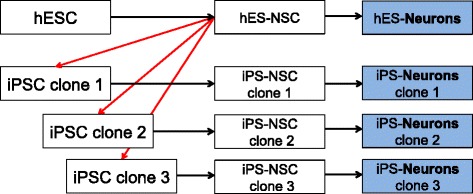
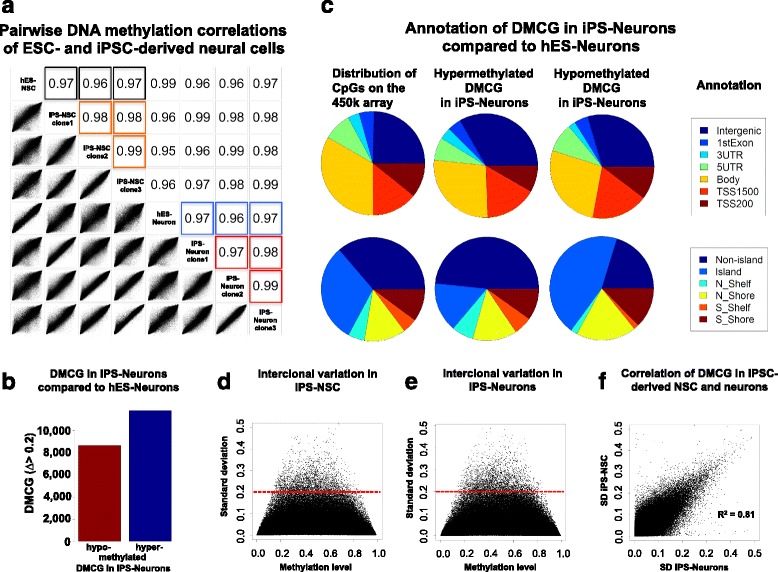
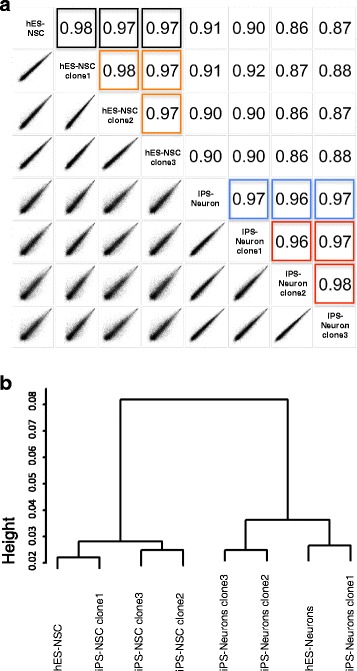
Background: Genetic predisposition and epigenetic alterations are both considered to contribute to sporadic neurodegenerative diseases (NDDs) such as Parkinson's disease (PD). Since cell reprogramming and the generation of induced pluripotent stem cells (iPSCs) are themselves associated with major epigenetic remodeling, it remains unclear to what extent iPSC-derived neurons lend themselves to model epigenetic disease-associated changes. A key question to be addressed in this context is whether iPSC-derived neurons exhibit epigenetic signatures typically observed in neurons derived from non-reprogrammed human embryonic stem cells (hESCs). Results: Here, we compare mature neurons derived from hESC and isogenic human iPSC generated from hESC-derived neural stem cells. Genome-wide 450 K-based DNA methylation and HT12v4 gene array expression analyses were complemented by a deep analysis of selected genes known to be involved in NDD. Our studies show that DNA methylation and gene expression patterns of isogenic hESC- and iPSC-derived neurons are markedly preserved on a genome-wide and single gene level. Conclusions: Overall, iPSC-derived neurons exhibit similar DNA methylation patterns compared to isogenic hESC-derived neurons. Further studies will be required to explore whether the epigenetic patterns observed in iPSC-derived neurons correspond to those detectable in native brain neurons.
Overview
The claims and statistics of this paper haven’t been checked yet.
Free: it reads the open-access text and checks the first 5 claims that cite a source we can check. Create a free account to check every claim.
Integrity signals
Registry
Cites
Statistics
Figures
Verification
Claims the paper makes
The claims and statistics of this paper haven’t been checked yet.
Free: it reads the open-access text and checks the first 5 claims that cite a source we can check. Create a free account to check every claim.
Claims other papers make about this one
Each is checked against this paper’s own text: does it say what the citing paper says it does?
The check wasn’t confident either way, so it gives no verdict — never disputed.
In the citing paper
“While cellular reprogramming reverts to the differentiated state of the cells, epigenetic memory and lineage-specific DNA methylation marks could affect the differentiation potential of the generated iPSC line [51,52,53].”
From Overcoming the Variability of iPSCs in the Manufacturing of Cell-Based Therapies (2023) · cites this paper as [51]
Experimental — accuracy not yet measured
Self-check
Percentages, sums and reported differences re-computed from the paper’s own numbers.
The self-check needs the paper’s full text.
Citations
Cites
α-Synuclein Locus Triplication Causes Parkinson's Disease
Singleton, A. B., Farrer, M., Johnson, J., Singleton, A., Hague, S., Kachergus, J., Hulihan, M., Peuralinna, T., Dutra, A., Nussbaum, R., et al. (2003) · Science · doi:10.1126/science.1090278 · Cited by 4,383 · cited 1×
“This is an important finding as elevated α-synuclein protein levels are directly linked to the development of PD [3, 4].”
BackgroundCausal relation between α-synuclein locus duplication as a cause of familial Parkinson's disease
Ibáñez, P., Bonnet, A.-M., Débarges, B., Lohmann, E., Tison, F., Agid, Y., Dürr, A., Brice, A., & Pollak, P. (2004) · The Lancet · doi:10.1016/s0140-6736(04)17104-3 · Cited by 1,044
RNA Toxicity from the ALS/FTD C9ORF72 Expansion Is Mitigated by Antisense Intervention
Donnelly, C. J., Zhang, P.-W., Pham, J. T., Haeusler, A. R., Mistry, N. A., Vidensky, S., Daley, E. L., Poth, E. M., Hoover, B., Fines, D. M., et al. (2013) · Neuron · doi:10.1016/j.neuron.2013.10.015 · Cited by 877
Kondo, T., Asai, M., Tsukita, K., Kutoku, Y., Ohsawa, Y., Sunada, Y., Imamura, K., Egawa, N., Yahata, N., Okita, K., et al. (2013) · Cell Stem Cell · doi:10.1016/j.stem.2013.01.009 · Cited by 741
Comprehensive analysis of DNA methylation data with RnBeads
Assenov, Y., Müller, F., Lutsik, P., Walter, J., Lengauer, T., & Bock, C. (2014) · Nature Methods · doi:10.1038/nmeth.3115 · Cited by 598 · cited 2×
“Genome-wide methylation raw data were pre-processed using R statistics software suites minfi and RnBeads [34] to extract the data, subtract the background, and to normalize the data using internal controls present on the chips.”
MethodEpigenetic mechanisms in neurological diseases: genes, syndromes, and therapies
Urdinguio, R. G., Sanchez-Mut, J. V., & Esteller, M. (2009) · The Lancet Neurology · doi:10.1016/s1474-4422(09)70262-5 · Cited by 582 · cited 13×
“DNA methylation alterations during neuronal differentiation of NSCs were observed specifically at the SNCA intron 1, but not for the other selected and analyzed NDD-associated genes.”
BackgroundInfluentialCooper, O., Seo, H., Andrabi, S., Guardia-Laguarta, C., Graziotto, J., Sundberg, M., McLean, J. R., Carrillo-Reid, L., Xie, Z., Osborn, T., et al. (2012) · Science Translational Medicine · doi:10.1126/scitranslmed.3003985 · Cited by 508
Koch, P., Opitz, T., Steinbeck, J. A., Ladewig, J., & Brüstle, O. (2009) · Proceedings of the National Academy of Sciences · doi:10.1073/pnas.0808387106 · Cited by 492 · cited 4×
“Taken together, our data indicate that isogenic hESCderived and iPSC-derived neurons generated via a highly standardized intermediate NSC population [14] display similar DNA methylation and gene expression patterns.”
BackgroundMethodGuenther, M. G., Frampton, G. M., Soldner, F., Hockemeyer, D., Mitalipova, M., Jaenisch, R., & Young, R. A. (2010) · Cell Stem Cell · doi:10.1016/j.stem.2010.06.015 · Cited by 456 · cited 1×
“However, the reprogramming process itself is based on a major epigenetic “reset” with the resulting iPSC exhibiting epigenetic patterns closely related to those of ESC [24, 25].”
BackgroundJowaed, A., Schmitt, I., Kaut, O., & Wüllner, U. (2010) · The Journal of Neuroscience · doi:10.1523/jneurosci.6119-09.2010 · Cited by 434
Disparate roles of zinc in chemical hypoxia-induced neuronal death
Kim, S., Seo, J.-W., Oh, S. B., Kim, S. H., Kim, I., Suh, N., & Lee, J.-Y. (2015) · Frontiers in Cellular Neuroscience · doi:10.3389/fncel.2015.00001 · Cited by 362
Masliah, E., Dumaop, W., Galasko, D., & Desplats, P. (2013) · Epigenetics · doi:10.4161/epi.25865 · Cited by 319 · cited 1×
“Furthermore, we chose MIR886, which was found to be differentially methylated in PD [20] and GNAS, a gene with a highly complex imprinted expression pattern [21] (Additional file 6).”
BackgroundExcitation-induced ataxin-3 aggregation in neurons from patients with Machado–Joseph disease
Koch, P., Breuer, P., Peitz, M., Jungverdorben, J., Kesavan, J., Poppe, D., Doerr, J., Ladewig, J., Mertens, J., Tüting, T., et al. (2011) · Nature · doi:10.1038/nature10671 · Cited by 303
A comparison of genetically matched cell lines reveals the equivalence of human iPSCs and ESCs
Choi, J., Lee, S., Mallard, W., Clement, K., Tagliazucchi, G. M., Lim, H., Choi, I. Y., Ferrari, F., Tsankov, A. M., Pop, R., et al. (2015) · Nature Biotechnology · doi:10.1038/nbt.3388 · Cited by 281 · cited 6×
“However, the reprogramming process itself is based on a major epigenetic “reset” with the resulting iPSC exhibiting epigenetic patterns closely related to those of ESC [24, 25].”
BackgroundResultInfluentialGene Duplication: A Drive for Phenotypic Diversity and Cause of Human Disease
Conrad, B., & Antonarakis, S. E. (2007) · Annual Review of Genomics and Human Genetics · doi:10.1146/annurev.genom.8.021307.110233 · Cited by 266 · cited 14×
“DNA methylation alterations during neuronal differentiation of NSCs were observed specifically at the SNCA intron 1, but not for the other selected and analyzed NDD-associated genes.”
BackgroundInfluentialInfluence of donor age on induced pluripotent stem cells
Lo Sardo, V., Ferguson, W., Erikson, G. A., Topol, E. J., Baldwin, K. K., & Torkamani, A. (2017) · Nature Biotechnology · doi:10.1038/nbt.3749 · Cited by 223
Bilic, J., & Belmonte, J. C. I. (2012) · STEM CELLS · doi:10.1002/stem.700 · Cited by 210 · cited 1×
“Nevertheless, the process of induced reprogramming is based on erasing the existing epigenetic state of the cell of origin [12, 13].”
BackgroundEpigenetic mechanisms in neurological and neurodegenerative diseases
Landgrave-Gómez, J., Mercado-Gómez, O., & Guevara-Guzmán, R. (2015) · Frontiers in Cellular Neuroscience · doi:10.3389/fncel.2015.00058 · Cited by 202 · cited 3×
“Epigenetic modification of such dosagesensitive genes could represent a missing link between familial and sporadic forms of NDD [1].”
BackgroundDracheva, S., Davis, K. L., Chin, B., Woo, D. A., Schmeidler, J., & Haroutunian, V. (2006) · Neurobiology of Disease · doi:10.1016/j.nbd.2005.08.012 · Cited by 178 · cited 1×
“We choose dosage-sensitive genes known to be involved in different neurological disorders, including APP (gene duplication, Alzheimer’s disease, AD), SNCA (gene duplication/triplication, Parkinson’s disease, PD) [17], and PMP22, which has been associated with Charcot-MarieTooth 1A (gene duplication) and several other…”
BackgroundGround rules of the pluripotency gene regulatory network
Li, M., & Belmonte, J. C. I. (2017) · Nature Reviews Genetics · doi:10.1038/nrg.2016.156 · Cited by 165
Aberrant epigenome in iPSC ‐derived dopaminergic neurons from Parkinson's disease patients
Fernández‐Santiago, R., Carballo‐Carbajal, I., Castellano, G., Torrent, R., Richaud, Y., Sánchez‐Danés, A., Vilarrasa‐Blasi, R., Sánchez‐Pla, A., Mosquera, J. L., Soriano, J., et al. (2015) · EMBO Molecular Medicine · doi:10.15252/emmm.201505439 · Cited by 139 · cited 11×
“Fernández-Santiago for the provision of the DNA methylation datasets on the non-dopaminergic neurons used in his study [11].”
BackgroundMethodResultInfluentialBiQ Analyzer HT: locus-specific analysis of DNA methylation by high-throughput bisulfite sequencing
Lutsik, P., Feuerbach, L., Arand, J., Lengauer, T., Walter, J., & Bock, C. (2011) · Nucleic Acids Research · doi:10.1093/nar/gkr312 · Cited by 130
Induced Pluripotency and Epigenetic Reprogramming
Hochedlinger, K., & Jaenisch, R. (2015) · Cold Spring Harbor Perspectives in Biology · doi:10.1101/cshperspect.a019448 · Cited by 111
L‐dopa increases α‐synuclein DNA methylation in Parkinson's disease patients in vivo and in vitro
Schmitt, I., Kaut, O., Khazneh, H., deBoni, L., Ahmad, A., Berg, D., Klein, C., Fröhlich, H., & Wüllner, U. (2015) · Movement Disorders · doi:10.1002/mds.26319 · Cited by 101 · cited 1×
“ESC and iPSC were analyzed as described elsewhere [33].”
MethodKim, M., Park, Y.-K., Kang, T.-W., Lee, S.-H., Rhee, Y.-H., Park, J.-L., Kim, H.-J., Lee, D., Lee, D., Kim, S.-Y., et al. (2014) · Human Molecular Genetics · doi:10.1093/hmg/ddt453 · Cited by 98 · cited 6×
“DAn were cultured for 42 days and exhibited a purity of 43% [15].”
BackgroundMethodResultInfluentialMallon, B. S., Hamilton, R. S., Kozhich, O. A., Johnson, K. R., Fann, Y. C., Rao, M. S., & Robey, P. G. (2014) · Stem Cell Research · doi:10.1016/j.scr.2013.11.010 · Cited by 79 · cited 4×
“They found no major differences in global gene expression patterns and an accordance of DNA methylation patterns of 98–99% [31].”
BackgroundResultInfluentialTuran, S., & Bastepe, M. (2013) · Hormone Research in Paediatrics · doi:10.1159/000355384 · Cited by 77 · cited 1×
“Furthermore, we chose MIR886, which was found to be differentially methylated in PD [20] and GNAS, a gene with a highly complex imprinted expression pattern [21] (Additional file 6).”
Backgroundde Boni, L., Tierling, S., Roeber, S., Walter, J., Giese, A., & Kretzschmar, H. A. (2011) · NeuroMolecular Medicine · doi:10.1007/s12017-011-8163-9 · Cited by 71 · cited 3×
“Previous studies on bulk brain tissue aimed at exploring whether DNA methylation changes of the SNCA gene could contribute to the development of iPD [2, 5], but the results were not conclusive.”
BackgroundResultUsing iPS Cells toward the Understanding of Parkinson’s Disease
Torrent, R., De Angelis Rigotti, F., Dell'Era, P., Memo, M., Raya, A., & Consiglio, A. (2015) · Journal of Clinical Medicine · doi:10.3390/jcm4040548 · Cited by 60 · cited 1×
“iPSC-derived neurons could represent an attractive experimental tool to study epigenetic alterations in PD [23].”
BackgroundMcDonald, K. L., Rapkins, R. W., Olivier, J., Zhao, L., Nozue, K., Lu, D., Tiwari, S., Kuroiwa‐Trzmielina, J., Brewer, J. M., Wheeler, H., et al. (2012) · European Journal of Cancer · doi:10.1016/j.ejca.2012.08.012 · Cited by 55 · cited 1×
“, changes in methylation patterns as a downstream result of genetic variants [29].”
BackgroundTranscriptional comparison of human induced and primary midbrain dopaminergic neurons
Xia, N., Zhang, P., Fang, F., Wang, Z., Rothstein, M., Angulo, B., Chiang, R., Taylor, J., & Reijo Pera, R. A. (2016) · Scientific Reports · doi:10.1038/srep20270 · Cited by 45 · cited 1×
“This is particularly relevant in the light of recent findings revealing substantial transcriptional differences between iPSC-derived and primary midbrain dopamine neurons [32].”
BackgroundPeripheral myelin protein 22 is expressed in human central nervous system
Ohsawa, Y., Murakami, T., Miyazaki, Y., Shirabe, T., & Sunada, Y. (2006) · Journal of the Neurological Sciences · doi:10.1016/j.jns.2006.03.004 · Cited by 43 · cited 1×
“We choose dosage-sensitive genes known to be involved in different neurological disorders, including APP (gene duplication, Alzheimer’s disease, AD), SNCA (gene duplication/triplication, Parkinson’s disease, PD) [17], and PMP22, which has been associated with Charcot-MarieTooth 1A (gene duplication) and several other…”
BackgroundBi-PROF: Bisulfite profiling of target regions using 454 GS FLX Titanium technology
Gries, J., Schumacher, D., Arand, J., Lutsik, P., Markelova, M. R., Fichtner, I., Walter, J., Sers, C., & Tierling, S. (2013) · Epigenetics · doi:10.4161/epi.25242 · Cited by 41 · cited 2×
“formation on a MiSeq instrument benchtop sequencer with the sequencing-by-synthesis technology [16] ac-”
MethodSuppression of the Imprinted Gene NNAT and X-Chromosome Gene Activation in Isogenic Human iPS Cells
Teichroeb, J. H., Betts, D. H., & Vaziri, H. (2011) · PLoS ONE · doi:10.1371/journal.pone.0023436 · Cited by 23 · cited 4×
“6%) of the transcriptome of isogenic hESC and iPSC [30].”
BackgroundMethodResultInfluentialEpigenetics of Pluripotent Cells
Medvedev, S. P., Pokushalov, E. A., & Zakian, S. M. (2012) · Acta Naturae · doi:10.32607/20758251-2012-4-4-28-46 · Cited by 20 · cited 1×
“Nevertheless, the process of induced reprogramming is based on erasing the existing epigenetic state of the cell of origin [12, 13].”
BackgroundJacobs, B. M. (2014) · Journal of Parkinson s Disease · doi:10.3233/jpd-130268 · Cited by 20 · cited 1×
“based models of PD, mainly focusing on familial forms of the disease, displayed some interesting and relevant phenotypes [10].”
Background
Cited by
Volpato, V., & Webber, C. (2020) · Disease Models & Mechanisms · doi:10.1242/dmm.042317 · Cited by 379
Human in vitro models for understanding mechanisms of autism spectrum disorder
Gordon, A., & Geschwind, D. H. (2020) · Molecular Autism · doi:10.1186/s13229-020-00332-7 · Cited by 47
Maternal immune activation primes deficiencies in adult hippocampal neurogenesis
Couch, A. C. M., Berger, T., Hanger, B., Matulevičiūtė, R., Srivastava, D. P., Thuret, S., & Vernon, A. C. (2021) · Brain Behavior and Immunity · doi:10.1016/j.bbi.2021.07.021 · Cited by 47
“During differentiation, hiPSC-derived cells do undergo epigenetic remodelling (Bachmann et al., 2021; Su et al., 2021), and genome-wide DNA methylation patterns and gene expression patterns are preserved between neurons, derived from hiPSCs and human embryonic stem cells (de Boni, 2018).”
BackgroundExploring noncoding variants in genetic diseases: from detection to functional insights
Wu, K., Bu, F., Wu, Y., Zhang, G., Wang, X., He, S., Liu, M., Chen, R., & Yuan, H. (2024) · Journal of genetics and genomics/Journal of Genetics and Genomics · doi:10.1016/j.jgg.2024.01.001 · Cited by 41
The use of induced pluripotent stem cells in domestic animals: a narrative review
Scarfone, R. A., Pena, S. M., Russell, K. A., Betts, D. H., & Koch, T. G. (2020) · BMC Veterinary Research · doi:10.1186/s12917-020-02696-7 · Cited by 39
Metadata
- Authors
- de Boni, L., Gasparoni, G., Haubenreich, C., Tierling, S., Schmitt, I., Peitz, M., Koch, P., Walter, J., Wüllner, U., & Brüstle, O.
- Affiliations
- Saarland University (DE)
- University of Bonn (DE)
- Corresponding author
- Walter, Jörn
- Wüllner, Ullrich
- Brüstle, Oliver
- ORCID
- Venue
- Clinical Epigenetics
- Published
- 2018-01-29
- Volume
- 10
- Issue
- 1
- Pages
- 13-13
- ISSN
- 1868-7075 (ISSN-L)
- 1868-7083
- PMC
- PMC5789607
- OpenAlex
- W2788963675
- Cited by
- 47
- References
- 36
- Citations by year
- 2026: 3 · 2025: 2 · 2024: 7 · 2023: 5 · 2022: 4 · 2021: 7 · 2020: 13 · 2019: 3 · 2018: 2
- FWCI
- 2.22
- Type
- journal article
- Language
- en
- Open access
- gold
- doi.org
- Licence
- cc-by
- Locations
- Clinical Epigenetics (publishedVersion, cc-by)
- PubMed Central (publishedVersion, cc-by)
- PubMed (publishedVersion)
- DOAJ (DOAJ: Directory of Open Access Journals) (submittedVersion, cc-by-sa)
- DZNE Pub (submittedVersion, cc-by)
- Funders
- BMBF (01-KU1216F, 01GNO813, 01ZX1314A)
- BONFOR
- DZNE
- BMBF/ANR (01KU1403B)
- Topics
- Life Sciences › Biochemistry, Genetics and Molecular Biology › Molecular Biology › Pluripotent Stem Cells Research
- Life Sciences › Biochemistry, Genetics and Molecular Biology › Molecular Biology › Epigenetics and DNA Methylation
- Life Sciences › Biochemistry, Genetics and Molecular Biology › Genetics › Genetic Syndromes and Imprinting
- Keywords
- DNA methylation, iPSC-derived neurons, neurodegenerative diseases, Parkinson's disease, epigenetic remodeling, cellular reprogramming, isogenic cell lines, gene expression, disease modeling, neural stem cells
- MeSH terms
- Human Embryonic Stem Cells, Cell Differentiation, Cells, Cultured, Humans, Neurons, Sequence Analysis, DNA, DNA Methylation, Oligonucleotide Array Sequence Analysis, Gene Expression Profiling, Epigenesis, Genetic, alpha-Synuclein, Induced Pluripotent Stem Cells
About these checks
Registry, retraction, Cites and statistics results are computed, not judged, with one exception: a printed reference that no index lists is read once by a model before it counts as a citation error. Claims are extracted by a model and kept only when their quote appears verbatim in the text; each cited source is then checked, with a model’s help, for whether it says what the claim relies on. Those verdicts can be wrong — read the claim’s quote and the cited source before relying on one.
Statistics and arithmetic are recomputed, not judged.
Confidence bands are shown only for fields calibrated on our annotated test set. None is calibrated yet, so no band is shown.
What counts as a claim ›How we measure confidence ›How we check this ›
Are you an author, or do you see a problem with this page? Request a review
Data sources
Bibliographic data: Semantic Scholar, OpenAlex, Crossref.
Contains information from the Semantic Scholar Academic Graph Datasets, made available under the ODC Attribution License (ODC-BY 1.0).
Semantic Scholar’s data is described in: Kinney, R., et al. (2023). The Semantic Scholar Open Data Platform. arXiv:2301.10140.
