

The DOI matches its Crossref record; 69 of the 70 references it cites were found in a registry or an index.
Clinical and imaging features of mixed Alzheimer and vascular pathologies
Open accessAbstract
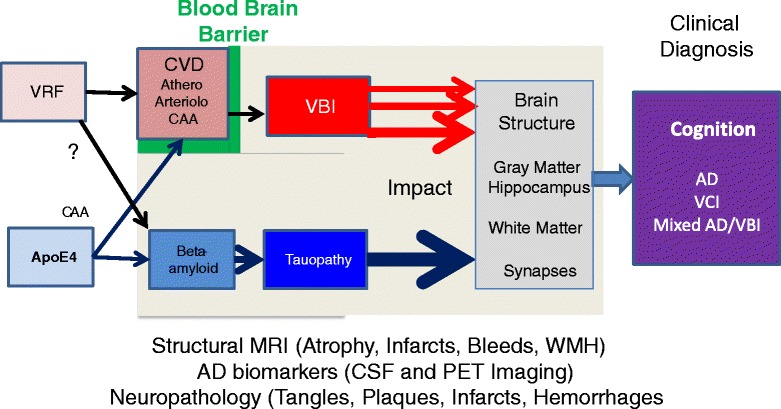
The co-occurrence of both Alzheimer disease (AD) pathology and vascular brain injury (VBI) is very common, especially amongst the oldest of old. In neuropathologic studies, the prevalence of AD, VBI, and mixed AD/VBI lesions ranks ahead of Lewy bodies and hippocampal sclerosis. In the modern era of structural magnetic resonance imaging (MRI) and amyloid positron emission tomography (PET) imaging, this review examines 1) the prevalence of mixed AD and VBI pathology, 2) the significance of these pathologies for cognitive impairment (AD and vascular cognitive impairment (VCI)), and 3) the diagnosis and treatment of mixed AD/VCI. Although epidemiologic studies report that vascular risk factors for arteriosclerosis increase the risk of incident AD, both autopsy and amyloid PET studies indicate that AD and VBI contribute additively, but independently, to the risk of dementia. The literature confirms the malignancy of AD and highlights the adverse effects of microinfarcts on cognitive function. For the clinical diagnosis of mixed AD/VCI, the presence of AD can be recognized by neuropsychological profile, structural imaging, cerebrospinal fluid biomarkers, and glucose PET and amyloid PET imaging. The diagnosis of VBI, however, still hinges predominantly on the structural MRI findings. Severe amnesia and atrophy of the hippocampus are characteristic of early AD, whereas the cognitive profile for VCI is highly variable and dependent on size and location of VBI. The cognitive profile of mixed AD/VBI is dominated by AD. With the notable exception of microinfarcts (which elude in vivo detection), infarcts, hemorrhages, and white matter hyperintensities on structural MRI currently represent the best markers for the presence VBI. Better markers that reflect the health and reactivity of intracerebral blood vessels are needed. For prevention and treatment, the type of underlying cerebrovascular disease (for example, arteriosclerosis or cerebral amyloid angiopathy) should be considered. It is likely that reduction of vascular risk factors for arteriosclerosis can significantly reduce vascular contributions to mixed dementia.
Overview
The claims and statistics of this paper haven’t been checked yet.
Run the check — free, no account needed. It reads the open-access text and checks the sources it cites.
Integrity signals
Registry
Cites
Statistics
Figures
Verification
Claims the paper makes
The claims and statistics of this paper haven’t been checked yet.
Run the check — free, no account needed. It reads the open-access text and checks the sources it cites.
Claims other papers make about this one
Each is checked against this paper’s own text: does it say what the citing paper says it does?
The check wasn’t confident either way, so it gives no verdict — never disputed.
In the citing paper
“Almost a quarter of AD patients develop Parkinsonian features, but the relative contribution of substantia nigra tangles and Lewy bodies to this presentation is unresolved [122].”
From The neuropathological diagnosis of Alzheimer's disease (2019) · cites this paper as [122]
Experimental — accuracy not yet measured
Self-check
Percentages, sums and reported differences re-computed from the paper’s own numbers.
The self-check needs the paper’s full text.
Citations
Cites
McKhann, G. M., Knopman, D. S., Chertkow, H., Hyman, B. T., Jack, C. R., Kawas, C. H., Klunk, W. E., Koroshetz, W. J., Manly, J. J., Mayeux, R., et al. (2011) · Alzheimer's & Dementia · doi:10.1016/j.jalz.2011.03.005 · Cited by 18,657
Albert, M. S., DeKosky, S. T., Dickson, D., Dubois, B., Feldman, H. H., Fox, N. C., Gamst, A., Holtzman, D. M., Jagust, W. J., Petersen, R. C., et al. (2011) · Alzheimer's & Dementia · doi:10.1016/j.jalz.2011.03.008 · Cited by 10,152
Sperling, R. A., Aisen, P. S., Beckett, L. A., Bennett, D. A., Craft, S., Fagan, A. M., Iwatsubo, T., Jack, C. R., Kaye, J., Montine, T. J., et al. (2011) · Alzheimer's & Dementia · doi:10.1016/j.jalz.2011.03.003 · Cited by 7,155
Sleep Drives Metabolite Clearance from the Adult Brain
Xie, L., Kang, H., Xu, Q., Chen, M. J., Liao, Y., Thiyagarajan, M., O’Donnell, J., Christensen, D. J., Nicholson, C., Iliff, J. J., et al. (2013) · Science · doi:10.1126/science.1241224 · Cited by 5,411
Hypothetical model of dynamic biomarkers of the Alzheimer's pathological cascade
Jack, C. R., Knopman, D. S., Jagust, W. J., Shaw, L. M., Aisen, P. S., Weiner, M. W., Petersen, R. C., & Trojanowski, J. Q. (2010) · The Lancet Neurology · doi:10.1016/s1474-4422(09)70299-6 · Cited by 4,806
Imaging brain amyloid in Alzheimer's disease with Pittsburgh Compound‐B
Klunk, W. E., Engler, H., Nordberg, A., Wang, Y., Blomqvist, G., Holt, D. P., Bergström, M., Savitcheva, I., Huang, G., Estrada, S., et al. (2004) · Annals of Neurology · doi:10.1002/ana.20009 · Cited by 4,496
Gorelick, P. B., Scuteri, A., Black, S. E., DeCarli, C., Greenberg, S. M., Iadecola, C., Launer, L. J., Laurent, S., Lopez, O. L., Nyenhuis, D., et al. (2011) · Stroke · doi:10.1161/str.0b013e3182299496 · Cited by 3,811
Self-citationNeurovascular pathways to neurodegeneration in Alzheimer’s disease and other disorders
Zlokovic, B. V. (2011) · Nature Reviews Neuroscience · doi:10.1038/nrn3114 · Cited by 2,969
The projected effect of risk factor reduction on Alzheimer's disease prevalence
Barnes, D. E., & Yaffe, K. S. (2011) · The Lancet Neurology · doi:10.1016/s1474-4422(11)70072-2 · Cited by 2,846
Albert, M., DeKosky, S. T., Dickson, D. W., Dubois, B., Feldman, H., Fox, N. C., Gamst, A. C., Holtzman, D. M., Jagust, W. J., Petersen, R. C., et al. (2013) · FOCUS The Journal of Lifelong Learning in Psychiatry · doi:10.1176/appi.focus.11.1.96 · Cited by 2,643
Cited by
Sorted by citations
The neuropathological diagnosis of Alzheimer's disease
DeTure, M. A., & Dickson, D. W. (2019) · Molecular Neurodegeneration · doi:10.1186/s13024-019-0333-5 · Cited by 3,329
“Almost a quarter of AD patients develop Parkinsonian features, but the relative contribution of substantia nigra tangles and Lewy bodies to this presentation is unresolved [122].”
BackgroundIadecola, C., Yaffe, K., Biller, J., Bratzke, L. C., Faraci, F. M., Gorelick, P. B., Gulati, M., Kamel, H., Knopman, D. S., Launer, L. J., et al. (2016) · Hypertension · doi:10.1161/hyp.0000000000000053 · Cited by 746
Brain Health: The Importance of Recognizing Cognitive Impairment: An IAGG Consensus Conference
Morley, J. E., Morris, J. C., Berg‐Weger, M., Soo Borson, B., Carpenter, B. D., del Campo, N., Dubois, B., Fargo, K. N., Fitten, L. J., Flaherty, J. H., et al. (2015) · Journal of the American Medical Directors Association · doi:10.1016/j.jamda.2015.06.017 · Cited by 341
Bennett, R. E., Robbins, A. B., Hu, M., Cao, X., Betensky, R. A., Clark, T., Das, S., & Hyman, B. T. (2018) · Proceedings of the National Academy of Sciences · doi:10.1073/pnas.1710329115 · Cited by 299
Hussain, B., Fang, C., & Chang, J. (2021) · Frontiers in Neuroscience · doi:10.3389/fnins.2021.688090 · Cited by 258
Metadata
- Authors
- Chui, H. C., & Ramirez-Gomez, L.
- Affiliations
- University of Southern California (US)
- Corresponding author
- Chui, Helena C
- Venue
- Alzheimer's Research & Therapy
- Published
- 2015-02-27
- Volume
- 7
- Issue
- 1
- Pages
- 21-21
- ISSN
- 1758-9193 (ISSN-L)
- PMC
- PMC4342006
- OpenAlex
- W2104703797
- Cited by
- 124
- References
- 70
- Citations by year
- 2026: 11 · 2025: 7 · 2024: 8 · 2023: 7 · 2022: 7 · 2021: 13 · 2020: 8 · 2019: 16 · 2018: 10 · 2017: 12 · 2016: 15 · 2015: 9
- FWCI
- 12.46
- Type
- journal article
- Language
- en
- Open access
- gold
- doi.org
- Locations
- Alzheimer s Research & Therapy (publishedVersion, cc-by)
- PubMed Central (publishedVersion, cc-by)
- PubMed (publishedVersion)
- Funders
- National Institute on Aging (P50AG005142, P01AG012435)
- Topics
- Health Sciences › Medicine › Psychiatry and Mental health › Dementia and Cognitive Impairment Research
- Life Sciences › Neuroscience › Neurology › Neurological Disease Mechanisms and Treatments
- Life Sciences › Neuroscience › Cellular and Molecular Neuroscience › Alzheimer's disease research and treatments
- Keywords
- Alzheimer's disease, vascular brain injury, vascular cognitive impairment, dementia, microinfarcts, white matter hyperintensities, cerebral amyloid angiopathy, arteriosclerosis, amyloid PET, cerebrospinal fluid biomarkers, structural MRI, cognitive impairment, vascular risk factors, hippocampal atrophy, amnesia
About these checks
Registry, retraction, Cites and statistics results are computed, not judged, with one exception: a printed reference that no index lists is read once by a model before it counts as a citation error. Claims are extracted by a model and kept only when their quote appears verbatim in the text; each cited source is then checked, with a model’s help, for whether it says what the claim relies on. Those verdicts can be wrong — read the claim’s quote and the cited source before relying on one.
Statistics and arithmetic are recomputed, not judged.
Confidence bands are shown only for fields calibrated on our annotated test set. None is calibrated yet, so no band is shown.
What counts as a claim ›How we measure confidence ›How we check this ›
Are you an author, or do you see a problem with this page? Request a review
