

The DOI matches its Crossref record; 53 of the 53 references it cites were found in a registry or an index.
Cerebrospinal fluid VILIP-1 and YKL-40, candidate biomarkers to diagnose, predict and monitor Alzheimer’s disease in a memory clinic cohort
Open accessAbstract
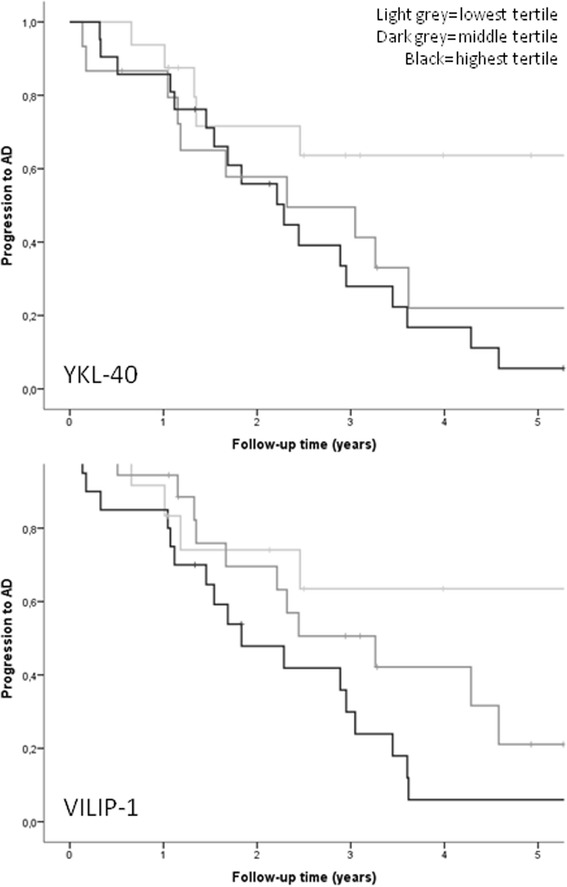
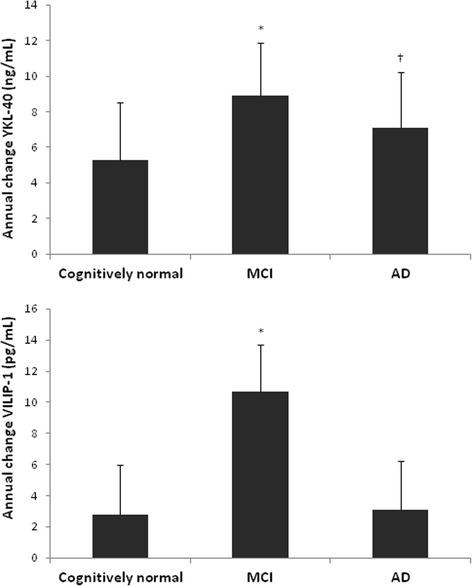
Introduction: We examined the utility of cerebrospinal fluid (CSF) proteins, Chitinase-3-like protein 1 (CHI3L1 or YKL-40), a putative marker of inflammation, and Visinin-like protein-1 (VILIP-1), a marker for neuronal injury, for diagnostic classification and monitoring of disease progression in a memory clinic cohort. Methods: CSF levels of YKL-40 and VILIP-1 were measured in 37 cognitively normal, 61 Mild Cognitive Impairment (MCI) and 65 Alzheimer’s disease (AD) patients from the memory clinic-based Amsterdam Dementia Cohort who underwent two lumbar punctures, with minimum interval of 6 months and a mean(SE) interval of 2.0(0.1) years. Mean(SE) cognitive follow-up was 3.8 (0.2) years. ANOVA was used to compare baseline differences of log-transformed CSF measures. Cox proportional hazard models were used to evaluate disease progression as a function of CSF tertiles. Linear mixed models were used to evaluate longitudinal change over time. All analyses were sex and age adjusted. Results: Baseline levels of YKL-40, but not VILIP-1, were higher in MCI and AD patients compared to cognitively normal individuals (mean (SE) pg/mL, 304 (16) and 288 (12) vs. 231 (16), p = 0.03 and p = 0.006). Baseline levels of both YKL-40 and VILIP-1 in MCI predicted progression to AD (HR 95 % CI = 3.0 (1.1–7.9) and 4.4 (1.5–13.0), respectively, for highest vs. lowest tertile). YKL-40 increased longitudinally in patients with MCI and AD (mean (SE) pg/mL per year, 8.9 (3.0) and 7.1 (3.1), respectively), but not in cognitively normal individuals, whereas levels of VILIP-1 increased only in MCI (mean (SE), 10.7 (2.6) pg/mL per year). Conclusions: CSF levels of YKL-40 may have utility for discriminating between cognitively normal individuals and patients with MCI or AD. Increased levels of both YKL-40 and VILIP-1 may be associated with disease progression. These CSF biomarkers should be considered for future evaluation in the characterization of the natural history of AD.
Overview
The claims and statistics of this paper haven’t been checked yet.
Run the check — free, no account needed. It reads the open-access text and checks the sources it cites.
Integrity signals
Registry
Cites
Statistics
Figures
Verification
Claims the paper makes
The claims and statistics of this paper haven’t been checked yet.
Run the check — free, no account needed. It reads the open-access text and checks the sources it cites.
Claims other papers make about this one
Each is checked against this paper’s own text: does it say what the citing paper says it does?
The cited source says what the claim attributes to it.
In the citing paper
“Two earlier reports have found that YKL-40 predicted progression to AD.22,49”
From CSF biomarkers of neuroinflammation and cerebrovascular dysfunction in early Alzheimer disease (2018) · cites this paper as [49]
Self-check
Percentages, sums and reported differences re-computed from the paper’s own numbers.
The self-check needs the paper’s full text.
Citations
Cites
McKhann, G., Drachman, D., Folstein, M., Katzman, R., Price, D., & Stadlan, E. M. (1984) · Neurology · doi:10.1212/wnl.34.7.939 · Cited by 27,915
McKhann, G. M., Knopman, D. S., Chertkow, H., Hyman, B. T., Jack, C. R., Kawas, C. H., Klunk, W. E., Koroshetz, W. J., Manly, J. J., Mayeux, R., et al. (2011) · Alzheimer's & Dementia · doi:10.1016/j.jalz.2011.03.005 · Cited by 18,657
Self-citationAlbert, M. S., DeKosky, S. T., Dickson, D., Dubois, B., Feldman, H. H., Fox, N. C., Gamst, A., Holtzman, D. M., Jagust, W. J., Petersen, R. C., et al. (2011) · Alzheimer's & Dementia · doi:10.1016/j.jalz.2011.03.008 · Cited by 10,152 · cited 1×
“The diagnosis of MCI was made according to Petersen criteria [37], and participants met the core clinical criteria for MCI of the National Institute on Aging–Alzheimer’s Association [2].”
MethodSelf-citationMild Cognitive Impairment: Clinical Characterization and Outcome
Petersen, R. C., Smith, G. E., Waring, S. C., Ivnik, R. J., Tangalos, E. G., & Kokmen, E. (1999) · Archives of Neurology · doi:10.1001/archneur.56.3.303 · Cited by 8,980
Diagnosis and management of dementia with Lewy bodies: Third report of the DLB consortium
McKeith, I. G., Dickson, D. W., Lowe, J., Emre, M., O'Brien, J. T., Feldman, H., Cummings, J., Duda, J. E., Lippa, C., Perry, E. K., et al. (2005) · Neurology · doi:10.1212/01.wnl.0000187889.17253.b1 · Cited by 5,069
Frontotemporal lobar degeneration: A consensus on clinical diagnostic criteria
Neary, D., Snowden, J. S., Gustafson, L., Passant, U., Stuss, D., Black, S., Freedman, M., Kertesz, A., Robert, P. H., Albert, M., et al. (1998) · Neurology · doi:10.1212/wnl.51.6.1546 · Cited by 5,047
Román, G. C., Tatemichi, T. K., Erkinjuntti, T., Cummings, J. L., Masdeu, J. C., Garcia, J. H., Amaducci, L., Orgogozo, J.-M., Brun, A., Hofman, A., et al. (1993) · Neurology · doi:10.1212/wnl.43.2.250 · Cited by 4,921
Hypothetical model of dynamic biomarkers of the Alzheimer's pathological cascade
Jack, C. R., Knopman, D. S., Jagust, W. J., Shaw, L. M., Aisen, P. S., Weiner, M. W., Petersen, R. C., & Trojanowski, J. Q. (2010) · The Lancet Neurology · doi:10.1016/s1474-4422(09)70299-6 · Cited by 4,806
Inflammation and Alzheimer’s disease
Akiyama, H. (2000) · Neurobiology of Aging · doi:10.1016/s0197-4580(00)00124-x · Cited by 4,514
Jack, C. R., Knopman, D. S., Jagust, W. J., Petersen, R. C., Weiner, M. W., Aisen, P. S., Shaw, L. M., Vemuri, P., Wiste, H. J., Weigand, S. D., et al. (2013) · The Lancet Neurology · doi:10.1016/s1474-4422(12)70291-0 · Cited by 4,396
Research works printed but not linked: 1
- Twisk JW. Applied longitudinal data analysis for epidemiology. Cambridge: Cambridge University Press; 2003.
Cited by
Sorted by citations
Chitinase-3 like-protein-1 function and its role in diseases
Zhao, T., Su, Z., Li, Y., Zhang, X., & You, Q. (2020) · Signal Transduction and Targeted Therapy · doi:10.1038/s41392-020-00303-7 · Cited by 536
Current state of Alzheimer’s fluid biomarkers
Molinuevo, J. L., Ayton, S., Batrla, R., Bednar, M. M., Bittner, T., Cummings, J., Fagan, A. M., Hampel, H., Mielke, M. M., Mikulskis, A., et al. (2018) · Acta Neuropathologica · doi:10.1007/s00401-018-1932-x · Cited by 518
Self-citationAmsterdam Dementia Cohort: Performing Research to Optimize Care
van der Flier, W. M., & Scheltens, P. (2018) · Journal of Alzheimer s Disease · doi:10.3233/jad-170850 · Cited by 395
Self-citationCSF biomarkers of neuroinflammation and cerebrovascular dysfunction in early Alzheimer disease
Janelidze, S., Mattsson, N., Stomrud, E., Lindberg, O., Palmqvist, S., Zetterberg, H., Blennow, K., & Hansson, O. (2018) · Neurology · doi:10.1212/wnl.0000000000006082 · Cited by 359
YKL-40 in the brain and cerebrospinal fluid of neurodegenerative dementias
Llorens, F., Thüne, K., Tahir, W., Kanata, E., Diaz-Lucena, D., Xanthopoulos, K., Kovatsi, E., Pleschka, C., Garcia-Esparcia, P., Schmitz, M., et al. (2017) · Molecular Neurodegeneration · doi:10.1186/s13024-017-0226-4 · Cited by 249
Metadata
- Authors
- Kester, M. I., Teunissen, C. E., Sutphen, C., Herries, E. M., Ladenson, J. H., Xiong, C., Scheltens, P., van der Flier, W. M., Morris, J. C., Holtzman, D. M., & Fagan, A. M.
- Affiliations
- Amsterdam UMC Location Vrije Universiteit Amsterdam (NL)
- Washington University in St. Louis (US)
- Corresponding author
- Kester, Maartje I.
- ORCID
- Venue
- Alzheimer's Research & Therapy
- Published
- 2015-09-17
- Volume
- 7
- Issue
- 1
- Pages
- 59-59
- ISSN
- 1758-9193 (ISSN-L)
- PMC
- PMC4574487
- OpenAlex
- W1931861387
- Cited by
- 146
- References
- 53
- Citations by year
- 2026: 8 · 2025: 17 · 2024: 11 · 2023: 10 · 2022: 9 · 2021: 14 · 2020: 25 · 2019: 15 · 2018: 12 · 2017: 14 · 2016: 11
- FWCI
- 10.00
- Type
- journal article
- Language
- en
- Open access
- gold
- doi.org
- Locations
- Alzheimer s Research & Therapy (publishedVersion, cc-by)
- PubMed Central (publishedVersion, cc-by)
- PubMed (publishedVersion)
- Amsterdam UMC (VU Amsterdam) - Institutional Repository (publishedVersion)
- Digital Commons@Becker (Washington University School of Medicine) (submittedVersion)
- Pure Amsterdam UMC (submittedVersion, other-oa)
- Data Archiving and Networked Services (DANS) (submittedVersion, other-oa)
- Data Archiving and Networked Services (DANS) (submittedVersion)
- Funders
- Eli Lilly and Company
- Stichting Dioraphte
- Alzheimer Nederland
- National Institute on Aging (P50AG005681, P01AG003991, U19AG032438, P01AG026276)
- Topics
- Health Sciences › Medicine › Psychiatry and Mental health › Dementia and Cognitive Impairment Research
- Life Sciences › Neuroscience › Cellular and Molecular Neuroscience › Alzheimer's disease research and treatments
- Health Sciences › Medicine › Clinical Neurology › Cerebrospinal fluid and hydrocephalus
- Keywords
- Alzheimer's disease, VILIP-1, YKL-40, cerebrospinal fluid biomarkers, mild cognitive impairment, disease progression, neuroinflammation, neuronal injury, dementia diagnosis, longitudinal biomarker changes, memory clinic patients, cognitive decline prediction, disease surveillance
- MeSH terms
- Chitinase-3-Like Protein 1, Aged, Alzheimer Disease, Analysis of Variance, Cross-Sectional Studies, Female, Follow-Up Studies, Humans, Longitudinal Studies, Male, Middle Aged, Neuropsychological Tests, Spinal Puncture, Biomarkers, Linear Models, Proportional Hazards Models, Disease Progression, Lectins, Neurocalcin, Kaplan-Meier Estimate, Adipokines, Cognitive Dysfunction
About these checks
Registry, retraction, Cites and statistics results are computed, not judged, with one exception: a printed reference that no index lists is read once by a model before it counts as a citation error. Claims are extracted by a model and kept only when their quote appears verbatim in the text; each cited source is then checked, with a model’s help, for whether it says what the claim relies on. Those verdicts can be wrong — read the claim’s quote and the cited source before relying on one.
Statistics and arithmetic are recomputed, not judged.
Confidence bands are shown only for fields calibrated on our annotated test set. None is calibrated yet, so no band is shown.
What counts as a claim ›How we measure confidence ›How we check this ›
Are you an author, or do you see a problem with this page? Request a review
