

The DOI matches its Crossref record; 51 of the 51 references it cites were found in a registry or an index.
Characterization and clinical use of inflammatory cerebrospinal fluid protein markers in Alzheimer’s disease
Open accessAbstract
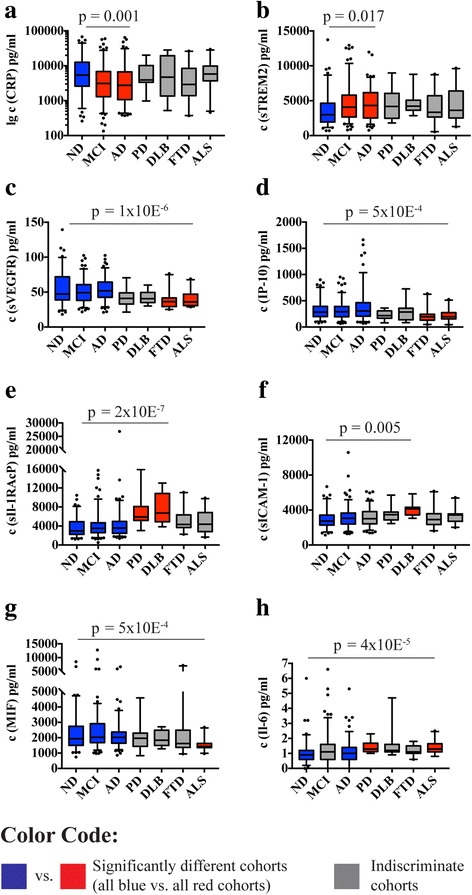
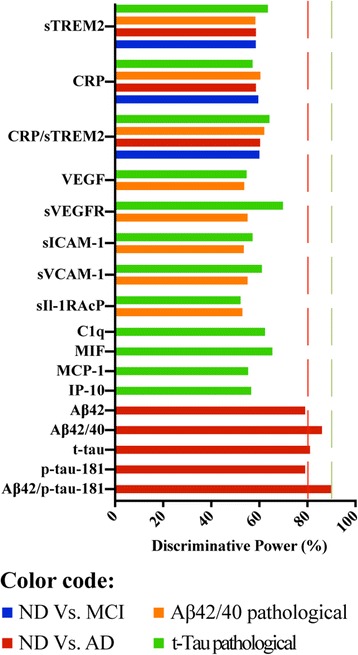
BACKGROUND: Neuroinflammation has gained increasing attention as a potential contributing factor in Alzheimer's disease (AD) pathology. A clinical cerebrospinal fluid biomarker capable of monitoring this process during the course of the disease has yet to emerge, chiefly owing to contradictory research findings. In this study, we sought to clarify the utility of inflammatory biomarkers in diagnostic procedures of AD in three steps: (1) to screen for proteins that are robustly detectable in cerebrospinal fluid; (2) based on this analysis, to explore any associations between the analytically robust markers and salient pathological features of AD; and (3) to determine the discriminative power of these markers in the clinical diagnosis of AD. METHODS: From a total of 46 proteins, 15 that were robustly detectable in cerebrospinal fluid were identified. A subsequent analysis of these markers in a cohort of 399 patients (nondemented subjects, patients with mild cognitive impairment [MCI], and patients with AD, supplemented by smaller cohorts of other diseases) was conducted. Fluid biomarker data were related to AD pathology and neuropsychological markers and adjusted for confounders such as age, sex, apolipoprotein E genotype, and biobank storage time. RESULTS: Cerebrospinal fluid levels of C-reactive protein and soluble TREM2 differed between nondemented subjects, patients with MCI, or patients with AD and were associated with amyloid and tau pathology. Several markers were associated with tau pathology only or with other neurodegenerative diseases. Correlations between neuropsychological performance and inflammatory markers were weak, but they were most prominent in AD and for the most challenging cognitive tests. All investigated covariates had significant influence, with varying effects across the markers. Still, none of the markers achieved discriminative power of more than 70% to distinguish between patient groups defined by clinical or neuropathological categories. CONCLUSIONS: Basic analytical considerations proved indispensable for this type of study because only one-third of the tested markers were robustly detectable in cerebrospinal fluid. Detectable inflammatory protein markers were associated in multiple ways with AD pathology. Yet, even significantly associated markers were not powerful enough in terms of effect strength, sensitivity, and specificity, and hence they were not suited for direct use in clinical diagnostic practice. Targets other than those most commonly considered in this field of research might provide results with better clinical applicability.
Overview
The claims and statistics of this paper haven’t been checked yet.
Run the check — free, no account needed. It reads the open-access text and checks the sources it cites.
Integrity signals
Registry
Cites
Statistics
Figures
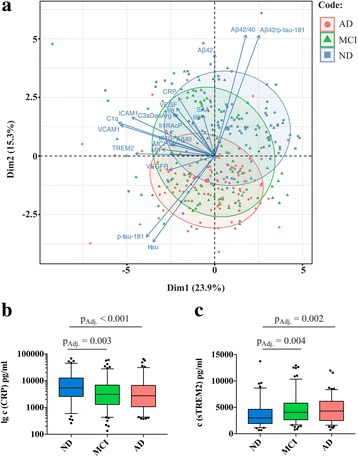
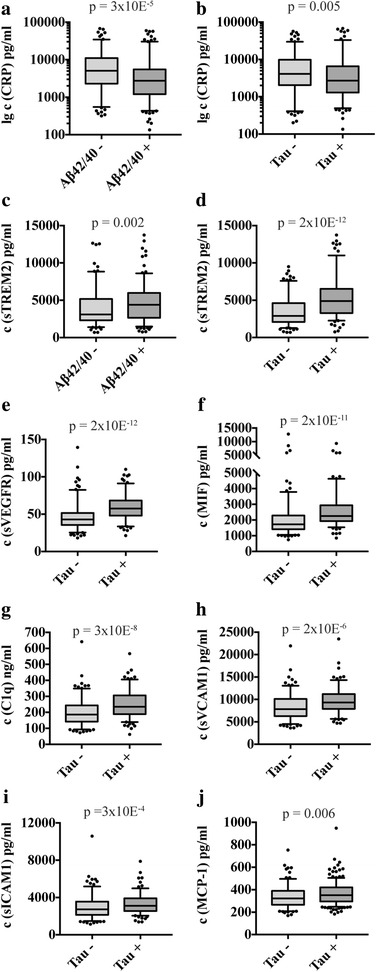
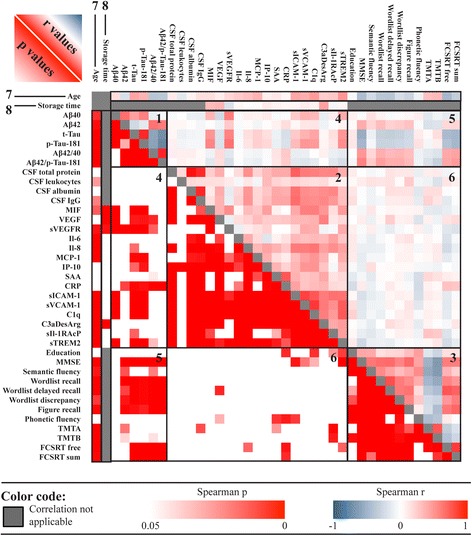
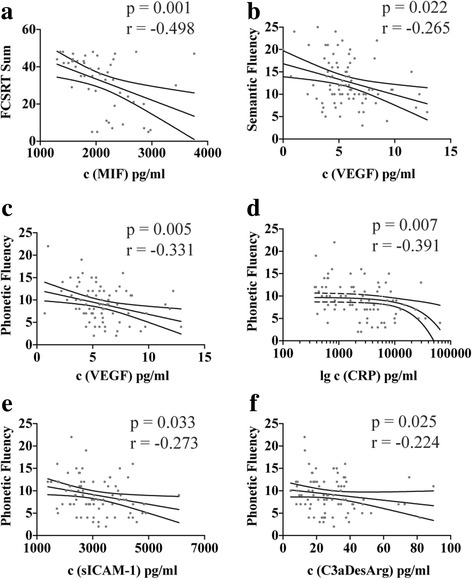
Verification
Claims the paper makes
The claims and statistics of this paper haven’t been checked yet.
Run the check — free, no account needed. It reads the open-access text and checks the sources it cites.
Claims other papers make about this one
Each is checked against this paper’s own text: does it say what the citing paper says it does?
In the citing paper
“It is concluded that CSF levels of these markers correspond to the pathological activity in the brain only in the later stages with cognitive demand tasks in AD [55].”
From Recent Advancements in Pathogenesis, Diagnostics and Treatment of Alzheimer’s Disease (2020) · cites this paper as [55]
Self-check
Percentages, sums and reported differences re-computed from the paper’s own numbers.
The self-check needs the paper’s full text.
Citations
Cites
Folstein, M. F., Folstein, S. E., & McHugh, P. R. (1975) · Journal of Psychiatric Research · doi:10.1016/0022-3956(75)90026-6 · Cited by 88,282
Hirono, N., Mori, E., Ikejiri, Y., Imamura, T., Shimomura, T., Hashimoto, M., Yamashita, H., & Ikeda, M. (1997) · PubMed · Cited by 21,012
Kok, J. S., Berg, I. J., & Scherder, E. J. A. (2013) · Dementia and Geriatric Cognitive Disorders Extra · doi:10.1159/000353441 · Cited by 20,589
Older Adults' Reasons for Using Technology while Aging in Place
Peek, S. T. M., Luijkx, K. G., Rijnaard, M. D., Nieboer, M. E., van der Voort, C. S., Aarts, S., van Hoof, J., Vrijhoef, H. J., & Wouters, E. (2015) · Gerontology · doi:10.1159/000430949 · Cited by 19,852
Sensitivity and False Alarm Rate of a Fall Sensor in Long-Term Fall Detection in the Elderly
Kangas, M., Korpelainen, R., Vikman, I., Nyberg, L., & Jämsä, T. J. (2014) · Gerontology · doi:10.1159/000362720 · Cited by 19,007
McKhann, G. M., Knopman, D. S., Chertkow, H., Hyman, B. T., Jack, C. R., Kawas, C. H., Klunk, W. E., Koroshetz, W. J., Manly, J. J., Mayeux, R., et al. (2011) · Alzheimer's & Dementia · doi:10.1016/j.jalz.2011.03.005 · Cited by 18,657 · cited 1×
“The AD cohort included patients with “probable Alzheimer’s disease” according to National Institute on Aging-Alzheimer’s Association criteria, supported by at least an intermediate level of evidence for AD pathology by CSF analysis or imaging [18].”
MethodThe ASA Statement on p -Values: Context, Process, and Purpose
Wasserstein, R. L., & Lazar, N. A. (2016) · The American Statistician · doi:10.1080/00031305.2016.1154108 · Cited by 6,306 · cited 1×
“When discussing biomarker findings, it is of great importance to consider not only statistical significance but also the effect strength, sensitivity, and specificity of the biomarker candidates [9, 43].”
BackgroundOverdependence on degraded gist memory in Alzheimer's disease.
Gallo, D. A., Shahid, K. R., Olson, M. A., Solomon, T. M., Schacter, D. L., & Budson, A. E. (2006) · Neuropsychology · doi:10.1037/0894-4105.20.6.625 · Cited by 4,757
Moms, J. C., Heyman, A., Mohs, R. C., Hughes, J. P., van Belle, G., Fillenbaum, G., Mellits, E. D., & Clark, C. (1989) · Neurology · doi:10.1212/wnl.39.9.1159 · Cited by 4,130
Apolipoprotein E and Alzheimer disease: risk, mechanisms and therapy
Liu, C.-C., Kanekiyo, T., Xu, H., & Bu, G. (2013) · Nature Reviews Neurology · doi:10.1038/nrneurol.2012.263 · Cited by 3,459 · cited 1×
“CRP was also the only inflammatory marker significantly associated with the ApoE genotype, the most influential genetic AD risk factor [19].”
Background
Cited by
Sorted by citations
Items 101–112 of 112
Li, V. O. K., Lam, J. C. K., & Han, Y. (2024) · medRxiv · doi:10.1101/2024.10.02.24314019
Fluid and Imaging Markers of Glial Reactivity
Suárez‐Calvet, M. (2025) · Springer eBooks · doi:10.1007/978-3-031-80849-4_6
Nasiri, E., Sankowski, R., Dietrich, H., Oikonomidi, A., Huerta, P. T., Popp, J., Al-Abed, Y., & Bacher, M. (2020) · Figshare · doi:10.6084/m9.figshare.12150948
Zhou, Y., Xu, J., Hou, Y., Leverenz, J. B., Kallianpur, A. R., Mehra, R., Liu, Y., Yu, H., Pieper, A. A., Jehi, L., et al. (2021) · Figshare · doi:10.6084/m9.figshare.14759706
Zhou, Y., Xu, J., Hou, Y., Leverenz, J. B., Kallianpur, A. R., Mehra, R., Liu, Y., Yu, H., Pieper, A. A., Jehi, L., et al. (2021) · Figshare · doi:10.6084/m9.figshare.14759694
Silva, D. F., Candeias, E., Esteves, A. R., Magalhães, J. D., Ferreira, I. L., Nunes‐Costa, D., Rego, A. C., Empadinhas, N., & Cardoso, S. M. (2020) · Figshare · doi:10.6084/m9.figshare.13199281
Brosseron, F., Maaß, A., Kleineidam, L., Ravichandran, K. A., Kolbe, C.-C., Wolfsgruber, S., Santarelli, F., Häsler, L. M., McManus, R. M., Ising, C., et al. (2023) · Figshare · doi:10.6084/m9.figshare.22602371
Self-citationAljuhani, M., Ashraf, A., Alqarni, A., Alshuhri, M. S., Alkhybari, E. M., AlHarbi, A., Almudayni, A., Alablani, F. J., & Alhulail, A. A. (2026) · Neurology International · doi:10.3390/neurolint18050084
“Soluble VCAM-1 in CSF is thought to arise, at least in part, from endothelial shedding in response to vascular stress or inflammation [4,5].”
InfluentialBiomarkers of angiogenesis in Alzheimer's disease: Systematic review and meta-analysis
Kapoor, A., Nguyen, A., Joyce, J. L., Gaubert, A., Han, S. D., Hughes, C. C. W., & Nation, D. A. (2026) · Journal of Alzheimer s Disease · doi:10.1177/13872877261453391
Alruwaili, M., Turkistani, A. A., Shilbayeh, S. A. R., Mirdad, D. S. A., Almulhim, M. F., Alnaaim, S., Almubarak, M., & Initiative, A. D. N. (2026) · Immunologic Research · doi:10.1007/s12026-026-09848-1
Metadata
- Authors
- Brosseron, F., Traschütz, A., Widmann, C. N., Kummer, M. P., Tacik, P., Santarelli, F., Jessen, F., & Heneka, M. T.
- Affiliations
- German Center for Neurodegenerative Diseases (DE)
- University of Bonn (DE)
- University of Cologne (DE)
- Corresponding author
- Heneka, Michael T.
- ORCID
- Venue
- Alzheimer's Research & Therapy
- Published
- 2018-02-26
- Volume
- 10
- Issue
- 1
- Pages
- 25-25
- ISSN
- 1758-9193 (ISSN-L)
- PMC
- PMC5828084
- OpenAlex
- W2796088161
- Cited by
- 113
- References
- 51
- Citations by year
- 2026: 6 · 2025: 9 · 2024: 16 · 2023: 10 · 2022: 12 · 2021: 16 · 2020: 29 · 2019: 10 · 2018: 5
- FWCI
- 11.72
- Type
- journal article
- Language
- en
- Open access
- gold
- doi.org
- Licence
- cc-by
- Locations
- Alzheimer s Research & Therapy (publishedVersion, cc-by)
- PubMed Central (publishedVersion, cc-by)
- PubMed (publishedVersion)
- Kölner Universitäts PublikationsServer (Universität zu Köln) (publishedVersion)
- Open Repository and Bibliography (University of Luxembourg) (submittedVersion, other-oa)
- DOAJ (DOAJ: Directory of Open Access Journals) (submittedVersion, cc-by-sa)
- DZNE Pub (submittedVersion, cc-by)
- Zenodo (CERN European Organization for Nuclear Research) (submittedVersion, cc-by)
- Funders
- EU/EFPIA/(Associated Partner) Innovative Medicines Initiative (2) Joint Undertaking (115568)
- European Union’s Seventh Framework Programme (FP7/2007-2013)
- INMiND (HEALTH-F2-2011-278850 TP21)
- Deutsche Forschungsgemeinschaft (KFO177, TP4)
- Topics
- Health Sciences › Medicine › Psychiatry and Mental health › Dementia and Cognitive Impairment Research
- Life Sciences › Neuroscience › Cellular and Molecular Neuroscience › Alzheimer's disease research and treatments
- Life Sciences › Neuroscience › Neurology › Neuroinflammation and Neurodegeneration Mechanisms
- Keywords
- Alzheimer's disease, cerebrospinal fluid biomarkers, neuroinflammation, inflammatory proteins, C-reactive protein, soluble TREM2, amyloid pathology, tau pathology, mild cognitive impairment, diagnostic accuracy, apolipoprotein E
- MeSH terms
- Adult, Aged, Aged, 80 and over, Alzheimer Disease, C-Reactive Protein, Cerebrospinal Fluid Proteins, Female, Humans, Male, Membrane Glycoproteins, Middle Aged, Receptors, Immunologic, Cohort Studies, Cytokines, Amyloid beta-Peptides, tau Proteins, Statistics, Nonparametric, Vascular Endothelial Growth Factor A
About these checks
Registry, retraction, Cites and statistics results are computed, not judged, with one exception: a printed reference that no index lists is read once by a model before it counts as a citation error. Claims are extracted by a model and kept only when their quote appears verbatim in the text; each cited source is then checked, with a model’s help, for whether it says what the claim relies on. Those verdicts can be wrong — read the claim’s quote and the cited source before relying on one.
Statistics and arithmetic are recomputed, not judged.
Confidence bands are shown only for fields calibrated on our annotated test set. None is calibrated yet, so no band is shown.
What counts as a claim ›How we measure confidence ›How we check this ›
Are you an author, or do you see a problem with this page? Request a review
