

Alcohol use and dementia: a systematic scoping review
Open accessThe DOI matches its Crossref record; 88 of the 89 references it cites were found in a registry or an index, and 1 are not checked yet; 41 of the 117 sources its claims cite were checked for support.
Abstract
BACKGROUND: Alcohol use has been identified as a risk factor for dementia and cognitive decline. However, some patterns of drinking have been associated with beneficial effects. METHODS AND RESULTS: To clarify the relationship between alcohol use and dementia, we conducted a scoping review based on a systematic search of systematic reviews published from January 2000 to October 2017 by using Medline, Embase, and PsycINFO. Overall, 28 systematic reviews were identified: 20 on the associations between the level of alcohol use and the incidence of cognitive impairment/dementia, six on the associations between dimensions of alcohol use and specific brain functions, and two on induced dementias. Although causality could not be established, light to moderate alcohol use in middle to late adulthood was associated with a decreased risk of cognitive impairment and dementia. Heavy alcohol use was associated with changes in brain structures, cognitive impairments, and an increased risk of all types of dementia. CONCLUSION: Reducing heavy alcohol use may be an effective dementia prevention strategy.
Verified 2026-10-05 · 1 reference not checked yet
Overview
CoChat Summary
TL;DR
This systematic scoping review of 28 systematic reviews found that light to moderate alcohol use in middle to late adulthood was associated with a decreased risk of cognitive impairment and dementia, while heavy alcohol use was associated with brain changes, cognitive impairment, and increased risk of all dementia types. Causality could not be established, and reducing heavy alcohol use may be an effective dementia prevention strategy.
Key findings
- The review identified 28 systematic reviews: 20 on associations between level of alcohol use and incidence of cognitive impairment/dementia, 6 on dimensions of alcohol use and specific brain functions, and 2 on induced dementias.
- Light to moderate alcohol use in middle to late adulthood was associated with a decreased risk of cognitive impairment and dementia; heavy alcohol use was associated with changes in brain structures, cognitive impairments, and an increased risk of all types of dementia. Causality could not be established.
- Quantified examples included: Xu et al. (2017) found lower dementia risk confined to at most 12.5 g/day, with risk bottom (RR 0.9) at roughly 6 g/day and elevated risk (about 10%) when the dose surpassed 23 drinks/week or 38 g/day; Ilomäki et al. (2015) reported light-to-moderate drinking RR 0.72 (95% CI 0.61–0.86) for Alzheimer’s disease and RR 0.74 (95% CI 0.61–0.91) for dementia; Anstey et al. (2009) pooled RRs for light-to-moderate vs no use were 0.72 for AD, 0.75 for vascular dementia, and 0.74 for all-cause dementia.
- Heavy alcohol use and alcohol use disorders were associated with increased risk for all types of dementia; alcohol-related and alcohol-induced dementias involve direct neurotoxicity, thiamine deficiency/Wernicke–Korsakoff syndrome, hepatic encephalopathy, epilepsy, head injury, and vascular risk factors.
Methods
- Systematic scoping review following PRISMA, registered under PROSPERO CRD42017080668; searched OVID Medline, Embase, and PsycINFO for systematic reviews published January 2000 to October 2017, with updates in March 2018 and June 2018; also used World Alzheimer Reports and a Google grey literature search.
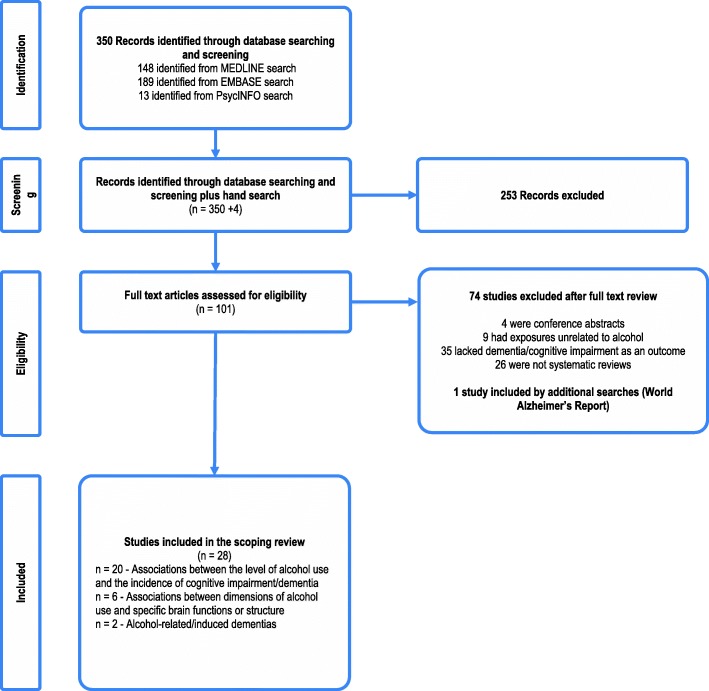
- Included systematic reviews/meta-analyses with an explicit search process assessing alcohol use and cognitive health, dementia, Alzheimer’s disease, vascular/other dementias, brain function, memory, or brain structures; excluded narrative reviews. The original search yielded 350 results, and 28 systematic reviews met all inclusion criteria.
- Two researchers performed searches and screening; data extracted included underlying individual studies, alcohol exposure measurements, dementia diagnoses, risk relations, study types, age restrictions, and review conclusions.
Limitations
- Stated by the paper: causality could not be established; all meta-analyses showed high heterogeneity; alcohol use was self-reported and usually assessed only once at baseline; there was lack of standardization of alcohol use categories; inconsistent or no control for confounders; former drinkers were usually grouped with lifetime abstainers (“sick quitters”); many studies lacked quality assessment or standardized dementia diagnoses; survivor bias was an issue; and cohort studies often excluded heavier drinkers and mostly studied older populations, limiting generalizability to heavy users or people with alcohol use disorders.
- Stated by the paper: this scoping review was limited by large heterogeneity in outcome operationalization and small overlap of underlying studies between reviews; two systematic reviews refrained from meta-analysis because of lack of exposure or outcome comparability.
- Evident from the text: as a review of systematic reviews, it does not provide new primary data or a pooled quantitative synthesis across all included reviews, so conclusions depend on the quality and limitations of the underlying observational studies.
Model-written summary. Check it against the paper before relying on it.
Integrity signals
Registry
Cites
Statistics
Figures
Verification
Claims the paper makes
29 Valid · 3 Not valid · 36 Not checked · 29 Own results and interpretations
At least one cited source doesn’t support this claim or points to a different paper, and none confirmed it — see the verdicts below.
In the paper
“Some of the genetic markers used for alcohol consumption are problematic as their associations with average volume of drinking and with heavy drinking occasions in overall light drinkers point in opposite directions ([80]; see also the discussion following [84]).”
§ Alcohol use and dementia: a systematic scoping review > Discussion
What the sources say
- Not checked yetcites [80] 80. Frick U, Rehm J. Can we establish causality with statistical analyses? The example of epidemiology. In: Wiedermann W, von Eye A, editors. Statistics and causality: methods for applied empirical research. Hoboken: Wiley; 2016. pp. 407–432.
- Disputedcites [84] 84. Holmes MV, Dale CE, Zuccolo L, Silverwood RJ, Guo Y, Ye Z, et al. Association between alcohol and cardiovascular disease: Mendelian randomisation analysis based on individual participant data. BMJ. 2014;349:g4164. doi: 10.1136/bmj.g4164. sourceExperimental — accuracy not yet measured
Our copy of Holmes et al. (2014) reports the opposite of the attributed point. The Discussion 'Principal findings' states that the rs1229984 A-allele was a proxy for all types of self-reported drinking behaviour — volume, top-third of drinkers, binge drinking and abstention — and that these patterns were 'nevertheless directionally concordant (that is, the A-allele resulted in lower alcohol consumption)', confirming the variant was 'suitable as a non-specific genetic proxy'. Table 1 (Results, Genetic association analysis) shows the same concordance (intake volume −17.22%, top tertile OR 0.70, binge drinker OR 0.78, abstainer OR 1.27, GGT −1.84%), and the abstract repeats it. No passage in our copy describes markers whose associations with average volume and with heavy drinking occasions among overall light drinkers run in opposite directions; the only discordances noted concern cardiovascular biomarkers (null HDL cholesterol, slightly higher triglycerides), not drinking measures. (LLM, conf=0.78)
Checked by a reasoning model — may be wrong.
plainstates an association- Asserted: passes — The authors put it forward as true.
- Checkable: passes — It can be checked against evidence.
- Load-bearing: unclear — It is unclear whether the paper’s conclusions depend on it.
- Based: passes — The paper gives a reason why it holds.
At least one cited source doesn’t support this claim or points to a different paper, and none confirmed it — see the verdicts below.
In the paper
“The findings of the underlying studies were heterogeneous, and, when these studies were combined, no significant relationship between heavy alcohol use and executive functioning was observed”
§ Alcohol use and dementia: a systematic scoping review > Results > Associations between dimensions of alcohol use and specific brain functions
What the sources say
- Disputedcites [38] 38. Montgomery C, Fisk JE, Murphy PN, Ryland I, Hilton J. The effects of heavy social drinking on executive function: a systematic review and meta-analytic study of existing literature and new empirical findings. Human Psychopharmacol. 2012;27:187–199. doi: 10.1002/hup.1268. sourceExperimental — accuracy not yet measured
The pooled-effect half of the sentence is supported: the Overview (meta-analytic results) reports a small, non-significant mean weighted effect size across the four included studies (Hedges g = 0.082; 95% CI -0.222 to 0.386; z = 0.529, p = .597), and the Study 1 Discussion states 'The meta-analytic results do not support the hypothesis that executive functioning is impaired in heavy drinking non-clinical participant samples.' However, the accompanying assertion that 'the findings of the underlying studies were heterogeneous' is contradicted by our copy: the same Overview passage reports a non-significant Q statistic (Q[df=3] = 1.986, p = .575), an I² inconsistency of 0.000% and T² = 0.000, with a fixed-effect model chosen a priori on the basis of demographic similarity. The paper's talk of 'equivocal'/'not always consistent' results (Introduction; Abstract background) refers to the wider prior literature, not to the studies it pooled. (LLM, conf=0.68)
Checked by a reasoning model — may be wrong.
plain- Asserted: passes — The authors put it forward as true.
- Checkable: passes — It can be checked against evidence.
- Load-bearing: unclear — It is unclear whether the paper’s conclusions depend on it.
- Based: passes — The paper gives a reason why it holds.
- Disputed
The cited sources support only part of this claim — read each source’s verdict below.
In the paper
“Alcohol use has been identified as a risk factor for dementia and cognitive decline.”
§ Alcohol use and dementia: a systematic scoping review > Abstract > Background
What the sources say
- Not checked yetcites [10] 10. Oslin D, Atkinson RM, Smith DM, Hendrie H. Alcohol related dementia: proposed clinical criteria. Int J Geriatr Psychiatry. 1998;13:203–212. doi: 10.1002/(SICI)1099-1166(199804)13:4<203::AID-GPS734>3.0.CO;2-B. source
- Partly supportedcites [11] 11. Ridley NJ, Draper B, Withall A. Alcohol-related dementia: an update of the evidence. Alzheimers Res Ther. 2013;5:3. doi: 10.1186/alzrt157. sourceExperimental — accuracy not yet measured
The “How much is too much?” section links heavy alcohol use to increased dementia risk and prolonged high consumption to cognitive deficits. The claim omits the paper’s dose qualification: it also reports that low-to-moderate drinking may reduce dementia risk. (LLM, conf=0.88)
- Not checked yetcites [12] 12. Harper C. The neuropathology of alcohol-related brain damage. Alcohol Alcohol. 2009;44:136–140. doi: 10.1093/alcalc/agn102. source
plainstates an association- Asserted: passes — The authors put it forward as true.
- Checkable: passes — It can be checked against evidence.
- Load-bearing: passes — The paper’s conclusions depend on it.
- Based: passes — The paper gives a reason why it holds.
None of the sources cited for this claim have been checked yet.
In the paper
“Furthermore, a prior diagnosis of an AUD was found to be significantly associated with dementia across all age and subtype categories, and observed relative risk (RR) of dementia exceeded the RRs of all other modifiable risk factors [4, 14].”
§ Alcohol use and dementia: a systematic scoping review > Background
What the sources say
- Not checked yetcites [4] 4. Prince M, Bryce R, Albanese E, Wimo A, Ribeiro W, Ferri CP. The global prevalence of dementia: a systematic review and metaanalysis. Alzheimers Dementia. 2013;9:63–75. doi: 10.1016/j.jalz.2012.11.007. source
- Could not verifycites [14] 14. Arksey H, O’Malley L. Scoping Studies: towards a methodological framework. Int J Soc Res Methodol. 2005;8:19–32. doi: 10.1080/1364557032000119616. sourceExperimental — accuracy not yet measured
Our copy of Arksey & O'Malley (2005) is a methodological framework for scoping studies built around a review of services to support carers (Stages 3-5, study selection and charting of 204 included studies); no passage mentions alcohol use disorder, dementia incidence, relative risks, or modifiable risk factors (searched: 'relative risk of dementia alcohol use disorder modifiable risk factors', 'alcohol use disorder associated with dementia across age and subtype categories', 'modifiable risk factor relative risk cohort study incidence'). The only occurrences of 'dementia' are in the reference list (Charlesworth 2001, on psychosocial interventions for family carers of people with dementia). Notably, Stage 5 states the scoping study 'does not seek to synthesise evidence or to aggregate findings from different studies' and 'cannot determine... the weight of evidence', so our copy offers nothing on which to check a comparative RR claim; the finding must come from the citing paper's other citation [4 or 14], which our copy does not name. (LLM, conf=0.75)
plainstates an association- Asserted: passes — The authors put it forward as true.
- Checkable: passes — It can be checked against evidence.
- Load-bearing: passes — The paper’s conclusions depend on it.
- Based: passes — The paper gives a reason why it holds.
Every source the paper cites for this claim was checked and supports it.
In the paper
“Many studies lacked a quality assessment for various outcomes, with many different operationalizations for cognitive functioning [32], and lacked standardization for the diagnoses of different types of dementia [27, 37].”
§ Alcohol use and dementia: a systematic scoping review > Results > Associations between alcohol use and the incidence of cognitive impairment/dementia, including dose-response studies
What the sources say
- Supportedcites [32] 32. Beydoun MA, Beydoun HA, Gamaldo AA, Teel A, Zonderman AB, Wang Y. Epidemiologic studies of modifiable factors associated with cognition and dementia: systematic review and meta-analysis. BMC Public Health. 2014;24:643. doi: 10.1186/1471-2458-14-643. source
The Discussion (limitations) of Beydoun et al. (2014) states that quantitative meta-analysis of all included studies 'was not possible due to the diversity of the cognitive outcome measurements between original studies included,' enumerating test batteries, single global scores such as MMSE, and factor-analytic domain composites — directly supporting the attributed clause that there were many different operationalizations of cognitive functioning. The Results (Description of study-level characteristics) reinforce this, reporting an almost even split between cognitive function/decline outcomes (51.0%) and AD/dementia/impairment outcomes (46.2%) across the 247 studies. The adjacent clauses in the citing sentence (lack of quality assessment, and non-standardized dementia diagnoses) are carried by other citations [27, 37] and were not judged here; note that the paper's own remark about quality was that it could not create a common quality measure for its review, not that primary studies omitted quality assessment. (LLM, conf=0.87)
plain- Asserted: passes — The authors put it forward as true.
- Checkable: passes — It can be checked against evidence.
- Load-bearing: passes — The paper’s conclusions depend on it.
- Based: passes — The paper gives a reason why it holds.
- Supported
68 more claims · 28 with their cited sources checked
Create a free account to see all 97 claims and to verify the 76 references still open.
- Probably not a substantial claim. 14
- It may state two separate claims as one. 12
Claims other papers make about this one
Each is checked against this paper’s own text: does it say what the citing paper says it does?
The source backs part of the claim, not all of it — or backs it for a different population, condition or comparison.
In the citing paper
“Alcohol consumption was relatively low among participants in MHAS, and alcohol consumption is a high-risk factor for cognitive impairment in older adults [24, 33, 34].”
From Digital exclusion and cognitive impairment in older people: findings from five longitudinal studies (2024) · cites this paper as [33]
Experimental — accuracy not yet measuredThe cited source says what the claim attributes to it.
In the citing paper
“In line with this a review of 28 systematic reviews concluded that heavy alcohol use was associated with increased risk of all-cause dementia and reduced grey matter volume in imaging studies. (206)”
From Dementia prevention, intervention, and care: 2024 report of the Lancet standing Commission (2024) · cites this paper as [206]
The cited source says what the claim attributes to it.
In the citing paper
“Heavy drinking is associated with brain changes, cognitive impairment, and dementia, a risk known for centuries.”
From Dementia prevention, intervention, and care: 2020 report of the Lancet Commission (2020) · cites this paper as [102]
Self-check
Percentages, sums and reported differences re-computed from the paper’s own numbers.
Each contradiction between two passages listed here was confirmed by an independent check.
Rated minor: it would not touch a result — a value no result rests on, a p-value that stays on the same side of the significance level, or a conflict that is clerical, resolved elsewhere in the paper, or outside its own findings.
In the paper
§ Alcohol use and dementia: a systematic scoping review > Results > Research topics
“| Neafsey and Collins [40] | 2013 |”
§ Alcohol use and dementia: a systematic scoping review > References
“40. Neafsey EJ, Collins MA. Moderate alcohol consumption and cognitive risk. Neuropsychiatr Dis Treat. 2011;7:465–484.”
Citations
Cites
Preferred Reporting Items for Systematic Reviews and Meta-Analyses: the PRISMA statement
Moher, D., Liberati, A., Tetzlaff, J., Altman, D. G., & for the PRISMA Group (2009) · BMJ · doi:10.1136/bmj.b2535 · Cited by 83,823
Preferred reporting items for systematic reviews and meta-analyses: the PRISMA Statement.
(2009) · PubMed Central · Cited by 44,859
Preferred reporting items for systematic reviews and meta-analyses: The PRISMA statement
Moher, D., Liberati, A., Tetzlaff, J., Altman, D. G., & the PRISMA Group* (2009) · Annals of Internal Medicine · doi:10.7326/0003-4819-151-4-200908180-00135 · Cited by 37,554
Scoping studies: towards a methodological framework
Arksey, H., & O'Malley, L. (2005) · International Journal of Social Research Methodology · doi:10.1080/1364557032000119616 · Cited by 36,742
Guidance for conducting systematic scoping reviews
Peters, M. D. J., Godfrey, C. M., Khalil, H., McInerney, P., Parker, D., & Soares, C. B. (2015) · International Journal of Evidence-Based Healthcare · doi:10.1097/xeb.0000000000000050 · Cited by 7,472
Dementia prevention, intervention, and care
Livingston, G., Sommerlad, A., Orgeta, V., Costafreda, S. G., Huntley, J., Ames, D., Ballard, C., Banerjee, S., Burns, A., Cohen-Mansfield, J., et al. (2017) · The Lancet · doi:10.1016/s0140-6736(17)31363-6 · Cited by 6,072
The global prevalence of dementia: a systematic review and metaanalysis.
Prince, M., Bryce, R., Albanese, E., Wimo, A., Ribeiro, W., & Ferri, C. P. (2013) · Alzheimer's & Dementia · doi:10.1016/j.jalz.2012.11.007 · Cited by 4,941
Kyu, H. H., Abate, D., Abate, K. H., Abay, S. M., Abbafati, C., Abbasi, N., Abbastabar, H., Abd-Allah, F., Abdela, J., Abdelalim, A., et al. (2018) · The Lancet · doi:10.1016/s0140-6736(18)32335-3 · Cited by 4,081
The Epidemiologic Transition: A Theory of the Epidemiology of Population Change
OMRAN, A. R. (2005) · The Milbank Quarterly · doi:10.1111/j.1468-0009.2005.00398.x · Cited by 3,823
Apolipoprotein E and Alzheimer disease: risk, mechanisms and therapy
Liu, C.-C., Kanekiyo, T., Xu, H., & Bu, G. (2013) · Nature Reviews Neurology · doi:10.1038/nrneurol.2012.263 · Cited by 3,459
Research works printed but not linked: 4
- 6. Alzeimer’s Disease International. World Alzheimer Report 2015: The Global Impact of Dementia. 2015.
- 49. European Medicines Agency. Guideline on the development of medicinal products for the treatment of alcohol dependence. London: European Medicines Agency; 2010.
- 56. Dufour MC. What is moderate drinking? Alcohol Res Health. 1999;23:5–14.
- 57. World Health Organization. International guide for monitoring alcohol consumption and related harm. Geneva: World Health Organization; 2000.
Cited by
Dementia prevention, intervention, and care: 2020 report of the Lancet Commission
Livingston, G., Huntley, J., Sommerlad, A., Ames, D., Ballard, C., Banerjee, S., Brayne, C., Burns, A., Cohen-Mansfield, J., Cooper, C., et al. (2020) · The Lancet · doi:10.1016/s0140-6736(20)30367-6 · Cited by 10,430
RetractedDementia prevention, intervention, and care: 2024 report of the Lancet standing Commission
Livingston, G., Huntley, J., Liu, K. Y., Costafreda, S. G., Selbæk, G., Alladi, S., Ames, D., Banerjee, S., Burns, A., Brayne, C., et al. (2024) · The Lancet · doi:10.1016/s0140-6736(24)01296-0 · Cited by 3,860
2022 Alzheimer's disease facts and figures
(2022) · Alzheimer's & Dementia · doi:10.1002/alz.12638 · Cited by 2,341
2021 Alzheimer's disease facts and figures
(2021) · Alzheimer's & Dementia · doi:10.1002/alz.12328 · Cited by 2,201
Handbook of Religion and Health
Koenig, H. G., VanderWeele, T., & Peteet, J. R. (2024) · doi:10.1093/oso/9780190088859.001.0001 · Cited by 1,139
Alzheimer’s disease: insights into pathology, molecular mechanisms, and therapy
Zheng, Q., & Wang, X. (2025) · Protein & Cell · doi:10.1093/procel/pwae026 · Cited by 410
Román, G. C., Jackson, R. E., Gadhia, R., Román, A. N., & Reis, J. (2019) · Revue Neurologique · doi:10.1016/j.neurol.2019.08.005 · Cited by 421
Biomarker modeling of Alzheimer’s disease using PET-based Braak staging
Therriault, J., Pascoal, T. A., Lussier, F. Z., Tissot, C., Chamoun, M., Bezgin, G., Servaes, S., Benedet, A. L., Ashton, N. J., Karikari, T. K., et al. (2022) · Nature Aging · doi:10.1038/s43587-022-00204-0 · Cited by 308
Safiri, S., Ghaffari Jolfayi, A., Fazlollahi, A., Morsali, S., Sarkesh, A., Daei Sorkhabi, A., Golabi, B., Aletaha, R., Motlagh Asghari, K., Hamidi, S., et al. (2024) · Frontiers in Medicine · doi:10.3389/fmed.2024.1474043 · Cited by 200
Dementia Prevention and Treatment: A Narrative Review
Reuben, D. B., Kremen, S., & Maust, D. T. (2024) · JAMA Internal Medicine · doi:10.1001/jamainternmed.2023.8522 · Cited by 202
Kong, H., Xu, L., & Wang, D. (2022) · CNS Neuroscience & Therapeutics · doi:10.1111/cns.13873 · Cited by 199
Promoting Successful Cognitive Aging: A Ten-Year Update
Krivanek, T. J., Gale, S. A., McFeeley, B. M., Nicastri, C. M., & Daffner, K. R. (2021) · Journal of Alzheimer’s Disease · doi:10.3233/jad-201462 · Cited by 172
Boyd, R. J., Avramopoulos, D., Jantzie, L. L., & McCallion, A. S. (2022) · Journal of Neuroinflammation · doi:10.1186/s12974-022-02584-x · Cited by 153
Causal associations between modifiable risk factors and the Alzheimer's phenome
Andrews, S. J., Fulton‐Howard, B., O'Reilly, P., Marcora, E., Goate, A. M., & collaborators of the Alzheimer's Disease Genetics Consortium (2021) · Annals of Neurology · doi:10.1002/ana.25918 · Cited by 156
Richmond-Rakerd, L. S., D’Souza, S., Milne, B. J., Caspi, A., & Moffitt, T. E. (2022) · JAMA Psychiatry · doi:10.1001/jamapsychiatry.2021.4377 · Cited by 146
Prediction of brain age and cognitive age: quantifying brain and cognitive maintenance in aging
Anatürk, M., Kaufmann, T., Cole, J. H., Suri, S., Griffanti, L., Zsoldos, E., Filippini, N., Singh‐Manoux, A., Kivimäki, M., Westlye, L. T., et al. (2021) · Human Brain Mapping · doi:10.1002/hbm.25316 · Cited by 132
Rehm, J. T., Rovira, P., Llamosas‐Falcón, L., & Shield, K. D. (2021) · Nutrients · doi:10.3390/nu13082652 · Cited by 133
“Most reviews found a curvilinear relationship with a protective effect for light to moderate drinking [39], even though heavy drinking is clearly detrimentally related to the incidence of dementia, in particular early onset dementia [40].”
BackgroundSelf-citationPark, D., Kim, J., Kim, H. J., Lee, D., Lee, D. S., Yoon, D. S., & Hwang, K. S. (2020) · Biosensors and Bioelectronics · doi:10.1016/j.bios.2020.112505 · Cited by 101
Vascular dementia: From pathobiology to emerging perspectives
Morgan, A. E., & Auley, M. T. M. (2024) · Ageing Research Reviews · doi:10.1016/j.arr.2024.102278 · Cited by 116
“However, light to moderate alcohol use has been linked with a reduced risk of cognitive impairment and dementia (Rehm et al., 2019).”
BackgroundAmyloid-β and Tau in Alzheimer’s disease: pathogenesis, mechanisms, and interplay
Abdulkhaliq, A. A., Kim, B., Almoghrabi, Y. M., Khan, J., Ajoolabady, A., Ren, J., Bahijri, S., Tuomilehto, J., Borai, A., & Pratico, D. (2026) · Cell Death & Disease · doi:10.1038/s41419-025-08186-8 · Cited by 87
In vivo methods for imaging blood–brain barrier function and dysfunction
Harris, W. J., Asselin, M., Hinz, R., Parkes, L. M., Allan, S. M., Schießl, I., Boutin, H., & Dickie, B. (2022) · European Journal of Nuclear Medicine and Molecular Imaging · doi:10.1007/s00259-022-05997-1 · Cited by 99
Vascular cognitive impairment – Past, present, and future challenges
Badji, A., Youwakim, J., Cooper, A., Westman, E., & Marseglia, A. (2023) · Ageing Research Reviews · doi:10.1016/j.arr.2023.102042 · Cited by 88
“with slower cognitive decline and reduce dementia risk (Koch et al., 2019; Rehm et al., 2019; Zhang et al., 2020).”
Xu, T., Ye, X., Lu, X., Lan, G., Xie, M., Huang, Z., Wang, T., Wu, J., Zhan, Z., & Xie, X. (2023) · Environment International · doi:10.1016/j.envint.2023.107803 · Cited by 80
Turrini, S., Wong, B., Eldaief, M. C., Press, D. Z., Sinclair, D. A., Koch, G., Avenanti, A., & Santarnecchi, E. (2023) · Ageing Research Reviews · doi:10.1016/j.arr.2023.101939 · Cited by 100
“Moreover, alcohol consumption is linearly negatively associated with grey and white matter volume (Rehm et al., 2019), so that high alcohol consumption correlates with increased atrophy.”
BackgroundLegault, J., Thompson, C., Martineau‐Dussault, M., André, C., Baril, A., Villar, G. M., Carrier, J., & Gosselin, N. (2021) · Brain Sciences · doi:10.3390/brainsci11060706 · Cited by 82
“Alcohol could lead to brain damage directly, through its neurotoxic effect on brain structure and function [137].”
BackgroundBrennan, S., McDonald, S. J., Page, M. J., Reid, J. E. A., Ward, S. A., Forbes, A. B., & McKenzie, J. E. (2020) · Systematic Reviews · doi:10.1186/s13643-019-1220-4 · Cited by 80
Alcohol use and dementia: new research directions
Visontay, R., Rao, R. T., & Mewton, L. R. (2020) · Current Opinion in Psychiatry · doi:10.1097/yco.0000000000000679 · Cited by 78
Review on anti-alzheimer drug development: approaches, challenges and perspectives
Abdallah, A. E. (2024) · RSC Advances · doi:10.1039/d3ra08333k · Cited by 72
Dietary Regulation of Gut-Brain Axis in Alzheimer’s Disease: Importance of Microbiota Metabolites
Frausto, D. M., Forsyth, C. B., Keshavarzian, A., & Voigt, R. M. (2021) · Frontiers in Neuroscience · doi:10.3389/fnins.2021.736814 · Cited by 61
Vilor‐Tejedor, N., Ciampa, I., Operto, G., Falcón, C., Suárez‐Calvet, M., Crous‐Bou, M., Shekari, M., Arenaza‐Urquijo, E. M., Milà‐Alomà, M., Grau‐Rivera, O., et al. (2021) · Alzheimer s Research & Therapy · doi:10.1186/s13195-021-00878-5 · Cited by 71
Digital exclusion and cognitive impairment in older people: findings from five longitudinal studies
Wang, Y., Wu, Z., Duan, L., Liu, S., Chen, R., Sun, T., Wang, J., Zhou, J., Wang, H., & Huang, P. (2024) · BMC Geriatrics · doi:10.1186/s12877-024-05026-w · Cited by 55
“Alcohol consumption was relatively low among participants in MHAS, and alcohol consumption is a high-risk factor for cognitive impairment in older adults [24, 33, 34].”
BackgroundEl–Sappagh, S., Alonso, J. M., Abuhmed, T., Ali, F., & Bugarín, A. (2023) · Artificial Intelligence Review · doi:10.1007/s10462-023-10415-5 · Cited by 70
Salvadó, G., Grothe, M. J., Groot, C., Moscoso, A., Schöll, M., Gispert, J. D., Ossenkoppele, R., & Initiative, F. T. A. D. N. (2021) · European Journal of Nuclear Medicine and Molecular Imaging · doi:10.1007/s00259-021-05192-8 · Cited by 52
The impact of heavy alcohol consumption on cognitive impairment in young old and middle old persons
Yen, F., Wang, S., Lin, S.-Y., Chao, Y.-H., & Wei, J. C. (2022) · Journal of Translational Medicine · doi:10.1186/s12967-022-03353-3 · Cited by 62
“Chronic alcohol use can result in thiamine deficiency, leading to WernickeKorsakoff syndrome [5].”
BackgroundInfluentialLeón, B. E., Kang, S., Franca-Solomon, G., Shang, P., & Choi, D. (2022) · Frontiers in Behavioral Neuroscience · doi:10.3389/fnbeh.2021.778456 · Cited by 66
“Heavy and chronic alcohol abuse is associated with changes in brain structure, cognitive deficits, and decreased brain volume (Rehm et al., 2019).”
BackgroundAlcohol as a Modifiable Risk Factor for Alzheimer’s Disease—Evidence from Experimental Studies
Chandrashekar, D. V., Steinberg, R. A., Han, D., & Sumbria, R. K. (2023) · International Journal of Molecular Sciences · doi:10.3390/ijms24119492 · Cited by 57
“A systematic scoping review of epidemiological data on alcohol and AD concluded that heavy alcohol use was associated with changes in brain structure, cognitive impairment, and an increased risk of all types of dementia [12].”
BackgroundInfluentialRestani, P., Fradera, U., Ruf, J.-C., Stockley, C. S., Teissèdre, P., Biella, S., Colombo, F., & Lorenzo, C. D. (2020) · Critical Reviews in Food Science and Nutrition · doi:10.1080/10408398.2020.1740644 · Cited by 51
“…cognitive effects in abstainers compared to those in light to moderate drinkers (Espeland et al. 2005; Ganguli et al. 2005; Zuccalà et al. 2001; Rehm et al. 2019), but the quality of the studies did not always permit definitive conclusions to be drawn or to identify a dose 11 of alcohol that…”
BackgroundEnhanced delivery of a low dose of aducanumab via FUS in 5×FAD mice, an AD model
Kong, C., Yang, E.-J., Shin, J., Park, J., Kim, S.-H., Park, S.-W., Chang, W. S., Lee, C.-H., Kim, H., Kim, H.-S., et al. (2022) · Translational Neurodegeneration · doi:10.1186/s40035-022-00333-x · Cited by 47
Raza, A., Saleem, S., Imran, S., Rahman, S. B., Haroon, M. H., Razzaq, A., Hussain, A., Iqbal, J., & Sathian, B. (2025) · Metabolic Brain Disease · doi:10.1007/s11011-025-01700-z · Cited by 60
A multimodal machine learning model for predicting dementia conversion in Alzheimer’s disease
Lee, M., Kim, H. W., Choe, Y. S., Yang, H. S., Lee, J., Lee, H., Yong, J. H., Kim, D., Lee, M., Kang, D. W., et al. (2024) · Scientific Reports · doi:10.1038/s41598-024-60134-2 · Cited by 62
Jennings, A., Thompson, A. S., Tresserra‐Rimbau, A., O’Neill, J. K., Hill, C., Bondonno, N. P., Kuhn, T. E., & Cassidy, A. (2024) · JAMA Network Open · doi:10.1001/jamanetworkopen.2024.34136 · Cited by 53
Kivimäki, M., Singh-Manoux, A., Batty, G. D., Sabia, S., Sommerlad, A., Floud, S., Jokela, M., Vahtera, J., Beydoun, M. A., Suominen, S. B., et al. (2020) · JAMA Network Open · doi:10.1001/jamanetworkopen.2020.16084 · Cited by 46
Bailey, K. L., Sayles, H. R., Campbell, J. R., Khalid, N., Anglim, M., Ponce, J., Wyatt, T. A., McClay, J. C., Burnham, E. L., Anzalone, A. J., et al. (2022) · Alcoholism Clinical and Experimental Research · doi:10.1111/acer.14838 · Cited by 53
“…to increase many of these comorbidities such as liver disease (Mandayam et al., 2004), diabetes (Carlsson et al., 2005), stroke (Reynolds et al., 2003), hypertension (Saunders et al., 1981), dementia (Rehm et al., 2019) renal disease (Perneger et al., 1999) and HIV/AIDs (Ferguson et al., 2020).”
Ethanol exposure alters Alzheimer's-related pathology, behavior, and metabolism in APP/PS1 mice
Day, S. M., Gironda, S. C., Clarke, C. W., Snipes, J. A., Nicol, N. I., Kamran, H., Vaughan, W., Weiner, J. L., & Macauley, S. L. (2022) · Neurobiology of Disease · doi:10.1016/j.nbd.2022.105967 · Cited by 51
Lee, Y. C., Kang, J. M., Lee, H., Kim, K., Kim, S., Yu, T. Y., Lee, E. M., Kim, C. T., Kim, D. K., Lewis, M., et al. (2020) · Alzheimer s Research & Therapy · doi:10.1186/s13195-020-00618-1 · Cited by 56
Mewton, L., Visontay, R., Hoy, N., Lipnicki, D. M., Sunderland, M., Lipton, R. B., Guerchet, M., Ritchie, K., Najar, J., Scarmeas, N., et al. (2023) · Addiction · doi:10.1111/add.16035 · Cited by 45
Kilian, C., Klinger, S., Rehm, J. T., & Manthey, J. (2023) · BMC Geriatrics · doi:10.1186/s12877-023-03972-5 · Cited by 48
“In a recent systematic review of 28 systematic reviews [3], high levels of alcohol use were found to be a risk factor for dementia as well as for structural and functional changes in the brain.”
BackgroundResultInfluentialSelf-citationDonroe, J. H., & Edelman, E. J. (2022) · Annals of Internal Medicine · doi:10.7326/aitc202210180 · Cited by 50
Alcohol Screening During US Primary Care Visits, 2014–2016
Chatterton, B., Agnoli, A. L., Schwarz, E. B., & Fenton, J. J. (2022) · Journal of General Internal Medicine · doi:10.1007/s11606-021-07369-1 · Cited by 55
Drobny, A., Boros, F. A., Balta, D., Huarcaya, S. P., Caylioglu, D., Qazi, N., Vandrey, J., Schneider, Y., Dobert, J. P., Pitcairn, C., et al. (2023) · Translational Neurodegeneration · doi:10.1186/s40035-023-00363-z · Cited by 49
Zhao, Q., Xiang, H., Cai, Y., Meng, S. S., Zhang, Y., & Qiu, P. (2022) · Journal of Affective Disorders · doi:10.1016/j.jad.2022.03.010 · Cited by 48
Marcatti, M., Fracassi, A., Montalbano, M., Natarajan, C., Krishnan, B., Kayed, R., & Taglialatela, G. (2022) · Cellular and Molecular Life Sciences · doi:10.1007/s00018-022-04255-9 · Cited by 38
Samuelsson, J., Najar, J., Wallengren, O., Kern, S., Wetterberg, H., Fässberg, M. M., Zetterberg, H., Blennow, K., Lissner, L., Rothenberg, E. M., et al. (2021) · European Journal of Nutrition · doi:10.1007/s00394-021-02688-9 · Cited by 40
Obst, J., Hall-Roberts, H. L., Smith, T. B., Kreuzer, M., Magno, L., Di Daniel, E., Davis, J. B., & Mead, E. (2021) · Scientific Reports · doi:10.1038/s41598-021-96144-7 · Cited by 46
Ophthalmic Biomarkers for Alzheimer’s Disease: A Review
Majeed, A., Marwick, B., Yu, H., Fadavi, H., & Tavakoli, M. (2021) · Frontiers in Aging Neuroscience · doi:10.3389/fnagi.2021.720167 · Cited by 41
Salvadó, G., Milà-Alomà, M., Shekari, M., Ashton, N. J., Operto, G., Falcon, C., Cacciaglia, R., Minguillon, C., Fauria, K., Niñerola-Baizán, A., et al. (2022) · European Journal of Nuclear Medicine and Molecular Imaging · doi:10.1007/s00259-022-05897-4 · Cited by 36
Topiwala, A., Levey, D. F., Zhou, H., Deak, J. D., Adhikari, K., Ebmeier, K. P., Bell, S., Burgess, S., Nichols, T. E., Gaziano, J. M., et al. (2025) · BMJ Evidence-Based Medicine · doi:10.1136/bmjebm-2025-113913 · Cited by 43
“4 Most studies have had limited inclusion of heavy or dependent drinkers, which restricts their power to detect the full range of alcohol’s effects.”
InfluentialFredriksen‐Goldsen, K. I., Jung, H. H., Kim, H., Petros, R., & Emlet, C. A. (2021) · Journal of Aging and Health · doi:10.1177/08982643211046466 · Cited by 38
Tucker, A. E., Pauneto, C. D. M. A., Barnett, A., & Coleman, L. G. (2022) · Frontiers in Behavioral Neuroscience · doi:10.3389/fnbeh.2022.886634 · Cited by 35
Palm, A., Vataja, R., Talaslahti, T., Ginters, M., Kautiainen, H., Elonheimo, H., Suvisaari, J., Lindberg, N., & Koponen, H. (2022) · International Journal of Geriatric Psychiatry · doi:10.1002/gps.5775 · Cited by 40
“Heavy drinking is associated with an elevated risk of all types of dementia.(4) According to the current diagnostic systems, alcohol‐related cognitive impairment can be classified into two main syndromes: Wernicke‐Korsakoff syndrome (WKS) and alcohol‐related dementia (ARD).”
BackgroundWeaver, D. F. (2023) · Brain Sciences · doi:10.3390/brainsci14010041 · Cited by 39
“Not surprisingly, chronic ethanol abuse has been identified as a risk factor for cognitive decline, AD and dementia [148].”
BackgroundSex/gender effects of glial reactivity on preclinical Alzheimer’s disease pathology
Vila‐Castelar, C., Akinci, M., Palpatzis, E., Dominguez, P. A., Operto, G., Kollmorgen, G., Quijano‐Rubio, C., Blennow, K., Zetterberg, H., Falcón, C., et al. (2024) · Molecular Psychiatry · doi:10.1038/s41380-024-02753-9 · Cited by 33
Role of plant-based diet in late-life cognitive decline: results from the Salus in Apulia Study
Zupo, R., Griseta, C., Battista, P., Donghia, R., Guerra, V., Castellana, F., Lampignano, L., Bortone, I., Lozupone, M., Giannelli, G., et al. (2021) · Nutritional Neuroscience · doi:10.1080/1028415x.2020.1853416 · Cited by 39
“to a decreased risk of both cognitive impairment and dementia [56, 57].”
BackgroundContador, I., Buch-Vicente, B., del Ser, T., Velasco, S. L., Villarejo‐Galende, A., Benito‐León, J., & Bermejo‐Pareja, F. (2024) · Journal of Clinical Medicine · doi:10.3390/jcm13144100 · Cited by 32
“Actually, substantial alcohol consumption, which is associated with other dementia RFs—education, tobacco smoking, and depression — has neurotoxic effects and may lead to structural and functional brain damage [241].”
BackgroundHuang, W. W. Y., Fan, S. X., Li, W.-Y., Thangavelu, V., Saripella, A., Englesakis, M. F., Yan, E., & Chung, F. F. (2025) · Journal of Clinical Anesthesia · doi:10.1016/j.jclinane.2025.111830 · Cited by 30
Samuelsson, J., Kern, S., Zetterberg, H., Blennow, K., Rothenberg, E. M., Wallengren, O., Skoog, I. G., & Zettergren, A. (2021) · Alzheimer s & Dementia Translational Research & Clinical Interventions · doi:10.1002/trc2.12183 · Cited by 32
Innate immune activation: Parallels in alcohol use disorder and Alzheimer’s disease
Ramos, A., Joshi, R., & Szabó, G. (2022) · Frontiers in Molecular Neuroscience · doi:10.3389/fnmol.2022.910298 · Cited by 32
“Along with the acute sedative effect of ethanol, chronic alcohol abuse is associated with cognitive dysfunction, dementia, neurodegeneration and gray and white matter shrinkage (Crews, 2008; Wilcox et al., 2014; Zahr, 2014; Yang et al., 2016; Schwarzinger et al., 2018; Rehm et al., 2019).”
BackgroundPlasma amyloid-beta oligomer is related to subjective cognitive decline and brain amyloid status
Kim, K. Y., Park, J., Jeong, Y. H., Kim, H. J., Lee, E. M., Park, J. Y., Kim, E., & Kim, W. J. (2022) · Alzheimer s Research & Therapy · doi:10.1186/s13195-022-01104-6 · Cited by 31
Mobaderi, T., Kazemnejad, A., & Salehi, M. (2024) · Scientific Reports · doi:10.1038/s41598-024-65887-4 · Cited by 36
“Some studies have indicated that moderate alcohol consumption might be linked to a decrease in the mortality rate related to ADRD 31–33 .”
BackgroundCausal cardiovascular risk factors for dementia: insights from observational and genetic studies
Kjeldsen, E. W., & Frikke‐Schmidt, R. (2024) · Cardiovascular Research · doi:10.1093/cvr/cvae235 · Cited by 39
“147 Several observational studies have reported an inverse association between midlife moderate alcohol consumption and dementia risk compared with abstinent drinkers.”
How does the brain remove its waste metabolites from within?
Cheng, Y., & Haorah, J. (2019) · PubMed Central · Cited by 37
Potential Role of Extracellular CIRP in Alcohol-Induced Alzheimer’s Disease
Sharma, A., Brenner, M., & Wang, P. (2020) · Molecular Neurobiology · doi:10.1007/s12035-020-02075-1 · Cited by 30
Increased risk of dementia in older female US veterans with alcohol use disorder
Bahorik, A. L., Bobrow, K., Hoang, T. D. M., & Yaffe, K. S. (2021) · Addiction · doi:10.1111/add.15416 · Cited by 35
Cerebrospinal fluid: A specific biofluid for the biosensing of Alzheimer's diseases biomarkers
Mirzaie, A., Nasrollahpour, H., Khalilzadeh, B., Jamali, A. A., Spiteri, R. J., Yousefi, H., Işıldak, İ., & Rahbarghazi, R. (2023) · TrAC Trends in Analytical Chemistry · doi:10.1016/j.trac.2023.117174 · Cited by 31
Alcohol promotes waste clearance in the CNS via brain vascular reactivity
Cheng, Y., Liu, X., Ma, X., García, R. J. B., Belfield, K. D., & Haorah, J. (2019) · Free Radical Biology and Medicine · doi:10.1016/j.freeradbiomed.2019.07.029 · Cited by 30
Zhang, Y., Xu, L., Zhang, Y., Pan, J., Wang, P., Tian, S., Li, H., Gao, B., Hou, T., Zhen, X.-C., et al. (2021) · Acta Pharmacologica Sinica · doi:10.1038/s41401-021-00753-x · Cited by 27
Shared genetic links between frontotemporal dementia and psychiatric disorders
Li, C., Pang, D., Lin, J., Yang, T., & Shang, H. (2022) · BMC Medicine · doi:10.1186/s12916-022-02335-y · Cited by 29
“Previous epidemiologic studies have shown that consumers of moderate amounts of alcohol might have a decreased risk of dementia and cognitive decline compared with nondrinkers [58, 59], though substantial heterogeneity”
BackgroundChoi, H., Elkind, M. S. V., Longstreth, W. T., Jr., Boehme, A. K., Hafen, R., Hoyt, E. J., & Thacker, E. L. (2022) · Neurology · doi:10.1212/wnl.0000000000201187 · Cited by 30
“Systematic reviews indicate that light to moderate drinking is associated with a lower risk for dementia compared with abstaining from alcohol.(21) In a cohort study of 1,341 participants with a mean follow-up of 21 years, never drinkers in midlife had a poorer performance (than infrequent drinkers) on various assessm…”
BackgroundLong-term effects of alcohol consumption on cognitive function in seniors: a cohort study in China
Han, L., & Jia, J. (2021) · BMC Geriatrics · doi:10.1186/s12877-021-02606-y · Cited by 30
“Moreover, our study did not find a protective effect of moderate alcohol consumption on cognition in seniors [14].”
BackgroundVaghari, D., Mohankumar, G., Tan, K., Lowe, A., Shering, C., Tiňo, P., & Kourtzi, Z. (2025) · Nature Communications · doi:10.1038/s41467-025-61355-3 · Cited by 33
Alcohol consumption and risk of Alzheimer's disease: A dose–response meta‐analysis
Xie, C., & Feng, Y. (2022) · Geriatrics and gerontology international/Geriatrics & gerontology international · doi:10.1111/ggi.14357 · Cited by 25
Lucerón‐Lucas‐Torres, M., Cavero‐Redondo, I., Martínez‐Vizcaíno, V., Saz‐Lara, A., Pascual‐Morena, C., & Álvarez‐Bueno, C. (2022) · Frontiers in Nutrition · doi:10.3389/fnut.2022.863059 · Cited by 27
The neuroimmune system – Where aging and excess alcohol intersect
Carlson, E. R., Guerin, S. P., Nixon, K., & Fonken, L. K. (2022) · Alcohol · doi:10.1016/j.alcohol.2022.08.009 · Cited by 27
Kim, H., Jeong, W., Kwon, J., Kim, Y.-S., Park, E., & Jang, S. (2021) · Scientific Reports · doi:10.1038/s41598-021-02201-6 · Cited by 29
Koorts, H., Ma, J., Swain, C. T. V., Rutter, H., Salmon, J., & Bolton, K. A. (2024) · International Journal of Behavioral Nutrition and Physical Activity · doi:10.1186/s12966-024-01579-6 · Cited by 26
“…and tested in consultation with a Deakin University research librarian, drawing on previous systematic reviews of related topics (e.g., [22, 34–36]), and informed by the PICO(T) (participants/population; intervention; comparator; outcomes, time) methodological approach, as recommended by…”
MethodImpact of Alcohol Abuse on Susceptibility to Rare Neurodegenerative Diseases
Araujo, I., Henriksen, A., Gamsby, J. J., & Gulick, D. (2021) · Frontiers in Molecular Biosciences · doi:10.3389/fmolb.2021.643273 · Cited by 27
“Not only does alcohol misuse damage physical and mental health, lifestyle, and family life (Donovan et al., 2005), recent studies suggest that a history of AUD is a major risk factor for common neurodegenerative disorders, such as, AD and related dementias, but not for some other neurodegenerative diseases (Schwarzing…”
BackgroundInfluentialKorhonen, K., Tarkiainen, L., Leinonen, T., Einiö, E. K., & Martikainen, P. (2022) · The British Journal of Psychiatry · doi:10.1192/bjp.2021.217 · Cited by 24
Adejumo, A., Noll, A., Rogal, S. S., Yakovchenko, V., Chia, L., Spoutz, P. M., Morgan, T. R. M., & Bajaj, J. S. (2023) · The American Journal of Gastroenterology · doi:10.14309/ajg.0000000000002189 · Cited by 24
“On the other hand, as expected, alcohol use disorder and alcohol-related cirrhosis were both associated with dementia likely due to the pervasive nature of the extent of alcohol’s injury on the brain (24).”
BackgroundColeman, L. G., Crews, F. T., & Vetreno, R. P. (2021) · International review of neurobiology · doi:10.1016/bs.irn.2021.08.001 · Cited by 31
Li, J., Wu, B., Tevik, K., Krokstad, S., & Helvik, A.-S. (2019) · BMJ Open · doi:10.1136/bmjopen-2018-028646 · Cited by 25
Boo, Y. Y., Jutila, O. I., Cupp, M. A., Manikam, L., & Cho, S. (2021) · Aging Clinical and Experimental Research · doi:10.1007/s40520-020-01783-x · Cited by 21
Marsland, P., Vore, A. S., DaPrano, E. M., Paluch, J. M., Blackwell, A. A., Varlinskaya, E. I., & Deak, T. (2022) · Alcohol · doi:10.1016/j.alcohol.2022.08.013 · Cited by 19
Geng, R., Zhang, Y. X., Liu, M., Deng, S., Ding, J., Zhong, H., & Tu, Q. (2022) · Frontiers in Aging Neuroscience · doi:10.3389/fnagi.2022.1024415 · Cited by 24
“We included pertinent covariates in the analysis based on prior research demonstrating their links to SUA (Dehlin et al., 2020; Dong et al., 2021; Nieradko-Iwanicka, 2022), cognitive impairment (Stephen et al., 2017; Rehm et al., 2019; Jia et al., 2020), or both (Chen et al., 2021).”
Lin, P., Chou, W., Hsiao, R. C.-J., Liu, T., & Yen, C. (2023) · International Journal of Environmental Research and Public Health · doi:10.3390/ijerph20043192 · Cited by 22
“, methamphetamine [27], opioid [28], and alcohol [29]) use disorders and schizophrenia spectrum and other psychotic disorders [30] increase the risk of cognitive dysfunctions that could potentially impede their understanding of the study aims and procedure, this study excluded caregivers with these psychiatric disorde…”
BackgroundMassa, F., Chincarini, A., Bauckneht, M., Raffa, S., Peira, E., Arnaldi, D., Pardini, M., Pagani, M., Orso, B., Donegani, M. I., et al. (2021) · European Journal of Nuclear Medicine and Molecular Imaging · doi:10.1007/s00259-021-05568-w · Cited by 21
Miyano, T., Ayukawa, Y., Anada, T., Takahashi, I., Furuhashi, H., Tokunaga, S., Hirata, A., Nakashima, N., Kato, K., & Fukuda, H. (2023) · Journal of Alzheimer s Disease · doi:10.3233/jad-230449 · Cited by 18
Singhaarachchi, P. H., Antal, P., Calon, F., Culmsee, C., Delpech, J.-C., Feldotto, M., Geertsema, J., Hoeksema, E. E., Kőrösi, A., Layé, S., et al. (2024) · Neuroscience & Biobehavioral Reviews · doi:10.1016/j.neubiorev.2024.105724 · Cited by 21
“…and heavy alcohol use are associated with increased risk of neuroinflammation, increased oxidative stress, increased neurodegeneration, and AD (Cataldo et al., 2010; Zhong et al., 2015; Alrouji et al., 2019; Sadeghmousavi et al., 2020; Lucey, 2020; Rehm et al., 2019; Lowe et al., 2020).”
BackgroundBhattacharya, D., Fujihashi, A., Majrashi, M., Bloemer, J., Bhattacharya, S., Buabeid, M. A., Escobar, M. E., Moore, T., Suppiramaniam, V. D., & Dhanasekaran, M. (2020) · Heliyon · doi:10.1016/j.heliyon.2019.e03045 · Cited by 19
“Various epidemiological studies have found that moderate, non-binge consumers of alcohol had a significantly lower risk of cognitive loss or dementia [37].”
BackgroundZhornitsky, S., Chaudhary, S., Le, T. M., Chen, Y. S., Zhang, S., Potvin, S., Chao, H. H., van Dyck, C. H., & Li, C. R. (2021) · Psychiatry Research Neuroimaging · doi:10.1016/j.pscychresns.2021.111380 · Cited by 21
Chosy, E. J., Edland, S. D., Launer, L. J., & White, L. R. (2022) · PLoS ONE · doi:10.1371/journal.pone.0264575 · Cited by 20
Metadata
- Authors
- Rehm, J., Hasan, O. S. M., Black, S. E., Shield, K. D., & Schwarzinger, M.
- Affiliations
- Centre for Addiction and Mental Health (CA)
- Sunnybrook Health Science Centre (CA)
- Corresponding author
- Rehm, Jürgen
- Venue
- Alzheimer's Research & Therapy
- Published
- 2019-01-05
- Volume
- 11
- Issue
- 1
- Pages
- 1-1
- ISSN
- 1758-9193 (ISSN-L)
- PMC
- PMC6320619
- OpenAlex
- W2914535606
- Semantic Scholar
- 90901905a20f3e4f4b90ace528bf95ace061f8ba
- Cited by
- 450
- References
- 88
- Citations by year
- 2026: 35 · 2025: 64 · 2024: 84 · 2023: 101 · 2022: 73 · 2021: 55 · 2020: 29 · 2019: 9
- FWCI
- 7.13
- Type
- journal article
- Language
- en
- Open access
- gold
- doi.org
- Licence
- cc-by
- creativecommons.org/licenses/by/4.0/ (tdm)
- Locations
- Alzheimer s Research & Therapy (publishedVersion, cc-by)
- Europe PMC (PubMed Central) (publishedVersion, cc-by)
- PubMed Central (publishedVersion, cc-by)
- PubMed (publishedVersion)
- TSpace (University of Toronto) (submittedVersion, cc-by)
- DOAJ (DOAJ: Directory of Open Access Journals) (submittedVersion, cc-by-sa)
- Topics
- Health Sciences › Medicine › Psychiatry and Mental health › Dementia and Cognitive Impairment Research
- Health Sciences › Medicine › Pathology and Forensic Medicine › Alcohol Consumption and Health Effects
- Health Sciences › Medicine › Clinical Neurology › Alcoholism and Thiamine Deficiency
- Keywords
- alcohol consumption, dementia, cognitive impairment, heavy drinking, light to moderate drinking, dementia risk factors, brain structural changes, dementia prevention, cognitive decline
- MeSH terms
- Alcohol Drinking, Brain, Dementia, Humans, Meta-Analysis as Topic, Cognitive Dysfunction
About these checks
Registry, retraction, Cites and statistics results are computed, not judged, with one exception: a printed reference that no index lists is read once by a model before it counts as a citation error. Claims are extracted by a model and kept only when their quote appears verbatim in the text; each cited source is then checked, with a model’s help, for whether it says what the claim relies on. Those verdicts can be wrong — read the claim’s quote and the cited source before relying on one.
The claim verdicts this report counts are experimental: their accuracy is not yet measured.
A language model drew the claims from the paper on 2026-10-04, under version 3 of the claim definition (model deepseek-v4.1-flash, prompt extract-v3).
A second model labelled each claim on 2026-10-04 (model jev-1.13-20260917, definition revision gold-guideline-v0.2).
Cited sources are checked with a language model’s help (qwen3.8-omni-flash and gpt-6-sol).
Statistics and arithmetic are recomputed, not judged.
Confidence bands are shown only for fields calibrated on our annotated test set. None is calibrated yet, so no band is shown.
What counts as a claim ›How we measure confidence ›How we check this ›
Are you an author, or do you see a problem with this page? Request a review
Data sources
Bibliographic data: Semantic Scholar, OpenAlex, Crossref.
Contains information from the Semantic Scholar Academic Graph Datasets, made available under the ODC Attribution License (ODC-BY 1.0).
Semantic Scholar’s data is described in: Kinney, R., et al. (2023). The Semantic Scholar Open Data Platform. arXiv:2301.10140.
