

Alcohol use and dementia: a systematic scoping review
Open accessThe DOI matches its Crossref record; 89 of the 89 references it cites were found in a registry or an index; 41 of the 117 sources its claims cite were checked for support.
Abstract
BACKGROUND: Alcohol use has been identified as a risk factor for dementia and cognitive decline. However, some patterns of drinking have been associated with beneficial effects. METHODS AND RESULTS: To clarify the relationship between alcohol use and dementia, we conducted a scoping review based on a systematic search of systematic reviews published from January 2000 to October 2017 by using Medline, Embase, and PsycINFO. Overall, 28 systematic reviews were identified: 20 on the associations between the level of alcohol use and the incidence of cognitive impairment/dementia, six on the associations between dimensions of alcohol use and specific brain functions, and two on induced dementias. Although causality could not be established, light to moderate alcohol use in middle to late adulthood was associated with a decreased risk of cognitive impairment and dementia. Heavy alcohol use was associated with changes in brain structures, cognitive impairments, and an increased risk of all types of dementia. CONCLUSION: Reducing heavy alcohol use may be an effective dementia prevention strategy.
Overview
CoChat Summary
TL;DR
This systematic scoping review of 28 systematic reviews found that light to moderate alcohol use in middle to late adulthood was associated with a decreased risk of cognitive impairment and dementia, while heavy alcohol use was associated with brain changes, cognitive impairment, and increased risk of all dementia types. Causality could not be established, and reducing heavy alcohol use may be an effective dementia prevention strategy.
Key findings
- The review identified 28 systematic reviews: 20 on associations between level of alcohol use and incidence of cognitive impairment/dementia, 6 on dimensions of alcohol use and specific brain functions, and 2 on induced dementias.
- Light to moderate alcohol use in middle to late adulthood was associated with a decreased risk of cognitive impairment and dementia; heavy alcohol use was associated with changes in brain structures, cognitive impairments, and an increased risk of all types of dementia. Causality could not be established.
- Quantified examples included: Xu et al. (2017) found lower dementia risk confined to at most 12.5 g/day, with risk bottom (RR 0.9) at roughly 6 g/day and elevated risk (about 10%) when the dose surpassed 23 drinks/week or 38 g/day; Ilomäki et al. (2015) reported light-to-moderate drinking RR 0.72 (95% CI 0.61–0.86) for Alzheimer’s disease and RR 0.74 (95% CI 0.61–0.91) for dementia; Anstey et al. (2009) pooled RRs for light-to-moderate vs no use were 0.72 for AD, 0.75 for vascular dementia, and 0.74 for all-cause dementia.
- Heavy alcohol use and alcohol use disorders were associated with increased risk for all types of dementia; alcohol-related and alcohol-induced dementias involve direct neurotoxicity, thiamine deficiency/Wernicke–Korsakoff syndrome, hepatic encephalopathy, epilepsy, head injury, and vascular risk factors.
Methods
- Systematic scoping review following PRISMA, registered under PROSPERO CRD42017080668; searched OVID Medline, Embase, and PsycINFO for systematic reviews published January 2000 to October 2017, with updates in March 2018 and June 2018; also used World Alzheimer Reports and a Google grey literature search.
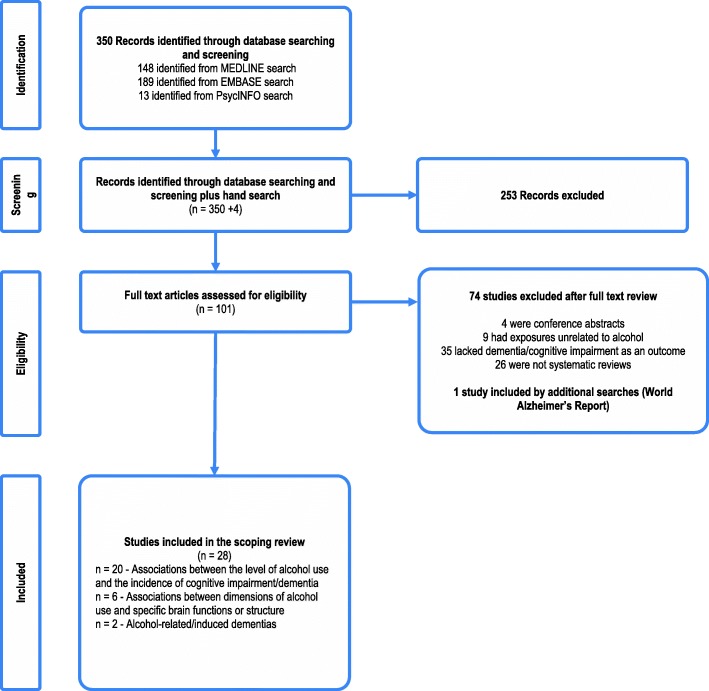
- Included systematic reviews/meta-analyses with an explicit search process assessing alcohol use and cognitive health, dementia, Alzheimer’s disease, vascular/other dementias, brain function, memory, or brain structures; excluded narrative reviews. The original search yielded 350 results, and 28 systematic reviews met all inclusion criteria.
- Two researchers performed searches and screening; data extracted included underlying individual studies, alcohol exposure measurements, dementia diagnoses, risk relations, study types, age restrictions, and review conclusions.
Limitations
- Stated by the paper: causality could not be established; all meta-analyses showed high heterogeneity; alcohol use was self-reported and usually assessed only once at baseline; there was lack of standardization of alcohol use categories; inconsistent or no control for confounders; former drinkers were usually grouped with lifetime abstainers (“sick quitters”); many studies lacked quality assessment or standardized dementia diagnoses; survivor bias was an issue; and cohort studies often excluded heavier drinkers and mostly studied older populations, limiting generalizability to heavy users or people with alcohol use disorders.
- Stated by the paper: this scoping review was limited by large heterogeneity in outcome operationalization and small overlap of underlying studies between reviews; two systematic reviews refrained from meta-analysis because of lack of exposure or outcome comparability.
- Evident from the text: as a review of systematic reviews, it does not provide new primary data or a pooled quantitative synthesis across all included reviews, so conclusions depend on the quality and limitations of the underlying observational studies.
Model-written summary. Check it against the paper before relying on it.
Integrity signals
Registry
Cites
Statistics
Figures
Verification
Claims the paper makes
29 Valid · 3 Not valid · 36 Not checked · 29 Own results and interpretations
At least one cited source doesn’t support this claim or points to a different paper, and none confirmed it — see the verdicts below.
In the paper
“Some of the genetic markers used for alcohol consumption are problematic as their associations with average volume of drinking and with heavy drinking occasions in overall light drinkers point in opposite directions ([80]; see also the discussion following [84]).”
§ Alcohol use and dementia: a systematic scoping review > Discussion
What the sources say
- Not checked yetcites [80] 80. Frick U, Rehm J. Can we establish causality with statistical analyses? The example of epidemiology. In: Wiedermann W, von Eye A, editors. Statistics and causality: methods for applied empirical research. Hoboken: Wiley; 2016. pp. 407–432.
- Disputedcites [84] 84. Holmes MV, Dale CE, Zuccolo L, Silverwood RJ, Guo Y, Ye Z, et al. Association between alcohol and cardiovascular disease: Mendelian randomisation analysis based on individual participant data. BMJ. 2014;349:g4164. doi: 10.1136/bmj.g4164. sourceExperimental — accuracy not yet measured
Our copy of Holmes et al. (2014) reports the opposite of the attributed point. The Discussion 'Principal findings' states that the rs1229984 A-allele was a proxy for all types of self-reported drinking behaviour — volume, top-third of drinkers, binge drinking and abstention — and that these patterns were 'nevertheless directionally concordant (that is, the A-allele resulted in lower alcohol consumption)', confirming the variant was 'suitable as a non-specific genetic proxy'. Table 1 (Results, Genetic association analysis) shows the same concordance (intake volume −17.22%, top tertile OR 0.70, binge drinker OR 0.78, abstainer OR 1.27, GGT −1.84%), and the abstract repeats it. No passage in our copy describes markers whose associations with average volume and with heavy drinking occasions among overall light drinkers run in opposite directions; the only discordances noted concern cardiovascular biomarkers (null HDL cholesterol, slightly higher triglycerides), not drinking measures. (LLM, conf=0.78)
Checked by a reasoning model — may be wrong.
plainstates an association- Asserted: passes — The authors put it forward as true.
- Checkable: passes — It can be checked against evidence.
- Load-bearing: unclear — It is unclear whether the paper’s conclusions depend on it.
- Based: passes — The paper gives a reason why it holds.
At least one cited source doesn’t support this claim or points to a different paper, and none confirmed it — see the verdicts below.
In the paper
“The findings of the underlying studies were heterogeneous, and, when these studies were combined, no significant relationship between heavy alcohol use and executive functioning was observed”
§ Alcohol use and dementia: a systematic scoping review > Results > Associations between dimensions of alcohol use and specific brain functions
What the sources say
- Disputedcites [38] 38. Montgomery C, Fisk JE, Murphy PN, Ryland I, Hilton J. The effects of heavy social drinking on executive function: a systematic review and meta-analytic study of existing literature and new empirical findings. Human Psychopharmacol. 2012;27:187–199. doi: 10.1002/hup.1268. sourceExperimental — accuracy not yet measured
The pooled-effect half of the sentence is supported: the Overview (meta-analytic results) reports a small, non-significant mean weighted effect size across the four included studies (Hedges g = 0.082; 95% CI -0.222 to 0.386; z = 0.529, p = .597), and the Study 1 Discussion states 'The meta-analytic results do not support the hypothesis that executive functioning is impaired in heavy drinking non-clinical participant samples.' However, the accompanying assertion that 'the findings of the underlying studies were heterogeneous' is contradicted by our copy: the same Overview passage reports a non-significant Q statistic (Q[df=3] = 1.986, p = .575), an I² inconsistency of 0.000% and T² = 0.000, with a fixed-effect model chosen a priori on the basis of demographic similarity. The paper's talk of 'equivocal'/'not always consistent' results (Introduction; Abstract background) refers to the wider prior literature, not to the studies it pooled. (LLM, conf=0.68)
Checked by a reasoning model — may be wrong.
plain- Asserted: passes — The authors put it forward as true.
- Checkable: passes — It can be checked against evidence.
- Load-bearing: unclear — It is unclear whether the paper’s conclusions depend on it.
- Based: passes — The paper gives a reason why it holds.
- Disputed
The cited sources support only part of this claim — read each source’s verdict below.
In the paper
“Alcohol use has been identified as a risk factor for dementia and cognitive decline.”
§ Alcohol use and dementia: a systematic scoping review > Abstract > Background
What the sources say
- Not checked yetcites [10] 10. Oslin D, Atkinson RM, Smith DM, Hendrie H. Alcohol related dementia: proposed clinical criteria. Int J Geriatr Psychiatry. 1998;13:203–212. doi: 10.1002/(SICI)1099-1166(199804)13:4<203::AID-GPS734>3.0.CO;2-B. source
- Partly supportedcites [11] 11. Ridley NJ, Draper B, Withall A. Alcohol-related dementia: an update of the evidence. Alzheimers Res Ther. 2013;5:3. doi: 10.1186/alzrt157. sourceExperimental — accuracy not yet measured
The “How much is too much?” section links heavy alcohol use to increased dementia risk and prolonged high consumption to cognitive deficits. The claim omits the paper’s dose qualification: it also reports that low-to-moderate drinking may reduce dementia risk. (LLM, conf=0.88)
- Not checked yetcites [12] 12. Harper C. The neuropathology of alcohol-related brain damage. Alcohol Alcohol. 2009;44:136–140. doi: 10.1093/alcalc/agn102. source
plainstates an association- Asserted: passes — The authors put it forward as true.
- Checkable: passes — It can be checked against evidence.
- Load-bearing: passes — The paper’s conclusions depend on it.
- Based: passes — The paper gives a reason why it holds.
None of the sources cited for this claim have been checked yet.
In the paper
“Furthermore, a prior diagnosis of an AUD was found to be significantly associated with dementia across all age and subtype categories, and observed relative risk (RR) of dementia exceeded the RRs of all other modifiable risk factors [4, 14].”
§ Alcohol use and dementia: a systematic scoping review > Background
What the sources say
- Not checked yetcites [4] 4. Prince M, Bryce R, Albanese E, Wimo A, Ribeiro W, Ferri CP. The global prevalence of dementia: a systematic review and metaanalysis. Alzheimers Dementia. 2013;9:63–75. doi: 10.1016/j.jalz.2012.11.007. source
- Could not verifycites [14] 14. Arksey H, O’Malley L. Scoping Studies: towards a methodological framework. Int J Soc Res Methodol. 2005;8:19–32. doi: 10.1080/1364557032000119616. sourceExperimental — accuracy not yet measured
Our copy of Arksey & O'Malley (2005) is a methodological framework for scoping studies built around a review of services to support carers (Stages 3-5, study selection and charting of 204 included studies); no passage mentions alcohol use disorder, dementia incidence, relative risks, or modifiable risk factors (searched: 'relative risk of dementia alcohol use disorder modifiable risk factors', 'alcohol use disorder associated with dementia across age and subtype categories', 'modifiable risk factor relative risk cohort study incidence'). The only occurrences of 'dementia' are in the reference list (Charlesworth 2001, on psychosocial interventions for family carers of people with dementia). Notably, Stage 5 states the scoping study 'does not seek to synthesise evidence or to aggregate findings from different studies' and 'cannot determine... the weight of evidence', so our copy offers nothing on which to check a comparative RR claim; the finding must come from the citing paper's other citation [4 or 14], which our copy does not name. (LLM, conf=0.75)
plainstates an association- Asserted: passes — The authors put it forward as true.
- Checkable: passes — It can be checked against evidence.
- Load-bearing: passes — The paper’s conclusions depend on it.
- Based: passes — The paper gives a reason why it holds.
Every source the paper cites for this claim was checked and supports it.
In the paper
“Many studies lacked a quality assessment for various outcomes, with many different operationalizations for cognitive functioning [32], and lacked standardization for the diagnoses of different types of dementia [27, 37].”
§ Alcohol use and dementia: a systematic scoping review > Results > Associations between alcohol use and the incidence of cognitive impairment/dementia, including dose-response studies
What the sources say
- Supportedcites [32] 32. Beydoun MA, Beydoun HA, Gamaldo AA, Teel A, Zonderman AB, Wang Y. Epidemiologic studies of modifiable factors associated with cognition and dementia: systematic review and meta-analysis. BMC Public Health. 2014;24:643. doi: 10.1186/1471-2458-14-643. source
The Discussion (limitations) of Beydoun et al. (2014) states that quantitative meta-analysis of all included studies 'was not possible due to the diversity of the cognitive outcome measurements between original studies included,' enumerating test batteries, single global scores such as MMSE, and factor-analytic domain composites — directly supporting the attributed clause that there were many different operationalizations of cognitive functioning. The Results (Description of study-level characteristics) reinforce this, reporting an almost even split between cognitive function/decline outcomes (51.0%) and AD/dementia/impairment outcomes (46.2%) across the 247 studies. The adjacent clauses in the citing sentence (lack of quality assessment, and non-standardized dementia diagnoses) are carried by other citations [27, 37] and were not judged here; note that the paper's own remark about quality was that it could not create a common quality measure for its review, not that primary studies omitted quality assessment. (LLM, conf=0.87)
plain- Asserted: passes — The authors put it forward as true.
- Checkable: passes — It can be checked against evidence.
- Load-bearing: passes — The paper’s conclusions depend on it.
- Based: passes — The paper gives a reason why it holds.
- Supported
68 more claims · 28 with their cited sources checked
Create a free account to see all 97 claims and to verify the 76 references still open.
- Probably not a substantial claim. 14
- It may state two separate claims as one. 12
Claims other papers make about this one
Each is checked against this paper’s own text: does it say what the citing paper says it does?
The source backs part of the claim, not all of it — or backs it for a different population, condition or comparison.
In the citing paper
“Alcohol consumption was relatively low among participants in MHAS, and alcohol consumption is a high-risk factor for cognitive impairment in older adults [24, 33, 34].”
From Digital exclusion and cognitive impairment in older people: findings from five longitudinal studies (2024) · cites this paper as [33]
Experimental — accuracy not yet measuredThe cited source says what the claim attributes to it.
In the citing paper
“In line with this a review of 28 systematic reviews concluded that heavy alcohol use was associated with increased risk of all-cause dementia and reduced grey matter volume in imaging studies. (206)”
From Dementia prevention, intervention, and care: 2024 report of the Lancet standing Commission (2024) · cites this paper as [206]
The cited source says what the claim attributes to it.
In the citing paper
“Heavy drinking is associated with brain changes, cognitive impairment, and dementia, a risk known for centuries.”
From Dementia prevention, intervention, and care: 2020 report of the Lancet Commission (2020) · cites this paper as [102]
Self-check
Percentages, sums and reported differences re-computed from the paper’s own numbers.
Each contradiction between two passages listed here was confirmed by an independent check.
Rated minor: it would not touch a result — a value no result rests on, a p-value that stays on the same side of the significance level, or a conflict that is clerical, resolved elsewhere in the paper, or outside its own findings.
In the paper
§ Alcohol use and dementia: a systematic scoping review > Results > Research topics
“| Neafsey and Collins [40] | 2013 |”
§ Alcohol use and dementia: a systematic scoping review > References
“40. Neafsey EJ, Collins MA. Moderate alcohol consumption and cognitive risk. Neuropsychiatr Dis Treat. 2011;7:465–484.”
Citations
Cites
Preferred Reporting Items for Systematic Reviews and Meta-Analyses: the PRISMA statement
Moher, D., Liberati, A., Tetzlaff, J., Altman, D. G., & for the PRISMA Group (2009) · BMJ · doi:10.1136/bmj.b2535 · Cited by 83,823
Preferred reporting items for systematic reviews and meta-analyses: the PRISMA Statement.
(2009) · PubMed Central · Cited by 44,859
Preferred reporting items for systematic reviews and meta-analyses: The PRISMA statement
Moher, D., Liberati, A., Tetzlaff, J., Altman, D. G., & the PRISMA Group* (2009) · Annals of Internal Medicine · doi:10.7326/0003-4819-151-4-200908180-00135 · Cited by 37,554
Scoping studies: towards a methodological framework
Arksey, H., & O'Malley, L. (2005) · International Journal of Social Research Methodology · doi:10.1080/1364557032000119616 · Cited by 36,742
Guidance for conducting systematic scoping reviews
Peters, M. D. J., Godfrey, C. M., Khalil, H., McInerney, P., Parker, D., & Soares, C. B. (2015) · International Journal of Evidence-Based Healthcare · doi:10.1097/xeb.0000000000000050 · Cited by 7,472
Dementia prevention, intervention, and care
Livingston, G., Sommerlad, A., Orgeta, V., Costafreda, S. G., Huntley, J., Ames, D., Ballard, C., Banerjee, S., Burns, A., Cohen-Mansfield, J., et al. (2017) · The Lancet · doi:10.1016/s0140-6736(17)31363-6 · Cited by 6,072
The global prevalence of dementia: a systematic review and metaanalysis.
Prince, M., Bryce, R., Albanese, E., Wimo, A., Ribeiro, W., & Ferri, C. P. (2013) · Alzheimer's & Dementia · doi:10.1016/j.jalz.2012.11.007 · Cited by 4,941
Kyu, H. H., Abate, D., Abate, K. H., Abay, S. M., Abbafati, C., Abbasi, N., Abbastabar, H., Abd-Allah, F., Abdela, J., Abdelalim, A., et al. (2018) · The Lancet · doi:10.1016/s0140-6736(18)32335-3 · Cited by 4,081
The Epidemiologic Transition: A Theory of the Epidemiology of Population Change
OMRAN, A. R. (2005) · The Milbank Quarterly · doi:10.1111/j.1468-0009.2005.00398.x · Cited by 3,823
Apolipoprotein E and Alzheimer disease: risk, mechanisms and therapy
Liu, C.-C., Kanekiyo, T., Xu, H., & Bu, G. (2013) · Nature Reviews Neurology · doi:10.1038/nrneurol.2012.263 · Cited by 3,459
Research works printed but not linked: 4
- 6. Alzeimer’s Disease International. World Alzheimer Report 2015: The Global Impact of Dementia. 2015.
- 49. European Medicines Agency. Guideline on the development of medicinal products for the treatment of alcohol dependence. London: European Medicines Agency; 2010.
- 56. Dufour MC. What is moderate drinking? Alcohol Res Health. 1999;23:5–14.
- 57. World Health Organization. International guide for monitoring alcohol consumption and related harm. Geneva: World Health Organization; 2000.
Cited by
Items 201–300 of 452
Understanding the Religion, Mental, and Social Health Relationship
Koenig, H. G., VanderWeele, T. J., & Peteet, J. R. (2023) · Oxford University Press eBooks · doi:10.1093/oso/9780190088859.003.0016 · Cited by 7
Reitz, N. L., Nunes, P. T., & Savage, L. M. (2024) · Frontiers in Behavioral Neuroscience · doi:10.3389/fnbeh.2024.1448691 · Cited by 5
May, A. C., Hendrickson, R. C., Pagulayan, K. F., & Schindler, A. G. (2024) · Drug and Alcohol Dependence · doi:10.1016/j.drugalcdep.2024.112419 · Cited by 6
Matthews, D. B., Kerr, E., Zank, A., Hartwig, J., Garscia, A., Stumo, S., & Sharma, P. (2025) · Advances in experimental medicine and biology · doi:10.1007/978-3-031-81908-7_11 · Cited by 5
Zhou, Y., Liao, J., & Wu, Y. (2025) · Alzheimer s & Dementia · doi:10.1002/alz.70542 · Cited by 5
Yusof, N. I. S. M., Ramasamy, K., & Fauzi, F. M. (2025) · Neurochemical Research · doi:10.1007/s11064-025-04524-6 · Cited by 6
Alcohol: the role in nutrition and health
Suter, P. M. (2020) · Elsevier eBooks · doi:10.1016/b978-0-12-818460-8.00025-3 · Cited by 5
Надеждин, А. В., Tetenova, E. J., Kolgashkin, A. J., Петухов, А. Е., Davydova, E. N., Kruzhalov, A. N., & Ea, K. (2023) · Medicina · doi:10.29234/2308-9113-2023-11-1-77-109 · Cited by 5
Ball, H. A., Coulthard, E. J., Fish, M., Bayer, A. J., Gallacher, J., & Ben‐Shlomo, Y. (2023) · BMJ Open · doi:10.1136/bmjopen-2023-073205 · Cited by 6
Alcohol consumption in elderly people. What is the real magnitude of the problem?
Fernández-Castro, I., Martín, M. M., & Veleiro, I. N. (2024) · Revista Clínica Española (English Edition) · doi:10.1016/j.rceng.2024.07.007 · Cited by 6
Hosokawa, M., Kabayama, M., Godai, K., Akagi, Y., Tachibana, Y., Gondo, Y., Yasumoto, S., Masui, Y., Hirata, T., Ishizaki, T., et al. (2024) · BMC Geriatrics · doi:10.1186/s12877-024-05354-x · Cited by 5
“Several risk factors for dementia were identified: aging [1], smoking [4], excessive alcohol consumption [5], obesity [6], diabetes [7], systolic hypertension [8], physical inactivity [9], and chronic inflammation.”
BackgroundPrevalence of alcohol use among U.S. older adults with pain: A scoping review
LaRowe, L. R., Granados, H. C., Philpotts, L. L., Vranceanu, A., & Ritchie, C. S. (2024) · Ageing Research Reviews · doi:10.1016/j.arr.2024.102541 · Cited by 8
Precision health in Alzheimer disease: Risk assessment‐based strategies
Azar, J., Salama, M., Chidambaram, S. B., Al‐Balushi, B., Essa, M. M., & Qoronfleh, M. W. (2021) · Precision Medical Sciences · doi:10.1002/prm2.12036 · Cited by 7
Alcohol use and cognitive performance: a comparison between Greece and the United States
Funk‐White, M., Moore, A. A., McEvoy, L. K., Bondi, M. W., Bergstrom, J., & Kaufmann, C. N. (2021) · Aging & Mental Health · doi:10.1080/13607863.2021.1998355 · Cited by 5
“found that while heavy alcohol use was linked with poorer cognitive outcomes, light to moderate alcohol use was associated with lower risk of cognitive impairment and dementia diagnosis (Rehm et al., 2019).”
BackgroundPadula, C. B., & Durazzo, T. C. (2022) · Alcohol and Alcoholism · doi:10.1093/alcalc/agac022 · Cited by 10
Multi‐time‐point data preparation robustly reveals MCI and dementia risk factors
Kaur, D., Bucholc, M., Finn, D. P., Todd, S., Wong‐Lin, K., & McClean, P. L. (2020) · Alzheimer s & Dementia Diagnosis Assessment & Disease Monitoring · doi:10.1002/dad2.12116 · Cited by 8
Sclerostin, vascular risk factors, and brain atrophy in excessive drinkers
Martín‐González, C., Godoy-Reyes, A. M., Abreu-González, P., Fernández-Rodríguez, C. M., Martín‐Ponce, E., Sánchez-Pérez, M. J., Alvisa-Negrín, J. C., Rodríguez-Gaspar, M., & González‐Reimers, E. (2023) · Frontiers in Human Neuroscience · doi:10.3389/fnhum.2023.1084756 · Cited by 5
“There is general agreement regarding the deleterious influence of heavy ethanol consumption on brain structure and function, but some controversy exists in relation to the effect of light-to moderate ethanol consumption on brain alterations (Ridley et al., 2013; Rehm et al., 2019; Peng et al., 2020).”
BackgroundDementia and Cognitive Decline: A HEALM Approach
Jaqua, E. E., Tran, M.-L. N., Alvarez, P., Gupta, M., & Yoong, J. (2024) · American Journal of Lifestyle Medicine · doi:10.1177/15598276241291508 · Cited by 5
“85 While light to moderate alcohol use may be associated with a decreased risk of cognitive impairment and dementia, Alcohol Use Disorder (AUD) speci fi cally increases the risk for AD.”
Sharma, A., Jyoti, A., Rasane, P., & Singh, J. (2025) · Inflammopharmacology · doi:10.1007/s10787-025-01788-w · Cited by 5
“…such as nitrogen dioxide (NO 2 ), nitrogen oxides (NOx) and carbon monoxide (Peters et al 2019), lifestyle factors such as alcohol consumption (Rehm et al 2019), stroke (Brainin et al 2020), tooth loss (Thomson and Barak 2020) and mental health conditions such as depression and anxiety…”
Associations of alcohol drinking with incident dementia: a prospective study from the UK Biobank
Chen, Y., Yin, X., Wang, X., Zheng, X., Yang, X., Zhou, J., Shi, M., & Zhang, Y. (2025) · European Journal of Epidemiology · doi:10.1007/s10654-025-01304-y · Cited by 5
Rosoff, D. B., Wagner, J., Perlstein, T., Reitz, J., Jung, J., Blaney, H. L., Gharib, A. M., Hsu, C., Heller, T., Koh, C., et al. (2026) · Journal of Hepatology · doi:10.1016/j.jhep.2026.01.025 · Cited by 7
Clinical analysis of alcoholic pellagra: A single‐center retrospective study
Chen, X., Yang, C., Du, C., & Jiang, G. (2022) · Journal of Cosmetic Dermatology · doi:10.1111/jocd.15036 · Cited by 4
The Life Course Approach to Cognitive Aging and Dementia
Chey, J., & Kwak, S. (2023) · Cambridge University Press eBooks · doi:10.1017/9781108974325.009 · Cited by 5
Does habitual moderate alcohol consumption enhance working memory performance?
Cansino, S., Torres-Trejo, F., Estrada-Manilla, C., & Ruiz‐Velasco, S. (2023) · Current Psychology · doi:10.1007/s12144-023-05459-3 · Cited by 4
“This outcome concurs with several studies that concluded that moderate alcohol intake benefits cognition (Rehm et al., 2019).”
Koenig, H. G., VanderWeele, T. J., & Peteet, J. R. (2023) · Oxford University Press eBooks · doi:10.1093/oso/9780190088859.003.0014 · Cited by 4
Vankwani, S., Mirza, M. R., Awan, F. R., Zafar, M., Nawrocki, A., Wasim, M., Khan, H. N., Ayesha, H., Larsen, M. R., & Choudhary, M. I. (2024) · Metabolic Brain Disease · doi:10.1007/s11011-024-01351-6 · Cited by 4
Investigating Modifiable Risk Factors Across Dementia Subtypes: Insights from the UK Biobank
Ma, X., Gao, H., Wu, Y., Zhu, X., Wu, S., & Lin, L. (2024) · Biomedicines · doi:10.3390/biomedicines12091967 · Cited by 4
“Furthermore, regarding lifestyle factors, light to moderate alcohol consumption in middle-aged and older adults has been associated with a reduced risk of cognitive impairment and dementia [50], potentially due to cardiovascular protective mechanisms, such as favorable effects on lipid levels [51].”
BackgroundGan, H., Wu, Y., Jiang, K., Ge, S., Yao, Y., Wang, R., & Ma, L. (2019) · ChemistrySelect · doi:10.1002/slct.201902787 · Cited by 4
Hospitalization and Socio-Health Care for Dementia in Spain
Llanes-Álvarez, C., de Llano, J. M. A., Álvarez-Navares, A. I., Roncero, C., Pastor-Hidalgo, M. T., Garmendia-Leiza, J. R., Alberola, I. A., & Franco, M. (2020) · Journal of Clinical Medicine · doi:10.3390/jcm9123875 · Cited by 5
“Finally, mild cognitive impairment gathers those who are between the expected cognitive decline of normal ageing and the more serious decline of dementia [10].”
BackgroundVicente-Castro, I., Redondo, N., Díaz, L. E., Gómez‐Martínez, S., Marcos, A., & Nova, E. (2023) · Nutrients · doi:10.3390/nu15030750 · Cited by 4
“Despite the well-established association between heavy drinking and all types of dementia, the evidence pertaining to moderate alcohol use and risk of dementia and impaired cognition is somehow contradictory, and the level of evidence and the methodological quality of the reviews published thus far has been judged to…”
BackgroundRecent Advancements in the Early Diagnosis and Treatment of Alzheimer's Disease
Wu, Y., Fu, L., Li, Q., Gao, X., Zhang, Y., Jin, C., Ding, F., Hong, S. C., Cai, H., & Li, Y. (2023) · Advanced Therapeutics · doi:10.1002/adtp.202300181 · Cited by 5
Palm, A., Talaslahti, T., Vataja, R., Ginters, M., Kautiainen, H., Elonheimo, H., Suvisaari, J., Lindberg, N., & Koponen, H. (2024) · European Archives of Psychiatry and Clinical Neuroscience · doi:10.1007/s00406-024-01804-0 · Cited by 5
“It is well established that chronic heavy alcohol use may lead to permanent brain damage, cognitive impairment, and dementia [17, 18].”
Combined Effect of Red Wine and Mocha Pot Coffee in Mild Vascular Cognitive Impairment
Pennisi, M., Cantone, M., Cappellani, F., Concerto, C., Ferri, R., Godos, J., Grosso, G., Lanza, G., Rodolico, A., Torrisi, G., et al. (2024) · Experimental Gerontology · doi:10.1016/j.exger.2024.112498 · Cited by 4
“Finally, a recent systematic review (Rehm et al., 2019) confirmed the protective effects of mild-to-moderate drinking for both AD and VaD.”
BackgroundKoenig, H. G., VanderWeele, T. J., & Peteet, J. R. (2023) · Oxford University Press eBooks · doi:10.1093/oso/9780190088859.003.0002 · Cited by 5
A decade of Alzheimer’s Research & Therapy: reflections on the past, present, and future
Galasko, D., & Scheltens, P. (2020) · Alzheimer s Research & Therapy · doi:10.1186/s13195-020-00629-y · Cited by 4
Huerta, J. M., Colorado-Yohar, S. M., Andreu-Reinón, M. E., Mokoroa, O., Tainta, M., Guevara, M., Gasque, A., Castilla, J., Petrova, D., Crous‐Bou, M., et al. (2025) · Frontiers in Nutrition · doi:10.3389/fnut.2025.1671047 · Cited by 4
Reviriego, R., Flores-López, M., Requena-Ocaña, N., Castilla-Ortega, E., Bordallo-Aragón, A., de Fonseca, F. R., Serrano, A., & García‐Marchena, N. (2025) · Acta Psychologica · doi:10.1016/j.actpsy.2025.105835 · Cited by 3
Park, W., Kim, Y., & Cho, S. (2024) · International Journal of Molecular Sciences · doi:10.3390/ijms25158526 · Cited by 4
“Controlling depression is another important requirement for the development of novel interventions for ARD [33].”
BackgroundSymptoms and Diagnosis of Dementia
Sharifi, F., Ghandali, R., Alimohammadi, M., & Ahmadipour, P. (2024) · Nutritional neurosciences · doi:10.1007/978-981-97-4117-5_3 · Cited by 6
Jack, H. E., Berger, D. B., Bobb, J. F., Oliver, M. M., Bradley, K. A., & Hallgren, K. A. (2025) · Addiction · doi:10.1111/add.16771 · Cited by 3
Adolescent Alcohol and the Spectrum of Cognitive Dysfunction in Aging
Deak, T., Burzynski, H. E., Nunes, P. T., Day, S. M., & Savage, L. M. (2025) · Advances in experimental medicine and biology · doi:10.1007/978-3-031-81908-7_12 · Cited by 3
Chen, S., Ke, W., Guan, X., Hong, S., Wu, S., Yu, Z., Lin, J., Wang, C., Fu, M., Xiao, Y., et al. (2025) · Journal of Affective Disorders · doi:10.1016/j.jad.2025.119573 · Cited by 4
Chuang, I., Chen, I.-C., Wu, Y., & Li, K. (2024) · Scientific Reports · doi:10.1038/s41598-024-61407-6 · Cited by 4
Forensic Aspects of Substance Use in Older Adults
Ghadigaonkar, D. S., Kandasamy, A., & Sivakumar, P. T. (2021) · Indian Journal of Psychological Medicine · doi:10.1177/02537176211047957 · Cited by 3
Kłosińska, U., & Leszko, M. (2022) · Journal of Drug Issues · doi:10.1177/00220426221145019 · Cited by 3
“Dementia is a syndrome characterized by a decline in cognition to such an extent that it impairs independent living and functioning range (Rehm et al., 2019).”
BackgroundPerfilev, M. A., Vassiliev, P. M., Ozerov, A. A., Maltsev, D. V., Pluzhnikova, A. R., & Merezhkina, D. V. (2023) · Russian Chemical Bulletin · doi:10.1007/s11172-023-3873-1 · Cited by 3
Phillips, A. Z., Carnethon, M. R., Bonham, M., Lovett, R., & Wolf, M. S. (2023) · Journal of the American Geriatrics Society · doi:10.1111/jgs.18497 · Cited by 3
“22 26 As such, it is critical that we better understand how older adults have consumed alcohol throughout the pandemic and any predictors of hazardous drinking (drinking in a way that puts one at risk of physical or psychological harm 27 ) among this population.”
BackgroundFitzpatrick, L., & Mortimore, G. (2023) · British Journal of Nursing · doi:10.12968/bjon.2023.32.20.972 · Cited by 4
Aging and age-related diseasesPreprint
Zhang, X., Ouyang, J. L., Tang, M., Fu, M., Peng, J., & Liu, Q. (2023) · doi:10.31219/osf.io/wzeps · Cited by 3
Pharmacological activators of ALDH2: A new strategy for the treatment of alcohol use disorders
Adasme, S., Fuentes, J., Gutiérrez-Vega, I., Isla, E. M., Pérez, V., Ponce, C. A., Quilaqueo, M. E., Herrera‐Marschitz, M., Quintanilla, M. E., Vásquez, D., et al. (2024) · International review of neurobiology · doi:10.1016/bs.irn.2024.07.003 · Cited by 4
Alcohol consumption effects on episodic memory across the adult lifespan
Cansino, S., Torres-Trejo, F., Estrada-Manilla, C., & Ruiz‐Velasco, S. (2025) · Trends in Psychology · doi:10.1007/s43076-025-00453-z · Cited by 2
Engel, S., Dillerud, M., Scalf, M., Dobbelmann, R., Du, Y., Lee, A. M., & Graves, S. M. (2025) · Alcohol · doi:10.1016/j.alcohol.2025.05.004 · Cited by 2
Alcohol Use Disorder and Dementia: A Scoping Review
Petrović, Z. K., Peraica, T., & Kozarić‐Kovačić, D. (2025) · Current Addiction Reports · doi:10.1007/s40429-025-00668-1 · Cited by 2
Kučera, M., Šeblová, D., Bosmans, J. E., Broulíková, H. M., & Kearns, P. B. (2025) · European Journal of Public Health · doi:10.1093/eurpub/ckaf112 · Cited by 2
“The lack of a statistically significant association between alcohol use and risk of dementia in our study is surprising and not in line with previous literature [28].”
Zhang, B., Bao, D., Ma, Y., Zhang, M., & Cao, Y. (2025) · Medicine · doi:10.1097/md.0000000000044853 · Cited by 3
“[12,13] 16] For middle-aged adults, light to moderate alcohol consumption has been associated with better cognitive performance, [17] whereas excessive drinking increases the risk of cognitive impairment.”
The Role of Cold-Inducible RNA-Binding Protein (CIRP) in Neurological Disorders
Lai, X., & Zhong, P. (2026) · Brain Sciences · doi:10.3390/brainsci16020205 · Cited by 2
“Alcohol consumption is an independent risk factor for neurological disorders, inducing multisystemic toxic effects and being associated with various brain pathologies, including hippocampal neuronal damage [96,97].”
Durazzo, T. C., Joseff, B. D. P., McNerney, M. W., Humphreys, K. N., & Meyerhoff, D. J. (2026) · Alcohol · doi:10.1016/j.alcohol.2026.03.006 · Cited by 2
The policy exposome of dementia: Gaps, opportunities, and research agenda
Kieny, C., Marks, G., Bourgeois, M., Alladi, S., Atshan, S., Brayne, C., Dow, W., Glymour, M. M., Knapp, D., Livingston, G., et al. (2026) · Alzheimer s & Dementia · doi:10.1002/alz.71362 · Cited by 2
“23 Alcohol control policies, including taxation, advertising bans, and availability restrictions, can reduce alcohol consumption and related harm.”
Broman, M. J., Grekin, E. R., Resko, S. M., & Agius, E. (2024) · Journal of American College Health · doi:10.1080/07448481.2024.2334071 · Cited by 4
“57 HID is associated with alcohol use disorder across age groups 6 and with other consequences, such as missing work and relational problems.”
Consumo de alcohol en las personas mayores. ¿Cuál es la magnitud real del problema?
Castro, I., Martín, M. M., & Veleiro, I. N. (2024) · Revista Clínica Española · doi:10.1016/j.rce.2024.06.005 · Cited by 3
Alcohol Abuse and Addiction in Older People
Religa, D., Tsevis, T., & Wahlund, L. (2024) · Practical issues in geriatrics · doi:10.1007/978-3-031-58488-6_3 · Cited by 4
Shen, G., Ye, F., Cheng, W., & Li, Q. (2024) · BioMedical Engineering OnLine · doi:10.1186/s12938-024-01305-0 · Cited by 2
Does concomitant diazepam and ethanol use modulate age-related cognitive decline in mice?
Carton, L., Landmann, C., Auger, F., Durieux, N., Laloux, C., Kyheng, M., Pétrault, M., Timmerman, K., Potey, C., Bergeron, S., et al. (2024) · Life Sciences · doi:10.1016/j.lfs.2024.123216 · Cited by 2
The Effect of Alcohol Consumption on Progressive Supranuclear Palsy: A Cross‐Sectional Study
Tian, M., Zhang, B., Liu, H., Han, Y., Mu, Y., Duan, R., Guo, D., Song, C., Ma, J., & Liu, Y. (2024) · CNS Neuroscience & Therapeutics · doi:10.1111/cns.70146 · Cited by 2
Shaping the future of geriatric chronic pain care: a research agenda for progress
LaRowe, L. R., Pham, T. V., Szapary, C. L., & Vranceanu, A. (2025) · Pain Management · doi:10.1080/17581869.2025.2493609 · Cited by 2
Brennan, P. L., Holahan, C. J., Moos, R. H., & Schutte, K. K. (2021) · BMC Public Health · doi:10.1186/s12889-021-12358-4 · Cited by 2
“Definitions of “light”, “moderate”, and “heavy” drinking have varied widely among studies of older adults’ alcohol consumption and cognitive function outcomes [6, 8, 14, 24].”
BackgroundAlcohol use and cognitive aging in middle-aged men: The Vietnam Era Twin Study of Aging
Garduno, A. C., Laughlin, G. A., Bergstrom, J., Tu, X. M., Cummins, K. M., Franz, C. E., Elman, J. A., Lyons, M. J., Reynolds, C. A., Neale, M. C., et al. (2022) · Journal of the International Neuropsychological Society · doi:10.1017/s1355617722000169 · Cited by 5
“A large body of literature shows that relative to non-drinkers, light, or moderate alcohol drinkers demonstrate better cognitive performance and show reduced risk of dementia (Beydoun et al., 2014; Neafsey & Collins, 2011; Rehm et al., 2019).”
BackgroundOrtega, M. D. P. S., Prieto, B. L. A., Charry, M. F. C., & Mejía-Arango, S. (2022) · Neurología Argentina · doi:10.1016/j.neuarg.2022.10.002 · Cited by 3
Arruda, F., Rosselli, M., Kurasz, A. M., Loewenstein, D., DeKosky, S. T., Lang, M. K., Conniff, J., Vélez-Uribe, I., Ahne, E., Shihadeh, L., et al. (2023) · Applied Neuropsychology Adult · doi:10.1080/23279095.2023.2222861 · Cited by 2
Psychological Well-Being and Positive Emotions
Koenig, H. G., VanderWeele, T. J., & Peteet, J. R. (2023) · Oxford University Press eBooks · doi:10.1093/oso/9780190088859.003.0012 · Cited by 2
Experimental laboratory models as tools for understanding modifiable dementia risk
Sinclair, D., Canty, A. J., Ziebell, J. M., Woodhouse, A., Collins, J. M., Perry, S. E., Roccati, E., Kuruvilla, M. V., Leung, J. Y. K., Atkinson, R. A. K., et al. (2024) · Alzheimer s & Dementia · doi:10.1002/alz.13834 · Cited by 2
Tokiya, M., Hashimoto, M., Fukuda, K., Kawamoto, K., Akao, C., Tsuji, M., Yakushiji, Y., Koike, H., & Matsumoto, A. (2024) · Environmental Health and Preventive Medicine · doi:10.1265/ehpm.24-00214 · Cited by 3
“Given the association between alcohol consumption, dementia [30], and the rs671 variant [10, 29], exposure magnitude was considered in statistical models.”
BackgroundModifiable chemical risk factors for amyloid-β and Tau protein in Alzheimer’s disease
Chinnathambi, S., Malik, S., Kumarappan, M., & Chandrashekar, M. (2024) · Advances in protein chemistry and structural biology · doi:10.1016/bs.apcsb.2024.10.005 · Cited by 18
Weng, X., Liang, H., Liu, K., Chen, J., Fei, Q., Liu, S., Guo, X., Wen, L., Wu, Y., Nie, Z., et al. (2022) · Environmental Science and Pollution Research · doi:10.1007/s11356-022-20840-8 · Cited by 2
“2004) but also be associated with dementia (Oslin and Cary 2003; Rehm et al. 2019).”
BackgroundHuang, Y., Li, Q., Chen, A., Li, Y., Chuang, Y.-N., Hu, X., Guo, S. J., He, X., Pang, Y., Zhou, J., et al. (2026) · JAMIA Open · doi:10.1093/jamiaopen/ooag060 · Cited by 2
Reaction Time and Visual Memory in Connection to Alcohol Use in Persons with Bipolar Disorder
Mazumder, A. H., Barnett, J. H., Isometsä, E. T., Lindberg, N., Torniainen‐Holm, M., Lähteenvuo, M., Lahdensuo, K., Kerkelä, M., Ahola‐Olli, A., Hietala, J. A., et al. (2021) · Brain Sciences · doi:10.3390/brainsci11091154 · Cited by 2
“Another systematic review of 28 reviews (2000–2017) revealed that light to moderate alcohol use in middle to late adulthood was associated with a decreased risk of cognitive impairment and dementia [31].”
BackgroundMitra, P. (2022) · Springer eBooks · doi:10.1007/978-3-030-84834-7_3 · Cited by 2
Kalagara, R., Asfaw, Z. K., Carr, M. T., Quinones, A., Downes, M., Vasan, V., Li, T., McCarthy, L., Hrabarchuk, E. I., Genadry, L., et al. (2023) · World Neurosurgery · doi:10.1016/j.wneu.2023.12.071 · Cited by 1
Dementia Appraisal: Overview of Good Clinical Practices, Barriers, and Gaps for Integrated Care
Margarida, A., Meira, B., Raquel, B., Francisco, P. M. B., Henrique, L., & Maria, V. A. (2023) · International Journal of Geriatrics and Gerontology · doi:10.29011/2577-0748.100073 · Cited by 1
Miller, L. R., Divers, R. M., Davis, K., Runk, A., Reed, C., & Calamia, M. (2024) · Journal of Applied Gerontology · doi:10.1177/07334648241302461 · Cited by 1
“Thus, as it is possible the full spectrum of health behaviors has not been assessed comprehensively across domains (e.g., alcohol use was not included [Rehm et al., 2019]) and within each domain (i.e., items broadly worded as “ I presently [engage in this health behavior] on a regular basis ” ).”
Kao, S.-K., Yueh, M., Yeh, H.-J., & Cheng, H. (2025) · British Journal of Ophthalmology · doi:10.1136/bjo-2025-327134 · Cited by 1
“30 Patients with depression and psychotic features may exhibit poorer cognitive performance, consequently increasing their likelihood of developing dementia in the future.”
He, C., Chu, J., Li, Y., Lü, P., & Cai, C. (2025) · Vascular Investigation and Therapy · doi:10.4103/vit.vit_1_25 · Cited by 1
Garrido, S. (2025) · Elsevier eBooks · doi:10.1016/b978-0-443-24059-1.00008-5 · Cited by 2
Doza, A., Lin, P. J., Rodriguez, G. M., Cigolle, C. T., & Mahmoudi, E. (2025) · Topics in Spinal Cord Injury Rehabilitation · doi:10.46292/sci24-00050 · Cited by 1
Jing, W., Zhang, Q., & Kang, J. (2025) · Educational Gerontology · doi:10.1080/03601277.2025.2575904 · Cited by 1
“In line with other studies (Rehm et al., 2019; Wang et al., 2021; Yang et al., 2022), limited alcohol consumption was associated with lower risk of cognitive impairment compared with excessive alcohol consumption.”
Diet Quality and Cognitive Health
Moyen, A., & Tessier, A. (2025) · Springer eBooks · doi:10.1007/978-3-031-32047-7_193-1 · Cited by 1
Somatic morbidity in bipolar disorders
Lageborn, C. T., Savinen, S., Sjölander, A., Chang, Z., Brikell, I., Kuja‐Halkola, R., D'Onofrio, B. M., Guðbjörnsdóttir, S., Garcia‐Argibay, M., Larsson, H., et al. (2026) · International Journal of Bipolar Disorders · doi:10.1186/s40345-026-00427-9 · Cited by 1
“Several mechanisms may contribute to the elevated risk of dementia in this population, including comorbid alcohol use disorder (Rehm et al. 2019), potential neurotoxic effects of recurrent manic episodes (Elefante et al. 2023), and lifestyle-related factors such as physical inactivity.”
Mazumder, A. H., Barnett, J. H., Isometsä, E. T., Lindberg, N., Torniainen‐Holm, M., Lähteenvuo, M., Lahdensuo, K., Kerkelä, M., Ahola‐Olli, A., Hietala, J. A., et al. (2021) · Brain Sciences · doi:10.3390/brainsci11111422 · Cited by 1
“Light to moderate alcohol use has been found to be associated with a decreased risk of cognitive impairment [9] in the normal population.”
BackgroundOlesen, M. A., & Quintanilla, R. A. (2022) · Elsevier eBooks · doi:10.1016/b978-0-323-88462-4.00003-1 · Cited by 5
Koenig, H. G., VanderWeele, T. J., & Peteet, J. R. (2023) · Oxford University Press eBooks · doi:10.1093/oso/9780190088859.003.0025 · Cited by 1
Substance Use and Substance Use Disorders
Koenig, H. G., VanderWeele, T. J., & Peteet, J. R. (2023) · Oxford University Press eBooks · doi:10.1093/oso/9780190088859.003.0010 · Cited by 2
Koenig, H. G., VanderWeele, T. J., & Peteet, J. R. (2023) · Oxford University Press eBooks · doi:10.1093/oso/9780190088859.003.0015 · Cited by 1
Kim, H. H., Kwon, M. J., Jo, S., Park, J. E., Kim, J. W., Kim, J. H., Kim, S. E., Kim, K. W., & Han, J. W. (2024) · Scientific Reports · doi:10.1038/s41598-024-60843-8 · Cited by 3
Kuszneruk, J., Chawrylak, K., Kłusek, M., Kubas, M., & Krzemińska, K. (2024) · Quality in Sport · doi:10.12775/qs.2024.18.53301 · Cited by 1
Bishop, N. J., Botoseneanu, A., Newsom, J. T., Allore, H. G., Nagel, C., Markwardt, S., Samper‐Ternent, R., & Quiñones, A. R. (2025) · Journal of global ageing. · doi:10.1332/29767202y2024d000000019 · Cited by 1
The Impact of Chronic Alcohol Consumption on Cognitive Function in Older People
Mitincu-Caramfil, S.-D., Pleșea-Condratovici, A., Balta, A. A. Ș., Bulza, V., Brădeanu, A. V., Moroianu, L.-A., Isailă, O.-M., & Drima, E. P. (2025) · Journal of Clinical Medicine · doi:10.3390/jcm14134595 · Cited by 1
“The cognitive deficiency associated with chronic alcohol consumption in elderly people represents an under investigated public health problem in Romania [1,2], especially considering the rural–urban differences and the impact of the reversible hepatic dysfunction on the cognitive performance [3].”
Kern, S., Skillbäck, T. B., Zetterberg, H., Dittrich, A., Ahlner, F., Zettergren, A., Wærn, M., Seidu, N. M., Andréasson, U., Blennow, K., et al. (2025) · Alzheimer s Research & Therapy · doi:10.1186/s13195-025-01819-2 · Cited by 1
“Heavy alcohol use was associated with changes in brain structures, cognitive impairments, and an increased risk for all types of dementia [9].”
Chemical Approaches for Array Based Detection of Amyloids
Simon, P. M., Xu, Y., & Kaur, A. (2025) · Advanced Sensor Research · doi:10.1002/adsr.202500108 · Cited by 1
Chakrabarti, A., Biswas, A., Dawn, M., Mukherjee, S., Das, S., Mukherjee, S., Roy, I., Saha, A., Ray, K., & Chakraborty, I. (2025) · The Indian Journal of Medical Research · doi:10.25259/ijmr_1661_2024 · Cited by 3
“Internationally systematic scoping review does show that heavy alcohol use is a risk for cognitive impairment at the population level 26 .”
Akefe, I. O., Maehashi, S., Ameh, M. P., Chinaka, C. C., Akanbi, A., Abunyewah, M., & Schweitzer, D. R. (2026) · Journal of dementia and Alzheimer's disease · doi:10.3390/jdad3010003 · Cited by 2
Metadata
- Authors
- Rehm, J., Hasan, O. S. M., Black, S. E., Shield, K. D., & Schwarzinger, M.
- Affiliations
- Centre for Addiction and Mental Health (CA)
- Sunnybrook Health Science Centre (CA)
- Corresponding author
- Rehm, Jürgen
- Venue
- Alzheimer's Research & Therapy
- Published
- 2019-01-05
- Volume
- 11
- Issue
- 1
- Pages
- 1-1
- ISSN
- 1758-9193 (ISSN-L)
- PMC
- PMC6320619
- OpenAlex
- W2914535606
- Semantic Scholar
- 90901905a20f3e4f4b90ace528bf95ace061f8ba
- Cited by
- 450
- References
- 88
- Citations by year
- 2026: 35 · 2025: 64 · 2024: 84 · 2023: 101 · 2022: 73 · 2021: 55 · 2020: 29 · 2019: 9
- FWCI
- 7.13
- Type
- journal article
- Language
- en
- Open access
- gold
- doi.org
- Licence
- cc-by
- creativecommons.org/licenses/by/4.0/ (tdm)
- Locations
- Alzheimer s Research & Therapy (publishedVersion, cc-by)
- Europe PMC (PubMed Central) (publishedVersion, cc-by)
- PubMed Central (publishedVersion, cc-by)
- PubMed (publishedVersion)
- TSpace (University of Toronto) (submittedVersion, cc-by)
- DOAJ (DOAJ: Directory of Open Access Journals) (submittedVersion, cc-by-sa)
- Topics
- Health Sciences › Medicine › Psychiatry and Mental health › Dementia and Cognitive Impairment Research
- Health Sciences › Medicine › Pathology and Forensic Medicine › Alcohol Consumption and Health Effects
- Health Sciences › Medicine › Clinical Neurology › Alcoholism and Thiamine Deficiency
- Keywords
- alcohol consumption, dementia, cognitive impairment, heavy drinking, light to moderate drinking, dementia risk factors, brain structural changes, dementia prevention, cognitive decline
- MeSH terms
- Alcohol Drinking, Brain, Dementia, Humans, Meta-Analysis as Topic, Cognitive Dysfunction
About these checks
Registry, retraction, Cites and statistics results are computed, not judged, with one exception: a printed reference that no index lists is read once by a model before it counts as a citation error. Claims are extracted by a model and kept only when their quote appears verbatim in the text; each cited source is then checked, with a model’s help, for whether it says what the claim relies on. Those verdicts can be wrong — read the claim’s quote and the cited source before relying on one.
The claim verdicts this report counts are experimental: their accuracy is not yet measured.
A language model drew the claims from the paper on 2026-10-04, under version 3 of the claim definition (model deepseek-v4.1-flash, prompt extract-v3).
A second model labelled each claim on 2026-10-04 (model jev-1.13-20260917, definition revision gold-guideline-v0.2).
Cited sources are checked with a language model’s help (qwen3.8-omni-flash and gpt-6-sol).
Statistics and arithmetic are recomputed, not judged.
Confidence bands are shown only for fields calibrated on our annotated test set. None is calibrated yet, so no band is shown.
What counts as a claim ›How we measure confidence ›How we check this ›
Are you an author, or do you see a problem with this page? Request a review
Data sources
Bibliographic data: Semantic Scholar, OpenAlex, Crossref.
Contains information from the Semantic Scholar Academic Graph Datasets, made available under the ODC Attribution License (ODC-BY 1.0).
Semantic Scholar’s data is described in: Kinney, R., et al. (2023). The Semantic Scholar Open Data Platform. arXiv:2301.10140.
