

Alcohol use and dementia: a systematic scoping review
Open accessThe DOI matches its Crossref record; 89 of the 89 references it cites were found in a registry or an index; 41 of the 117 sources its claims cite were checked for support.
Abstract
BACKGROUND: Alcohol use has been identified as a risk factor for dementia and cognitive decline. However, some patterns of drinking have been associated with beneficial effects. METHODS AND RESULTS: To clarify the relationship between alcohol use and dementia, we conducted a scoping review based on a systematic search of systematic reviews published from January 2000 to October 2017 by using Medline, Embase, and PsycINFO. Overall, 28 systematic reviews were identified: 20 on the associations between the level of alcohol use and the incidence of cognitive impairment/dementia, six on the associations between dimensions of alcohol use and specific brain functions, and two on induced dementias. Although causality could not be established, light to moderate alcohol use in middle to late adulthood was associated with a decreased risk of cognitive impairment and dementia. Heavy alcohol use was associated with changes in brain structures, cognitive impairments, and an increased risk of all types of dementia. CONCLUSION: Reducing heavy alcohol use may be an effective dementia prevention strategy.
Overview
CoChat Summary
TL;DR
This systematic scoping review of 28 systematic reviews found that light to moderate alcohol use in middle to late adulthood was associated with a decreased risk of cognitive impairment and dementia, while heavy alcohol use was associated with brain changes, cognitive impairment, and increased risk of all dementia types. Causality could not be established, and reducing heavy alcohol use may be an effective dementia prevention strategy.
Key findings
- The review identified 28 systematic reviews: 20 on associations between level of alcohol use and incidence of cognitive impairment/dementia, 6 on dimensions of alcohol use and specific brain functions, and 2 on induced dementias.
- Light to moderate alcohol use in middle to late adulthood was associated with a decreased risk of cognitive impairment and dementia; heavy alcohol use was associated with changes in brain structures, cognitive impairments, and an increased risk of all types of dementia. Causality could not be established.
- Quantified examples included: Xu et al. (2017) found lower dementia risk confined to at most 12.5 g/day, with risk bottom (RR 0.9) at roughly 6 g/day and elevated risk (about 10%) when the dose surpassed 23 drinks/week or 38 g/day; Ilomäki et al. (2015) reported light-to-moderate drinking RR 0.72 (95% CI 0.61–0.86) for Alzheimer’s disease and RR 0.74 (95% CI 0.61–0.91) for dementia; Anstey et al. (2009) pooled RRs for light-to-moderate vs no use were 0.72 for AD, 0.75 for vascular dementia, and 0.74 for all-cause dementia.
- Heavy alcohol use and alcohol use disorders were associated with increased risk for all types of dementia; alcohol-related and alcohol-induced dementias involve direct neurotoxicity, thiamine deficiency/Wernicke–Korsakoff syndrome, hepatic encephalopathy, epilepsy, head injury, and vascular risk factors.
Methods
- Systematic scoping review following PRISMA, registered under PROSPERO CRD42017080668; searched OVID Medline, Embase, and PsycINFO for systematic reviews published January 2000 to October 2017, with updates in March 2018 and June 2018; also used World Alzheimer Reports and a Google grey literature search.
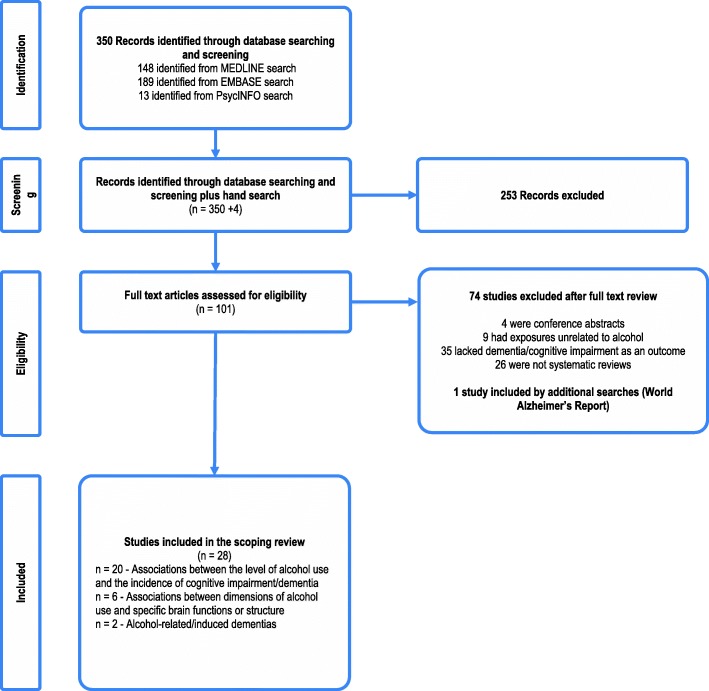
- Included systematic reviews/meta-analyses with an explicit search process assessing alcohol use and cognitive health, dementia, Alzheimer’s disease, vascular/other dementias, brain function, memory, or brain structures; excluded narrative reviews. The original search yielded 350 results, and 28 systematic reviews met all inclusion criteria.
- Two researchers performed searches and screening; data extracted included underlying individual studies, alcohol exposure measurements, dementia diagnoses, risk relations, study types, age restrictions, and review conclusions.
Limitations
- Stated by the paper: causality could not be established; all meta-analyses showed high heterogeneity; alcohol use was self-reported and usually assessed only once at baseline; there was lack of standardization of alcohol use categories; inconsistent or no control for confounders; former drinkers were usually grouped with lifetime abstainers (“sick quitters”); many studies lacked quality assessment or standardized dementia diagnoses; survivor bias was an issue; and cohort studies often excluded heavier drinkers and mostly studied older populations, limiting generalizability to heavy users or people with alcohol use disorders.
- Stated by the paper: this scoping review was limited by large heterogeneity in outcome operationalization and small overlap of underlying studies between reviews; two systematic reviews refrained from meta-analysis because of lack of exposure or outcome comparability.
- Evident from the text: as a review of systematic reviews, it does not provide new primary data or a pooled quantitative synthesis across all included reviews, so conclusions depend on the quality and limitations of the underlying observational studies.
Model-written summary. Check it against the paper before relying on it.
Integrity signals
Registry
Cites
Statistics
Figures
Verification
Claims the paper makes
29 Valid · 3 Not valid · 36 Not checked · 29 Own results and interpretations
At least one cited source doesn’t support this claim or points to a different paper, and none confirmed it — see the verdicts below.
In the paper
“Some of the genetic markers used for alcohol consumption are problematic as their associations with average volume of drinking and with heavy drinking occasions in overall light drinkers point in opposite directions ([80]; see also the discussion following [84]).”
§ Alcohol use and dementia: a systematic scoping review > Discussion
What the sources say
- Not checked yetcites [80] 80. Frick U, Rehm J. Can we establish causality with statistical analyses? The example of epidemiology. In: Wiedermann W, von Eye A, editors. Statistics and causality: methods for applied empirical research. Hoboken: Wiley; 2016. pp. 407–432.
- Disputedcites [84] 84. Holmes MV, Dale CE, Zuccolo L, Silverwood RJ, Guo Y, Ye Z, et al. Association between alcohol and cardiovascular disease: Mendelian randomisation analysis based on individual participant data. BMJ. 2014;349:g4164. doi: 10.1136/bmj.g4164. sourceExperimental — accuracy not yet measured
Our copy of Holmes et al. (2014) reports the opposite of the attributed point. The Discussion 'Principal findings' states that the rs1229984 A-allele was a proxy for all types of self-reported drinking behaviour — volume, top-third of drinkers, binge drinking and abstention — and that these patterns were 'nevertheless directionally concordant (that is, the A-allele resulted in lower alcohol consumption)', confirming the variant was 'suitable as a non-specific genetic proxy'. Table 1 (Results, Genetic association analysis) shows the same concordance (intake volume −17.22%, top tertile OR 0.70, binge drinker OR 0.78, abstainer OR 1.27, GGT −1.84%), and the abstract repeats it. No passage in our copy describes markers whose associations with average volume and with heavy drinking occasions among overall light drinkers run in opposite directions; the only discordances noted concern cardiovascular biomarkers (null HDL cholesterol, slightly higher triglycerides), not drinking measures. (LLM, conf=0.78)
Checked by a reasoning model — may be wrong.
plainstates an association- Asserted: passes — The authors put it forward as true.
- Checkable: passes — It can be checked against evidence.
- Load-bearing: unclear — It is unclear whether the paper’s conclusions depend on it.
- Based: passes — The paper gives a reason why it holds.
At least one cited source doesn’t support this claim or points to a different paper, and none confirmed it — see the verdicts below.
In the paper
“The findings of the underlying studies were heterogeneous, and, when these studies were combined, no significant relationship between heavy alcohol use and executive functioning was observed”
§ Alcohol use and dementia: a systematic scoping review > Results > Associations between dimensions of alcohol use and specific brain functions
What the sources say
- Disputedcites [38] 38. Montgomery C, Fisk JE, Murphy PN, Ryland I, Hilton J. The effects of heavy social drinking on executive function: a systematic review and meta-analytic study of existing literature and new empirical findings. Human Psychopharmacol. 2012;27:187–199. doi: 10.1002/hup.1268. sourceExperimental — accuracy not yet measured
The pooled-effect half of the sentence is supported: the Overview (meta-analytic results) reports a small, non-significant mean weighted effect size across the four included studies (Hedges g = 0.082; 95% CI -0.222 to 0.386; z = 0.529, p = .597), and the Study 1 Discussion states 'The meta-analytic results do not support the hypothesis that executive functioning is impaired in heavy drinking non-clinical participant samples.' However, the accompanying assertion that 'the findings of the underlying studies were heterogeneous' is contradicted by our copy: the same Overview passage reports a non-significant Q statistic (Q[df=3] = 1.986, p = .575), an I² inconsistency of 0.000% and T² = 0.000, with a fixed-effect model chosen a priori on the basis of demographic similarity. The paper's talk of 'equivocal'/'not always consistent' results (Introduction; Abstract background) refers to the wider prior literature, not to the studies it pooled. (LLM, conf=0.68)
Checked by a reasoning model — may be wrong.
plain- Asserted: passes — The authors put it forward as true.
- Checkable: passes — It can be checked against evidence.
- Load-bearing: unclear — It is unclear whether the paper’s conclusions depend on it.
- Based: passes — The paper gives a reason why it holds.
- Disputed
The cited sources support only part of this claim — read each source’s verdict below.
In the paper
“Alcohol use has been identified as a risk factor for dementia and cognitive decline.”
§ Alcohol use and dementia: a systematic scoping review > Abstract > Background
What the sources say
- Not checked yetcites [10] 10. Oslin D, Atkinson RM, Smith DM, Hendrie H. Alcohol related dementia: proposed clinical criteria. Int J Geriatr Psychiatry. 1998;13:203–212. doi: 10.1002/(SICI)1099-1166(199804)13:4<203::AID-GPS734>3.0.CO;2-B. source
- Partly supportedcites [11] 11. Ridley NJ, Draper B, Withall A. Alcohol-related dementia: an update of the evidence. Alzheimers Res Ther. 2013;5:3. doi: 10.1186/alzrt157. sourceExperimental — accuracy not yet measured
The “How much is too much?” section links heavy alcohol use to increased dementia risk and prolonged high consumption to cognitive deficits. The claim omits the paper’s dose qualification: it also reports that low-to-moderate drinking may reduce dementia risk. (LLM, conf=0.88)
- Not checked yetcites [12] 12. Harper C. The neuropathology of alcohol-related brain damage. Alcohol Alcohol. 2009;44:136–140. doi: 10.1093/alcalc/agn102. source
plainstates an association- Asserted: passes — The authors put it forward as true.
- Checkable: passes — It can be checked against evidence.
- Load-bearing: passes — The paper’s conclusions depend on it.
- Based: passes — The paper gives a reason why it holds.
None of the sources cited for this claim have been checked yet.
In the paper
“Furthermore, a prior diagnosis of an AUD was found to be significantly associated with dementia across all age and subtype categories, and observed relative risk (RR) of dementia exceeded the RRs of all other modifiable risk factors [4, 14].”
§ Alcohol use and dementia: a systematic scoping review > Background
What the sources say
- Not checked yetcites [4] 4. Prince M, Bryce R, Albanese E, Wimo A, Ribeiro W, Ferri CP. The global prevalence of dementia: a systematic review and metaanalysis. Alzheimers Dementia. 2013;9:63–75. doi: 10.1016/j.jalz.2012.11.007. source
- Could not verifycites [14] 14. Arksey H, O’Malley L. Scoping Studies: towards a methodological framework. Int J Soc Res Methodol. 2005;8:19–32. doi: 10.1080/1364557032000119616. sourceExperimental — accuracy not yet measured
Our copy of Arksey & O'Malley (2005) is a methodological framework for scoping studies built around a review of services to support carers (Stages 3-5, study selection and charting of 204 included studies); no passage mentions alcohol use disorder, dementia incidence, relative risks, or modifiable risk factors (searched: 'relative risk of dementia alcohol use disorder modifiable risk factors', 'alcohol use disorder associated with dementia across age and subtype categories', 'modifiable risk factor relative risk cohort study incidence'). The only occurrences of 'dementia' are in the reference list (Charlesworth 2001, on psychosocial interventions for family carers of people with dementia). Notably, Stage 5 states the scoping study 'does not seek to synthesise evidence or to aggregate findings from different studies' and 'cannot determine... the weight of evidence', so our copy offers nothing on which to check a comparative RR claim; the finding must come from the citing paper's other citation [4 or 14], which our copy does not name. (LLM, conf=0.75)
plainstates an association- Asserted: passes — The authors put it forward as true.
- Checkable: passes — It can be checked against evidence.
- Load-bearing: passes — The paper’s conclusions depend on it.
- Based: passes — The paper gives a reason why it holds.
Every source the paper cites for this claim was checked and supports it.
In the paper
“Many studies lacked a quality assessment for various outcomes, with many different operationalizations for cognitive functioning [32], and lacked standardization for the diagnoses of different types of dementia [27, 37].”
§ Alcohol use and dementia: a systematic scoping review > Results > Associations between alcohol use and the incidence of cognitive impairment/dementia, including dose-response studies
What the sources say
- Supportedcites [32] 32. Beydoun MA, Beydoun HA, Gamaldo AA, Teel A, Zonderman AB, Wang Y. Epidemiologic studies of modifiable factors associated with cognition and dementia: systematic review and meta-analysis. BMC Public Health. 2014;24:643. doi: 10.1186/1471-2458-14-643. source
The Discussion (limitations) of Beydoun et al. (2014) states that quantitative meta-analysis of all included studies 'was not possible due to the diversity of the cognitive outcome measurements between original studies included,' enumerating test batteries, single global scores such as MMSE, and factor-analytic domain composites — directly supporting the attributed clause that there were many different operationalizations of cognitive functioning. The Results (Description of study-level characteristics) reinforce this, reporting an almost even split between cognitive function/decline outcomes (51.0%) and AD/dementia/impairment outcomes (46.2%) across the 247 studies. The adjacent clauses in the citing sentence (lack of quality assessment, and non-standardized dementia diagnoses) are carried by other citations [27, 37] and were not judged here; note that the paper's own remark about quality was that it could not create a common quality measure for its review, not that primary studies omitted quality assessment. (LLM, conf=0.87)
plain- Asserted: passes — The authors put it forward as true.
- Checkable: passes — It can be checked against evidence.
- Load-bearing: passes — The paper’s conclusions depend on it.
- Based: passes — The paper gives a reason why it holds.
- Supported
68 more claims · 28 with their cited sources checked
Create a free account to see all 97 claims and to verify the 76 references still open.
- Probably not a substantial claim. 14
- It may state two separate claims as one. 12
Claims other papers make about this one
Each is checked against this paper’s own text: does it say what the citing paper says it does?
The source backs part of the claim, not all of it — or backs it for a different population, condition or comparison.
In the citing paper
“Alcohol consumption was relatively low among participants in MHAS, and alcohol consumption is a high-risk factor for cognitive impairment in older adults [24, 33, 34].”
From Digital exclusion and cognitive impairment in older people: findings from five longitudinal studies (2024) · cites this paper as [33]
Experimental — accuracy not yet measuredThe cited source says what the claim attributes to it.
In the citing paper
“In line with this a review of 28 systematic reviews concluded that heavy alcohol use was associated with increased risk of all-cause dementia and reduced grey matter volume in imaging studies. (206)”
From Dementia prevention, intervention, and care: 2024 report of the Lancet standing Commission (2024) · cites this paper as [206]
The cited source says what the claim attributes to it.
In the citing paper
“Heavy drinking is associated with brain changes, cognitive impairment, and dementia, a risk known for centuries.”
From Dementia prevention, intervention, and care: 2020 report of the Lancet Commission (2020) · cites this paper as [102]
Self-check
Percentages, sums and reported differences re-computed from the paper’s own numbers.
Each contradiction between two passages listed here was confirmed by an independent check.
Rated minor: it would not touch a result — a value no result rests on, a p-value that stays on the same side of the significance level, or a conflict that is clerical, resolved elsewhere in the paper, or outside its own findings.
In the paper
§ Alcohol use and dementia: a systematic scoping review > Results > Research topics
“| Neafsey and Collins [40] | 2013 |”
§ Alcohol use and dementia: a systematic scoping review > References
“40. Neafsey EJ, Collins MA. Moderate alcohol consumption and cognitive risk. Neuropsychiatr Dis Treat. 2011;7:465–484.”
Citations
Cites
Preferred Reporting Items for Systematic Reviews and Meta-Analyses: the PRISMA statement
Moher, D., Liberati, A., Tetzlaff, J., Altman, D. G., & for the PRISMA Group (2009) · BMJ · doi:10.1136/bmj.b2535 · Cited by 83,823
Preferred reporting items for systematic reviews and meta-analyses: the PRISMA Statement.
(2009) · PubMed Central · Cited by 44,859
Preferred reporting items for systematic reviews and meta-analyses: The PRISMA statement
Moher, D., Liberati, A., Tetzlaff, J., Altman, D. G., & the PRISMA Group* (2009) · Annals of Internal Medicine · doi:10.7326/0003-4819-151-4-200908180-00135 · Cited by 37,554
Scoping studies: towards a methodological framework
Arksey, H., & O'Malley, L. (2005) · International Journal of Social Research Methodology · doi:10.1080/1364557032000119616 · Cited by 36,742
Guidance for conducting systematic scoping reviews
Peters, M. D. J., Godfrey, C. M., Khalil, H., McInerney, P., Parker, D., & Soares, C. B. (2015) · International Journal of Evidence-Based Healthcare · doi:10.1097/xeb.0000000000000050 · Cited by 7,472
Dementia prevention, intervention, and care
Livingston, G., Sommerlad, A., Orgeta, V., Costafreda, S. G., Huntley, J., Ames, D., Ballard, C., Banerjee, S., Burns, A., Cohen-Mansfield, J., et al. (2017) · The Lancet · doi:10.1016/s0140-6736(17)31363-6 · Cited by 6,072
The global prevalence of dementia: a systematic review and metaanalysis.
Prince, M., Bryce, R., Albanese, E., Wimo, A., Ribeiro, W., & Ferri, C. P. (2013) · Alzheimer's & Dementia · doi:10.1016/j.jalz.2012.11.007 · Cited by 4,941
Kyu, H. H., Abate, D., Abate, K. H., Abay, S. M., Abbafati, C., Abbasi, N., Abbastabar, H., Abd-Allah, F., Abdela, J., Abdelalim, A., et al. (2018) · The Lancet · doi:10.1016/s0140-6736(18)32335-3 · Cited by 4,081
The Epidemiologic Transition: A Theory of the Epidemiology of Population Change
OMRAN, A. R. (2005) · The Milbank Quarterly · doi:10.1111/j.1468-0009.2005.00398.x · Cited by 3,823
Apolipoprotein E and Alzheimer disease: risk, mechanisms and therapy
Liu, C.-C., Kanekiyo, T., Xu, H., & Bu, G. (2013) · Nature Reviews Neurology · doi:10.1038/nrneurol.2012.263 · Cited by 3,459
Research works printed but not linked: 4
- 6. Alzeimer’s Disease International. World Alzheimer Report 2015: The Global Impact of Dementia. 2015.
- 49. European Medicines Agency. Guideline on the development of medicinal products for the treatment of alcohol dependence. London: European Medicines Agency; 2010.
- 56. Dufour MC. What is moderate drinking? Alcohol Res Health. 1999;23:5–14.
- 57. World Health Organization. International guide for monitoring alcohol consumption and related harm. Geneva: World Health Organization; 2000.
Cited by
Items 301–400 of 452
Munteanu, C., Popescu, C., Vlădulescu-Trandafir, A.-I., Maraver, F., Carbajo, J. M., & Onose, G. (2026) · International Journal of Molecular Sciences · doi:10.3390/ijms27031595 · Cited by 1
“In many observational studies, light-to-moderate alcohol intake has been associated with a lower incidence of dementia [24] compared with abstinence [25].”
Davis, C. H., Chok, J. M., Jariwala, N., Paiko, L., Ma, L., Humber, M. B., Beaudreau, S. A., & Gould, C. E. (2026) · Journal of Behavioral Medicine · doi:10.1007/s10865-026-00677-z · Cited by 1
“…social contacts and shared activities, is also linked to increased risk (Kuiper et al., 2015), as are factors that can be influenced by diet and lifestyle, including obesity (Qu et al., 2020), high cholesterol (Wee et al., 2023), diabetes (Amidei et al., 2021), and alcohol use (Rehm et al., 2019).”
Kluckert, C., & Hüll, M. (2021) · PSYCH up2date · doi:10.1055/a-1220-4197 · Cited by 2
Daugherty, J., Treves-Kagan, S., Gottfredson, N. C., Miedema, S. S., & Haarbauer-Krupa, J. K. (2022) · Injury Prevention · doi:10.1136/ip-2022-044710 · Cited by 1
Brain Alterations and Cognitive Deficits Induced by Alcohol Use Disorder
Naassïla, M. (2023) · Springer eBooks · doi:10.1007/978-3-031-32483-3_31 · Cited by 1
Koenig, H. G., VanderWeele, T. J., & Peteet, J. R. (2023) · Oxford University Press eBooks · doi:10.1093/oso/9780190088859.003.0027 · Cited by 1
Koenig, H. G., VanderWeele, T. J., & Peteet, J. R. (2023) · Oxford University Press eBooks · doi:10.1093/oso/9780190088859.003.0008 · Cited by 2
Understanding the Religion–Physical Health Relationship
Koenig, H. G., VanderWeele, T. J., & Peteet, J. R. (2023) · Oxford University Press eBooks · doi:10.1093/oso/9780190088859.003.0031 · Cited by 1
Koenig, H. G., VanderWeele, T. J., & Peteet, J. R. (2023) · Oxford University Press eBooks · doi:10.1093/oso/9780190088859.003.0017 · Cited by 1
Supporting older adults who misuse alcohol
Davenport, C. J., & Craven, R. (2024) · Nursing Older People · doi:10.7748/nop.2024.e1469 · Cited by 1
Florea, M. (2019) · FARMACIA · doi:10.31925/farmacia.2019.4.11 · Cited by 1
“Recent evidence suggest that alcohol use may play an important role in the development of early-onset dementia [21].”
BackgroundFörstl, H., & Förstl, S. (2021) · Springer Reference Pflege, Therapie, Gesundheit · doi:10.1007/978-3-662-62426-5_58 · Cited by 1
Diagnosis Test Meta-Analysis for Apolipoprotein E in Alzheimer’s Disease
Xiong, X., Xiao, H., Zhang, Y., Yu, D., Chuan, J., Zhong, L., Yin, Q., & Tong, R. (2020) · Disease Markers · doi:10.1155/2020/6486031 · Cited by 2
Alnasir, F. A. (2022) · Recent Advances in Clinical Trials · doi:10.33425/2771-9057.1015 · Cited by 2
“It includes unhealthy behavior [9], lack of physical activity, and excessive alcohol consumption (studies found that heavy alcohol use increased the risk of all types of dementia) [10].”
BackgroundPublic Health and Human Flourishing
Koenig, H. G., VanderWeele, T. J., & Peteet, J. R. (2023) · Oxford University Press eBooks · doi:10.1093/oso/9780190088859.003.0032 · Cited by 1
Koenig, H. G., VanderWeele, T. J., & Peteet, J. R. (2023) · Oxford University Press eBooks · doi:10.1093/oso/9780190088859.003.0006 · Cited by 1
Asociaciones entre dieta y función cognitiva en el Proyecto SUN
Muñoz, M. I. (2022) · Depósito Académico Digital Universidad de Navarra (University of Navarra) · doi:10.15581/10171/63292 · Cited by 1
Alcoholic beverages and health effects
Haghparast, P., & Tchalikian, T. (2022) · Elsevier eBooks · doi:10.1016/b978-0-12-824315-2.00244-x · Cited by 3
Funcionamiento Cognitivo y Factores de Riesgo de Deterioro Cognitivo en Adultos Mayores Chilenos.
Carter, G. N. (2023) · doi:10.29393/tmudec-14fl1fc14 · Cited by 1
Koenig, H. G., VanderWeele, T. J., & Peteet, J. R. (2023) · Oxford University Press eBooks · doi:10.1093/oso/9780190088859.002.0003 · Cited by 1
Intelligence: The Quest for a Universal Assessment FrameworkPreprint
Herzog, D. J., & Herzog, N. J. (2024) · Qeios · doi:10.32388/tgpfzf · Cited by 1
Intelligence: The Quest for a Universal Assessment FrameworkPreprint
Herzog, D. J., & Herzog, N. J. (2025) · Qeios · doi:10.32388/tgpfzf.2 · Cited by 1
Ji, L., Ma, X., Zhang, Y., Li, X., Cai, Z., Shen, J., Wu, Y., Li, J., & Su, J. (2025) · Research Square · doi:10.21203/rs.3.rs-6872563/v1 · Cited by 1
Predicting Alzheimer’s Disease Progression from Sparse Multimodal Data by NeuralODE ModelsPreprint
Zanin, A., Pagani, S., Corti, M., Crepaldi, V., Fede, G. D., Antonietti, P. F., & the Alzheimer’s Disease Neuroimaging Initiative, A. D. N. I. (2025) · bioRxiv (Cold Spring Harbor Laboratory) · doi:10.1101/2025.08.26.672412 · Cited by 4
Täglich ein Gläschen gegen die Demenz?
Jung, P. (2019) · MMW - Fortschritte der Medizin · doi:10.1007/s15006-019-0899-4
Research Progress on Mild Cognitive Impairment and Its Relationship with Lifestyle
侯, 继. (2019) · Advances in Clinical Medicine · doi:10.12677/acm.2019.912215
Study on the Influencing Factors of Mild Cognitive Impairment in the Elderly
侯, 继. (2020) · Advances in Clinical Medicine · doi:10.12677/acm.2020.101012
Campane, L. Z. (2020) · Digital Library of Theses and Dissertations (Universidade de São Paulo) · doi:10.11606/t.5.2020.tde-09012020-151727
Yang, J., Qiu, Z., & Fang, Y. (2020) · Neuropsychiatric Disease and Treatment · doi:10.2147/ndt.s254998
Global Health Risk Factors: Alcohol Consumption
Rehm, J. T., Manthey, J., & Shield, K. D. (2020) · Springer eBooks · doi:10.1007/978-3-030-05325-3_37-1
Self-citationThe Association between Long Term Alcohol Consumption and Dementia
Marfoh, J. (2021) · International Journal of Medical and Health Sciences Research · doi:10.18488/journal.9.2021.81.13.23
Piersson, A. D., Mohamad, M., Suppiah, S., & Rajab, N. F. (2021) · Clinical and Translational Imaging · doi:10.1007/s40336-021-00440-1
Iacono, A. J. (2021) · UWSpace (University of Waterloo)
“But man is not made for defeat”: insights into Ernest Hemingway’s dementia
Coutinho, L., & Teive, H. A. G. (2022) · Arquivos de Neuro-Psiquiatria · doi:10.1590/0004-282x-anp-2021-0299
Shifting threat criterion for morphed facial expressions reduces negative affect
O'Brien, S. L. B., Christensen, B. K., & Goodhew, S. C. (2022) · Behaviour Research and Therapy · doi:10.1016/j.brat.2022.104067
'But man is not made for defeat': Insights into Ernest Hemingway's Dementia
Coutinho, L., & Ghizoni Teive, H. A. (2022) · UST Research Online (University of St. Thomas - Minnesota)
Alcoholschade voor de drinker zelf en (anderen in) de maatschappij
Voogt, C. V., Vromans, L., Kools, N., & van Hasselt, N. (2022) · TSG - Tijdschrift voor gezondheidswetenschappen · doi:10.1007/s12508-022-00337-y · Cited by 1
“Ook heeft alcoholgebruik invloed op dementie: overmatig alcoholgebruik en comadrinken verhogen het risico op dementie [4].”
BackgroundTampi, R. R., & Tampi, D. J. (2021) · Springer eBooks · doi:10.1007/978-3-030-58663-8_10 · Cited by 2
Förstl, H., & Förstl, S. (2020) · Springer Reference Pflege, Therapie, Gesundheit · doi:10.1007/978-3-662-55793-8_58-1 · Cited by 2
Charles Arthur Mercier – Psychiatry in History
Haldipur, C. V. (2022) · The British Journal of Psychiatry · doi:10.1192/bjp.2021.203
Visual memory and alcohol use in a middle-aged birth cohort
Mazumder, A. H., Barnett, J. H., Halt, A., Taivalantti, M., Kerkelä, M., Järvelin, M., & Veijola, J. (2024) · BMC Public Health · doi:10.1186/s12889-024-18153-1
Alcohol Intake Differentiates AD and LATE: A Telltale Lifestyle from Two Large-Scale DatasetsPreprint
Wu, X.-X., Peng, C., Nelson, P., & Cheng, Q. (2022) · medRxiv · doi:10.1101/2022.08.29.22279349
“Existing studies [11, 15, 16, 32–39] have shown that several lifestyle factors, including alcohol, daily living activities, and cognitive activities, are closely linked to AD.”
ResultTargeting pathological changes in the gut protects the CNS from neuropathology.
Charpentier, B. (2022) · ThinkIR: The University of Louisville's Institutional Repository (University of Louisville) · doi:10.18297/etd/3966
ATIVIDADES PROTETORAS CONTRA A NEURODEGENERAÇÃO EM IDOSOS
da Silva, B. L., de Oliveira, K. G. F., de Moura, L. R., Mascarenhas, R. D. O., & de Galiza, F. T. (2022) · Instituto Produzir eBooks · doi:10.4322/978-65-84941-04-5-004.pdf
EFFECT OF HEPTRAL ON THE COGNITIVE FUNCTIONS OF RATS AFTER CHRONIC 153 ALCOHOL INTOXICATION
Бородкина, Л. Е., Smolnyakova, Y. A., Музыко, Е. А., Tivon, Y. V., & Tyurenkov, I. N. (2022) · Journal of Volgograd State Medical University · doi:10.19163/1994-9480-2022-19-1-153-157
Demência em Idosos: abordagem interprofissional
(2022) · Instituto Produzir eBooks · doi:10.4322/978-65-84941-04-5
Overview of Risk Factors for Dementia
Hlaváčová, S. (2022) · Listy klinické logopedie · doi:10.36833/lkl.2022.024
Motoric Cognitive Risk Syndrome and Cognitive Frailty
Ciolek, C. H., & Ross, C. M. (2023) · Topics in Geriatric Rehabilitation · doi:10.1097/tgr.0000000000000392
“Heavy alcohol use is associated with adverse changes in brain structures, cognitive impairments, and increased risk of all types of dementia, such as WernickeKorsakoff syndrome.(87) Thus, reducing heavy alcohol use may be a component of an effective dementia prevention strategy and is supported by a WHO conditional re…”
BackgroundEstimation of Prosody in Music: A Case Study of Geet Ramayana
Salgaonkar, A., & Velankar, M. R. (2023) · Advances in intelligent systems and computing · doi:10.1007/978-981-99-0887-5_6
Mann, T. (2023) · Carleton University's Institutional Repository (MacOdrum Library, Carleton University) · doi:10.22215/etd/2023-15550
Society Interacting with Brain, Cognition, and Health in Late Life
Chey, J. (2023) · Cambridge University Press eBooks · doi:10.1017/9781108974325.008
Factores asociados al deterioro cognitivo y demencia
Morán, G. S. P., Flores, G. D. M., Munzón, A. M. L., Vivanco, M. J. V., & Salem, J. L. Q. (2023) · doi:10.58995/lb.redlic.20.179
Investigación contemporánea desde una visión multdisciplinar. Libro 3. Ciencias de la Salud
SAS), R. E. L. D. I. C. (. (2023) · doi:10.58995/lb.redlic.20
Shades of grey: choice, control and capacity in alcohol-related brain damage
Kane, N. B., Broderick, N., Rao, E., Keene, A. R., & Rao, R. T. (2023) · BJPsych Bulletin · doi:10.1192/bjb.2023.92
Koenig, H. G., VanderWeele, T. J., & Peteet, J. R. (2023) · Oxford University Press eBooks · doi:10.1093/oso/9780190088859.003.0034
Koenig, H. G., VanderWeele, T. J., & Peteet, J. R. (2023) · Oxford University Press eBooks · doi:10.1093/oso/9780190088859.003.0021
Koenig, H. G., VanderWeele, T. J., & Peteet, J. R. (2023) · Oxford University Press eBooks · doi:10.1093/oso/9780190088859.003.0007
Koenig, H. G., VanderWeele, T. J., & Peteet, J. R. (2023) · Oxford University Press eBooks · doi:10.1093/oso/9780190088859.003.0005 · Cited by 1
Koenig, H. G., VanderWeele, T. J., & Peteet, J. R. (2023) · Oxford University Press eBooks · doi:10.1093/oso/9780190088859.003.0029
Levin, J. (2023) · Oxford University Press eBooks · doi:10.1093/oso/9780190088859.002.0007
Koenig, H. G., VanderWeele, T. J., & Peteet, J. R. (2023) · Oxford University Press eBooks · doi:10.1093/oso/9780190088859.003.0033
Koenig, H. G., VanderWeele, T. J., & Peteet, J. R. (2023) · Oxford University Press eBooks · doi:10.1093/oso/9780190088859.002.0009
Alzheimer’s Disease and Other Dementias
Koenig, H. G., VanderWeele, T. J., & Peteet, J. R. (2023) · Oxford University Press eBooks · doi:10.1093/oso/9780190088859.003.0023
Koenig, H. G., VanderWeele, T. J., & Peteet, J. R. (2023) · Oxford University Press eBooks · doi:10.1093/oso/9780190088859.003.0024
Koenig, H. G., VanderWeele, T. J., & Peteet, J. R. (2023) · Oxford University Press eBooks · doi:10.1093/oso/9780190088859.003.0020
Koenig, H. G., VanderWeele, T. J., & Peteet, J. R. (2023) · Oxford University Press eBooks · doi:10.1093/oso/9780190088859.003.0026
Disease Prevention, Detection, and Treatment
Koenig, H. G., VanderWeele, T. J., & Peteet, J. R. (2023) · Oxford University Press eBooks · doi:10.1093/oso/9780190088859.003.0030 · Cited by 1
Koenig, H. G., VanderWeele, T. J., & Peteet, J. R. (2023) · Oxford University Press eBooks · doi:10.1093/oso/9780190088859.003.0019
Koenig, H. G., VanderWeele, T. J., & Peteet, J. R. (2023) · Oxford University Press eBooks · doi:10.1093/oso/9780190088859.002.0004
Personality Traits and Disorders
Koenig, H. G., VanderWeele, T. J., & Peteet, J. R. (2023) · Oxford University Press eBooks · doi:10.1093/oso/9780190088859.003.0011
Schizophrenia and Other Psychoses
Koenig, H. G., VanderWeele, T. J., & Peteet, J. R. (2023) · Oxford University Press eBooks · doi:10.1093/oso/9780190088859.003.0009
Koenig, H. G., VanderWeele, T. J., & Peteet, J. R. (2023) · Oxford University Press eBooks · doi:10.1093/oso/9780190088859.003.0004
Koenig, H. G., VanderWeele, T. J., & Peteet, J. R. (2023) · Oxford University Press eBooks · doi:10.1093/oso/9780190088859.003.0018
Koenig, H. G., VanderWeele, T. J., & Peteet, J. R. (2023) · Oxford University Press eBooks · doi:10.1093/oso/9780190088859.003.0003 · Cited by 1
Koenig, H. G., VanderWeele, T. J., & Peteet, J. R. (2023) · Oxford University Press eBooks · doi:10.1093/oso/9780190088859.003.0013
Koh, H. K. (2023) · Oxford University Press eBooks · doi:10.1093/oso/9780190088859.002.0006
Koenig, H. G., VanderWeele, T. J., & Peteet, J. R. (2023) · Oxford University Press eBooks · doi:10.1093/oso/9780190088859.003.0028
Koenig, H. G., VanderWeele, T. J., & Peteet, J. R. (2023) · Oxford University Press eBooks · doi:10.1093/oso/9780190088859.003.0022
Studies on Religion and Health
Koenig, H. G., VanderWeele, T. J., & Peteet, J. R. (2023) · Oxford University Press eBooks · doi:10.1093/oso/9780190088859.005.0001 · Cited by 1
CHRONIC ALCOHOL-INDUCED ENCEPHALOPATHY: PREDICTORS OF COGNITIVE IMPAIRMENT AND FUNCTIONAL DISABILITY
Duve, K. V. (2023) · Clinical and Preventive Medicine · doi:10.31612/2616-4868.7.2023.08
“…possible links not only between chronic alcohol abuse (defined as the consumption of more than 60 g of pure alcohol per day for men and more than 40 g of pure alcohol per day for women) but also between irregular alcohol consumption and an increased risk of cognitive impairment or dementia [14].”
BackgroundFaborode, J. A. (2023) · ResearchSpace (University of KwaZulu-Natal) · doi:10.29086/10413/22786
Mališauskaitė, G., Nizalova, O. Y., Gousia, K., Teo, H., & Forder, J. (2024) · Social Science & Medicine · doi:10.1016/j.socscimed.2024.116746 · Cited by 1
de Almeida, M. A., Barbosa, M. T., Resende, E. D. P. F., Carvalho, V. A., Santos, A. P. B., Machado, J. C. B., Lara, V. P., Gomes, K. B., Machado, T. H., & Caramelli, P. (2024) · Canadian Journal on Aging / La Revue canadienne du vieillissement · doi:10.1017/s0714980824000126
“…has indicated that light to moderate alcohol consumption can reduce dementia risk and excessive consumption or abstention might heighten it (Rehm, Hasan, Black, Shield, & Schwarzinger, 2019), the current results contrastingly align with a large study in individuals with a median age of 78…”
Sex-Related Vulnerability to Alcohol in Older Drinkers: A Narrative Review
Nixon, S. J., Sullivan, M., & Lewis, B. (2024) · Current Addiction Reports · doi:10.1007/s40429-024-00569-9
“In contrast to the uncertainty of daily drinking, heavy episodic use, i.e., binge drinking, is generally associated with increased risk for decline and dementia [see [40] for a recent scoping review].”
Wu, D.-M., Cheng, Y., Lin, S., & Yao, J. (2024) · SSRN Electronic Journal · doi:10.2139/ssrn.4845146
Odeigah, O. W., & Patton, R. (2024) · Drugs Education Prevention and Policy · doi:10.1080/09687637.2024.2376083
“Among middle-aged and older adults, excessive alcohol use has been associated with frailty (Strandberg et al., 2018), cardiovascular diseases (Thun et al., 1997), cancers (Cao et al., 2015; Kunzmann et al., 2018), cognitive decline and risk of dementia (Rehm et al., 2019).”
Genetic and Nongenetic Risk Factors for Dementia
Khosravi, S., Masoudi, M., & Tarki, A. (2024) · Nutritional neurosciences · doi:10.1007/978-981-97-4117-5_2
Asioli, F. (2024) · RIVISTA SPERIMENTALE DI FRENIATRIA · doi:10.3280/rsf2024-002002
Bonner‐Jackson, A. (2024) · Oxford University Press eBooks · doi:10.1093/med/9780197690024.003.0015
What might melatonin supplementation provide for humans beyond improved onset to sleep?
Shea, L. A. (2024) · Exploration of neuroscience · doi:10.37349/en.2024.00066
Healthy lifestyles, plasma proteomic profile and long-term risk of dementiaPreprint
Shen, J., Wu, M., Huang, Y., Yan, M., Yang, Y., Xu, X., Zong, G., Yang, J., Li, X., Chen, H., et al. (2024) · medRxiv · doi:10.1101/2024.12.01.24317800
Information Technologies for Early Detection of Alzheimer’s Disease in the Elderly: A Survey
Liu, Z. Q., Fei, Z., Zhou, W., & Fei, M. (2024) · Communications in computer and information science · doi:10.1007/978-981-96-0188-2_24
Grundlagen der Diagnostik und Therapie
(2024) · Elsevier eBooks · doi:10.1016/b978-3-437-22487-4.16001-0
Wietelmann, D. (2025) · PSYCH up2date · doi:10.1055/a-2395-8143
Shekari, M., Escalante, A. G., Milà‐Alomà, M., Falcón, C., López‐Martos, D., Sánchez‐Benavides, G., Brugulat‐Serrat, A., Niñerola‐Baizán, A., Ashton, N. J., Karikari, T. K., et al. (2025) · medRxiv · doi:10.1101/2025.07.09.25331011
Ortega, M. D. P. S., Prieto, B. L. A., Ríos-Cruz, S. G., & Mejía-Arango, S. (2025) · Acta Colombiana de Psicología · doi:10.14718/acp.2025.28.10
Metadata
- Authors
- Rehm, J., Hasan, O. S. M., Black, S. E., Shield, K. D., & Schwarzinger, M.
- Affiliations
- Centre for Addiction and Mental Health (CA)
- Sunnybrook Health Science Centre (CA)
- Corresponding author
- Rehm, Jürgen
- Venue
- Alzheimer's Research & Therapy
- Published
- 2019-01-05
- Volume
- 11
- Issue
- 1
- Pages
- 1-1
- ISSN
- 1758-9193 (ISSN-L)
- PMC
- PMC6320619
- OpenAlex
- W2914535606
- Semantic Scholar
- 90901905a20f3e4f4b90ace528bf95ace061f8ba
- Cited by
- 450
- References
- 88
- Citations by year
- 2026: 35 · 2025: 64 · 2024: 84 · 2023: 101 · 2022: 73 · 2021: 55 · 2020: 29 · 2019: 9
- FWCI
- 7.13
- Type
- journal article
- Language
- en
- Open access
- gold
- doi.org
- Licence
- cc-by
- creativecommons.org/licenses/by/4.0/ (tdm)
- Locations
- Alzheimer s Research & Therapy (publishedVersion, cc-by)
- Europe PMC (PubMed Central) (publishedVersion, cc-by)
- PubMed Central (publishedVersion, cc-by)
- PubMed (publishedVersion)
- TSpace (University of Toronto) (submittedVersion, cc-by)
- DOAJ (DOAJ: Directory of Open Access Journals) (submittedVersion, cc-by-sa)
- Topics
- Health Sciences › Medicine › Psychiatry and Mental health › Dementia and Cognitive Impairment Research
- Health Sciences › Medicine › Pathology and Forensic Medicine › Alcohol Consumption and Health Effects
- Health Sciences › Medicine › Clinical Neurology › Alcoholism and Thiamine Deficiency
- Keywords
- alcohol consumption, dementia, cognitive impairment, heavy drinking, light to moderate drinking, dementia risk factors, brain structural changes, dementia prevention, cognitive decline
- MeSH terms
- Alcohol Drinking, Brain, Dementia, Humans, Meta-Analysis as Topic, Cognitive Dysfunction
About these checks
Registry, retraction, Cites and statistics results are computed, not judged, with one exception: a printed reference that no index lists is read once by a model before it counts as a citation error. Claims are extracted by a model and kept only when their quote appears verbatim in the text; each cited source is then checked, with a model’s help, for whether it says what the claim relies on. Those verdicts can be wrong — read the claim’s quote and the cited source before relying on one.
The claim verdicts this report counts are experimental: their accuracy is not yet measured.
A language model drew the claims from the paper on 2026-10-04, under version 3 of the claim definition (model deepseek-v4.1-flash, prompt extract-v3).
A second model labelled each claim on 2026-10-04 (model jev-1.13-20260917, definition revision gold-guideline-v0.2).
Cited sources are checked with a language model’s help (qwen3.8-omni-flash and gpt-6-sol).
Statistics and arithmetic are recomputed, not judged.
Confidence bands are shown only for fields calibrated on our annotated test set. None is calibrated yet, so no band is shown.
What counts as a claim ›How we measure confidence ›How we check this ›
Are you an author, or do you see a problem with this page? Request a review
Data sources
Bibliographic data: Semantic Scholar, OpenAlex, Crossref.
Contains information from the Semantic Scholar Academic Graph Datasets, made available under the ODC Attribution License (ODC-BY 1.0).
Semantic Scholar’s data is described in: Kinney, R., et al. (2023). The Semantic Scholar Open Data Platform. arXiv:2301.10140.
