

Effects of low- and high-intensity physical exercise on physical and cognitive function in older persons with dementia: a randomized controlled trial
Open accessThe DOI matches its Crossref record; 109 of the 109 references it cites were found in a registry or an index.
Abstract
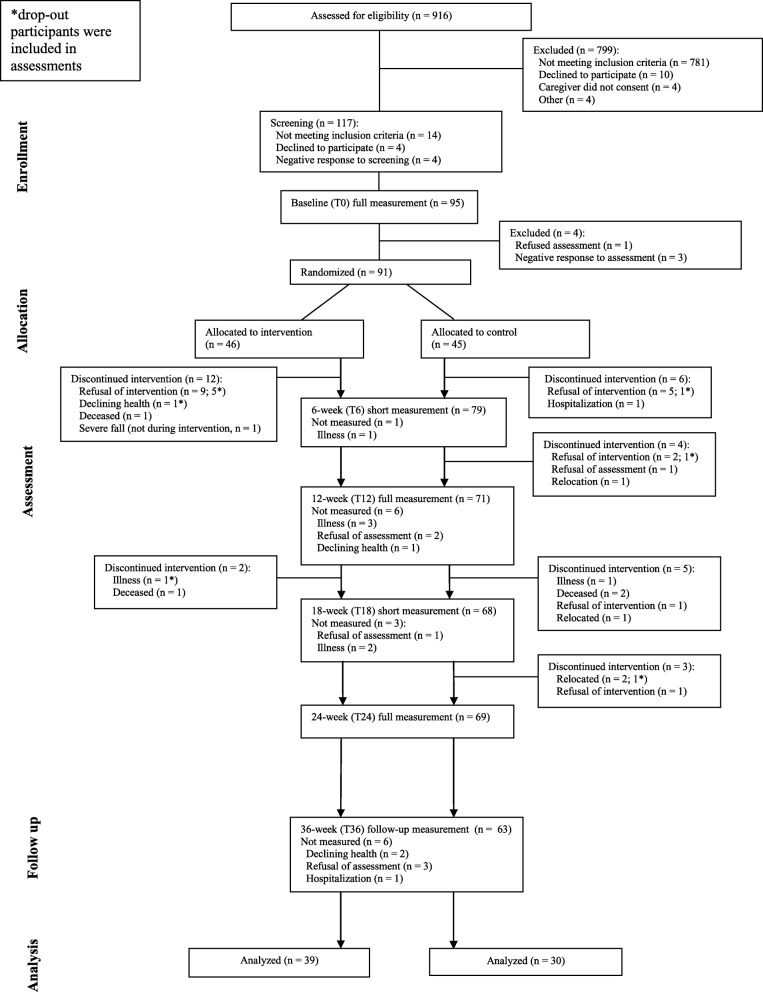
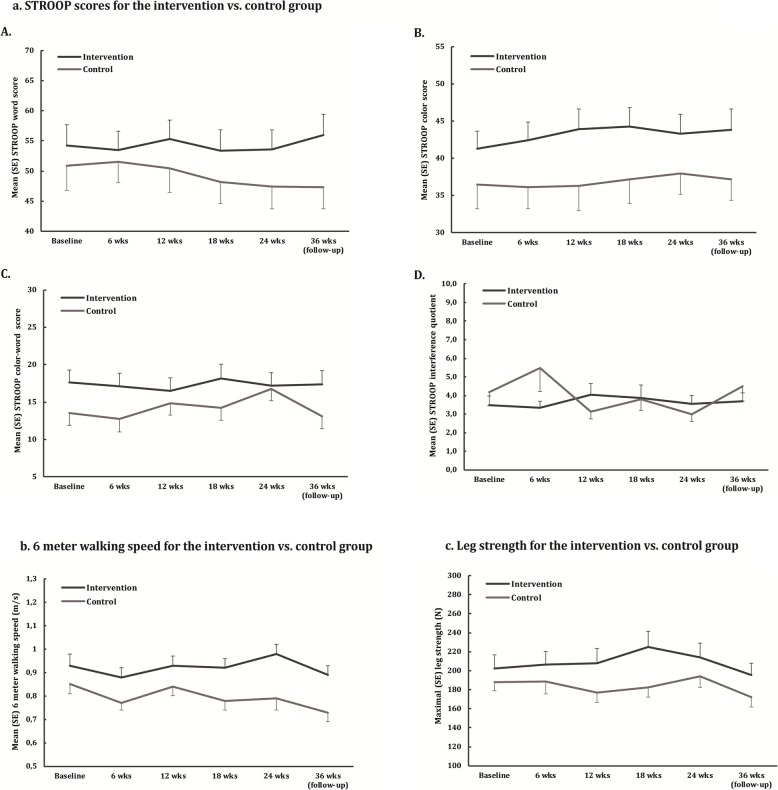
Background: Potential moderators such as exercise intensity or apolipoprotein-E4 (ApoE4) carriership may determine the magnitude of exercise effects on physical and cognitive functions in patients with dementia (PwD). We determined the effects of a 24-week aerobic and strength training program with a low- and high-intensity phase on physical and cognitive function. Methods: In an assessor-blinded randomized trial, 91 PwD (all-cause dementia, recruited from daycare and residential care facilities, age 82.3 ± 7.0 years, 59 women, Mini-Mental State Examination 20.2 ± 4.4) were allocated to the exercise or control group. In the exercise group, PwD participated in a walking and lower limb strength training program with 12 weeks low- and 12 weeks high-intensity training offered three times/week. Attention-matched control participants performed flexibility exercises and recreational activities. We assessed adherence, compliance, and exercise intensity for each session. We assessed physical (endurance, gait speed, mobility, balance, leg strength) and cognitive (verbal memory, visual memory, executive function, inhibitory control, psychomotor speed) functions with performance-based tests at baseline and after 6, 12, 18, 24, and 36 weeks (follow-up). ApoE4 carriership was determined post-intervention. Results: Sixty-nine PwD were analyzed. Their mean attendance was ~ 60% during the study period. There were no significant effects of the exercise vs. control intervention on endurance, mobility, balance, and leg strength in favor of the exercise group (Cohen’s d = 0.13–0.18). Gait speed significantly improved with ~ 0.05 m/s after the high-intensity phase for exercise participants (Cohen’s d = 0.41) but declined at follow-up. There were no significant effects of the exercise vs. control intervention on any of the cognitive measures (Cohen’s d ~ − 0.04). ApoE4 carriership did not significantly moderate exercise effects on physical or cognitive function. Conclusions: Exercise was superior to control activities for gait speed in our sample of PwD. However, the training effect provided no protection for mobility loss after detraining (follow-up). There were no beneficial effects of the exercise vs. control group on cognitive function. Exercise intensity moderated the effects of exercise on gait speed. ApoE4 carriership moderated the effect of exercise on global cognition only (trend level). Trial registration: Netherlands Trial Register, NTR5035. Registered on 2 March 2015.
Overview
The claims and statistics of this paper haven’t been checked yet.
Free: it reads the open-access text and checks the first 5 claims that cite a source we can check. Create a free account to check every claim.
Integrity signals
Registry
Cites
Statistics
Figures
Verification
Claims the paper makes
The claims and statistics of this paper haven’t been checked yet.
Free: it reads the open-access text and checks the first 5 claims that cite a source we can check. Create a free account to check every claim.
Claims other papers make about this one
Each is checked against this paper’s own text: does it say what the citing paper says it does?
In the citing paper
“Good quality RCTs of exercise interventions for people with dementia found they did not improve neuropsychiatric symptoms, cognition or functioning.(524, 525)”
From Dementia prevention, intervention, and care: 2024 report of the Lancet standing Commission (2024) · cites this paper as [524]
Self-check
Percentages, sums and reported differences re-computed from the paper’s own numbers.
The self-check needs the paper’s full text.
Citations
Cites
Statistical Power Analysis for the Behavioral Sciences
Muller, K. (1989) · Technometrics · doi:10.1080/00401706.1989.10488618 · Cited by 99,167
Folstein, M. F., Folstein, S. E., & McHugh, P. R. (1975) · Journal of Psychiatric Research · doi:10.1016/0022-3956(75)90026-6 · Cited by 88,282
Statistical power analysis for the behavioral sciences
(1990) · Computers, Environment and Urban Systems · doi:10.1016/0198-9715(90)90050-4 · Cited by 65,269
Kok, J. S., Berg, I. J., & Scherder, E. J. A. (2013) · Dementia and Geriatric Cognitive Disorders Extra · doi:10.1159/000353441 · Cited by 20,589
Self-citationOlder Adults' Reasons for Using Technology while Aging in Place
Peek, S. T. M., Luijkx, K. G., Rijnaard, M. D., Nieboer, M. E., van der Voort, C. S., Aarts, S., van Hoof, J., Vrijhoef, H. J. M., & Wouters, E. J. M. (2016) · Gerontology · doi:10.1159/000430949 · Cited by 19,690
Sensitivity and False Alarm Rate of a Fall Sensor in Long-Term Fall Detection in the Elderly
Kangas, M., Korpelainen, R., Vikman, I., Nyberg, L., & Jämsä, T. (2015) · Gerontology · doi:10.1159/000362720 · Cited by 18,909
Studies of interference in serial verbal reactions
Stroop, J. R. (1935) · Journal of Experimental Psychology · doi:10.1037/h0054651 · Cited by 18,622
The Timed “Up & Go”: A Test of Basic Functional Mobility for Frail Elderly Persons
Podsiadlo, D., & Richardson, S. (1991) · Journal of the American Geriatrics Society · doi:10.1111/j.1532-5415.1991.tb01616.x · Cited by 14,418
Corder, E. H., Saunders, A. M., Strittmatter, W. J., Schmechel, D. E., Gaskell, P. C., Small, G. W., Roses, A. D., Haines, J. L., & Pericak-Vance, M. A. (1993) · Science · doi:10.1126/science.8346443 · Cited by 9,429 · cited 1×
“For example, the presence of the apolipoprotein-E4 (ApoE4) allele, a risk factor for Alzheimer’s disease (AD) [29], may mediate the magnitude of exercise effects.”
BackgroundGarber, C. E., Blissmer, B., Deschenes, M. R., Franklin, B. A., Lamonte, M. J., Lee, I.-M., Nieman, D. C., & Swain, D. P. (2011) · Medicine & Science in Sports & Exercise · doi:10.1249/mss.0b013e318213fefb · Cited by 9,319
Research works printed but not linked: 2
- Wechsler D Wechsler Adult Intelligence Scale – third edition: administration and scoring manual 1997
- Luteijn F Vanderploeg FAE Groninger intelligence test manual 1983
Cited by
Items 101–186 of 186
Liang, Z., Li, C.-Y., Sui, S., He, Z., Ren, Y., Zhou, Z., & Kim, K. (2025) · Healthcare · doi:10.3390/healthcare13131545 · Cited by 2
“Moderate-intensity PA is significantly related to improved health, while low-intensity PA has fewer health benefits [51].”
O papel do exercício físico na neuroplasticidade e cognição da pessoa idosa
de Oliveira, A. P. T., Vargas, F. C., Sáber, J., Kihana, K. T., Tagliari, I. A., & Machado, J. M. T. (2025) · Caderno Pedagógico · doi:10.54033/cadpedv22n9-230 · Cited by 1
Chang, Y.-H., Huang, S.-F., Yang, H.-R., & Liao, J. (2025) · Dementia · doi:10.1177/14713012251367079 · Cited by 1
“…et al., 2021; Gebhard & Mess, 2022; Goldberg et al., 2019; Harwood et al., 2023; Henskens et al., 2018; Lamb et al., 2018; Papatsimpas et al., 2023; Sanders et al., 2020; Toots et al., 2016, 2017), music therapy (Baker et al., 2022; Cheung et al., 2022; Narme et al., 2014; Park et al., 2020;…”
InfluentialYoshiura, K., Murata, M., Hamasuna, M., Miyagawa, Y., Kaneda, K., Fukuhara, R., Hashimoto, M., & Takebayashi, M. (2025) · Psychogeriatrics · doi:10.1111/psyg.70085 · Cited by 1
“In the present study, the adherence rate was higher than that re-ported in some previous studies [26–28].”
Jing, W., Zhang, Q., & Kang, J. (2025) · Educational Gerontology · doi:10.1080/03601277.2025.2575904 · Cited by 1
“Similarly, Sanders et al. (2020) and Lamb et al. (2018) also failed to observe cognitive benefits from physical activity in randomized controlled trials, suggesting that physical activity alone may not sufficiently stimulate cognition.”
Tang, L., Pan, X., Wang, Y., Qiu, C., Yu, X., Liu, F., Wang, L., & Zhu, X. (2025) · BMC Geriatrics · doi:10.1186/s12877-025-06827-3 · Cited by 1
“However, several other randomized controlled trials did not find evidence that PA improves cognitive function [47, 48].”
Immediate and Long-Term Effectiveness of a Therapeutic Exercise Protocol in Patients with Dementia
Ferreira-Sánchez, M. D. R., Celia, G.-M., Jorge, A.-J., Ana, M. J., Gómez-Sánchez, S., de Bernardo, N., & Elena, S.-J. (2026) · Journal of Clinical Medicine · doi:10.3390/jcm15041482 · Cited by 1
“Some studies conclude that physical exercise improves gait speed but does not provide protective effects in the follow-up period for mobility loss [87], consistent with the results of the present study, although other investigations have observed significant improvements after an 8-week follow-up…”
Jehu, D. A., Hanson, M., Huang, Y., Soares, A. L. D. S., Patel, C., Hergott, C., Waller, J. L., Young, L., Hall, W., Robinson‐Johnson, D., et al. (2026) · Molecular and Cellular Neuroscience · doi:10.1016/j.mcn.2026.104077 · Cited by 1
Huang, X., Zhang, S., Zhao, X., Lan, Y. B., An, R., Li, B., Yu, F., Sun, Y., & 万巧琴 (2026) · Journal of Alzheimer s Disease · doi:10.1177/13872877261441823 · Cited by 1
“This gap may be partly attributable to the relatively narrow dose range recommended in current physical activity guidelines (typically 2 – 3 sessions per week), 4,25 which limits variability needed to detect dose-response patterns.”
Proteomic Study on the Amelioration of Cognitive Impairments in 3×Tg-AD Mice by Treadmill Exercise
Fu, Q., Yi, Z., Guan, Y., Tang, J., Wang, S., & Wan, C. (2026) · Journal of Proteome Research · doi:10.1021/acs.jproteome.5c01288 · Cited by 1
APOE ε4, physical activity, and the brain: a review of systematic reviews
Ali, N., Chakbazof, N., Pour, S. G., Contreras, L., Estrada, J., Alexander, G. E., Raichlen, D. A., & Yassine, H. N. (2026) · Frontiers in Aging Neuroscience · doi:10.3389/fnagi.2026.1798639 · Cited by 1
“These studies that found no effects of physical activity, included older samples with mean ages of 85.4 and 82.3 (SD: 7.0) years, respectively (Eggermont et al., 2009; Sanders et al., 2020).”
InfluentialChristogianni, A. (2022) · Advances in healthcare information systems and administration book series · doi:10.4018/978-1-6684-6044-3.ch015 · Cited by 1
Tang, C., Zhou, Y., Huang, A., & Hattori, S. (2025) · Statistics in Medicine · doi:10.1002/sim.10288 · Cited by 1
“This finding was consistent with some previous randomized controlled trials [33, 34].”
Sontáková, L., Bártová, A., Daďová, K., Holmerová, I., & Šteffl, M. (2020) · Research Square · doi:10.21203/rs.3.rs-15634/v3 · Cited by 1
Understanding emerging biomarkers and lifestyle factors in aging and Alzheimer disease
Schultz, S. A. (2020) · Open Scholarship Institutional Repository (Washington University in St. Louis) · doi:10.7936/2y01-5674
Sontáková, L., Bártová, A., Daďová, K., Holmerová, I., & Šteffl, M. (2020) · Research Square · doi:10.21203/rs.3.rs-15634/v2
“Sanders [55] 2020 30 min walking and lower limb strength training program with 12 weeks low- and 12 weeks high-intensity training; 3x a week; 24 weeks 39 MMSE”
BackgroundMethodInfluentialEffects of physical exercise on cognitively impaired older adults: a systematic review
Sontáková, L., Bártová, A., Daďová, K., Holmerová, I., & Šteffl, M. (2021) · AUC KINANTHROPOLOGICA · doi:10.14712/23366052.2021.5
Pei, F., Gendi, F., Wang, Y., Li, H., Du, S., Cui, S., Fu, J., & Chang, C. K. (2022) · Research Square · doi:10.21203/rs.3.rs-1983491/v1
My Experiential Life: Living with Early-Stage Alzheimer’s Disease
Gibbs, D., & Barker, T. H. (2022) · Cambridge University Press eBooks · doi:10.1017/9781009330961.016
dos Santos, U. R. (2022) · Digital Library of Theses and Dissertations (Universidade de São Paulo) · doi:10.11606/d.109.2022.tde-08112022-084835
Kang, D., Ha, C., Lee, H., & Kim, N. (2023) · Journal of Health Informatics and Statistics · doi:10.21032/jhis.2023.48.3.276
Körperliche Aktivität als Therapieform
Fleckenstein, J. (2023) · Springer eBooks · doi:10.1007/978-3-662-66990-7_5
Investigating the Difference in Exercise Self-Efficacy According to the Grade of Muscle Injury
Büyüklüoğlu, G., Günaydın, H., Örsçelik, A., Karaaslan, B., & Kocahan, T. (2023) · Düzce Tıp Fakültesi Dergisi · doi:10.18678/dtfd.1307372
Medicina, F. D. I. C. E. (2024) · Even3 Publicações eBooks · doi:10.29327/5342373
BENEFÍCIOS DA ATIVIDADE FÍSICA NA PREVENÇÃO E TRATAMENTO DE DISTÚRBIOS MENTAIS
PENNO, A. E., JACOBS, G. K., & HARTMANN, G. T. (2024) · Anais do III Congresso Brasileiro de Saúde On-line · doi:10.51161/conbrasau2024/32249
Sanders, L. M. J., Hortobágyi, T., Scholten, E., van der Zee, E., & van Heuvelen, M. J. G. (2024) · PsyArXiv (OSF Preprints) · doi:10.31234/osf.io/ctjg9
Self-citationEstimulación cognitiva a través de terapia física en paciente con Alzheimer: revisión sistemática
Tiana, K. E. T., & Vallejo, P. F. C. (2024) · Revista Científica de Salud BIOSANA · doi:10.62305/biosana.v4i3.156
Воронина, Е. А., Ivko, O. M., Шевелева, К. М., Михеев, В. В., Lenkin, S. G., Пономарев, А. С., Bashuk, V. V., Касымов, Р. Х., & Yakusheva, E. N. (2025) · Успехи геронтологии · doi:10.34922/ae.2024.37.6.009
Ivko, O. M., Сергеевна, Н. И., Ильницкий, А. Н., Пономарев, А. С., Гехаев, А. У., Veys, E. E., & Владимировна, С. В. (2025) · Успехи геронтологии · doi:10.34922/ae.2024.37.6.014
Estela-Zape, J. L., Escobar, A. M. P., López, W. A. C., Ortiz, D. C. G., Hernández-Carrillo, M., Navarro, S. D., & Payán-Salcedo, H. A. (2025) · Geriatric Nursing · doi:10.1016/j.gerinurse.2025.03.017
Américo, L. M., Nogueira, C. J., Nogueira, M. P. P., Maia, B. D. L. C., & Guimarães, A. C. (2025) · Aracê. · doi:10.56238/arev7n4-176
Cavalcanti, B. H., Cavalcanti, R. R., de Souza, M. C., & Pontes‐Silva, A. (2025) · Journal of Bodywork and Movement Therapies · doi:10.1016/j.jbmt.2025.04.019
Physical Exercise as a Therapeutic Strategy in Alzheimer’s Disease: Mechanisms and Benefits
Bartoszek, A., Kopeć, K., Adamiuk, J., Marut, A., Biskup, M., Misiuk, J., Skuba, A., Załuska, K., Świdniak, A., & Nykiel, S. (2025) · Quality in Sport · doi:10.12775/qs.2025.41.58848
“For more advanced cases, supervised low-impact activities such as chair-based exercises and stretching programs help maintain mobility and prevent muscle atrophy [1,12].”
InfluentialTung, H., Chen, K., & Belcastro, F. P. (2025) · Worldviews on Evidence-Based Nursing · doi:10.1111/wvn.70060
Effect of high-intensity exercises in elderly patient with dementia: A systematic review
Singh, S., Aman, I., Aryal, P., Zutshi, K., Saifi, S., & Khan, H. M. (2025) · Physiotherapy - The Journal of Indian Association of Physiotherapists · doi:10.4103/pjiap.pjiap_10_25
Indonesia, U. P., Putri, L. A., Rahmi, U., Indonesia, U. P., Salasa, S., & Indonesia, U. P. (2025) · Jurnal Porkes · doi:10.29408/porkes.v8i2.30222
Dementia Burden, Prevention, Intervention and Care in Jordan
Alzayadneh, W., Alzayadneh, E. M., Al-Jamal, M., Qatawneh, A. T., Shafagoj, B., & Alkayed, N. J. (2025) · Jordan Medical Journal · doi:10.35516/jmj.v59i4.4674
“…and meta-analysis of seven studies of tailored activity program interventions that use activities tailored to abilities and interests of persons living with dementia identified a moderate effect on improving quality of life, decreasing neuropsychiatric symptoms, and decreasing carer burden (71).”
Fuentes-Barría, H., Alarcón-Rivera, M., Aguilera-Eguía, R. A., Maureira-Sánchez, J., & Roco-Videla, Á. (2025) · Retos · doi:10.47197/retos.v72.117030
Exercise as a Therapeutic Intervention for Alzheimer’s Disease
Hwang, D.-J., & Cho, J.-Y. (2025) · Advances in neurobiology · doi:10.1007/978-981-95-0066-6_16
Krafft, J. (2024) · Repository KITopen (Karlsruhe Institute of Technology) · doi:10.5445/ir/1000173704
Mao, S., Xie, L., & Lu, N. (2023) · Figshare · doi:10.6084/m9.figshare.22618397
Dąbek, M., Gajda-Bathelt, M., Kulczycka, J., Sadkowska, P., Perlicka, Z., Smolińska, K., Jania, K., Popow, W., Ciołkosz, M., & Antczak, T. (2025) · International Journal of Innovative Technologies in Social Science · doi:10.31435/ijitss.2(46).2025.3420
THE RELATIONSHIP BETWEEN EXERCISE AND COGNITIVE HEALTH
Alvarado, C. J., & Alvarado, C. J. (2025) · UA Campus Repository (The University of Arizona)
Antón Peláez, D., & Azorín, M. I. I. (2024) · Zaguan (University of Zaragoza Repository)
Arranz Fraca, L., & Olivan, M. P. D. (2025) · Zaguan (University of Zaragoza Repository)
Marchese, V. G., Savage, L., Martins, L. T. C., Shelawala, N., Huynh, A., Rudy, A., & Reoli, R. (2025) · Physical Therapy Reviews · doi:10.1080/10833196.2025.2605393
Rodrigues, J. V. S. C., Cointo, L. S., & Lima, L. N. (2025) · Health Residencies Journal - HRJ · doi:10.51723/hrj.v6i32.1162
Braz, A. F. (2024) · LA Referencia (Red Federada de Repositorios Institucionales de Publicaciones Científicas)
Chronic Aerobic Exercise Alleviates Amyloid-induced Capillary DysfunctionPreprint
Cárdenas‐Rivera, A., Erdogmus, E. K., Birmingham, A., Yee, E., Anton, J., Lu, Z., Li, Y., Singh, N., Johnson, M. M., Loghmani, N., et al. (2026) · bioRxiv (Cold Spring Harbor Laboratory) · doi:10.64898/2026.01.15.699787
“At the vascular level, improvements in endothelial function, arterial compliance, and systemic oxygen delivery have been observed during acute PA [35,37–42].”
Afanador-Restrepo, D. F., Zapata-Gil, S., Sánchez, J. A. G., Bermúdez, L. M. V., & Cardona, C. M. B. (2025) · Cultura Ciencia y Deporte · doi:10.12800/ccd.v20i66.2335
Carvalho, A. C., Martins, L. P. D. C., Filho, L. C. D. C. M., Santos, F. R., Andrade, I. B., Rodrigues, S. S., Protasio, J. R., Carreira, M. M., Filho, R. T. Z., & Zaiden, T. C. D. T. (2026) · Revista Eletrônica Acervo Saúde · doi:10.25248/reas.e22779.2026
Jha, S., Khatun, T., Azharuddin, M., Sehgal, C. A., Parveen, S., & Noohu, M. M. (2026) · Journal of Gerontology and Geriatrics · doi:10.3390/jgg74010003
“Sanders et al. (2020) [22] delivered aerobic and strength training interventions twice per week for 12 weeks, with each session lasting 60 min.”
InfluentialBaschirotto, C., Venturelli, M., & Pedrinolla, A. (2026) · BMC Geriatrics · doi:10.1186/s12877-026-07020-w
“The final column shows the overall risk of bias for each study 38, 39] reported placebo physical and cognitive activity, 2 studies reported stretching and mobility, and 1 study [24] reported regular cognitive therapy.”
InfluentialLi, Y., Liu, Q., Yu, K., Chen, L., & Lu, C. (2026) · Journal of Visualized Experiments · doi:10.3791/69660
Jost, Z., Chroboczek, M., Skurewicz-Palicka, M., Sawicka, A. K., Deptuła, M., Zawrzykraj, M., Laskowski, R., Olek, R. A., Radak, Z. O., & Kujach, S. (2026) · GeroScience · doi:10.1007/s11357-026-02129-7
Application of Interactive Technologies to the Development of Cognitive Functions Remotely
Radzevičius, R. (2022) · Lithuanian University of Health Sciences
Liao, H., Chou, C.-N., & Chao, W. (2026) · International Journal of Older People Nursing · doi:10.1111/opn.70071
Liriano, A., Bencosme, A. I., Furzán, A., Cateb, B., Arias, C., Dagostini, C. M., Meireles, C., Gomes, D. M., Jorquera, D., Moros, D., et al. (2026) · Principles and Practice of Clinical Research Journal · doi:10.21801/ppcrj.2025.114.1
The effect of physical exercise on Alzheimer's disease from an occupational therapy perspective
Διαμάντη, Α. Λ. (2026) · University of Thessaly Institutional Repository (University of Thessaly)
Agbangla, N. F., Bunlon, F., Caby, I., & Albinet, C. T. (2026) · doi:10.51224/sportrxiv.845
Transforming Dementia Caregiving Through Assistive Technologies
Zhang, Q., Wu, Y., & Xu, L. (2026) · Frontiers research topics · doi:10.3389/978-2-8325-8067-7
Quan, J., Zhu, L., Chen, Z., Chen, Z., Li, B., & Yu, S. (2026) · BMC Geriatrics · doi:10.1186/s12877-026-07746-7
Carpi, M., Bartolo, M. D., Isaza, V. H., Noce, G., Percio, C. D., Lopez, S., Carducci, F., Lizio, R., Afragola, A. P., Bölükbaş, B., et al. (2026) · GeroScience · doi:10.1007/s11357-026-02367-9
Resistance training effect on functional decline in older adults with dementia
Ndirangu, M. W., & Soldera, J. (2026) · World Journal of Meta-Analysis · doi:10.13105/wjma.121960
Lu, Y., Xu, C., Fu, P., & Gong, L. (2026) · Cells · doi:10.3390/cells15141284
“Furthermore, there is a dose–response effect between exercise benefits and intensity, meaning that higher-intensity exercise yields greater improvements than lower-intensity exercise [124–127].”
Non-pharmacological strategies for the management of Alzheimer's disease
de Oliveira, G. L. D. S., & Bertollo, A. G. (2026) · Dementia & Neuropsychologia · doi:10.1590/1980-5764-dn-2025-0290
“It is important to note that some factors, such as exercise intensity, can influence the magnitude of exercise effects on physical and cognitive functions 31 .”
Jehu, D. A., Hanson, M., Huang, Y., Soares, A. L. D. S., Hergott, C., Waller, J. L., Young, L., Hall, W., Robinson‐Johnson, D., Allen, C., et al. (2026) · Life · doi:10.3390/life16081230
“Lastly, most exercise studies in PWD have focused on community-dwelling individuals or those receiving outpatient/day-care services, which may limit generalizability to individuals residing in long-term care settings who often experience greater cognitive and functional impairment [21,26,27].”
Delgado-Molina, M. C., Viviescas, B. J. B., & Yerena, C. E. G. (2026) · Avances en Biomédicina
Avances en Biomedicina. Vol. 15, Nº 1. Enero Junio 2026
Biomedicina, A. E. (2026) · Avances en Biomédicina
da Silva, R. D. C. C. (2025) · Lume (Universidade Federal do Rio Grande do Sul)
Şahin, G., & Mutlay, F. (2026) · European Review of Aging and Physical Activity · doi:10.1186/s11556-026-00432-y
Faieta, J. M., Devos, H., Philippou, E., Negm, A. M., Vaduvathiriyan, P., Erickson, K. I., Hirsch, M. A., van Wegen, E. E. H., Fakorede, S., Dagne, M. B., et al. (2026) · Archives of Physical Medicine and Rehabilitation · doi:10.1016/j.apmr.2026.08.001 · Cited by 1
Ferrari, S. S. D. A. R., Ramos, M. V., de Abreu, F. M. C., de Oliveira, D. A., Silva, L. D. D. S., Ferreira, C. S., Linhares, B. Q. H. D. S., Titze‐de‐Almeida, R., Tavares, M. C. H., & Titze-de-Almeida, S. S. (2026) · The Journals of Gerontology Series A · doi:10.1093/gerona/glag224
ТЕОРИЯ ВОЗРАСТНОЙ ЖИЗНЕСПОСОБНОСТИ В ГЕРИАТРИЧЕСКОЙ МЕДИЦИНЕ
Яроцкий, С. Ю., Прощаев, К. И., Ильницкий, А. Н., Гаврилова, А. А., & Фесенко, Э. В. (2026) · Успехи геронтологии · doi:10.34922/ae.2026.39.4.006
Rungseethanakul, S., & Yingyongyudha, A. (2023) · Journal of Food Health and Bioenvironmental Science
de Paula, M. V. S., Gomes, W. D. S., Silva, B. A., de Aguiar, M. M., da Costa, R. A., & de Araújo, A. X. P. (2025) · BIUS -Boletim Informativo Unimotrisaúde em Sociogerontologia
Wang, Y. T., Zheng, X., Wang, Y. T., Bian, L., & Peng, P. (2026) · Physiotherapy · doi:10.1016/j.physio.2026.102390
Grajales, A. I. L. (2026) · Tesis Doctorals en Xarxa (Consorci de Serveis Universitaris de Catalunya)
Mutairi, A. A., Al-Ramadan, M., Qarin, M. I. A., Al-Abbas, M. S., Qahtani, N. A. A., Maghraby, M. A. A., Ahsan, M., & Abualait, T. (2026) · Medicine · doi:10.1097/md.0000000000051091
Shin, S., & Kim, M. (2026) · GeroScience · doi:10.1007/s11357-026-02596-y
Shi, L., Li, W., Zhan, S., Liu, X., Wu, Z., Liu, Z., Chen, C., Wang, S., & Li, J. (2026) · Frontiers in Immunology · doi:10.3389/fimmu.2026.1954022
Silva, J. L. D., Agbangla, N. F., Page, C. L., Ghernout, W., & Andrieu, B. (2022) · doi:10.3389/fpsyg.2022.888851.s001
Metadata
- Authors
- Sanders, L. M. J., Hortobágyi, T., Karssemeijer, E. G. A., Van der Zee, E. A., Scherder, E. J. A., & van Heuvelen, M. J. G.
- Affiliations
- University Medical Center Groningen (NL)
- Radboud University Nijmegen (NL)
- Vrije Universiteit Amsterdam (NL)
- Corresponding author
- Sanders, L. M. J.
- Venue
- Alzheimer's Research & Therapy
- Published
- 2020-03-19
- Volume
- 12
- Issue
- 1
- Pages
- 28-28
- ISSN
- 1758-9193 (ISSN-L)
- PMC
- PMC7082953
- OpenAlex
- W3012896574
- Semantic Scholar
- b6d8a91b9fbc1e8b28386cbc448fed06ce7a36d6
- Cited by
- 154
- References
- 109
- Citations by year
- 2026: 27 · 2025: 35 · 2024: 32 · 2023: 24 · 2022: 17 · 2021: 15 · 2020: 4
- FWCI
- 10.94
- Type
- journal article
- Language
- en
- Open access
- gold
- doi.org
- Licence
- cc-by
- creativecommons.org/licenses/by/4.0/ (tdm)
- creativecommons.org/licenses/by/4.0/ (vor)
- Locations
- Alzheimer s Research & Therapy (publishedVersion, cc-by)
- PubMed Central (publishedVersion, cc-by)
- PubMed (publishedVersion)
- VU Research Portal (publishedVersion, other-oa)
- Radboud Repository (Radboud University) (submittedVersion)
- DOAJ (DOAJ: Directory of Open Access Journals) (submittedVersion, cc-by-sa)
- University of Groningen research database (University of Groningen / Centre for Information Technology) (submittedVersion, cc-by)
- Radboud Repository (Radboud University) (submittedVersion, other-oa)
- Data Archiving and Networked Services (DANS) (submittedVersion, other-oa)
- Funders
- ZonMW (733050303)
- Topics
- Health Sciences › Medicine › Psychiatry and Mental health › Dementia and Cognitive Impairment Research
- Health Sciences › Medicine › Public Health, Environmental and Occupational Health › Physical Activity and Health
- Health Sciences › Health Professions › Physical Therapy, Sports Therapy and Rehabilitation › Balance, Gait, and Falls Prevention
- Keywords
- dementia, physical activity, exercise intensity, aerobic exercise, resistance training, walking speed, physical function, cognitive function, APOE ε4, older adults, walking, mobility (physical function), balance, detraining, exercise adherence, residential care, daycare centers, executive function, memory, psychomotor speed
- MeSH terms
- Aged, Aged, 80 and over, Cognition, Dementia, Exercise Therapy, Female, Humans, Netherlands, Exercise
About these checks
Registry, retraction, Cites and statistics results are computed, not judged, with one exception: a printed reference that no index lists is read once by a model before it counts as a citation error. Claims are extracted by a model and kept only when their quote appears verbatim in the text; each cited source is then checked, with a model’s help, for whether it says what the claim relies on. Those verdicts can be wrong — read the claim’s quote and the cited source before relying on one.
Statistics and arithmetic are recomputed, not judged.
Confidence bands are shown only for fields calibrated on our annotated test set. None is calibrated yet, so no band is shown.
What counts as a claim ›How we measure confidence ›How we check this ›
Are you an author, or do you see a problem with this page? Request a review
Data sources
Bibliographic data: Semantic Scholar, OpenAlex, Crossref.
Contains information from the Semantic Scholar Academic Graph Datasets, made available under the ODC Attribution License (ODC-BY 1.0).
Semantic Scholar’s data is described in: Kinney, R., et al. (2023). The Semantic Scholar Open Data Platform. arXiv:2301.10140.
