

The DOI matches its Crossref record; 54 of the 54 references it cites were found in a registry or an index.
White matter hyperintensities across the adult lifespan: relation to age, Aβ load, and cognition
Open accessAbstract
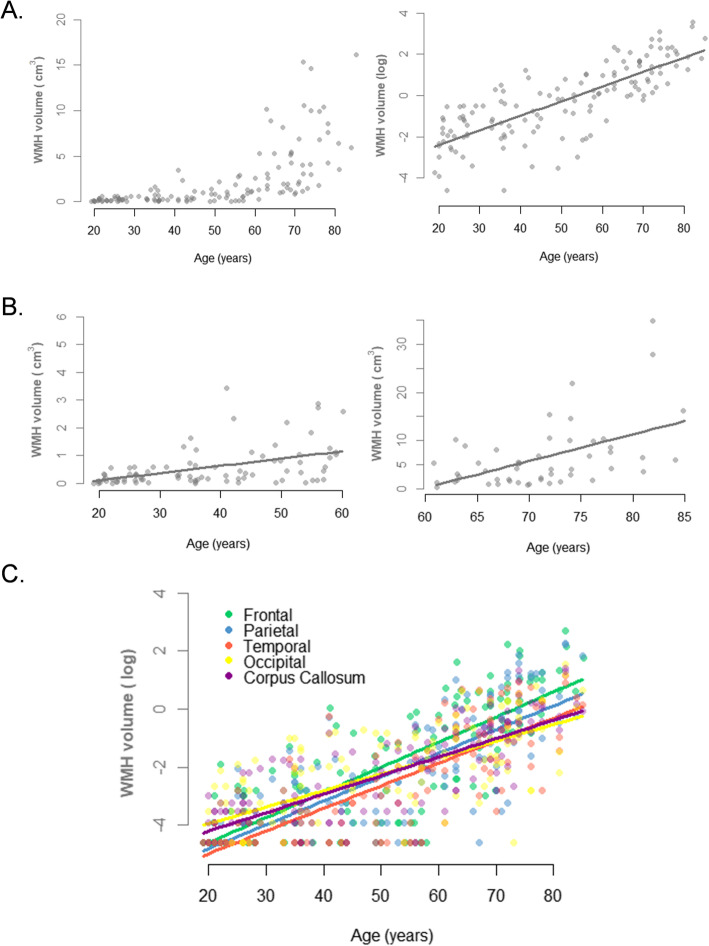
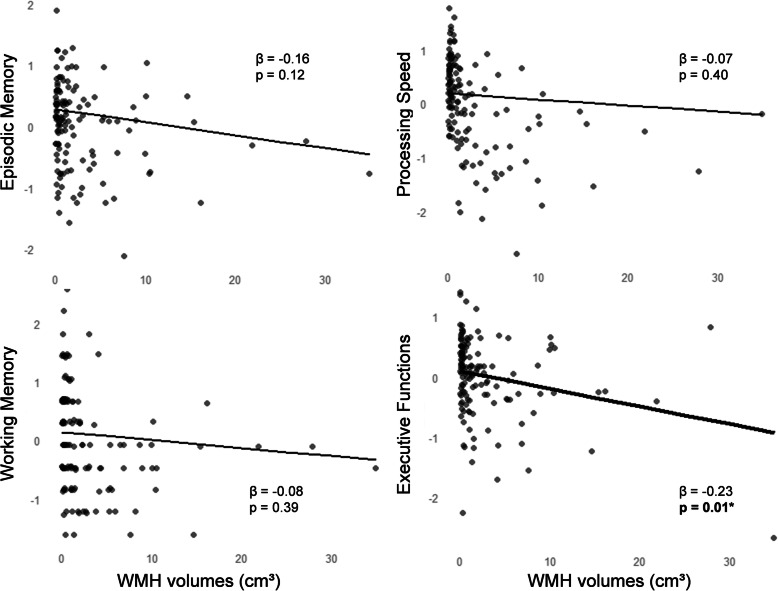
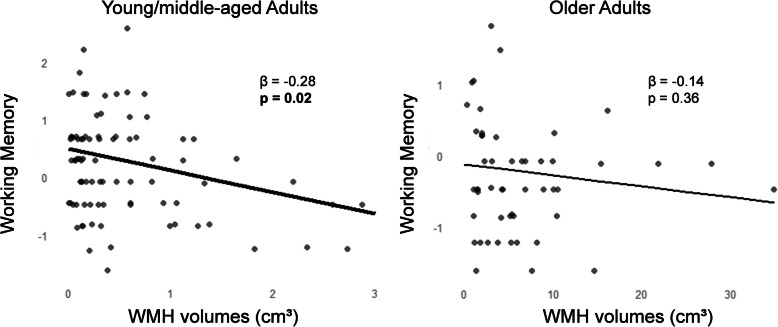
BACKGROUND: White matter hyperintensities (WMH) are very frequent in older adults and associated with worse cognitive performance. Little is known about the links between WMH and vascular risk factors, cortical β-amyloid (Aβ) load, and cognition in cognitively unimpaired adults across the entire lifespan, especially in young and middle-aged adults. METHODS: One hundred and thirty-seven cognitively unimpaired adults from the community were enrolled (IMAP cohort). Participants underwent (i) a comprehensive neuropsychological assessment of episodic memory, processing speed, working memory, and executive functions; (ii) brain structural T1 and FLAIR MRI scans used for the automatic segmentation of total and regional (frontal, parietal, temporal, occipital, and corpus callosum) WMH; and (iii) a Florbetapir-PET scan to measure cortical Aβ. The relationships of total and regional WMH to age, vascular risk factors, cortical Aβ, and cognition were assessed within the whole sample, but also splitting the sample in two age groups (≤ or > 60 years old). RESULTS: WMH increased with age across the adult lifespan, i.e., even in young and middle-aged adults. Systolic blood pressure, diastolic blood pressure, and glycated hemoglobin were all associated with higher WMH before, but not after, adjusting for age and the other vascular risk factors. Higher frontal, temporal, and occipital WMH were associated with greater Aβ, but this association was no longer significant when adjusting for age and vascular risk factors. Higher total and frontal WMH were associated with worse performance in executive functions, with no interactive effect of the age group. In contrast, there was a significant interaction of the age group on the link between WMH and working memory, which was significant within the subgroup of young/middle-aged adults only. Adding cortical Aβ load in the models did not alter the results, and there was no interaction between WMH and Aβ on cognition. CONCLUSION: WMH increased with age and were associated with worse executive functions across the adult lifespan and with worse working memory in young/middle-aged adults. Aβ load was weakly associated with WMH and did not change the relationship found between WMH and executive functions. This study argues for the clinical relevance of WMH across the adult lifespan, even in young and middle-aged adults with low WMH.
Overview
The claims and statistics of this paper haven’t been checked yet.
Run the check — free, no account needed. It reads the open-access text and checks the sources it cites.
Integrity signals
Registry
Cites
Statistics
Figures
Verification
Claims the paper makes
The claims and statistics of this paper haven’t been checked yet.
Run the check — free, no account needed. It reads the open-access text and checks the sources it cites.
Claims other papers make about this one
Each is checked against this paper’s own text: does it say what the citing paper says it does?
The source backs part of the claim, not all of it — or backs it for a different population, condition or comparison.
In the citing paper
“Previous studies investigating the impact of regional distribution of WMHs on executive function (EF) found that WMHs in all cortical regions (frontal areas, occipital, parietal and temporal) are associated with deficits in EF scores [15,16,17]”
From Amyloid-PET and White Matter Hyperintensities Have Independent Effects on Baseline Cognitive Function and Synergistic Effects on Longitudinal Executive Function (2023) · cites this paper as [16]
Experimental — accuracy not yet measured
Self-check
Percentages, sums and reported differences re-computed from the paper’s own numbers.
The self-check needs the paper’s full text.
Citations
Cites
Dementia prevention, intervention, and care
Livingston, G., Sommerlad, A., Orgeta, V., Costafreda, S. G., Huntley, J., Ames, D., Ballard, C., Banerjee, S., Burns, A., Cohen-Mansfield, J., et al. (2017) · The Lancet · doi:10.1016/s0140-6736(17)31363-6 · Cited by 6,072
Pantoni, L. (2010) · The Lancet Neurology · doi:10.1016/s1474-4422(10)70104-6 · Cited by 3,405
Wechsler Adult Intelligence Scale--Fourth Edition
Wechsler, D. (2012) · PsycTESTS Dataset · doi:10.1037/t15169-000 · Cited by 2,232
Reproducibility of quantitative tractography methods applied to cerebral white matter
Wakana, S., Caprihan, A., Panzenboeck, M. M., Fallon, J. H., Perry, M., Gollub, R. L., Hua, K., Zhang, J., Jiang, H., Dubey, P., et al. (2007) · NeuroImage · doi:10.1016/j.neuroimage.2007.02.049 · Cited by 1,686
Hua, K., Zhang, J., Wakana, S., Jiang, H., Li, X., Reich, D. S., Calabresi, P. A., Pekar, J. J., van Zijl, P. C. M., & Mori, S. (2007) · NeuroImage · doi:10.1016/j.neuroimage.2007.07.053 · Cited by 1,507
de Leeuw, F.-E. (2001) · Journal of Neurology, Neurosurgery & Psychiatry · doi:10.1136/jnnp.70.1.9 · Cited by 1,291
White matter hyperintensities, cognitive impairment and dementia: an update
Prins, N. D., & Scheltens, P. (2015) · Nature Reviews Neurology · doi:10.1038/nrneurol.2015.10 · Cited by 1,284
Hammers, A., Allom, R. J., Koepp, M. J., Free, S. L., Myers, R., Lemieux, L., Mitchell, T. N., Brooks, D. J., & Duncan, J. S. (2003) · Human Brain Mapping · doi:10.1002/hbm.10123 · Cited by 1,270
Screening for dementia by memory testing
Grober, E. H., Herman Buschke, L., Crystal, H., Bang, S., & Dresner, R. (1988) · Neurology · doi:10.1212/wnl.38.6.900 · Cited by 956
What are White Matter Hyperintensities Made of?
Wardlaw, J. M., Hernández, M. C. V., & Maniega, S. M. (2015) · Journal of the American Heart Association · doi:10.1161/jaha.114.001140 · Cited by 948
Cited by
Sorted by citations
Items 101–130 of 130
Hayes, C. A., Briggs, A., Gills, J. L., & The Health and Aging Brain Study (HABS‐HD) Study Team (2026) · Alzheimer s & Dementia Translational Research & Clinical Interventions · doi:10.1002/trc2.70214 · Cited by 1
Mendl-Heinisch, C., Bittner, N., Miller, T., Dellani, P. R., Bamberg, F., Berger, K., Bohmann, P., Decker, J. A., Flöel, A., Greiser, K. H., et al. (2026) · GeroScience · doi:10.1007/s11357-026-02232-9 · Cited by 1
Bonvini, G., Sattin, D., Iraci, N., Dobrowolny, G., Cola, M. C. D., Musarò, A., Lunetta, C., & Zulueta, A. (2026) · Mechanisms of Ageing and Development · doi:10.1016/j.mad.2026.112233 · Cited by 1
Wang, W., Shi, L., Ma, H., Zhu, S., Ge, Y., & Xu, K. (2023) · PeerJ · doi:10.7717/peerj.15581 · Cited by 1
Shirsath, M. A., O’Connor, J. D., Boyle, R. T., Newman, L., Knight, S. P., Hernández, B., Whelan, R., Meaney, J. F., & Kenny, R. A. (2024) · Cerebral Circulation - Cognition and Behavior · doi:10.1016/j.cccb.2024.100212 · Cited by 1
Silent cerebral infarcts in sickle cell disease: Really silent?
Garnier‐Crussard, A., Cotton, F., Desestret, V., Krolak‐Salmon, P., & Fort, R. (2021) · Journal of Neuroradiology · doi:10.1016/j.neurad.2021.03.002 · Cited by 1
Self-citationZhuo, Z., Tian, D., Duan, Y., Li, R., Bai, Y., Shi, Y., Xu, X., Xu, S., Lv, S. J., Cao, G., et al. (2022) · Research Square · doi:10.21203/rs.3.rs-2224463/v1
MRI white matter hyperintensities and neuropsychological performance in a clinical sample
Paredes, J., & Daniel, M. (2023) · Applied Neuropsychology Adult · doi:10.1080/23279095.2023.2276438
Démarche diagnostique devant une leucopathie vasculaire
Grosset, L., & Jouvent, É. (2024) · Pratique Neurologique - FMC · doi:10.1016/j.praneu.2023.12.004
张, 健. (2024) · Advances in Clinical Medicine · doi:10.12677/acm.2024.142470
Cherdak, M. A. (2023) · Advances in Gerontology · doi:10.1134/s2079057024600198
Alter und Neurodegeneration in der Bildgebung
Bischof, G. N., & Hoenig, M. C. (2024) · Klinische Neurophysiologie · doi:10.1055/a-2252-2148
Disrupted structural network resilience in atherosclerosis: A large-scale cohort study
Tang, H., Zhu, W., Jing, J., Zhou, Y., Liu, H., Li, S., Li, S., Liu, Z., Liu, Z., Pan, Y., et al. (2025) · Brain Research · doi:10.1016/j.brainres.2025.149653
Husein, N. K., Lin, K. N., Chan, D. K. E., Jiang, J., Crawford, J. D., Sachdev, P. S., & Wen, W. X. (2025) · SSRN Electronic Journal · doi:10.2139/ssrn.5259819
Menze, I., Bernal, J., Kievit, R., Yakupov, R., Altenstein, S., Bartels, C., Büerger, K., Butryn, M., Dechent, P., Ewers, M., et al. (2025) · medRxiv · doi:10.1101/2025.06.16.25329648
Miscellaneous Diseases and Normal Findings
Uher, T. (2025) · Springer eBooks · doi:10.1007/978-3-031-98945-2_12
Regional brain age is decreased in children with sickle cell anemia
Mirro, A. E., Power, L. C., Wang, J., Germino-Watnick, P., Roberts, H., Cam, Y., Guilliams, K. P., Fellah, S., Chen, Y., An, H., et al. (2025) · Blood Advances · doi:10.1182/bloodadvances.2025017172
Relationship between amyloid burden, cholinergic integrity, and cognitive function
Lee, L., Chou, C., Shih, Y., Fang, Y.-M., Chiu, Y.-L., Chuang, Y., & Liu, Y.-C. (2025) · Journal of Alzheimer s Disease · doi:10.1177/13872877251406620
Alshikho, M. J., Lao, P. J., Edwards, N. C., Pyne, J. D., Cotton‐Samuel, D., Morales, C. D., Berroa, J., Morel, N. M., Benavides, A., Ventura, R. E., et al. (2026) · Scientific Reports · doi:10.1038/s41598-025-33418-4
Qin, J., Wu, D., Chu, Y., Wang, Y., Qian, W., Xu, X., & Xu, Y. (2026) · Acta Radiologica · doi:10.1177/02841851261421597
Li, Y., Wang, Y., Liu, S., Ma, Y., & Wu, J. (2026) · Clinical Autonomic Research · doi:10.1007/s10286-026-01221-4
Wang, Y., Sun, B., Li, H. L., Ma, Y., Wang, Y., & Song, Y. (2026) · Frontiers in Aging Neuroscience · doi:10.3389/fnagi.2026.1807882
Lu, J., Ma, J., Xiang, Y., Wu, J., Zheng, M., Li, L., Hua, X., & Xu, J. (2026) · Brain Research · doi:10.1016/j.brainres.2026.150441
Khodanovich, M. Y., Светлик, М. В., Kamaeva, D. A., Usova, A. V., Anan’ina, T. V., Wasserlauf, I. E., Shadrina, M., Pashkevich, V., Moshkina, M., Obukhovskaya, V. B., et al. (2026) · Biomedicines · doi:10.3390/biomedicines14081691
Brain aging clocks: From methodological advances to cellular mechanisms
Suk, K. (2026) · Experimental Gerontology · doi:10.1016/j.exger.2026.113260
Norms for Automatic Estimation of White Matter Hyperintensities Burden: LST-AI Service in neuGRID
Boccali, A., Francesco, S. D., Crema, C., Demaria, C., Baronio, C. M., Archetti, D., & Redolfi, A. (2026) · Diagnostics · doi:10.3390/diagnostics16152460
Lin, K., Sachdev, P. S., Jiang, J., & Initiative, A. D. N. (2026) · Brain Imaging and Behavior · doi:10.1007/s11682-026-01187-x
Claffey, P., Briggs, R., Kennelly, S., & O’Neill, D. J. (2026) · Springer eBooks · doi:10.1007/978-3-032-21928-2_15
Makhlouf, Y., Tekaya, W., Hiba, B., Saoussen, M., Souebni, L., Kaouther, B. A., Fazaa, A., & Ahmed, L. (2026) · Rheumatology (Bulgaria) · doi:10.35465/7wqc7q36
Mohammadi, S., Sharbafshaaer, M., Pirozzi, M. A., Trojsi, F., Ghaderi, S., Iturria‐Medina, Y., & Fereshtehnejad, S.-M. (2026) · Frontiers in Aging Neuroscience · doi:10.3389/fnagi.2026.2005174
Metadata
- Authors
- Garnier-Crussard, A., Bougacha, S., Wirth, M., André, C., Delarue, M., Landeau, B., Mézenge, F., Kuhn, E., Gonneaud, J., Chocat, A., Quillard, A., Ferrand-Devouge, E., de La Sayette, V., Vivien, D., Krolak-Salmon, P., & Chételat, G.
- Affiliations
- Inserm (FR)
- German Center for Neurodegenerative Diseases (DZNE) Dresden (DE)
- Corresponding author
- Chételat, Gaël
- ORCID
- Venue
- Alzheimer's Research & Therapy
- Published
- 2020-10-08
- Volume
- 12
- Issue
- 1
- Pages
- 127-127
- ISSN
- 1758-9193 (ISSN-L)
- PMC
- PMC7545576
- OpenAlex
- W3092538613
- Cited by
- 130
- References
- 54
- Citations by year
- 2026: 18 · 2025: 33 · 2024: 22 · 2023: 25 · 2022: 20 · 2021: 12
- FWCI
- 6.17
- Type
- journal article
- Language
- en
- Open access
- gold
- doi.org
- Locations
- Alzheimer s Research & Therapy (publishedVersion, cc-by)
- PubMed Central (publishedVersion, cc-by)
- PubMed (publishedVersion)
- HAL (submittedVersion)
- DOAJ (DOAJ: Directory of Open Access Journals) (submittedVersion, cc-by-sa)
- DZNE Pub (submittedVersion, other-oa)
- Funders
- Institut National de la Santé et de la Recherche Medicale
- Programme Hospitalier de Recherche Clinique (PHRCN 2011-A01493-38, 2012 12-006-0347)
- Agence Nationale de la Recherche
- Fondation Plan Alzheimer
- Fondation LECMA-Vaincre Alzheimer (13732)
- Association France Alzheimer et maladies apparentées, the Région Basse-Normandie
- Agence régionale de santé Auvergne-Rhône-Alpes
- Horizon 2020 (667696)
- Topics
- Health Sciences › Medicine › Clinical Neurology › Cerebrovascular and genetic disorders
- Health Sciences › Medicine › Psychiatry and Mental health › Dementia and Cognitive Impairment Research
- Life Sciences › Neuroscience › Neurology › Neurological Disease Mechanisms and Treatments
- Keywords
- white matter hyperintensities, vascular risk factors, aging, executive function, working memory, episodic memory, processing speed, young and middle-aged adults, systolic blood pressure, HbA1c, cognitive aging
- MeSH terms
- Aged, Brain, Cognition, Humans, Longevity, Magnetic Resonance Imaging, Middle Aged, Neuropsychological Tests, White Matter
About these checks
Registry, retraction, Cites and statistics results are computed, not judged, with one exception: a printed reference that no index lists is read once by a model before it counts as a citation error. Claims are extracted by a model and kept only when their quote appears verbatim in the text; each cited source is then checked, with a model’s help, for whether it says what the claim relies on. Those verdicts can be wrong — read the claim’s quote and the cited source before relying on one.
Statistics and arithmetic are recomputed, not judged.
Confidence bands are shown only for fields calibrated on our annotated test set. None is calibrated yet, so no band is shown.
What counts as a claim ›How we measure confidence ›How we check this ›
Are you an author, or do you see a problem with this page? Request a review
