

Artificial intelligence-based computational framework for drug-target prioritization and inference of novel repositionable drugs for Alzheimer’s disease
Open accessPublished version of a preprint
The DOI matches its Crossref record; 61 of the 62 references it cites were found in a registry or an index.
Abstract
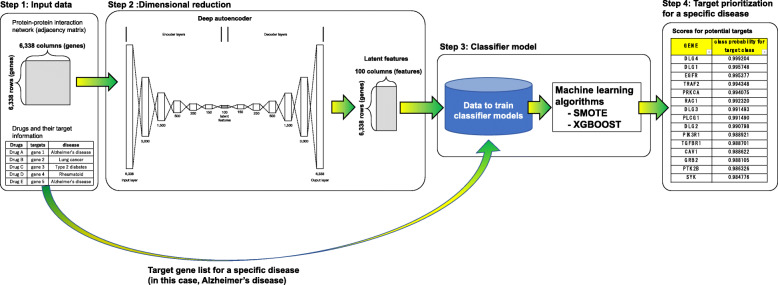
Background: Identifying novel therapeutic targets is crucial for the successful development of drugs. However, the cost to experimentally identify therapeutic targets is huge and only approximately 400 genes are targets for FDA-approved drugs. As a result, it is inevitable to develop powerful computational tools that can identify potential novel therapeutic targets. Fortunately, the human protein-protein interaction network (PIN) could be a useful resource to achieve this objective. Methods: In this study, we developed a deep learning-based computational framework that extracts low-dimensional representations of high-dimensional PIN data. Our computational framework uses latent features and state-of-the-art machine learning techniques to infer potential drug target genes. Results: We applied our computational framework to prioritize novel putative target genes for Alzheimer’s disease and successfully identified key genes that may serve as novel therapeutic targets (e.g., DLG4, EGFR, RAC1, SYK, PTK2B, SOCS1). Furthermore, based on these putative targets, we could infer repositionable candidate-compounds for the disease (e.g., tamoxifen, bosutinib, and dasatinib). Conclusions: Our deep learning-based computational framework could be a powerful tool to efficiently prioritize new therapeutic targets and enhance the drug repositioning strategy.
Overview
The claims and statistics of this paper haven’t been checked yet.
Free: it reads the open-access text and checks the first 5 claims that cite a source we can check. Create a free account to check every claim.
Integrity signals
Registry
Cites
Statistics
Figures
Verification
Claims the paper makes
The claims and statistics of this paper haven’t been checked yet.
Free: it reads the open-access text and checks the first 5 claims that cite a source we can check. Create a free account to check every claim.
Claims other papers make about this one
Each is checked against this paper’s own text: does it say what the citing paper says it does?
The source backs part of the claim, not all of it — or backs it for a different population, condition or comparison.
In the citing paper
“AI-based approaches typically require a large volume of information for training purposes [41].”
From The role of AI in drug discovery: challenges, opportunities, and strategies (2023) · cites this paper as [41]
Experimental — accuracy not yet measuredThe cited source says what the claim attributes to it.
In the citing paper
“Additionally, the advancement of artificial intelligence (AI)-based computational tools is facilitating drug repurposing, presenting a promising strategy AD drug development.431–433”
From Recent advances in Alzheimer's disease: Mechanisms, clinical trials and new drug development strategies. (2024) · cites this paper as [433]
Self-check
Percentages, sums and reported differences re-computed from the paper’s own numbers.
The self-check needs the paper’s full text.
Citations
Cites
Adam: A Method for Stochastic Optimization
Kingma, D. P., & Ba, J. (2014) · arXiv · doi:10.48550/arxiv.1412.6980 · Cited by 98,946 · cited 1×
“We optimized the deep autoencoder network by using “adam” [27] optimizer with a learning rate = 1.”
MethodScikit-learn: Machine Learning in Python
Pedregosa, F., Varoquaux, G., Gramfort, A., Michel, V., Thirion, B., Grisel, O., Blondel, M., Müller, A., Nothman, J., Louppe, G., et al. (2012) · arXiv · doi:10.48550/arxiv.1201.0490 · Cited by 71,016 · cited 1×
“To build the Xgboost algorithm-based binary classifiers, we used the XGBClassifier and scikit-learn [43] python modules.”
MethodXGBoost: A Scalable Tree Boosting System
Chen, T., & Guestrin, C. (2016) · Proceedings of the 22nd ACM SIGKDD International Conference on Knowledge Discovery and Data Mining · doi:10.1145/2939672.2939785 · Cited by 54,569 · cited 2×
“The binary classifier models are based on, Xgboost algorithm, the 155 most efficient implementation of gradient boosting algorithm [22].”
MethodCollective dynamics of ‘small-world’ networks
Watts, D. J., & Strogatz, S. H. (1998) · Nature · doi:10.1038/30918 · Cited by 43,060 · cited 2×
“…statistical topological features in the PIN for each gene, we calculated the following representative network metrics: indegree, outdegree, betweenness, closeness, PageRank [31], cluster coefficient [32], nearest neighbor degree (NND) [33], bow-tie structures [34], and indispensable nodes [35, 36].”
BackgroundMethodSMOTE synthetic minority over-sampling technique
Chawla, N. V., Bowyer, K. W., Hall, L. O., & Kegelmeyer, W. P. (2002) · Journal of Artificial Intelligence Research · doi:10.1613/jair.953 · Cited by 32,865 · cited 4×
“In order to make class-balanced training datasets for building binary classifiers, we used a state of the art sampling method, SMOTE (Synthetic Minority Oversampling TEchnique) [21] that synthetically creates new cases in minority class (in this study, “positive” case) (see Materials and Method in details).”
MethodInfluentialReducing the dimensionality of data with neural networks
Hinton, G. E., & Salakhutdinov, R. R. (2006) · Science · doi:10.1126/science.1127647 · Cited by 20,928
The anatomy of a large-scale hypertextual Web search engine
Brin, S., & Page, L. (1998) · Computer Networks and ISDN Systems · doi:10.1016/s0169-7552(98)00110-x · Cited by 16,004 · cited 2×
“355 Page rank [47]; Page rank for a given node is a metric to roughly estimate the importance 356 of the node in the network.”
BackgroundMethodTensorFlow: A system for large-scale machine learning
Abadi, M., Barham, P., Chen, J., Chen, Z., Davis, A., Dean, J., Devin, M., Ghemawat, S., Irving, G., Isard, M., et al. (2016) · arXiv (Cornell University) · doi:10.48550/arxiv.1605.08695 · Cited by 11,822
DrugBank 5.0: a major update to the DrugBank database for 2018
Wishart, D. S., Feunang, Y. D., Guo, A. C., Lo, E. J., Marcu, A., Grant, J. R., Sajed, T., Johnson, D., Li, C., Sayeeda, Z., et al. (2018) · Nucleic Acids Research · doi:10.1093/nar/gkx1037 · Cited by 8,404 · cited 1×
“324 We obtained information of drugs and that of their target genes from DrugBank 325 database [42] (http://www.”
BackgroundNetwork medicine: a network-based approach to human disease
Barabási, A.-L., Gulbahce, N., & Loscalzo, J. (2011) · Nature Reviews Genetics · doi:10.1038/nrg2918 · Cited by 5,034 · cited 1×
“47 Data of genome wide PINs are typical non-linear high-dimensional big-data in biomedical 48 domain and are composed of thousands of proteins and more than ten-thousands of 49 interactions among them [8,9].”
Background
Research works printed but not linked: 1
- Van Der Maaten L Postma E Van den Herik J Dimensionality reduction: a comparative J Mach Learn Res 2009 10 66-71 13
Cited by
Zhang, J., Zhang, Y., Wang, J., Xia, Y., Zhang, J., & Chen, L. (2024) · Signal Transduction and Targeted Therapy · doi:10.1038/s41392-024-01911-3 · Cited by 1,138
The role of AI in drug discovery: challenges, opportunities, and strategies
Blanco-González, A., Cabezón, A., Seco-González, A., Conde-Torres, D., Antelo-Riveiro, P., Piñeiro, Á., & Garcia-Fandino, R. (2023) · Pharmaceuticals · doi:10.3390/ph16060891 · Cited by 690
“AI-based approaches typically require a large volume of information for training purposes [41].”
BackgroundHossain, M. S., & Hussain, M. H. (2025) · Pharmacology Research & Perspectives · doi:10.1002/prp2.70131 · Cited by 121
Applied Artificial Intelligence in Materials Science and Material Design
Chávez‐Ángel, E., Eriksen, M., Castro‐Álvarez, A., García, J. H., Botifoll, M., Ávalos‐Ovando, Ó., Arbiol, J., & Mugarza, A. (2025) · Advanced Intelligent Systems · doi:10.1002/aisy.202400986 · Cited by 100
Toumaj, S., Heidari, A., Shahhosseini, R., & Navimipour, N. J. (2024) · Artificial Intelligence Review · doi:10.1007/s10462-024-11041-5 · Cited by 89
Artificial intelligence revolution in drug discovery: A paradigm shift in pharmaceutical innovation
Jarallah, S. J., Almughem, F. A., Alhumaid, N. K., Fayez, N. A., Alradwan, I. A., Alsulami, K. A., Tawfik, E. A., & Alshehri, A. A. (2025) · International Journal of Pharmaceutics · doi:10.1016/j.ijpharm.2025.125789 · Cited by 93
Artificial intelligence (AI) in drug design and discovery: A comprehensive review
Bhat, A. R., & Ahmed, S. (2025) · In Silico Research in Biomedicine · doi:10.1016/j.insi.2025.100049 · Cited by 80
The Road to Personalized Medicine in Alzheimer’s Disease: The Use of Artificial Intelligence
Silva‐Spínola, A., Baldeiras, I., Arrais, J. P., & Santana, I. J. (2022) · Biomedicines · doi:10.3390/biomedicines10020315 · Cited by 67
Mapping protein–protein interactions by mass spectrometry
Liu, X., Abad, L., Chatterjee, L., Cristea, I. M., & Varjosalo, M. T. (2024) · Mass Spectrometry Reviews · doi:10.1002/mas.21887 · Cited by 64
“For example, a deep learning ‐ based computational framework (Tsuji et al., 2021) was developed and applied on PPI networks to prioritize putative drug targets for Alzheimer's disease.”
Astillero‐Lopez, V., González-Rodríguez, M., Villar‐Conde, S., Flores‐Cuadrado, A., Martínez-Marcos, A., Úbeda‐Bañón, I., & Saiz‐Sánchez, D. (2022) · Alzheimer s & Dementia · doi:10.1002/alz.12580 · Cited by 58
Drug repurposing for Alzheimer’s disease from 2012–2022—a 10-year literature review
Grabowska, M. E., Huang, A., Wen, Z., Li, B., & Wei, W.-Q. (2023) · Frontiers in Pharmacology · doi:10.3389/fphar.2023.1257700 · Cited by 55
“For instance, we included studies developing general drug repurposing tools and making predictions for AD (Wu et al., 2013; Croset et al., 2014; Issa et al., 2016; Liu et al., 2016; Jiang et al., 2019; Yu and Gao, 2019; Zeng et al., 2019; Cai et al., 2021; Chen et al., 2021; Tsuji et al., 2021; Muslu et al., 2022), as…”
BackgroundAmbreen, S., Umar, M., Noor, A., Jain, H., & Ali, R. (2024) · European Journal of Medicinal Chemistry · doi:10.1016/j.ejmech.2024.117164 · Cited by 54
AI-Driven Drug Discovery for Rare Diseases
Gangwal, A., & Lavecchia, A. (2024) · Journal of Chemical Information and Modeling · doi:10.1021/acs.jcim.4c01966 · Cited by 59
Artificial intelligence for dementia drug discovery and trials optimization
Doherty, T., Yao, Z., Khleifat, A. A. L., Tantiangco, H., Tamburin, S., Albertyn, C., Thakur, L., Llewellyn, D. J., Oxtoby, N. P., Lourida, I., et al. (2023) · Alzheimer's & Dementia · doi:10.1002/alz.13428 · Cited by 48
“A genome-wide AD-associated gene was recently identified using a support vector machine (SVM)–based approach that integrated gene expression data with human brain–specific gene network data.”
Mechanistic Insights for Drug Repurposing and the Design of Hybrid Drugs for Alzheimer’s Disease
Padhi, D., & Govindaraju, T. (2022) · Journal of Medicinal Chemistry · doi:10.1021/acs.jmedchem.2c00335 · Cited by 47
Harnessing the potential of machine learning and artificial intelligence for dementia research
Ranson, J. M., Bucholc, M., Lyall, D. M., Newby, D., Winchester, L. M., Oxtoby, N. P., Veldsman, M., Rittman, T., Marzi, S. J., Skene, N., et al. (2023) · Brain Informatics · doi:10.1186/s40708-022-00183-3 · Cited by 51
“Machine learning approaches can help clarify how and why certain drugs reduce risk, improving our understanding of dementia aetiology and promoting identification of new drug targets [120, 121].”
BackgroundThe Alzheimer’s Knowledge Base: A Knowledge Graph for Alzheimer Disease Research
Romano, J. D., Truong, V. Q., Kumar, R., Venkatesan, M., Graham, B. E., Hao, Y., Matsumoto, N., Li, X., Wang, Z. P., Ritchie, M. D., et al. (2024) · Journal of Medical Internet Research · doi:10.2196/46777 · Cited by 51
“Tsuji et al [9] used an autoencoder neural network to perform dimensionality reduction of a high-density protein interaction network to identify new possible drug targets and then found drugs associated with those targets.”
Artificial intelligence for dementia prevention
Newby, D., Orgeta, V., Marshall, C. R., Lourida, I., Albertyn, C. P., Tamburin, S., Raymont, V., Veldsman, M., Koychev, I., Bauermeister, S., et al. (2023) · Alzheimer's & Dementia · doi:10.1002/alz.13463 · Cited by 42
Gautam, V., Gaurav, A., Masand, N., Lee, V. S., & Patil, V. M. (2022) · Molecular Diversity · doi:10.1007/s11030-022-10489-3 · Cited by 47
“This method can be applied to other CNS diseases as well [148].”
BackgroundMethodMaterials discovery of ion-selective membranes using artificial intelligence
Maleki, R., Shams, S. M., Chellehbari, Y. M., Rezvantalab, S., Jahromi, A. M., Asadnia, M., Abbassi, R., Aminabhavi, T. M., & Razmjou, A. (2022) · Communications Chemistry · doi:10.1038/s42004-022-00744-x · Cited by 39
Piquing artificial intelligence towards drug discovery: Tools, techniques, and applications
Agu, P. C., & Obulose, C. N. (2024) · Drug Development Research · doi:10.1002/ddr.22159 · Cited by 44
“…datasets, phenotypic and expression data, disease associations, patents, publications, clinical trials, research grants, and more, to understand the biological mechanisms underlying diseases and to find novel proteins and/or genes that can be targeted to treat those diseases (Tsuji et al., 2021).”
BackgroundTarget identification and assessment in the era of AI
Pun, F. W., Podolskiy, D. I., Izumchenko, E., Mortlock, A. A., Oprea, T. I., Scheibye‐Knudsen, M., Fortney, K., Morgen, E. K., Ren, F., & Zhavoronkov, A. A. (2026) · Nature Reviews Drug Discovery · doi:10.1038/s41573-026-01412-8 · Cited by 40
Machine learning in Alzheimer’s disease drug discovery and target identification
Geng, C., Wang, Z., & Tang, Y. (2024) · Ageing Research Reviews · doi:10.1016/j.arr.2023.102172 · Cited by 34
Wei, W., Yao, J., Zhang, T., Wen, J., Zhang, Z., Luo, Y.-M., Cao, Y., & Li, H. (2023) · Frontiers in Neuroscience · doi:10.3389/fnins.2023.1059496 · Cited by 31
“EGFR is a potential therapeutic target for AD (Tsuji et al., 2021; Zhang et al., 2022).”
BackgroundZulhafiz, N. A., Teoh, T.-C., Chin, A., & Chang, S. (2025) · Computer Methods and Programs in Biomedicine · doi:10.1016/j.cmpb.2025.108604 · Cited by 32
Jian, C., Wei, L., Mo, R., Li, R., Liang, L., Chen, L., Zou, C., Meng, Y., Liu, Y., & Zou, D. (2021) · Frontiers in Aging Neuroscience · doi:10.3389/fnagi.2021.731180 · Cited by 31
New Drug Design Avenues Targeting Alzheimer’s Disease by Pharmacoinformatics-Aided Tools
Arrué, L., Cigna-Méndez, A., Barbosa, T., Borrego-Muñoz, P., Struve-Villalobos, S., Oviedo, V., Martínez-García, C., Sepúlveda-Lara, A., Millán, N., Montesinos, J. C. E. M., et al. (2022) · Pharmaceutics · doi:10.3390/pharmaceutics14091914 · Cited by 31
Safety, target engagement, and biomarker effects of bosutinib in dementia with Lewy bodies
Pagán, F., Torres-Yaghi, Y. A., Hebron, M. L., Wilmarth, B., Turner, R. S., Matar, S., Ferrante, D., Ahn, J., & Moussa, C. (2022) · Alzheimer s & Dementia Translational Research & Clinical Interventions · doi:10.1002/trc2.12296 · Cited by 25
“Of 120 subjects approached, 39 were screened, 13 did not meet inclusion/exclusion criteria, and 26 were randomized (Figure 1 and Table 1) and included male and female participants (12:1) in the bosutinib arm and all male participants (13) in the placebo arm with an average age 72.”
BackgroundHaque, M. A., & Siddique, H. R. (2025) · Computational Biology and Chemistry · doi:10.1016/j.compbiolchem.2025.108611 · Cited by 24
Artificial Intelligence in Drug Discovery and Development
Sahgal, G., & Sundarasekar, J. (2024) · Interdisciplinary biotechnological advances · doi:10.1007/978-981-97-1148-2_17 · Cited by 21
Novel use of FDA-approved drugs identified by cluster analysis of behavioral profiles
Edmister, S. T., Hernández, T. D. R., Ibrahim, R., Brown, C. A., Gore, S. V., Kakodkar, R., Kreiling, J. A., & Créton, R. (2022) · Scientific Reports · doi:10.1038/s41598-022-10133-y · Cited by 18
Deep Learning-Enabled Multi-Omics Integration: A New Frontier in Precise Drug Target Discovery
Ren, Y., Bai, H., Wang, J., Yang, Y., & Wang, Y. (2026) · Biology · doi:10.3390/biology15050410 · Cited by 18
“To address the complexity of target identification in neurodegenerative disorders, Tsuji et al. developed a computational framework utilizing a deep autoencoder to prioritize putative target genes for AD [130].”
Emerging paradigms in Alzheimer's therapy
Agnes Preethy, H., Rajendran, K., Sukumar, A. J., & Krishnan, U. M. (2024) · European Journal of Pharmacology · doi:10.1016/j.ejphar.2024.176872 · Cited by 18
Zhang, L., Chen, K., Li, S., Liu, S. K., & Wang, Z. (2025) · Current Issues in Molecular Biology · doi:10.3390/cimb47121061 · Cited by 13
“The issues of data scarcity and heterogeneity are particularly pronounced in chemical medicine, where they significantly constrain the accuracy and generalizability of predictive models [137,138].”
Wu, X.-L., Li, Z., Chen, G., Yin, Y., & Chen, C. Y. (2023) · Frontiers in Molecular Biosciences · doi:10.3389/fmolb.2023.1227371 · Cited by 14
Identification of new potential candidates to inhibit EGF via machine learning algorithm
Torabi, M., Yasami‐Khiabani, S., Sardari, S., Golkar, M., Pérez‐Sánchez, H., & Ghasemi, F. (2023) · European Journal of Pharmacology · doi:10.1016/j.ejphar.2023.176176 · Cited by 11
Transforming drug discovery: the impact of AI and molecular simulation on R&D efficiency
Iwata, H. (2024) · Bioanalysis · doi:10.1080/17576180.2024.2437283 · Cited by 12
Spendlove, M., Gibson, T. M., McCain, S., Stone, B. C., Gill, T., & Pickett, B. E. (2023) · PeerJ · doi:10.7717/peerj.16088 · Cited by 9
“In particular, some algorithms specifically focus on performing these tasks for particular diseases or conditions (Di et al., 2019; Dwane et al., 2021; Yang et al., 2021b; Behan et al., 2019; Mejía-Pedroza, Espinal-Enríquez & Hernández-Lemus, 2018; Urán Landaburu et al., 2020; Tsuji et al., 2021).”
BackgroundWorkforce forecasting for state transportation agencies: A machine learning approach
Ogungbire, A., & Mitra, S. K. (2024) · International Journal of Transportation Science and Technology · doi:10.1016/j.ijtst.2024.05.004 · Cited by 9
Mou, F. S., Ahmed, T., Huda, M. N., & Nandi, A. K. (2026) · Artificial Intelligence Review · doi:10.1007/s10462-025-11484-4 · Cited by 9
Bakulin, A., Teyssier, N., Kampmann, M., Khoroshkin, M., & Goodarzi, H. (2024) · PLoS Computational Biology · doi:10.1371/journal.pcbi.1012346 · Cited by 9
Wang, X., Ezeana, C. F., Wang, L., Puppala, M., Huang, Y., He, Y., Yu, X., Yin, Z., Zhao, H., Lai, E. C., et al. (2022) · Alzheimer s & Dementia Translational Research & Clinical Interventions · doi:10.1002/trc2.12351 · Cited by 8
Advancements in breast cancer therapy: Integrating AI tools for drug discovery and clinical trials
Pandey, V., Verma, P., Natesan, G., & Chaube, U. (2025) · Computers in Biology and Medicine · doi:10.1016/j.compbiomed.2025.111067 · Cited by 8
Jiang, S., Tian, Z., Yang, Y., Li, X., Zhou, F., Cheng, J., Lyu, J., Gao, T., Zhang, P., Han, H., et al. (2025) · Acta Pharmaceutica Sinica B · doi:10.1016/j.apsb.2025.08.015 · Cited by 6
Role of artificial intelligence in pharmaceutical health care
Lu, K. (2024) · Journal of the American Pharmacists Association · doi:10.1016/j.japh.2023.12.012 · Cited by 9
Zhang, Y.-H., Zhao, P., Gao, H., Zhong, M., & Li, J. (2024) · Journal of Alzheimer s Disease · doi:10.3233/jad-231389 · Cited by 9
Dsouza, N., Gupta, D. B., & Selvaa Kumar, C. (2023) · Biomedical and Biotechnology Research Journal (BBRJ) · doi:10.4103/bbrj.bbrj_104_23 · Cited by 7
Vashishth, T. K., Sharma, V., Sharma, K. K., Vidyant, S., & Bhardwaj, A. (2024) · Advances in medical technologies and clinical practice book series · doi:10.4018/979-8-3693-3212-2.ch012 · Cited by 13
Application of computational methods in the drug discovery and development of Alzheimer's disease
Zhang, Q., Gong, X., Liu, H., & Yao, X. (2025) · Acta Pharmaceutica Sinica B · doi:10.1016/j.apsb.2025.07.038 · Cited by 10
“…of human protein — protein interaction network features, a DL-based framework was developed to identify novel potential AD genes, such as DLG4 , EGFR , RAC1 , SYK , PTK2B , and SOCS1 , as well as to discover potential therapeutic agents for AD, including tamoxifen, bosutinib, and dasa-tinib 177 .”
Target repositioning using multi-layer networks and machine learning: The case of prostate cancer
Picard, M., Scott‐Boyer, M., Bodein, A., Leclercq, M., Prunier, J., Périn, O., & Droit, A. (2024) · Computational and Structural Biotechnology Journal · doi:10.1016/j.csbj.2024.06.012 · Cited by 6
“Even more recently, embedded features calculated through deep learning models have been used with success in target repositioning efforts [20,21].”
BackgroundThe Role of Bioengineering in Healthcare
Dhivya, S., Areche, F. O., Kumar, B., Hariprabhu, M., & Mutha, S. (2023) · Advances in chemical and materials engineering book series · doi:10.4018/978-1-6684-7412-9.ch016 · Cited by 5
Ma, Y., Tian, H., Xiao, W., Ma, Y., Su, H., Zhu, L., Jiang, Y. L., Li, G., Li, Y., Yuan, M., et al. (2025) · ACS Omega · doi:10.1021/acsomega.5c07349 · Cited by 8
Mathematical and Artificial Intelligence Techniques in Modern Drug Discovery: A Review
Agrwal, A., Kumar, R., Maheshwari, S., Sharma, M., Batra, C. M., Sharma, S., & Gaur, V. (2025) · Drug Development Research · doi:10.1002/ddr.70212 · Cited by 4
“Integrating the predictive capabilities of AI with the knowledge and experience of human researchers can enhance the drug discovery process and accelerate the development of novel pharmaceuticals (Tsuji et al. 2021; Basu et al. 2020; Vamathevan et al. 2019).”
Molecular Docking in Drug Designing and Metabolism
Saikia, S., Puzari, M., & Chetia, P. (2023) · Springer eBooks · doi:10.1007/978-981-99-2816-3_14 · Cited by 6
Neural network embedding of functional microconnectome
Shirakami, A., Hase, T., Yamaguchi, Y., & Shimono, M. (2025) · Network Neuroscience · doi:10.1162/netn_a_00424 · Cited by 4
“These methods have been employed for community detection (Ye et al., 2018), node clustering (Yang et al., 2019), and even drug-target gene inference for diseases like Alzheimer ’ s disease (Tsuji et al., 2021).”
Self-citationMansour, H. M. (2024) · Ageing Research Reviews · doi:10.1016/j.arr.2024.102195 · Cited by 3
Decoding Tomorrows Biotechnology: AI and Machine Learning Unveiled
Thikare, V. P., & Pathak, P. S. (2024) · International Journal for Research in Applied Science and Engineering Technology · doi:10.22214/ijraset.2024.58430 · Cited by 3
Artificial intelligence in preclinical epilepsy research: Current state, potential, and challenges
Medel‐Matus, J., Santana‐Gomez, C., Escalante, R. G., Duncan, D., Viana, P. F., Cereda, G. S., Kuroda, N., & Galanopoulou, A. S. (2025) · Epilepsia Open · doi:10.1002/epi4.70137 · Cited by 3
“128 In many instances, the data accessible may be constrained, or of insufficient quality and consistency, which can compromise the accuracy and reliability of the results.”
Recent Advances in the Application of Artificial Intelligence in Alzheimer's Disease
Yao, L., Ni, J., Wei, M., Li, T., Li, F., Wang, T., Xiao, W., Shi, J., & Tian, J. (2025) · Current Alzheimer Research · doi:10.2174/0115672050410489250930175402 · Cited by 2
Takahara, W., Kobayashi, Y., Morita, M., Okuyama, K., & Nobuyuki, K. (2021) · Journal of Computer Chemistry Japan · doi:10.2477/jccj.2021-0026 · Cited by 2
Unraveling the Mysteries of Alzheimer's Disease Using Artificial Intelligence
Tripathi, S., Sharma, Y., & Kumar, D. (2024) · Reviews on Recent Clinical Trials · doi:10.2174/0115748871330861241030143321 · Cited by 2
Emerging diagnostic biomarkers and therapeutic targets in Alzheimer's disease
Dineshbhai, T. K., Rafaliya, D., Singh, A., Maheshwari, S., Lalan, M. S., & Chakraborthy, G. S. (2026) · Inflammopharmacology · doi:10.1007/s10787-026-02341-z · Cited by 1
“Machine learning techniques can uncover possible therapeutic targets, forecast drug reactions, and enable drug repurposing, thus minimizing the time and expenses linked to conventional drug development methods (Tsuji et al. 2021 ).”
The Emerging Role of AI in Dementia Research and Healthcare
Ranson, J. M., Bucholc, M., Lyall, D. M., Newby, D., Winchester, L. M., Oxtoby, N. P., Veldsman, M., Rittman, T., Marzi, S. J., Skene, N., et al. (2022) · Brain informatics and health · doi:10.1007/978-981-19-5272-2_4 · Cited by 1
Kaur, G., Singh, H., Mehta, S., & ., K. (2024) · International Conference on Computational Intelligence and Communication Technologies (CCICT) · doi:10.1109/ccict62777.2024.00081
“Tsuji et al. (2021) [14] have presented a novel computational paradigm for drug-target prioritization in the context of Alzheimer's disease, based on the use of machine learning in their study .”
BackgroundTorabi, M., Sardari, S., Pérez‐Sánchez, H., & Ghasemi, F. (2025) · Future Medicinal Chemistry · doi:10.1080/17568919.2025.2545166
Singh, R., Pandey, P., Kumar, A., & Mishra, M. K. (2025) · Current Bioinformatics · doi:10.2174/0115748936370246250903052830
Rehman, M., Liu, Q., Javed, M., Ghulam, A., & Kumar, T. (2026) · Journal of Computer-Aided Molecular Design · doi:10.1007/s10822-026-00818-1
Shaikh, K., Thanki, R. M., & Shaikh, A. (2026) · Synthesis lectures on engineering, science, and technology · doi:10.1007/978-3-032-10277-5_2
Preclinical strategies for investigating drug delivery platforms
Kumar, V., Mustafa, G., Singh, R., Shukla, S. K., & Ahmed, Z. (2026) · Elsevier eBooks · doi:10.1016/b978-0-443-45717-3.00005-2
Patwekar, M., Patwekar, F., Kari, Z. A., Mohammed, A., & Sharma, R. (2026) · Pathology - Research and Practice · doi:10.1016/j.prp.2026.156594
Legal and Regulatory Implications of AI Utilization in Drug Development
Khalid, M. S., Shahzad, R., Rashan, L. J., & Shehzad, A. (2026) · Springer eBooks · doi:10.1007/978-981-92-0875-3_12 · Cited by 1
Elwakil, B. H., Helal, A. M., El-Khatib, A. M., Abdelnaser, A., Darwish, A. A.-E., Shehata, N. S., Akl, S. H., Moneer, E. A., Bakr, B. A., & Wakil, A. E. (2026) · Journal of Biomedical Materials Research Part B Applied Biomaterials · doi:10.1002/jbm.b.70150
Bi, X., Wang, Y., Wang, J., & Liu, C. (2026) · Frontiers in Pharmacology · doi:10.3389/fphar.2026.1927954
Wang, J., Li, Z., Wang, T., Jiang, L., Sharif, A., Takechi, R., Li, T., Chong, L. H., Fang, F., Pang, Z., et al. (2026) · Acta Pharmaceutica Sinica B · doi:10.1016/j.apsb.2026.09.013
Nagrami, F. U. H., Shukla, P., Yadav, R., & Prakash, J. (2026) · Frontiers in Oncology · doi:10.3389/fonc.2026.1885312 · Cited by 1
Poonam, Rana, R., Thakur, M., Sharma, A., Pannu, S., Sharma, S., Naman, S., Rani, S., Devi, D., Kumar, V., et al. (2026) · Frontiers in Oncology · doi:10.3389/fonc.2026.1908830
Grabowska, M. E., Huang, A., Wen, Z., Li, B., & Wei, W.-Q. (2023) · doi:10.3389/fphar.2023.1257700.s002
Metadata
- Authors
- Tsuji, S., Hase, T., Yachie-Kinoshita, A., Nishino, T., Ghosh, S., Kikuchi, M., Shimokawa, K., Aburatani, H., Kitano, H., & Tanaka, H.
- Affiliations
- Research Center for Advanced Science and Technology, The University of Tokyo (JP)
- Tokyo Medical and Dental University (JP)
- Systems Biology Institute (JP)
- The University of Osaka (JP)
- Center for Mathematical Modeling and Data Science, The University of Osaka (JP)
- Corresponding author
- Tsuji, Shingo
- Hase, Takeshi
- ORCID
- Venue
- Alzheimer's Research & Therapy
- Published
- 2021-05-03
- Volume
- 13
- Issue
- 1
- Pages
- 92-92
- ISSN
- 1758-9193 (ISSN-L)
- PMC
- PMC8091739
- OpenAlex
- W3158891634
- Semantic Scholar
- 5a009e0181955d90fbdfe3d4dfc8a2fe712db65b
- Cited by
- 75
- References
- 62
- Citations by year
- 2026: 12 · 2025: 16 · 2024: 20 · 2023: 15 · 2022: 10 · 2021: 2
- FWCI
- 6.19
- Type
- journal article
- Language
- en
- Open access
- gold
- doi.org
- Licence
- cc-by
- creativecommons.org/licenses/by/4.0 (tdm)
- creativecommons.org/licenses/by/4.0 (vor)
- Locations
- Alzheimer s Research & Therapy (publishedVersion, cc-by)
- bioRxiv (Cold Spring Harbor Laboratory) (acceptedVersion, cc-by-nc-nd)
- PubMed Central (publishedVersion, cc-by)
- PubMed (publishedVersion)
- DOAJ (DOAJ: Directory of Open Access Journals) (submittedVersion, cc-by-sa)
- Funders
- Japan Society for the Promotion of Science (17H06107, 20K15778)
- Topics
- Life Sciences › Pharmacology, Toxicology and Pharmaceutics › Drug Discovery › Computational Drug Discovery Methods
- Life Sciences › Biochemistry, Genetics and Molecular Biology › Molecular Biology › Bioinformatics and Genomic Networks
- Life Sciences › Neuroscience › Cellular and Molecular Neuroscience › Alzheimer's disease research and treatments
- Keywords
- drug target prioritization, drug repurposing, Alzheimer's disease, protein-protein interaction network, deep learning, drug target identification, latent representations, drug candidates, PSD-95, EGFR, Rac1, Syk, Pyk2, SOCS1, tamoxifen, bosutinib, dasatinib
- MeSH terms
- Machine Learning, Alzheimer Disease, Artificial Intelligence, Pharmaceutical Preparations, Humans, Drug Repositioning
About these checks
Registry, retraction, Cites and statistics results are computed, not judged, with one exception: a printed reference that no index lists is read once by a model before it counts as a citation error. Claims are extracted by a model and kept only when their quote appears verbatim in the text; each cited source is then checked, with a model’s help, for whether it says what the claim relies on. Those verdicts can be wrong — read the claim’s quote and the cited source before relying on one.
Statistics and arithmetic are recomputed, not judged.
Confidence bands are shown only for fields calibrated on our annotated test set. None is calibrated yet, so no band is shown.
What counts as a claim ›How we measure confidence ›How we check this ›
Are you an author, or do you see a problem with this page? Request a review
Data sources
Bibliographic data: Semantic Scholar, OpenAlex, Crossref.
Contains information from the Semantic Scholar Academic Graph Datasets, made available under the ODC Attribution License (ODC-BY 1.0).
Semantic Scholar’s data is described in: Kinney, R., et al. (2023). The Semantic Scholar Open Data Platform. arXiv:2301.10140.
