

The DOI matches its Crossref record; 8 of the 8 references it cites were found in a registry or an index.
Challenges at the APOE locus: a robust quality control approach for accurate APOE genotyping
Published version of a preprint
Abstract
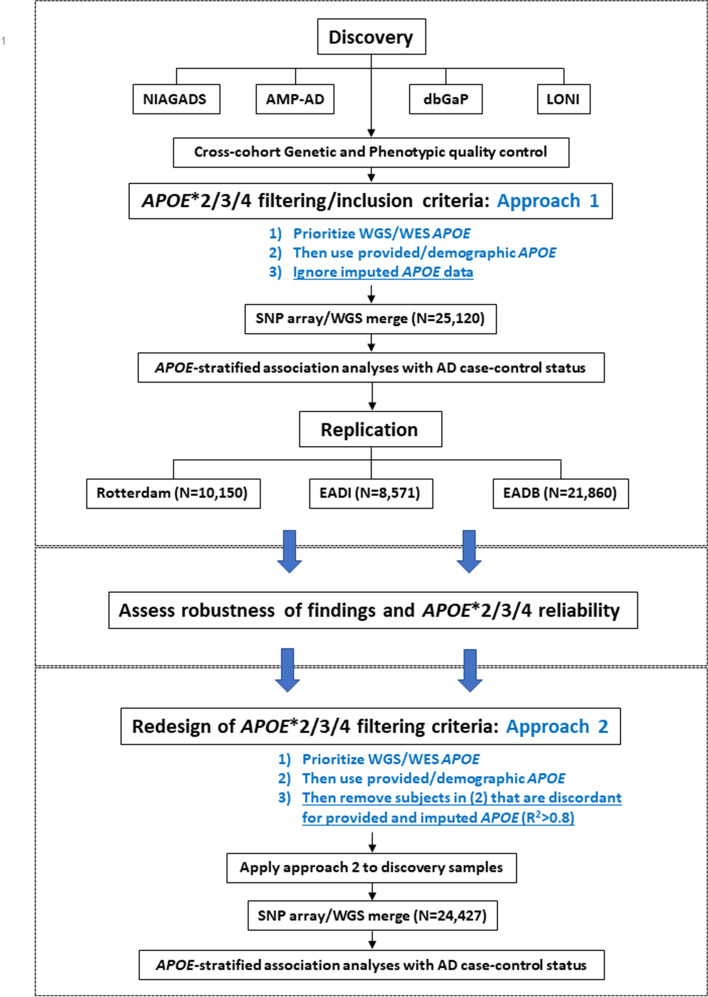
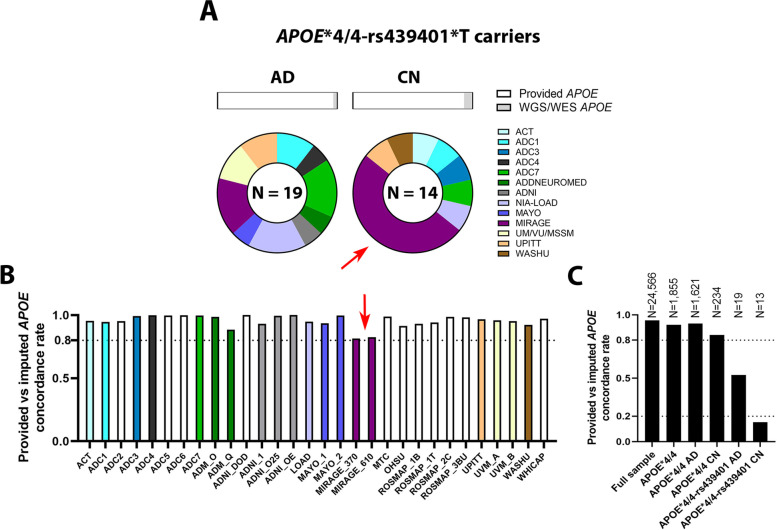
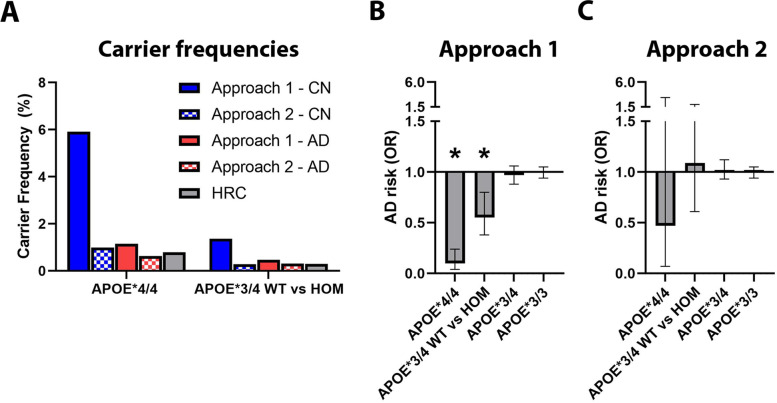
Background: Genetic variants within the APOE locus may modulate Alzheimer’s disease (AD) risk independently or in conjunction with APOE *2/3/4 genotypes. Identifying such variants and mechanisms would importantly advance our understanding of APOE pathophysiology and provide critical guidance for AD therapies aimed at APOE . The APOE locus however remains relatively poorly understood in AD, owing to multiple challenges that include its complex linkage structure and uncertainty in APOE *2/3/4 genotype quality. Here, we present a novel APOE *2/3/4 filtering approach and showcase its relevance on AD risk association analyses for the rs439401 variant, which is located 1801 base pairs downstream of APOE and has been associated with a potential regulatory effect on APOE . Methods: We used thirty-two AD-related cohorts, with genetic data from various high-density single-nucleotide polymorphism microarrays, whole-genome sequencing, and whole-exome sequencing. Study participants were filtered to be ages 60 and older, non-Hispanic, of European ancestry, and diagnosed as cognitively normal or AD ( n = 65,701). Primary analyses investigated AD risk in APOE *4/4 carriers. Additional supporting analyses were performed in APOE *3/4 and 3/3 strata. Outcomes were compared under two different APOE *2/3/4 filtering approaches. Results: Using more conventional APOE *2/3/4 filtering criteria (approach 1), we showed that, when in-phase with APOE *4, rs439401 was variably associated with protective effects on AD case-control status. However, when applying a novel filter that increases the certainty of the APOE *2/3/4 genotypes by applying more stringent criteria for concordance between the provided APOE genotype and imputed APOE genotype (approach 2), we observed that all significant effects were lost. Conclusions: We showed that careful consideration of APOE genotype and appropriate sample filtering were crucial to robustly interrogate the role of the APOE locus on AD risk. Our study presents a novel APOE filtering approach and provides important guidelines for research into the APOE locus, as well as for elucidating genetic interaction effects with APOE *2/3/4.
Overview
The claims and statistics of this paper haven’t been checked yet.
Run the check — free, no account needed. It reads the open-access text and checks the sources it cites.
Integrity signals
Registry
Cites
Statistics
Figures
Verification
Claims the paper makes
The claims and statistics of this paper haven’t been checked yet.
Run the check — free, no account needed. It reads the open-access text and checks the sources it cites.
Claims other papers make about this one
Each is checked against this paper’s own text: does it say what the citing paper says it does?
In the citing paper
“This includes state-of-the-art quality control of APOE ε4 status and resolving of phenotypes and age information across duplicated samples.”
From APOE loss-of-function variants: Compatible with longevity and associated with resistance to Alzheimer’s disease pathology (2024) · cites this paper as [28]
Self-check
Percentages, sums and reported differences re-computed from the paper’s own numbers.
The self-check needs the paper’s full text.
Citations
Cites
Integrated Systems Approach Identifies Genetic Nodes and Networks in Late-Onset Alzheimer’s Disease
Zhang, B., Gaiteri, C., Bodea, L.-G., Wang, Z., McElwee, J., Podtelezhnikov, A. A., Zhang, C., Xie, T., Tran, L., Dobrin, R., et al. (2013) · Cell · doi:10.1016/j.cell.2013.03.030 · Cited by 1,657
Dementia and Alzheimer Disease Incidence: A Prospective Cohort Study
Kukull, W. A., Higdon, R., Bowen, J. D., McCormick, W. C., Teri, L., Schellenberg, G. D., van Belle, G., Jolley, L., & Larson, E. B. (2002) · Archives of Neurology · doi:10.1001/archneur.59.11.1737 · Cited by 806
Annotation-free quantification of RNA splicing using LeafCutter
Li, Y. I., Knowles, D. A., Humphrey, J., Barbeira, A. N., Dickinson, S. P., Im, H. K., & Pritchard, J. K. (2018) · Nature Genetics · doi:10.1038/s41588-017-0004-9 · Cited by 765
A Quarter Century of APOE and Alzheimer’s Disease: Progress to Date and the Path Forward
Belloy, M. E., Napolioni, V., & Greicius, M. D. (2019) · Neuron · doi:10.1016/j.neuron.2019.01.056 · Cited by 570
Self-citationNon-coding variability at the APOE locus contributes to the Alzheimer’s risk
Zhou, X., Chen, Y., Mok, K. Y., Kwok, T. C. Y., Mok, V. C. T., Guo, Q., Ip, F. C., Chen, Y., Mullapudi, N., Initiative, A. D. N., et al. (2019) · Nature Communications · doi:10.1038/s41467-019-10945-z · Cited by 120
Choi, K., Lee, J., Gunasekaran, T., Kang, S., Lee, W., Jeong, J., Lim, H., Zhang, X., Zhu, C., Won, S.-Y., et al. (2019) · Journal of Clinical Medicine · doi:10.3390/jcm8081236 · Cited by 72
Roses, A., Sundseth, S., Saunders, A., Gottschalk, W., Burns, D., & Lutz, M. (2016) · Alzheimer's & Dementia · doi:10.1016/j.jalz.2016.03.015 · Cited by 70
APOE and dementia – resequencing and genotyping in 105,597 individuals
Rasmussen, K. L., Tybjærg‐Hansen, A., Nordestgaard, B. G., & Frikke‐Schmidt, R. (2020) · Alzheimer's & Dementia · doi:10.1002/alz.12165 · Cited by 64
Self-citation
Research works printed but not linked: 56
- Farrer LA, Cuppples LA, Haines JL, et al. Effects of age, sex, and ethnicity on the association between Apolipoprotein E genotype and Alzheimer disease. JAMA. 1997;278:1349–56. · DOI · Paper page
- Reiman EM, Arboleda-Velasquez JF, Quiroz YT, et al. Exceptionally low likelihood of Alzheimer’s dementia in APOE2 homozygotes from a 5,000-person neuropathological study. Nat Commun. 2020;11:667. · DOI · Paper page
- Arboleda-Velasquez JF, Lopera F, O’Hare M, et al. Resistance to autosomal dominant Alzheimer’s disease in an APOE3 Christchurch homozygote: a case report. Nat Med. 2019. https://doi.org/10.1038/s41591-019-0611-3. · DOI · Paper page
- Babenko VN, Afonnikov DA, Ignatieva EV, Klimov AV, Gusev FE, Rogaev EI. Haplotype analysis of APOE intragenic SNPs. BMC Neurosci. 2018;19. https://doi.org/10.1186/s12868-018-0413-4. · DOI
- Kulminski AM, Philipp I, Loika Y, He L, Culminskaya I. Protective association of the ε2/ε3 heterozygote with Alzheimer’s disease is strengthened by TOMM40–APOE variants in men. Alzheimer’s Dement. 2021:1–9. · DOI
- Xiao H, Gao Y, Liu L, Li Y. Association between polymorphisms in the promoter region of the apolipoprotein e (Apoe) gene and Alzheimer’s disease: a meta-analysis. Excli J. 2017;16:921–38.
- Zhang A, Zhao Q, Xu D, Jiang S. Brain APOE expression quantitative trait loci-based association study identified one susceptibility locus for Alzheimer’s disease by interacting with APOE ϵ4. Sci Rep. 2018;8:8–12. · DOI
- Kulminski AM, Huang J, Wang J, He L, Loika Y, Culminskaya I. Apolipoprotein E region molecular signatures of Alzheimer’s disease. Aging Cell. 2018;17:e12779. · DOI
- Kulminski AM, Philipp I, Loika Y, He L, Culminskaya I. Haplotype architecture of the Alzheimer’s risk in the APOE region via co-skewness. Alzheimer’s Dement Diagnosis, Assess Dis Monit. 2020;12:e12129.
- Limon-sztencel A, Lipska-zi BS, Chmara M, et al. The algorithm for Alzheimer risk assessment based on APOE promoter polymorphisms. Alzheimers Res Ther. 2016;8:1–7. · DOI
- Blue EE, Cheng A, Chen S, Yu C-E. Association of uncommon, noncoding variants in the APOE region with risk of Alzheimer disease in adults of European ancestry. JAMA Netw Open. 2020;3:e2017666. · DOI
- Zhao N, Liu C, Qiao W, Bu G, Apolipoprotein E. Receptors, and modulation of Alzheimer’s disease. Biol Psychiatry. 2018;83:347–57. · DOI · Paper page
- Williams T, Borchelt DR, Chakrabarty P. Therapeutic approaches targeting Apolipoprotein e function in Alzheimer’s disease. Mol Neurodegener. 2020;15:1–19. · DOI
- Kulminski AM, Shu L, Loika Y, et al. Genetic and regulatory architecture of Alzheimer’s disease in the APOE region. Alzheimer’s Dement Diagnosis, Assess Dis Monit. 2020;12:1–10.
- Candás-Estébanez B, Padró-Miquel A, Ruiz-Iruela C, Corbella-Inglés E, Pintó-Sala X, Alía-Ramos P. APOE variants E2, E3, and E4 can be miscalled by classical PCR-RFLP when the Christchurch variant is also present. J Clin Lab Anal. 2017;31:31–3. · DOI
- Main BF, Jones PJH, MacGillivray RTA, Banfield DK. Apolipoprotein E genotyping using the polymerase chain reaction and allele-specific oligonucleotide primers. J Lipid Res. 1991;32:183–7. · DOI
- Ingelsson M, Shin Y, Irizarry MC, et al. Genotyping of apolipoprotein E: comparative evaluation of different protocols. Curr Protoc Hum Genet. 2003;Chapter 9:1–13.
- Zhong L, Xie YZ, Cao TT, et al. A rapid and cost-effective method for genotyping apolipoprotein e gene polymorphism. Mol Neurodegener. 2016;11:1–8. · DOI
- Ghebranious N, Ivacic L, Mallum J, Dokken C. Detection of ApoE E2, E3 and E4 alleles using MALDI-TOF mass spectrometry and the homogeneous mass-extend technology. Nucleic Acids Res. 2005;33:1–6. · DOI
- Huang J, Pallotti S, Zhou Q, et al. PERHAPS: paired-end short reads-based HAPlotyping from next-generation sequencing data. Brief Bioinform. 2021;22:1–13. · DOI
- Naj AC, Jun G, Beecham GW, et al. Common variants at MS4A4/MS4A6E, CD2AP, CD33 and EPHA1 are associated with late-onset Alzheimer’s disease. Nat Genet. 2011;43:436–43. · DOI · Paper page
- Wittwer CT, Ririe KM, Andrew RV, David DA, Gundry RA, Balis UJ. The LightCycler(TM): a microvolume multisample fluorimeter with rapid temperature control. Biotechniques. 1997;22:176–81. · DOI
- Hixson JE, Vernier DT. Restriction isotyping of human apolipoprotein E by gene amplification and cleavage with HhaI. J Lipid Res. 1990;31:545–8. · DOI · Paper page
- Lai E, Riley J, Purvis I, Roses A. A 4-Mb high-density single nucleotide polymorphism-based map around human APOE. Genomics. 1998;54:31–8. · DOI
- Ahmadian A, Gharizadeh B, Gustafsson AC, et al. Single-nucleotide polymorphism analysis by pyrosequencing. Anal Biochem. 2000;280:103–10. · DOI
- Ardlie KG, DeLuca DS, Segrè AV, et al. The Genotype-Tissue Expression (GTEx) pilot analysis: multitissue gene regulation in humans. Science. 2015;348:648–60. · DOI · Paper page
- Bellenguez C, Küçükali F, Jansen I, et al. Large meta-analysis of genome-wide association studies expands knowledge of the genetic etiology of Alzheimer’s disease and highlights potential translational opportunities. medRxiv. 2020. https://doi.org/10.1101/2020.10.01.20200659. · DOI
- Weiner MW, Aisen PS, Clifford RJJ, et al. The Alzheimer’s disease neuroimaging initiative: progress report and future plans. Alzheimers Dement. 2010;6:202–11. · DOI
- Lee JH, Cheng R, Graff-radford N, Foroud T. Analyses of the National Institute on aging late-onset Alzheimer’s disease family study: implication of additional loci. Arch Neurol. 2008;65:1518–26. · DOI
- Kamboh MI, Minster RL, Demirci FY, et al. Association of CLU and PICALM variants with Alzheimer’s disease. Neurobiogy of Aging. 2012;33:518–21. · DOI
- Weiner MW, Veitch DP, Hayes J, et al. Effects of traumatic brain injury and posttraumatic stress disorder on Alzheimer’s disease in veterans, using the Alzheimer’s Disease Neuroimaging Initiative. Alzheimer’s Dement. 2014;10:S226–35.
- Li H, Wetten S, Li L, et al. Candidate single-nucleotide polymorphisms from a genomewide association study of Alzheimer disease. Arch Intern Med. 2008;65:45–53.
- Hofman A, Breteler MMB, Van Duijn CM, et al. The Rotterdam study: 2010 objectives and design update. Eur J Epidemiol. 2009;24:553–72. · DOI · Paper page
- Alpérovitch A, Amouyel P, Dartigues JF, et al. Vascular factors and risk of dementia: design of the Three-City Study and baseline characteristics of the study population. Neuroepidemiology. 2003;22:316–25. · DOI · Paper page
- Bis JC, Jian X, Chen BWK, et al. Whole exome sequencing study identifies novel rare and common Alzheimer’s-associated variants involved in immune response and transcriptional regulation. Mol Psychiatry. 2020;25:1859–75. · DOI · Paper page
- De Jager PL, Ma Y, McCabe C, et al. A multi-omic atlas of the human frontal cortex for aging and Alzheimer’s disease research. Sci Data. 2018;5:180142. · DOI · Paper page
- Wang M, Beckmann ND, Roussos P, et al. The Mount Sinai cohort of large-scale genomic, transcriptomic and proteomic data in Alzheimer’s disease. Sci Data. 2018;5:180185. · DOI · Paper page
- Bennett DA, Schneider JA, Buchman AS, Barnes LL, Boyle PA, Wilson RS. Overview and findings from the rush memory and aging project. Curr Alzheimer Res. 2012;9:646–63. · DOI
- Beecham GW, Bis JC, Martin ER, et al. The Alzheimer’s disease sequencing project: study design and sample selection. Neurol Genet. 2017;3:e194. · DOI · Paper page
- Crane PK, Foroud T, Montine TJ, Larson EB. Alzheimer’s disease sequencing project discovery and replication criteria for cases and controls: data from a community-based prospective cohort study with autopsy follow-up. Alzheimers Dement. 2017;13:1410–3. · DOI
- Lee JH, Cheng R, Barral S, et al. Identification of novel loci for Alzheimer disease and replication of CLU, PICALM, and BIN1 in Caribbean Hispanic individuals. Arch Neurol. 2011;68:320–8. · DOI · Paper page
- Lovestone S, Francis P, Kloszewska I, et al. AddNeuroMed - the European collaboration for the discovery of novel biomarkers for Alzheimer’s disease. Ann N Y Acad Sci. 2009;1180:36–46. · DOI
- Allen M, Carrasquillo MM, Funk C, et al. Human whole genome genotype and transcriptome data for Alzheimer’s and other neurodegenerative diseases. Sci Data. 2016;3:160089. · DOI · Paper page
- Carrasquillo MM, Zou F, Pankratz VS, et al. Genetic variation in PCDH11X is associated with susceptibility to late onset Alzheimer’s disease. Nat Genet. 2009;41:192–8. · DOI · Paper page
- Besser L, Kukull W, Knopman DS, et al. Version 3 of the national Alzheimer’s coordinating center’s uniform data set. Alzheimer Dis Assoc Disord. 2018;32:351–8. · DOI
- Kunkle BW, Grenier-Boley B, Sims R, et al. Genetic meta-analysis of diagnosed Alzheimer’s disease identifies new risk loci and implicates Aβ, tau, immunity and lipid processing. Nat Genet. 2019;51:414–30. · DOI · Paper page
- Naj AC, Jun G, Beecham GW, et al. Common variants in MS4A4/MS4A6E, CD2uAP, CD33, and EPHA1 are associated with late-onset Alzheimer’s disease. Nat Genet. 2011;43:436–41. · DOI · Paper page
- Beecham GW, Martin ER, Li Y, et al. Genome-wide association study implicates a chromosome 12 risk locus for late-onset Alzheimer disease. Am J Hum Genet. 2009;84:35–43. · DOI · Paper page
- Chen CY, Pollack S, Hunter DJ, Hirschhorn JN, Kraft P, Price AL. Improved ancestry inference using weights from external reference panels. Bioinformatics. 2013;29:1399–406. · DOI
- Conomos MP, Miller MB, Thornton TA. Robust inference of population structure for ancestry prediction and correction of stratification in the presence of relatedness. Genet Epidemiol. 2015;39:276–93. · DOI
- Gogarten SM, Sofer T, Chen H, et al. Genetic association testing using the GENESIS R/Bioconductor package. Bioinformatics. 2019;35:5346–8. · DOI
- Taliun D, Harris DN, Kessler MD, et al. Sequencing of 53,831 diverse genomes from the NHLBI TOPMed Program. Nature. 2021;590:290–9. · DOI · Paper page
- Das S, Forer L, Schönherr S, et al. Next-generation genotype imputation service and methods. Nat Genet. 2016;48:1284–7. · DOI · Paper page
- McCarthy S, Das S, Kretzschmar W, et al. A reference panel of 64,976 haplotypes for genotype imputation. Nat Genet. 2016;48:1279–83. · DOI · Paper page
- Auton A, Abecasis GR, Altshuler DM, et al. A global reference for human genetic variation. Nature. 2015;526:68–74. · DOI · Paper page
- Adelson RP, Renton AE, Li W, et al. Empirical design of a variant quality control pipeline for whole genome sequencing data using replicate discordance. Sci Rep. 2019;9:1–12. · DOI
Cited by
Sorted by citations
APOE Genotype and Alzheimer Disease Risk Across Age, Sex, and Population Ancestry
Belloy, M. E., Andrews, S. J., Le Guen, Y., Cuccaro, M., Farrer, L. A., Napolioni, V., & Greicius, M. D. (2023) · JAMA Neurology · doi:10.1001/jamaneurol.2023.3599 · Cited by 320
Self-citationChemparathy, A., Le Guen, Y., Chen, S., Lee, E.-G., Leong, L., Gorzynski, J. E., Jensen, T. D., Ferrasse, A., Xu, G., Xiang, H., et al. (2024) · Neuron · doi:10.1016/j.neuron.2024.01.008 · Cited by 43
Self-citation
Metadata
- Authors
- Belloy, M. E., Eger, S. J., Le Guen, Y., Damotte, V., Ahmad, S., Ikram, M. A., Ramirez, A., Tsolaki, A. C., Rossi, G., Jansen, I. E., de Rojas, I., Parveen, K., Sleegers, K., Ingelsson, M., Hiltunen, M., Amin, N., Andreassen, O., Sánchez-Juan, P., Kehoe, P., Amouyel, P., Sims, R., Frikke-Schmidt, R., van der Flier, W. M., Lambert, J.-C., (EADB), F. T. E. A. &. D. B., He, Z., Han, S. S., Napolioni, V., & Greicius, M. D.
- ORCID
- Belloy, Michael E.
- Venue
- Alzheimer's Research & Therapy
- Published
- 2022-02-04
- Volume
- 14
- Issue
- 1
- ISSN
- 1758-9193
- PMC
- PMC8815198
- Cited by
- 22
- References
- 8
- Language
- en
About these checks
Registry, retraction, Cites and statistics results are computed, not judged, with one exception: a printed reference that no index lists is read once by a model before it counts as a citation error. Claims are extracted by a model and kept only when their quote appears verbatim in the text; each cited source is then checked, with a model’s help, for whether it says what the claim relies on. Those verdicts can be wrong — read the claim’s quote and the cited source before relying on one.
Statistics and arithmetic are recomputed, not judged.
Confidence bands are shown only for fields calibrated on our annotated test set. None is calibrated yet, so no band is shown.
What counts as a claim ›How we measure confidence ›How we check this ›
Are you an author, or do you see a problem with this page? Request a review
